The first steel cuff locked around Adrian Cole’s wrist with a sharp click. Officer Melissa Grant twisted his arm higher and pressed his chest against the hood of the dark-blue sedan, using enough force to make the metal flex beneath his weight. Pedestrians slowed at the corner of Spring Street and Fifth Avenue, but nobody stepped closer. To them, it looked like another arrest already decided before anyone knew what had happened.
Adrian did not struggle.
He was forty-three years old, six feet three inches tall, and built like a man who had spent most of his life treating physical discipline as routine rather than performance. His fitted mustard-yellow T-shirt stretched across broad shoulders, and a dark tattoo wrapped around his upper arm beneath the short sleeve. His shaved head reflected the afternoon sunlight, while his expression remained controlled despite Melissa’s knee pressing against the back of his leg.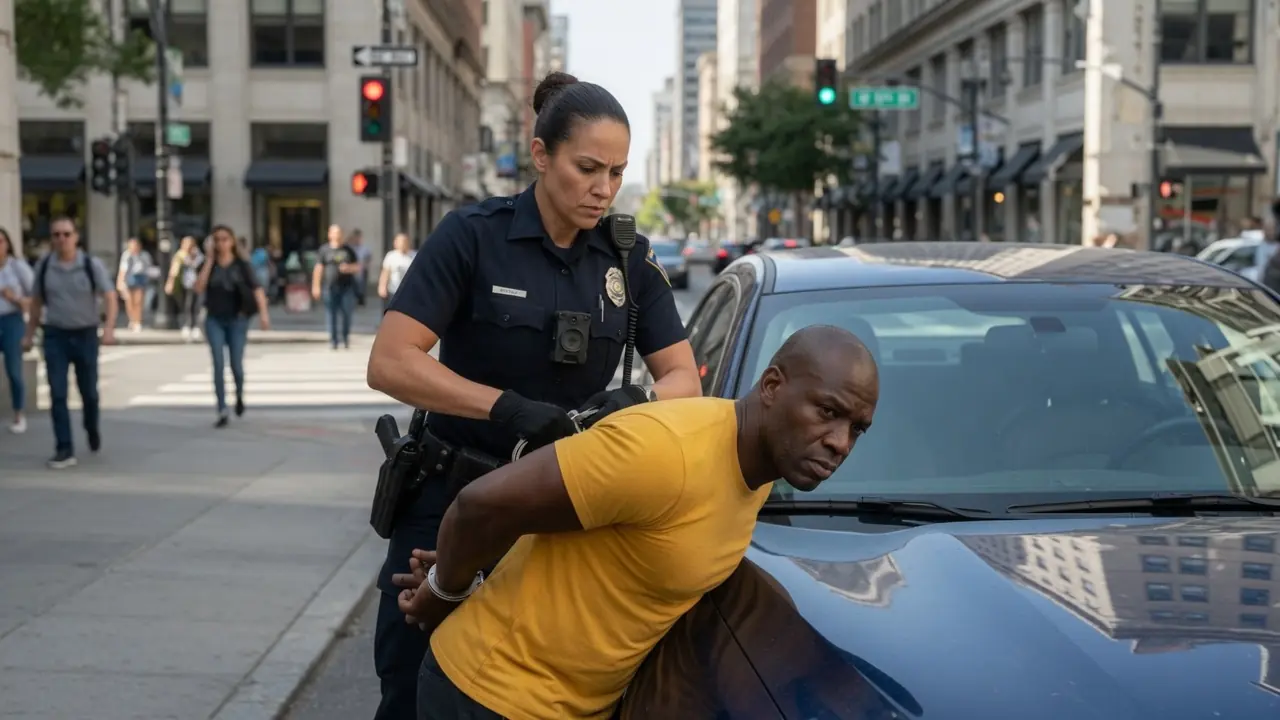
The dark-blue sedan belonged to him.
The registration was inside his wallet.
The federal credentials identifying him as Director of Protective Operations for the Department of Justice were clipped inside the inner pocket of his jacket, which rested on the driver’s seat. Melissa had not checked any of it before deciding he was a thief.
Five minutes earlier, Adrian had parked outside a pharmacy to pick up medication for his father. He had just opened the driver’s door when Melissa’s patrol car stopped behind him without lights or siren. She stepped out quickly, ordered him to move away from the vehicle, and placed one hand near her holster.
Adrian asked why.
Melissa answered by demanding proof that the sedan belonged to him.
He told her the registration was inside the car and asked permission to retrieve it. She refused, claiming his attempt to approach the open door looked suspicious. When Adrian calmly offered his name so she could run the plate, Melissa moved behind him and grabbed his wrist.
“You people always have a story,” she said.
Her body camera captured every word.
Adrian noticed the red recording light immediately. He also noticed the storefront camera above the pharmacy door, a traffic camera facing the intersection, and at least four civilians holding phones. Years of protective work had trained him to map every observer and exit before emotion could interfere with judgment.
Melissa interpreted his calmness as arrogance.
She asked whether the vehicle was stolen.
Adrian said no.
She asked why a man dressed like him was driving a sedan registered to a federal government contractor.
Adrian told her the contractor was his own security consultancy, a company used by the Justice Department for specialized training and witness protection logistics. Melissa laughed and ordered him against the hood.
Now the second cuff hovered near his free wrist.
Melissa leaned closer. “Nobody is coming to save you.”
Adrian looked toward the intersection. “They are not coming to save me.”
Three black SUVs turned onto Spring Street.
“They are coming for you.”
Melissa followed his eyes.
The SUVs moved in a tight formation and stopped across two lanes without striking the curb or blocking the ambulance route. Their doors opened almost simultaneously. Men and women in dark suits stepped out carrying federal credentials, portable evidence cases, and sealed warrants.
Melissa’s grip loosened.
Adrian did not pull away.
A tall Black woman in a charcoal suit approached first. Special Agent Renee Lawson had spent nineteen years investigating public corruption, civil-rights violations, and coordinated misconduct inside law-enforcement agencies. She had also worked with Adrian for nearly a decade and knew that if he ever warned someone to finish an arrest, evidence had already been secured.
“Officer,” Renee called, “remove your hands from Director Cole.”
Melissa looked toward the gold credential in Renee’s hand. “This man is under arrest.”
“For what?”
“Vehicle theft and resisting.”
Renee glanced at the sedan’s visible license plate. “Did you run the registration?”
Melissa hesitated.
That pause lasted less than two seconds, but every phone around them recorded it.
“I had reasonable suspicion,” she said.
“Based on what?”
“He was behaving evasively.”
Adrian turned his head slightly against the hood. “I gave her my full name, asked her to run the plate, and requested permission to retrieve the registration.”
Melissa forced his arm higher. “Stop talking.”
Renee’s voice hardened. “Take the cuff off him now.”
Two federal agents moved closer. Melissa’s left hand drifted toward her radio while her right remained on Adrian’s wrist. She looked toward her patrol car, perhaps hoping another officer would arrive and restore the familiar balance of power.
Instead, two more black SUVs stopped behind the first group.
The street filled with federal personnel.
Melissa unlocked the cuff.
Adrian straightened slowly and rubbed the red mark around his wrist. He made no sudden movement and did not approach Melissa. His restraint made her aggression look even more exposed.
She pointed at him. “He threatened me.”
Renee faced Adrian. “Exact words?”
Adrian repeated the entire exchange from memory.
Melissa interrupted. “He twisted what I said.”
“Your body camera will settle that,” Renee replied.
The officer’s face changed.
“My camera may not have activated properly.”
Adrian looked at the red light on her chest. “It has been recording since you stepped out of the cruiser.”
Melissa covered the camera instinctively.
Renee noticed.
“So did his phone,” she said. “And the pharmacy camera. And our surveillance vehicle parked half a block away.”
Melissa stared at her.
The patrol stop had not been planned as a controlled operation. Adrian genuinely came to collect his father’s medication. But the federal team had been following him because he was carrying documents connected to an investigation involving Melissa’s precinct.
The officer had unknowingly arrested the man transporting evidence against her own unit.
Renee presented a federal warrant authorizing the seizure of Melissa’s body camera, department phone, patrol computer, radio, and vehicle recording system. Melissa read the first page and shook her head.
“This is harassment.”
“No,” Renee said. “This is preservation.”
“What investigation?”
Adrian answered before Renee could.
“Operation Glass Badge.”
Melissa became still.
The name had never appeared in public records. Only federal investigators, two cooperating officers, and senior Justice Department officials knew it existed. If Melissa recognized it, she had heard the name from someone already under federal scrutiny.
Renee stepped closer. “Why does that title mean something to you?”
“It doesn’t.”
“You reacted.”
“I reacted because this is ridiculous.”
Adrian picked up his jacket from the sedan without reaching inside it. Renee removed his federal credential and displayed it where Melissa could see.
ADRIAN COLE
DIRECTOR OF PROTECTIVE OPERATIONS
UNITED STATES DEPARTMENT OF JUSTICE
Melissa looked from the credential to the cuff mark on his wrist.
“You should have identified yourself,” she said.
Adrian’s expression turned colder. “You should have treated me lawfully before knowing who I was.”
The crowd murmured.
A white man standing near the pharmacy lowered his phone and looked ashamed. Earlier, he had laughed when Melissa accused Adrian of stealing the car. A woman beside him had whispered that a man built like Adrian probably deserved whatever happened.
Now everyone understood that his title had changed their judgment faster than any evidence.
Renee did not arrest Melissa immediately.
The warrant authorized evidence seizure, not detention. She instructed another agent to collect the camera and phone while the officer waited beside her cruiser. Melissa protested that federal agents had no authority over a city officer performing a local arrest.
Renee handed her a second document.
It identified Melissa as a subject in an investigation involving unlawful detention, evidence fabrication, racial profiling, conspiracy, and retaliation against complainants.
Melissa’s hands began to shake.
The investigation had started eleven months earlier after a Black schoolteacher named Bernard Lewis was arrested for stealing his own pickup truck. Melissa claimed Bernard had been unable to identify the vehicle’s owner and became aggressive when questioned.
His wife arrived with the title twenty minutes later.
Instead of releasing him, officers charged Bernard with obstruction and resisting arrest. The department offered to dismiss the charges if he agreed not to file a complaint.
Bernard refused.
His case reached a civil-rights attorney, who discovered that Melissa had made seven similar arrests during the previous year. Five involved Black drivers accused of stealing vehicles later proven to belong to them or close family members.
None resulted in theft convictions.
Nearly all produced resistance charges.
A college student named Isaiah Moore was pulled from his mother’s luxury SUV after Melissa decided he looked too young to own it. A contractor named Darnell Brooks was handcuffed beside his work truck because she claimed the company logo appeared recently attached.
The company belonged to Darnell.
A retired Army colonel named Frank Wallace spent forty minutes against a patrol car while officers tried to prove his sports sedan was stolen. When the registration confirmed ownership, Melissa cited him for disorderly conduct because he demanded her badge number.
Every case contained the same language:
The suspect became verbally aggressive and made movements consistent with preparing to flee or resist.
Adrian had read the reports.
The wording appeared so frequently that investigators suspected officers were copying from a template. A confidential source inside the precinct eventually provided a file called Street Control Language.
It contained ready-made phrases designed to justify searches, handcuffing, and physical force.
Melissa’s name appeared in the document history.
Operation Glass Badge widened after investigators found disparities across the precinct. Black drivers represented sixteen percent of registered vehicle owners in the district but nearly sixty percent of vehicle-theft stops.
The precinct commander dismissed the numbers as crime-based enforcement.
The arrest locations told another story.
Most stops occurred near wealthy shopping districts, luxury apartment buildings, or corporate parking garages. Officers were not following theft reports. They were questioning Black people appearing in spaces officers had silently decided did not belong to them.
Adrian’s sedan had been parked outside the same pharmacy where Frank Wallace had been detained.
That intersection was already under observation.
Melissa had walked directly into a federal investigation and recreated the exact pattern it was designed to expose.
Her supervisor arrived ten minutes later.
Lieutenant Warren Dale stepped from an unmarked police SUV with anger already visible in his face. He ignored the federal vehicles and went directly to Melissa.
“What happened?”
She pointed toward Adrian. “He resisted a vehicle investigation, and these people interfered.”
Warren faced Renee. “My officer has authority to detain suspicious subjects.”
“Director Cole was not suspicious.”
“He was beside a vehicle connected to a government contractor.”
“He owns the company.”
“That was not obvious.”
Adrian stepped closer. “Why should ownership need to be obvious from my face?”
Warren looked at him. “Do not play games with me.”
Renee handed the lieutenant a warrant bearing his own name.
The anger vanished.
His phone, computer, and department office were now subject to search. Warren read the warrant quickly, then looked toward Melissa.
“Say nothing else.”
Renee smiled faintly. “You arrived too late for that.”
The officer’s body-camera footage was reviewed inside a federal mobile command vehicle. It showed Melissa watching Adrian leave the pharmacy before she approached him.
She said into her radio, “Black male, expensive vehicle, possible mismatch.”
Dispatch responded that there was no stolen-vehicle report matching the sedan.
Melissa replied, “I’ll find out what he gives me.”
Her camera recorded the plate clearly.
She never called it in.
She walked directly toward Adrian and demanded that he move away from the car. When he requested an explanation, she said, “People like you always want paperwork after getting caught.”
She grabbed him before asking his name.
The footage proved every statement in her preliminary account was false.
Worse, the camera captured audio from her patrol car before the stop. Warren’s voice came through the radio.
“That sedan is tied to Cole Protective.”
Melissa asked, “The federal contractor?”
“Yes. See whether the driver knows what he’s carrying.”
Renee replayed the line three times.
This was no random act of profiling.
Warren knew Adrian’s company was connected to the Justice Department. The officers may not have known Adrian’s exact title, but they suspected he was carrying investigative material.
Melissa’s stop had two purposes.
Intimidate him and search the car.
The evidence inside Adrian’s vehicle included copies of precinct emails, altered body-camera logs, and payment records involving a private towing company. The original files had already been secured elsewhere, but Warren did not know that.
He hoped a vehicle stop would create a reason to seize the documents before they reached federal headquarters.
Melissa’s prejudice made her the perfect officer to carry it out. Warren could give her a vague suggestion and trust her to manufacture suspicion from Adrian’s presence beside an expensive car.
The plan collapsed because she became too aggressive too quickly.
Federal agents detained Warren for attempting to interfere with the search warrant. Melissa was suspended by the city while investigators reviewed her devices.
Her phone contained a private group chat involving eight officers.
The chat was called Neighborhood Fit.
Officers posted photographs of Black drivers, luxury cars, young men entering high-end stores, and families moving into expensive neighborhoods. Captions mocked clothing, accents, and claims of ownership.
One photograph showed Adrian’s sedan taken two days earlier.
Warren had posted it.
Federal consultant’s car. Watch for the Black security guy. He may be carrying files.
Melissa replied:
I’ll stop him if he shows up.
The arrest had been planned before Adrian entered the pharmacy.
Investigators also discovered messages coordinating false reports. Officers were instructed to describe subjects as aggressive whenever a stop produced no criminal evidence. Resistance charges protected officers from complaints by making civilians appear dangerous.
Melissa had used the phrase put your face through the hood in three earlier body-camera recordings.
She claimed it was merely forceful communication.
One of the people she threatened was a seventeen-year-old boy waiting beside his father’s car.
The federal search of Warren’s office uncovered an even larger scheme. His precinct worked closely with TowRight Recovery, a company owned by his brother-in-law.
When officers accused drivers of vehicle theft, they impounded cars pending ownership verification. TowRight charged daily storage fees, administrative fees, and document-review fees.
Even innocent owners often paid thousands to recover vehicles.
Some could not afford it.
After thirty days, TowRight initiated lien proceedings and sold the cars at auction. Warren received hidden payments through a consulting company registered to his wife.
Profiling had become profitable.
Officers targeted vehicles likely to carry high resale value and owners they believed would struggle to fight quickly. A Black driver in a luxury car represented not only someone Melissa considered suspicious, but a potential asset for the towing network.
Adrian’s sedan was worth seventy-eight thousand dollars.
If officers had arrested him, they intended to seize it.
Melissa denied knowing about the payments, but her messages showed she received gift cards and cash bonuses after high-value impounds. She referred to successful seizures as “clean catches.”
One message about Bernard Lewis’s truck read:
Owner is loud but broke. Let storage finish him.
Bernard testified before a federal grand jury.
So did Isaiah, Darnell, Frank, and twenty-three others whose vehicles had been taken during manufactured stops. Some had lost work because tools remained inside impounded trucks. Others missed medical appointments or lost housing after spending savings on towing fees.
The damage extended far beyond the roadside.
Adrian remained involved as both investigator and victim.
He disliked the second role.
News outlets repeatedly described him as the federal director whose arrest exposed the precinct, but he corrected reporters whenever possible. The precinct had already been exposed by residents who filed complaints long before anyone powerful listened.
His credentials only forced the system to react faster.
“Nothing Officer Grant did became wrong after she saw my identification,” he told one reporter. “It was wrong while she believed I was nobody.”
The city initially defended Melissa.
A police union representative claimed Adrian deliberately withheld his identity to provoke a confrontation. He argued that officers faced difficult split-second decisions and could not be expected to verify every ownership claim before ensuring safety.
The body-camera video destroyed that defense.
Melissa had not faced a split-second danger.
She had more than three minutes to run the plate and repeatedly refused.
The union later argued that Adrian’s muscular build justified heightened caution. Prosecutors responded by displaying footage of him following every instruction until Melissa physically forced him onto the hood.
He never threatened her.
She threatened him twice.
Melissa was indicted on charges of conspiracy, deprivation of civil rights, falsification of records, obstruction, unlawful seizure, and participation in the towing fraud. Warren faced additional financial and racketeering charges.
Five officers accepted plea agreements.
Two claimed they joined the group chat only because refusing would damage their careers. Prosecutors acknowledged the pressure but reminded them that fear of losing promotions did not excuse destroying other people’s lives.
TowRight Recovery was shut down.
Authorities seized its storage lots, computers, auction records, and financial accounts. More than one hundred vehicle cases required review.
Thirty-two cars still held by the company were returned without fees.
Owners whose vehicles had already been sold received compensation from seized assets and a city restitution fund. The process took years, but the records finally acknowledged that many had never been criminals.
Melissa went to trial.
Her attorney focused heavily on Adrian’s federal role, claiming the Justice Department used him as bait. Adrian answered that he went to the pharmacy for medication, not an operation.
“You knew the intersection was under surveillance,” the attorney said.
“Yes.”
“You knew officers might approach you.”
“I knew misconduct had occurred there before.”
“You refused to identify yourself as a federal director.”
“I gave Officer Grant my legal name and asked her to verify the car.”
“You concealed your power.”
Adrian looked toward the jury.
“I did not conceal my humanity.”
The courtroom became silent.
The prosecutor played Melissa’s first words from the body camera.
People like you always want paperwork after getting caught.
The video showed her refusing to run the plate, ignoring dispatch, twisting Adrian’s arm, and threatening to drive his face through the hood. The jury also saw the Neighborhood Fit messages and her promise to stop him before he arrived.
Melissa was convicted on every major count.
Warren followed months later.
The precinct commander resigned after evidence showed he received regular summaries of TowRight revenue and ignored complaints about vehicle seizures. The city entered federal oversight requiring automatic plate verification before theft-related detentions whenever immediate danger did not exist.
Body-camera recordings uploaded automatically to an outside server.
Officers could no longer write reports after reviewing one another’s accounts. Towing assignments moved to a randomized public system, and no police employee or relative could hold financial interest in a contracted company.
An independent civilian office gained authority to investigate complaints.
Adrian returned to Spring Street almost a year after the arrest.
The pharmacy still stood on the corner, and the dark-blue sedan remained his daily vehicle. A faint scratch marked the hood where his belt buckle had dragged across the paint.
He never repaired it.
His father sat in the passenger seat holding the medication Adrian had originally gone to collect. Robert Cole was seventy-three, retired from the postal service, and deeply unimpressed by federal attention.
“You could have told her who you were sooner,” Robert said.
“She should not have needed my title.”
“I know.”
“You just said I should have used it.”
Robert looked through the windshield. “A father can understand the principle and still hate seeing his son in handcuffs.”
Adrian smiled faintly.
Across the street, Bernard Lewis stood beside his returned pickup. The truck had been sold at auction after TowRight seized it, but investigators located the buyer and arranged compensation before returning it.
Bernard walked over and touched the scratch on Adrian’s hood.
“You keeping that?”
“Yes.”
“Why?”
“It reminds me that the car was never the most important thing she tried to take.”
Bernard understood.
The arrest had attempted to take ownership of the story itself. Melissa wanted the uniform to decide who belonged, who looked suspicious, whose calmness counted as defiance, and whose words could be replaced by an official report.
For years, the precinct had succeeded.
Black drivers were forced against cars they owned, then charged for reacting to humiliation. Their vehicles disappeared into a towing network while officers called the process procedure.
Adrian’s arrest did not create the truth.
It placed the truth in front of too many cameras to erase.
The black SUVs made the moment impossible to bury, but the real evidence had been carried for years by people whose complaints were dismissed because no federal title appeared beside their names.
Adrian looked toward the restored pickup, the pharmacy camera, and the corner where Melissa had ordered him against the hood.
She believed authority meant nobody could question her first assumption.
By the time the cuffs closed, she thought she had captured a thief.
What she had actually captured was the final recorded piece of a case that would take her badge, her freedom, and the system that paid officers to treat ownership like something Black people had to prove before being treated as human.