The stream of water struck the homeowner square in the chest hard enough to drive him half a step backward.
His light-blue polo instantly darkened.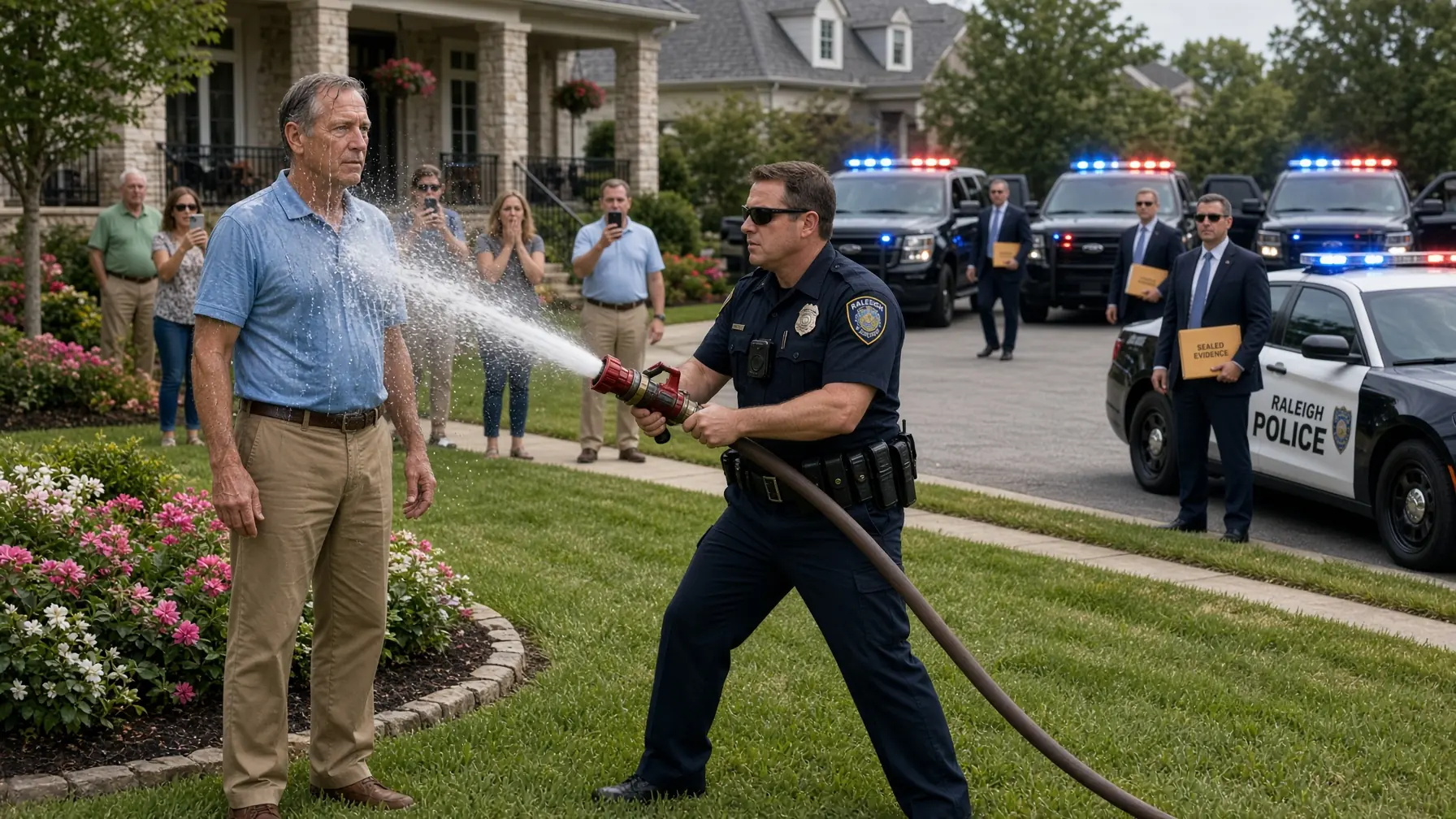
Water exploded across his shoulders, splashed into his face, and poured from his gray hair while neighbors watched from porches and sidewalks along Hawthorne Ridge, one of the quietest residential streets outside Raleigh, North Carolina.
Officer Cole Hutchins kept both hands wrapped around the heavy garden-hose nozzle.
He was forty-two, broad through the shoulders, dressed in a dark navy patrol uniform with black sunglasses covering his eyes.
He pushed the nozzle forward.
Another burst struck the homeowner.
“Still feeling tough?” Hutchins shouted. “Keep running your mouth and I’ll put you face-down on your own lawn.”
The man did not charge him.
He did not raise his fists.
He did not even step toward him.
Fifty-seven-year-old Daniel Mercer simply wiped water from his eyes and looked at the officer.
“You’re doing a fine job proving every complaint I gave them was true.”
For the first time, Hutchins hesitated.
Only slightly.
Then his mouth curled into a contemptuous smile.
“You think anybody cares about your little complaints?”
Daniel’s soaked khaki pants clung to his legs.
Water ran into his shoes.
Behind him stood the brick house he had owned for sixteen years, the front flower beds his late wife had designed, and the hedge he had been trimming when the confrontation began.
Across the street, three neighbors were holding phones.
Hutchins saw them.
He did not appear concerned.
He stepped closer.
“Nobody’s coming to save you, old man. On this street, I decide what happened.”
Daniel looked beyond him.
Something changed in his expression.
Hutchins noticed.
“What?”
Daniel did not answer immediately.
A low engine rumble rolled down Hawthorne Ridge.
Then another.
Three large black SUVs turned onto the street.
Their emergency lights flashed behind the windshields.
They moved past the line of parked vehicles and stopped behind the local patrol cruisers.
Hutchins slowly turned.
Doors opened.
Men and women in business clothes stepped out.
One raised a credential wallet.
Another carried a sealed document case.
Daniel looked back at Hutchins.
“Then turn around,” he said. “The people who came to seize your precinct’s records would love to hear your version.”
The garden hose dropped several inches.
For the first time that morning, Cole Hutchins looked uncertain.
The confrontation had begun forty minutes earlier with something ordinary.
Daniel Mercer had walked outside just after eight on Saturday morning carrying pruning shears and a mug of coffee.
He was a retired municipal engineer who had spent thirty-one years working on water, transportation, and public-infrastructure projects throughout North Carolina.
Retirement had not suited him particularly well.
His daughter joked that he needed a project every week or he became unbearable.
That Saturday, the project was the front hedge.
Daniel had clipped perhaps six feet of it when a city utility truck appeared at the end of the street.
That interested him.
Two workers climbed out near a fire hydrant.
Then a police cruiser arrived.
Officer Hutchins stepped out.
Daniel recognized him immediately.
Most residents on Hawthorne Ridge did.
Hutchins had been involved in three neighborhood disputes over the previous year.
In every case, Daniel thought his behavior had been unnecessarily aggressive.
But Daniel’s interest went deeper than neighborhood gossip.
Six months earlier, Daniel had volunteered to help a community accountability group review public records related to municipal towing contracts, nuisance-property enforcement, and police-authorized impoundments.
He was not law enforcement.
He had no arrest authority.
What he did have was three decades of experience reading contracts, maps, procurement files, work orders, and invoices.
Numbers made sense to him.
Patterns made even more sense.
The group initially asked Daniel to review billing data connected to a towing company called Ridgeway Recovery.
Within two weeks, he found something strange.
Several vehicles had been towed from properties without the required municipal authorization forms.
Some impoundment records used duplicate case numbers.
Others showed police-requested tows occurring before the officers supposedly arrived.
Then Daniel noticed one officer’s name appearing repeatedly.
Cole Hutchins.
Daniel did not accuse anyone.
He documented.
That was his habit.
He created timelines.
Compared signatures.
Matched dispatch logs against invoices.
Requested additional public records.
Soon the issue looked larger.
A small group of officers appeared to be using nuisance and traffic enforcement to steer business toward Ridgeway Recovery.
Vehicle owners complained about unexpected fees.
Some said they had been pressured to pay cash.
A few claimed personal property had disappeared after vehicles were impounded.
The department had treated each complaint separately.
Daniel assembled them chronologically.
Then he forwarded everything to the community group’s attorney.
The attorney sent the package to state investigators.
Eventually, federal investigators became interested because some disputed contracts and enforcement activities touched federally funded municipal programs.
Daniel never met most of the investigators.
He did not need to.
He simply kept records.
That was exactly what Hutchins did not know when he pulled onto Hawthorne Ridge that Saturday.
The hydrant inspection should have taken fifteen minutes.
Instead, Hutchins wandered toward Daniel’s property.
Daniel noticed him looking at a pickup parked beside the garage.
“Morning,” Daniel said.
Hutchins stopped.
“Your truck?”
“Yes.”
“Plate’s expired.”
Daniel looked at the rear plate.
“No, it isn’t.”
Hutchins walked closer.
“Looks expired to me.”
Daniel set down the pruning shears.
“Registration renews in November.”
Hutchins stared at him.
“You telling me I don’t know how to read a plate?”
“I’m telling you November comes after August.”
A neighbor laughed from a porch.
That was the wrong sound at the wrong time.
Hutchins turned.
Then back toward Daniel.
“License and registration.”
Daniel frowned.
“The truck is parked on private property.”
“I asked for your identification.”
“For what violation?”
Hutchins stepped onto the driveway.
“You people always want to turn everything into an argument.”
Daniel’s eyes narrowed.
“You people?”
“You know what I mean.”
“No.”
Hutchins pointed toward the pickup.
“I’m investigating a possible registration violation.”
Daniel looked at the truck.
Then the officer.
“You can read the registration sticker from where you’re standing.”
“Get your license.”
Daniel remained still.
That irritated Hutchins more.
“Now.”
Daniel went inside.
He returned with his wallet and vehicle paperwork.
Hutchins checked both.
The registration was valid.
He should have left.
He did not.
Instead, he began looking around the property.
“What’s that camera for?”
Daniel glanced toward a small security camera mounted above the garage.
“My driveway.”
“You recording me?”
“It records motion.”
Hutchins looked up at it.
“You got signs posted?”
“No sign required for my own exterior camera.”
Hutchins stared.
Daniel suddenly understood something important.
The officer was not casually curious.
He was nervous about being recorded.
“You know my name?” Daniel asked.
Hutchins looked at him.
“What?”
“You knew who I was before you walked over here, didn’t you?”
Hutchins laughed.
“Should I?”
Daniel said nothing.
A second patrol cruiser turned onto the street.
That confirmed his suspicion.
Hutchins had called backup before asking about the registration.
The second officer, a younger deputy named Tyler Grant, approached.
“What’s going on?”
Hutchins answered.
“Noncompliant homeowner.”
Daniel looked at Grant.
“My vehicle registration is current.”
Grant looked toward Hutchins.
Hutchins snapped, “That isn’t the issue anymore.”
“What is?”
Daniel asked the question calmly.
Hutchins turned toward him.
“Your attitude.”
Daniel almost smiled.
“Is attitude a criminal offense now?”
Hutchins stepped closer.
“Keep pushing.”
Daniel’s neighbor, Susan Blake, had already started recording.
“Daniel,” she called, “you want me to call somebody?”
Hutchins pointed toward her.
“Stay on your property.”
Susan was standing on her property.
She lifted her phone higher.
“I am.”
Grant looked uncomfortable.
Daniel noticed.
Hutchins did too.
“Go check the other end of the block,” Hutchins told him.
Grant hesitated.
“The utility guys—”
“I said handle the block.”
Grant reluctantly walked away.
Now Hutchins and Daniel were nearly alone at the edge of the lawn.
Almost.
The neighbors remained.
The cameras remained.
And Hutchins was becoming angrier by the minute.
Daniel had a garden hose stretched across the lawn.
He had used it earlier to rinse dirt from the flower beds.
Hutchins noticed it when Daniel turned toward the porch.
“Where are you going?”
“Inside.”
“We’re not done.”
“I gave you my registration.”
“I told you we’re not done.”
Daniel looked back.
“Am I detained?”
Hutchins stepped closer.
“Do you want to be?”
“No.”
“Then stop acting clever.”
Daniel folded his arms.
“I asked a legal question.”
“You think because you file paperwork and complain about officers you know everything?”
That sentence confirmed it.
Daniel stared at him.
“So you do know who I am.”
Hutchins realized what he had revealed.
His jaw tightened.
“I know you’re the neighborhood busybody who keeps sending complaints downtown.”
Daniel nodded slowly.
“And that bothers you.”
“What bothers me is people who think they can ruin careers because they don’t like being told what to do.”
“I never complained about being told what to do.”
“No?”
“I complained about tow invoices appearing before dispatch calls.”
Hutchins became very still.
Daniel continued.
“I complained about duplicated case numbers.”
“Watch yourself.”
“I complained about missing authorization forms.”
Hutchins stepped toward him.
“You don’t know what you’re talking about.”
Daniel’s voice remained calm.
“Then the records should clear everything up.”
Hutchins looked toward the neighbors.
His face changed.
He wanted the conversation over.
Not by leaving.
By controlling Daniel.
He picked up the garden hose.
Daniel looked at him.
“Put that down.”
Hutchins turned the nozzle in his hand.
“Or what?”
Susan shouted from across the street.
“Officer, leave him alone.”
Hutchins opened the nozzle.
The first burst hit Daniel in the chest.
The neighborhood erupted in gasps.
Daniel staggered slightly.
Then planted his feet.
Hutchins sprayed him again.
“You still want to lecture me?”
Water hit Daniel’s neck and face.
He wiped his eyes.
“You’re doing a fine job proving every complaint I gave them was true.”
Hutchins moved closer.
“Keep running your mouth and I’ll put you face-down on your own lawn.”
Daniel did not move.
The officer lowered the hose.
“Nobody’s coming to save you, old man. On this street, I decide what happened.”
Then the SUVs appeared.
The first person out was Special Agent Laura Kane.
She had spent eighteen years investigating public corruption, procurement fraud, and misuse of government authority.
Behind her came Agent Michael Torres and two evidence technicians.
A fourth vehicle stopped farther down the street.
Hutchins stared.
Kane walked toward him.
“Officer Hutchins?”
He released the hose nozzle.
“Yes.”
She displayed credentials.
“Federal Bureau of Investigation.”
Hutchins looked toward Daniel.
Daniel said nothing.
Kane looked at his soaked clothing.
“What happened here?”
Hutchins answered immediately.
“He became confrontational during a lawful police contact.”
Susan shouted from across the road.
“That’s a lie.”
Kane turned.
Susan held up her phone.
“I recorded everything.”
Another neighbor raised his.
“So did I.”
Kane returned her attention to Hutchins.
“Is your body camera active?”
His hand went to his chest.
The small status light was off.
Kane looked at it.
Then at him.
“When did you deactivate it?”
“It malfunctioned.”
Daniel laughed softly.
Hutchins glared.
Agent Torres walked toward Daniel.
“Mr. Mercer?”
“Yes.”
“You injured?”
“No.”
“Need medical attention?”
“No.”
Kane looked toward the arriving local supervisor.
“Sergeant, separate Officer Hutchins from the witnesses.”
Hutchins stiffened.
“Why?”
“Because we’re preserving statements.”
“This is my scene.”
Kane looked directly at him.
“No. It isn’t.”
That was the moment his authority disappeared.
Not metaphorically.
Operationally.
The local sergeant arrived and ordered Hutchins away from Daniel.
Kane then approached Daniel.
“We were on our way to execute record-preservation warrants.”
“I guessed.”
“You didn’t know it would be today.”
“No.”
Kane glanced at the wet shirt.
“Interesting timing.”
Daniel looked toward Hutchins.
“For him especially.”
The federal investigation had been developing for four months.
Daniel’s records were only the beginning.
Once investigators obtained lawful access to financial and departmental records, they found deeper irregularities.
Ridgeway Recovery had received a disproportionately high number of police-requested impounds.
Some charges exceeded contract limits.
Several cash payments disappeared from official accounting.
There were suspicious reimbursements.
Unexplained deposits appeared in accounts associated with two municipal employees.
Then investigators found communications linking a Ridgeway manager with officers inside the precinct.
One message read:
Send the easy ones our way. Same arrangement.
Another said:
Hutch knows which calls to flag.
The meaning was not yet legally established, but it demanded investigation.
That Saturday, agents had obtained authority to seize and preserve specific departmental and contractor records before they could disappear.
The three SUVs were heading toward the precinct when Kane received an update.
Daniel Mercer was in an active confrontation with Hutchins.
A local dispatcher had flagged the address because Daniel’s name appeared in the investigation as a cooperating records witness.
Kane diverted the team.
That was why the SUVs arrived.
Not to rescue Daniel.
Not because he possessed secret authority.
Because an officer connected to an active investigation had unexpectedly confronted a documented witness.
That fact immediately raised the stakes.
Hutchins was placed on administrative leave that afternoon.
His body camera was seized for forensic examination.
It had not malfunctioned.
Records showed he manually disabled recording shortly before confronting Daniel.
Investigators then examined his dispatch history.
The second patrol unit had not been requested because Daniel posed a threat.
Hutchins had privately messaged Grant before the encounter.
Mercer guy lives here. Come by.
That changed everything.
The contact was no longer plausibly random.
Grant admitted the truth during an interview.
“Hutchins said Mercer was the guy causing trouble with the towing complaints.”
“What kind of trouble?”
“He said Mercer was trying to get officers investigated.”
“Did he say why you were going to his house?”
Grant looked down.
“He said he wanted to put some pressure on him.”
Pressure.
One word.
Enough to transform a strange roadside-style encounter into possible retaliation against a cooperating witness.
Grant had not known about the hose.
He had left before Hutchins used it.
He agreed to cooperate.
The precinct records produced more evidence.
Hutchins was not the mastermind.
He was a participant in a broader scheme built around convenience and opportunity.
Ridgeway Recovery benefited from favorable police referrals.
Certain officers received cash, free vehicle services, or other benefits.
Some supervisors ignored questionable paperwork because towing reduced abandoned-vehicle complaints and made enforcement numbers look productive.
Not every tow was improper.
Not every officer was involved.
That distinction mattered.
Investigators separated legitimate work from misconduct.
Daniel’s spreadsheets helped.
He had kept original records.
Dates.
Times.
Invoice numbers.
Vehicle identification numbers.
Dispatch references.
What once looked like boring administrative detail became a map.
Three officers were eventually charged in connection with falsified records and improper benefits.
A Ridgeway manager entered a cooperation agreement.
Two municipal employees resigned before disciplinary hearings.
The police department brought in an outside auditing team.
Hutchins faced additional scrutiny for retaliating against Daniel and making false statements about their confrontation.
The garden-hose incident became impossible for him to explain away.
There were five civilian videos.
One doorbell camera.
A garage camera.
And his own disabled body-camera log.
Evidence overwhelmed narrative.
Exactly as Daniel had always believed it would.
Months later, Hutchins appeared at an administrative hearing.
He wore a suit.
Daniel attended as a witness.
Susan sat behind him.
Kane was not there.
Her federal work continued separately.
The panel played Susan’s video.
Hutchins stood holding the hose.
His own voice filled the room.
“Still feeling tough?”
Water struck Daniel.
Then:
“Nobody’s coming to save you, old man. On this street, I decide what happened.”
The recording stopped.
The panel chair looked at Hutchins.
“Why did you say that?”
Hutchins shifted.
“I was frustrated.”
“With what?”
“His refusal to cooperate.”
The chair looked down at the report.
“He provided identification.”
“Yes.”
“Valid registration.”
“Yes.”
“He remained on his own property.”
“Yes.”
“What lawful instruction did he refuse?”
Silence.
His attorney leaned toward him.
Hutchins finally said, “I handled the situation badly.”
Daniel looked at him.
The chair continued.
“Did you know Mr. Mercer had filed complaints related to towing practices?”
Hutchins hesitated.
“I knew he complained frequently.”
“That wasn’t the question.”
Another pause.
“Yes.”
“Did that influence your decision to contact him?”
“No.”
The panel produced Grant’s message.
Mercer guy lives here. Come by.
Hutchins stared at it.
Then came Grant’s testimony about applying pressure.
Hutchins’s explanation collapsed.
He was terminated.
Separate legal proceedings continued.
The department did not describe the firing as punishment for spraying the “wrong homeowner.”
Daniel appreciated that.
That interpretation would have been too simple.
Hutchins should not have needed to discover who Daniel knew, what records he possessed, or whether federal investigators were already approaching.
The conduct was wrong before the SUVs appeared.
Ridgeway Recovery lost its municipal contract after an audit.
The city adopted new towing controls.
Every police-requested tow required a digital authorization linked to dispatch records.
Fees had to match published schedules.
Vehicle owners automatically received itemized records.
Cash payments triggered additional auditing.
Officers could no longer repeatedly direct work toward one contractor without supervisory review.
Complaint systems changed too.
Similar allegations were automatically grouped.
Supervisors could no longer look at ten separate complaints and pretend they represented ten unrelated worlds.
Daniel considered that the most important reform.
Systems failed when information remained divided.
Corruption loved isolated paperwork.
Patterns appeared only when someone placed the pages next to each other.
One year after the confrontation, Daniel stood in the same front yard replacing a section of irrigation line.
Susan walked over.
“You know what today is?”
Daniel looked up.
“Saturday.”
She shook her head.
“One year since Officer Garden Hose.”
Daniel groaned.
“Please don’t call him that.”
“It’s what the neighborhood calls him.”
“That’s terrible.”
“It’s accurate.”
Daniel laughed.
Susan looked toward the flower bed.
“You ever think about how weird the timing was?”
“The SUVs?”
“Yes.”
“All the time.”
“People still say he picked the wrong homeowner.”
Daniel stopped working.
“I don’t like that.”
Susan raised an eyebrow.
“Why?”
“Because there shouldn’t be a right homeowner to spray with a hose.”
She nodded.
Daniel wiped dirt from his hands.
“If I hadn’t collected those records, he still would’ve been wrong.”
“Yes.”
“If no federal investigation existed?”
“Still wrong.”
“If I rented this house?”
“Still wrong.”
“If nobody had recorded it?”
Susan lifted her phone.
“Still wrong. Just harder to prove.”
Daniel smiled.
“Exactly.”
That difference mattered.
Truth and proof were not always the same thing.
Daniel had spent his career working with systems because systems needed documentation.
Pipes had specifications.
Roads had plans.
Contracts had numbers.
Property had boundaries.
Government power needed records for the same reason.
Without them, somebody like Hutchins could say:
I decide what happened.
The videos proved otherwise.
The invoices proved otherwise.
The dispatch logs proved otherwise.
The federal records proved otherwise.
Daniel eventually framed nothing from the incident.
No photograph of the SUVs.
No newspaper clipping.
No screenshot of Hutchins losing his badge.
Instead, he kept one document in his office.
The first spreadsheet he had built from the towing invoices.
Ugly.
Plain.
Rows and columns.
No drama at all.
It represented the beginning.
His daughter once asked why.
“Because everybody remembers the hose.”
“And?”
“The hose wasn’t what exposed them.”
She looked at the spreadsheet.
“This did?”
“This helped.”
Daniel leaned back.
“People think corruption gets uncovered because somebody makes a big speech or catches a villain doing something spectacular.”
He tapped the paper.
“Usually it starts because two numbers that should match don’t.”
She smiled.
“That sounds exactly like something an engineer would say.”
“Probably.”
The garden-hose confrontation became the image people remembered.
An officer spraying an older homeowner.
Neighbors recording.
Black SUVs arriving.
Federal investigators stepping onto the street.
It made a perfect story about sudden reversal.
But Daniel understood the real reversal had begun months earlier.
Quietly.
At a desk.
With invoices.
The SUVs did not magically create accountability.
The evidence brought them.
And Hutchins’s greatest mistake was not failing to notice the vehicles approaching behind him.
It was believing he could determine reality simply because he wore the uniform.
He looked at a homeowner and believed he could redefine cooperation as defiance.
He looked at complaints and believed they were harmless.
He looked at a disabled camera and believed his report would become the only record.
Then he raised the hose.
Daniel stood there soaked from head to shoes while Hutchins told him nobody was coming.
For several seconds, perhaps Hutchins truly believed that.
Then engines rolled down the street.
He turned.
And everything he thought he controlled began disappearing at once.
Not because powerful strangers had suddenly decided Daniel mattered.
Because months of evidence had already established that the truth mattered.
By the time the black SUVs reached Hawthorne Ridge, they were not arriving to create the case.
They were arriving because the case was already waiting for them.