Rain had turned Constitution Avenue into a mirror of flashing red and blue when Colonel Simone Carter pulled her dark sedan against the curb outside the Franklin Federal Building in Washington, D.C. She had driven nearly four hours without stopping because the thick black folder lying on her passenger seat had been transferred directly into her custody and could not legally leave it until an authorized federal investigator signed the chain-of-custody form. Simone wore no uniform that night, only a charcoal-gray overcoat over a dark blouse and tailored trousers, her black hair secured into a sleek low bun. To anyone passing her on the sidewalk, she looked like an exhausted professional arriving late for another government meeting.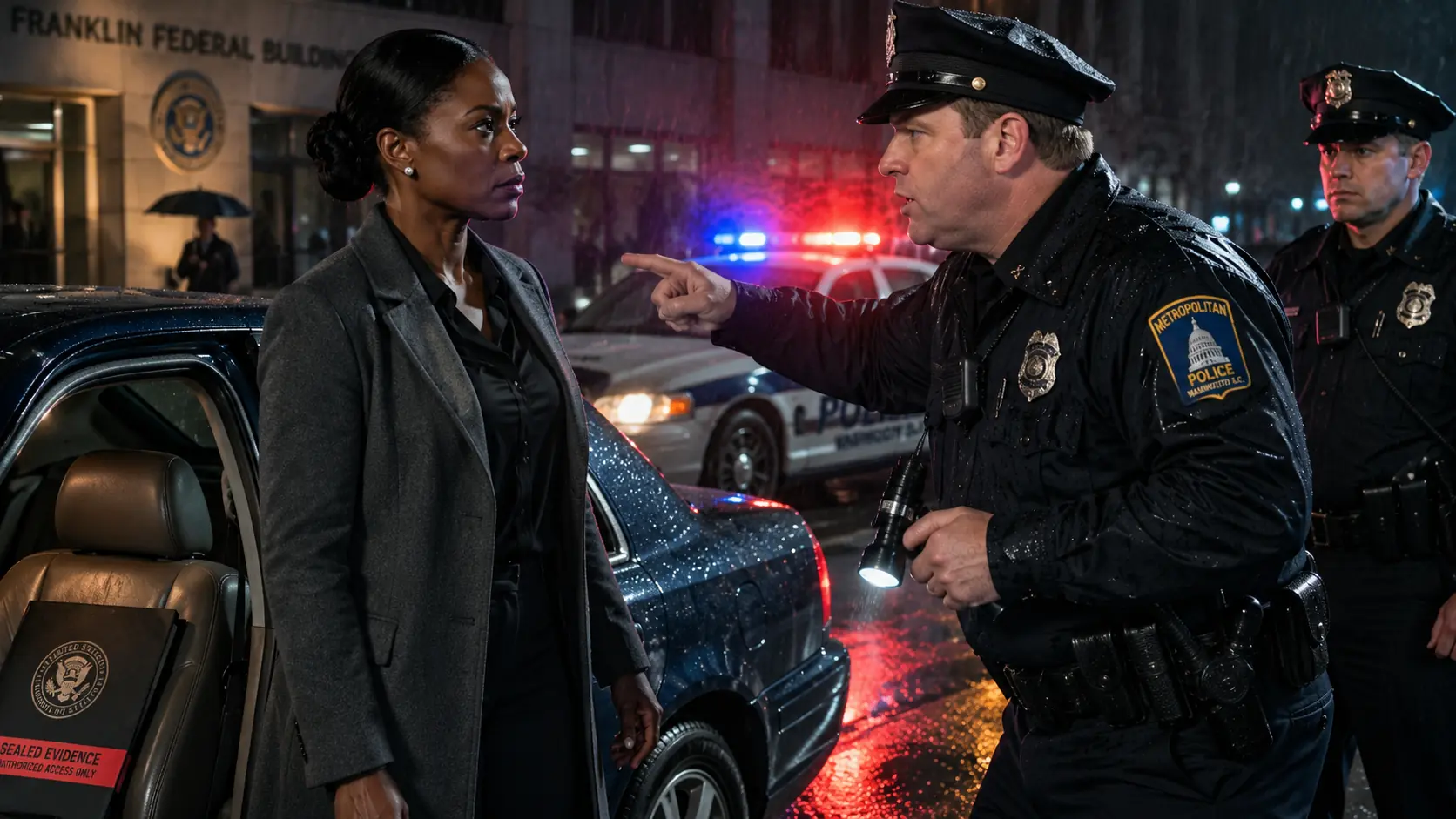
Officer Raymond Keller saw something else. The forty-five-year-old patrol officer had been sitting in his cruiser half a block away when Simone parked briefly beside a restricted loading zone near the federal building’s employee entrance. He drove forward, activated his emergency lights, and stopped behind her before she could retrieve the sealed folder. By the time Simone opened her door, Keller was already walking toward her with a flashlight in one hand and suspicion fixed across his face.
“Stay inside the vehicle.” Simone stopped halfway out and calmly returned to the driver’s seat with both hands visible. Keller leaned toward the window, asked for her license, and demanded to know why she had stopped in a restricted zone. Simone explained that she was delivering time-sensitive material to investigators inside the building and had authorization to use the secure entrance.
Keller glanced toward the passenger seat. His flashlight caught the metallic federal seal embossed across the black folder, along with a red strip clearly marked SEALED EVIDENCE — AUTHORIZED ACCESS ONLY. He stared at it for several seconds before looking back at Simone. Something about his expression changed from routine irritation into certainty.
“What’s in the folder?”
“Material I’m authorized to transport.”
“That wasn’t my question.”
“And I’m not permitted to discuss its contents with you.”
Keller smiled coldly. “Step out.”
Simone studied him for a moment before complying. Rain hit her face as she closed the driver’s door and stood beside the sedan. Keller immediately positioned himself between her and the vehicle.
“Step away from that folder,” he said, his voice sharpened by contempt. “Women like you don’t carry federal documents.”
Simone’s expression became completely still.
“What exactly does ‘women like you’ mean, Officer?”
“You heard me.”
“Yes,” Simone replied. “I did.”
Keller pointed toward the sidewalk. “Move.”
Simone took one controlled step backward but did not break eye contact. “That folder is sealed federal evidence. You do not have authorization to open it, inspect it, remove it, or disturb the custody seal.” Keller scoffed and asked whether she expected him to believe she had somehow been trusted with classified government material simply because she wore a nice coat.
“I didn’t ask you to believe me.”
“What did you ask?”
“Nothing. You stopped me.”
That answer irritated him. Keller reached through the open passenger-side door and placed his gloved hand against the edge of the folder. Simone’s voice became colder.
“Do not touch that.”
Keller froze.
“Excuse me?”
“Touch that seal and you’ll turn this traffic stop into a federal evidence incident.”
Keller pulled the folder toward him anyway. “One more threat and I’ll cuff you before you can invent another title.”
Simone looked directly at him.
“Then cuff Colonel Simone Carter and explain why you opened evidence the federal task force is waiting for upstairs.”
For the first time, Keller hesitated.
The hesitation lasted perhaps two seconds. Then pride took over. He looked toward the second officer who had just arrived, a younger patrolman named Daniel Price, and laughed as though Simone had told an absurd joke.
“Colonel?”
Simone said nothing.
Keller looked her up and down. “Where’s the uniform?”
“I’m not required to travel in one.”
“Convenient.”
Price stepped closer. “Ray, maybe we should verify her credentials first.”
Keller turned sharply. “I know how to do my job.”
Price lowered his voice. “I’m just saying the building’s right there.”
Keller ignored him. He lifted the folder from the seat.
Simone immediately moved one step forward.
Keller’s free hand dropped toward his restraints.
“Back up.”
“Put the folder down.”
“You don’t give me orders.”
“No,” Simone answered. “The seal does.”
Keller looked at the red evidence strip. For a moment, common sense seemed to compete with his ego. Then he pressed his thumb beneath the edge.
Price stepped forward.
“Ray.”
Keller stopped.
Price pointed at the label. “It says authorized access only.”
Keller glared at him. “And we’re police.”
“That doesn’t automatically make us authorized.”
Simone looked at Price for the first time with something resembling approval. “Correct.”
Keller’s face hardened further.
“You both want to lecture me now?”
Nobody answered.
The rain intensified.
Across the street, two pedestrians slowed and began watching. A black SUV idled near the federal building entrance, but Keller paid no attention to it.
He placed the folder on the hood of Simone’s sedan and demanded identification beyond her driver’s license. Simone told him her credentials were inside the inner pocket of her coat and asked permission before reaching for them. Keller told her to move slowly.
She removed a leather case and handed it over.
Keller opened it.
The photograph matched.
The name matched.
The title beneath it read:
SIMONE E. CARTER — FEDERAL SECURITY LIAISON — SPECIAL INVESTIGATIVE AUTHORITY
Additional credentials identified her rank.
Keller stared.
Price leaned close enough to read.
“Colonel,” he whispered.
Keller closed the case.
“It could be fake.”
Simone almost smiled, but there was no humor in it. “Then verify it.”
Keller radioed dispatch and requested credential confirmation. The dispatcher asked him to repeat Simone’s name twice, then told him to stand by. Seconds became nearly a minute.
Price glanced toward the federal building again.
“Ray, maybe we should leave the evidence alone until we get confirmation.”
Keller’s jaw tightened.
“I’m not letting a suspect dictate procedure.”
Simone looked at him. “What crime am I suspected of committing?”
“Possession of restricted material.”
“Based on what?”
Keller gestured toward the folder.
“You have it.”
“That is not evidence of unauthorized possession.”
He stepped toward her.
“You’re getting real comfortable telling me how law enforcement works.”
Simone did not move.
“I’ve spent twenty-one years working around investigations, Officer Keller.”
He frowned.
“How do you know my name?”
She looked at his badge.
That earned a brief silence from Price.
Keller looked embarrassed and angry.
Then dispatch returned.
“Unit Twelve, credential status confirmed. Subject is authorized. Federal liaison credential active.”
Price immediately relaxed.
Keller did not.
He stared at the radio.
“Confirm rank.”
Dispatch paused.
“Colonel Simone Elise Carter. Credentials valid.”
Price exhaled.
Keller looked toward Simone.
The correct response should have been simple: apologize, return the folder, and end the encounter.
He did none of those things.
Instead he said, “I still need to know what’s inside.”
Simone’s expression changed.
“Why?”
“Because it was visible during a stop.”
“That does not give you access.”
“You were illegally parked.”
“Then issue the parking citation.”
Keller looked toward the sealed folder again.
“What are you transporting?”
“I already told you I cannot discuss that.”
“You can tell me.”
“No.”
Keller stepped closer.
“You really want to make this difficult?”
Simone lowered her voice.
“You already made it difficult when you touched evidence after being warned not to.”
Price glanced between them.
“Ray, dispatch confirmed her.”
Keller snapped, “Stay out of it.”
That sentence would matter later.
Simone noticed Price’s body camera. The small red recording indicator remained active. She looked at Keller’s chest.
His camera was recording too.
Good.
“Officer Keller,” Simone said, “I am formally advising you again that this folder is sealed evidence under documented federal custody. Return it to the passenger seat and allow me to continue delivery.”
Keller laughed.
“Or what?”
Simone did not answer immediately.
Then she looked toward the black SUV across the street.
“Or the people waiting for it are going to come down here.”
Keller followed her gaze.
The SUV doors opened.
Three people stepped out.
They were not uniformed police officers. All three wore dark rain jackets with federal credentials displayed visibly at chest level. The woman leading them moved quickly across the street while speaking into a radio.
Keller stared.
“Who are they?”
Simone answered quietly.
“The people I warned you about.”
Special Agent Elena Ruiz reached the curb first. She was followed by two investigators from a joint federal corruption task force. Ruiz looked at Simone, then at Keller, then at the folder sitting on the hood in the rain.
“What happened?”
Simone kept her answer simple.
“Officer Keller removed the folder from my vehicle after I advised him it was sealed evidence.”
Ruiz’s face hardened.
“Did he open it?”
“Not yet.”
Keller immediately intervened.
“I’m conducting a lawful traffic stop.”
Ruiz raised one hand.
“That isn’t what I asked.”
Keller looked irritated.
“I found federal material in a civilian vehicle.”
Ruiz looked toward Simone.
“She is the courier listed on the custody transfer.”
Keller fell silent.
Ruiz approached the folder without touching it.
“Was the seal compromised?”
Simone examined the edge.
“Pressure applied. No visible break.”
One investigator photographed the folder from several angles before anyone moved it.
Keller looked increasingly uncomfortable.
“This is ridiculous.”
Ruiz turned.
“Officer, please step away from the evidence.”
Keller’s face reddened.
“This is my scene.”
“No,” Ruiz said. “It stopped being solely your scene when you handled federal evidence.”
Price remained silent.
Keller pointed toward Simone.
“She was parked illegally.”
Ruiz nodded. “Then cite her.”
The simplicity of the answer seemed to humiliate him.
“That doesn’t explain why she refused to answer questions.”
“She was not required to tell you what sealed evidence contained.”
Keller stared at her.
Ruiz continued. “Especially because you weren’t on the access list.”
Keller’s jaw tightened.
“What access list?”
Simone looked at him.
“The one inside that folder.”
Nobody moved.
Something changed in Keller’s face.
Simone saw it.
So did Ruiz.
It was small, perhaps only a moment of recognition, but investigators were trained to notice moments like that.
Ruiz asked, “Do you know what case this evidence belongs to?”
Keller answered too quickly.
“No.”
Simone watched him.
Price looked at Keller now too.
Ruiz’s voice became measured.
“Then why did that bother you?”
“What bothered me?”
“When Colonel Carter said your access status might be referenced inside.”
Keller laughed nervously.
“You people are reading into nothing.”
Ruiz turned toward one of her investigators.
“Secure the folder.”
The agent carefully placed it inside a waterproof evidence sleeve.
Keller stepped forward.
“You’re taking something from my stop.”
Ruiz looked directly at him.
“You were never entitled to possess it.”
Keller reached toward the sleeve.
Price caught his arm.
“Ray.”
Keller spun.
“Take your hand off me.”
Price released him immediately.
But the damage was done.
Everyone had seen it.
Keller was no longer behaving like an officer worried about suspicious documentation. He was behaving like a man desperate to control who opened it.
Ruiz noticed.
“Officer Keller, remain where you are.”
He laughed.
“You ordering me around now?”
“Yes.”
That answer silenced him.
Ruiz asked Price to identify his supervisor. Price radioed for Sergeant Michael Danner, who arrived several minutes later and looked almost physically ill when he saw federal investigators surrounding one of his officers.
“What happened?”
Keller began talking immediately.
Simone remained silent.
Ruiz stopped him.
“We’ll review both body cameras.”
Keller’s expression changed again.
“My camera?”
“Yes.”
“Why?”
“Because this incident involves potential interference with evidence.”
Keller looked toward his chest.
The red indicator was still blinking.
Price looked at him.
The federal team escorted Simone into the building while local supervisors remained outside reviewing preliminary circumstances. The folder was transferred upstairs under a new documented custody entry explaining the roadside contact. Simone finally removed her wet coat and entered a secure conference room where seven investigators had been waiting for nearly forty minutes.
Ruiz closed the door.
“You want to tell them?”
Simone looked around the table.
“No.”
Ruiz understood.
She opened the evidence sleeve.
Investigators photographed the original seal again before cutting it in accordance with procedure.
Inside were financial ledgers, photographs, encrypted storage devices, witness statements, and certified copies of police evidence records collected during a six-month corruption investigation. The task force had been examining allegations that officers in one metropolitan unit were manipulating vehicle seizures, drug evidence, and confidential informant payments.
Officer Raymond Keller’s name appeared fourteen times.
Simone watched Ruiz turn the first page.
“There he is.”
Nobody celebrated.
The records connected Keller to a suspected evidence diversion operation involving narcotics seized during traffic stops. Several confiscated packages had allegedly disappeared before laboratory testing, while falsified property-room entries concealed the shortages. Investigators already had suspicions but lacked a complete chain connecting street seizures to altered records.
The folder provided that chain.
Worse for Keller, one document contained photographs of him entering an evidence facility during hours when his access card supposedly showed him off duty.
Another included bank transfers connected to an intermediary.
The traffic stop suddenly looked different.
Had Keller truly stopped Simone randomly?
Investigators checked.
His cruiser’s automatic license-plate reader had scanned Simone’s vehicle twelve minutes before the stop.
The vehicle itself was registered through a federal fleet protection system that returned limited information to ordinary police databases.
Nothing should have told Keller what Simone was carrying.
Unless someone had warned him.
Ruiz ordered investigators to review his communications.
The first major break came from a message received thirty-eight minutes before the stop.
Courier left Baltimore. Dark blue sedan. Female driver. Folder stays with her.
The sender used a prepaid number.
Keller replied:
Understood.
The room became silent.
Simone leaned back slowly.
The encounter had never been about illegal parking.
The insult had not merely been arrogance.
Keller had been waiting.
Investigators immediately alerted prosecutors.
Outside, Sergeant Danner had already removed Keller from active duty pending review because of the evidence-handling incident. Keller protested loudly, insisting federal agents were retaliating because he challenged a powerful woman.
Then internal affairs arrived.
They took his phone.
Keller stopped arguing.
By midnight, the prepaid number had been connected through location data to Detective Paul Renner, an evidence-room liaison already mentioned several times inside the seized records. Renner attempted to leave Washington before investigators could locate him.
He made it twenty-three miles.
Federal agents stopped him at a highway rest area.
His vehicle contained $46,000 in cash.
The following morning, search warrants were executed at three residences, one storage facility, and a private garage used by members of the suspected network. Investigators recovered missing narcotics, altered property labels, burner phones, and spreadsheets tracking seized items.
Keller was arrested before noon.
He did not resist.
Simone saw the news from a conference room television.
A reporter described him as a veteran officer taken into federal custody following an investigation into evidence theft and obstruction.
No mention was made of what he had said to Simone.
That was fine with her.
The insult was ugly.
The corruption was bigger.
Three days later, Officer Daniel Price met Simone outside the federal building.
He looked uncomfortable.
“I should’ve stopped him earlier.”
Simone studied him.
“You did tell him to stop.”
“Not soon enough.”
“No.”
Price accepted the answer.
“I was afraid he’d come after my job.”
Simone nodded.
“That fear is how people like him keep control.”
Price looked toward the sidewalk.
“I heard my body camera helped.”
“It did.”
“Am I in trouble?”
“That isn’t my decision.”
He looked at her.
Simone continued. “But telling the truth after hesitation still matters.”
Price nodded.
“I’m sorry for what he said to you.”
Simone’s expression softened slightly.
“You didn’t say it.”
“I stood there.”
“That’s something you’ll have to decide what to do with.”
Price understood.
He left without asking for forgiveness.
Months later, the corruption case reached federal court. Keller, Renner, and several others faced charges involving evidence theft, obstruction, conspiracy, falsifying records, and unlawful distribution of seized narcotics. Prosecutors introduced the black folder as one of the critical evidence packages establishing the original investigation timeline.
The defense tried to challenge its chain of custody.
That failed.
Ironically, Keller’s roadside interference had created even more documentation around the folder than would normally have existed. Photographs showed the intact seal before and after his contact. Body-camera footage recorded Simone repeatedly warning him not to touch it.
His own voice became evidence.
At one hearing, prosecutors played the moment he told Simone, “Women like you don’t carry federal documents.”
Keller looked toward the defense table.
Simone sat several rows behind the prosecutors.
She did not react.
The statement was not needed to prove every criminal charge, but it revealed something important about Keller’s confidence. He had believed he could define who appeared legitimate.
He believed authority belonged to him before facts did.
That arrogance had pushed him toward the folder.
And the folder contained the case against him.
After the proceedings ended, Ruiz met Simone on the courthouse steps.
“Strangest delivery we’ve ever had.”
Simone smiled faintly.
“I’d prefer the next one involve fewer police cars.”
Ruiz laughed.
Then she became serious.
“You know what bothers me?”
“What?”
“If he hadn’t touched the folder, we might not have found the burner message that quickly.”
Simone looked toward the street.
“He panicked.”
“He recognized what it might contain.”
“Yes.”
Ruiz shook her head.
“He stopped the evidence because he was afraid of the evidence.”
Simone buttoned her coat.
“And proved why it existed.”
The department later reviewed dozens of cases involving Keller’s unit. Several convictions based heavily on disputed evidence were reopened, and disciplinary proceedings extended beyond the officers criminally charged. Supervisors were questioned about ignored inventory discrepancies and unexplained access patterns.
Daniel Price remained with the department.
He received formal counseling for failing to intervene quickly enough during Simone’s roadside detention, but investigators credited his body-camera recording and truthful testimony.
Two years later, Price became a field-training officer.
On his first day with a rookie, he repeated one rule before they left the station.
“A badge does not make you authorized for everything.”
The rookie looked confused.
Price continued.
“If someone tells you evidence is sealed, verify before touching.”
That lesson traveled farther than Simone ever knew.
As for the black folder, it remained inside federal evidence storage long after the trial.
The outer cover still carried faint water marks from the rainy night outside the Franklin Federal Building.
One corner remained slightly bent where Keller had grabbed it.
Investigators considered replacing the damaged cover.
Ruiz refused.
“Leave it.”
“Why?”
She looked at the crease.
“Because that’s where he made the mistake.”
The folder became a quiet reminder of the case.
Not because it looked important.
Because Keller believed Simone did not.
He saw a Black woman standing beside an ordinary sedan wearing civilian clothes.
He decided she could not possibly belong near federal evidence.
He decided appearance was enough to override a seal.
He decided his suspicion mattered more than her warning.
And he reached for the one object he should never have touched.
Simone Carter never celebrated his arrest.
She did not need revenge.
She had something stronger.
A record.
A body camera.
A chain of custody.
A folder full of evidence.
And one officer arrogant enough to place his own hands directly on the case that would end his career.