The wooden chair scraped violently across the courtroom floor when Officer Cole Tanner kicked its rear leg. Thirty-four-year-old Dr. Iris Bennett remained seated, her mustard-yellow blazer perfectly straight and her long braids resting over one shoulder. She was a Black American woman with calm dark eyes and an expression so controlled that Tanner mistook it for weakness. Leaning over her, the forty-six-year-old white American police officer pointed one thick finger inches from her face and growled, “Answer me now, or I’ll drag you out myself, you arrogant liar.”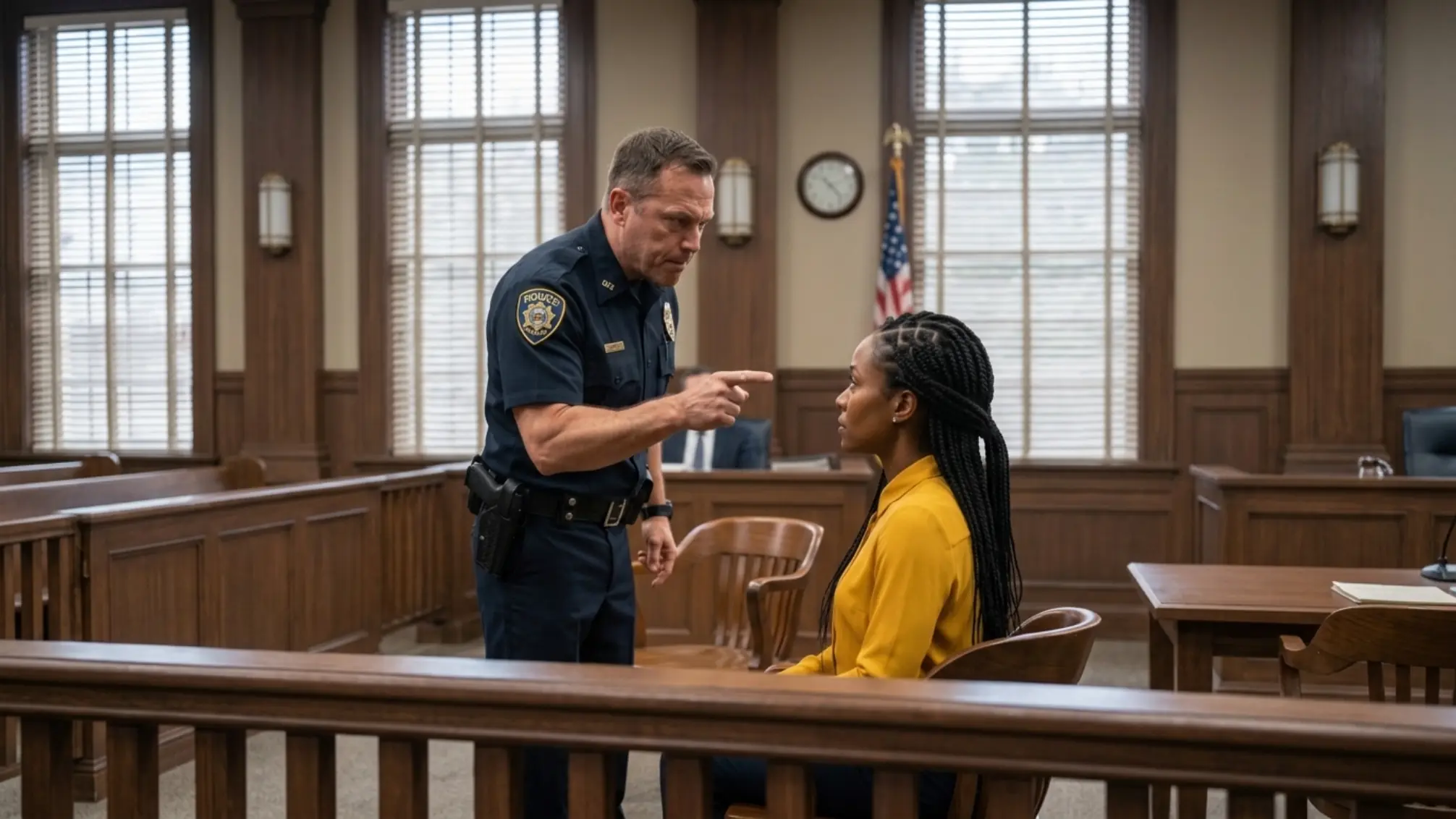
Every conversation inside Fulton County Courtroom Four stopped.
The judge had temporarily left the bench to review an evidentiary dispute in chambers. Jurors had not yet been brought in, but attorneys, clerks, defendants, witnesses, and several uniformed officers remained inside. Tanner had been assigned to courtroom security for the morning, though everyone who worked in the building knew he behaved less like a guard and more like an owner protecting his private territory.
Iris looked at the hand gripping her upper arm.
“Take your hand off me before you embarrass yourself.”
Tanner tightened his fingers. “You think that yellow suit and that attitude scare me?”
He yanked her upward and raised his other hand, either intending to shove her or frighten her into flinching. Iris moved before anyone else could react. She caught his wrist, turned her body, and used his own momentum to send him down beside the overturned chair.
Tanner struck the floor hard enough to lose his breath.
Iris did not hit him. She did not kneel on his neck, twist his arm beyond control, or continue after he stopped resisting. She released him immediately, stepped backward, and raised both hands where every camera in the room could see them.
A second officer rushed forward.
“Don’t touch her!” Tanner shouted from the floor. “Arrest her!”
Iris looked toward the courtroom’s security camera, then at the court reporter sitting frozen beside her machine.
“Please preserve the recording from the moment Officer Tanner approached me.”
Tanner pushed himself upright, humiliation burning across his face. “You assaulted a police officer.”
“No,” Iris said. “I stopped one from assaulting me.”
Assistant District Attorney Martin Sloane emerged from the side corridor just as two officers helped Tanner stand. Sloane was a forty-one-year-old white American prosecutor with carefully styled brown hair, an expensive navy suit, and the permanent expression of a man inconvenienced by everyone around him. He looked first at Tanner, then at Iris, and appeared to reach a conclusion without asking a single question.
“What did she do?”
“She attacked me,” Tanner said. “I told her to identify herself, and she became violent.”
Iris picked up her black leather portfolio from beneath the overturned chair. “That is not what happened.”
Sloane held out his hand. “Identification.”
“You could ask politely.”
“I could also have you placed in holding until the judge returns.”
Iris studied him for a moment before opening the portfolio. She removed a plain driver’s license and handed it over, keeping the other credentials concealed inside.
Sloane read the card.
“Dr. Iris Bennett,” he said. “What kind of doctor?”
“The kind who understands that information becomes more useful when people reveal what they are willing to do without it.”
Sloane frowned. “Are you trying to be clever?”
“No. I am allowing you the opportunity to make an informed decision.”
Tanner stepped closer again, though the two officers beside him kept a hand near his shoulder.
“She needs cuffs.”
One of the officers, a young Latino American deputy named Daniel Ruiz, looked uncomfortable. “The camera will show what happened.”
Tanner turned on him. “I said she attacked me.”
Ruiz did not answer.
Sloane returned the license. “Why were you sitting here?”
“I was instructed to wait for Judge Rebecca Holloway.”
“For what case?”
“I’ll discuss that with the judge.”
Tanner laughed bitterly. “She probably wandered in looking for free legal help.”
Iris slowly placed her license back inside the portfolio.
“That comment should also remain in the recording.”
Sloane gestured toward the exit. “You can wait in the public corridor.”
“Judge Holloway instructed me to remain in this courtroom.”
“She is not here.”
“But her order remains.”
Sloane stepped into Iris’s path. “I am the senior prosecutor assigned to this session. I am asking you to leave.”
“And I am declining.”
The silence inside the courtroom deepened.
Most people expected Iris to reveal herself then. She could have produced the state credential inside her portfolio, made one telephone call, or spoken the title that would have changed the posture of every person confronting her. Instead, she remained calm and watched.
For eleven months, the Georgia Office of Public Integrity had investigated allegations involving Fulton County police officers, prosecutors, and courtroom personnel. Complaints repeatedly named Officer Cole Tanner, his supervisor Lieutenant Brent Walsh, and Assistant District Attorney Martin Sloane. Yet each accusation disappeared before reaching a meaningful hearing.
Dash-camera footage became unavailable.
Witnesses withdrew.
Courtroom recordings were marked corrupted.
Defendants accepted sudden plea agreements after reporting intimidation.
The pattern was obvious, but proving it required more than statistics. Investigators needed to observe how the system responded when its members believed no powerful person was watching.
That was why Dr. Iris Bennett had entered the courthouse without an escort.
Iris was not a physician. She held a doctorate in law and public administration and served as special counsel for the Georgia Office of Public Integrity. Her team investigated misconduct involving public agencies, government attorneys, and law-enforcement officials. She had spent years examining how abuse survived inside institutions—not because every employee participated, but because enough people looked away.
Judge Rebecca Holloway had invited Iris to observe a pretrial hearing involving a twenty-two-year-old Black American college student named Malik Turner. Tanner arrested Malik outside a convenience store after claiming he matched the description of a robbery suspect. The actual suspect was nearly fifteen years older, six inches shorter, and had a visible facial tattoo Malik did not possess.
Tanner’s report said Malik became aggressive and attempted to flee.
A damaged surveillance camera from a nearby pharmacy suggested otherwise.
The camera belonged to a private business beyond the police department’s control. Its footage showed Tanner pushing Malik against a patrol car before asking his name. It also showed Lieutenant Walsh arriving and switching off another officer’s body camera.
Sloane knew the pharmacy footage existed.
He had not disclosed it to Malik’s defense attorney.
Instead, the prosecutor offered a plea deal requiring Malik to admit obstruction in exchange for dismissal of the robbery allegation. Malik refused because he had done nothing wrong. His mother filed complaints, contacted local reporters, and eventually reached Iris’s office.
That morning’s hearing was meant to determine whether the arrest report contained false statements.
But the judge had another purpose.
She wanted Iris to observe the courtroom before anyone knew who she was.
Tanner’s attack had answered several questions in less than three minutes.
The side door opened, and Judge Holloway returned wearing her black robe. She was a fifty-five-year-old Black American judge with silver threaded through her short natural hair and a gaze capable of reducing dishonest attorneys to silence.
She stopped when she saw the overturned chair.
“Why is Officer Tanner standing beside my witness with his fists clenched?”
Sloane answered quickly. “Your Honor, Ms. Bennett became physically aggressive after refusing to identify herself.”
Iris looked at the judge but said nothing.
Judge Holloway turned to the court reporter. “Ms. Collins?”
The reporter cleared her throat. “Officer Tanner approached Dr. Bennett, kicked her chair, grabbed her arm, and threatened to drag her from the courtroom. When he raised his hand, she redirected him to the floor and released him.”
Tanner shook his head. “That’s not what happened.”
Judge Holloway looked toward Deputy Ruiz. “Deputy?”
Ruiz swallowed. “The reporter’s description is accurate, Your Honor.”
Sloane gave him a sharp glance.
The judge noticed.
“Mr. Sloane, did you witness the beginning of the incident?”
“No, but Officer Tanner—”
“Then stop representing assumptions as facts in my courtroom.”
She turned toward Iris. “Are you injured?”
“No, Your Honor.”
“Do you require medical attention?”
“No.”
“Would you like Officer Tanner removed?”
Iris finally glanced at him. “Not yet.”
Tanner scoffed. “She doesn’t decide where I go.”
Judge Holloway’s voice became cold. “At this moment, Officer Tanner, I am deciding whether you go downstairs under escort.”
Lieutenant Brent Walsh entered from the main doors before the judge could continue. Walsh was a fifty-two-year-old white American police supervisor with silver hair, a thick neck, and polished captain-style confidence despite holding a lower rank. Tanner had apparently sent him an emergency message during the confrontation.
“What’s the problem?” Walsh asked.
Judge Holloway stared at him. “You entered an active courtroom without acknowledging the bench.”
Walsh stopped. “Apologies, Your Honor. I was told one of my officers had been attacked.”
“You were told incorrectly.”
Tanner spoke over her. “She threw me to the floor.”
“After you kicked her chair, seized her arm, and raised your hand,” the judge replied.
Walsh looked at Iris.
Recognition flickered across his face—not of her identity, but of the danger presented by a composed witness surrounded by cameras.
“We should take statements privately,” he said.
Iris’s expression barely changed.
“Why privately?”
“To prevent unnecessary disruption.”
“The disruption occurred publicly.”
Walsh stepped toward Tanner. “Cole, go downstairs and complete an incident report.”
Iris spoke before he could move.
“No.”
Walsh turned. “Excuse me?”
“Officer Tanner should remain inside the courtroom until the recording is secured and an independent supervisor arrives. Allowing him access to the department reporting system before the footage is preserved creates an avoidable evidence-integrity problem.”
Tanner laughed. “Listen to her pretending she runs an investigation.”
Walsh’s eyes narrowed. “Ma’am, I have handled police investigations for twenty-seven years.”
“That explains why complaints connected to your unit keep disappearing.”
The air changed.
Sloane looked toward Walsh.
Tanner stopped smiling.
Walsh’s voice lowered. “Who are you?”
Iris placed her portfolio on the counsel table.
“You had several opportunities to ask that without threatening, insulting, or touching me.”
She opened the portfolio and removed a gold-edged state credential.
Judge Holloway remained silent as Iris held it where the officers could read.
DR. IRIS BENNETT
SPECIAL COUNSEL
GEORGIA OFFICE OF PUBLIC INTEGRITY
Tanner’s face emptied.
Walsh stepped backward.
Sloane stared at the credential, then toward the courtroom cameras as though noticing them for the first time.
Iris clipped the identification to her mustard-yellow blazer.
“This courthouse, this police unit, and the district attorney’s office have been under joint investigation for eleven months,” she said. “Today’s hearing concerned concealed evidence in the prosecution of Malik Turner. Officer Tanner has now provided direct evidence of intimidation, unlawful physical contact, false reporting, and attempted retaliation in a recorded courtroom.”
Tanner shook his head. “This was a setup.”
“No,” Iris replied. “A setup requires someone to make you behave differently from how you normally behave. No one told you to kick the chair.”
“You refused to identify yourself.”
“Civilians are not required to produce credentials merely because an officer dislikes where they are sitting.”
“You threatened me.”
“I warned you to release my arm.”
Walsh tried to recover his authority. “This conversation should continue with counsel present.”
“It will,” Iris said. “Your counsel, not the department attorney who has helped close complaints against your unit.”
Sloane looked offended. “Are you accusing my office of misconduct?”
Iris removed a second folder.
“I am informing you that your email account was preserved under a sealed judicial order at six this morning.”
Sloane’s mouth opened but no words emerged.
Judge Holloway spoke to the courtroom clerk. “Lock the doors. No one leaves until state investigators arrive.”
Tanner looked toward the exit.
Deputy Ruiz quietly stepped in front of it.
Within twelve minutes, four investigators from the Office of Public Integrity entered the courtroom. Their director, a forty-eight-year-old Asian American attorney named Grace Park, served preservation orders on Tanner, Walsh, and Sloane. Department-issued phones, access cards, and electronic devices were collected before any of the men could send additional messages.
The courtroom security footage was copied onto three separate drives.
The court reporter’s transcript was sealed.
Witnesses were interviewed independently.
Iris submitted her own statement last.
By afternoon, investigators had enough evidence to suspend Tanner and Walsh. Sloane was removed from active prosecutions pending review. Yet the incident inside Courtroom Four represented only the visible edge of a much larger structure.
The seized devices revealed coordination.
Tanner routinely sent arrest reports to Walsh before entering them into the official system. Walsh edited descriptions of force, removed witness names, and advised officers which camera failures would appear plausible. When defendants complained, Sloane identified the ones most likely to attract attention and offered reduced charges in exchange for waiving civil claims.
One message from Tanner concerned Malik Turner.
Kid won’t fold. Mom keeps calling reporters. Need pressure.
Walsh replied:
Martin can put obstruction on the table. No plea, make the next hearing unpleasant.
Sloane answered:
Give me a clean report and I’ll handle the rest.
The report was not clean.
It was false.
Investigators recovered body-camera footage Walsh believed had been deleted. A cloud backup captured Tanner pushing Malik, searching him without legal cause, and mocking him when he asked why he was being detained. The recording also captured Walsh telling another officer to switch off his camera before they discussed how to justify the arrest.
Malik’s case was dismissed immediately.
Judge Holloway ordered his record sealed and referred the misconduct findings to the state bar, the police standards council, and federal civil-rights authorities. Malik walked out of the courthouse beside his mother, no longer facing prison for refusing to confess to something he had not done.
Reporters waited outside.
He declined to speak.
“I want to go home,” he said.
Iris understood.
Public vindication could not return the months he spent frightened, the semester he lost, or the nights his mother expected a telephone call saying her son had been harmed in custody. Clearing his name was necessary, but it was not the same as restoring what had been taken.
Tanner insisted he had been targeted because of his aggressive policing style. His attorney described the courtroom incident as a reasonable response to a suspicious individual who resisted lawful instruction.
The video destroyed that claim.
It showed Iris sitting silently when Tanner approached. It captured him kicking the chair, gripping her arm, threatening to drag her away, and raising his hand. It also showed her releasing him the moment the threat ended.
No shouting.
No attack.
No confusion.
Just an officer using power against someone he believed had none.
Walsh retired before the disciplinary hearing, hoping to preserve his benefits. The state challenged the retirement after investigators proved he falsified official records and interfered with active cases.
Sloane resigned from the district attorney’s office. The state bar later suspended his license after finding that he concealed evidence, misled courts, and participated in retaliatory prosecutions.
Tanner refused to resign.
His termination hearing took place three months later in a packed municipal chamber. He wore a dark suit instead of his uniform and avoided looking toward Iris, who sat beside Grace Park at the state’s table.
Tanner’s attorney argued that one bad moment should not erase twenty-three years of service.
Iris testified without anger.
“This case is not about one moment,” she said. “It is about what that moment revealed. Officer Tanner believed he could threaten a seated woman, invent an accusation, and rely on other officials to repeat his version before checking the evidence. He believed that because the system had rewarded the same behavior many times before.”
The attorney asked why Iris had not identified herself immediately.
“Would he have treated you differently if he knew your title?”
“Yes.”
“Then your experiment was deceptive.”
Iris looked toward the disciplinary board.
“Respect that appears only after authority is revealed is not professionalism. It is fear.”
The room remained silent.
She continued. “The important question is not how Officer Tanner treats a state investigator. It is how he treats someone he believes cannot challenge him.”
The board voted unanimously to terminate him.
His law-enforcement certification was later revoked.
Several criminal cases involving Tanner were reopened. Wrongfully convicted defendants received new hearings, and multiple civil settlements followed. The city created independent evidence-preservation rules preventing local supervisors from controlling complaints against their own units.
Deputy Daniel Ruiz became one of the investigation’s most important witnesses. He admitted that he had seen Tanner intimidate people before and remained silent because Walsh controlled assignments and promotions.
“I should have spoken sooner,” Ruiz told Iris.
“Yes,” she said.
He lowered his eyes.
Then she added, “Speaking late does not erase the silence. But it can stop the next one.”
Ruiz testified publicly and accepted disciplinary consequences for failing to report earlier misconduct. He remained with the department under a new command structure and later helped train officers on intervention duties.
Judge Holloway ordered the damaged courtroom chair preserved.
It eventually became part of an ethics exhibit at the state judicial training center. A small plaque beneath it carried no dramatic description of Iris’s identity or Tanner’s fall.
It displayed one sentence:
POWER IS MOST DANGEROUS WHEN IT BELIEVES NO ONE IMPORTANT IS WATCHING.
Months after the investigation ended, Iris returned to Courtroom Four for a routine oversight meeting. The wood had been polished, the security system replaced, and a new chair stood where Tanner had kicked the old one.
Malik Turner was there.
He had returned to college and was studying public policy. His mother waited in the corridor while he thanked Judge Holloway and the attorneys who helped clear his name.
Before leaving, Malik approached Iris.
“Were you really not afraid?” he asked.
Iris considered the question.
“I was afraid he might hurt me.”
“You looked calm.”
“Calm is not the absence of fear. It is deciding fear does not get to choose your next move.”
Malik glanced toward the chair.
“Did you know catching his wrist would end his career?”
“No.”
“Then why did you do it?”
“Because he had already decided my body belonged to his authority.”
She picked up her portfolio.
“I corrected him.”
Iris never considered Tanner’s fall the victory. The real victory came from the records that could no longer disappear, the defendants who received new hearings, and the officials who learned that silence was not neutrality.
Tanner believed the woman in the yellow blazer was merely someone he could frighten from a courtroom.
He kicked her chair because he expected her to move.
He grabbed her arm because he expected everyone else to accept his explanation.
And when Iris finally stood, he discovered that the truth she had kept hidden was not simply her title.
It was the evidence already surrounding him—and the fact that, for the first time in his career, the person he tried to silence had arrived specifically to make sure the whole system heard him.