The crowded security waiting area of the Cook County courthouse fell silent. Court employees, attorneys, defendants, and families turned toward the tall Black woman standing beneath the courtroom doors with a dark state portfolio pressed against her side. She wore a tailored charcoal suit over a cream blouse, small gold earrings, and the official lapel pin of the Illinois Attorney General’s Office.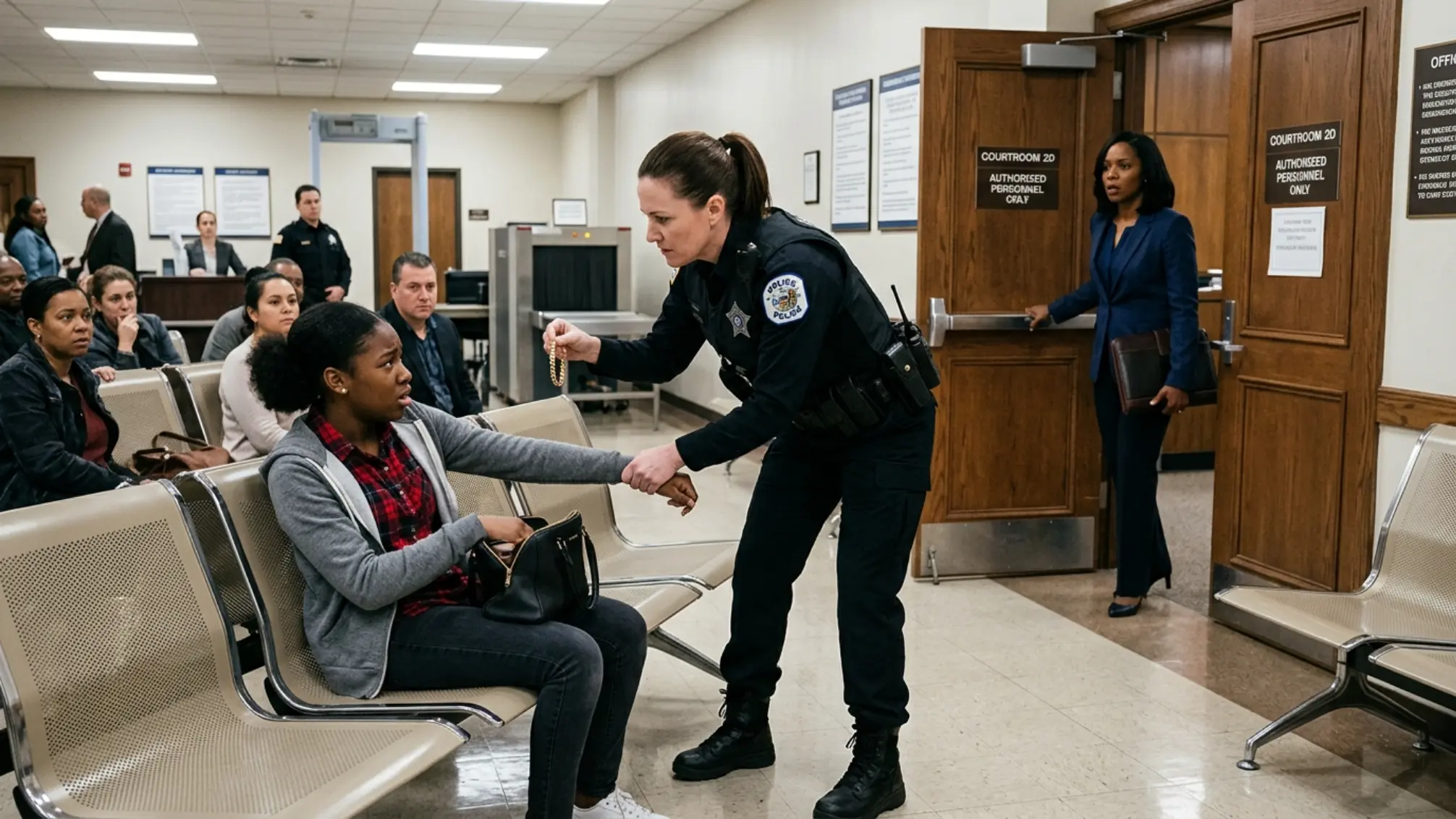
Attorney General Vanessa Brooks did not raise her voice.
She did not need to.
Sloan’s fingers remained locked around Imani’s wrist for one second longer than they should have. The white officer’s fair complexion began to redden as she looked from Vanessa’s face to the state seal embossed on the portfolio. Behind the Attorney General stood two senior investigators, a courthouse administrator, and the presiding judge whose hearing Vanessa had just left.
“I said release her,” Vanessa repeated.
Sloan loosened her grip.
Imani pulled her arm against her chest and remained seated in the metal chair. She had deep brown skin, frightened dark eyes, natural black hair gathered into a low puff, and a gray hoodie over a red plaid shirt. Her handbag lay open across her knees, and the gold bracelet Sloan claimed to have discovered rested in the officer’s gloved palm.
Vanessa crossed the waiting area without rushing. She stopped between Sloan and her daughter, then looked down at the red marks forming around Imani’s wrist. The Attorney General’s expression changed so slightly that most people would not have noticed it.
Sloan noticed.
“Ma’am, there appears to have been a misunderstanding,” she began.
Vanessa looked at the bracelet. “Who reported it stolen?”
“A courthouse employee.”
“Name?”
“I’m still confirming that.”
“What time was the report made?”
Sloan hesitated. “A few minutes ago.”
“Dispatch number?”
“I don’t have it in front of me.”
Vanessa turned toward the courthouse administrator. “Mr. Hale, was a theft reported in this building?”
Administrator Thomas Hale already had his phone in his hand. He spoke quietly with the central security office, listened for several seconds, and then shook his head.
“No theft report appears in the system.”
Sloan’s jaw tightened. “The reporting party may have approached me directly.”
Vanessa faced her again. “Who?”
“I said I’m confirming that.”
“You accused a minor of felony theft, searched her bag, threatened to handcuff her, and physically restrained her without knowing who allegedly lost the property.”
“I had probable cause.”
“State it.”
Sloan glanced at the people watching from the rows of chairs. Until Vanessa appeared, their attention had strengthened her authority. Now every witness made her explanation more dangerous.
“She was acting nervous,” Sloan said.
Imani stared at her. “You kept circling my chair.”
“Be quiet,” Sloan snapped.
Vanessa stepped closer. “You will not speak to my daughter that way again.”
The officer shifted her weight and touched the front of her tactical vest. Her black uniform displayed a courthouse police patch, a name strip, and a body camera mounted above the word POLICE. The camera’s status light was dark.
Vanessa pointed toward it.
“Why is your body camera off?”
Sloan looked down as though noticing it for the first time. “Battery issue.”
“Remove it from your vest and place it on the table.”
“You don’t command courthouse police.”
“No,” Vanessa replied. “But the chief judge does, and he is standing behind me.”
Sloan slowly turned.
Presiding Judge Malcolm Avery had stepped through the courtroom doors. His expression contained no confusion, only disappointment sharpened by years on the bench. He looked first at Imani, then at the open handbag, and finally at Sloan’s inactive camera.
“Officer,” he said, “do exactly as the Attorney General instructed.”
Sloan removed the body camera.
One of Vanessa’s investigators placed it inside a clear evidence pouch without touching its controls. The second investigator photographed the bracelet in Sloan’s palm before asking her to set it on a clean sheet of paper.
Sloan protested immediately. “This is evidence in my investigation.”
Vanessa’s gaze did not move. “You no longer have an investigation.”
“I caught her with stolen property.”
“You found an object inside a bag after standing beside that bag with your body camera disabled.”
The statement moved through the waiting area like a current.
Imani looked at her mother, then toward the ceiling. A dark security camera was mounted above the rows of chairs, angled directly toward the place where she had been sitting. Another camera faced the courthouse entrance.
Vanessa followed her daughter’s eyes.
“Secure all surveillance footage from this floor,” she told Hale. “No copying, exporting, deleting, or viewing until an independent evidence technician arrives.”
Hale nodded and called the control room.
Sloan took a step backward. “There’s no reason to treat me like a criminal.”
Vanessa looked at Imani’s wrist again. “That is an interesting concern for you to express now.”
Twenty-five minutes earlier, Imani had been sitting alone in the courthouse waiting area while her mother attended a closed hearing upstairs. Vanessa had offered to have an investigator stay with her, but Imani refused. She was sixteen, not six, and she had brought homework, headphones, and a paperback novel to occupy herself.
She had come to the courthouse because they were supposed to have lunch afterward.
Vanessa’s schedule had become increasingly difficult since taking office, and private time between mother and daughter often disappeared beneath emergency hearings, press briefings, and late-night calls. Imani had joked that the courthouse cafeteria might be the only restaurant where her mother could not be pulled into another building.
She chose a chair near the wall, placed her handbag across her lap, and began reading.
Officer Sloan noticed her almost immediately.
The officer walked past once, looking at Imani’s shoes and bag. She passed again several minutes later, slower this time. On the third pass, she stopped beside the chairs and asked why Imani was sitting there.
“My mother is in court,” Imani answered.
“What case?”
“I don’t know. It’s closed.”
Sloan gave a small humorless laugh. “Your mother is in a closed hearing, but you don’t know what it’s about?”
“She works here today.”
“That isn’t what I asked.”
Imani removed one earbud. “Am I doing something wrong?”
Sloan did not answer. She asked for identification instead.
Imani explained that her school identification was inside the small front pocket of her handbag. Sloan told her to retrieve it, then moved so close that her hip pressed against the chair’s armrest.
Imani opened the front pocket, removed the card, and handed it over.
Sloan studied the name.
“Imani Brooks.”
“Yes.”
“Address says Springfield.”
“We live there.”
“What are you doing in Chicago?”
“I told you. My mother has a hearing.”
Sloan stared at the card as though waiting for it to expose a lie. Then she looked toward the hallway and asked Imani to stand. When Imani questioned why, Sloan accused her of being uncooperative.
A court clerk approached at that moment and asked Sloan for directions to another floor. The officer turned away for only a few seconds.
Imani saw Sloan’s left hand move.
It passed near the open main zipper of her handbag and disappeared from view behind the officer’s sleeve. When the clerk walked away, Sloan reached into the bag and immediately pulled out the gold bracelet.
She never asked permission to search.
She never asked who owned it.
She simply held it up and announced that Imani had been caught.
Now, with the Attorney General standing beside her, Imani described each movement slowly. Vanessa did not interrupt or complete her sentences. She wanted the account in her daughter’s own words, preserved before anyone could suggest they had coordinated a story.
Sloan laughed once when Imani finished.
“That is ridiculous. Why would I plant jewelry on a random teenager?”
Vanessa answered carefully. “That question will be examined after the footage is preserved.”
“There may not be footage from that angle.”
“The camera is directly above you.”
“It could have been blocked.”
“You sound unusually familiar with its limitations.”
Sloan said nothing.
The courthouse police commander arrived several minutes later. Chief Alan Whitmore was a fifty-six-year-old white man with silver hair, tired eyes, and a reputation for avoiding conflict by calling it miscommunication. He listened to Sloan’s summary before speaking with Imani.
Sloan told him she had received a verbal report from an unidentified woman who claimed her bracelet was missing. She said Imani matched the description of someone seen near the woman’s belongings and consented to the search.
“I never consented,” Imani said.
Whitmore looked toward Vanessa. “Madam Attorney General, perhaps we should discuss this privately.”
“No,” Vanessa replied. “The initial accusation was made publicly. Evidence preservation can be discussed publicly as well.”
Whitmore lowered his voice. “I understand that emotions are high because this involves your daughter.”
“This involves a minor restrained by an officer whose camera was disabled while she conducted an undocumented search.”
“I’m not defending anyone.”
“You began by asking me to leave the witnesses.”
Whitmore’s mouth tightened.
Judge Avery ordered the waiting area temporarily closed. Everyone who had observed the encounter was asked to remain long enough to provide contact information. No one was compelled to give a statement immediately, and each witness was told they could keep any recording made on a personal phone.
That instruction mattered.
Vanessa had investigated enough police misconduct cases to know how quickly an institutional account could become the only account. A single missing video, one vague report, and a supervisor’s desire to protect the department could transform certainty into doubt.
An independent technician arrived from the state inspector general’s office. He entered the security control room with a courthouse IT employee and a representative from the public defender’s office serving as an outside observer.
The footage was exported twice.
Each copy received a digital verification hash and was sealed in a separate evidence drive. The original system was locked against automatic deletion until the investigation concluded.
Vanessa did not watch the video that afternoon.
She returned to Springfield with Imani after a doctor photographed the bruising around her wrist. At home, her daughter barely touched dinner. She sat at the kitchen table with her hoodie sleeves pulled over her hands and stared at the same page of her schoolbook for nearly twenty minutes.
Vanessa placed a mug of tea beside her.
“You don’t have to talk tonight.”
Imani looked up. “Would they have believed me if you weren’t my mother?”
Vanessa sat across from her.
The honest answer hurt more than any reassuring lie could soften.
“I don’t know,” she said.
Imani nodded as though she had expected it. “She looked at me like she had already decided what I was.”
Vanessa reached across the table but stopped before touching her daughter’s hand. Imani closed the distance herself.
“I saw her do it,” the girl whispered. “And for a second, when she said she found it, I wondered whether I had imagined her hand.”
“That is what power can do when it speaks with certainty.”
“I hated that I doubted myself.”
“You remembered. You said what happened. You kept your hands visible, and you asked for the camera. You did everything right.”
Imani’s eyes filled. “I shouldn’t have needed to do everything right.”
“No,” Vanessa said. “You should not have.”
The preliminary footage review took place the next morning without Vanessa present. The inspector general’s office sent a written summary three hours later.
Camera One showed Sloan entering the waiting area with the bracelet already in her right hand.
Camera Two showed her transfer it into her left hand while approaching Imani. When the clerk asked for directions, Sloan angled her body between the handbag and the room. Her left hand moved into the open zipper for approximately two seconds.
Twenty-seven seconds later, she searched the bag and withdrew the same bracelet.
The video was clear.
There was no obstruction.
There was no uncertainty.
Investigators then examined where the bracelet had come from. Sloan initially claimed a frightened woman had handed it to her before leaving the courthouse. No surveillance footage showed such an exchange. Entry records contained no complainant, and no theft report had been made in the building.
The bracelet belonged to Sloan.
A jeweler confirmed that she purchased it eighteen months earlier. Photographs on her social media account showed her wearing it at a family wedding. A partial fingerprint recovered from the clasp matched Sloan, while no usable print belonging to Imani appeared on the polished surface.
The case could have ended as the misconduct of one officer.
Vanessa refused to assume that it did.
She formally recused herself from the criminal investigation because her daughter was the victim. A special prosecutor from another county received authority over charging decisions, while the state inspector general examined courthouse police practices.
The first audit found that Sloan had initiated forty-two theft-related stops during the previous three years.
Thirty-six involved Black or Latino visitors.
Only five resulted in charges.
Four of those five cases depended on property “discovered” by Sloan during searches that had not been recorded from beginning to end.
One case involved a nineteen-year-old Black nursing student named Kiara Davis. Sloan claimed she found a courthouse employee’s wallet inside Kiara’s backpack. Kiara accepted a plea agreement to misdemeanor theft because her public defender warned that a felony conviction could end her nursing career.
The courthouse employee later told investigators she had found the wallet beneath her own desk before Kiara entered the building.
No one informed the prosecutor.
Another case involved a Latino father named Mateo Ruiz, who was accused of stealing a watch while waiting for his brother’s arraignment. Sloan’s report stated that a witness saw Mateo near the owner’s briefcase. Investigators could not locate the witness because the name and phone number in the report were false.
Mateo spent six nights in jail before charges were dismissed.
He lost his warehouse job.
The pattern grew clearer with every file.
Sloan frequently targeted visitors who appeared frightened, young, unfamiliar with the courthouse, or unable to hire private attorneys. She accused them of minor thefts, conducted aggressive searches, and wrote reports describing nervous behavior as evidence of guilt.
Chief Whitmore had approved eleven of those reports.
When investigators questioned him, he claimed he had no reason to doubt an experienced officer. Emails told a different story. Two courthouse employees had warned him that Sloan seemed to “find” stolen property too conveniently. A public defender requested preservation of hallway footage in Kiara’s case, but Whitmore replied that the camera system had already overwritten it.
Records later showed the footage still existed when he sent that email.
Whitmore had not watched it.
He had simply declined to preserve it.
The Attorney General’s identity had not caused Sloan to plant the bracelet. Sloan did not know who Imani was when she selected her.
That made the incident more disturbing.
Imani had not been targeted to hurt a powerful official. She had been targeted because Sloan believed she was powerless.
At the administrative hearing, Sloan wore a dark suit and sat between two attorneys. She denied planting the bracelet despite the video. Her defense argued that the camera angle created an optical illusion and that she had merely adjusted the bag while checking for weapons.
The special prosecutor played the footage frame by frame.
Sloan’s empty right hand approached the bag.
Her closed left hand entered it.
Her open left hand came out.
Her right hand later reached inside and removed the bracelet.
The jeweler’s receipt appeared on the next screen.
Sloan stopped looking at the panel.
Imani testified from a separate room through a secure video connection so she would not have to sit near the officer. She described the hand near the zipper, the sudden accusation, and the pressure of Sloan’s fingers around her wrist.
One of Sloan’s attorneys asked why Imani had not shouted when she believed evidence was being planted.
“I wasn’t sure anyone would believe me,” she answered.
The attorney asked whether her mother’s position had made her feel powerful after the courthouse doors opened.
Imani looked directly into the camera.
“No. It made me realize how differently that moment could have ended for another girl.”
Sloan was dismissed from courthouse police before the hearing concluded. The special prosecutor later charged her with official misconduct, evidence tampering, unlawful restraint, filing false reports, and obstruction of justice.
Chief Whitmore resigned after being placed on administrative leave. A grand jury reviewed whether his failure to preserve evidence had crossed from negligence into criminal concealment.
Kiara Davis’s conviction was vacated.
The courtroom was nearly full when the judge cleared her record. Kiara cried quietly as the clerk returned the nursing school documents she had once believed were useless. Her program reinstated her after learning that the theft case had been manufactured.
Mateo Ruiz received a formal apology and financial compensation for his wrongful detention. The warehouse could not give him back the job he had lost, but another company hired him after the investigation became public.
More than two dozen cases were reopened.
Some involved Sloan directly. Others involved officers who had learned that vague accusations, missing footage, and frightened defendants were rarely challenged inside a busy courthouse.
Vanessa introduced reforms only after the independent investigation ended. Every courthouse search would now require a documented legal basis, recorded consent, or judicial authorization. Officers could no longer deactivate body cameras inside public waiting areas without triggering an immediate alert to central control.
Alleged stolen property had to be photographed where it was first reported, entered into an electronic chain-of-custody system, and linked to an identified complainant before a search occurred. Juveniles could not be interrogated about suspected crimes without a guardian or attorney present, except during an immediate safety emergency.
Vanessa presented the reforms without mentioning Imani’s name.
Her daughter had already become a symbol in news reports, and Vanessa refused to turn her pain into a permanent public identity. She wanted people to remember the system that failed, not reduce a sixteen-year-old girl to the worst fifteen minutes of her life.
Months later, Imani returned to the courthouse.
She had resisted the idea at first. The building still appeared in her dreams, always with endless rows of chairs and a zipper she could not close before Sloan reached it.
This time, she entered beside her mother.
She wore the same gray hoodie, not because she had forgotten what happened, but because she refused to let the officer decide which clothes were safe for her to wear.
Kiara Davis waited inside the restored waiting area. She had asked to meet Imani before returning to nursing school. The two young women embraced without speaking.
A new security officer stood near the entrance with his body camera active. He greeted them, explained where they could wait, and did not ask why they belonged there.
Imani sat in the same chair.
Her mother remained standing beside her.
“You can go to your hearing,” Imani said.
Vanessa looked toward the courtroom doors. “I can be late.”
“I’m okay.”
“You do not have to prove that.”
“I know.”
Vanessa studied her daughter’s face, then nodded. Before walking away, she placed a hand lightly on Imani’s shoulder.
The courthouse returned to its ordinary rhythm around them. Attorneys crossed the tiled floor, clerks carried files, families whispered beside closed doors, and shoes echoed down the corridors.
Nothing about the room announced what had happened there.
But the cameras now preserved every angle. Searches produced permanent records. Complaints could no longer disappear through a supervisor’s silence.
Officer Sloan had believed she could manufacture guilt by placing a bracelet inside the bag of a frightened Black teenager.
She chose Imani because she expected fear to keep the girl quiet.
Instead, Imani remembered the movement of one hand, spoke while an officer threatened her, and held onto the truth long enough for the evidence to catch up.
Her mother’s title opened the first door.
What followed ensured that the same door would no longer remain closed to everyone else.