Every student outside Jefferson High turned toward the driveway. Three black SUVs rolled through the open gates without sirens, forcing the gathered crowd to separate as they stopped beside the main entrance. Officer Todd Wallace’s hand remained inches from Maya Carter’s phone, but the cruel confidence that had filled his face began to disappear.
Maya stood in front of him with rainwater running from her braids and soaking the cobalt-blue shirt beneath her backpack straps. Less than ten minutes earlier, Wallace had poured a bottle of water over her head in front of half the senior class because she refused to apologize for defeating his nephew during a debate. Now dozens of phones were recording the moment he realized the frightened girl he had chosen to humiliate was not as isolated as he believed.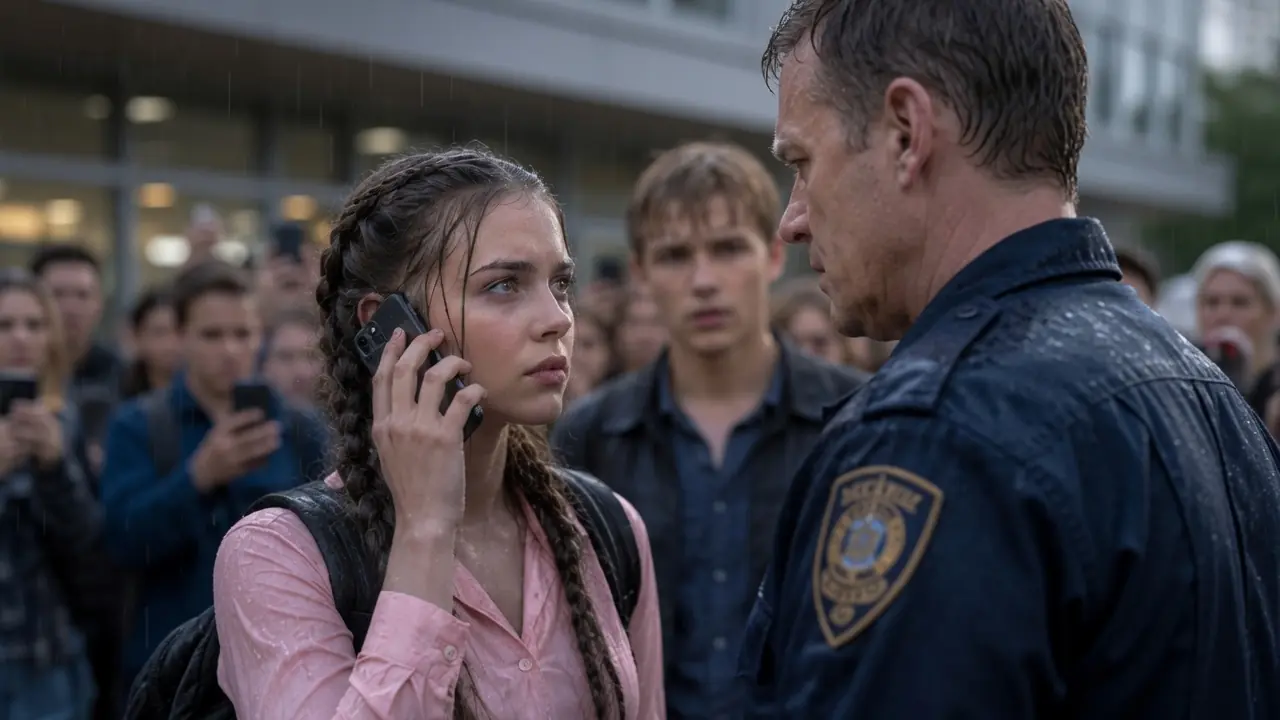
The first SUV door opened, and Colonel Daniel Carter stepped onto the pavement. He wore a charcoal coat over a black shirt, dark trousers, and polished boots, but there were no medals, insignia, or visible weapons on him. At forty-nine, Daniel had a tall, powerful build, close-cropped black hair touched with gray, and the disciplined stillness of a man who never wasted movement.
Two men and one woman emerged from the second vehicle. They wore plain clothes and carried identification folders rather than rifles. The third SUV contained Jefferson County’s sheriff, an attorney from the state civil-rights office, and the district’s newly appointed superintendent.
Officer Wallace recognized the sheriff first. “Chief, this girl disrupted school operations and threatened an officer.”
Sheriff Michael Grant did not answer immediately. He looked at Maya’s soaked clothes, the bottle lying near Wallace’s boot, and the students holding phones around them. Then he turned toward the school’s security camera above the entrance and noticed that its indicator light was dark.
“Why is the exterior camera disabled?” Grant asked.
Wallace glanced upward. “Technical failure.”
One of the plainclothes investigators opened a tablet. “It stopped recording forty-three seconds before you approached the student.”
Wallace’s nephew, Ethan, took a small step backward.
Daniel walked past the investigators and stopped in front of Maya. He did not ask whether she was hurt first. He gently removed his coat and placed it around her shoulders, then used the edge of his sleeve to wipe water from her cheek.
“Did he touch you?” he asked.
“He grabbed my wrist when I reached for my phone.”
Daniel looked at the faint red marks forming above her hand. His expression remained calm, but the students nearest him instinctively moved farther away. Maya knew that silence; it was the same silence that filled their kitchen whenever her father received news that demanded complete control.
Officer Wallace pointed toward Daniel. “Back away from her. This is an active police matter.”
Daniel turned slowly. “You poured water on a minor, grabbed her, disabled a camera, and threatened everyone filming you.”
“She was creating a disturbance.”
“She won a debate.”
Ethan’s face hardened. “She insulted police officers in front of the class.”
Maya finally looked at him. “I cited public court records.”
“You called my family corrupt.”
“I said any system without accountability becomes permission for abuse. Your uncle decided to prove my point.”
A few students murmured in agreement. Wallace ordered them to leave, but nobody obeyed. The arrival of the sheriff and state investigators had changed the meaning of his uniform; it no longer looked like unquestionable authority. It looked like evidence.
Daniel had spent twenty-four years in the military, including assignments he rarely discussed outside secure rooms. He had led small teams through situations where a single emotional decision could endanger everyone. Yet the most important lesson he gave Maya had nothing to do with combat.
Never become the chaos someone else needs you to become.
Maya followed that lesson outside Jefferson High. She did not strike Wallace, scream at Ethan, or throw the empty bottle back. She called her father, named the officer, activated her phone’s emergency recording, and waited.
What Wallace did not know was that Daniel had created the emergency contact after Maya began receiving anonymous threats three weeks earlier. Every call to Emergency One automatically uploaded audio, location data, and video from both cameras to an encrypted account accessible by Daniel’s attorney. The moment Maya said they had crossed the line, the system alerted Daniel and two trusted contacts.
Those threats had started after the first round of Jefferson High’s civic-debate tournament. Maya’s team was assigned the question of whether local police departments required stronger external oversight. She spent nights reading lawsuits, public budgets, disciplinary reports, and city-council minutes.
One set of numbers caught her attention. Jefferson County had paid settlements in three excessive-force cases during the previous four years, but none of the officers involved appeared in the public disciplinary database. Two complaints named Todd Wallace.
The cases ended without admissions of wrongdoing. Wallace remained employed and was later assigned as Jefferson High’s school-resource officer, giving him daily authority over hundreds of teenagers.
Maya did not accuse him personally during the debate. She argued that confidential discipline and weak civilian review allowed patterns to remain hidden. Ethan Wallace, who happened to be on the opposing team, treated the argument as an attack against his family.
He mocked Maya’s father’s military background, suggesting anyone raised by a “government weapon” had no right to discuss abuse of power. Maya did not respond emotionally. She presented court documents showing that Wallace’s department had failed to preserve body-camera footage in two settled cases.
Ethan lost the round by a unanimous decision.
The following day, someone taped a note inside Maya’s locker.
STOP DIGGING BEFORE SOMEBODY DIGS INTO YOUR FAMILY.
Maya photographed it and reported it to Assistant Principal Leonard Price. He dismissed it as immature competition and advised her to avoid provoking Ethan before the tournament finals.
A second note appeared beneath her windshield wiper. This one contained a printed photograph of Daniel leaving their home, with the words CLASSIFIED MEN STILL BLEED written across the bottom.
Daniel wanted to contact law enforcement immediately. Maya asked him to wait because she believed the threat came from a student trying to intimidate her. He agreed only after installing the emergency recording system and arranging for a former colleague to monitor unusual activity near the school.
The threats continued. Maya’s debate notes disappeared from a locked classroom cabinet. Her student email account was accessed after midnight, and messages were sent to teachers accusing Ethan’s family of crimes she had never alleged.
The administration suspended Maya from the debate team for “targeted harassment.” Ethan replaced her in the championship round.
Daniel reviewed the email metadata and discovered the messages originated from an administrative computer inside Jefferson High. He quietly contacted Superintendent Evelyn Ross, who had joined the district less than a month earlier and was already reviewing complaints about selective discipline.
Ross asked Daniel not to confront the school. She needed evidence showing who had used the computer and whether administrators participated.
Maya returned to class while pretending the suspension had silenced her. She continued researching public records from home. The deeper she looked, the clearer the pattern became.
Students whose parents challenged school discipline were frequently accused of misconduct by Wallace. Several had been searched without witnesses, removed from athletic teams, or pressured into signing statements they did not understand.
Most of the targeted families were Black, Latino, immigrant, or financially unable to hire attorneys. Their complaints rarely reached the school board because Assistant Principal Price marked them as resolved through informal conferences.
One former student, nineteen-year-old Marcus Bell, agreed to speak with Maya. Wallace had accused him of bringing stolen electronics to school after finding two new phones in his backpack. Marcus explained that he repaired devices for money, but Wallace confiscated them anyway.
The phones never entered the official evidence system.
Another student said Wallace took cash from his locker during a search and threatened to arrest him if he complained. A third described being forced to pay a private “security restitution fee” after Wallace accused him of damaging a patrol vehicle.
Every payment went through a youth-behavior program operated by a nonprofit called Jefferson Student Safety Partners. Public filings showed the organization’s director was Wallace’s sister.
Maya gave the records to her father three days before the debate incident. Daniel forwarded them to Attorney Lena Brooks, a former military prosecutor now working in civil-rights law. Brooks contacted the state inspector general, who opened a confidential preliminary review.
The investigation was already underway when Wallace poured water over Maya.
His public attack did not create the case. It exposed his desperation.
Sheriff Grant ordered Wallace to step away from Maya. Wallace refused and claimed the sheriff lacked authority over an officer assigned through the city department.
Grant removed a folded document from his jacket. “Your city chief placed you on administrative suspension eleven minutes ago.”
“That is impossible.”
“The notice was delivered after investigators confirmed you accessed confidential juvenile records without authorization.”
Wallace’s face tightened. He looked toward Assistant Principal Price, who had appeared behind the glass entrance doors but had not stepped outside.
Price immediately turned away.
The female investigator beside Grant introduced herself as Special Agent Monica Hayes from the state inspector general’s public-integrity unit. She informed Wallace that he was not under arrest yet but was required to surrender his badge, service weapon, school keys, and department-issued devices.
Wallace laughed once. “You built an investigation around a teenager losing a debate?”
Hayes looked toward the students. “No. We built it around stolen property, fraudulent payments, suppressed complaints, unauthorized database access, and obstruction.”
Ethan’s mouth opened, but no words came out.
Wallace attempted to push past Daniel toward the school entrance. Daniel shifted one step and blocked him without touching him. The movement was small, but Wallace stopped as if he had reached a wall.
“Move,” Wallace said.
Daniel’s voice remained low. “You were brave when she stood alone.”
“I said move.”
“You are surrounded by cameras, investigators, and students whose fear kept your scheme alive. Choose your next movement carefully.”
Sheriff Grant took Wallace’s weapon. Agent Hayes collected his phone, while another investigator sealed the empty bottle and requested copies of every student recording. The superintendent ordered the school placed under immediate administrative review.
Assistant Principal Price attempted to leave through a side entrance.
Two investigators met him before he reached his car.
The crowd outside Jefferson High remained until Maya was escorted inside to change into dry clothes. Several students who had laughed during the humiliation avoided her eyes. Others approached Daniel and offered their videos.
One boy named Tyler held out his phone with both hands. “I recorded Wallace turning off the camera.”
The clip showed the officer using a school master key to open the exterior security panel. Ethan stood beside him, watching.
Another video captured Ethan handing his uncle the water bottle. A third recorded Wallace saying, “Your kind always talks too much,” before pouring it over Maya.
Daniel accepted none of the devices personally. He directed students to Agent Hayes so the recordings could be preserved properly. He refused to allow anger to contaminate the evidence.
Inside a private office, Maya sat wrapped in a blanket while Dr. Nina Patel, the school nurse, examined her wrist. Daniel waited beside the door, close enough for Maya to feel protected without making the room smaller.
“I should have called sooner,” Maya said.
“You called when you needed help.”
“I thought I could handle it.”
“You did handle it.”
“He still humiliated me.”
Daniel sat opposite her. “What happened to you was humiliating because he designed it that way. That shame belongs to him, not you.”
Maya looked down at the blanket. “Everyone laughed.”
“Some laughed because they were cruel. Some laughed because they were frightened and wanted him looking at you instead of them. Neither reaction defines you.”
The investigation expanded rapidly. Search warrants were executed at Wallace’s office, his home, the nonprofit’s headquarters, and Assistant Principal Price’s school computer. Investigators recovered confiscated phones, tablets, jewelry, cash, and student belongings that had never been logged as evidence.
Jefferson Student Safety Partners had collected more than two hundred thousand dollars in “restitution,” “behavioral intervention,” and “expedited resolution” payments. Families were told payment could prevent suspension, arrest, immigration consequences, or permanent school records.
Most allegations supporting those payments were never formally documented.
Wallace selected students, created accusations, and pressured families. Price altered school records to support the stories, while Wallace’s sister processed the money through the nonprofit. Ethan helped identify targets by sharing private conversations, family circumstances, and rumors about students who kept cash or expensive devices.
The debate tournament threatened the scheme because Maya’s research connected Wallace’s missing body-camera footage with complaints at Jefferson High. Ethan searched her locker, copied her notes, and gave them to his uncle.
Wallace used Price’s computer to send false messages from Maya’s account. He wanted the administration to discredit her before she presented the evidence publicly.
Then Maya won the debate anyway.
Wallace’s response outside the school was meant to finish what the forged emails had started. By provoking her into striking or threatening him, he could arrest her, seize her phone, and portray her research as revenge from a violent student.
Maya’s calm ruined that plan.
Her phone recording captured Wallace demanding the device before identifying any lawful reason for seizure. It also recorded Ethan saying they needed to “erase what she found” moments before Daniel answered.
The criminal charges arrived over several weeks. Wallace was charged with misconduct in office, theft, extortion, tampering with evidence, unlawful access to juvenile records, and conspiracy. Additional civil-rights charges followed after investigators documented the pattern of targeting minority students.
Price resigned before the school board could remove him. He was later charged with falsifying records and obstructing mandatory reporting procedures.
Wallace’s sister claimed the nonprofit operated legally, but bank records showed personal purchases, mortgage payments, and luxury travel funded through student restitution accounts. She joined the others under indictment.
Ethan was seventeen. Prosecutors did not treat him as the mastermind, but they did not excuse his choices. He admitted accessing Maya’s locker, providing student information, and participating in the confrontation.
The juvenile court required him to cooperate, perform community service, and complete a restorative-justice program. He was removed from the debate team and transferred from Jefferson High after several families requested protective orders.
Maya struggled with that decision.
Part of her wanted Ethan punished as severely as possible. Another part recognized that his uncle had taught him cruelty was loyalty and accountability was betrayal. Understanding the influence did not erase the harm, but it helped Maya decide what justice should accomplish.
At Ethan’s restorative conference, he sat across from her without his uncle beside him. The arrogance that once filled his face had disappeared.
“I thought you wanted to destroy my family,” he said.
“I wanted public records to be public.”
“You knew people would look at my uncle.”
“Because his name appeared repeatedly.”
Ethan stared at his hands. “He said if I let you win, everyone would think he was guilty.”
“You did let me win,” Maya replied. “You just waited until after the debate to prove my argument.”
Ethan began crying quietly. Maya did not comfort him, but she did not mock him either. She told him apology without truth was merely another attempt to control how the injured person reacted.
He then admitted something investigators had not discovered. Wallace kept a second storage locker under another man’s name. Inside were old phones, disciplinary files, cash envelopes, and body-camera memory cards from cases dating back six years.
The locker transformed the investigation.
Several people previously accused of crimes received new hearings after the recovered footage contradicted Wallace’s reports. One man’s conviction was overturned when video showed evidence had been placed inside his vehicle after the search began.
The city paid settlements, but money could not restore lost jobs, damaged families, or years spent under false accusations. Daniel reminded Maya that exposing a system did not produce an instant happy ending. It created the possibility of repair, which was slower and less satisfying than revenge.
Jefferson High underwent major reforms. School-resource officers could no longer conduct student searches without an administrator, written justification, and functioning body cameras. Families received immediate access to disciplinary records and independent appeal procedures.
The district created a confidential reporting channel managed outside the school administration. Every payment connected to discipline was prohibited unless authorized by a court or published district policy.
Superintendent Ross invited Maya to join a student oversight council. Maya accepted only after insisting the council include students who had actually experienced suspension, searches, disability discrimination, and language barriers.
She returned to the debate team the following semester. Her first competition took place in the same auditorium where Ethan had accused her of attacking police.
The final question was whether public institutions should fear scrutiny.
Maya stood behind the podium wearing a navy blazer over a blue blouse. Daniel sat near the back rather than in the front row, giving her the independence she had asked for while remaining close enough that she could find him with one glance.
“Accountability is not an attack on honorable authority,” Maya said. “It is how honorable authority proves it deserves public trust.”
She did not mention Wallace by name.
She did not need to.
Maya won the state championship and used the scholarship to study constitutional law and public policy. Years later, she would remember the trophy less clearly than she remembered the moment outside Jefferson High when water ran down her face and laughter surrounded her.
That day taught her that courage did not always look fearless. Sometimes courage was a trembling hand holding a phone. Sometimes it was refusing to become violent when violence would give an abuser exactly the story he wanted.
Daniel never deployed soldiers against the school, despite the rumors students repeated afterward. The people in the SUVs were investigators, attorneys, and officials operating under warrants and lawful authority.
The war Wallace never saw coming was not fought with weapons.
It was fought with recordings, bank records, public filings, preserved messages, witness statements, and frightened families finally realizing they were not alone.
Months after Wallace’s conviction, Maya and Daniel returned to Jefferson High for the dedication of a student civil-rights resource center. The exterior security camera above the entrance had been replaced, and a small sign beneath it explained how students could report officer misconduct.
Maya stood where Wallace had once poured water over her.
“Do you still think I called too late?” she asked.
Daniel shook his head. “You called after you gave the system every chance to correct itself.”
“And when it didn’t?”
“You documented the truth.”
Maya looked toward the entrance, where students were walking past without knowing how many records, hearings, and painful testimonies had changed the rules protecting them.
Wallace believed she was alone because nobody moved during the first seconds of her humiliation. He mistook silence for abandonment and fear for loyalty.
He never understood that Maya had already connected every threat, forged message, missing camera file, and stolen record to people prepared to follow the evidence wherever it led.
They thought she was alone.
They never saw the truth gathering behind her.