The second slap exploded across the supermarket parking lot before Marcus Reed could finish rising from one knee. His wrists remained locked behind his back, and blood darkened the corner of his mouth where Officer Daniel Hayes’s ring had cut the skin. Marcus’s midnight-blue ceremonial commissioner uniform was still neatly fastened despite the dust on one trouser leg, its gold shoulder braids, state-seal collar pins, commissioner badge, and departmental commendation bars reflecting the police lights. Hayes stood over him smiling as if the gathered crowd had come to admire his authority.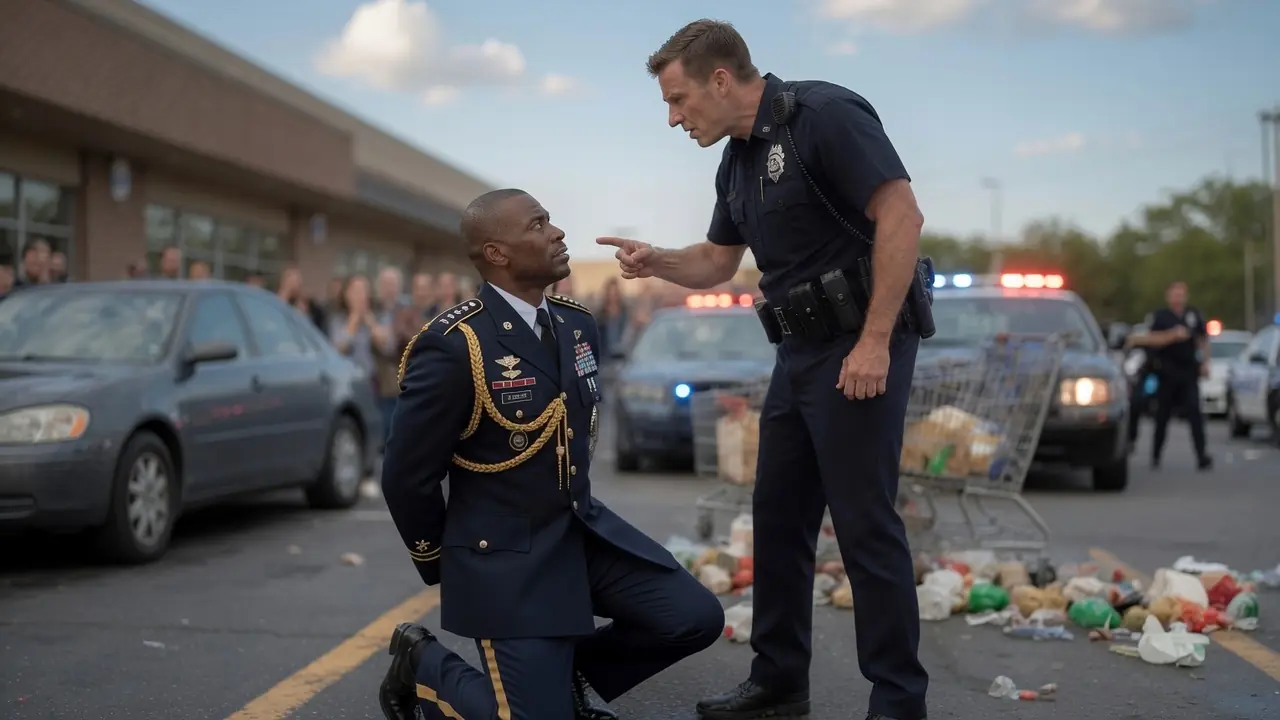
“That uniform doesn’t belong to you,” Hayes repeated, pressing two fingers against Marcus’s forehead. “Men like you buy badges online and expect everyone to believe the costume.”
Marcus slowly raised his eyes. “My credentials were inside the wallet you threw under your cruiser.”
“I found a fake badge carried by a fraud.”
“You looked at it for less than three seconds.”
“I don’t need three seconds to recognize someone pretending to be important.”
Marcus said nothing.
That silence made Hayes angrier than resistance would have. He had expected pleading, shouting, or panic—anything he could describe later as threatening behavior. Instead, Marcus watched him with the cold concentration of an investigator documenting every decision.
Twenty minutes earlier, Marcus had stepped from the supermarket carrying groceries for his mother. He had attended the annual State Law Enforcement Service Ceremony that morning, which explained the formal commissioner uniform. Rather than return to headquarters before visiting her, he stopped to buy the soup, medication, and fresh fruit she had requested.
His black government SUV was parked near the cart return.
Hayes saw Marcus placing grocery bags inside it and pulled his patrol car across two empty spaces behind him. No emergency lights had been activated. No store employee had reported a suspicious person.
The officer simply walked toward Marcus and demanded to know where he had obtained the uniform.
Marcus answered calmly. “It was issued by the State Police Commission.”
Hayes laughed.
He asked whether Marcus believed a polished badge and expensive vehicle could make people ignore what was obvious. Marcus requested the officer’s name and the reason for the confrontation.
Hayes moved closer.
“People like you love asking questions when they get caught.”
Marcus kept both hands visible. “Caught doing what?”
“Impersonating a law-enforcement official.”
“My identification is inside my coat.”
“Reach slowly.”
Marcus removed the dark leather credential wallet using two fingers and offered it badge-side open. The gold commissioner emblem appeared beneath his photograph, appointment number, security strip, and signature of the governor.
Hayes glanced at it.
Then he slapped it from Marcus’s hand.
The wallet skidded beneath the patrol cruiser.
“That is the best fake I’ve seen all month.”
A younger officer named Thomas Bell had arrived moments earlier in a second patrol car. He stared at the gold insignia on Marcus’s shoulders and seemed to recognize that something was wrong.
“Daniel,” Thomas said quietly, “we should verify the appointment number.”
Hayes turned. “Did I ask you?”
“No, but that rank insignia—”
“Stand back and secure the scene.”
Marcus looked from one officer to the other. Thomas’s quick retreat revealed that Hayes’s control over his colleagues had been established long before that afternoon.
Hayes ordered Marcus to place both hands against the SUV.
Marcus complied.
The officer searched his coat and removed a secure state government phone. Its screen displayed an incoming encrypted call from DIRECTOR CARTER—PUBLIC INTEGRITY.
Hayes held it up for the crowd.
“Look at this. He even programmed fake government contacts.”
“That is a protected state device,” Marcus warned. “Set it down.”
Hayes threw it onto the asphalt.
The glass cracked, but the call remained connected.
Marcus heard a faint voice through the damaged speaker.
“Commissioner Reed?”
Hayes stepped on the phone.
“That uniform doesn’t belong to you,” he said again.
Marcus turned his head slightly. “Touch me again—your body camera becomes assault evidence.”
Hayes grabbed his collar.
He shoved Marcus against the SUV and attempted to force both arms behind him. Marcus was stronger, taller, and trained in defensive-control techniques, but he refused to respond with physical force. One movement could be separated from its context and described as an attack on an officer.
He allowed Hayes to apply the cuffs.
The officer tightened them beyond what was necessary.
When Marcus requested that he check the spacing, Hayes kicked the back of his knee and forced him onto the pavement. The grocery cart rolled away, struck a concrete divider, and overturned. Apples scattered beneath parked cars, a carton of milk split open, and his mother’s medication disappeared beneath a sedan.
People began recording.
Hayes performed for them.
“This man was caught impersonating a commissioner,” he announced. “He resisted investigation and attempted to intimidate officers with a fake government device.”
“I did not resist,” Marcus said.
Hayes slapped him.
A woman screamed.
Thomas stepped forward. “Daniel, stop.”
“Return to your cruiser.”
“You hit a handcuffed man.”
“He moved toward me.”
“He is on his knee.”
Hayes faced him with one hand near his duty belt. “You want to join him?”
Thomas stopped.
The secure phone vibrated beneath Hayes’s boot.
He picked it up, saw the words CONNECTION ACTIVE, and threw it toward his cruiser. The device landed beside the front tire, still transmitting audio to the state integrity team waiting less than two miles away.
Marcus tasted blood but kept his breathing controlled.
The operation had not been designed to expose Hayes in the supermarket parking lot. Marcus had planned to meet a protected witness inside the store’s café after the ceremony. The witness possessed internal records connecting Hayes’s Special Enforcement Unit to illegal seizures, fabricated arrests, and retaliatory surveillance.
Marcus did not know whether the witness had arrived.
He knew only that Hayes had interrupted the meeting before it could begin.
The first black SUV entered through the northern driveway.
Four more followed.
They moved in disciplined formation around the marked cruisers without blocking civilian vehicles. Doors opened almost simultaneously, and investigators stepped onto the pavement wearing dark suits, body armor, and badges from the State Office of Public Integrity.
Director Evelyn Carter emerged from the lead vehicle.
Her silver-blond hair was tied neatly behind her head, and her expression changed when she saw Marcus kneeling in cuffs. Her gaze moved from the blood on his face to Hayes’s clenched hand and the cracked secure phone beside the cruiser.
Hayes raised his palm.
“This is an active police scene. Stay back.”
Evelyn displayed her credentials. “Release State Police Commissioner Marcus Reed immediately.”
The parking lot became silent.
Hayes looked down at Marcus.
“Commissioner?”
Marcus held his gaze. “You had the credential in your hand.”
“That badge was fake.”
Evelyn stopped several feet away. “The appointment number you refused to verify belongs to the sitting State Police Commissioner.”
Hayes recovered quickly. “He assaulted me.”
“Your camera will show that.”
“The camera malfunctioned.”
The red indicator remained visible on his chest.
Thomas looked at it.
So did every person recording nearby.
Evelyn signaled for him to unlock Marcus.
Thomas moved immediately.
Hayes seized the younger officer’s forearm. “Do not touch those cuffs.”
Evelyn’s voice became dangerously quiet. “Remove your hand.”
“This is my arrest.”
“No lawful arrest exists.”
“He impersonated an officer.”
“He is the highest-ranking state police executive in this jurisdiction.”
Hayes tightened his grip on Thomas.
Two integrity agents stepped closer.
Evelyn looked directly at him. “Remove your hand, or my investigators will remove it for you.”
Hayes released Thomas.
The handcuffs opened with a soft click.
Marcus rose carefully. His right knee faltered after being pressed against the asphalt, but he steadied himself without assistance. He straightened the gold braiding on his shoulder, adjusted the commissioner badge on his chest, and wiped blood from his mouth using a folded handkerchief.
He showed no satisfaction.
That disturbed Hayes more than anger would have.
Marcus retrieved his credential wallet from beneath the cruiser. The leather had been scratched, but the appointment card remained intact.
He held it toward Hayes.
The title was unmistakable:
MARCUS ELIJAH REED
STATE POLICE COMMISSIONER
EXECUTIVE AUTHORITY—STATEWIDE OPERATIONS
Hayes stared at it.
“You should have identified yourself clearly.”
Marcus closed the wallet. “I did.”
“You never said you were the actual commissioner.”
“I said the uniform and credentials were issued by the State Police Commission.”
“You knew I would think it was fake.”
“I knew you had a scanner inside your cruiser.”
Hayes pointed at the ceremonial uniform. “You don’t look like a commissioner.”
The words escaped before he could stop them.
Several members of the crowd reacted audibly.
Marcus took one step closer. “Describe what a commissioner is supposed to look like.”
Hayes looked away.
Evelyn ordered investigators to collect his body camera, duty phone, radio, patrol computer, and vehicle recording system. Hayes immediately refused, claiming city property could not be seized without authorization.
She handed him a sealed warrant.
His name appeared on the first page.
So did the name of his commander, Captain Richard Sloan.
The warrant authorized the State Office of Public Integrity to preserve every complaint, arrest report, evidence log, vehicle-seizure record, body-camera file, and financial transaction connected to the Special Enforcement Unit.
Hayes read the opening paragraph twice.
“This investigation is about me?”
Marcus answered. “It was about your unit before you raised your hand.”
Hayes’s face reddened.
“You set me up.”
“I went grocery shopping.”
“You wore that uniform to provoke a reaction.”
“I attended an official ceremony.”
“You came here knowing we were being investigated.”
“I came to meet a witness.”
Hayes suddenly looked toward the supermarket entrance.
That involuntary movement gave Evelyn more information than any confession could have.
“Which witness?” she asked.
Hayes said nothing.
Marcus watched him carefully. The officer had not recognized the commissioner, but he knew someone inside the store planned to speak with investigators. The stop may have begun with prejudice, yet the arrival of the Special Enforcement Unit was not entirely accidental.
Hayes had been watching the parking lot.
Captain Richard Sloan arrived six minutes later in an unmarked police SUV. He was fifty-six, broad through the waist, and carried the confidence of a commander accustomed to internal complaints disappearing before reaching outside authorities.
He walked directly toward Marcus.
“Why is my officer being surrounded?”
Evelyn handed him a second warrant.
Richard read his own name and stopped.
“This is political retaliation.”
“No,” Marcus said. “This is evidence preservation.”
Richard glanced at the blood on Marcus’s face. “What happened here has nothing to do with the investigation.”
“Your officer assaulted the official supervising it.”
“You concealed your identity.”
“He refused to scan it.”
Richard faced Hayes. “Do not answer another question.”
Evelyn looked between them. “That advice arrived late.”
Operation Clear Shield had begun fourteen months earlier after a Black courthouse investigator named Isaiah Ford was arrested outside a downtown hotel. Isaiah wore a formal state investigator’s uniform while attending an official awards dinner. Hayes accused him of purchasing the badge online and claimed the uniform looked too expensive to belong to him.
Isaiah presented valid identification.
Hayes called it counterfeit.
The arrest report stated Isaiah had reached toward an officer’s weapon. Hotel surveillance showed his hands remained raised until Hayes forced him against the wall. The first seven minutes of body-camera footage disappeared.
Charges were dismissed.
The arrest remained on Isaiah’s professional record until he agreed not to sue.
Isaiah refused.
His attorney found thirteen similar incidents involving the Special Enforcement Unit. Black investigators, state regulators, court officers, private security directors, and public-safety executives had been accused of impersonation after presenting legitimate credentials.
Many were carrying expensive watches, government devices, cash, or official vehicles.
Those items were seized during the arrests.
Some were never returned.
The department called each disappearance an administrative error.
Internal complaints produced nothing.
Captain Sloan reviewed them himself and concluded his officers had acted reasonably under uncertain conditions. People who continued challenging the unit later faced traffic stops, workplace complaints, licensing investigations, or anonymous accusations involving professional misconduct.
The retaliation looked unrelated when viewed one case at a time.
Together, it formed a system.
A former evidence technician named Rebecca Lane finally copied the hidden records. She discovered that officers maintained private files on anyone who complained. The files contained home addresses, employers, family information, financial vulnerabilities, and professional licenses.
The unit called them Correction Profiles.
Rebecca sent a sample to the State Office of Public Integrity and agreed to meet Marcus at the supermarket café. She claimed the complete archive proved that Hayes and Richard had created a profitable seizure network protected by false arrest reports.
She never reached the café.
Evelyn ordered investigators to search every unmarked vehicle connected to Richard’s unit. Hayes objected, but the warrant covered them.
Inside the rear compartment of a plain gray sedan, agents found Rebecca.
Her wrists were zip-tied.
A strip of tape covered her mouth.
Two Special Enforcement officers sat in the front seats with no arrest report, no body-camera footage, and no legal explanation for detaining her. One claimed Rebecca had voluntarily agreed to answer questions.
She shook her head violently.
The parking-lot confrontation changed instantly from officer misconduct to an active kidnapping investigation.
Hayes stepped backward.
Evelyn noticed.
“Did you know she was inside that vehicle?”
“No.”
“Why did you look toward the store when the commissioner mentioned a witness?”
“I was checking the crowd.”
“Why are two members of your unit holding her without documentation?”
“Ask them.”
“We will.”
Marcus looked at Richard. “Your people intercepted a protected witness.”
Richard remained expressionless. “I know nothing about that.”
Hayes’s secure group messages later proved otherwise.
The officers had followed Rebecca for three days. Richard ordered them to seize her phone, locate the copied records, and frighten her into signing a statement withdrawing every allegation.
Hayes was supposed to monitor the supermarket entrances.
When he saw Marcus, he did not know the man was the commissioner. He only saw a Black man in a high-ranking ceremonial uniform arriving in a government SUV near the scheduled meeting.
His prejudice created the confrontation.
His criminal purpose made him stay.
Evelyn placed Hayes under arrest.
He pulled away when an integrity agent reached for his wrist. The movement became the physical struggle he had tried to provoke from Marcus.
Hayes swung his elbow.
The agent blocked it and guided him against the patrol hood. Two investigators secured his hands while he shouted that the entire scene had been manufactured.
Marcus watched without moving.
The same crowd that had seen him kneeling now watched Hayes in cuffs.
He offered no taunt.
He simply said, “Read him every right you denied everyone else.”
Richard attempted to leave during the arrest.
State investigators blocked his SUV and seized his phone before he could activate a remote-deletion application. His screen showed an open command directed toward the Special Enforcement evidence server.
The deletion failed.
Technicians had already mirrored the system.
Searches of police headquarters uncovered hundreds of altered reports. Officers used a private template describing suspects as aggressive, evasive, or reaching toward weapons. The language appeared even when civilian videos showed people standing still.
They deliberately provoked reactions before activating cameras.
Touching a person’s uniform, questioning their authority, insulting professional credentials, and threatening arrest were part of a method known privately as breaking the performance.
Hayes believed every Black official displaying authority was performing.
He considered humiliation a test.
Anyone who became angry was dangerous.
Anyone who remained calm was deceptive.
No response could establish innocence.
The financial records showed why the unit valued these confrontations. Seized vehicles, electronics, jewelry, and professional equipment were transferred to a private auction company owned by Richard’s brother.
Storage charges accumulated quickly.
People unable to recover property before the deadline lost it permanently. The auction company sold the items, then returned money to Richard and Hayes through fake consulting payments.
Marcus’s government SUV had been worth nearly ninety thousand dollars.
Hayes intended to seize it as part of the impersonation case.
His group-chat message sent moments before the first slap read:
High-value fraud in commissioner costume. Vehicle should pay well.
The uniform he called fake was not merely the target of his contempt.
It was his excuse to take the SUV.
Rebecca’s files documented seventy-two questionable arrests. Forty-one involved Black professionals accused of impersonating authority, possessing stolen credentials, or carrying illegal government equipment.
Most charges disappeared after property had already been transferred.
One victim was Dr. Elena Brooks, director of a state forensic laboratory. Hayes accused her of stealing her laboratory identification and seized a refrigerated evidence case she was transporting between facilities.
The case contained time-sensitive samples.
The delay ruined them and damaged a criminal prosecution.
Hayes reported that Elena had failed to explain the contents.
Her dash camera recorded her explaining them three times.
Another victim was Anthony Graves, a retired county police chief wearing a ceremonial commissioner’s coat during a memorial event. Hayes laughed at the insignia, detained him for forty minutes, and confiscated his father’s gold watch.
The watch appeared in auction records six weeks later.
Anthony died before the investigation recovered it.
His daughter received the watch after agents searched Richard’s brother’s warehouse. She held it during the public hearing and asked why her father’s dignity became believable only after someone powerful suffered the same treatment.
Marcus had no satisfactory answer.
His title made the system respond faster.
It did not make what happened to him more wrong.
The state reopened every case connected to the unit. Arrests based solely on altered reports were dismissed, and convictions were reviewed by an independent panel.
Seized vehicles and property were returned wherever possible.
When items had already been sold, frozen auction assets funded restitution. The amounts could replace money but not the missed jobs, damaged reputations, or family objects lost forever.
Thomas Bell cooperated fully.
He admitted watching Hayes abuse people and remaining silent because Hayes controlled schedules, evaluations, and promotions. His testimony helped prosecutors, but Marcus refused to pretend that late honesty erased earlier cowardice.
“You knew he was lying,” Marcus said during one interview.
“Yes.”
“You knew the cameras were being turned off.”
“Yes.”
“You watched him hit people.”
Thomas lowered his eyes. “Yes.”
“Fear explains your silence. It does not make the silence harmless.”
Thomas accepted disciplinary charges and lost his rank. He later spent years assisting the independent unit reviewing misconduct complaints, but Marcus told him that redemption could be demonstrated only through sustained conduct.
One useful act would not settle the debt.
Hayes and Richard went to trial separately.
Hayes’s defense claimed Marcus intentionally wore an unusual ceremonial uniform to provoke suspicion. His attorney enlarged photographs of the gold braiding, state-seal pins, and commissioner badge, asking whether an ordinary patrol officer could reasonably recognize such senior insignia.
Marcus answered carefully.
“He did not need to recognize the uniform.”
“What did he need to recognize?”
“A valid credential, a cooperative person, and the absence of a crime.”
“You could have announced your full title immediately.”
“I handed him the appointment card.”
“You expected special respect?”
“I expected him not to slap a handcuffed man.”
The courtroom went silent.
Prosecutors played the complete parking-lot footage. Jurors heard Hayes say the uniform could not belong to Marcus. They watched him throw the government phone, ignore Thomas’s request for verification, force Marcus onto one knee, and strike him twice.
They also saw the group-chat message valuing the SUV.
The encounter was not an honest mistake.
It was prejudice serving theft.
Rebecca testified about the hidden profiles, report templates, retaliatory files, and her abduction. Other victims described careers damaged by fabricated arrests and property taken under false authority.
Hayes was convicted of assault, kidnapping conspiracy, civil-rights violations, theft, falsifying records, obstruction, extortion, and official misconduct.
Richard received a longer sentence after prosecutors proved he designed the network and ordered Rebecca’s detention. The private auction company was dissolved, and its owners were ordered to repay every traceable dollar.
The police department entered state oversight.
Body cameras began recording automatically whenever patrol doors opened or emergency lights activated. Officers could not deactivate them during civilian contact without triggering an immediate notification to an independent server.
Civilian complaints bypassed local commanders.
Property could not be sold until a judge reviewed the seizure and the owner had a meaningful opportunity to challenge it. No officer, relative, contractor, or department budget could profit from confiscated assets.
Ceremonial and executive law-enforcement credentials were added to statewide verification systems, but Marcus insisted training focus on something more fundamental.
“A person should not need a recognizable title to avoid being assaulted,” he told the oversight board.
One year after the parking-lot incident, Marcus returned to the supermarket.
He wore an ordinary charcoal coat instead of the commissioner uniform. The scratch remained on his credential wallet, and the secure phone still sat cracked inside the integrity office’s evidence display.
A young store employee approached with a framed bottle of medication.
It was the prescription that had rolled beneath a parked car during the arrest. A customer had found it and returned it that evening.
Marcus touched the frame.
His mother had received a replacement dose, but the object reminded him how quickly an abuse of authority could reach people who were not even present.
Outside, the cart return had been repaired. No police lights flashed across the pavement, and shoppers moved between cars without watching someone kneel in handcuffs.
Evelyn joined him beside the black SUV.
“You repaired the uniform?” she asked.
“The tailor repaired the collar.”
“And the badge?”
“The badge was never damaged.”
She looked at him. “Hayes tried to decide it could not belong to you.”
“He tried to decide I could not belong inside it.”
“Was that the mistake that ended him?”
Marcus looked across the parking lot.
“No. The mistake was believing he had the right to destroy anyone he considered less important.”
Hayes thought he was exposing a fraud in front of a crowd. He believed one slap would break Marcus’s performance and prove that the commissioner uniform, credentials, and authority had been stolen.
Instead, each strike exposed the officer.
The arriving black SUVs did not transform Marcus from an ordinary man into someone worthy of respect. His title did not create his dignity, and the gold badge did not make the assault unlawful.
The integrity team simply prevented Hayes from rewriting the ending.
He raised his hand believing the man kneeling before him had no power.
By the time he discovered whose collar he had grabbed, every camera had already recorded exactly who the real fraud was.