Officer Ava Johnson tightened her fist around the old man’s faded denim jacket as the distant rumble grew louder. She still believed it came from ordinary weekend riders, the kind she regularly scattered with flashing lights and threats of impoundment. James Harris remained beside his battered black motorcycle without pulling away, his steady gray-blue eyes fixed on the highway beyond her shoulder. The faint recognition in his expression irritated her more than fearlessness would have.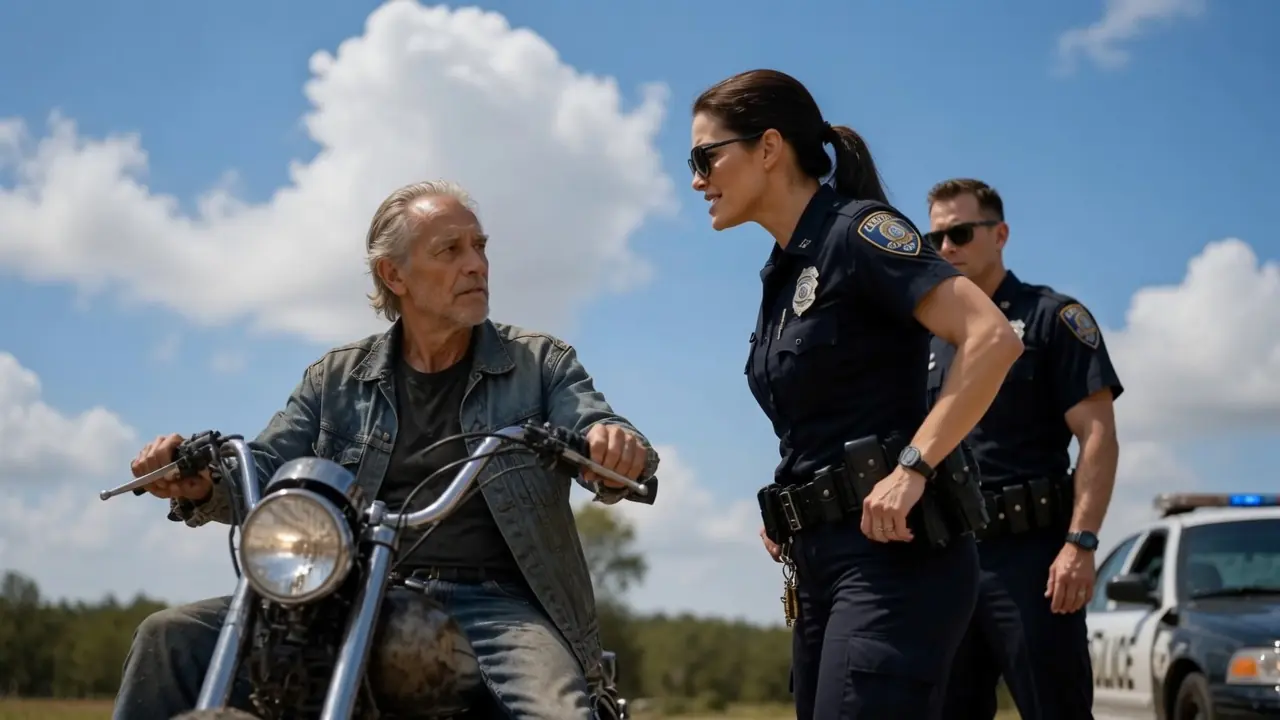
“Hands behind your back,” Ava ordered.
“For what offense?”
“Failure to obey, unsafe equipment, and threatening an officer.”
“I asked you to remove your hand from my clothing.”
Ava shoved him against the motorcycle seat, expecting the eighty-two-year-old man to stumble. James planted one heavy boot on the gravel and remained upright, forcing her to step back before their shoulders collided. His movement was controlled rather than aggressive, but it exposed how little physical control she actually possessed over him. Officer Mark Ellis, her younger partner, moved closer with concern tightening his face.
“Ava, slow down,” Mark said. “He pulled over immediately.”
“He refused to get off the bike.”
“He asked why he was stopped.”
“You want to run this scene?”
Mark did not answer, but his hand moved away from his holster.
The motorcycles appeared around the highway bend moments later. More than thirty machines advanced in two disciplined columns, their headlights moving together beneath blue-and-silver flags marked with the seal of the State Militia Police. These were not regular soldiers but members of the governor-controlled civil-defense force, trained to support law enforcement during disasters, evacuations, missing-person searches, wildfires, and infrastructure emergencies.
The riders did not scatter across the highway or race toward the station. They maintained exact spacing, controlled speed, and matching formation as if the road itself had become part of an official ceremony. Dark patrol SUVs followed them carrying command officers, medical personnel, and representatives from the State Civil Defense Commission.
Ava released James’s jacket.
The lead motorcycle carried a broad-shouldered Black commander wearing a formal dark-blue State Militia Police uniform beneath his riding vest. Behind him rode active militia officers, retired commanders, search-and-rescue specialists, emergency deputies, and instructors from the state civil-defense academy. Their insignia reflected in the sunlight as the convoy turned into the gas station.
The commander shut off his motorcycle.
Every other engine fell silent within seconds.
The sudden quiet felt heavier than the thunder that had preceded it.
Commander Marcus Bell removed his helmet and saw James standing beside the old black motorcycle, his jacket wrinkled where Ava had grabbed him. Marcus’s expression changed immediately. He dismounted, placed his helmet on the seat, and walked toward the old man with his spine straight and his jaw rigid.
Ava stepped into his path. “This individual is being detained.”
Marcus stopped several feet away. “For what?”
“Unsafe operation, refusal to comply, and aggressive behavior.”
James looked toward him. “I asked her not to pull me off the motorcycle.”
Marcus’s eyes moved toward Ava’s body camera. “Is that recording?”
“It activates automatically.”
“Good.”
He stepped around her and faced James.
Without hesitation, Marcus raised his right hand in a precise formal salute.
Every uniformed militia officer behind him did the same.
More than thirty hands rose together.
Customers beside the fuel pumps lowered their phones slightly, stunned by the transformation unfolding in front of them. Moments earlier, they had watched Ava mock an elderly biker seated on a rusted machine. Now commanders, rescue officers, emergency deputies, and state civil-defense specialists stood motionless before him with a level of respect no police order could manufacture.
James returned the salute.
Only after he lowered his hand did the others lower theirs.
Ava looked from Marcus to the old man. “Who is he?”
Marcus’s voice remained controlled but cold. “Chief Commander James Elijah Harris, retired head of the State Militia Police.”
“That doesn’t put him above traffic law.”
“No one said it did.”
“He was operating an unsafe motorcycle.”
Marcus examined the machine. “That motorcycle passed inspection yesterday at the State Militia Police academy.”
Ava pointed toward the faded tank and rust-stained exhaust. “Look at it.”
“I have,” Marcus replied. “I also know why it looks that way.”
The motorcycle was a 1972 Harley-Davidson rebuilt from the machine James had ridden during the earliest years of the State Militia Police. Its paint had never been restored because several dents came from rescue operations that had shaped the force’s history. A long scratch across the tank came from the night James rode through a flooded county road to reach families trapped after a dam failure.
The motorcycle was old.
It was not unsafe.
Its registration, insurance, and current mechanical inspection were stored inside a leather pouch beneath the seat. Ava had demanded none of them before insulting the machine and ordering James down. She had judged the rider, the rust, and the worn clothing before looking for facts.
Mark approached more carefully. “Commander Harris, may I see the documents?”
James looked at him. “You may ask.”
The difference settled over everyone watching.
James opened the pouch slowly and handed Mark the paperwork. The younger officer examined the inspection certificate, registration, and insurance before walking to the patrol car to verify the plate. Less than a minute later, he returned.
“Everything is valid,” Mark said.
Ava’s face hardened. “The exhaust was too loud.”
Mark held up the inspection form. “It passed the state sound limit.”
“I heard it from half a mile away.”
“You heard the convoy,” Marcus said. “There were thirty-four motorcycles behind him.”
A few customers near the pumps began whispering.
Ava had mistaken the convoy’s engines for James’s old Harley and activated her lights before the actual riders reached the station. Rather than test her assumption, she had transformed it into a confrontation. Her camera would show her slapping the handlebar, ridiculing the motorcycle, grabbing James’s jacket, and threatening to drag an eighty-two-year-old man onto gravel.
She looked toward James. “You should have told me who was coming.”
“You did not ask.”
“You could have explained who you were.”
“I handed you my license.”
“You sat there acting like you were above me.”
James’s eyes became colder. “I sat there with both hands visible.”
Marcus stepped closer. “Why did you call him a joke before requesting any documents?”
“I was talking about the motorcycle.”
“Why did you threaten to rip him off it?”
“He challenged my authority.”
“No,” James said. “I challenged your reason.”
The distinction silenced her.
The convoy had been traveling to the dedication of the James E. Harris Civil Defense and Emergency Recovery Center, a new facility outside the state capital. James was supposed to lead the final twelve miles on the motorcycle he had preserved for fifty years. The officers turned back only because his emergency beacon remained motionless longer than expected.
James had not called anyone.
His helmet carried a safety transmitter monitored by the convoy coordinator. When the signal stopped beside the gas station, Marcus redirected the formation to investigate. Ava believed the riders had arrived because James secretly summoned powerful friends.
They had arrived because no one in the convoy was willing to leave him behind.
“So this is a publicity parade?” she asked.
Marcus stared at her. “It is an escort.”
“For him?”
“For the man who built the force standing behind me.”
James had joined the original State Civil Guard at seventeen after devastating tornadoes destroyed part of his rural county. The early organization possessed few vehicles, limited equipment, and almost no public trust. Volunteers responded to fires, missing children, floods, and infrastructure failures using personal trucks and borrowed radios.
James quickly became known for remaining calm when everyone else panicked.
During a major flood forty-nine years earlier, rising water separated a rural neighborhood from emergency crews. Roads collapsed, radio communication failed, and local agencies withdrew after nightfall because the current became too dangerous. James loaded ropes, medicine, and flotation gear onto his motorcycle and followed an abandoned railroad embankment through the storm.
He reached twenty-three trapped residents.
Among them were six children, two pregnant women, and an elderly man dependent on oxygen. James organized a rescue route, established a signal system with flashlights, and guided small teams across the floodwater throughout the night.
Every resident survived.
That operation inspired the state to reorganize the Civil Guard into the professional State Militia Police: a civilian defensive force operating under the governor during disasters and large-scale emergencies. James became one of its first instructors and later its longest-serving commander.
He trained officers to use authority without confusing it with ownership.
He taught them that frightened civilians might shout, freeze, run, or refuse to understand instructions, and that a professional’s responsibility was to reduce danger rather than punish emotion. He insisted that physical force was failure unless every safer option had already disappeared.
Marcus Bell had entered the academy as an angry twenty-year-old recruit. He was strong, impatient, and close to dismissal after repeatedly challenging instructors. James saw discipline beneath the anger and kept him after hours for additional training.
“You don’t need to become smaller,” James had told him. “You need to become controlled.”
Marcus eventually rose to command the entire force.
Dozens of officers in the convoy carried similar memories. James had helped one through addiction, defended another after a false complaint, and quietly paid for the medical treatment of an officer’s child. Several search-and-rescue commanders standing behind him were alive because James had personally pulled them from dangerous operations.
Ava knew none of this.
She saw only an old man on a motorcycle she considered worthless.
“That history doesn’t change today’s violation,” she said.
James nodded. “You’re correct.”
Her expression shifted, believing he had agreed.
“My history does not make your conduct wrong,” he continued. “It was wrong before they arrived.”
Marcus looked toward the civilians recording. “Exactly.”
Ava reached for James’s license. “I’m still writing the citation.”
Mark stepped between them. “What violation are you citing?”
“I’ll decide after reviewing the stop.”
“You can’t invent the cause afterward.”
Her eyes narrowed. “Be careful, Officer Ellis.”
The warning revealed something James had already noticed.
Mark was afraid of her.
His lowered voice, stiff posture, and repeated glances toward her supervisor stripes showed that this incident was not simply about the motorcycle. Ava had behaved this way before, and people within her department had learned that challenging her could damage their careers.
James faced Mark. “Has she done this to other riders?”
Ava moved closer. “He isn’t answering you.”
Mark looked at James, then at the raised phones and the line of militia officers. “Yes.”
“Mark.”
“You stop older riders near this station nearly every weekend.”
“They violate equipment regulations.”
“Not all of them.”
“Stop talking.”
Mark’s voice strengthened. “You told us old bikes were easy impounds because the owners couldn’t afford the towing charges.”
The gas station became silent again.
Ava stepped toward him so quickly that Marcus and two militia police officers shifted forward. She stopped before making contact but stood inches from Mark’s face.
“You’re confused,” she said.
“No.”
“You’re going to destroy your career over a stranger who doesn’t know your name?”
James looked at him. “Mark Ellis.”
The officer blinked.
“I heard your partner say it,” James explained. “Now I know it.”
Mark’s shoulders straightened.
The gas station owner emerged carrying a thick folder. Harold Boone had watched Ava stop riders beside his property for almost a year. The resulting confrontations blocked fuel lanes, frightened customers, and ended with motorcycles taken by the same towing company.
Harold had filed two complaints.
Nobody had investigated.
“I have recordings,” he said. “Seventeen stops.”
Ava turned on him. “Stay out of police business.”
“You keep doing it on my property.”
“I can cite this station for interfering.”
Harold held up the folder. “That’s what you threatened last time.”
James studied Ava’s expression.
Her fear was no longer about public embarrassment. Something larger existed beneath the anger. She was not merely defending a bad stop.
She was protecting a system.
Marcus contacted the county professional-standards division while Mark requested an outside supervisor. Ava attempted to order the State Militia Police convoy away, but the riders remained peaceful customers standing on private property with Harold’s permission.
They parked.
They waited.
Captain Laura Bennett arrived eighteen minutes later with an investigator and evidence technician. She separated Ava and Mark, secured their body cameras, and collected copies of the civilian recordings before accepting anyone’s complete statement.
Ava claimed she stopped James for excessive exhaust noise.
The patrol dashboard video showed she activated her lights while his motorcycle was idling quietly at a traffic signal. The loud rumble came from the approaching convoy, still hidden beyond the highway curve.
Her stated reason was impossible.
Laura verified the motorcycle documents and found no violation. She also saw the stretched fabric on James’s jacket where Ava had seized him. Harold’s recording captured her threatening to pull him from the motorcycle.
Ava was placed on administrative leave before sunset.
She surrendered her badge, weapon, radio, and vehicle keys beside the pump where she had mocked James. As another officer escorted her away, she looked toward the old commander.
“You destroyed my life.”
James shook his head. “I asked you to remove your hand.”
The convoy continued toward the new recovery center. James refused the comfortable seat offered inside a government SUV and returned to his motorcycle instead. Marcus joined him at the front.
When they entered the State Militia Police academy grounds, officers lined both sides of the road.
The old Harley moved slowly between them.
Every uniformed militia officer saluted.
James’s hands remained steady on the handlebars, but his eyes became wet beneath his riding glasses. He had resisted allowing the recovery center to carry his name because he believed the work had always belonged to teams, not one commander.
The salutes showed him something different.
They were honoring the standard he had left behind.
During the ceremony, James spoke briefly about authority.
“A uniform does not make the public smaller,” he said. “It makes our responsibility larger. The moment an officer uses authority to feed pride, that officer has stopped protecting anyone.”
Marcus looked through the glass doors toward the rusted motorcycle.
The words traveled beyond the ceremony.
The investigation into Ava Johnson expanded over the following weeks. Harold’s recordings showed seventeen motorcycle stops near his station. Most riders were elderly, working-class, or traveling alone.
Many had valid documents.
Ava repeatedly threatened impoundment for minor or invented violations. When owners protested, she contacted Ridgeway Recovery, a towing company owned by her cousin.
The company charged nearly five hundred dollars for pickup and more than one hundred dollars for every day of storage. Riders unable to pay quickly were pressured to surrender their titles before the fees exceeded the motorcycles’ value.
Ridgeway later sold the machines to collectors.
The bikes Ava called junk often contained rare engines, original frames, and historical parts worth thousands of dollars. She selected motorcycles that looked neglected to ordinary observers but carried substantial restoration value.
James’s Harley was worth more than she imagined.
Its connection to the founding commander of the State Militia Police made it historically significant. Had Ava succeeded in impounding it, Ridgeway could have held the motorcycle under fabricated safety claims until storage fees became impossible.
She believed an old rider would surrender.
She did not expect an official convoy to arrive before the tow truck.
Mark provided messages showing that Ava trained officers to provoke physical reactions. They were told to stand close, grab jackets, touch motorcycles, and issue rapid commands until a rider pulled away.
Pulling away became resistance.
Protecting the motorcycle became interference.
Raising a voice became disorderly conduct.
The strategy produced paperwork strong enough to defend almost any seizure.
Mark admitted remaining silent during earlier incidents. His cooperation helped investigators, but it did not erase what other riders suffered. He apologized to every owner he could locate and accepted formal discipline.
James met with him at the recovery center.
“I should have spoken sooner,” Mark said.
“Yes.”
“I believed she would end my career.”
“She used that fear.”
“It doesn’t excuse me.”
“No.”
Mark waited, expecting comfort James did not immediately provide.
The old commander had learned that forgiveness offered too quickly could become another way to avoid responsibility. He gestured toward a workshop where militia officers were documenting recovered motorcycles.
“Help return what was taken,” James said. “Make the apology lead somewhere.”
Mark volunteered every weekend.
Investigators recovered twelve motorcycles from Ridgeway’s storage yard. Four others had already been sold, but transaction records allowed authorities to identify the buyers. Owners received their property back without charges, and seized assets funded restitution when motorcycles could not be recovered.
One machine belonged to seventy-six-year-old retired firefighter Samuel Ortiz.
Ava had confiscated it after claiming the rear light failed. Gas station footage showed the light functioning before she approached. Samuel could not afford the towing charges and surrendered the title.
When the motorcycle returned, Samuel placed both hands on the faded tank and began crying.
“It belonged to my brother,” he said. “He died during a flood rescue.”
James understood.
Old steel could carry memory more faithfully than photographs.
Ava had treated those memories as merchandise.
She was charged with extortion, theft, conspiracy, falsification of reports, civil-rights violations, and official misconduct. The owner of Ridgeway Recovery faced additional charges involving fraudulent liens, illegal sales, and payment of kickbacks.
During Ava’s trial, her attorney claimed the confrontation became exaggerated only because James was a famous State Militia Police commander. He argued that the convoy intimidated her and transformed a routine stop into a spectacle.
Prosecutors played the recording from the beginning.
The jury heard her first words before anyone knew the convoy was approaching.
Is this some kind of joke? Shut that junk off.
They watched her slap the handlebar, grab James’s clothing, and threaten to pull an eighty-two-year-old man onto gravel. They saw him keep his hands visible and ask calmly why he had been stopped.
His title did not cause her conduct.
It prevented her from controlling the ending.
James testified for less than an hour.
The defense attorney asked whether his former command position entitled him to special treatment.
“No.”
“Yet every militia officer saluted you.”
“That happened afterward.”
“You expected Officer Johnson to recognize you?”
“I expected her to recognize procedure.”
The jury convicted Ava on every major count.
Her law-enforcement certification was permanently revoked, and the court ordered restitution for the riders she had targeted. Ridgeway Recovery lost its license and assets connected to the scheme.
The police department changed its impoundment policies. Officers could no longer summon towing companies without recorded evidence and independent supervisor approval. Vehicle owners received immediate access to the reason for seizure and an expedited hearing before storage charges accumulated.
Equipment citations required photographic proof.
Impoundment revenue could not benefit officers, relatives, towing contractors, or police budgets.
Mark remained with the department after completing discipline and retraining. Years later, he became an investigator specializing in vehicle-seizure complaints and retaliation against younger officers.
James returned to the gas station the following summer.
The old Harley still carried faded paint, rusted pipes, and the dented tank. Harold had installed a wooden sign near the pumps:
ALL RIDERS WELCOME. RESPECT THE ROAD. RESPECT EACH OTHER.
Samuel Ortiz parked beside James on his recovered motorcycle.
Mark arrived in a patrol vehicle but remained near the store, giving the riders space. Marcus led another State Militia Police convoy around the highway bend, though this one arrived without urgency, federal investigators, or an officer’s hand gripping James’s jacket.
James started the engine.
Its low mechanical heartbeat rolled across the gravel.
A young militia police recruit approached and asked why James had never restored the motorcycle. The old commander placed one weathered hand against the tank.
“Restoration would make it look new,” he said. “I don’t need it to look new. I need it to remember.”
The recruit stepped back and saluted.
James returned it before leading the convoy onto the highway.
Ava had believed age meant weakness, rust meant worthlessness, and authority allowed her to decide another person’s value before hearing his name. The State Militia Police convoy did not transform James Harris into someone important.
The salutes merely revealed what had been sitting quietly on that motorcycle from the beginning.
She had mistaken humility for powerlessness—and grabbed the one man every militia officer had been trained to respect.