“Sit still—your attitude ends the second this hair hits the floor.”
Officer Caleb Rourke pressed the electric clippers against the left side of the Black woman’s carefully styled curls. The harsh buzzing filled the booking room while a thick section of hair slipped onto the gray floor beside her polished green heels. She sat upright in the metal chair, dressed in a dark emerald tailored blazer, matching trousers, and a crisp white blouse, refusing to give him the reaction he clearly wanted.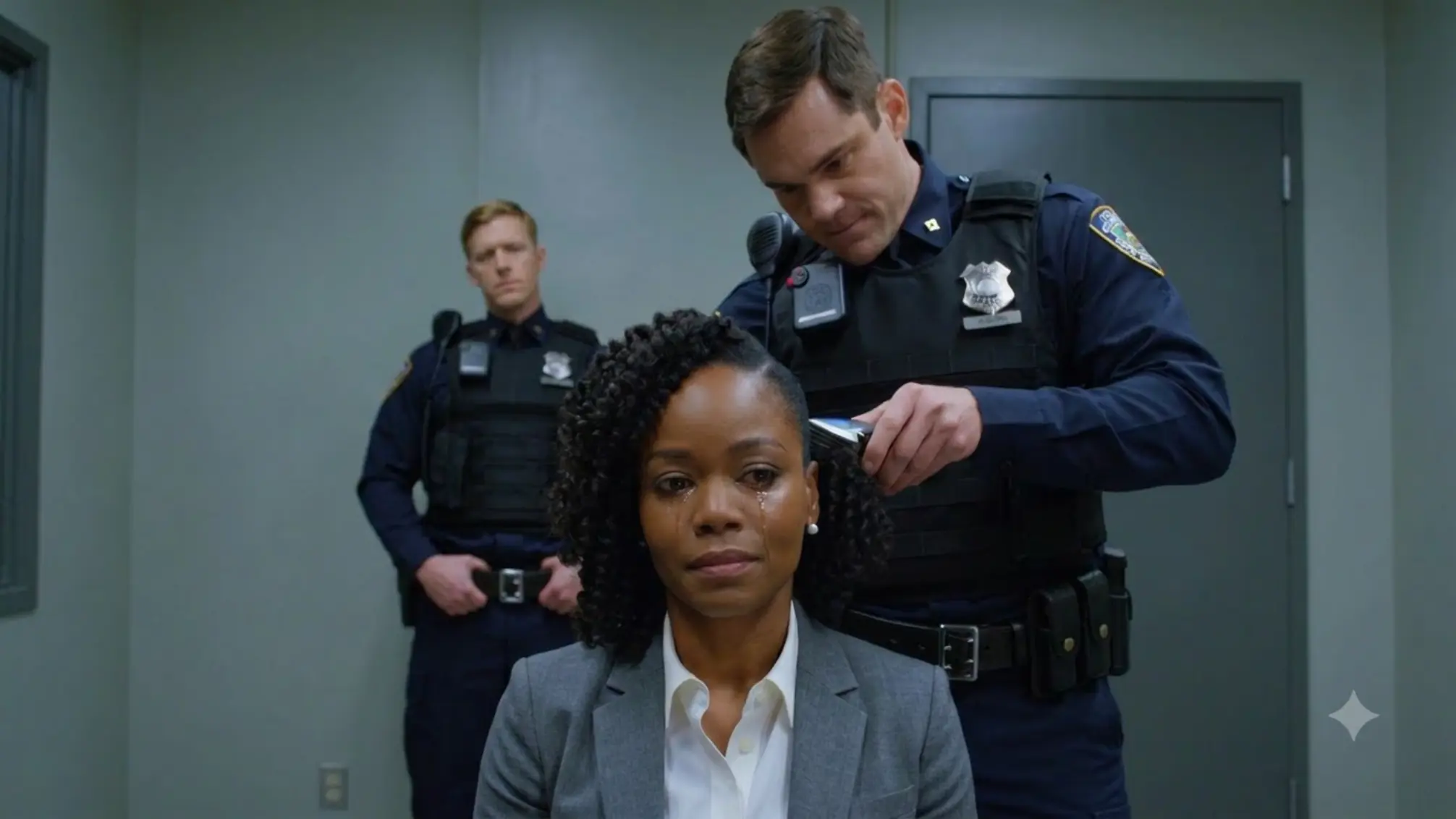
“Touch one more curl, and your badge becomes evidence,” she said.
Rourke leaned closer, his square jaw tightening beneath the fluorescent light. His black protective vest covered most of his navy uniform, and the silver badge on his chest almost touched her shoulder as he moved the clippers higher. “In this room, I decide what evidence looks like.”
The woman stared into the observation window ahead of her.
“Then keep cutting,” she answered. “Because the state attorney is about to walk in and ask who put clippers on Assistant Counsel Greene.”
The second officer standing near the wall stopped breathing for a moment.
Officer Nathan Bell had watched Rourke bring the woman into the room thirty minutes earlier. He had watched him reject her identification, ignore her request for a supervisor, and remove her phone before she could complete a call. Until that final sentence, Bell had assumed she was another detainee whose confidence had irritated the wrong officer.
Now he looked at her emerald suit again.
Nothing about it resembled the clothes of someone who had been wandering the streets without purpose. Her white blouse remained neatly buttoned despite the rough arrest, and a slim gold watch circled her wrist. Small pearl earrings framed her face, one side now exposed where Rourke had dragged the clippers through her curls.
Rourke laughed.
“Assistant counsel to whom?”
The woman looked directly at him.
“The Illinois State Attorney’s Public Integrity Division.”
Bell stepped away from the wall.
“Caleb.”
Rourke kept the clippers running.
“What?”
“We should verify that.”
“We already verified her.”
“No, you threw her wallet into the property box.”
Rourke finally switched off the clippers. “She interfered with an arrest, refused a lawful order, and gave us a fake government title. That is all the verification I need.”
The woman’s name was Simone Greene.
She was thirty-six years old and had worked in the State Attorney’s Office for nearly eight years. Her current assignment placed her inside the Public Integrity Division, where she reviewed misconduct allegations involving public officials, law-enforcement contracts, evidence handling, and misuse of municipal authority.
She had not entered Chicago’s Twelfth District station by accident.
For four months, Simone had been examining a pattern of complaints involving people arrested near West Hawthorne Avenue. Different officers appeared in the reports, but the same names surfaced repeatedly whenever body-camera footage went missing, property disappeared, or charges changed after detainees reached the station.
Caleb Rourke appeared in nine of those complaints.
Nathan Bell appeared in four.
The department dismissed each case separately. One complainant had an expired license. Another had argued during booking. A third had accepted a reduced charge and later withdrew his statement.
Simone saw what the internal reviews refused to see.
The complaints described the same tactics.
Phones were taken before recordings could be uploaded. Personal property was inventoried inaccurately. Detainees who requested attorneys were placed in isolation rooms where cameras supposedly failed. Those who complained about threats were later described as aggressive or unstable.
The most disturbing allegation came from a twenty-two-year-old college student named Amaya Lewis.
Amaya claimed Rourke cut part of her natural hair during booking after she refused to unlock her phone. The department said no such event occurred. The booking-room camera had suffered a “technical interruption,” and the bag containing Amaya’s hair ties and broken phone was misplaced before the evidence review.
Simone had interviewed Amaya twice.
The young woman described the buzzing clippers, Rourke’s voice, and Officer Bell standing near the door without stopping him. She remembered one sentence more clearly than anything else.
Your attitude ends when I say it ends.
It was almost identical to what Rourke had just told Simone.
That was why she had come to the district.
Earlier that evening, Simone met an internal police auditor named Daniel Cho at a diner three blocks from the station. Cho had quietly gathered dispatch logs showing that several detainees were transported to Twelfth District without being entered into the official system for as long as two hours.
He believed officers were using that unrecorded window to pressure people before formal booking.
Cho handed Simone a flash drive inside a plain white envelope.
“If this disappears,” he said, “they’ll say the logs never existed.”
“Who knows you copied them?”
“Someone in records knows.”
“Rourke?”
“I don’t know.”
Simone placed the envelope inside the inner pocket of her green blazer.
“Then assume he does.”
They left separately.
Simone walked toward the parking garage where her car waited. Halfway across West Hawthorne Avenue, she saw two officers forcing a young Black delivery driver against the hood of his van. The driver kept repeating that his registration was inside the glove compartment.
Rourke stood behind him.
Bell searched the vehicle.
Simone stopped on the sidewalk and began recording.
Rourke noticed within seconds.
“Move along.”
“I’m standing on a public sidewalk.”
“This is an active investigation.”
“I’m not interfering.”
Rourke walked toward her.
“Put the phone away.”
“No.”
He moved close enough to block her view of the driver. “I gave you a lawful order.”
“You gave me a preference.”
Rourke reached for her phone.
Simone pulled it back.
That was all he needed.
He accused her of obstruction, twisted her arm behind her back, and ordered Bell to take the phone. When Simone identified herself as an assistant counsel with the State Attorney’s Office, Rourke barely looked at the credential wallet.
“Anyone can buy a badge online,” he said.
Bell examined it longer.
“Caleb, this looks real.”
Rourke knocked the wallet from his hand.
“She’s trying to intimidate us.”
Simone was placed in the patrol car while the delivery driver remained beside the van. Through the window, she saw Rourke remove something from the driver’s pocket and hand it to Bell.
The driver was released ten minutes later without a citation.
Simone was taken to the station.
Rourke did not know the video from her phone had already uploaded to secure storage. He also did not know that Daniel Cho was waiting for her scheduled confirmation call. When she failed to make it, Cho contacted State Attorney Evelyn Price.
By the time Rourke brought Simone into the booking room, two separate offices were already attempting to locate her.
Simone had been searched twice.
The white envelope containing the flash drive was removed from her blazer and placed beside her phone. Rourke filled out the property sheet but did not list either item.
Simone watched him leave both boxes blank.
“I want a copy of that inventory.”
“You’ll get one when I’m finished.”
“You omitted my phone and envelope.”
“You don’t tell me how to complete paperwork.”
“I’m telling you the record is false.”
That was when he decided her hair violated booking safety policy.
No written rule required it to be cut.
The station kept clippers for medical or sanitation circumstances, but their use required supervisory authorization and documented consent unless an immediate emergency existed. Simone had no contamination issue, medical concern, or hidden object in her curls.
Rourke simply wanted to demonstrate that her title meant nothing inside his room.
He ordered her into the chair.
Bell objected quietly.
Rourke told him to close the door.
Now, with Simone’s hair on the floor and her government title hanging in the air, Bell finally moved toward the property counter.
“I’m checking the wallet.”
Rourke stepped in front of him.
“You’re doing nothing until I finish.”
“This could become a serious problem.”
“It becomes a serious problem if you panic.”
Simone looked at Bell through the mirror.
“It became serious when you watched him switch off the hallway camera.”
Bell’s face lost color.
Rourke turned.
“What are you talking about?”
“The camera outside this room went dark six minutes before you brought me inside.”
“You couldn’t see the control panel.”
“I saw the indicator disappear in the reflection of the observation window.”
Rourke set the clippers on the metal table.
“You think noticing a light makes you an investigator?”
“No. Eight years in Public Integrity makes me an investigator.”
Footsteps approached outside.
Not one person.
Several.
Rourke reached for Simone’s property box.
Bell caught his wrist.
“Don’t.”
Rourke stared at him.
“Take your hand off me.”
“You didn’t list the phone.”
“Move.”
Bell remained between him and the evidence.
The booking-room door opened.
State Attorney Evelyn Price entered first.
She was fifty-eight, composed, and dressed in a charcoal suit beneath a long coat. Behind her stood Daniel Cho, two investigators from the Public Integrity Division, the station commander, and Deputy Superintendent Laura Mendoza.
Evelyn’s eyes moved across the room.
She saw Simone in the chair.
She saw the missing section of her hair.
Then she saw the clippers on the table and the curls scattered across the floor.
No one spoke.
Evelyn stepped closer.
“Assistant Counsel Greene.”
Simone stood.
“State Attorney Price.”
Rourke looked from one woman to the other.
The certainty drained from his face.
Deputy Superintendent Mendoza turned toward him. “Officer Rourke, step away from the evidence table.”
“This detainee obstructed an arrest.”
“Step away.”
“She gave us false identification.”
Evelyn held out her hand.
Bell retrieved the credential wallet from the property box and passed it to her. Evelyn opened it, confirmed Simone’s photograph and title, then handed it to Mendoza.
“It appears your officer never performed the verification he claims he performed,” Evelyn said.
Rourke pointed toward Simone. “She resisted.”
Simone looked at Cho.
“Did you locate the cloud upload?”
“Yes.”
“The arrest is recorded?”
“Every second.”
Rourke’s expression changed again.
Mendoza noticed.
“What arrest?”
Simone explained the delivery driver, the demand that she stop recording, and the seizure of her phone. She then pointed toward the white envelope.
“That contains copied dispatch records connected to an active state investigation. It was removed from me and omitted from the inventory.”
Evelyn faced Rourke.
“Did you open it?”
“No.”
“Did you know what was inside?”
“No.”
“Then why wasn’t it listed?”
Rourke looked at the property sheet.
“I had not completed the form.”
“You signed the bottom.”
He said nothing.
Mendoza ordered the room sealed.
No one was permitted to touch the clippers, property box, floor, forms, or camera controls. A crime-scene documentation team photographed the room before Simone was allowed to collect her belongings.
Bell remained near the wall.
He could no longer pretend he was merely a witness.
Mendoza turned to him.
“Officer Bell, did you see Officer Rourke cut Assistant Counsel Greene’s hair?”
Bell swallowed.
“Yes.”
“Did she consent?”
“No.”
“Was a supervisor present?”
“No.”
“Did you attempt to stop him?”
Bell looked at Simone.
“Not soon enough.”
Rourke moved toward the door.
An investigator blocked him.
“Am I under arrest?” he demanded.
Evelyn answered calmly.
“You are being separated from a scene connected to potential evidence tampering, unlawful detention, official misconduct, and interference with a state investigation.”
“You can’t accuse me because she has friends in high places.”
Simone stood in front of him.
“This is not happening because of who I know.”
She pointed toward the hair on the floor.
“It is happening because you treated me exactly the way nine other people said you treated them.”
Rourke’s face tightened.
He understood then.
Simone had not simply been a government attorney caught in the wrong place. She had been investigating him before he ever placed his hands on her.
The station commander ordered Rourke’s badge and service equipment removed pending investigation. Bell was also placed on administrative leave, but before surrendering his radio, he asked to speak privately with Mendoza.
His statement lasted three hours.
Bell admitted that Rourke routinely created gaps in camera coverage by claiming equipment resets. He described unofficial booking delays, incomplete property sheets, and threats made before detainees entered the formal system.
He also admitted that he had remained silent.
In Amaya Lewis’s case, Bell had stood at the door while Rourke cut several curls from the young woman’s hair. He later signed a report claiming she arrived with uneven hair and behaved unpredictably.
“Why did you sign it?” Mendoza asked.
Bell stared at the table.
“Because Caleb said one report could destroy both our careers.”
“And you believed helping him would protect yours?”
“I told myself I was protecting my family.”
Mendoza leaned forward.
“You protected the officer creating the danger.”
Bell had no answer.
The investigation expanded before sunrise.
Cho’s dispatch logs identified twenty-seven people brought to Twelfth District during unexplained recording gaps. Eleven agreed to speak with investigators. Their accounts described the same booking room, the same disabled cameras, and the same insistence that complaints would disappear because officers controlled the reports.
A construction worker said cash vanished from his wallet.
A teenage boy said officers threatened to arrest his mother unless he unlocked his phone.
A restaurant employee described being held for ninety minutes without any booking entry before agreeing to sign a statement he did not understand.
Amaya Lewis returned to the station with her attorney.
She stood outside the sealed booking room and looked through the observation window.
“That’s the chair,” she said.
Simone stood beside her, now wearing a temporary scarf wrapped carefully over the uneven section of her hair.
Amaya looked at her.
“He did it to you too?”
“Yes.”
“Did anyone stop him?”
“Eventually.”
Amaya’s eyes filled.
“No one stopped him for me.”
Simone did not offer an easy apology on behalf of a system that had ignored her.
Instead, she said, “They will hear you now.”
Rourke’s home and locker were searched after investigators recovered messages showing he knew Simone’s identity before cutting her hair. Bell had photographed her credential in the patrol car and sent the image to Rourke.
The message timestamp was clear.
Rourke replied:
State lawyer or not, she learns who controls booking.
That sentence ended his argument that the credential appeared fake.
Investigators also recovered photographs of confiscated cash, private messages discussing which detainees were unlikely to complain successfully, and a list of camera outages coordinated with specific arrests.
The missing property had not all gone to Rourke.
Two other officers and a civilian evidence clerk became targets of the investigation. The clerk altered inventory records after valuables disappeared, while the officers wrote conduct reports portraying detainees as unreliable.
The system was small enough to hide inside one station and organized enough to damage dozens of lives.
Rourke was charged with official misconduct, evidence tampering, unlawful restraint, obstruction, and offenses connected to the mistreatment of several detainees. Bell entered a cooperation agreement but was not allowed to avoid responsibility completely.
His silence had been an active part of the system.
The station commander retired before the disciplinary hearing after investigators proved he ignored repeated camera failures. Deputy Superintendent Mendoza publicly acknowledged that internal review procedures had treated matching complaints as isolated events rather than evidence of a pattern.
Simone refused to become the only face of the case.
Reporters wanted photographs of her damaged hair and emotional interviews about the booking room. She agreed to speak only if Amaya and the other complainants were included.
“This investigation did not become valid when it happened to a government attorney,” Simone told the press. “It was valid when the first person reported it.”
The statement changed the public conversation.
The story was no longer about an important woman receiving unacceptable treatment.
It was about ordinary people being treated as though their complaints did not matter until someone with institutional authority suffered the same conduct.
During the preliminary hearing, Rourke wore a plain gray suit. His attorney argued that cutting Simone’s hair was a misguided safety decision rather than an act of retaliation.
The prosecutor displayed the department rule requiring supervisory approval.
No approval existed.
The attorney claimed Rourke believed something was hidden in Simone’s curls.
The prosecutor played the booking-room audio.
Your attitude ends the second this hair hits the floor.
No safety concern appeared in his words.
Then the message about teaching a state lawyer who controlled booking was displayed on the courtroom screen.
Rourke lowered his eyes.
Bell testified against him.
He described the disabled cameras, false reports, and the way fear spread through the unit. Rourke’s attorney accused Bell of blaming a colleague to save himself.
Bell did not deny his motive.
“I should have spoken earlier,” he said. “I didn’t. That made every person who entered that room less safe.”
Rourke eventually accepted a plea agreement after the evidence clerk provided financial records and additional messages. He lost his badge permanently and received a sentence reflecting the combined misconduct rather than treating each event as an unrelated mistake.
Bell was dismissed from the department and ordered to complete the penalties contained in his cooperation agreement. He later wrote letters to several victims, though Simone made clear that forgiveness was not part of any legal requirement.
Twelfth District changed its booking procedures.
Cameras could no longer be disabled by officers working inside the same unit. Any interruption generated an automatic alert to an external monitoring center. Property inventories required digital photographs, and detainees received immediate electronic copies.
Hair alteration was prohibited except during documented medical emergencies approved by a supervisor and recorded continuously.
Requests for legal counsel were entered automatically into a system officers could not privately edit. Public Integrity investigators were given direct access to booking delays and unexplained gaps.
Six months after the incident, Simone returned to the station.
Her curls had begun growing evenly again, though she wore them in a shorter natural style. The emerald suit had been repaired and professionally cleaned, but she chose not to wear it.
She entered in a new forest-green blazer, matching trousers, and a white blouse.
Amaya stood beside her.
The former booking room had been converted into a recorded interview space with clear glass walls and visible camera indicators. A plaque near the entrance explained the new evidence-preservation requirements.
Amaya read it.
“Do you think the rules will stop someone like him?”
“Rules alone?” Simone asked.
Amaya nodded.
“No.”
“Then what will?”
“Records he cannot erase, witnesses who are protected, supervisors who actually review complaints, and officers who understand that silence is a decision.”
Amaya looked through the glass.
“I still hate that room.”
“You do not have to forgive the room.”
Simone touched the short curls near her temple.
“But it no longer belongs to him.”
State Attorney Evelyn Price later offered Simone a leadership role overseeing public-integrity investigations across several districts. Simone accepted on one condition: previous complaints dismissed for “insufficient evidence” had to be reopened whenever they matched a confirmed pattern.
The condition was approved.
Over the next year, twelve cases were reviewed again. Charges were corrected, stolen property was reimbursed, and disciplinary actions reached officers previously protected by incomplete reports.
Not every wrong could be repaired.
Some people had moved away. Others wanted no further contact with the department. A few refused to believe the new investigation would treat them differently.
Simone understood.
Trust could not be restored by announcing that trust had been restored.
It had to be earned through what happened when the next unknown person entered the room.
A year after the arrest, a young Black woman was brought into Twelfth District following a disputed traffic stop. She wore her natural hair in long twists and asked immediately for a lawyer.
The booking officer documented the request.
The cameras remained active.
Her property was photographed and listed.
No one touched her hair.
No supervisor recognized her name because there was nothing important to recognize. She was not an attorney, official, celebrity, or relative of anyone powerful.
She was simply a person whose rights applied before anyone knew who she was.
When Simone reviewed the booking audit the following morning, she paused at the video.
The interaction was professional, ordinary, and uneventful.
That was the result she had been working toward.
Rourke became afraid only when the state attorney entered and called Simone by her title. He had believed the woman in the chair could be controlled until someone powerful recognized her.
Real accountability arrived later, when the system stopped asking whether the person in the chair possessed power.
The badge on Rourke’s chest had once allowed him to decide what counted as evidence.
The recording, the witnesses, and the people he dismissed finally answered him.
Evidence was what remained after his authority was gone.