“Shut up—those scrubs don’t make you important.”
Officer Peter Kowalski forced Dr. Simone Carter harder against the hood of her gray sedan. The metal was still warm from the engine, and its edge pressed painfully beneath her ribs while the steel handcuffs tightened around her wrists. Red-and-blue lights flashed across the quiet Chicago street, turning the houses, trees, and frightened faces of nearby residents into fragments of color.
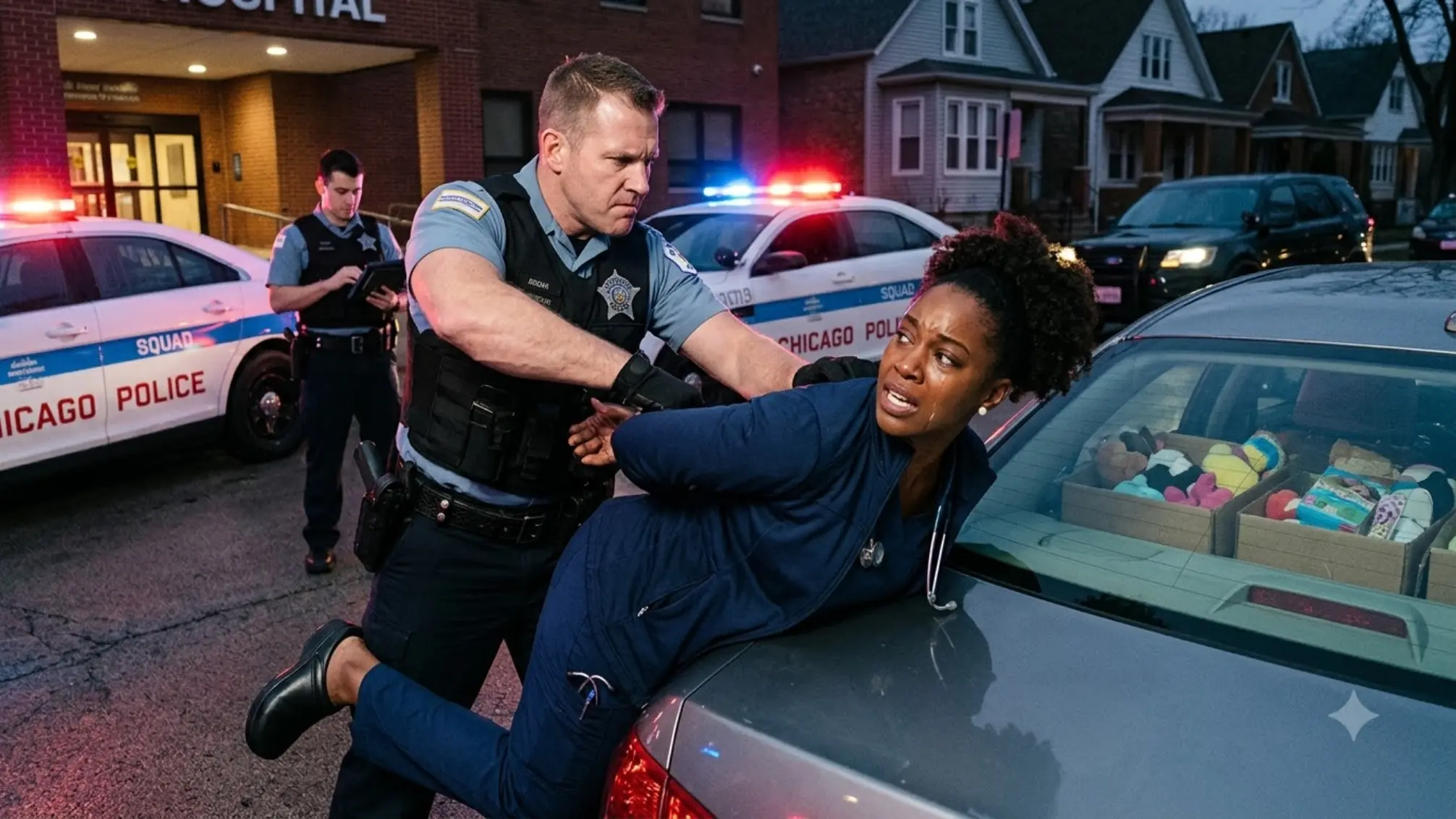
Simone twisted her head just enough to breathe.
“They make your hands evidence.”
Kowalski yanked her upright and dragged her toward his cruiser. He was forty, broad through the shoulders, with close-cut brown hair and a face twisted by the certainty that his uniform made every decision final.
“I’ll bury you before anyone believes that.”
Simone looked beyond him.
A black government SUV had stopped behind the patrol vehicles without using a siren. Its rear door opened, and a tall woman in a charcoal coat stepped onto the pavement.
Simone’s voice turned cold.
“Turn around—your chief’s boss just heard everything.”
Kowalski tightened his grip instead.
“Everybody has a powerful relative once the cuffs go on.”
“My father is Chief Douglas Harmon.”
The second officer standing near the patrol car froze.
Kowalski scoffed, but the sound lacked its earlier confidence.
Then the woman from the SUV approached beneath the flashing lights, displaying a gold state credential.
“Release Dr. Carter,” she ordered. “Now.”
Kowalski turned.
The woman was Attorney General’s Special Investigator Renee Walker, director of the state Public Integrity Task Force. Even Chicago Police Chief Douglas Harmon answered her office when allegations involved corruption, official misconduct, or obstruction of state investigations.
Kowalski did not immediately release Simone.
“She is under arrest.”
“For what?”
“Disorderly conduct, obstruction, and resisting.”
Simone raised her cuffed hands as far as his grip allowed.
“I asked why he stopped me.”
Renee’s gaze shifted to Kowalski’s body camera.
Its indicator light was dark.
“Why is your camera disabled?”
“It malfunctioned.”
The younger officer, Daniel Price, looked down at his own working camera. His face showed that he understood the danger before Kowalski did.
Renee stepped closer.
“Officer Price, did Dr. Carter strike, threaten, or attempt to flee?”
Price swallowed.
“No, ma’am.”
Kowalski glared at him.
“She refused commands.”
“She asked what crime she committed,” Price answered.
“That is not your decision.”
“It is my statement.”
Kowalski’s jaw tightened.
Across the street, a young woman continued recording with her phone. Simone had noticed her earlier, standing beneath a porch light without lowering the camera even when Kowalski ordered everyone to step back.
That witness was the only reason Simone had remained certain the truth would survive.
Renee extended one hand.
“Give me the handcuff key.”
Kowalski did not move.
“This is an active police matter.”
“It became a state matter when you detained a protected witness connected to my investigation.”
The street went quiet.
Kowalski looked at Simone differently.
Not with recognition.
With fear.
Renee repeated the order.
“Give me the key.”
Price removed his own key and unlocked Simone before Kowalski could object. The cuffs opened, revealing deep red marks around her wrists.
Simone stepped away from the officer but did not rub the injuries. She looked directly at the body camera on his chest.
“He turned it off before approaching my car.”
Renee faced Price.
“Is that true?”
Price hesitated.
Kowalski interrupted.
“My camera was already malfunctioning.”
Price looked toward the ground.
“It was recording when we left the station.”
Kowalski stepped toward him.
“You don’t know that.”
“I watched you stop it after we parked.”
The statement hung between them.
Renee motioned to two investigators who had exited the SUV behind her.
“Secure Officer Kowalski’s camera, radio, phone, and patrol unit. Do not allow him to delete or transmit anything.”
Kowalski’s hand moved toward his phone.
One investigator blocked him.
“Hands visible.”
“This is insane,” Kowalski said. “She was driving suspiciously in an area with reported thefts.”
Simone stared at him.
“I was driving home from Mercy Lakes Medical Center.”
“You fit a description.”
“Of what?”
Kowalski said nothing.
Renee turned toward the open rear door of Simone’s sedan. The back seat was filled with sealed boxes containing stuffed animals, coloring books, and small blankets.
“What are those?” she asked.
“Donations for pediatric oncology,” Simone answered. “I was taking them to a storage room near my apartment because the hospital delivery entrance was closed.”
Renee looked at Kowalski.
“You suspected a physician transporting children’s donations of committing what crime?”
“She made an illegal turn.”
Price raised his head.
“She did not.”
Kowalski’s expression darkened.
Price continued before fear could stop him.
“The light was green. She turned legally. You told me to follow her anyway.”
Renee asked, “Why?”
Price looked at Kowalski, then at Simone.
“He said the car looked like one connected to pharmacy thefts.”
Simone’s vehicle was a gray sedan with a valid hospital parking permit clearly displayed beneath the windshield.
Renee took out a notebook.
“Did dispatch provide a suspect description?”
“No.”
“Was there an active theft call?”
“No.”
“Did the plate return stolen?”
“No.”
Kowalski spoke sharply.
“He is a probationary officer. He does not understand proactive policing.”
Renee’s expression remained controlled.
“He understands the difference between a dispatch call and your imagination.”
Simone finally rubbed her wrists.
Twelve hours earlier, she had begun her emergency-room shift with a child suffering an asthma attack. Before sunrise, she helped restart the heart of an elderly patient in cardiac arrest. By evening, she had treated a construction worker with a crushed hand, a teenager injured in a car accident, and a mother struggling to breathe after an allergic reaction.
She had eaten half an energy bar.
Her scrubs smelled faintly of disinfectant and hospital air. Her shoulders ached, and her feet burned inside her work shoes.
She had wanted only to drive home.
Kowalski had followed her for six blocks before activating his lights.
When Simone pulled over, she lowered the window, placed both hands on the steering wheel, and waited. Kowalski approached from behind with one hand already resting on his weapon.
“License and registration.”
“They’re in my bag on the passenger seat.”
“Get them.”
When she moved slowly, he shouted for her to stop.
When she stopped, he accused her of refusing instructions.
The contradiction was immediate.
Simone asked why she had been pulled over.
He told her not to become difficult.
Price checked the license and returned to say everything was valid. Kowalski ordered him to run it again. Then he demanded permission to search the car.
Simone refused.
That refusal changed his face.
He ordered her outside, claimed he smelled marijuana, and ignored her statement that she had never used it. Price later admitted he smelled nothing.
Kowalski saw the boxes in the back seat and claimed they could contain stolen medication. Simone explained that they were hospital donations.
He accused her of rehearsing a story.
When she attempted to identify herself as Dr. Simone Carter, he interrupted and pushed her onto the hood.
Now Renee instructed the investigators to photograph every box without opening it.
“The vehicle stays sealed until a warrant is obtained or the owner gives consent,” she said.
“I do not consent,” Simone replied.
Kowalski laughed bitterly.
“You see? Obstruction.”
Renee looked at him.
“Exercising a constitutional right is not obstruction.”
Chief Douglas Harmon arrived three minutes later.
His official SUV stopped behind Renee’s vehicle, and he stepped out wearing a dark suit beneath a police overcoat. He was sixty-two, tall and silver-haired, with the controlled posture of a man who had spent decades entering scenes where emotion could destroy evidence.
Then he saw his daughter.
He saw the wet tear tracks on her face, the marks around her wrists, and the imprint of the car hood along her cheek.
For one dangerous moment, he stopped being police chief.
“Simone.”
“I’m all right.”
“You are not.”
Renee moved between Douglas and Kowalski—not to protect the officer, but to preserve the integrity of what followed.
“Chief, this is now an external investigation.”
Douglas understood.
He looked at Kowalski without approaching him.
“Was your body camera active?”
Kowalski’s answer came more softly now.
“It malfunctioned.”
Douglas turned to Price.
“Yours?”
“Yes, Chief.”
“Preserve it.”
“It’s still running.”
Douglas nodded.
“Good.”
Kowalski tried another defense.
“Chief, I had no idea she was your daughter.”
Douglas’s face became colder.
“That should not have mattered.”
The sentence struck harder than anger.
Kowalski lowered his eyes.
Simone understood why Renee had called her a protected witness.
The traffic stop had not been random.
Three weeks earlier, Simone treated a young Black man named Marcus Ellis after officers brought him to Mercy Lakes with a fractured rib, dislocated shoulder, and bruising across his back. The arrest report claimed Marcus injured himself while running from police.
Marcus whispered a different story.
He said Officer Kowalski and two others beat him behind an abandoned warehouse after discovering that he had recorded them collecting money from a local drug dealer.
Simone documented the injuries precisely.
She photographed them according to hospital evidence protocol, recorded Marcus’s statements, and notified the legal department. The matter reached Renee Walker’s Public Integrity Task Force.
Kowalski’s name appeared in the report.
Simone was scheduled to testify before a confidential state grand jury the following week.
Only a limited number of people knew.
Someone had told him.
Renee opened her tablet and showed Douglas a secure notification.
“At 7:14 tonight, someone accessed the protected witness database and searched Dr. Carter’s address and vehicle registration.”
“From where?” Douglas asked.
“Your department.”
Kowalski’s face changed.
Renee continued.
“The terminal was assigned to Officer Kowalski.”
He shook his head.
“Other people use that workstation.”
“Your personal credentials opened the file.”
“My password could have been compromised.”
“Your patrol car then positioned itself two blocks from Mercy Lakes before her shift ended.”
Kowalski looked toward Price.
The younger officer appeared horrified.
“You told me we were watching a stolen vehicle route.”
“Shut up.”
Renee’s investigators stepped between them.
“Officer Kowalski,” she said, “you are now ordered not to speak to Officer Price.”
Kowalski spread his hands.
“You’re building a conspiracy from a traffic stop.”
“No,” Simone said. “You built it when you searched my protected record.”
He turned toward her.
“You think your father can save you from everything?”
Douglas’s hands tightened at his sides, but he remained where he stood.
Simone stepped forward.
“My father did not save me tonight.”
She pointed across the street.
“The woman with the phone did. Officer Price did. The live database log did. Every record you forgot you couldn’t control did.”
Renee ordered Kowalski detained for questioning and evidence preservation. He was not handcuffed immediately, but his weapon, badge, and phone were removed. An investigator escorted him toward the black SUV.
As he passed Simone, he leaned slightly closer.
“You have no idea how far this goes.”
Renee heard him.
“That sounded like a threat.”
Kowalski smiled.
“It was advice.”
The investigation moved quickly because silence had already protected the scheme for too long.
Price gave a full statement before midnight. He admitted Kowalski told him to ignore dispatch protocols and follow Simone from the hospital. Kowalski claimed she was linked to organized pharmacy theft, but no bulletin supported the claim.
Price also revealed that Kowalski had repeatedly switched off his body camera during earlier arrests.
Supervisors knew.
They called it equipment failure.
Renee’s team searched Kowalski’s phone after obtaining a warrant. Messages connected him to Sergeant Alan Brooks, a respected shift supervisor with fifteen years in the department.
At 6:48 that evening, Brooks sent Kowalski Simone’s vehicle description.
She leaves Mercy after seven. Make sure she misses the hearing.
Kowalski replied:
How far?
Brooks answered:
Scare her. Search the car. If anything turns up, better.
Another message followed.
No camera.
The purpose was not necessarily to arrest Simone permanently. It was to intimidate her, damage her credibility, or plant evidence inside her vehicle. The unopened donation boxes offered an ideal place to hide stolen medication.
One box had already been disturbed.
Investigators found its tape cut and resealed with a different adhesive. Inside, beneath two stuffed bears, they discovered three prescription bottles containing controlled pain medication.
The bottles had not come from Mercy Lakes.
Their lot numbers matched medication reported missing from an evidence locker controlled by Sergeant Brooks.
Simone stared at the bottles through the transparent evidence bag.
“If he had completed the search…”
“He would have found them,” Renee said.
“And arrested me.”
“Yes.”
The false discovery would have transformed Simone from a physician witness into a suspected drug thief. Her testimony about Marcus’s injuries would have looked like retaliation against an officer investigating her.
The plan depended on Kowalski controlling the search, the camera, and the report.
Price’s hesitation complicated it.
The bystander’s phone destroyed it.
Kowalski agreed to cooperate after investigators showed him the messages, medication lot numbers, and witness-database access. He admitted Sergeant Brooks ordered the stop, but insisted the conspiracy extended beyond one supervisor.
Brooks had protected officers collecting money from dealers, stealing seized property, and using violence against anyone who recorded them.
Marcus Ellis had filmed one payment.
That was why he was beaten.
Simone’s medical documentation made the injuries impossible to dismiss as an accident. Brooks needed her silenced before the grand jury.
The task force arrested Brooks at his home before dawn.
Inside a locked cabinet, investigators found cash, confiscated phones, controlled substances, and copies of internal complaints that should never have left department offices.
Several files were marked with handwritten warnings.
Unreliable.
Prior record.
Pressure family.
Simone’s file contained a photograph of Douglas beside her at a hospital fundraiser.
Brooks knew exactly whose daughter she was.
That had not stopped him.
He believed harming the chief’s daughter would demonstrate that no witness was beyond reach.
The investigation expanded through the precinct.
Three officers were arrested. Two supervisors were suspended. An evidence clerk admitted altering property records, while a dispatcher confessed that she had provided officers with private information about complainants.
Douglas faced intense public criticism.
The corruption had grown inside his department.
He did not defend himself with ignorance.
At a press conference, he stood beside Renee and Simone.
“This department failed to detect officers using public authority as a private weapon,” he said. “The fact that the conspiracy reached my daughter does not make it more serious. It proves how serious every earlier complaint already was.”
Simone refused to let reporters frame the case as a father rescuing his daughter.
“My title did not stop the officer,” she said. “My profession did not stop him. My father’s position did not stop him because he did not know it at first.”
She looked into the cameras.
“The witnesses, recordings, and preserved evidence stopped him. Those protections must exist for everyone.”
Marcus Ellis testified before the grand jury.
His video showed Kowalski and Brooks collecting cash from a dealer behind the warehouse. Hospital photographs proved that his injuries occurred before officers claimed he fell while running.
The charges against Marcus were dismissed.
Brooks and Kowalski faced prosecution for conspiracy, official misconduct, evidence planting, unlawful restraint, assault, and obstruction. Kowalski’s cooperation reduced his sentence but did not save his badge or freedom.
During the hearing, his attorney argued that he had followed a superior’s orders.
Simone testified from the witness stand.
“You told me my scrubs did not make me important,” she said. “You were right about one thing.”
Kowalski looked up.
“My importance should never have determined whether you obeyed the law.”
The courtroom remained silent.
Brooks was convicted after other officers testified and financial records connected him to years of illegal payments. The evidence clerk and dispatcher received sentences tied to their roles.
Douglas introduced sweeping reforms, but he knew policies alone could become another performance.
Witness database searches now required automatic external review. Body-camera shutdowns triggered immediate alerts outside the officer’s own chain of command. Searches involving protected witnesses required approval from state investigators, and evidence rooms received independent audits.
Price remained in the department after cooperating fully, though his probationary period was extended and his conduct reviewed. He later apologized to Simone.
“I should have stopped him before he touched you.”
“Yes,” she said.
“I was afraid.”
“So was I.”
He looked down.
“What made you speak?”
“You did not want the recording to show you standing there forever.”
Price nodded.
“That’s exactly what I thought.”
Six months later, Simone completed another twelve-hour emergency shift.
She walked into the hospital parking garage wearing navy scrubs beneath a green coat. Her gray sedan had been professionally cleaned, but a shallow dent remained in the hood where Kowalski forced her down.
The repair shop had offered to remove it.
She declined.
Not because she wanted to preserve pain.
Because the dent reminded her that the official report once claimed nothing happened there.
Her phone rang.
Douglas was calling.
“You driving home?”
“Yes.”
“Call me when you arrive.”
“I’m thirty-six.”
“You were thirty-six the last time too.”
She smiled.
“All right.”
Before entering the car, Simone looked toward a young Black nurse being questioned by a security officer near the exit gate. The nurse held up her parking pass while the guard examined it.
Simone watched.
The guard returned the pass and stepped aside politely.
No shouting.
No hands.
No assumption that the woman’s uniform was a costume.
Simone climbed into her car.
The stuffed animals from that night had eventually reached the pediatric ward. One remained on her office shelf—a small brown bear found inside the resealed box where the stolen medication had been planted.
Marcus later asked why she kept it.
“Because someone tried to turn kindness into evidence against me,” she said.
“And failed?”
Simone looked at the bear.
“They failed because evidence belonged to more people than they expected.”
Kowalski believed his badge would decide what the street remembered.
Brooks believed a false search would decide what the court believed.
Both men overlooked the stranger holding a phone, the young officer whose conscience finally became stronger than fear, and the investigators already following the records they thought they controlled.
Simone’s father was the police chief.
The woman stepping out of the black SUV outranked him.
But the most powerful figure on that street was the truth surviving in every place the corrupt officers forgot to erase.