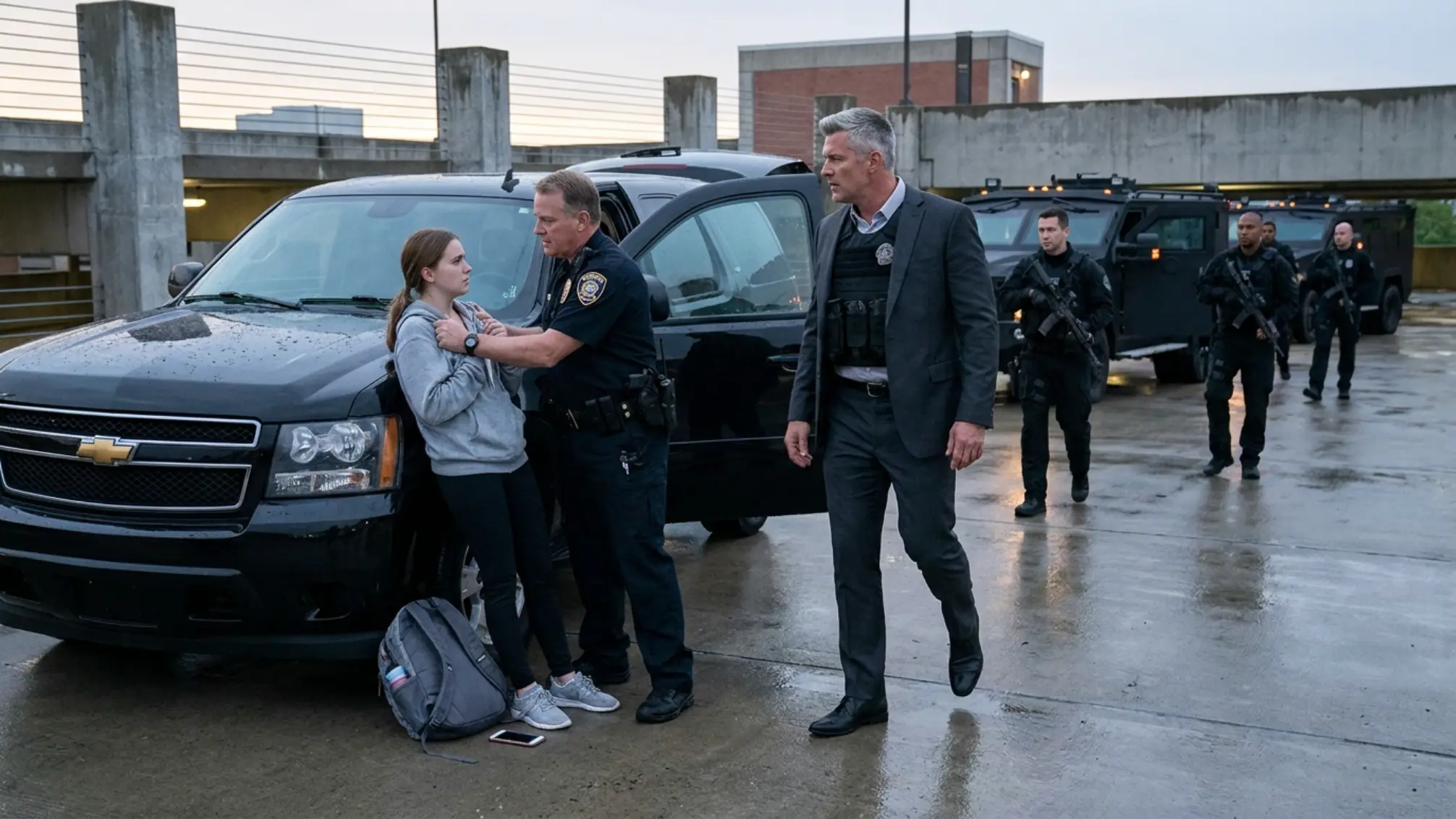
The third level of the parking garage at Ronald Reagan Washington National Airport echoed with engines, rolling suitcases, and the distant announcement of delayed flights. Cold rain blew through the open concrete walls, leaving the floor slick beneath rows of fluorescent lights. Travelers hurried toward the elevators with their heads lowered, too tired to notice the black federal SUV parked near the eastern stairwell. Then a teenage girl’s body struck its hood hard enough to make the metal shake.
“Stop fighting me,” Officer Raymond Doyle snapped.
Seventeen-year-old Sophie Mercer cried out as he twisted her right wrist behind her back. Her pale-gray hoodie had ridden up at one shoulder, and her long light-brown hair fell across her tear-filled blue eyes. The backpack she had been carrying lay open on the wet floor, surrounded by notebooks, a phone charger, a wallet, and a framed photograph wrapped in tissue paper.
“I’m not fighting you,” Sophie gasped. “You’re hurting me.”
“You were trying to break into a government vehicle.”
“That is my father’s car.”
Doyle laughed and pushed her more firmly against the hood. He was forty-six, broad through the chest, with short graying hair and the hard expression of a man accustomed to being obeyed before he had explained himself. His airport police uniform was clean, but his badge sat slightly crooked, and the hand gripping Sophie’s shoulder trembled with more agitation than the situation required.
“Your father doesn’t drive federal plates,” he said.
“He does.”
“You expect me to believe a kid in a sweatshirt owns a key to a restricted vehicle?”
“I never said I owned it. I said it belongs to my dad.”
Sophie tried to turn her head toward the rear passenger door. It stood several inches open, though she was certain she had closed it after retrieving her backpack. A cold feeling moved through her stomach.
Doyle noticed the direction of her gaze and shoved her face back toward the windshield.
“Eyes forward.”
Nearby travelers began slowing down. A family with two small children stopped near the elevator. A businessman lowered his suitcase handle and raised his phone. Two flight attendants stood beside a concrete pillar, watching with visible concern.
Sophie saw them but felt no relief. Doyle’s grip was tightening, and the more she tried to explain, the more determined he seemed to punish her for speaking.
“I have identification,” she said. “It fell out of my bag.”
Doyle glanced down.
A black leather credential wallet rested near his boot.
He released her shoulder only long enough to pick it up. Sophie’s heart lurched as he turned it over in his hand.
“Don’t open that.”
Doyle smirked. “Now you’re giving me orders?”
“It isn’t mine.”
“Then why was it in your bag?”
“My father gave it to me in case security questioned why I was near the vehicle.”
“That sounds convenient.”
“It has his name and number. Call him.”
Doyle opened the wallet.
One side displayed the gold shield of the Federal Protective Operations Bureau. The other held a credential identifying Jonathan Mercer as the supervisory commander of a joint federal tactical task force. Beneath the photograph was a warning that unauthorized possession, alteration, or misuse of the credential constituted a federal offense.
Doyle stared at it for half a second.
Then he laughed.
“Fake federal identification too?”
Sophie’s panic sharpened. “It isn’t fake.”
“Your father print this in his basement?”
“Call the number.”
“Keep talking and I’ll add resisting arrest.”
“I’m not resisting.”
Doyle bent her wrist until she cried out again.
“That sounded like resistance.”
The businessman filming stepped forward. “Officer, she’s a child.”
Doyle turned his head. “Back away unless you want to interfere with an arrest.”
The man stopped, but he kept recording.
Sophie pressed her cheek against the rain-speckled hood and tried not to cry. Her father had warned her never to use his position to frighten or threaten anyone. He had taught her that badges existed to protect people, not to end arguments. Yet as Doyle mocked the credential and tightened his grip, Sophie understood that the officer was not interested in the truth.
“Open it again,” she said through clenched teeth, “and you’ll learn exactly whose daughter you assaulted.”
Doyle leaned close enough for her to smell bitter coffee on his breath.
“I don’t care if your father is the president.”
Tires screamed behind the patrol car.
Every head in the garage turned.
Two armored black SUVs shot up the concrete ramp and stopped at sharp angles, blocking the nearest exit. Their brakes slammed, doors flew open, and tactical agents stepped onto the wet pavement in coordinated silence. They wore black body armor marked with federal insignia, and their rifles remained lowered but ready.
Doyle’s grip weakened.
A tall man emerged from the lead vehicle.
Jonathan Mercer was forty-eight, broad-shouldered, and dressed in a charcoal suit beneath a tactical vest. Silver streaked the sides of his short dark hair, and his gray eyes moved immediately from the open federal credential in Doyle’s hand to Sophie’s face against the hood.
The entire garage seemed to become quieter as he approached.
“Take your hands off my daughter.”
Sophie lifted her head. “Dad.”
Doyle slowly released her.
Jonathan crossed the remaining distance, caught Sophie by the shoulders, and looked over her face and arms for injuries. His controlled expression did not change, but his voice dropped into the tone his agents recognized as more dangerous than shouting.
“Are you hurt?”
“My wrist.”
“Anything else?”
“My shoulder. I’m okay.”
“You don’t have to be okay yet.”
Doyle cleared his throat. “Sir, I observed her attempting to enter a restricted federal vehicle.”
“She had the key.”
“I had no way of confirming—”
“You had my credential.”
“I believed it was fraudulent.”
Jonathan took the wallet from his hand. “You believed a credential with a live verification code, embedded security seal, and direct operations number was fraudulent?”
Doyle’s face began losing color.
“I was following procedure.”
“Your procedure includes slamming a seventeen-year-old against a vehicle before verifying her identity?”
“She became uncooperative.”
The businessman spoke from behind his phone. “She asked him to call the number. He refused.”
Several other witnesses nodded.
Jonathan looked at Doyle for a long moment, then turned toward Sophie.
“What were you doing here?”
“You asked me to bring the blue briefing folder from the house,” she said. “Mom dropped me at the terminal. I came to put it in the SUV before your team landed.”
“And the rear door?”
“It was closed when I walked away.”
Jonathan’s eyes moved past her.
The right rear door of the black SUV now stood completely open.
His expression changed.
He handed the credential to one of his agents and walked toward the vehicle. Inside the rear compartment, a securing strap hung loose across an empty section of carpet. A rectangular imprint showed where a hardened black case had rested only minutes earlier.
Jonathan stopped breathing for a beat.
“Where’s the case?”
Sophie went white. “I thought you took it.”
Every tactical agent turned toward the empty rear seat.
Jonathan looked at Agent Lena Ruiz, his second-in-command. “Lock the garage.”
Ruiz lifted her radio. “All teams, seal every exit. Nobody leaves levels two through four. Request airport operations freeze elevator access and preserve all surveillance footage.”
Metal security gates began lowering across the vehicle ramps.
Doyle stepped backward. “What is happening?”
Jonathan faced him.
“What did you remove from this SUV?”
“Nothing.”
“You were standing beside an open federal vehicle while its secured evidence case disappeared.”
“I never touched the car.”
Sophie shook her head. “He kept looking toward the rear door.”
Doyle’s eyes flicked toward her with sudden hatred.
Jonathan saw it.
He stepped between them. “Look at my daughter like that again, and your next interview will happen in restraints.”
Doyle raised his hands. “I was called about a suspicious person.”
“By whom?”
“Anonymous report.”
“What time?”
“About ten minutes ago.”
“Show me the dispatch record.”
Doyle reached slowly toward the radio on his shoulder. “Dispatch, confirm the suspicious-person call regarding the black SUV on level three.”
Static answered.
He tried again.
No response.
Ruiz looked at one of the agents. “Check his device.”
Doyle pulled away when the agent approached. “You have no authority to seize police equipment.”
Jonathan’s gaze hardened. “A classified federal evidence container disappeared during your detention of my daughter. At this moment, I have authority to secure anything reasonably connected to that theft.”
“I want my union representative.”
“You can ask for one during questioning.”
“I’m not under arrest.”
“Not yet.”
Agent Ruiz removed Doyle’s radio and examined the screen. Her brow tightened.
“This device isn’t connected to airport dispatch.”
Doyle’s face changed.
Ruiz turned it over. “The casing is department issue. Internal board is aftermarket.”
Jonathan asked, “Encrypted private frequency?”
“Looks like it.”
Doyle lunged for the radio.
Two agents seized him before he took a full step.
The witnesses gasped as he was forced against the patrol car. Jonathan never looked away from him.
“Who were you communicating with?”
Doyle remained silent.
Jonathan turned to Sophie. “Think carefully. What happened before he approached you?”
She rubbed her swollen wrist. “I unlocked the SUV, placed the folder on the front passenger seat, and picked up my backpack. Then I heard him shouting. He said I was stealing the vehicle.”
“Did you see anyone else near the car?”
“No. But when he grabbed me, I heard another door close.”
“Which direction?”
Sophie closed her eyes, replaying the moment.
The hood had been cold beneath her palms. Her belongings had hit the ground. Doyle had shouted loudly, almost theatrically, drawing every nearby traveler’s attention toward him. Behind the noise, she had heard something softer.
“A sliding door,” she said. “Maybe a delivery van.”
Agent Ruiz pointed toward the far row. “There was a white maintenance van near the stairwell when we entered. It’s gone.”
The garage exit alarms sounded.
A voice came over Ruiz’s radio. “Eastern vehicle gate breached. White utility van forced through the barrier and turned south toward the service road.”
Jonathan looked at Doyle. “That was the distraction. You detained Sophie, created a crowd, and kept every eye away from the rear of the SUV.”
“I don’t know anything about a van.”
“But you knew which vehicle to watch.”
Doyle gave a thin smile. “Prove it.”
Jonathan’s anger became very still.
“What was in the case?” Sophie asked.
He looked at her, knowing she deserved an answer but not the classified details.
“Evidence from an eighteen-month investigation.”
“What kind of evidence?”
“Enough to identify federal employees, contractors, and law enforcement officers connected to a protected smuggling route.”
Doyle’s smile disappeared.
Jonathan saw it.
“So you do know what was inside.”
“I reacted to the word smuggling.”
“You reacted before I finished the sentence.”
Doyle looked toward the lowering gates, measuring distances.
Agent Ruiz stepped closer. “Don’t.”
He ran anyway.
Doyle tore free from one agent, drove an elbow into another, and sprinted between parked vehicles. Travelers scattered. He drew his service pistol as he reached the concrete stairwell.
Jonathan moved Sophie behind the armored SUV.
“Stay down.”
Doyle fired once toward the overhead lights.
Glass and sparks rained across the floor.
The tactical agents advanced without firing into the crowded garage. Ruiz circled through the opposite row while two others blocked the stairwell entrance. Doyle grabbed a male traveler by the collar and pulled him against his chest, pressing the pistol beneath his jaw.
“Open the gate,” he shouted.
Jonathan stepped into view with his hands visible.
“Let him go.”
“You don’t control this.”
“You assaulted my daughter, helped steal federal evidence, and drew a weapon in a crowded airport garage. You stopped controlling anything the moment you chose that path.”
Doyle tightened his arm around the hostage.
“That case is already gone.”
“Then tell me who has it.”
“You think this ends with me?”
“No. I think it begins with you.”
Doyle glanced toward a side exit.
That brief movement was enough.
Ruiz emerged behind him and struck his gun arm against the concrete wall. The weapon discharged into the ceiling. The hostage dropped away as three agents drove Doyle to the ground and secured his wrists.
Jonathan approached while Ruiz removed a phone taped beneath Doyle’s vest.
The screen showed an active tracking map.
A blinking point moved south along the George Washington Memorial Parkway.
Ruiz looked up. “The case has a tracker.”
Jonathan shook his head. “Not the case. One of the evidence drives inside it.”
He took the phone.
Doyle laughed bitterly from the floor. “You won’t reach them before they wipe it.”
Jonathan studied the route.
The tracking point suddenly left the parkway and turned toward an abandoned freight facility near the river. It was not moving randomly. Whoever possessed the case believed they had escaped and were heading toward a prepared extraction point.
Jonathan gave Ruiz the phone. “Contact Virginia State Police and river patrol. Quietly. No sirens near the facility.”
He looked toward Sophie.
She stood beside the SUV with a blanket around her shoulders, given to her by one of the flight attendants. Her face remained pale, but she was watching everything.
“I need to go,” Jonathan said.
“I know.”
“Agent Miller will stay with you until your mother arrives.”
Sophie glanced at Doyle. “Was he the officer you were investigating?”
“We didn’t know his name.”
“But he knew yours.”
Jonathan nodded. “Someone inside the task force leaked my vehicle assignment and arrival time.”
“The real case isn’t only missing,” Sophie said. “Someone wanted you to chase it.”
Jonathan studied her.
She pointed toward the blue briefing folder visible on the front passenger seat. “You told me that folder was urgent. But if the black case was already in the SUV, why did you need me to bring anything?”
“I received a message from your mother’s number saying she had found the folder at home.”
“I never saw Mom send it.”
Jonathan pulled out his phone and opened the message.
The wording was almost correct, but Sophie’s mother always called him Jon, never Jonathan. The message had been designed to bring Sophie to the garage at a precise time, placing Jonathan’s daughter directly beside the target vehicle.
“This wasn’t only a theft,” he said.
Doyle stared at the floor.
Jonathan crouched near him. “They used my family to control my response.”
Doyle remained silent.
“They expected me to become angry, abandon procedure, and lead my agents away from the airport.”
A faint smile touched Doyle’s mouth.
Jonathan understood.
“The case in the van is bait.”
Agent Ruiz looked toward the terminal doors. “Then where is the actual target?”
Jonathan’s eyes shifted to the folder inside the SUV.
He opened the passenger door but did not touch it.
The blue folder appeared ordinary. However, the top edge had been cut and resealed. A tiny black device was hidden beneath its cardboard lining.
Ruiz examined it from a distance. “Transmitter?”
“Possibly a network bridge.”
The investigation involved protected cargo data stored on an isolated federal system accessible only inside a temporary operations suite at the airport. The tactical team’s arrival would activate that suite. A concealed device carried into the secure area could copy credentials, open a remote connection, or destroy the original case files.
The stolen black case was never the true objective.
It was meant to empty the command post.
Jonathan called the operations suite.
No one answered.
“Ruiz, take half the team after the van. Treat it as a diversion but secure the evidence. I’m going upstairs.”
She nodded. “And Doyle?”
“Federal custody.”
Doyle finally spoke. “You’re too late.”
Jonathan stood. “Men like you always say that when they realize silence can’t save them.”
Sophie caught his sleeve before he left.
“Dad.”
He turned.
“Be careful.”
Jonathan touched her cheek. “I should have been here sooner.”
“You came.”
The words nearly broke his control.
He pressed a brief kiss to her forehead and moved toward the elevator with four agents.
The airport operations suite occupied a restricted section above Terminal Two. When Jonathan arrived, the corridor lights were off, and the electronic access panel had been disabled. An airport contractor lay unconscious near the doorway, breathing but bleeding from a wound above his temple.
The agents entered.
Inside, server screens flashed with unauthorized file transfers. A man in a federal technician’s uniform stood beside the main terminal while a second person forced an analyst to remain seated at gunpoint.
Jonathan recognized the technician.
Caleb Voss was a cybersecurity specialist assigned to Jonathan’s own task force.
Voss looked toward him and smiled. “You were supposed to follow the case.”
“You were supposed to know me better.”
“I knew exactly what you would do if someone touched your daughter.”
“That was your mistake. You believed anger makes a man predictable.”
Voss’s partner dragged the analyst toward the emergency stairwell.
Jonathan raised his weapon but had no clear shot.
“Let her go.”
Voss continued the data transfer. “This investigation dies tonight. Every protected source, undercover identity, and financial record will be gone.”
“No. You copied a decoy archive.”
Voss looked at the screen.
The transfer reached one hundred percent.
Then every file turned red.
Jonathan had ordered the sensitive database separated from the airport network days earlier after detecting irregular credential requests. The system now contained marked records designed to identify anyone attempting an unauthorized extraction.
Voss stared at him. “You knew?”
“I suspected a leak. Doyle confirmed it.”
The armed partner panicked and turned his weapon toward Jonathan.
The analyst drove her chair backward into his knees. Agents rushed forward, disarmed him, and pulled the woman to safety.
Voss reached beneath the terminal.
Jonathan struck him before he could activate the device hidden there. Voss crashed against the server rack, and the two men fought through overturned chairs and scattered equipment. Voss was younger, but Jonathan’s fury had been sharpened by the image of Sophie pinned against the SUV.
He forced Voss onto the floor and secured his wrists.
“You used my daughter.”
Voss coughed and smiled weakly. “And you still lost the case.”
Jonathan’s radio came alive.
“Commander, Ruiz. We stopped the van at the freight yard. Case recovered intact. Two suspects in custody.”
Voss’s smile vanished.
“And the tracking drive?” Jonathan asked.
“Still inside. No data breach.”
Jonathan looked down at the man who had endangered his child and betrayed every officer working beside him.
“You didn’t steal an investigation,” he said. “You delivered us the rest of your network.”
By sunrise, Officer Raymond Doyle, Caleb Voss, and six additional suspects were in federal custody. Search warrants uncovered payments routed through shell companies, falsified dispatch calls, restricted airport maps, and recordings of previous thefts disguised as routine police encounters. Doyle had used his uniform to detain innocent travelers while accomplices searched vehicles or exchanged contraband nearby.
The assault on Sophie had not been an impulsive mistake.
He had been selected because witnesses would focus on a uniformed officer controlling a frightened teenager. Her humiliation and fear were part of the plan.
The video recorded by the businessman spread among investigators before it ever reached the public. It showed Sophie repeatedly asking Doyle to verify the credential. It showed him refusing, mocking her, and applying more force whenever she spoke.
Most importantly, it captured a white maintenance van sliding quietly away in the background.
Doyle eventually pleaded guilty to conspiracy, theft of federal evidence, assault, obstruction, and weapons violations. Voss faced additional charges for disclosing protected identities and attempting to compromise a federal intelligence system. Their arrests led investigators to three more officers and two contractors who had used airport security procedures to protect a trafficking network.
Sophie’s wrist required a brace, but no bones were broken.
The deeper injuries took longer.
For several weeks, she froze whenever a police cruiser slowed near her school. She woke at night remembering her face against the cold hood and Doyle’s voice telling her that the truth did not matter.
Jonathan attended every medical appointment and sat outside her bedroom whenever she could not sleep.
One evening, Sophie found him at the kitchen table staring at his federal credential.
“You keep blaming yourself,” she said.
He looked up. “I gave you that wallet.”
“You gave me a way to prove who I was.”
“And it didn’t protect you.”
“No object can protect someone from a person who refuses to look at the truth.”
Jonathan lowered his eyes.
Sophie sat across from him. “You told me badges are supposed to mean responsibility.”
“They are.”
“Then don’t let what he did change what yours means.”
Months later, Sophie testified at Doyle’s sentencing. She wore the same pale-gray hoodie beneath a dark jacket, not because she lacked better clothes but because she refused to allow the memory of that day to take something ordinary away from her.
Doyle would not look at her.
Sophie stood before the judge and spoke clearly.
“He thought fear would make me silent. He thought his uniform meant nobody would question him. But authority is not the power to hurt someone until they stop speaking. It is the responsibility to listen before harm is done.”
The judge sentenced Doyle to twenty-two years in federal prison.
Outside the courthouse, reporters crowded around Jonathan, asking how quickly he had recognized that the missing case was part of a larger attack. He ignored them and walked directly toward Sophie.
“You were good in there,” he said.
“I was terrified.”
“Courage isn’t the absence of that.”
She smiled. “I’ve heard that somewhere.”
Jonathan opened the rear door of the federal SUV for her.
Sophie paused.
It was the same vehicle from the garage. The damaged hood had been repaired, the evidence compartment replaced, and the interior thoroughly examined. Still, she stared at it as though the cold concrete, fluorescent lights, and Doyle’s grip remained trapped inside.
Jonathan did not hurry her.
“We can take another car.”
Sophie shook her head.
She placed one hand on the door, took a slow breath, and climbed inside by choice.
Jonathan closed it gently.
The black SUV pulled away from the courthouse beneath the clear Virginia sky. No tactical convoy followed them, no alarms sounded, and no sealed case waited in the rear compartment.
There was only a father driving his daughter home.
The investigation had begun with a missing evidence case, but it uncovered something more dangerous than stolen files. It revealed how easily power could be hidden behind procedure, how quickly a uniform could become a distraction, and how deeply corruption depended on frightened people believing they would never be heard.
Doyle had tried to turn Sophie into another silent witness.
Instead, the girl he slammed against the hood became the voice that brought his entire network down.