“You expect me to believe a woman like you owns 1425 Ellison Estate?” Officer Derek Vaughn demanded, jabbing one thick finger toward the identification in her hand. “Step away from that gate before I drag you off this driveway.”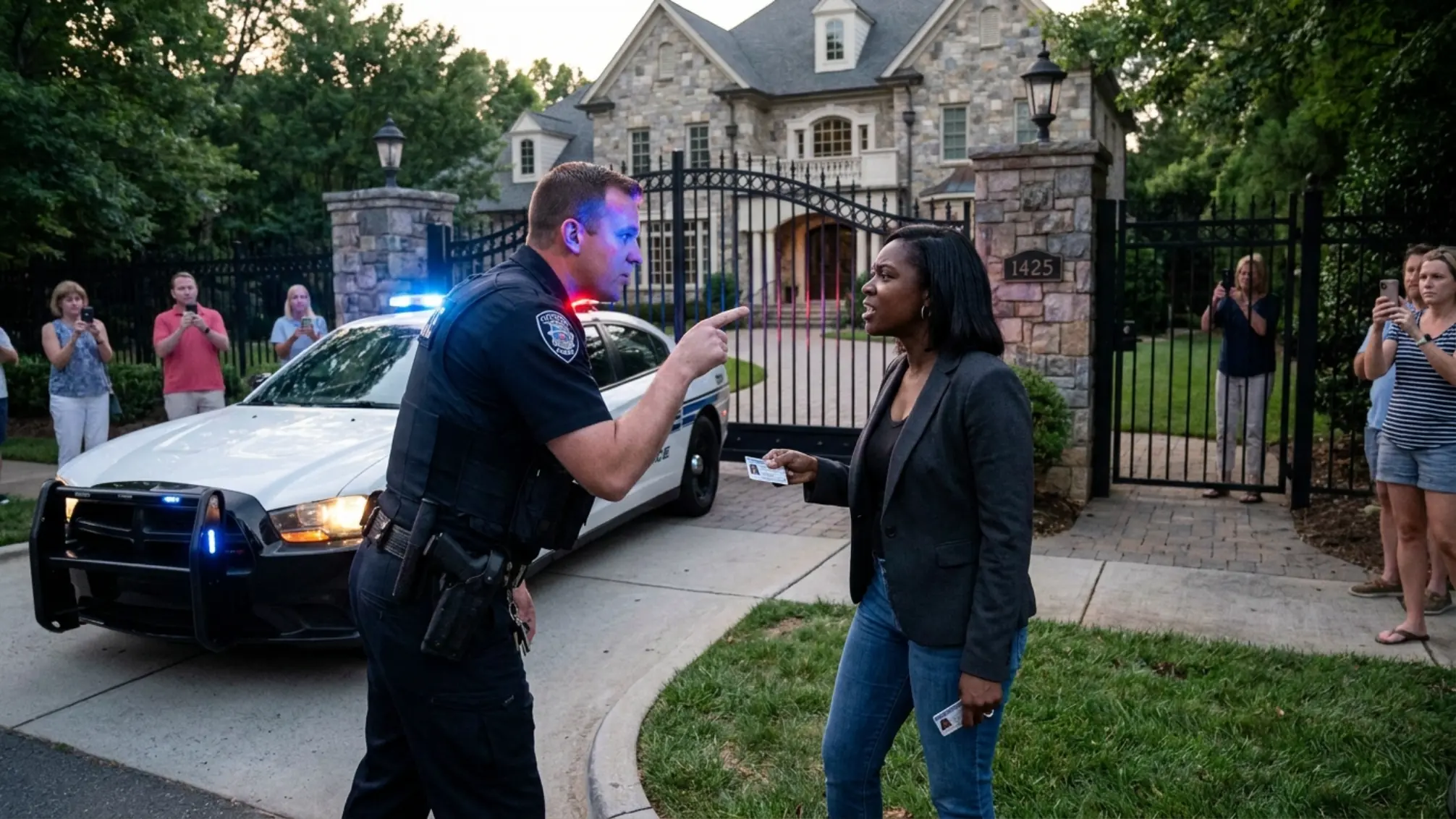
Dr. Evelyn Monroe held the license higher, forcing him to look at the address printed beneath her photograph. “That address is on my identification. Verify it—or stop embarrassing yourself in front of my neighbors.”
Derek stepped closer until barely a foot separated them. “Keep talking to me like that, and I’ll put you on your knees right here.”
Evelyn locked her dark eyes on his. “Touch me, and the next vehicle turning onto this street will be the end of your badge.”
The confrontation unfolded at dusk outside one of the largest homes in Ellison Ridge, an exclusive neighborhood outside Charlotte, North Carolina. Warm light glowed behind the tall windows of Evelyn’s stone mansion, but a marked patrol cruiser sat diagonally across her driveway, blocking the iron gate. Blue and red lights flashed across the hedges, the carved address marker, and the expensive homes lining the quiet street.
Evelyn Monroe was fifty-nine years old, with deep brown skin, intelligent dark eyes, and black hair gathered neatly into a low bun. She wore a charcoal blazer over a plain black top, fitted blue jeans, and comfortable shoes after spending three exhausting days speaking at a legal reform conference. Her older gray sedan looked modest among the luxury vehicles parked throughout Ellison Ridge, but it was registered to her at the exact address where Derek now accused her of trespassing.
Derek Vaughn was forty-one, broad-shouldered, fair-skinned, and confident in the aggressive way of a man rarely forced to justify himself. His patrol uniform fit tightly across his muscular frame, and his body camera sat dark against the center of his vest. He had noticed Evelyn’s sedan turning toward the private gate while passing the neighborhood entrance and followed without receiving any dispatch call.
He saw an older Black woman driving an aging car toward a mansion and decided the scene could not be legitimate.
That decision came before he checked the license plate.
It came before he saw her identification.
It came before he asked a single neutral question.
Evelyn had pressed the remote control mounted inside her vehicle when Derek’s cruiser accelerated around her and stopped across the driveway. He emerged with one hand resting near his duty belt and shouted for her to switch off the engine. She complied, lowered the window, and asked whether there was an emergency.
“Get out of the car and move away from the property,” he ordered.
“This is my property.”
“Out of the car.”
Evelyn stepped onto the driveway slowly, keeping her hands visible. She had spent nearly three decades investigating cases in which ordinary movements were later described as threatening. Her legal career taught her that clarity mattered, but it also taught her that evidence did not always protect a person from an officer determined not to see it.
She removed her license and held it toward him.
Derek glanced at the photograph but barely looked at the address. “Where did you get this?”
“The Department of Motor Vehicles.”
“Don’t get clever.”
“You asked for identification. I provided it.”
Derek looked toward the mansion beyond the gate. Its pale stone walls, high windows, and carefully maintained grounds seemed to offend his assumptions more than the license challenged them. He looked back at Evelyn’s sedan and then at her clothes.
“You expect me to believe this is your house?”
“It has been my house for fourteen years.”
“Who actually lives here?”
“I do.”
“Who employs you?”
“No one in that house.”
His expression hardened. “So now you own the place.”
“I owned it before you arrived.”
A porch door opened across the street. A gray-haired white man stepped onto his lawn, followed by his wife. Two other residents emerged from homes farther down the block, drawn by the flashing lights and raised voices.
None approached Evelyn.
A woman whispered that she had never seen her before.
Evelyn heard her.
Ellison Ridge contained nearly two hundred homes, and Evelyn traveled frequently for work. She attended few neighborhood functions and preferred quiet dinners to homeowners’ association gatherings. The fact that some residents did not recognize her was neither surprising nor evidence of criminal activity.
Derek treated the whispers as confirmation.
“Turn around and put your hands behind your back.”
Evelyn did not move. “Am I under arrest?”
“You are being detained while I determine why you’re attempting to enter this property.”
“You have my address.”
“That card could be altered.”
“Scan it.”
“I don’t take instructions from suspects.”
“What crime do you suspect?”
“Trespassing, attempted burglary, identity fraud. We’ll find out.”
“You invented three offenses after receiving proof that I live here.”
Derek’s jaw tightened. A younger neighbor began recording from beside the stone gate. Another person held a phone above the roof of a parked vehicle.
Evelyn saw the cameras and understood that Derek saw them too. Instead of calming him, the audience seemed to trap him inside his first decision. Releasing her would require admitting that he had blocked a homeowner from her own driveway without cause.
He pointed toward the pavement. “On your knees.”
“No.”
The answer was quiet.
Derek took another step. “I said kneel.”
“And I said no. I am not armed, I have not threatened you, and you have no lawful reason to humiliate me.”
“You don’t decide what is lawful.”
“That is the first accurate thing you’ve said. Courts decide—and I have spent thirty years standing in them.”
Derek laughed. “Now you’re a lawyer too?”
Evelyn opened her blazer enough to reach the phone in her pocket. “I’m contacting counsel and requesting a supervisor.”
His hand shot forward.
Derek ripped the phone from her fingers before she could unlock it. The device struck the pavement and cracked across one corner. Evelyn looked down at the broken screen, then slowly raised her eyes.
“That was private property.”
“You made a threatening movement.”
“I reached for a phone after telling you exactly what I was doing.”
“Stop arguing.”
“Return it.”
Derek moved so quickly that several neighbors gasped.
His open hand struck Evelyn across the left side of her face.
The sound echoed against the stone gate and surrounding houses.
Her head turned with the impact. One earring fell onto the driveway, and the license slipped from her fingers. For several seconds, no one moved.
Evelyn pressed one hand against her burning cheek.
She did not cry.
She did not shout.
She turned back toward Derek with a look so controlled that his confidence briefly faltered.
“You have no idea what you just did,” she said.
He laughed, but the sound came out thinner than before. “Important people don’t frighten me.”
“This is not about importance.”
“Then stop pretending your job changes the law.”
“My job taught me how carefully the law records men like you.”
Derek looked toward the neighbors. More phones were raised now. He pointed at them and shouted that they were interfering with an active investigation.
No one stopped recording.
One resident, Daniel Price, stepped closer to the edge of his lawn. “Officer, her name is on the property directory.”
Derek turned sharply. “Go back inside.”
Daniel remained where he was. “You asked whether she lived here. I’m telling you she does.”
“You are not part of this.”
“I watched her move in fourteen years ago.”
Derek’s face reddened. “Another word, and I’ll detain you too.”
Evelyn looked toward Daniel. They had exchanged little more than polite greetings over the years, but his statement broke the silence that had allowed Derek’s assumption to dominate the street.
A second patrol cruiser arrived.
Officer Melissa Grant stepped out, a thirty-three-year-old Black woman with six years in the department. She approached cautiously, looking from Evelyn’s reddened cheek to the broken phone and then toward Derek.
“What happened?”
Derek answered first. “Suspicious person attempted to enter the estate using questionable identification. She became confrontational and reached for something.”
Melissa examined Evelyn’s empty hands. “Was she armed?”
“Unknown.”
Evelyn pointed toward her license on the pavement. “My identification shows this address.”
Melissa picked it up.
She looked at the photograph.
Then she looked at Evelyn again.
Recognition came slowly, followed by alarm.
“Dr. Monroe?”
Derek glanced between them. “You know her?”
Melissa’s posture changed. “I attended the state procedural-justice training last year. She wrote part of the curriculum.”
Evelyn corrected her softly. “I chaired the committee.”
Melissa looked toward Derek’s inactive camera. “Sergeant Vaughn, is your body camera recording?”
He glanced down. “It malfunctioned.”
“Did you notify dispatch?”
“It happened during the stop.”
“Mine is active now.”
Derek lowered his voice. “Don’t undermine me in front of a suspect.”
“She is the homeowner.”
“You don’t know that.”
Melissa held the license beside the gate marker. Both displayed 1425 Ellison Estate.
“She has identification, a matching vehicle registration, a resident confirming her identity, and the gate remote in her car.”
“She could have stolen all of it.”
Evelyn let her hand fall from her cheek. “Officer Grant, request a district commander, internal affairs, and medical documentation. Preserve every recording from this street.”
Derek pointed at her again. “You don’t give orders here.”
Melissa looked directly at him. “She is requesting evidence preservation.”
“She’s trying to take control.”
“No,” Evelyn said. “I am trying to prevent you from controlling what remains after this evening.”
A black command vehicle turned onto the street.
Its headlights swept across the gate before it stopped behind the patrol cars. District Commander Robert Hayes stepped out in a white command shirt beneath a dark jacket. He was fifty-six, with graying hair and a face that normally revealed little emotion.
He saw Evelyn.
Then he saw the swelling on her cheek.
He stopped in the middle of the street.
Derek was still speaking when Hayes began walking toward them. “Commander, I have a possible impersonation and trespassing situation. The subject is claiming to own the property and—”
“Stop talking.”
The quiet command cut through him.
Hayes approached Evelyn first. “Dr. Monroe, are you injured?”
“She struck the pavement with my phone before Officer Vaughn struck me.”
Hayes looked toward the broken device.
Then he turned to Derek. “Did you hit her?”
“She resisted lawful commands.”
“That was not my question.”
“She made an aggressive movement.”
“Did you strike her?”
Derek glanced toward the watching neighbors. “I used an open-hand distraction technique.”
Evelyn’s voice remained calm. “He slapped me after taking my phone.”
Hayes looked toward Melissa.
“My camera has been active since I arrived,” she said. “Several residents recorded the earlier encounter.”
Derek stepped closer to the commander. “Sir, you’re accepting her version before reviewing the facts.”
Hayes’s expression became colder. “I know Dr. Evelyn Monroe.”
The words silenced him.
“She chaired the independent commission that rewrote this department’s use-of-force policy,” Hayes continued. “She argued the case that preserved our federal grant funding. She has trained every command officer above the rank of lieutenant.”
Derek stared at Evelyn.
For the first time, he looked at her as a person whose identity carried institutional power.
Evelyn saw the change and hated it.
He should not have needed her résumé to recognize her rights.
Hayes ordered Derek to surrender his badge, duty weapon, body camera, radio, department phone, and vehicle keys. Derek protested that only internal affairs could seize his equipment.
Hayes nodded toward the unmarked sedan arriving behind the command vehicle. “They’re here.”
Two internal affairs investigators stepped out wearing gloves and carrying evidence containers. They separated Derek from the other officers and instructed him not to communicate with any witness.
A paramedic photographed Evelyn’s face and examined her jaw. The impact had not fractured anything, but swelling had already begun beneath her left eye.
Internal affairs secured the broken phone, her identification, the cruiser systems, and every available civilian recording. Investigators also requested surveillance footage from the estate gate, neighboring doorbell cameras, and a traffic camera at the neighborhood entrance.
Evelyn refused to enter her home until every item on the driveway had been documented.
She had learned that once evidence moved, explanations multiplied.
Commander Hayes apologized privately near the gate.
“This never should have happened.”
“No,” Evelyn replied.
“We will handle it.”
“That phrase has buried more complaints than it has resolved.”
Hayes absorbed the rebuke. “What do you want?”
“An independent investigation. Preservation orders issued tonight. No informal interviews before witnesses receive written instructions. And I will not participate in any employment decision.”
“He assaulted you.”
“Which is why I cannot control the investigation.”
Hayes looked toward Derek standing beside the cruiser. “You are protecting his process after he denied yours.”
“I am protecting the record.”
The investigation began before midnight.
The first evidence came from the gate camera. It showed Evelyn using the correct remote, the iron gates beginning to open, and Derek’s cruiser swerving across the entrance. No emergency call preceded the stop.
His patrol computer told an equally damaging story.
The plate check returned Evelyn’s full name, valid registration, and exact home address before he ordered her out of the car. He had the information within thirty-two seconds of entering the driveway.
He later claimed he had not noticed it.
The system showed he opened the record twice.
A neighbor’s video captured him looking directly at Evelyn’s license before calling it suspicious. Another recording preserved the moment he took her phone and struck her.
Derek’s body camera had not malfunctioned.
Device logs showed that he manually deactivated it eighteen seconds before approaching her vehicle. He attempted to reactivate it only after Commander Hayes arrived, but the system recorded every switch command.
Investigators then reviewed his previous stops.
The pattern extended far beyond Evelyn.
Derek had initiated forty-six suspicious-person encounters in affluent neighborhoods during the previous three years. Thirty-eight involved Black or Latino residents, visitors, contractors, domestic employees, or delivery workers.
Only two resulted in arrests.
Neither arrest produced a conviction.
In eleven reports, Derek claimed a caller had reported suspicious behavior. Dispatch records showed no calls before six of those encounters. Like Evelyn’s detention, he had initiated the stops himself and created the report afterward.
One case involved a Black cardiologist walking from his disabled vehicle toward his own home. Derek handcuffed him for failing to explain why he was in the neighborhood quickly enough.
Another involved a Latino architect photographing a house he had designed. Derek searched his equipment bag after claiming that professional cameras might be burglary tools.
Both complaints had been closed by a supervisor.
That supervisor was Lieutenant Paul Reeves, who signed nearly identical conclusions stating that Derek had acted reasonably based on the totality of circumstances. Investigators discovered that Reeves rarely interviewed complainants and never requested neighborhood surveillance footage unless a lawsuit had already been filed.
Derek’s behavior survived because his reports were treated as truth and everyone else’s account as accusation.
Evelyn’s case changed that equation only because too many people recorded it and too many senior officials recognized her name.
The realization angered her more than the slap.
At home the following morning, she stood before the bathroom mirror and examined the purple shadow beneath her eye. Her legal career had exposed her to stories of violence, humiliation, and institutional denial, but professional knowledge did not make physical pain abstract.
She remembered the neighbors watching.
She remembered the second before Derek struck her, when she saw the decision forming in his face.
Most of all, she remembered how quickly his attitude changed after Commander Hayes identified her.
Evelyn had never wanted safety based on status.
She wanted a system in which the address on an ordinary woman’s identification was enough.
Three weeks later, the city held an emergency public hearing. Residents filled the council chamber, and dozens more watched from outside.
Derek’s attorney described the incident as a rapidly evolving encounter. He claimed Evelyn’s refusal to kneel and attempt to reach for her phone caused a reasonable fear that she might be armed.
The civilian recordings played next.
They showed her announcing that she was reaching for her phone.
They showed Derek taking it.
They showed her standing empty-handed before he slapped her.
No movement was hidden.
No danger appeared.
The attorney then argued that Derek could not have known who Evelyn was.
She took the microphone after him.
“He did not need to know who I was,” she said.
The chamber became silent.
“He did not need to know my profession, my education, my court record, or my relationship with this department. He needed only to examine the identification in his hand and compare it to the information already displayed inside his cruiser.”
She placed a printed dispatch record on the table.
“The truth was available before he opened my car door. It was available before he broke my phone. It remained available before he struck me.”
Evelyn looked toward Derek.
“He rejected each fact because accepting any one of them would have required admitting that his first assumption was wrong.”
Derek was dismissed for unlawful detention, excessive force, evidence interference, false reporting, discriminatory enforcement, and deliberate deactivation of recording equipment. State prosecutors later charged him with assault, official misconduct, and obstruction.
Lieutenant Reeves was removed from supervisory duties and eventually resigned after investigators reopened twenty-seven complaints he had closed without meaningful review.
Several past cases were referred to the district attorney. Charges based primarily on Derek’s unrecorded statements were dismissed, and the city reimbursed residents for impound fees, court costs, and wrongful detention expenses.
Evelyn rejected a private settlement that required confidentiality.
Instead, she negotiated a public consent agreement establishing permanent changes. Officers had to record the legal basis for suspicious-person stops before demanding identification whenever circumstances allowed. Manual body-camera deactivation triggered an automatic alert and independent review.
Supervisors could no longer close complaints involving force without interviewing the complainant and examining available civilian footage. Reports claiming anonymous calls had to include verifiable dispatch references.
Most importantly, the department prohibited vague descriptions such as “did not appear to belong” from being used as justification for detention.
Six months later, Evelyn returned from another conference.
She wore the same blazer and drove the same gray sedan. As she approached Ellison Estate, the iron gate opened normally.
No cruiser blocked her path.
Daniel Price stood near his mailbox and raised one hand in greeting. Several neighbors who had watched in silence now attended monthly meetings devoted to documenting interactions with local authorities.
Evelyn did not mistake their discomfort for transformation.
Change came slowly, and often only after people saw injustice touch someone they respected.
Inside her home, the broken phone rested inside a glass evidence box returned after the criminal case. She kept it in her office beside the written ruling that sustained Derek’s dismissal.
Not as a trophy.
As a reminder.
Derek Vaughn had stood outside a Black woman’s mansion and decided ownership had a face that did not resemble hers. The license, vehicle record, gate remote, and neighbor’s testimony could not overcome an assumption he valued more than evidence.
Only authority greater than his forced him to stop.
But by then, the entire street had seen what happened when certainty wore a badge and refused to verify itself.
Derek believed Evelyn’s address was impossible.
The investigation proved something else was impossible to defend:
He had known exactly where she lived before he ever ordered her out of the car.