Officer Wade Mercer turned toward the coastal highway just as three black SUVs swept around the curve. They moved in a tight formation, their tinted windows reflecting the ocean and the steep green mountains rising behind the road. The vehicles stopped around his patrol car without blocking civilian traffic, and eight men and women in dark jackets stepped out with federal credentials already visible. Wade’s hand remained wrapped around his steel cuffs, but the confidence drained from his face.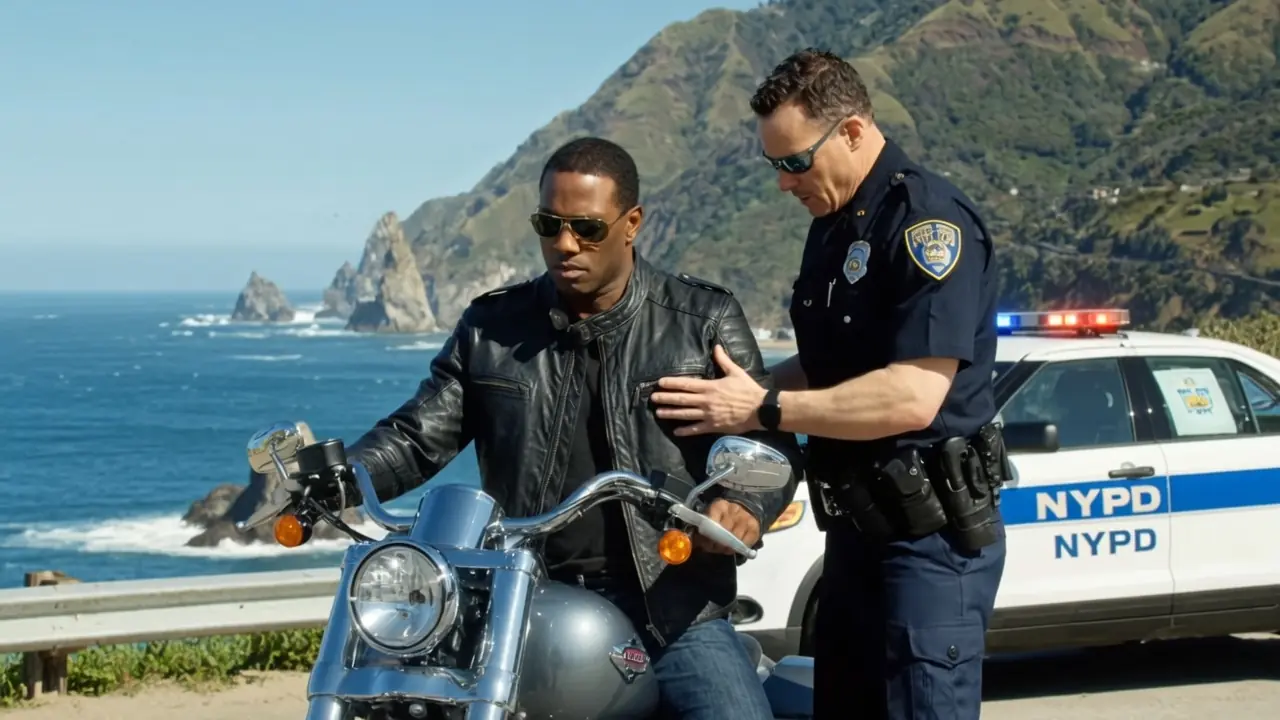
The Black motorcyclist calmly straightened his leather jacket. His name was Julian Cross, and he stood six feet two inches tall with deep brown skin, close-cropped black hair, and the muscular frame of a man who had spent two decades training his body to remain controlled under pressure. His black aviator sunglasses hid most of his expression, but his jaw remained relaxed. He had not raised his voice once.
Wade looked from Julian to the federal agents. “What is this?”
A tall woman with dark hair approached first. “Special Agent Elena Torres, Department of Justice.”
“This man resisted a lawful traffic stop.”
Elena glanced at the motorcycle, then at Julian. “We watched the entire stop through his live transmitter.”
Wade’s eyes moved toward Julian’s jacket. A tiny device had been clipped beneath the leather collar, nearly invisible against the black fabric. It had recorded the officer’s first insult, every unwanted touch, and the moment Wade reached toward his cuffs after Julian refused to surrender identification without a reason. The recording was already stored on a federal server.
Julian removed his sunglasses. “You were told to keep your hands off me.”
“You refused an order.”
“You never gave a lawful one.”
Wade stepped closer, but two agents moved between them. Their hands remained away from their weapons, yet their positioning made the warning unmistakable. Wade had spent fifteen years using physical pressure to control frightened drivers, but these people did not appear frightened.
The coastal road belonged to the small California community of Harbor Ridge, a wealthy town built between the cliffs and the Pacific Ocean. Tourists knew it for expensive restaurants, luxury vacation homes, and scenic motorcycle routes. Local residents also knew that certain drivers were stopped far more often than others. Complaints had accumulated for years, but most disappeared inside the same department that received them.
Julian had entered Harbor Ridge that morning on a silver motorcycle registered in his own name. He traveled below the speed limit, wore a helmet, and obeyed every traffic signal. Wade began following him less than a minute after he crossed the town line. The patrol car remained behind him through three legal turns before the lights finally activated.
Julian pulled over immediately.
Wade approached without greeting him and demanded that he get off the motorcycle. Julian asked why he had been stopped. The officer responded by telling him that people riding expensive bikes often stole them from coastal cities.
Julian asked whether the license plate had been reported stolen.
Wade did not answer.
Instead, he ordered Julian to hand over his identification and motorcycle registration. Julian requested the legal basis for the detention before reaching inside his jacket, knowing Wade could claim he had made a threatening movement. The officer’s irritation quickly turned into hostility.
“You boys always have to make things difficult,” Wade said.
The phrase was clearly captured by Julian’s transmitter.
When Julian remained seated, Wade grabbed the front of his leather jacket and attempted to pull him from the motorcycle. Julian knocked the officer’s arm away with one controlled movement. Wade immediately reached for his handcuffs and threatened to slam him against the bike.
That was when the black SUVs arrived.
Wade looked toward Elena. “You set me up.”
“No one instructed you to profile him, grab him, or threaten him.”
“He was refusing to cooperate.”
“Refusing an unlawful demand is not resistance.”
Wade pointed toward Julian. “He threatened me.”
Julian lifted his hands slightly. “Play the recording.”
Elena signaled to another agent, who opened a tablet and replayed the confrontation at full volume. Wade’s voice carried across the roadside turnout while several tourists watched from parked cars. Every line sounded worse outside the heat of the moment.
The recording captured Wade saying the street belonged to him. It captured him mocking Julian’s expensive motorcycle and suggesting he could not have obtained it legally. It captured Julian asking repeatedly whether he was detained and what traffic law he had violated.
Wade’s hand moved toward his radio.
Agent Torres stopped him. “Do not contact your department yet.”
“I am entitled to notify my supervisor.”
“Your supervisor is already part of the investigation.”
The officer froze.
Julian stepped away from the motorcycle and removed his riding gloves. The gesture was slow and deliberate, giving everyone a clear view of his empty hands. Beneath the gloves were thick calluses across his palms and knuckles, marks earned through years of military service and tactical instruction.
Wade stared at him. “Who are you?”
“Federal tactical instructor.”
“For what agency?”
“Several.”
Julian had served twelve years in Naval Special Warfare before an injury moved him into training and operational review. He now taught controlled-force procedures to federal protective teams, military investigators, and specialized law-enforcement units. His job involved studying how trained people responded when fear, authority, and ego collided.
Harbor Ridge had become his newest assignment.
The investigation began after a twenty-two-year-old Black college student named Devin Shaw suffered a fractured shoulder during a traffic stop. Officer Wade Mercer claimed Devin accelerated toward him and reached beneath his seat. Dash-camera footage showed the student’s vehicle remained stationary.
The department said the camera angle was misleading.
A second driver, Rafael Mendoza, reported that Wade dragged him from his truck because one taillight was cracked. Wade claimed Rafael became violent. A roadside business camera showed the officer striking him before Rafael lifted either hand.
That video disappeared from the business two days later.
A third complaint came from an elderly Black veteran named Samuel Price. Wade stopped him outside a seaside pharmacy and accused him of stealing his own car. Samuel carried the title inside the glove compartment, but Wade handcuffed him before allowing him to retrieve it.
Samuel’s blood pressure rose dangerously while he sat on the curb.
The police department cleared Wade in all three incidents.
Its internal investigators relied on his reports, the statements of officers who arrived afterward, and body-camera recordings that mysteriously began only after drivers were restrained. People who challenged the findings were warned that filing false accusations against police could lead to prosecution.
The Department of Justice became involved when a former dispatcher provided internal radio recordings. Officers had been joking about “coastal fishing,” their private phrase for stopping unfamiliar Black and Latino drivers entering Harbor Ridge. They described the stops as an easy way to find warrants, drugs, or frightened people who would consent to searches.
Wade’s name appeared in most of the conversations.
Julian was selected to conduct a controlled field operation because he knew exactly how to provoke a corrupt pattern without breaking any law. He would enter town alone on a valuable motorcycle, travel the route named in the complaints, and document whether officers targeted him.
The operation was supposed to remain observational.
No one expected Wade to escalate within minutes.
Elena presented the warrant authorizing the seizure of Wade’s body camera, patrol computer, personal phone, and department-issued radio. The officer read the first page twice. His name appeared beside allegations of civil-rights violations, falsification of reports, evidence tampering, and conspiracy.
“This proves nothing,” he said.
“It gives us legal authority to preserve evidence.”
“You people are protecting him because he’s one of yours.”
Julian looked directly at Wade. “You only became interested in who I was after learning I had power.”
Wade’s mouth tightened.
“That is the problem,” Julian continued. “The people you hurt before me did not have federal agents around the corner.”
One of the agents removed Wade’s radio while another collected the patrol computer. The body camera was detached and sealed inside an evidence bag. Wade protested that it contained confidential law-enforcement material, but the warrant covered every recording created during the stop.
Elena asked him to unlock his phone.
He refused.
A second warrant already authorized forensic access.
The officer finally noticed several civilians recording from the turnout. His face flushed again. “Turn those cameras off.”
Elena shook her head. “They are standing in a public place.”
“They are interfering with an investigation.”
“No. They are documenting one.”
A Harbor Ridge police SUV appeared at the far end of the road. Lieutenant Carl Reeves stepped out before the vehicle had completely stopped. He was a broad white man in his late fifties with silver hair and a reputation for defending his officers publicly.
“What is happening here?” Carl demanded.
Elena showed him her credentials and warrant.
He barely glanced at them. “Officer Mercer informed dispatch that an armed suspect resisted arrest.”
Julian looked toward Wade. “He never checked whether I was armed.”
Carl’s eyes settled on the Black motorcyclist. “Keep your hands where I can see them.”
Federal agents shifted immediately.
Elena stepped between Carl and Julian. “Lieutenant, you are interfering with a federal operation.”
“I am responding to an officer-needs-assistance call.”
“Your officer transmitted false information.”
Carl reached for his own radio. “I want every available unit here.”
Elena raised one hand. Agents moved toward the lieutenant before he completed the call. One displayed a second warrant bearing Carl Reeves’s name.
The lieutenant stopped speaking.
Wade looked at his supervisor. “You said this was handled.”
Carl’s face hardened. “Be quiet.”
The exchange lasted only two seconds, but every federal investigator heard it.
Elena smiled without warmth. “Handled how?”
Neither officer answered.
Julian moved toward his motorcycle, but Wade stepped into his path. “You are not leaving with that bike until I verify ownership.”
Agent Torres looked at him in disbelief. “You are currently under federal investigation.”
“I still have authority in this town.”
Julian placed one hand on the handlebar. “That sentence explains why we came.”
Wade grabbed his wrist.
The movement was sudden, desperate, and foolish.
Julian rotated his arm, caught Wade’s thumb, and shifted his weight. The officer lost balance and dropped to one knee beside the motorcycle. Julian released him immediately, never striking or twisting farther than necessary.
Federal agents pulled Wade backward.
He began shouting that Julian had attacked him.
“You grabbed him again in front of eight federal witnesses,” Elena said.
Wade’s breathing became heavy. “He humiliated me.”
“No,” Julian replied. “You keep doing that yourself.”
The arrest came minutes later.
Steel handcuffs closed around Wade’s wrists while tourists watched from the scenic overlook. He demanded that Carl order the agents away, but the lieutenant was being detained beside the police SUV.
Wade looked toward Julian with pure hatred. “This town will bury you in court.”
Julian put his sunglasses back on. “Your own recordings will speak first.”
The first major discovery came from Wade’s patrol computer. Investigators found a folder containing photographs of vehicles owned by Black and Latino residents from nearby cities. Officers had marked license plates, workplaces, travel habits, and family addresses.
The file was labeled Visitors.
Beside certain names were notes such as argues law, records stops, likely to complain, and safe pressure. The final phrase referred to people officers believed lacked money, influence, or reliable witnesses.
Samuel Price’s name carried the note old, nervous, no camera.
Devin Shaw’s entry said student, parents out of state.
Julian’s rental vehicle had been added less than three minutes after he entered Harbor Ridge. Wade’s note described him as Black male, expensive motorcycle, possible theft, test compliance.
There had never been a traffic violation.
Wade had selected him as an experiment.
Investigators also recovered deleted messages between Wade and Carl. Officers were instructed to begin body-camera recordings only after establishing physical control whenever a driver seemed likely to resist questioning.
One message from Carl read:
Create the danger before the camera starts. The report explains the rest.
Wade responded with a thumbs-up symbol.
The department’s official body-camera policy required continuous recording from the beginning of every enforcement encounter. In practice, Carl rewarded officers whose incomplete footage supported aggressive arrests.
Officers who recorded too early were told they lacked tactical awareness.
The system became more disturbing as investigators searched deeper. Traffic stops often ended with vehicle searches that produced small quantities of drugs or weapons. Several people insisted the items did not belong to them.
Evidence records showed that the same two officers repeatedly discovered contraband during stops initiated by Wade.
One of those officers, Tyler Grant, requested an attorney before federal agents finished reading his warrant. He accepted a cooperation agreement within forty-eight hours.
Tyler admitted Wade maintained an unofficial evidence supply inside a locked cabinet at the station. Confiscated drugs from old cases were divided into small packets and planted in vehicles when officers wanted leverage.
The purpose was not always prosecution.
Sometimes officers threatened drivers with felony charges unless they signed vehicle-forfeiture agreements. Expensive cars, motorcycles, and trucks could then be seized and sold through municipal auctions.
Harbor Ridge had generated nearly three million dollars through civil forfeiture during the previous four years.
A private towing company owned by Carl’s brother handled most seized vehicles. The company charged storage fees high enough to prevent many owners from recovering property even after charges were dismissed.
Part of the money flowed back to officers through bonuses, training funds, and unreported cash.
Julian’s motorcycle was worth more than thirty thousand dollars.
Wade had not merely profiled him.
He had already begun planning to take the bike.
His body camera contained footage recorded inside the patrol car before he approached Julian. Wade photographed the motorcycle through the windshield and called Carl.
“Clean-looking rider, expensive machine,” Wade said.
Carl asked, “Local plate?”
“No.”
“See what he gives you.”
“If he pushes back?”
“Weapon reach. Tow the bike.”
The recording continued because Wade forgot the camera was already running.
The entire stop had been designed before he touched Julian’s jacket.
When prosecutors played the audio during Wade’s detention hearing, his attorney argued that the conversation referred only to officer safety. The judge rejected the explanation and ordered Wade held without bail after learning he had contacted another officer from a temporary holding room.
That call instructed the officer to “clean the visitor files.”
Federal agents were already searching the server.
Carl attempted to blame everything on Wade, describing him as an aggressive officer who ignored supervision. Messages proved the lieutenant reviewed arrest reports, approved camera deletions, and received monthly payments from his brother’s towing company.
He had built the system Wade used.
The investigation reached the town government within weeks. The police chief claimed he knew nothing about targeted stops, but emails showed he received repeated complaints and forwarded them directly to Carl without independent review.
The mayor had praised forfeiture revenue during budget meetings.
City attorneys warned that the department’s practices created legal risk, yet those warnings remained buried in confidential memoranda. Harbor Ridge had protected its image by silencing the people damaged beneath it.
The public consequences arrived quickly.
Devin Shaw’s criminal case was dismissed. Rafael Mendoza’s assault conviction was vacated after the recovered video proved Wade struck first. Samuel Price received a formal apology, though he said an apology could not erase the memory of sitting handcuffed beside his own car while strangers watched.
Forty-one cases connected to Wade’s unit were reopened.
Twenty-six convictions were overturned during the first year.
Seized vehicles were returned whenever ownership could be established. Families received compensation for property sold illegally, and the towing company lost its municipal contract.
Several officers resigned.
Others cooperated.
Wade refused every plea agreement.
He insisted Julian had attacked him, federal agents had targeted Harbor Ridge for political reasons, and civilian witnesses misunderstood the dangers of police work. His attorney repeatedly emphasized Julian’s military background.
During the federal trial, the defense played the moment Julian forced Wade to one knee.
“You are trained to injure people, correct?” the attorney asked.
“I am trained to control dangerous situations,” Julian replied.
“You could have broken Officer Mercer’s wrist.”
“Yes.”
“You chose not to?”
“I used the minimum force required to stop him from grabbing me.”
“You wanted to demonstrate superiority.”
Julian looked toward the jury. “I wanted his hands off my body.”
The prosecutor replayed the roadside footage.
It showed Wade initiating every physical contact. Julian repeatedly created distance, kept his hands visible, and warned the officer before defending himself.
The final encounter occurred after federal agents had already identified themselves.
Wade still grabbed him.
Special Agent Torres testified that Julian’s restraint prevented the confrontation from becoming more dangerous. She explained that an untrained civilian might have panicked, fought desperately, or reached toward the officer’s hands without understanding how quickly that movement could be misrepresented.
Julian survived because he knew exactly what Wade was trying to create.
Others had not possessed that advantage.
Tyler Grant described the unofficial training officers received. Wade taught them to stand close, issue rapid conflicting commands, and touch drivers until someone reacted.
Once a person pulled away, officers called it resistance.
Once hands moved, officers claimed they feared a weapon.
The body camera began afterward.
Wade was convicted of conspiracy, civil-rights violations, evidence tampering, obstruction, theft, and filing false reports. Carl Reeves was convicted in a separate trial, along with his brother and two city officials involved in the forfeiture scheme.
The court imposed restitution exceeding twelve million dollars.
Harbor Ridge entered federal oversight.
New rules required body cameras to activate automatically when patrol lights turned on. Officers could no longer review one another’s footage before writing reports, and civilian complaints went to an independent office outside the police department.
Forfeiture revenue could not be used to fund police salaries or bonuses.
Julian returned to Harbor Ridge eight months later.
He rode the same silver motorcycle along the same coastal highway. The ocean remained bright blue, and sunlight covered the mountain ridges exactly as it had during the stop.
This time, no patrol car followed him.
He parked at the scenic overlook where Wade had grabbed his jacket. A small group waited beside the guardrail: Devin, Rafael, Samuel, Elena Torres, and several families whose vehicles had been returned.
Samuel approached first.
The elderly veteran looked at the motorcycle and smiled. “So it really was yours.”
Julian removed his sunglasses. “That was never the difficult part to prove.”
“No,” Samuel said. “The difficult part was convincing them we belonged to ourselves.”
The town had invited Julian to speak at a public meeting, but he refused to become the heroic center of what happened. He told officials the real story belonged to residents who filed complaints when nobody believed them.
His operation succeeded because their evidence created the map.
Without them, the black SUVs would never have come around the curve.
Devin asked whether Julian had been afraid when Wade reached toward his cuffs.
“Yes.”
“You didn’t look afraid.”
“Control is not the absence of fear.”
“What is it?”
“Choosing what fear is allowed to make you do.”
Julian looked across the road toward the place where Wade’s patrol car had stood. The officer believed aggression guaranteed obedience and that a badge made every response beneath him suspicious.
He expected another frightened Black motorcyclist he could pull from an expensive bike, accuse of resisting, and erase inside a report.
Wade’s mistake was not stopping a federal tactical instructor.
His mistake was believing the people he had targeted before Julian were less entitled to dignity, safety, and the truth.
The black SUVs only made that truth impossible to bury.