Officer Grant Mercer slowly turned toward the black SUV parked beside the luxury boutique. His hand remained wrapped around the wheelchair handle, but the force behind his grip vanished when he saw Damon Holloway step onto the sidewalk. Damon wore a charcoal suit, a white shirt, a black tie, and the federal security pin issued to members of the city’s newly formed Public Integrity Advisory Council.
The crowd around them grew silent. Several shoppers continued recording, while a teenage girl near the boutique window whispered that more than sixty thousand people were watching her livestream. Behind Mercer, his younger partner looked from the disabled body camera on Mercer’s chest to the SUV’s tinted windows and seemed to understand that something far larger than a sidewalk dispute had just begun.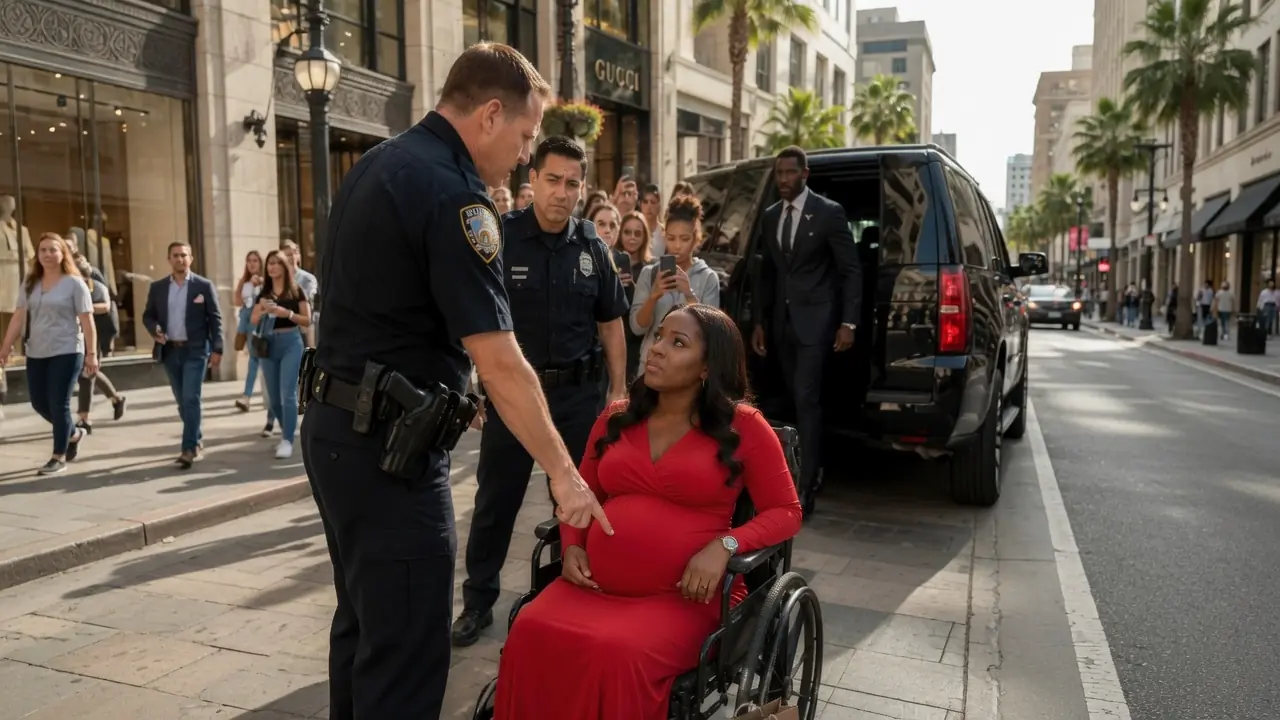
Nia Holloway remained seated in her wheelchair. At thirty-four, she was thirty-one weeks pregnant and recovering from a fractured ankle suffered during a traffic accident six weeks earlier. Her doctor had ordered her to avoid placing weight on the injury, but nothing in that instruction required her to surrender her dignity to a police officer who had decided she looked wrong outside an expensive store.
Mercer tightened his jaw. “Who are you supposed to be?”
Damon stopped several feet away rather than moving into the officer’s space. “The man who watched you turn off your body camera before touching my wife.”
Mercer glanced down at the dark indicator on his chest. “The battery failed.”
“It failed immediately after the boutique manager pointed at her?”
The officer’s younger partner lowered his gaze. He had watched Mercer press the camera’s power switch after stepping out of the patrol car. Until that moment, he had believed the confrontation would end with another trespass warning and an embarrassed person being forced away from the shopping district.
Damon raised one hand toward the SUV. Its rear display became visible through the open passenger door. The screen showed multiple camera angles of Mercer approaching Nia, disabling his body camera, tearing the shopping appointment card from her hand, and grabbing the wheelchair without asking a single question.
Mercer released the handle.
“That recording is private property,” he said.
Nia looked directly at him. “So is the chair you tried to move while I was sitting in it.”
Twenty-three minutes earlier, Nia had arrived outside Bellamy Row, an exclusive shopping district lined with luxury boutiques, palm trees, hotels, and restaurants whose menus displayed no prices. She had come to inspect the wheelchair access outside Maison Laurent, the most profitable store in a building owned by Holloway Urban Holdings.
Damon had founded the company twelve years earlier, but Nia had helped turn it from a real-estate operation into an investment group with strict accessibility and civil-rights policies. She was not merely the owner’s wife. She was the company’s general counsel, a voting partner, and the person who reviewed every serious complaint involving tenants.
Three disabled customers had contacted her during the previous month. One was an elderly veteran who said a police officer ordered him away from the boutique because his mobility scooter made the entrance “look like a clinic.” Another was a Black woman with multiple sclerosis who had been accused of begging while waiting for a rideshare.
The third complaint came from a pregnant hotel employee who used a wheelchair during recovery from surgery. She said Officer Mercer grabbed her chair, rolled her into the street, and threatened to arrest her when she demanded his name.
All three incidents supposedly occurred beyond the range of functioning security cameras. All three police reports claimed the complainants had become disruptive. None contained body-camera footage.
Nia asked the boutique’s general manager, Celeste Vaughn, for an explanation. Celeste denied knowing about any discriminatory conduct and blamed a private district association responsible for sidewalk security. When Nia requested camera records, Celeste said the system automatically deleted footage after seventy-two hours.
That statement was false.
Holloway Urban Holdings had installed the cameras and paid for encrypted thirty-day storage. Celeste could hide clips from the boutique’s local console, but she could not erase the mirrored files preserved by the building owner.
Damon suggested sending investigators openly. Nia disagreed. The complaints described treatment that occurred only when employees believed no powerful witness was present. Arriving with attorneys and security personnel would produce a polished performance rather than the truth.
She scheduled an appointment under her own name to review a limited-edition handbag for an upcoming charity auction. Celeste received the appointment but apparently never connected Nia Holloway with Holloway Urban Holdings because the building itself was legally owned through a separate company.
Damon remained nearby in the SUV with the company’s security director and a retired federal investigator. The vehicle’s computers received live feeds from the exterior cameras. Nia carried a phone programmed to transmit audio whenever she pressed its side button three times.
The test was supposed to determine whether wheelchair users could enter the boutique without obstruction. It took less than four minutes to receive an answer.
Nia stopped beside the entrance while an employee prepared a portable ramp required by the building lease. Celeste appeared behind the glass door, studied Nia’s wheelchair and black maternity dress, and instructed the employee to take the ramp away.
She then made a phone call.
Mercer’s patrol vehicle arrived before Nia could contact the boutique again. He stepped onto the sidewalk with Officer Luis Ortega, his new partner, and walked directly toward Nia. He did not speak to Celeste in public, though camera footage showed her nodding at him through the window.
“You need to move,” Mercer said.
“I have an appointment inside.”
“This entrance is for customers.”
“I am a customer.”
Mercer looked at the handbag attached to her wheelchair. “That bag is probably worth more than your chair.”
Nia recognized the tactic immediately. He was not investigating conduct. He was creating humiliation, provoking anger, and establishing a public story in which she appeared suspicious before anyone examined the facts.
She presented the appointment confirmation on her phone. Mercer refused to read it and demanded identification. Nia handed him her driver’s license, but he barely looked at the name.
Celeste stepped outside and claimed the boutique had no record of the appointment. Her employee stared at the ground, unwilling to contradict her.
Nia asked Celeste to check the reservation system. Celeste said the store did not permit “unverified individuals” to block the entrance. There were almost twelve feet of open sidewalk behind the wheelchair.
Travelers and shoppers began slowing down. Mercer ordered them to keep moving, but the luxury district was full of tourists accustomed to filming anything unusual. The first phone appeared before he touched Nia.
“Are you accusing me of a crime?” she asked.
“I’m telling you to leave.”
“Under what authority?”
Mercer smiled. “The authority standing in front of you.”
Nia pressed the side button on her phone.
Inside the SUV, Damon heard the conversation through the speakers. He watched Mercer’s body-camera light switch off and saw the officer gesture toward Celeste before moving behind Nia’s wheelchair.
The security director wanted to intervene immediately. Damon stopped him for several seconds, long enough to record Mercer placing both hands on the chair and attempting to pull it backward.
Nia locked the wheels.
“You can’t stay here,” Mercer snapped. “Move before I drag you and that fake designer bag off this sidewalk.”
She placed one hand protectively over her stomach. “Touch this chair again, and your body camera becomes evidence.”
Mercer threatened to handcuff her.
That was when Damon stepped from the SUV.
Now Mercer attempted to reshape the confrontation. He told the crowd that Nia had refused a lawful order and had been impersonating a customer to enter a secured commercial property. He claimed Damon was interfering with police activity and ordered him to identify himself.
Damon handed his identification to Ortega, not Mercer. The younger officer read it twice and immediately stepped away from Nia.
“Sir,” Ortega said quietly to Mercer, “the building is owned by his company.”
Mercer’s face hardened. “That does not make the sidewalk private.”
“No,” Nia replied. “It makes your claim that I was trespassing inside my own building especially difficult.”
Celeste retreated toward the boutique door.
Nia pointed toward her. “Do not let the manager leave.”
Mercer moved between Celeste and the crowd. “Nobody is being detained except the woman who refused my instructions.”
A new vehicle stopped behind the patrol car. Deputy Chief Angela Foster stepped out with two internal-affairs investigators. Damon had contacted her before leaving the SUV because Mercer’s name already appeared in the three complaints reviewed by Holloway Urban Holdings.
Foster watched the footage on the vehicle display before addressing him.
“Officer Mercer, surrender your body camera and remain where you are.”
“This is a misunderstanding.”
“Your camera did not fail.”
“You cannot know that yet.”
Foster held up a department tablet. “The device sent a manual shutdown command from your user profile.”
Mercer looked toward Ortega as though expecting support. The younger officer shook his head.
“He turned it off,” Ortega said. “I saw him.”
Mercer’s expression changed from arrogance to betrayal. “Be very careful, rookie.”
“That sounded like another threat,” Nia said.
Internal affairs collected Mercer’s weapon, badge, phone, and body camera. Foster did not arrest him immediately, but she placed him on emergency suspension and instructed him not to communicate with Celeste or any district employee.
Celeste claimed she needed to return inside to protect expensive merchandise. Damon’s security director informed her that the boutique had been temporarily sealed under the building’s emergency evidence-preservation policy.
“You cannot close my store,” Celeste said.
“We own the walls, the camera system, the loading entrance, and the lease you violated,” Nia replied. “The merchandise may be yours. The right to discriminate from our property is not.”
The teenage livestream continued capturing every word.
Within an hour, the video had spread across social media. Millions watched Mercer point at Nia’s pregnant stomach, grip her wheelchair, and threaten to drag her away while Celeste observed from the doorway.
Maison Laurent’s corporate office issued a statement describing Celeste as a respected manager and the incident as an incomplete interaction being misrepresented online. Holloway Urban Holdings responded by releasing the full camera sequence, beginning with Celeste removing the access ramp and quietly calling Mercer.
The additional footage eliminated any claim that the confrontation began with disruptive conduct.
Internal affairs searched Mercer’s department phone. Messages between him and Celeste extended back almost three years.
Celeste regularly sent photographs of people she wanted removed. Some messages contained no allegations of crime, only descriptions such as “wheelchair near entrance,” “young Black men browsing too long,” “woman wearing hotel uniform,” or “man who appears homeless.”
Mercer usually arrived within minutes.
Afterward, he marked the encounter as a trespass warning, suspicious-person investigation, or voluntary relocation. The official language concealed the actual purpose: protecting the district’s luxury image by driving away people Celeste believed made wealthy shoppers uncomfortable.
The arrangement was not unpaid.
Maison Laurent’s local marketing account sent monthly consulting payments to a private company registered to Mercer’s cousin. The invoices described emergency-planning services that were never performed.
Investigators found similar payments from two restaurants and a jewelry boutique. Mercer had converted police authority into a private removal service.
Businesses paid him to make unwanted people disappear from public sidewalks. Those who objected risked arrest, fabricated charges, property seizure, or public humiliation.
The wheelchair complaints represented only part of the scheme. Street musicians had lost instruments during questionable confiscations. Hotel workers had been searched after finishing late shifts. Young Black shoppers were accused of organized retail theft without stolen merchandise being found.
Mercer’s reports followed the same pattern. The person became aggressive. The person refused lawful commands. The person left before identification could be verified.
Without body-camera footage, the officer’s account usually prevailed.
But the cameras had not failed as often as Mercer claimed.
Forensic technicians discovered that he manually disabled his device during thirty-eight incidents over three years. Department policy permitted shutdowns only inside bathrooms, hospitals, confidential victim interviews, or protected tactical discussions.
Luxury storefronts appeared nowhere on that list.
Damon’s mirrored building archive contained recordings from sixteen of those incidents. Celeste had hidden each clip from the local boutique system after Mercer filed his report, believing the footage had been erased permanently.
One video showed him rolling the elderly veteran’s mobility scooter into the street. Another captured Celeste laughing after the pregnant hotel employee was threatened with arrest.
A third showed Mercer taking five hundred dollars from a street vendor’s envelope before ordering him never to return.
When investigators confronted Celeste with the footage, she blamed corporate pressure. She said regional executives measured her performance partly through the appearance of exclusivity surrounding the store.
“The sidewalk became crowded,” she explained. “Customers paying thousands of dollars did not want to step around people sitting outside.”
“People sitting outside?” Nia repeated. “You mean disabled customers.”
“Not everyone was a customer.”
“You never checked.”
Celeste looked away.
The investigation spread to the Bellamy Row Business Association. Its internal manual encouraged stores to report “visual disruptions,” “accessibility congestion,” and “non-luxury activity.” Those phrases were deliberately vague, allowing employees to target people without writing openly discriminatory instructions.
One presentation warned that wheelchairs, medical devices, service workers, and large family groups could weaken a “curated premium environment” if they remained near storefronts too long.
Nia read the slides inside her office while resting her injured ankle. Her daughter’s heartbeat had been checked after the confrontation, and both mother and baby were healthy. Still, the memory of Mercer pulling the chair stayed with her more intensely than the insult.
A wheelchair was not luggage. It was part of her temporary physical freedom. Grabbing it without consent had been an invasion of her body as much as grabbing her arm.
Maison Laurent’s regional director requested a private meeting. Nia agreed only if the three disabled complainants were invited and permitted to bring attorneys.
The meeting occurred in the now-closed boutique. Empty display shelves lined the walls because the company had removed its merchandise while fighting eviction from the building.
The veteran described being pushed toward traffic. The woman with multiple sclerosis explained that Mercer’s confrontation triggered symptoms requiring hospitalization. The hotel employee said she had stopped using the sidewalk entirely, taking a longer route behind loading docks because she feared seeing him again.
The regional director apologized and offered confidential settlements.
Nia refused to negotiate secrecy.
“You do not get to purchase silence and call it reform.”
Holloway Urban Holdings terminated the boutique’s lease for civil-rights violations, falsified security reports, and interference with accessibility obligations. Maison Laurent could challenge the decision in court, but the preserved footage made its position weak.
The company settled instead. It compensated victims, dismissed the executives who approved the image-management program, and funded an independent accessibility center inside the district.
Mercer faced criminal charges involving bribery, assault under color of law, theft, evidence tampering, and civil-rights violations. Prosecutors also reopened arrests linked to his disabled cameras.
Celeste was charged with conspiracy, obstruction, and falsifying complaints. She entered a cooperation agreement and provided communications showing that several business owners knew Mercer’s services included intimidation.
Ortega remained on duty after investigators confirmed he had not participated in earlier incidents. He testified that he froze during the first minute because Mercer was a senior officer who controlled probationary evaluations.
Nia did not excuse his silence.
“You watched him put his hands on a pregnant woman’s wheelchair,” she told him during the disciplinary hearing.
“I know.”
“What will you do differently next time?”
“I will intervene before the person being harmed has to prove they are important.”
That answer mattered more to her than an apology.
Deputy Chief Foster created a policy requiring automatic supervisory alerts whenever an officer manually deactivated a body camera in a public commercial area. Businesses could no longer request police removal from public sidewalks without identifying a specific alleged offense.
Every trespass complaint required verification of property boundaries, because Celeste had frequently claimed authority over sidewalks owned by the city or common areas controlled by Holloway Urban Holdings.
Damon and Nia redesigned Bellamy Row’s access standards. Every entrance received permanent ramps, wider waiting areas, seating, and independent complaint stations. Security contracts were reviewed by a community panel that included disabled residents, retail workers, and civil-rights attorneys.
Several luxury tenants objected that the new rules would change the district’s appearance.
“That is the point,” Nia replied.
Three months after the confrontation, she returned to Bellamy Row carrying her newborn daughter. Her ankle had healed enough that she no longer needed the wheelchair, though Damon pushed it beside them because Nia intended to donate it to the new accessibility center.
The former Maison Laurent space had reopened as a mixed retail and community showroom. Small designers rented displays beside adaptive-clothing companies, wheelchair-accessory makers, and local artists.
The veteran attended the opening on his mobility scooter. The hotel employee arrived with her husband and stood near the entrance without looking over her shoulder.
A reporter asked Nia whether she believed the system changed because Mercer discovered she owned the building.
“He did not change,” she said. “He was stopped.”
“What would have happened if you had been an ordinary shopper?”
“I was an ordinary shopper. Ownership should not determine whether someone can sit on a sidewalk without being assaulted.”
Damon watched from beside the black SUV, holding their daughter against his chest. The vehicle no longer represented approaching power to Nia. It reminded her of the screen inside, displaying footage Mercer believed he had erased.
He had counted on the usual sequence: disable the camera, frighten the target, write the report, and let authority erase the difference between truth and paperwork.
This time, the truth existed in too many places.
It lived in the mirrored recordings, the livestreams, the messages, the payment records, and the voices of people who finally realized their experiences formed a pattern.
Mercer had told Nia she could not stay there.
Months later, she stood at the same entrance while disabled customers, workers, families, and shoppers passed freely around her.
The officer who tried to remove her was awaiting trial. The manager who called him no longer controlled the door. The contract that rewarded exclusion had been exposed and dismantled.
Nia looked toward the sidewalk where her wheelchair had once been grabbed. A permanent bronze sign had been installed beside the entrance.
It contained only one sentence:
Public dignity does not require private permission.