The sealed packet of cocaine had not been inside Adrian Cole’s wallet when he entered the Grand Meridian Hotel. He knew that because the wallet had remained in the inner pocket of his cream knit shirt from the moment he left his vehicle until Officer Grant Mercer grabbed him beside the marble reception desk. Adrian also knew the evidence seal printed across the plastic belonged to the FBI’s Miami field office. What he did not yet know was how two local police officers had obtained it—or why they were reckless enough to plant it on the federal agent investigating them.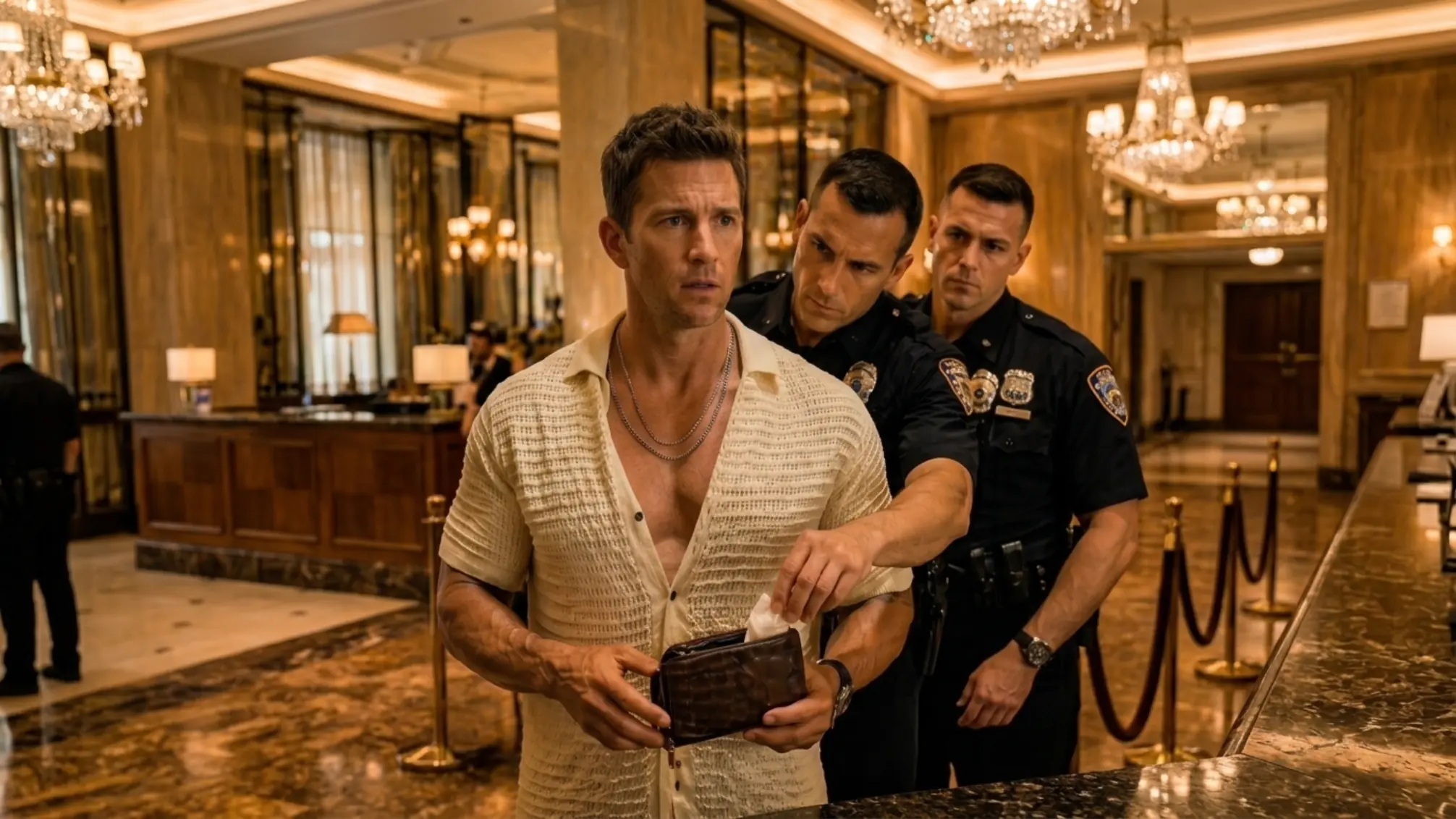
“Give me your hands,” Mercer ordered, twisting Adrian’s right arm behind his back. “We found cocaine, so quit acting innocent.”
Adrian was a forty-six-year-old white American FBI agent with deeply tanned skin, a bald head, a powerful muscular build, and a large black tattoo visible across the open collar of his cream shirt. He could have broken Mercer’s grip in less than two seconds, but twenty years of federal work had taught him that winning the physical moment often destroyed the larger case. Instead, he remained still while the second officer, forty-four-year-old Owen Briggs, held the packet inches from his face. Around them, hotel guests had begun recording with their phones.
“Check the seal,” Adrian said coldly. “Before you make the worst arrest of your life.”
Briggs examined the white powder through the clear plastic and laughed. “One more lie, and I’ll bury you with possession and trafficking.”
“Cuff me,” Adrian replied. “Then explain to the FBI why you seized its evidence.”
Mercer forced Adrian’s other arm behind him and locked the handcuffs tightly around both wrists. The officer leaned close enough for Adrian to smell coffee and mint on his breath. “Everybody claims to know someone important after we catch them.”
“I didn’t say I knew the FBI.”
Adrian looked directly at him.
“I said you were holding its property.”
That should have slowed them down.
Instead, Briggs pushed the leather wallet onto the polished counter and pulled the federal identification card halfway from its compartment. A gold badge sat beneath it, reflecting the hotel’s warm chandelier light. Briggs glanced at the card for less than a second before shoving it back inside.
“Fake,” he said.
Adrian almost smiled. “Run the badge number.”
Mercer tightened the cuffs another notch. “You don’t give orders.”
“Then consider it professional advice.”
The confrontation had begun less than three minutes earlier. Adrian had arrived at the hotel for a meeting with Special Agent Elena Torres, who was operating undercover inside a narcotics task force suspected of diverting seized drugs back onto the streets. Adrian served as assistant special agent in charge of the Miami FBI office, but the hotel staff knew him only as Daniel Cross, a wealthy private-security consultant attending a real estate conference. His appearance was deliberately memorable: open designer shirt, heavy watch, visible tattoo, and enough cash in his wallet to attract dishonest officers.
For six months, the FBI had investigated Mercer and Briggs.
Both men worked for the Harbor Point Police Department’s vice and narcotics unit. Their arrest numbers were among the highest in the county, and local newspapers repeatedly praised them for taking drugs and weapons off the streets. Yet the evidence connected to their cases showed a strange pattern. Seized narcotics frequently weighed less when they arrived at the evidence facility than they did in photographs taken during arrests.
Small differences could be explained by damaged packaging or field testing.
These differences could not.
A four-kilogram seizure became three and a half before laboratory intake. Six hundred prescription pills became four hundred and seventy-three. Cash recorded at an arrest scene disappeared between the patrol car and the property room. Complaints were filed, but defendants accused of trafficking rarely received public sympathy, and prosecutors treated every allegation as an attempt to escape responsibility.
Then one defendant died.
Twenty-six-year-old Black American restaurant worker Jamal Price had been arrested after Mercer and Briggs claimed they found cocaine inside his vehicle. Jamal insisted the packet had been planted. He refused a plea agreement and spent seven months in jail awaiting trial because his family could not afford the bond.
Three days before the hearing that might have exposed inconsistencies in the officers’ reports, Jamal was found unconscious in his cell.
The official ruling called his death an accidental overdose.
The drugs inside his body matched a batch previously seized by Mercer and Briggs.
That was when Adrian took control of the investigation personally.
He did not believe the officers had directly caused Jamal’s death, but someone had moved narcotics from police custody into the county jail. The same network might be selling seized evidence through dealers, informants, or corrupt detention staff. Mercer and Briggs appeared at the center of every path the FBI followed.
The Grand Meridian meeting was supposed to produce the first direct proof.
Elena Torres had spent four months working undercover as an accountant for Vincent Cade, a Miami businessman who purchased stolen drugs from police officers and resold them through private clubs. Cade planned to meet Mercer that afternoon inside the hotel lounge. Elena had arranged for Adrian to receive a flash drive containing financial records, coded payments, and videos showing officers delivering sealed evidence bags.
Adrian entered the lobby fifteen minutes early.
Mercer and Briggs were already waiting.
He recognized them immediately but did not react. They wore full uniforms instead of plain clothes, which meant the planned exchange had probably changed. Adrian walked toward the reception desk and asked whether a package had been left under the name Daniel Cross.
The clerk found nothing.
Then Mercer approached.
“You staying here?”
Adrian turned slowly. “Is there a problem?”
“You’ve been standing near the desk watching people.”
“I’ve been standing near the desk waiting for a package.”
“Identification.”
Adrian gave him a standard driver’s license connected to the cover identity. It was legitimate enough to survive routine examination. Mercer studied it while Briggs moved behind Adrian.
“What kind of package?” Mercer asked.
“Business documents.”
“From whom?”
“That’s private.”
Mercer smiled without warmth. “Not anymore.”
Adrian held out one hand for the license. “Unless I’m detained, return it.”
Briggs grabbed his upper arm.
The movement was fast but not professional. It was the action of a man trying to provoke resistance. Adrian allowed himself to be turned toward the counter, keeping his hands visible.
“I do not consent to a search.”
Mercer reached inside the open shirt and removed the leather wallet.
The packet of cocaine appeared moments later.
Adrian knew immediately that the officers had been warned.
Somebody inside the investigation had told them Daniel Cross would arrive carrying a wallet, and the plan was no longer merely to avoid the FBI operation. They intended to destroy it by arresting the supposed informant before he could meet Elena.
What they did not know was that Daniel Cross and Adrian Cole were the same man.
Now Mercer began dragging him toward the hotel entrance while Briggs collected the wallet, firearm, phone, and packet. Guests moved away from the doors, but their cameras remained raised. The hotel security manager, a thirty-eight-year-old Asian American man named Thomas Lee, stepped from behind the front desk.
“Officer, our cameras cover this entire area.”
Mercer glared at him. “Are you interfering with an arrest?”
“No. I’m informing you that the footage is being preserved.”
“Preserve whatever you want.”
Adrian turned his head toward Thomas. “Make an external copy before they return with a warrant.”
Mercer shoved him forward. “Stop talking.”
“That advice wasn’t for you.”
Outside, humid afternoon air pressed against the hotel entrance. Mercer forced Adrian against the hood of a marked patrol vehicle while Briggs removed the service weapon from the holster beneath his shirt. The second officer stepped back sharply.
“He’s armed.”
Adrian stared at him. “You already knew that.”
Briggs drew his pistol anyway and aimed it at Adrian’s chest.
“Don’t move.”
“My hands are cuffed.”
“Keep them where I can see them.”
“That instruction would be easier if you hadn’t locked them behind me.”
Several witnesses gasped, but Adrian’s voice remained calm. He knew every second was being recorded from multiple angles. More importantly, the hotel’s surveillance system had captured Mercer reaching into the wallet before the cocaine appeared clearly in his hand.
Briggs examined the serial number on Adrian’s weapon.
The color shifted in his face.
Federal service weapons were registered differently from civilian firearms. The number alone did not reveal Adrian’s position, but it would become difficult to explain once dispatch ran it through the system.
Mercer saw the hesitation.
“What?”
Briggs lowered his voice. “The weapon may be government-issued.”
Mercer looked toward Adrian.
“You federal?”
“I already gave you a badge.”
“That wasn’t an answer.”
“It was a better one.”
Mercer reached for the keys on his belt.
Adrian moved away from him.
“Don’t unlock them.”
The officer froze. “What?”
“You decided I was a trafficker. You accused me publicly, seized my weapon, rejected my credentials, and planted federal evidence in my wallet.”
“I didn’t plant anything.”
“Then take me to the station and write that statement under your name.”
Mercer’s jaw tightened. “This can be resolved here.”
“It could have been resolved when I told you to verify the badge.”
Briggs looked toward the hotel windows. Nearly every visible person was recording.
A black Chevrolet Tahoe entered the circular drive.
Then another.
The vehicles stopped behind the police cruiser, blocking its exit without touching it. Doors opened, and six FBI agents stepped onto the pavement wearing dark tactical jackets with yellow lettering across the chest.
Special Agent Elena Torres came from the first vehicle.
Elena was a forty-year-old Latina American woman with dark hair pulled into a severe ponytail and an expression of controlled fury. She looked at the packet in Briggs’s hand, the federal weapon on the hood, and Adrian in cuffs.
Then she faced the officers.
“Which one of you searched my supervisor?”
Mercer straightened. “This man is under arrest for drug possession.”
Elena displayed her credentials. “Special Agent Elena Torres, Federal Bureau of Investigation.”
Briggs took one step backward.
She pointed toward Adrian. “That is Assistant Special Agent in Charge Adrian Cole.”
Mercer reached for the keys again.
Adrian shook his head. “Leave them.”
Elena understood immediately.
“Photograph the cuffs before removal,” she told another agent. “Record the serial numbers, tension, wrist injuries, and the exact location of every seized item.”
Mercer looked between them. “You can’t take over a local arrest.”
Elena stepped closer. “You are holding federal evidence stolen from an active investigation.”
“We found it in his wallet.”
“The packet was logged into our Miami evidence system three days ago.”
Briggs’s eyes moved toward the seal.
The identification number was printed clearly beneath the FBI abbreviation. Only someone with access to restricted evidence had been able to remove it. The packet had originally been seized from Vincent Cade’s storage apartment during an unrelated covert search and planted with a tracking tag inside the seal.
Elena removed a small receiver from her jacket.
The screen displayed the packet’s location.
“We have been tracking that evidence since it left our secure facility at six twelve this morning.”
Mercer stared at Briggs.
Briggs stared back.
For the first time, Adrian saw genuine fear pass between them. One officer had expected the other to understand where the packet came from. Neither had anticipated that the FBI deliberately tracked it.
Adrian turned toward Elena. “Where’s Agent Morris?”
Elena’s expression hardened. “Missing.”
Daniel Morris was the evidence technician assigned to the operation. His access card had opened the secure storage room before dawn. Security video then showed him leaving the building with a dark gym bag and entering a vehicle registered to Harbor Point Police Lieutenant Calvin Ross.
Ross supervised Mercer and Briggs.
The corruption extended higher than Adrian feared.
Federal agents removed the handcuffs only after photographing the injuries around his wrists. Adrian accepted his badge, wallet, and firearm from Elena, but he did not touch the cocaine packet. An evidence specialist placed it inside a larger transparent container.
Mercer raised both hands. “I want a lawyer.”
“You’re not under arrest,” Adrian said.
The officer looked surprised.
“Not yet.”
Adrian turned toward Briggs.
“Where were you taking me?”
“The station.”
“Which entrance?”
“The main entrance.”
“That’s a lie.”
Briggs said nothing.
The patrol vehicle’s navigation system showed a destination entered fifteen minutes earlier: an abandoned Harbor Point evidence annex near the industrial docks. The building had closed two years ago after flooding damaged its lower floor.
Adrian looked at Mercer. “You planned to take Daniel Cross there.”
“We didn’t know who you were.”
“That is the only true thing you’ve said.”
Local police supervisors arrived within minutes, including Chief Raymond Keller, a sixty-year-old white American man who looked more angry about the witnesses than the conduct. He ordered Mercer and Briggs to return to headquarters for internal questioning.
Adrian blocked the patrol car.
“No.”
Keller’s eyes narrowed. “This is my department.”
“And this is a federal obstruction investigation.”
“You haven’t established probable cause.”
Adrian nodded toward the packet. “Tracked federal evidence was planted during an unlawful search conducted by two officers connected to a lieutenant whose vehicle removed that evidence from our facility.”
Chief Keller lowered his voice. “We can cooperate without humiliating the department.”
“Your officers tried to transport a federal agent to an abandoned building.”
“You don’t know that.”
“The navigation record does.”
Keller turned toward Mercer. “Is that true?”
Mercer looked at the ground.
The chief’s face changed.
Adrian ordered both officers separated. Their phones, body cameras, radios, weapons, and vehicle systems were secured before anyone could erase data. Federal investigators also entered the Grand Meridian and copied every security recording.
The lobby video provided the most damaging evidence.
It showed Briggs standing behind Adrian while Mercer searched the wallet. Briggs removed the cocaine packet from beneath his vest and passed it into Mercer’s left hand. Mercer then placed that hand inside the wallet before announcing the discovery.
The act lasted less than two seconds.
It was still clear enough to end both careers.
The investigation expanded before sunset.
Daniel Morris was found alive inside the abandoned evidence annex. He had been beaten, restrained with plastic ties, and left inside a locked storage room. Morris admitted that Lieutenant Ross threatened his family and forced him to open the federal evidence vault.
Ross intended to use the packet to frame Daniel Cross, whom he believed was Elena’s confidential informant.
Someone had leaked the alias but not Adrian’s identity.
Morris told investigators that Mercer and Briggs were supposed to arrest Cross, seize the expected flash drive, and transport him to the annex. Ross would then destroy the financial records and make the supposed informant disappear inside the local criminal system under trafficking charges.
They expected him to spend days in jail before anyone questioned the arrest.
They expected no one powerful to care.
Adrian’s meeting with Elena had been bait from the beginning. The FBI suspected a leak and deliberately circulated different meeting locations and times among limited groups. Only the information provided to Morris mentioned the Grand Meridian and the Daniel Cross identity.
The corrupted evidence technician had not chosen betrayal willingly, but fear made him useful.
The hotel arrest revealed the entire route.
Federal agents arrested Lieutenant Ross that evening while he attempted to leave Florida in a rented vehicle. His phone contained messages from Mercer and Briggs discussing the packet, the abandoned annex, and the need to recover “whatever Cross brought.”
A message from Briggs read:
If he resists, we write the gun first and the drugs second.
Mercer answered:
Nobody argues with both.
Other records exposed years of misconduct. The officers seized drugs, skimmed portions before evidence intake, and transferred them to Vincent Cade through intermediaries. Cade paid cash, funded vacations, and provided information about rival dealers whom Mercer and Briggs later arrested.
Those arrests improved their reputations while eliminating Cade’s competition.
Lieutenant Ross protected the operation by altering property logs and assigning internal complaints to loyal supervisors. Chief Keller claimed ignorance, but audits showed that he had repeatedly rejected requests for independent evidence-room inspections.
He resigned before the federal grand jury finished its work.
Mercer and Briggs were charged with conspiracy, civil-rights violations, evidence tampering, narcotics trafficking, kidnapping, obstruction, and assault on a federal officer. Ross faced additional charges connected to Daniel Morris’s abduction.
Vincent Cade attempted to negotiate immunity.
Adrian refused to promise it.
“You purchased drugs stolen from police evidence and helped frame innocent people,” he told Cade during an interview. “Cooperation may change the recommendation. It does not rewrite what you did.”
Cade eventually provided records identifying prosecutors, detention officers, and dealers connected to the network.
Jamal Price’s case became central.
The cocaine found inside his vehicle had come from an earlier police seizure. Mercer planted it after Jamal refused to become an informant. When Jamal continued challenging the arrest from jail, a detention employee connected to Cade placed drugs inside his cell, hoping an infraction would discredit him before trial.
Jamal consumed them during a period of despair and died.
His mother, Patricia Price, attended every day of Mercer’s trial.
She was a fifty-four-year-old Black American elementary school administrator who carried a photograph of her son inside a blue folder. The defense argued that Jamal’s death was too distant from the officers’ original conduct to matter.
The judge allowed the evidence.
A chain did not become innocent merely because several people touched it.
During trial, Mercer insisted he genuinely believed Adrian’s badge was fake. Prosecutors played the hotel footage showing him refuse to call the number printed on the credential.
They also displayed the tracked evidence packet and its movement from the FBI vault to Ross’s vehicle, then Briggs’s vest, and finally Adrian’s wallet.
Briggs pleaded guilty before the jury returned. He testified against Mercer and Ross in exchange for consideration during sentencing, but his cooperation came only after the videos made denial impossible.
Mercer was convicted on every major count.
Ross was convicted two months later.
Daniel Morris received a reduced sentence because of the threats against his family, but he still lost his federal position and accepted responsibility for opening the evidence vault. Adrian visited him once before sentencing.
“I was afraid,” Morris said.
“I know.”
“You would have done something different?”
“I would like to believe so.”
“That isn’t an answer.”
Adrian considered him. “Courage is easier to describe after the danger belongs to someone else. But you had options before you opened that door.”
Morris looked down.
Adrian did not offer false comfort.
Compassion did not require dishonesty.
The Harbor Point Police Department underwent federal supervision. Evidence intake became digitally tracked from the moment of seizure. Officers could no longer transport narcotics without two-person verification, sealed weight records, and automatic camera activation.
Hundreds of cases involving Mercer and Briggs were reviewed.
Dozens were dismissed.
Several wrongfully convicted people received compensation, though no payment could return the years taken from them.
Patricia Price received a formal apology from the city. She accepted the document but refused to attend the press conference.
“My son needed you to believe him while he was alive,” she wrote in response. “Do not ask me to celebrate that you finally believe him now.”
Her words became part of the department’s training program.
Six months after the hotel arrest, Adrian returned to the Grand Meridian. The marble lobby looked exactly as it had that afternoon—warm lights, polished counters, expensive luggage, and quiet conversations.
Thomas Lee, the security manager who preserved the footage, met him near the front desk.
“The staff still talks about it,” Thomas said.
“They should talk about why they kept recording.”
“Some people worried the officers would take their phones.”
“They had reason to worry.”
Thomas handed Adrian a new coffee. “The hotel owner wanted to put up a plaque.”
Adrian shook his head. “Don’t turn somebody’s corruption into decoration.”
“What should we do instead?”
“Keep the cameras working. Protect employees who speak. Save evidence before powerful people ask you not to.”
Thomas nodded.
Adrian stood beside the same counter where the cocaine packet appeared. The marble had been polished so thoroughly that no stain remained.
The officers had believed appearances would decide the story.
A muscular man with tattoos, cash, a firearm, and cocaine would look guilty. Two uniformed officers would look credible. A report written quickly enough would become truth before anyone examined how the evidence appeared.
They were almost right.
The difference was a hotel camera, a tracked seal, several witnesses, and a man who understood that calmness could preserve more evidence than anger.
Mercer and Briggs did not lose because their victim happened to be an FBI agent.
They lost because the badge they dismissed belonged to someone with the resources to force every claim into the light.
Adrian never forgot that most people they had framed possessed no such protection.
That was why, when Mercer reached for the handcuff keys, Adrian had not allowed him to erase the moment.
The officers wanted the restraints removed as soon as they discovered his authority.
Adrian kept them on long enough for the cameras to record the truth:
They had not arrested an innocent man by accident.
They had planted drugs on the wrong one.