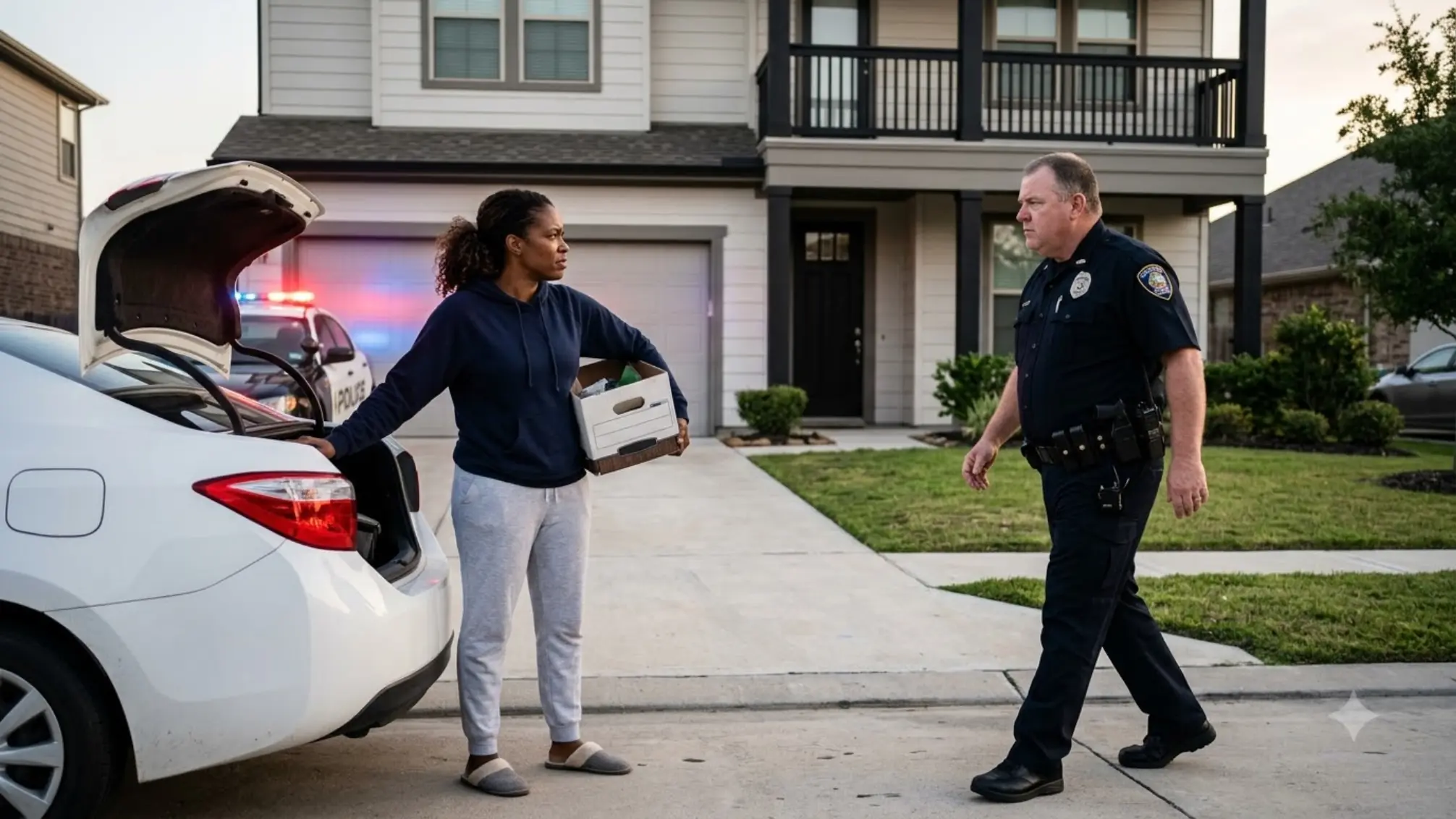
At 6:43 on a gray Thursday evening, United States District Judge Maya Vance stood beside her silver sedan with a cardboard box balanced against her hip. The trunk remained open behind her, revealing grocery bags, court files, and a broken side mirror wrapped in a towel. A marked police cruiser blocked the driveway of her modern two-story home, its flashing red and blue lights reflecting across the white garage door. Officer Nolan Price marched toward her with one hand near his duty belt, already wearing the expression of a man who had decided she was guilty.
For one second, Price hesitated.
Then his eyes moved toward the dark front window behind Maya.
Sixteen-year-old Julian Vance stood inside the house, barely visible through the glass. His left cheek was swollen. A narrow bandage crossed his eyebrow, and both hands were trembling around the edge of the curtain. He had been home less than twenty minutes after surviving a collision that should have killed him.
Maya turned her head only slightly.
“Stay inside, Julian,” she said. “Put the kettle on.”
It sounded like an ordinary instruction between a mother and her child. Julian understood what it really meant. Lock the doors. Call the number she had made him memorize. Do not come outside no matter what happens.
Price continued forward.
“You expect me to believe you’re a federal judge dressed like that?”
Maya looked down briefly at her navy hoodie, light gray lounge pants, and flat house slippers. She had changed out of her courtroom clothes after rushing Julian home from an urgent-care clinic. Her black robe was hanging over a chair inside, and her judicial identification remained in the locked compartment beneath the driver’s seat.
“My clothes are not evidence of a crime,” she said.
“The vehicle was reported stolen.”
“By whom?”
Price’s jaw tightened. “That information is part of an active investigation.”
“The registration is in my name.”
“We’ll determine that after you step away.”
Maya did not move. “The car was struck forty minutes ago by a black SUV that followed my son for six miles. Someone tore off the passenger mirror while trying to force him into a drainage barrier. I have already reported the collision.”
Price glanced at the damaged side of the sedan, but he showed no surprise.
That told Maya more than his answer would have.
He had known about the crash before he entered the driveway.
A second officer, Erin Bell, stepped out of the cruiser and remained near the open driver’s door. She was younger than Price, perhaps thirty, and her body camera displayed a blinking red light. Price’s camera showed no light at all.
Maya pointed toward his chest. “Activate your camera.”
Price looked down, then back at her. “It’s recording.”
“It is not.”
“Stop giving commands.”
“Then follow your department’s policy without being reminded.”
Bell looked at Price. “Sir, your indicator is off.”
He turned sharply. “Watch the house.”
Bell’s shoulders stiffened, but she obeyed. Maya noticed the younger officer’s right hand remained away from her weapon. She also noticed Bell studying the sedan’s broken mirror, the blood on Maya’s palms, and the bruise forming along her wrist.
Price took another step.
“Put the box down.”
“No.”
“That wasn’t a request.”
“Neither was my demand that you activate your camera.”
Price reached for the cardboard box. Maya twisted away, and one corner tore open. Prescription bottles, gauze, a small bag of groceries, and Julian’s cracked mobile phone spilled onto the driveway.
Price immediately kicked the phone away.
Maya stared at it sliding beneath the sedan.
Her voice dropped. “Why did you do that?”
“You reached into the box.”
“I was holding the box.”
“You made a sudden movement.”
“You grabbed it.”
Price seized her wrist.
Maya pulled back. “Release me.”
Instead, he twisted her arm behind her.
Bell stepped forward. “Officer Price, she hasn’t threatened us.”
“She’s resisting.”
Maya’s coffee-colored skin tightened around her knuckles as she tried to keep her balance. “I am standing on my property while you attempt an unlawful seizure.”
Price pushed harder.
Her knees struck the driveway first. Her palms scraped across the concrete, opening the shallow cuts she had received while pulling Julian from the damaged car. Fresh blood appeared across her skin.
Price forced her chest down and placed one knee between her shoulder blades.
Inside the house, Julian flinched away from the window.
Maya lifted her head just enough to see him.
“Stay inside,” she repeated.
Price pulled one wrist behind her.
“You should have followed instructions.”
Maya’s breathing became tight, but her voice remained controlled. “You were not sent here to investigate a stolen car.”
Price froze for half a beat.
“You were sent to recover Julian’s phone,” she continued.
His knee pressed harder into her back.
Bell stared at him. “What is she talking about?”
“Nothing,” Price snapped. “Cuff her.”
Bell did not move.
Price reached for his own handcuffs, but Maya turned her face toward his body camera.
“Your camera is off because Senator Vale’s security director called you before dispatch did.”
The officer’s expression changed.
Maya had not guessed.
She had seen the name on the screen mounted inside his cruiser when he arrived. Graham Vale. The same surname as the eighteen-year-old driver Julian had identified at the crash site.
Price leaned close to her ear. “You need to stop talking.”
“You need to remove your knee.”
“You think your title makes you untouchable?”
“No,” Maya said. “I think the law makes both of us accountable.”
Three hours earlier, Julian had left school in Maya’s sedan because his own used hatchback was in the repair shop. He had permission to drive directly home, stop for groceries, and call when he reached the neighborhood. Maya had still been at the federal courthouse reviewing sealed filings in a public-corruption case involving contracts awarded through Senator Graham Vale’s political network.
Julian never made the call.
At 5:51, Maya received a voice message filled with engine noise and panic.
“Mom, there’s a black SUV following me. It keeps getting beside the car. I think it’s Connor Vale.”
Then came the sound of metal striking metal.
The message ended.
Maya left the courthouse with her clerk and contacted emergency services while driving toward Julian’s last shared location. She found the sedan angled beside a drainage ditch six miles from home, one wheel hanging over the edge. Julian was on the ground, bleeding from the eyebrow, while two motorists tried to keep him conscious.
The black SUV had disappeared.
Julian told her Connor Vale had followed him from a gas station. Connor was the senator’s nephew and the son of Marcus Vale, a real-estate developer whose companies had received more than eighty million dollars in public redevelopment contracts. Julian had recently begun working part-time for a technology repair shop, where he had discovered files on a damaged laptop abandoned by one of Marcus Vale’s former accountants.
Julian had not opened every document. He had opened enough.
Invoices had been altered. Companies that existed only on paper had been paid for construction work never completed. Several transfers matched dates listed in sealed warrants Maya had reviewed in court.
Julian had copied the files onto his phone before realizing who owned the laptop.
Connor Vale somehow learned about it.
At the crash site, Maya asked Julian whether the phone still worked.
“The screen is broken,” he said, “but it recorded everything.”
The sedan’s dashboard camera automatically uploaded low-resolution clips to the phone. Julian had also activated a voice recording when the SUV began following him. Before Maya could examine it, a tow truck arrived without being requested.
The driver said the police had sent him.
Maya refused to release the sedan.
Ten minutes later, Officer Price called her mobile phone and insisted the car had to be impounded as part of a collision investigation. Maya asked for his incident number. He disconnected.
She drove Julian to urgent care, then brought him home herself.
Now Price was kneeling on her back in her own driveway.
A radio crackled at Bell’s shoulder.
“Unit Seven, confirm status.”
Bell looked at Price.
He reached toward her radio. “Suspect detained. Possible stolen vehicle.”
Bell pulled away before he could touch it. “Dispatch, registration returns to Maya Vance at this address. No stolen-vehicle entry appears in the system.”
Price stared at her.
Bell continued. “Request supervisor and medical assistance. One detained woman has bleeding injuries.”
“Cancel that,” Price ordered.
Bell stepped backward. “No, sir.”
The front door opened.
Price turned immediately, releasing one of Maya’s wrists to reach toward his firearm.
Julian stood inside the doorway with his hands raised. His face was pale, but his voice was steady.
“My mother told me to stay inside.”
Maya’s heart pounded. “Julian, close the door.”
“I called the number.”
Price rose from her back. “Get inside now.”
Julian did not move. “The recording is already uploaded.”
The officer’s face lost color.
“What recording?” Bell asked.
Julian looked directly at her body camera. “The SUV hitting my car. Connor Vale threatening me. Officer Price calling him afterward.”
Price lunged toward the porch.
Maya caught his trouser leg from the ground, forcing him to stumble. He spun and kicked her hand away, then reached for Julian.
Bell stepped between them.
“Back up,” she said.
Price stared at his younger partner as if she had betrayed him. “Move.”
“No.”
“That’s an order.”
Bell’s hand hovered near her radio. “You are attempting to enter a private residence without consent, a warrant, or an emergency.”
“The boy has evidence.”
“Evidence of what?”
Price had no safe answer.
The sound of approaching engines filled the street.
Two unmarked state vehicles turned into the neighborhood, followed by a dark federal sedan and an ambulance. Price looked toward the road, then toward his cruiser as if calculating whether he could reach it.
Maya slowly pushed herself onto one knee.
“You should stay,” she said. “Running will look terrible on every camera recording you forgot about.”
The first vehicle stopped across the driveway.
Captain Samuel Rhodes stepped out wearing his uniform jacket. He had served in the department for twenty-six years and had personally met Judge Vance during courthouse-security briefings. When he saw her bleeding on the concrete, his face hardened.
“Officer Price,” Rhodes said, “step away from the judge.”
Price lifted both hands slightly. “Captain, she interfered with a stolen-vehicle investigation.”
Rhodes looked at the silver sedan. Then he looked at Maya.
“That is Judge Maya Vance.”
“I didn’t know who she was.”
Maya stood with Bell’s help. Blood ran down the side of her palm.
“You knew exactly who I was,” she said. “The question is who paid you to pretend otherwise.”
Two investigators from the state bureau approached. Behind them came Special Agent Lena Ortiz from the federal public-corruption task force. Ortiz’s presence confirmed that Julian’s call had reached the right person.
Captain Rhodes examined Price’s inactive body camera.
“Why is this off?”
“It malfunctioned.”
Bell spoke before he could continue. “He refused to activate it after Judge Vance requested that he do so.”
Rhodes turned toward her. “Your camera recorded the encounter?”
“Yes, Captain.”
“All of it?”
“Yes.”
Price looked toward the street. More neighbors had stepped onto their porches, several holding phones.
Rhodes removed Price’s firearm from his holster.
“You are relieved of duty pending investigation.”
“You can’t do this based on her story.”
“I’m doing it based on what I can see, what dispatch recorded, and what your partner’s camera captured.”
Special Agent Ortiz walked to Maya. “Judge Vance, an ambulance will treat your hands. We also need Julian’s device preserved.”
“It is beneath the car,” Maya said. “Officer Price kicked it there.”
Ortiz looked at Price. “Do not move.”
A technician photographed the phone before retrieving it with gloved hands. The screen had shattered further, but the internal memory remained intact. Julian provided the password while standing beside his mother.
The first recovered recording began inside the sedan.
Connor Vale’s black SUV appeared in the left lane. It swerved toward Julian, struck the side mirror, then pulled ahead and forced the sedan toward the ditch. Connor’s voice came through a lowered window.
“Give me the phone, or next time you won’t crawl out.”
The recording continued after the collision.
Julian’s phone had fallen beneath the driver’s seat, where the microphone captured Connor making a call.
“He still has it,” Connor said. “Send Price to the house.”
The final segment was even more damaging.
Price answered through the SUV’s speaker.
“I’ll handle the mother.”
No one in the driveway spoke after the audio ended.
Captain Rhodes looked at the officer he had supervised for nine years.
Price stared at the concrete.
Ortiz ordered him placed in handcuffs.
By midnight, Connor Vale had been arrested at a private airfield while attempting to board his uncle’s chartered plane. Investigators found a new passport, seventy thousand dollars in cash, and a second phone containing messages from Marcus Vale’s security director.
Officer Price was booked for unlawful restraint, obstruction of justice, evidence tampering, and conspiracy. His service records revealed that he had received consulting payments through a company owned by his brother-in-law. The company’s only client was a private security firm controlled by the Vale family.
The discovery transformed the case.
Price had not acted alone or impulsively. For more than three years, he had used police databases to track witnesses, delay reports, and identify people connected to investigations involving Vale businesses. Complaints against him had repeatedly disappeared after being transferred to Deputy Chief Warren Cole.
Cole was arrested two days later.
Investigators recovered deleted emails showing that he had assigned Price to Maya’s home without creating an official dispatch entry. His instruction was short: recover the phone, frighten the mother, and describe the encounter as a stolen-vehicle misunderstanding.
Marcus Vale believed Maya’s position created a problem. Because she had reviewed sealed warrants tied to his companies, any direct threat against her could trigger federal scrutiny. He therefore planned to make the encounter appear accidental.
His plan failed because Julian kept recording.
Maya recused herself from every case connected to the investigation. She gave a formal statement as a victim, surrendered relevant communications, and refused to use her judicial authority to influence charging decisions. She wanted the evidence to survive every accusation that she had acted out of anger.
But she did not hide her anger.
At a public hearing three months later, a council member asked whether Officer Price’s conduct became more serious because he had targeted a federal judge.
“No,” Maya replied. “It became more visible because he targeted a federal judge. The unlawful force would have been just as wrong if I were a teacher, a cashier, or an unemployed mother standing beside her own car.”
She placed photographs of her injured hands on the table.
“He did not stop because I explained the law. He did not stop when dispatch confirmed ownership. He did not stop when his partner questioned him. He stopped only when people arrived whom he considered powerful enough to fear.”
Officer Bell testified next.
She admitted that she should have intervened the moment Price grabbed Maya. Her hesitation had lasted less than a minute, but she refused to excuse it.
“I was afraid of disobeying a senior officer,” Bell said. “Judge Vance was the person paying for my fear.”
Her honesty mattered. The department retained her, required additional training, and later assigned her to help develop a mandatory intervention policy. Officers would now face discipline for standing by while another officer committed an unlawful act.
Price rejected a plea agreement and went to trial.
His attorney argued that he believed the sedan was stolen and that Maya had resisted a lawful investigation. Bell’s body-camera footage destroyed that claim. It showed dispatch confirming Maya as the registered owner. It showed Price ignoring the information, kicking Julian’s phone, and refusing to activate his camera.
The dashcam recording supplied motive.
The payment records supplied conspiracy.
Price was convicted on every major count.
Connor Vale pleaded guilty to aggravated assault, witness intimidation, and conspiracy after investigators found messages in which he bragged that his family could “make police reports disappear.” Marcus Vale and his security director were convicted of bribery, fraud, and obstruction. Senator Graham Vale was not charged for his nephew’s collision, but a separate investigation found that his campaign had received illegal contributions routed through the same shell companies.
He resigned before impeachment proceedings began.
The public-contracting scheme eventually reached more than one hundred and forty million dollars. Money intended for schools, housing repairs, and flood prevention had been redirected through false invoices. Several officials went to prison, and the city recovered a portion of the stolen funds through asset forfeiture.
Julian’s damaged phone remained sealed as evidence until the final appeal ended.
By then, he was nineteen and studying computer science. He no longer froze when a dark SUV appeared behind him, though he still checked his mirrors more often than other drivers. Maya never told him to forget what happened. She taught him how to live without allowing it to control every road ahead.
Three years after the confrontation, they stood together in the driveway beside a different silver sedan.
Maya’s palms had healed, leaving two pale lines near the base of her thumbs. Julian placed a new dashboard camera behind the windshield and tested the connection to a secure backup service.
“You know most people just use these for insurance,” Maya said.
Julian smiled. “Most people don’t have our family history.”
A police cruiser passed slowly on the street.
The officer behind the wheel raised one hand in greeting and continued driving.
Maya watched until the cruiser turned the corner. Then she looked at the place where Officer Price had forced her onto the concrete.
He had believed a uniform, political protection, and an inactive camera made him untouchable. The Vale family had believed money could turn violence into a misunderstanding and evidence into silence.
They had forgotten that the frightened teenager they tried to run off the road understood technology better than they understood accountability.
They had also forgotten that the woman standing between them and her son was not afraid of powerful men.
She had spent her career placing the law above names, offices, and fortunes.
When they brought corruption to her driveway and bloodied her hands in front of her child, Maya Vance did not need revenge.
She only needed the recording to keep playing.