The saliva struck Branson Callaway across the left cheek and slid slowly toward the collar of his gray hoodie.
Forty people stood inside the crowded front lobby of the Atlanta Police Department, yet no one made a sound. A printer hummed behind the reception counter. Somewhere near the entrance, a little boy dropped a plastic toy onto the tile, but even he seemed to understand that something terrible had just happened.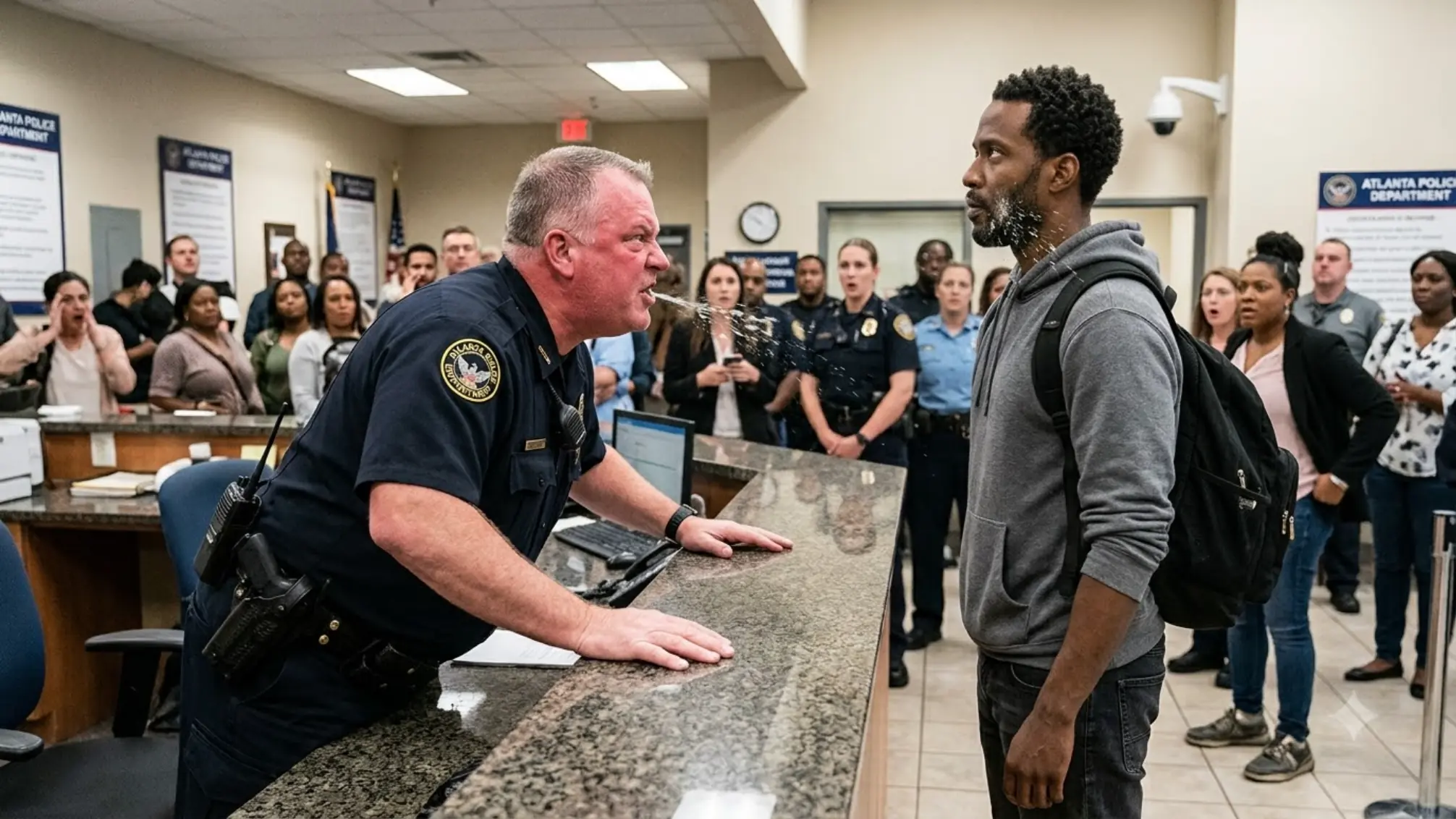
Desk Sergeant Philip Doyle remained inches from Branson’s face.
At fifty-one, Doyle was a broad, heavyset white American police sergeant with short graying hair, a thick neck, and a flushed expression made worse by anger. His navy uniform stretched tightly across his shoulders, and one hand remained braced against the polished granite counter as though the entire building belonged to him.
“Get out,” Doyle said. “Trash like you doesn’t belong in my station.”
Branson slowly lifted the sleeve of his gray hoodie and wiped his cheek.
He was a thirty-eight-year-old Black American man with deep brown skin, short tightly curled hair, a trimmed beard, and calm dark eyes. He wore worn sneakers, faded jeans, and a black backpack over one shoulder. Nothing about him announced authority, wealth, or rank.
That had been intentional.
Branson looked past Doyle toward the ceiling.
Eight security cameras covered the lobby from different angles. Their black glass domes reflected the fluorescent lights, and every one of them appeared active.
Then he checked the digital clock above the records window.
10:31 a.m.
“You just touched the wrong man,” Branson said.
Doyle grabbed the front of his hoodie and pulled him closer across the counter. “Say it again, and I’ll put you through that door.”
Branson’s eyes moved toward the nearest camera.
“Do it,” he said. “Then explain it to your new deputy chief.”
The lobby stopped breathing.
Doyle’s grip remained locked around the gray fabric, but his expression changed. Confusion appeared first, followed by a brief flash of uncertainty. Then pride pushed both away.
“You think I’m stupid?”
“I think you made your decision before asking my name.”
A second officer rushed from behind the counter.
Sergeant Troy Brenner was forty-six, white American, powerfully built, and known throughout the department for treating every disagreement like an attack on his authority. He grabbed Branson’s shoulder and shoved him backward.
The black backpack slipped free and struck the floor.
Its zipper opened halfway.
A sealed folder, several documents, and a leather identification case slid onto the tile.
Brenner pointed toward the entrance. “You heard him. Get out.”
Branson bent carefully and gathered the papers.
Doyle kicked one document away before he could reach it.
The paper stopped near the feet of a young patrol officer standing beside the metal detector. Officer Daniel Ruiz, a twenty-seven-year-old Latino American man, looked down and read the heading.
His face changed immediately.
CITY OF ATLANTA
EXECUTIVE APPOINTMENT ORDER
BRANSON ELIJAH CALLAWAY
DEPUTY CHIEF OF PROFESSIONAL STANDARDS
Ruiz looked from the document to Branson.
“Sergeant,” he said quietly.
Doyle did not turn. “Stay out of this.”
“Sergeant, you need to read this.”
“I said stay out of it.”
Branson picked up the leather case and opened it.
Inside sat a city command credential bearing his photograph, full name, and appointment date. A gold deputy chief’s badge rested beside it.
Brenner stared.
Doyle finally released Branson’s hoodie.
“That can be bought online.”
Branson closed the case. “The mayor’s office might disagree.”
Several civilians raised their phones.
A white American woman standing in line to report a stolen vehicle had recorded the spit. An elderly Black American man near the entrance had captured Brenner shoving the backpack. Two college students were streaming the confrontation live.
Doyle saw them.
“Put those phones away. Recording inside a police facility is prohibited.”
A civilian employee behind the counter spoke before fear could stop her.
“No, it isn’t.”
Doyle turned toward her.
Twenty-nine-year-old records clerk Hannah Brooks immediately lowered her eyes, but she did not withdraw the statement.
The public lobby had no lawful recording prohibition. Everyone working there knew it.
Doyle pointed at her. “We’ll discuss your attitude later.”
Branson looked at the clock again.
10:33.
“You threaten employees often?” he asked.
Doyle’s embarrassment returned as anger. “I don’t care who you claim to be. You entered without checking in, ignored orders, and disrupted my lobby.”
“I checked in at 10:17.”
“No, you didn’t.”
“The civilian desk issued a visitor pass.”
Branson reached toward his hoodie, but the plastic badge was gone.
Doyle had torn it off during the confrontation.
It lay beneath the counter, face down.
Officer Ruiz picked it up.
The visitor badge displayed a security verification code and the words AUTHORIZED EXECUTIVE APPOINTMENT.
Doyle looked toward the receptionist.
She was a thirty-four-year-old Black American woman named Keisha Ward. Her hands trembled above the keyboard.
“Did you issue that?” Doyle demanded.
Keisha hesitated.
Branson watched her carefully. He had read her name before entering the building. She had submitted two internal complaints against Doyle during the previous eighteen months.
Both complaints disappeared.
“Tell the truth,” Branson said. “No one in this room is permitted to retaliate against you.”
Doyle laughed. “You don’t give orders here.”
Branson met his eyes.
“I was appointed to oversee professional standards, internal investigations, discipline, and command integrity. Giving that order is exactly why I came.”
Keisha looked toward the active camera above her desk.
“Yes,” she said. “I issued the pass.”
The lobby filled with nervous whispers.
Doyle turned on her. “Why didn’t you call me?”
“I called the executive floor.”
“I run this lobby.”
“The appointment was confirmed.”
“By whom?”
“The chief’s office.”
Doyle’s face went pale.
Branson placed his documents back inside the backpack.
He had been scheduled to meet Police Chief Leonard Hayes at 10:45. The appointment was meant to introduce him privately to the command staff before a formal announcement that afternoon.
Branson had asked to enter through the public lobby alone.
For eleven months, the mayor’s office had received complaints about the Atlanta department’s central precinct. Black American residents described being treated as suspects while attempting to report crimes. Latino American delivery workers said officers questioned them before allowing them to enter. Homeless residents were ordered away even when they came seeking help.
Employees reported something worse.
Supervisors intimidated staff who documented misconduct. Complaints disappeared before reaching internal affairs. Security footage was overwritten. Officers who challenged senior sergeants received undesirable shifts, failed evaluations, and disciplinary reviews.
Philip Doyle’s name appeared in seventeen complaints.
Troy Brenner’s appeared in twelve.
Both remained highly rated.
Chief Hayes described them as old-school officers who maintained control under pressure. The officers’ union praised their productivity. Their official files contained no sustained misconduct findings.
Branson did not believe the paperwork.
Before accepting the appointment, he asked one question:
“What happens when someone walks into that lobby without looking important?”
Now he had the answer running down the collar of his hoodie.
The elevator doors opened.
Chief Leonard Hayes stepped out with two assistant chiefs and the mayor’s public safety adviser. Hayes was a sixty-two-year-old white American man with silver hair, a narrow face, and thirty-seven years inside the department.
He walked into the lobby smiling.
Then he saw Branson.
The smile disappeared.
He saw the wet mark across the gray hoodie, the backpack on the floor, Doyle standing directly in front of him, and dozens of raised phones.
“Deputy Chief Callaway?”
The title moved through the lobby like electricity.
Doyle stepped backward.
Brenner removed his hand from Branson’s shoulder as though the fabric had burned him.
Chief Hayes approached quickly. “What happened?”
Doyle answered first.
“This man entered aggressively, refused to identify himself, and threatened officers.”
The woman recording near the line laughed in disbelief.
Hayes looked toward her phone, then at the cameras.
Branson said nothing.
The chief faced Doyle. “Did you verify his identification?”
“He produced a fake badge.”
Hayes looked at the leather case in Branson’s hand. “That badge was issued yesterday by my office.”
Doyle’s mouth opened.
Nothing came out.
Brenner attempted to save him. “Chief, the situation happened fast. We were protecting a restricted area.”
“This is the public lobby.”
“He was carrying a backpack.”
“So are three other people standing in line.”
“He was acting suspicious.”
Branson finally spoke.
“I asked where the executive elevator was.”
Brenner’s jaw tightened. “You questioned our instructions.”
“I asked a question.”
“You refused to leave.”
“I had an appointment with the chief.”
Doyle pointed toward him. “He got smart with me.”
Branson’s expression remained calm. “So you spat in my face.”
Chief Hayes turned slowly toward Doyle.
“You did what?”
“It wasn’t like that.”
Forty witnesses reacted at once.
Voices rose from every corner.
“He spit directly on him.”
“We all saw it.”
“The other one shoved him.”
“He never fought back.”
“Check the cameras.”
A young white American mother stepped forward while holding her daughter’s hand. “The man in the hoodie didn’t do anything. Your sergeant screamed before he even asked why he was here.”
Doyle looked around as though the witnesses had betrayed him.
“This is police business. Everyone needs to stop interfering.”
Branson looked at Chief Hayes. “Order the lobby secured.”
Hayes hesitated.
That hesitation told Branson more than any apology could.
The chief was not deciding whether preservation was necessary. He was calculating the consequences of making it official.
Branson lowered his voice. “Chief, if anyone accesses, disables, exports, or deletes the security system before independent copies are created, I will treat it as evidence tampering.”
Hayes nodded sharply.
“Secure every camera. Lock the system.”
The public safety adviser immediately called the city’s information-security office.
Branson turned toward the civilians.
“No one is detained. Anyone who recorded the incident may leave after providing contact information voluntarily. Your devices will not be seized without lawful process.”
Doyle stepped closer. “You can’t undermine officers in front of the public.”
Branson looked at the saliva still visible on his sleeve.
“You did that yourself.”
Chief Hayes ordered Doyle and Brenner to surrender their badges, duty weapons, department phones, radios, access cards, and body cameras.
Doyle’s confidence returned for one final attempt at control.
“I want union representation.”
“You are entitled to it,” Hayes said.
“I’m not handing over anything until my representative arrives.”
Branson faced him. “Your right to representation applies before questioning. It does not allow you to carry potential evidence out of the building.”
“You don’t even work here yet.”
“My appointment became effective at midnight.”
Doyle looked toward Chief Hayes.
The chief nodded.
Branson stepped closer to the sergeant.
“Your first official interaction with your new commanding officer was to order him out, spit in his face, threaten him, and intimidate witnesses. Do not add insubordination and evidence interference.”
For the first time that morning, Doyle obeyed without arguing.
He removed his badge and placed it on the counter.
Brenner followed.
Officer Ruiz collected the equipment under Branson’s supervision. When he reached for Doyle’s body camera, he noticed the indicator light was dark.
“Camera’s off,” Ruiz said.
Doyle shrugged. “Battery died.”
“The charger log says it was removed at full power this morning.”
Doyle glared at him. “You suddenly an expert?”
Ruiz held his ground. “No, Sergeant. I can read.”
Chief Hayes looked toward Brenner’s camera.
It was also off.
Branson turned toward the ceiling cameras. “That explains why they were comfortable.”
Doyle’s face hardened.
“You came here trying to trap us.”
“No.”
Branson removed a clean handkerchief from his backpack and wiped the remaining saliva from his jaw.
“You believed I was powerless. I gave you no instructions on how to behave.”
The city’s information-security team arrived within twenty minutes. They copied video from all eight lobby cameras and placed the original system under preservation hold.
The recordings were worse than witnesses described.
Doyle noticed Branson the moment he entered. He watched him receive the visitor pass, saw Keisha point toward the executive elevators, and waited until she turned away before approaching.
There had been no confusion.
He knew Branson was expected upstairs.
The footage captured Doyle taking the visitor pass, reading it, and dropping it behind the counter. Then he accused Branson of entering without authorization.
Another camera recorded Brenner watching from twenty feet away before moving closer. He did not enter because he believed anyone was in danger.
He came to support Doyle’s humiliation of a civilian.
The spit was clear from three angles.
The sound was captured too.
Trash like you doesn’t belong in my station.
The words ended any possibility of describing the encounter as a security mistake.
Branson watched the footage once.
Then he asked for the previous ninety days of lobby video.
The information-security director checked the storage system.
Only nineteen days remained.
Department policy required one hundred eighty days.
“Who authorized deletion?” Branson asked.
The director examined the administrative logs.
The account belonged to Sergeant Doyle.
Chief Hayes looked visibly ill.
“I didn’t know he had administrator access.”
“He should not,” the director said. “Desk sergeants can review live footage, not alter retention settings.”
Brenner’s credentials appeared in the logs too.
For months, one of them shortened retention windows after complaints were filed. Videos disappeared before investigators requested them.
Branson ordered every available recording duplicated.
Then he reopened all twenty-nine complaints involving Doyle or Brenner.
The first came from seventy-year-old Black American veteran? Can't use military. Need not. Let's avoid. An elderly Black American retired teacher named Samuel Price. We need continue directly in story; no issue. Branson found a complaint from seventy-year-old Black American retired teacher Samuel Price, who entered the station after his home was burglarized. Doyle accused him of being intoxicated because his hands shook from medication. When Samuel objected, Brenner pushed him outside and threatened arrest.
The complaint was marked resolved through customer education.
A Latino American father named Luis Mendoza reported his missing sixteen-year-old daughter. Doyle told him teenagers ran away when parents were too strict and refused to issue an alert for six hours. The girl was later found injured in another county.
That complaint disappeared entirely.
Keisha’s complaints described Doyle using racial insults after the public lobby closed. She also reported that Brenner removed cash from an arrested man’s property envelope before booking.
Internal affairs claimed Keisha withdrew both statements.
She had not.
Branson called her into a conference room with a city attorney and an independent investigator present.
“You will not be punished for anything you say here,” he told her.
Keisha sat with both hands folded tightly in her lap.
“They always say that.”
“Who is ‘they’?”
“Supervisors. Internal affairs. The chief’s people.”
Branson did not defend the department.
“What happened after you complained?”
“My schedule changed. I lost weekends with my son. Doyle wrote me up for disrespect when I asked why.”
“Did Chief Hayes know?”
“I emailed his office.”
“Did anyone respond?”
“Assistant Chief Nolan called me. He said good employees should learn which battles protect their careers.”
Branson wrote the exact words.
“What made you speak today?”
Keisha looked through the conference-room glass toward the public lobby.
“He did it with forty people watching. He didn’t even care.”
“That surprised you?”
“No.”
Her answer carried more weight than anger.
“What surprised me was that you didn’t hit him back.”
Branson looked at the red mark where Doyle’s fingers had grabbed his hoodie.
“He wanted resistance. Resistance would have let him change the story.”
Keisha nodded slowly.
“He always changes the story.”
The investigation expanded beyond Doyle and Brenner.
Assistant Chief Nolan had closed complaints without interviews. Internal-affairs supervisors classified discriminatory incidents as communication failures. Camera administrators granted Doyle unauthorized access because he promised to handle footage requests himself.
Chief Hayes claimed he trusted experienced supervisors.
Branson answered bluntly.
“You trusted the people complaints named more than the people filing them.”
Hayes lowered his eyes.
“I thought they were maintaining order.”
“You saw low complaint numbers and called that success.”
“They had strong arrest statistics.”
“Fear creates excellent compliance statistics.”
The chief did not resign immediately. Branson did not demand it without completing the review. But Hayes lost operational control of the investigation, and the mayor assigned an independent oversight team.
Doyle and Brenner remained suspended.
Their department phones revealed a private group chat involving six supervisors and nine officers. They shared photographs of civilians, mocked complainants, and warned one another when internal-affairs requests arrived.
One message from Doyle read:
Lobby belongs to us. If people walk in with attitude, fix it before paperwork starts.
Brenner replied:
No paperwork, no problem.
Another officer asked how to handle cameras.
Doyle answered:
Retention setting is thirty days unless somebody important complains.
Branson stared at that sentence for a long time.
Doyle had built an entire system around predicting who mattered.
Poor people did not.
People without lawyers did not.
People speaking accented English did not.
Black American residents in hoodies did not.
The system failed only when Doyle spat on someone he later discovered possessed authority.
Branson refused to let the department describe that as the lesson.
During a press conference, a reporter asked whether Doyle’s greatest mistake was failing to recognize his new deputy chief.
“No,” Branson said.
The cameras turned toward him.
“His greatest mistake was believing anyone walking into a police station could deserve that treatment.”
The reporter asked why Branson wore a hoodie rather than command attire.
“I was not conducting an undercover test. I was traveling from a community meeting and had not yet received my uniform specifications.”
“Would the incident have happened if you wore a suit?”
“Sergeant Doyle’s behavior suggests it might not have.”
“Does that make your clothing relevant?”
“It makes his judgment relevant.”
Doyle’s attorney later claimed Branson deliberately provoked the incident by withholding his identity.
The security footage proved otherwise.
Branson displayed the visitor pass.
He presented the appointment order.
He told Doyle he was expected by the chief.
Doyle discarded every piece of information because accepting it would have required him to treat Branson as someone who belonged.
The disciplinary hearing took place three months later.
Doyle wore a gray suit and sat beside his union attorney. Brenner sat at a separate table after agreeing to testify in exchange for consideration on lesser administrative charges.
Forty lobby witnesses were not needed.
The footage spoke clearly enough.
Doyle watched himself spit in Branson’s face.
His attorney argued that the sergeant had experienced stress after a difficult morning.
Branson testified last.
“Did Sergeant Doyle apologize?” the attorney asked.
“After Chief Hayes identified me.”
“Does that matter?”
“Yes.”
“Why?”
“Because he apologized to a deputy chief. He never apologized to the man in the hoodie.”
The attorney objected that the distinction was rhetorical.
The board allowed the answer.
Branson continued.
“Respect shown only after rank is revealed is not respect. It is fear of consequences.”
Doyle looked down.
The board unanimously terminated him for excessive force, discriminatory conduct, falsification, evidence destruction, witness intimidation, insubordination, and conduct unbecoming an officer.
Brenner was also terminated after investigators proved he participated in deleting footage and retaliating against employees. His cooperation reduced the department’s recommendation against his certification, but the state revoked it anyway.
Assistant Chief Nolan resigned.
Chief Hayes retired after the mayor concluded that his leadership allowed the culture to spread. His retirement announcement praised decades of service, but an independent report stated plainly that he failed to act on repeated warnings.
Keisha became supervisor of civilian services.
Officer Ruiz joined the rebuilt professional-standards division. Branson warned him that telling the truth once did not erase earlier silence.
“I know,” Ruiz said.
“Then prove what you learned the next time the person being mistreated has no title.”
The department changed its camera system so local supervisors could not alter retention periods. Public-lobby footage was stored outside the precinct and preserved automatically whenever a complaint was filed.
Visitors received digital confirmation of appointments on multiple systems.
Civilian complaints were reviewed independently.
Retaliation against employees became grounds for immediate suspension.
Sixteen closed cases were reopened. Several arrests were dismissed, stolen property was returned, and families received formal apologies. Luis Mendoza’s daughter recovered, but he refused to meet department officials.
“You wanted me to be polite while my child was missing,” he wrote. “I do not owe you politeness now.”
Branson placed the letter inside the training curriculum.
One year after the confrontation, he returned to the same lobby at 10:31 on a Monday morning.
This time he wore a dark command suit with his deputy chief’s badge visible. The granite counter remained, but the atmosphere had changed. Officers greeted visitors before questioning them. A homeless American man sat near the wall drinking water while a civilian employee helped him file a report.
No one ordered him out.
Keisha stood behind the desk.
“You checking the cameras?” she asked.
Branson looked up.
All eight lights were active.
“Always.”
She glanced at his cheek.
“You still think about it?”
“I think about how many people stood here before me without forty witnesses willing to speak.”
An officer approached a young Black American man wearing a hoodie and carrying a backpack.
The officer asked whether he needed assistance.
The young man said he had an appointment upstairs.
The officer verified it, returned the identification, and pointed toward the elevator.
The entire exchange lasted twenty seconds.
No shouting.
No suspicion disguised as procedure.
No demand that the visitor prove he deserved basic dignity.
Branson watched until the elevator doors closed.
Philip Doyle believed the station belonged to him because people feared what he could do inside it. He spat on a stranger because he assumed the uniform would make his version of events stronger than the truth.
For years, that assumption had been correct.
Then one Monday morning, forty witnesses kept recording, eight cameras remained active, and the quiet Black American man in the gray hoodie looked at the clock instead of lowering his head.
Doyle thought Branson’s calm meant weakness.
It was patience.
Branson knew the command appointment had already taken effect. He knew the cameras were watching. And he knew that within minutes, the people who had protected Doyle would have to choose between defending him publicly and admitting what the station had become.
The sergeant lost his badge because he spat on the wrong man.
The department changed because Branson refused to let anyone believe that was the only reason it mattered.