Malcolm White entered Riverside Mall on a crowded Saturday afternoon carrying fifty-eight dollars, a handwritten list, and one private mission. His younger sister Lily was turning thirteen the next day, and he wanted to buy her something with money he had earned tutoring middle-school students in mathematics. Lily had mentioned a pink hoodie in a storefront window weeks earlier, pretending she did not care when their mother said it was too expensive. Malcolm remembered the exact color, size, and matching scarf she had admired.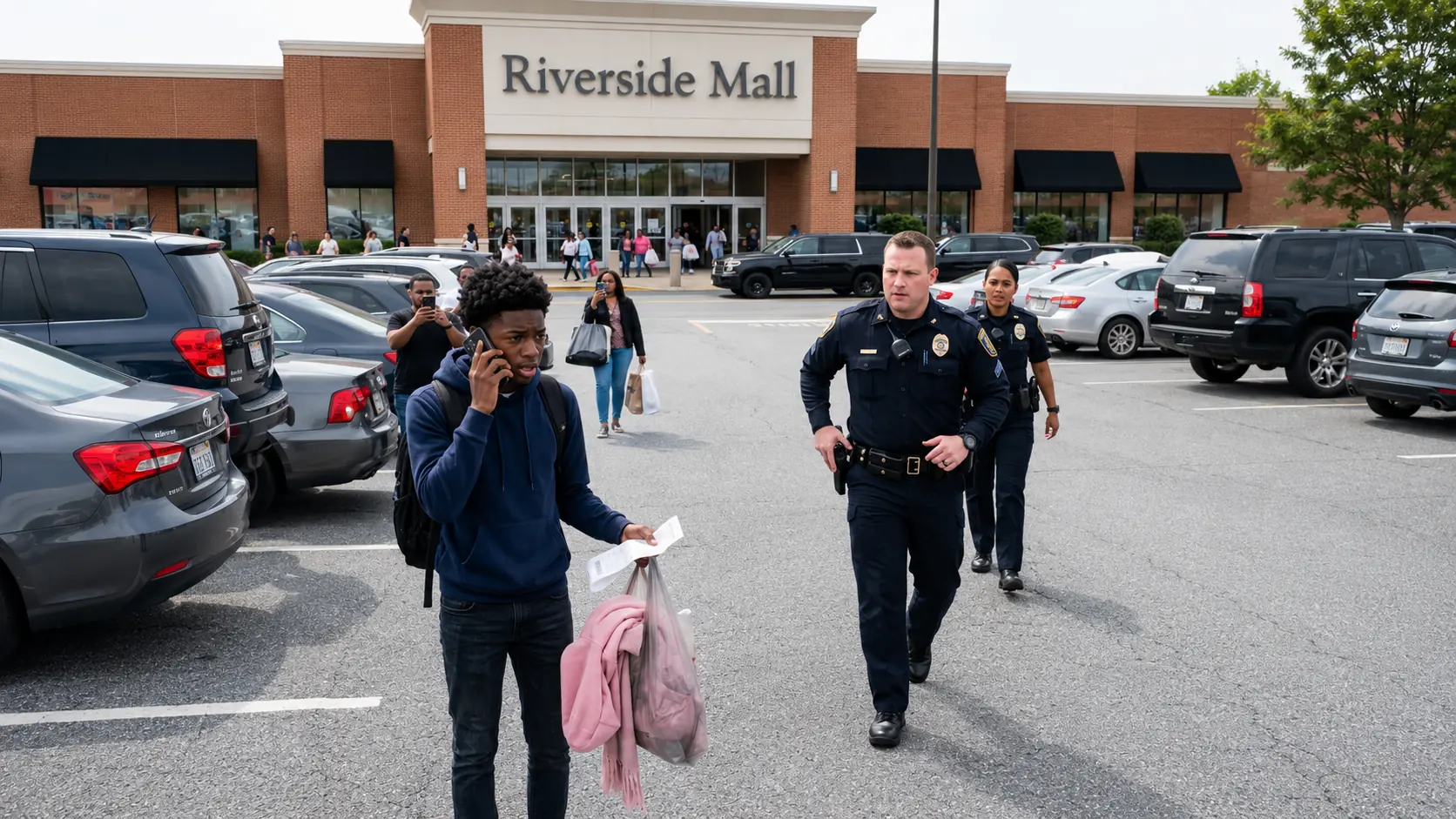
At sixteen, Malcolm was already accustomed to people describing him as unusually serious. He earned straight A’s at Riverside High School, led the robotics club, volunteered at a neighborhood food bank, and had recently received an early acceptance letter from the Massachusetts Institute of Technology. His teachers spoke confidently about the places he would go, but his family cared even more about the person he remained. Malcolm could discuss advanced calculus with adults, then spend an hour helping Lily repair a broken science project without making her feel embarrassed.
He found the hoodie inside Style Avenue and held it beneath the bright store lights. The fabric was soft, the color matched Lily’s favorite backpack, and the price left him enough money for the scarf. Malcolm photographed both items and sent the picture to his mother.
She’ll love them, right?
His mother answered almost immediately.
Perfect. Keep the receipt, professor.
Malcolm smiled and approached the register.
Amanda Fletcher, the young sales clerk working that afternoon, scanned the items and asked whether they were gifts. Malcolm explained that his sister was turning thirteen. Amanda folded the hoodie carefully, placed the matching scarf on top, and tucked the printed receipt inside the bag.
“Your sister is lucky,” Amanda said.
“She’ll remind everyone of that tomorrow.”
Malcolm paid with his debit card and thanked her. As he turned away, his phone displayed another message, this one from his father.
Leaving the office now. I can pick you up in twenty minutes.
Malcolm typed a quick response.
I’ll wait outside the south entrance. Love you, Dad.
He slipped the phone into his hand rather than his pocket because he expected another call. Then an alarm sounded three stores away.
The sharp electronic beeping came from Tech Plaza, where a man had rushed through the exit carrying stolen headphones and two boxed tablets. Mall security guard Brian Hughes received the alert over his radio but reached the corridor too late to see the man clearly. A frightened employee described the suspect as a young man wearing a hooded sweatshirt.
Hughes scanned the crowd.
He saw teenagers in jackets, adults carrying backpacks, and families moving between stores. Yet his attention settled immediately on Malcolm, the only Black teenage boy visible near the south entrance. Malcolm wore a navy hoodie and carried a school backpack.
Hughes raised his radio.
“Possible suspect moving toward the south parking lot. Black male, late teens, dark hoodie, backpack.”
That description contained no height, facial features, shoes, direction of travel, or stolen property. It did not match the actual thief, a white man in his early twenties wearing a red hoodie and carrying no backpack. But Officer Ryan Blake heard only the words Black male and hoodie as his patrol car turned toward Riverside Mall.
Malcolm walked through the glass doors into the bright parking lot. His shopping bag swung lightly at his side while he called Lily.
“Are you still pretending you don’t care about your birthday?”
“I don’t care,” she replied. “But if you bought me something ugly, I’m returning it.”
“You’ll need the receipt.”
“I knew it. You bought socks.”
Malcolm laughed.
A shout cut across the parking lot.
“You! Stop right there!”
Malcolm lowered the phone.
Officer Ryan Blake was moving rapidly toward him, one hand hovering beside his holster. Blake was thirty-eight, broad through the shoulders, with short brown hair and an expression already hardened by certainty. His partner, Officer Jason Reed, followed several steps behind, looking less aggressive but saying nothing.
Malcolm stopped.
“Is there a problem?”
Blake pointed toward the pavement.
“Drop the phone. You match the thief, hoodie and all.”
Lily’s frightened voice came through the speaker.
“Malcolm?”
He slowly lowered the phone but did not drop it.
“I was inside buying a birthday gift. I have the receipt.”
“Hands where I can see them.”
Malcolm raised both hands, holding the shopping bag in one and the phone in the other.
“I’m not resisting.”
Blake closed the distance.
“Put everything down.”
Malcolm placed the bag and phone carefully on the pavement. The screen remained illuminated with Lily’s name. He removed the receipt from the bag and held it between two fingers.
“I paid for this. Check it before you touch me.”
Blake barely looked at the paper.
“Talk again, and I’ll put you on the pavement.”
Malcolm’s heart began pounding, but he kept his voice controlled.
“Try it. Then answer the FBI director calling my phone.”
Blake laughed.
“Now your father runs the FBI?”
Malcolm said nothing.
His father had taught him never to use the family name as a threat. Nathan White’s job was not something Malcolm discussed at school, partly for security and partly because Nathan wanted his children to build lives independent of his title. Most people believed Nathan worked in federal administration. Malcolm himself rarely knew where his father traveled or which investigations he supervised.
Blake grabbed Malcolm’s shoulder and turned him toward a parked car.
“Spread your hands on the hood.”
The metal was hot beneath Malcolm’s palms.
“You have the wrong person.”
“Everyone says that.”
“Check the receipt.”
“Anyone can fake a receipt.”
Reed picked it up and read the time stamp.
“Blake, it says he bought these twelve minutes ago.”
Blake did not release Malcolm.
“Could be stolen with the bag.”
A crowd began forming near the mall entrance. Shoppers lifted their phones. Some whispered to one another, but no one stepped close enough to intervene.
Blake pulled Malcolm’s backpack from his shoulders and emptied it onto the asphalt. A calculus textbook struck the ground, followed by notebooks, pens, a library book, and a blue folder containing his MIT acceptance documents. The wind caught several pages and pushed them beneath nearby cars.
Blake lifted the acceptance letter.
“MIT?”
Malcolm turned his head.
“That belongs to me.”
Blake looked at him with a thin smile.
“You steal this too?”
“I earned it.”
A few nervous laughs came from the crowd. Most people remained silent.
The sound cut Malcolm more deeply than the officer’s grip. He had spent four years studying late into the night, taking advanced classes, helping his mother after surgery, and completing application essays after Lily went to sleep. Blake reduced all of it to another suspected theft without reading more than the school’s name.
Amanda came running from the mall with her store tablet pressed against her chest.
“Officers, wait! I sold him those clothes.”
Blake turned.
“Stay back.”
Amanda stopped several feet away.
“I have the transaction record. Malcolm White, debit card ending in 3948, purchase completed at 2:43. I remember him because he said it was for his sister.”
She held out the screen.
Reed looked toward it.
“That appears legitimate.”
Blake stepped between Amanda and Malcolm.
“This is police business.”
“But he didn’t steal anything.”
“I said step back.”
Amanda’s face tightened with fear, but she remained near the crowd. She opened the mall’s internal messaging application and asked her manager to preserve every camera recording from the store and south corridor.
Malcolm’s phone began vibrating on the pavement.
Dad Calling.
Blake glanced down.
“Your FBI director again?”
Malcolm looked at the screen.
“Answer it.”
“I’m not your secretary.”
“Then let me answer.”
Blake kicked the phone farther away.
The crowd reacted with angry murmurs.
A dispatcher’s voice came through Blake’s radio.
“Unit Forty-Three, be advised, possible suspect may be armed.”
Malcolm’s stomach dropped.
“I’m not armed.”
Blake drew his weapon.
“On your knees.”
Reed moved forward.
“Blake, we already searched him.”
“Get down!”
Malcolm lowered himself carefully. His hands remained raised above his head while shoppers backed away in panic.
“I don’t have a weapon.”
“Face down.”
Malcolm looked at the receipt near Blake’s boot, Amanda’s tablet, and the scattered pages proving where he had been. None of it seemed to matter.
He lowered himself onto the asphalt.
Blake forced his right arm behind his back and pressed one knee between his shoulders. Malcolm’s cheek scraped the rough surface. Pain shot through his shoulder as Blake twisted it higher.
“I’m not resisting.”
“Stop moving.”
“I’m not moving.”
Blake increased the pressure.
Malcolm struggled to draw a full breath.
“I can’t breathe.”
“Then stop talking.”
Shouts erupted from the crowd.
“He’s a child!”
“The clerk confirmed the purchase!”
“Get your knee off him!”
Reed looked toward Sergeant Kenneth Graham, who had just arrived in another patrol car. Graham collected the receipt, examined Malcolm’s student identification, and listened as Amanda explained the transaction.
For one hopeful second, Malcolm believed the sergeant would order Blake to release him.
Instead, Graham looked at the phones recording them and made the decision he believed would protect the department.
“Bring him in for questioning.”
Amanda stared at him.
“You know he didn’t steal those clothes.”
“We need to complete the investigation.”
Malcolm was pulled upright and handcuffed. His wrists burned beneath the metal restraints. Blake shoved him toward the patrol car while Reed gathered only some of the scattered belongings.
The pink hoodie remained on the pavement.
Malcolm looked through the crowd until he found Amanda.
“My phone.”
She hurried toward it after the officers passed.
The screen lit again.
Dad Calling.
Amanda answered.
“Hello?”
Nathan White’s voice came through immediately.
“Who is this, and where is my son?”
Amanda turned toward the patrol car.
“My name is Amanda Fletcher. Your son was arrested outside Riverside Mall.”
A long silence followed.
“Was he injured?”
She watched Blake push Malcolm’s head beneath the patrol-car door frame.
“Yes.”
“Tell me exactly what happened.”
Amanda described everything.
Nathan did not interrupt.
When she finished, he asked her to remain at the mall, preserve the transaction record, and send the video to a secure number he provided. Then he called the FBI regional operations center.
The patrol car pulled away before Malcolm saw Amanda speaking to his father. Inside the back seat, every bump sent pain through his shoulder. Reed turned once, his face showing discomfort.
“This will get sorted out.”
Malcolm stared at the metal partition.
“It was already sorted out in the parking lot.”
Reed did not answer.
At Riverside Police Station, Malcolm was placed inside a small holding room with gray walls, a bolted table, and a camera blinking in one corner. His request to call his parents was delayed because Blake claimed processing had not been completed.
Malcolm sat alone for nearly an hour.
He spoke directly toward the camera.
“My name is Malcolm Alexander White. I am sixteen years old. I bought a hoodie and scarf for my sister. The receipt was in my hand. The clerk confirmed it. I did not steal anything.”
He paused, swallowing the tightness in his throat.
“I asked to call my parents. They said no.”
In Graham’s office, Reed displayed footage from the mall’s security system. The real thief appeared clearly on the screen leaving through the east exit six minutes before Blake approached Malcolm.
Graham leaned back.
“So the kid wasn’t even near Tech Plaza.”
“No.”
“And we had the receipt.”
“Yes.”
“The clerk verified it.”
“Yes.”
Graham looked toward Blake.
“We release him and document the mistake.”
Blake folded his arms.
“There was no mistake. He matched the description.”
“The description was wrong.”
“We didn’t know that at the time.”
“You knew it before you put him in the car.”
Blake’s expression hardened.
“You questioning my judgment?”
Graham glanced toward the station lobby, where hurried voices had begun rising.
“I think someone else is about to.”
The front doors opened.
Ten federal agents entered wearing dark suits and navy FBI jackets. Agent Victoria Collins led them across the lobby with credentials held visibly in one hand. Two agents moved toward the evidence room, while others secured the booking computers and dispatch desk.
Graham came out of his office.
“What is this?”
Collins displayed her badge.
“Federal Bureau of Investigation. We are here for Malcolm White.”
“He’s involved in a local theft investigation.”
“No, Sergeant. He is a minor being held after evidence established he committed no crime.”
Blake stepped forward.
“You don’t storm my station over some shoplifting suspect.”
Collins looked directly at him.
“You are Officer Ryan Blake?”
“Yes.”
“Do not discuss this incident without counsel. You are now the subject of a federal civil-rights investigation.”
The color left Blake’s face.
Two agents opened Malcolm’s holding-room door.
He stood quickly, uncertain whether this represented another escalation.
“Malcolm White?” one agent asked.
“Yes.”
“I’m Agent Phillips. You are not under arrest. We are taking you to your father.”
Malcolm followed them into the lobby.
He stopped when he saw the line of federal agents surrounding Blake, Reed, and Graham. Every officer in the station had gone silent.
Then the front doors opened again.
Nathan White entered wearing a dark suit with an FBI credential clipped to his belt. He was forty-eight, tall, and composed, though the control in his face could not hide the fear he had carried since seeing the parking-lot video.
Malcolm stared at him.
“Dad?”
Nathan crossed the room and placed both hands on his son’s shoulders.
“Let me see you.”
His eyes moved over the scrape on Malcolm’s cheek, swelling near his shoulder, and red marks around his wrists.
“Did they take you to a doctor?”
“No.”
“Did they let you call home?”
“No.”
Nathan embraced him briefly, then turned toward the officers.
“I am Nathan White, regional director of the Federal Bureau of Investigation.”
No one moved.
“And this is my son.”
Blake’s mouth opened, but no words came.
Nathan looked toward Collins.
“Play the footage.”
A wall-mounted monitor showed Malcolm buying the gift. It showed Amanda printing the receipt, the actual thief escaping elsewhere, Blake approaching Malcolm without asking a single investigative question, and the moment the officer drove him face-first onto the pavement.
Malcolm’s voice filled the station.
“I can’t breathe.”
Blake’s recorded response followed.
“Then stop talking.”
Nathan allowed the silence afterward to settle over everyone in the room.
“My son had a receipt, a witness, video confirmation, no weapon, and no stolen property,” he said. “Which piece of evidence did you believe justified that force?”
Blake finally spoke.
“I followed the information provided by dispatch.”
“Dispatch said a suspect might be armed after you had already searched him.”
“The original description matched.”
Nathan displayed photographs side by side.
The thief was a white adult in a red hoodie.
Malcolm was a Black teenager in navy clothing.
“The only meaningful similarity was that both were male.”
Blake looked toward Graham.
The sergeant lowered his eyes.
Nathan continued.
“You ignored the clerk. You ignored the receipt. You ignored the student identification. You ignored the security footage. Every fact challenged your assumption, and you treated the contradiction as another reason to punish him.”
Blake’s voice rose.
“You’re only here because he’s your son.”
Nathan stepped closer.
“You are correct.”
The admission startled everyone.
“My position brought ten agents through that door within an hour. Most families do not have that power.”
He pointed toward the holding corridor.
“That is why this investigation will not stop with Malcolm.”
Federal agents had already begun reviewing Riverside Police Department’s complaint history. Blake had received two excessive-force allegations during the previous eighteen months. Both were dismissed after internal reviews lasting less than forty-eight hours.
Several other complaints described stops based on vague suspect descriptions involving Black residents.
Nathan faced Graham.
“Preserve every body-camera recording, dispatch log, personnel complaint, and use-of-force report involving Officer Blake.”
Graham nodded.
“Yes, Director.”
“His badge and weapon.”
Blake looked sharply toward him.
“You cannot suspend me.”
Graham’s expression changed.
“I can.”
Blake removed his badge, placed it on the front desk, then surrendered his firearm. For the first time that afternoon, he looked less angry than frightened.
Nathan returned to Malcolm.
“Are you ready to leave?”
Malcolm glanced at Blake.
“I want my things.”
Agents returned to the mall and recovered his books, backpack, shopping bag, and most of the MIT documents. Amanda had protected the pink hoodie and scarf inside the store after the police left. The gifts were dirty but undamaged.
She met Malcolm at the hospital later that evening.
“I’m sorry I couldn’t stop them.”
“You tried.”
“It wasn’t enough.”
“You did more than anyone else.”
Doctors diagnosed a strained shoulder, bruised ribs, and abrasions along Malcolm’s cheek. Nothing was permanently damaged, but the emotional injuries remained harder to measure.
That night, Lily opened the shopping bag and began crying.
“You got hurt buying this for me.”
Malcolm handed her the hoodie.
“That doesn’t make it yours any less.”
She hugged him carefully, avoiding his shoulder.
News of the arrest spread nationwide. Videos recorded by witnesses showed every stage of the encounter. Some viewers focused on the dramatic arrival of federal agents, but Nathan repeatedly redirected attention toward the evidence ignored before they appeared.
At a press conference, he stood beside Malcolm without using his son as decoration.
“My position accelerated accountability,” Nathan said. “Justice should not require an FBI director in the family.”
The federal investigation found that Blake had repeatedly escalated encounters after receiving vague descriptions involving Black suspects. Reed admitted he often recognized the problems but remained silent because Blake was the senior officer. Graham acknowledged that he ordered Malcolm transported partly because he feared releasing him in front of a recording crowd would make the department appear uncertain.
Their decisions had protected authority rather than truth.
Blake was charged with deprivation of civil rights under color of law, falsifying an arrest report, and unlawful use of force. His report claimed Malcolm resisted, reached toward his waistband, and refused to provide proof of purchase. Every statement was contradicted by video.
Reed cooperated and accepted disciplinary suspension for failing to intervene.
Graham resigned before the city completed its administrative review.
The mall terminated Hughes’s security contract but offered him participation in a restorative training program after Malcolm requested that accountability include education when possible. Hughes later admitted that he selected Malcolm without seeing him leave the electronics store.
“I saw the description I expected to see,” he said.
Riverside introduced mandatory body-camera activation, independent complaint reviews, stronger intervention rules, and detailed suspect-description requirements. “Black male wearing a hoodie” could no longer be treated as sufficient grounds for detention without additional facts.
Months later, Malcolm attended a community meeting with his father.
He approached the microphone without prepared notes.
“I was buying a gift,” he said. “They saw a threat.”
The room became silent.
“Do not wait until the person on the pavement belongs to someone powerful before you decide he deserves help.”
That statement became the defining line of the case.
Malcolm entered MIT the following fall. He kept the navy hoodie from the day of the arrest, though his mother repeatedly offered to replace it. He wanted to remember that clothing had never caused what happened.
Assumptions had.
Before leaving for college, Malcolm returned once to Riverside Mall. Amanda was still working at Style Avenue, now as an assistant manager. She showed him a new staff policy requiring employees to preserve receipts and transaction footage whenever customers were questioned by security.
Near the south entrance stood a public notice explaining that security personnel could not detain someone based solely on race, clothing, or a vague resemblance to a suspect.
Malcolm read it quietly.
Nathan stood beside him.
“Does it feel different?”
“No.”
His father waited.
Malcolm looked across the parking lot where Blake had forced him down.
“But maybe it will be different for the next kid.”
That mattered more than revenge.
Blake had believed authority allowed him to decide who looked guilty before examining evidence. Ten federal agents forced him to confront the consequences, but they had not made Malcolm innocent.
The receipt had already proved that.
Amanda’s testimony had proved it.
The security footage had proved it.
Malcolm’s calm cooperation had proved it.
The truth existed long before powerful people entered the parking lot.
The real injustice was that no one respected it until the FBI arrived.