At the bus stop, a small boy from the poorest block froze when the driver barked, “No pay, no ride,” and began closing the door on an elderly woman trembling in the snow after losing her purse.
The boy had only five dollars, but he could not ignore the cruelty unfolding in front of him. He stepped forward and paid for the stranger.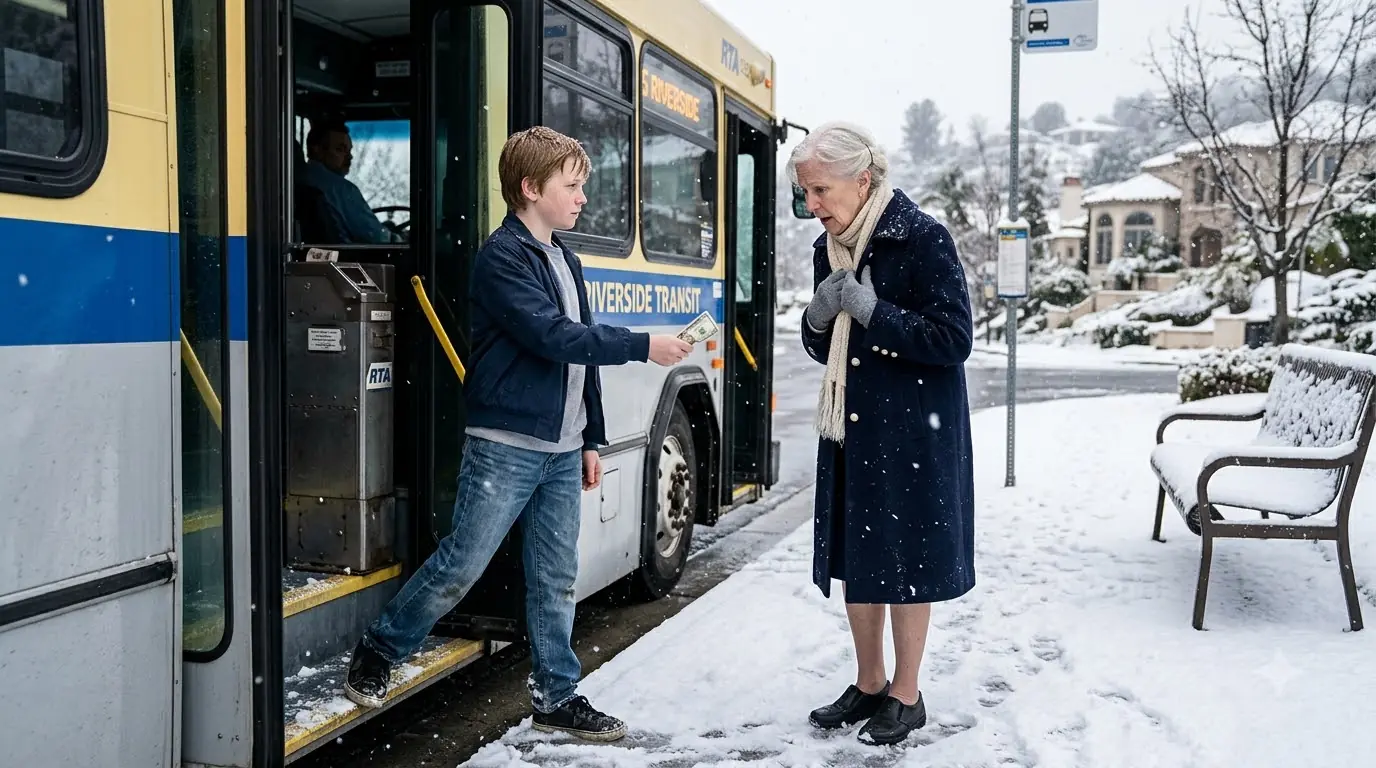
That single act of courage would change everything, because the woman he helped was the mother of one of the richest men in the state. When that billionaire learned what had happened, his entire world was about to be turned upside down.
Twelve-year-old Tommy Reed stood on the corner of the wealthiest street in Riverside, clutching a worn notebook in one hand and his bus fare in the other. He watched sleek cars glide past and wondered whether anyone inside them ever worried about how they would get home.
The January wind in Riverside was different from the wind in Millbrook. Along the wide avenues lined with oak trees and wrought-iron gates, the air carried wood smoke from fireplaces and the faint scent of expensive evergreens.
It whispered through bare branches with a polite reserve even as the sky darkened with the promise of snow.
In Millbrook, where Tommy lived, the wind had teeth. It howled through cracks in old windows and carried the metallic bite of coming storms, mixed with the diesel smell of buses that rarely arrived on time.
Tommy tightened his grip on the plastic grocery bag he carried. Inside were his father’s work gloves, forgotten on the kitchen counter that morning.
His father, Robert, was still at a construction site three blocks behind the mansion district, working a double shift in the freezing cold.
Robert had once worked in an office as a data analyst. He could find patterns in numbers the way other people found shapes in clouds.
His talent should have carried him forward, but his manager made certain it did not.
When Robert’s cost-saving analysis threatened to expose his supervisor’s incompetence, termination paperwork appeared within a week. The document cited performance issues.
It was a lie that clung to his record like tar.
Robert accepted whatever work he could find afterward. Hands meant for keyboards now gripped shovels, hammers, and heavy construction tools.
The work was difficult, and the pay was worse, but it kept the lights on.
Barely.
Tommy pulled his thin jacket tighter around his body. He was small for twelve, with sandy-brown hair and watchful green eyes.
He checked the time on his old wristwatch.
The number 40 bus was due in three minutes.
If he missed it, he would have to walk four miles through the dark. His mother needed her evening medication by six.
The bus stop stood on the dividing line between two worlds.
Behind Tommy, Riverside’s mansions rose proudly along the hill. Ahead, the road sloped toward the highway, the factories, and rows of narrow houses where families like his lived.
Tommy was not alone at the stop.
An elderly woman sat at the far end of the bench, looking like a piece of fine porcelain left outside in bad weather.
She wore a coat that had once been expensive, made from navy wool with pearl buttons. Now the cuffs were soiled, and the fabric looked rumpled.
Her white hair was pinned up, though several strands had escaped and moved across her forehead in the wind.
She sat with rigid posture, her gloved hands folded in her lap, staring at the street sign as though it contained answers to questions she could no longer remember.
Tommy studied her from the corner of his eye.
She did not belong there.
The number 40 carried tired nurses, construction workers, warehouse employees, and people like Tommy who remained invisible to most of Riverside.
This woman looked as if she belonged behind one of the wrought-iron gates on the hill.
Yet she sat at the bus stop, shivering as the temperature dropped and the first snowflakes began falling.
The woman suddenly started patting her coat pockets.
Her movements became urgent.
She looked beneath the bench, across the sidewalk, and then down at the empty space beside her.
“Ma’am,” Tommy said quietly, “are you all right?”
She turned toward him, startled.
Her eyes were pale blue, sharp and intelligent, but clouded with confusion.
“My bag,” she said.
Her voice was refined and cultured, though fear trembled beneath it.
“I had a handbag. I know I did. I must have set it down somewhere.”
Tommy glanced along the empty sidewalk.
“Did you leave it somewhere you were walking?”
“I went to see the gardens,” she said, her voice beginning to falter. “The winter gardens at the Riverside Botanical Center.”
She pressed one gloved hand against her forehead.
“They were beautiful. I kept walking, and somewhere along the way, I must have put my bag down.”
The woman looked helplessly at Tommy.
“I do not remember where. My telephone, wallet, and everything else were inside.”
Before Tommy could respond, the diesel engine of the number 40 bus rumbled around the corner.
The vehicle was a scarred and rust-streaked beast, with grime across its windows and worn paint along its sides.
The doors opened with a hiss.
The driver glared down at them.
His name badge read GUS.
Tommy knew Gus.
Everyone in Millbrook knew Gus.
He did not wait, smile, or care.
“Move,” Gus barked. “I am already behind schedule.”
The elderly woman rose unsteadily and approached the bus steps.
“Sir,” she began, trying to preserve her dignity, “I seem to have lost my purse. If you could allow me to ride until I can contact my family…”
“No pay, no ride,” Gus interrupted with a harsh laugh. “Read the sign.”
The woman’s face flushed.
“I am not requesting charity. I am in distress. If you could simply…”
“Three dollars or stay on the pavement.”
The cruelty struck Tommy like a blow.
He watched the woman shrink inward and step back as though the driver had physically pushed her.
It was not only embarrassment.
It was the shock of being treated as though she were worthless.
The elderly woman returned to the curb.
“I understand,” she whispered. “I apologize for delaying you.”
Gus reached toward the door lever.
“Wait.”
Tommy’s voice came out louder than he expected.
He moved forward and placed his foot between the closing doors.
“Move your foot, kid!” Gus shouted.
Tommy did not move.
His heart hammered while he reached into his pocket and felt the folded bills and coins inside.
Five dollars.
It was his mother’s medication co-payment.
It was the milk money.
It was everything they had left for that evening.
Watching the woman being abandoned in the January cold felt worse than an empty refrigerator.
Tommy climbed the steps and placed the money into the fare box.
The coins struck the metal tray with a loud clatter.
“That is for both of us,” he said, looking Gus directly in the eyes.
Gus stared at the money.
Then he grunted.
“Whatever. Sit down.”
Tommy turned back toward the woman and extended his hand.
“Come on. It is all right.”
She looked at his hand as though it were the most valuable thing she had ever seen.
Her eyes filled with tears.
She placed her soft, cold, papery hand into his and allowed him to help her onto the bus.
The vehicle lurched forward before they were completely seated.
Tommy guided her toward a place in the middle, away from the noise near the back and Gus’s hostile glare at the front.
They sat on cracked vinyl seats.
The bus smelled of wet wool, old rubber, and tired people.
Outside, the snowfall became heavier.
“You did not have to do that,” the woman said. “That was your money.”
“It is only money,” Tommy replied.
His stomach tightened as he thought about dinner and his mother’s medicine.
“My father always says nobody should be left behind when they need help.”
The woman studied him carefully.
“What is your name?”
“Tommy. Tommy Reed.”
“I am Margaret.”
She extended her hand formally.
“Margaret Hartley.”
They shook hands with the solemnity of two people making an agreement.
“Why is a twelve-year-old riding a bus alone?” Margaret asked.
“My mother is sick at home. She has multiple sclerosis.”
Tommy looked through the dark window.
“Today is not a good day, so I am going home to make dinner and help her take her medication.”
Margaret’s expression shifted.
“And your father?”
“He is still working. Construction.”
Tommy hesitated.
“He used to work in an office, but he was fired. Now he accepts whatever jobs he can find.”
“I see.”
Margaret’s voice became quiet.
They rode without speaking while the landscape changed around them.
The bus descended from the wealthy neighborhood toward the crowded districts where houses pressed close together.
Snow began covering rooftops, sidewalks, and parked vehicles.
“This is my stop,” Tommy said when the bus slowed near Maple and Third.
He collected his notebook and grocery bag.
Then he looked at Margaret’s pale and confused face.
“Where are you going?”
“The downtown terminal, I suppose,” she answered uncertainly. “I can find a telephone there.”
Tommy bit his lower lip.
He knew the downtown terminal.
At night, it became crowded with danger and desperation.
The thought of sending a confused elderly woman there made his stomach tighten.
The bus stopped.
The doors opened, and freezing air rushed inside.
Margaret stood as though intending to follow Tommy from the bus.
The moment her feet touched the curb, she swayed and grabbed the nearby pole.
Her face turned pale.
Her breathing became rapid.
“Ma’am!”
Tommy dropped his bag and caught her arm.
“Are you all right?”
“I feel dizzy.”
Margaret pressed one hand against her chest.
“Lightheaded. It may be the cold. I only need a moment.”
Tommy looked around frantically.
Snow fell in thick sheets, and the wind was becoming stronger.
Margaret shook visibly, either from the cold, the shock, or both.
The bus pulled away and left them alone on the dark corner.
“My house is right there,” Tommy said, pointing half a block away. “Please come inside. You need to sit down and warm up.”
“I could not impose…”
“Please.”
Tommy’s voice became urgent.
“You are not well. It is not safe out here, and my mother is home. She will know what to do.”
Margaret looked at the swirling snow.
Another wave of dizziness passed through her.
She nodded weakly.
“Only for a moment, until I catch my breath.”
Tommy held her arm and guided her down the block toward a narrow brick building.
A crooked metal number, 414, hung beside the front door.
“We are on the third floor,” he warned. “We will go slowly.”
They climbed together.
Margaret gripped the banister while Tommy remained close.
The stairwell smelled of the dinners being cooked inside neighboring apartments.
Paint peeled from the walls, and every step creaked.
By the second landing, Margaret’s breathing had become labored.
Tommy pretended to adjust the grocery bag, giving her time to rest without embarrassing her.
“We are almost there,” he said.
At the third floor, he inserted the key into the apartment lock.
He moved it left, then right, and pushed firmly.
The door opened with a groan.
“Mom,” Tommy called, “I am home. I brought someone who needs help.”
The apartment was small but meticulously clean.
The linoleum floor was cracked, yet someone had scrubbed it until it shone.
Children’s drawings decorated the walls inside mismatched frames.
The apartment was also cold.
Almost as cold as the street.
A woman appeared in the bedroom doorway, leaning against a cane.
She was younger than Margaret expected, perhaps in her early forties, with light-brown hair pulled back and warm gray eyes.
When she saw Margaret, surprise immediately gave way to concern.
“Oh, my goodness.”
She moved forward even though every step clearly caused pain.
“Please come in. Sit down. You look as if you are about to faint.”
Her voice was gentle and genuinely worried.
She wore a thick robe over several layers of clothing.
“Mom, this is Margaret,” Tommy said while helping guide the elderly woman toward the sofa. “She lost her purse.”
He continued quickly.
“The bus driver was going to leave her in the snow, so I paid her fare. When we got off, she became dizzy and almost fell.”
“I am Helen Reed.”
Tommy’s mother helped Margaret sit and immediately placed a thin quilt around her shoulders.
“Tommy, bring water and start the kettle.”
“I do not want to impose,” Margaret said automatically.
She was deeply grateful to be sitting and out of the wind.
“You are not imposing.”
Helen’s smile was warm and sincere.
Helen slowly lowered herself into the armchair across from Margaret.
Her movements revealed the disease’s effects on her body, but her face remained open and kind.
There was no suspicion or resentment over the unexpected guest.
“Tommy says you lost your purse. That must be frightening.”
“I went walking,” Margaret explained. “I visited the botanical gardens and continued farther than I intended.”
She rubbed her forehead.
“Somewhere along the way, I must have set it down. I cannot remember where.”
“That happens to me as well,” Helen said, her voice sympathetic rather than pitying. “I forget why I walked into a room or where I placed something.”
She smiled faintly.
“It can be unsettling.”
Margaret looked at this woman who was struggling with her own health and living in obvious poverty, yet offering compassion without hesitation.
“You are very kind.”
“Kindness does not cost anything,” Helen said simply.
“My son believed you needed help, so here you are. We are glad to have you.”
Tommy brought a glass of water and placed the old kettle on the stove.
While it heated, Helen asked gentle questions about Margaret’s walk and the gardens, keeping her talking and calm.
Margaret gradually relaxed under the warmth of Helen’s voice.
“The witch hazel was blooming,” she said. “Yellow flowers against gray bark. It was beautiful.”
“I used to take Tommy there when he was small,” Helen said.
Her face brightened with the memory.
“That was before I became too ill to walk that far. The winter garden truly is special.”
The two women spoke easily.
They came from different worlds, but found common ground through simple conversation.
Helen asked nothing intrusive and made no judgment.
She simply provided the comfort of another human being.
Tommy poured chamomile tea into chipped mugs and apologized that it was the only kind they had.
Margaret wrapped both hands around the warm cup.
Her heartbeat slowed, and the dizziness began to fade.
“You have a remarkable son,” she told Helen. “What he did on that bus was extraordinary.”
Helen’s eyes grew bright.
“He has a good heart. His father and I tried to teach him that people matter more than possessions.”
She looked toward Tommy.
“You help when you can.”
“You taught him well.”
As they continued talking, Margaret’s observant eyes began noticing details that Helen’s warmth had initially hidden.
The refrigerator door stood partially open, revealing that it was nearly empty.
A stack of bills rested on the table, one marked FINAL NOTICE in red.
A pill organizer sat beside a blood-pressure monitor.
The radiator beneath the window remained cold and clearly broken.
Blankets had been rolled against the window frames to block the drafts.
Margaret also noticed the pride with which everything was maintained.
The floor was spotless.
The curtains had been carefully repaired.
The drawings on the walls were arranged with the precision of a gallery.
This family had almost nothing.
They still welcomed her without hesitation and shared their warmth, time, and concern.
As Margaret began feeling normal again, an old radio on the kitchen counter crackled to life.
Helen must have switched it on while preparing the tea.
A thin announcer’s voice moved through the static.
“We repeat our leading weather story. The National Weather Service has upgraded the winter storm warning to a blizzard warning for the metropolitan area, effective at eight tonight through six tomorrow morning. Eight to twelve inches of heavy snow are expected, with winds reaching forty-five miles per hour. Whiteout conditions are likely. Residents are strongly advised to avoid all travel.”
The apartment door opened with a blast of wind and snow.
A tall, lean man stepped inside, shaking snow from his coat.
He had kind eyes that widened when he saw Margaret sitting on the sofa.
“Helen? Tommy?”
Concern and confusion entered his voice.
“What is happening?”
“Robert.”
Helen’s face brightened.
“Come inside and close the door. This is Margaret. She needed help.”
Tommy stood quickly.
“Dad, Margaret lost her purse. The bus driver was cruel to her, so I paid the fare.”
He pointed toward the window.
“Then she became dizzy after we left the bus, so I brought her here. Now there is a blizzard coming.”
Robert looked from his son to his wife and then to the elderly woman wrapped inside their quilt.
His gaze moved toward the window, where snow struck the glass under the force of the rising wind.
He looked back at Margaret, noticing her expensive coat, advanced age, and vulnerability.
Robert approached the window and studied the deteriorating weather.
The street was already disappearing beneath white.
When he turned around, his decision had been made.
“Ma’am, I am Robert Reed.”
He extended a rough hand marked by construction work.
“Tommy’s father. I am very glad he found you. Nobody should be outside in what is coming.”
Margaret shook his hand.
“I am Margaret Hartley. Your son was extremely kind.”
Robert smiled.
“He gets that from his mother.”
He exchanged a look with Helen.
An entire conversation passed silently between them.
Then he faced Margaret again.
“Mrs. Hartley, I do not know how you planned to return home, but travel is no longer safe.”
He looked outside once more.
“The roads will be impassable within the hour.”
“I intended to call for a car,” Margaret began.
“No service will send a driver into this storm,” Robert said gently. “Even if somebody agreed, it would not be safe.”
He kept his voice kind but firm.
“We would like you to stay here tonight. Wait until the storm passes. In the morning, when the roads are clear, you can call anyone you need.”
“I could not possibly impose on your family.”
“You are not imposing,” Helen said.
Her warmth was now supported by determination.
“We have a bed and a roof that does not leak. We will not send you into a blizzard.”
She looked directly at Margaret.
“That is final.”
Margaret studied their faces.
Tommy’s earnest concern.
Helen’s firm kindness.
Robert’s quiet certainty.
These people possessed so little, yet they were offering everything they had without hesitation.
“Then I should contact my son,” Margaret said, her voice thick with emotion. “He needs to know I am safe.”
She looked toward the wall.
“May I use your telephone?”
“Of course.”
Helen pointed toward an old rotary telephone.
Margaret stood with Helen’s help and approached it.
Her fingers still trembled as she dialed a number she knew by memory.
It rang twice.
“Mother?”
William’s voice was frantic.
“Where are you? I have called everywhere. Your assistant said you left for a walk hours ago and did not return.”
He drew a sharp breath.
“I was preparing to organize a search.”
“William, stop. I am fine.”
Margaret kept her voice calm and soothing.
“I visited the botanical gardens and became confused about the route home. A kind family helped me.”
She glanced toward the Reeds.
“I am staying with them tonight because of the storm.”
“What family? Where are you? I will send a car immediately.”
“You will do no such thing. There is a blizzard warning, and the roads are unsafe.”
“Mother…”
“I am warm, fed, and being cared for by generous people. I will telephone you in the morning when the roads are clear.”
“I need to know where you are. I need to confirm you are safe.”
“I am at…”
Margaret looked toward Helen.
“414 Maple Street, apartment 3B,” Helen supplied quietly.
Margaret repeated it into the telephone.
“The Reed family has taken excellent care of me.”
“The Reed family,” William repeated.
Margaret heard the sound of him writing.
“Mother, at least allow me to…”
“William.”
Her voice changed into the tone that had raised a future chief executive and would not be challenged.
“I am seventy-four years old, not a child. I am safe.”
She tightened her grip on the receiver.
“You will not attempt to travel here tonight. Promise me.”
There was a long pause.
“I promise.”
“First light,” he added quickly. “I will come at first light.”
“When it is safe,” Margaret corrected.
“When it is safe.”
“I will see you in the morning. Do not worry.”
She ended the call and turned.
The Reed family had moved away to provide privacy and pretended they had not listened.
Margaret could still see tension in Robert’s shoulders and worry in Helen’s eyes.
“He will not come tonight,” she assured them. “He is protective, but not foolish.”
“You must have been terrified,” Helen said. “Being lost like that.”
“I was.”
Margaret looked toward Tommy.
“Then your son appeared. My guardian angel on a bus.”
Tommy lowered his head in embarrassment, but a small smile appeared.
Robert clapped his hands softly.
“If we are all staying, we should eat.”
He looked toward his son.
“Tommy, check what we have.”
Tommy opened the refrigerator.
Margaret watched him assess its sparse contents.
Six eggs.
Half a gallon of milk.
A small piece of cheese.
Wilted lettuce.
His face showed no disappointment.
Only practical calculation.
“Scrambled eggs,” he announced. “Toast too, if we still have bread.”
“We have bread,” Helen confirmed. “And a little butter.”
Tommy moved through the kitchen with practiced efficiency.
He cracked the eggs into a bowl and whisked them carefully.
Margaret noticed how he scraped every drop from the shell and bowl, wasting nothing.
He placed a scratched pan on the stove.
Robert returned to the window and watched the storm intensify.
“It is becoming worse,” he said. “We made the correct decision.”
He crossed to the radiator and placed his hand against the metal.
It was completely cold.
Robert frowned and opened the oven.
“The heat has been broken since Tuesday,” he explained. “The landlord keeps promising to repair it.”
He adjusted the temperature carefully.
“We will use the oven to warm the apartment tonight.”
“Is that safe?” Margaret asked.
“If we are careful. We will keep ventilation and monitor everything closely.”
Robert offered a tired smile.
“We have managed before. We are resourceful.”
Margaret watched him work.
Something about his movements held her attention.
He carried himself with a straight back despite obvious exhaustion.
He remained methodical even while his life seemed close to collapse.
There was quiet dignity in the way he adjusted the room, checked the window, and protected his family with whatever tools remained available.
Margaret thought of Arthur.
Her husband had returned from Vietnam carrying nightmares and determination.
He refused to allow war to destroy him.
Arthur built a life through stubborn decency and force of will.
Tommy toasted slices of bread in a pan, turning them with a fork until they became golden.
He set the table using mismatched plates.
One had a chip along the edge.
Another was slightly cracked.
A third appeared to be a souvenir from a place nobody in the family had ever visited.
The forks belonged to different sets.
Paper napkins were folded neatly.
“Dinner is ready,” Tommy announced.
They gathered around the small table.
Margaret immediately noticed that her plate held the largest portion of eggs.
Helen, Robert, and Tommy had divided what remained into servings too small to satisfy people who had worked all day.
“Please.”
Margaret pushed her plate toward the center.
“This is far too much. I cannot accept it.”
“You can and you will,” Helen replied.
Her voice remained gentle but unyielding, and her smile removed any sting from the command.
“You suffered a terrible shock today. You need food.”
“We are fine.”
“But you barely have enough.”
“We have enough,” Robert said firmly. “We will not allow a guest to remain hungry.”
He nodded toward the plate.
“Please eat.”
Margaret looked at all three faces.
They smiled and genuinely wanted her to accept what they had offered.
Emotion tightened her throat.
“You are very kind,” she whispered.
They ate together, four people brought into one room by chance and compassion.
The eggs were slightly overcooked, and the toast was dry.
It remained the most meaningful meal Margaret had eaten in years because every bite had been given with sincere care.
Robert asked polite questions about the gardens and her walk while carefully avoiding anything too personal.
Helen told stories about Tommy’s school and neighborhood, painting their difficult life with warmth and humor.
Margaret watched the family with growing fascination.
Helen and Robert communicated through glances and small gestures, the private language of people who had survived years of hardship together.
Tommy anticipated his mother’s needs before she spoke.
He refilled her water and adjusted the cushion behind her back.
Whenever Robert passed Helen, his hand briefly rested on her shoulder.
The touch carried an entire message.
I am here.
We are all right.
We will survive.
“Tell me about your family,” Helen said after dinner. “Your son must have been worried.”
“William,” Margaret replied. “My son’s name is William.”
She smiled faintly.
“He is protective. Sometimes overly protective.”
“My husband passed away five years ago. Arthur Hartley.”
“I am sorry,” Helen said sincerely. “Five years is not long.”
“No.”
Margaret lowered her eyes.
“In some ways, it feels like yesterday. In others, it feels like an entire lifetime.”
She looked toward the cold window.
“Arthur was my partner in everything. Marriage, business, and life.”
Her voice softened.
“We built our company together from nothing. Even now, I sometimes turn to tell him something before remembering he is gone.”
“That is how love works,” Robert said quietly.
“The people who matter most never completely leave.”
Something in his voice made Margaret examine him.
She saw old grief inside his eyes and understood that he had also lost someone important.
After dinner, Helen insisted on cleaning despite Margaret’s offer to help.
“You are still recovering,” Helen said. “Sit and rest.”
Margaret sat on the worn sofa while Tommy dried dishes and Robert prepared the apartment for the night.
She watched them work together.
The family had almost no material comfort, yet seemed to possess everything that truly mattered.
The wind howled outside.
The building groaned under the storm.
Inside, warmed by the oven and something less tangible, Margaret felt safer than she had in months.
Three loud knocks struck the apartment door.
The sound was aggressive and demanding.
The warmth vanished from the room.
Helen’s face turned pale.
Robert’s jaw tightened.
Tommy froze, and fear appeared across his young face before he tried to hide it.
Robert approached the door and opened it only a few inches, positioning his body between the visitor and his family.
A large man filled the doorway.
He wore a stained canvas jacket.
A scowl seemed permanently carved into his broad face.
His small eyes held the practiced cruelty of someone accustomed to intimidating weaker people.
“Reed,” he said. “We need to discuss the rent.”
“Mr. Vickers.”
Robert maintained a neutral voice, though Margaret heard the tension beneath it.
“This is not a good time. There is a blizzard.”
“The rent was due Friday.”
Vickers pushed against the door.
Robert had to either move or create a physical confrontation.
He stepped back and allowed the landlord inside.
“You are five days late again.”
Robert’s hands closed into fists at his sides.
A muscle moved in his jaw, but his voice remained controlled.
“I explained when I called Tuesday. My paycheck was short because the site closed during last week’s snow.”
He glanced toward his family.
“I will have the full amount by Wednesday. My foreman promised additional hours this weekend.”
“Wednesday is not good enough.”
Vickers pulled a folded document from his back pocket.
He struck it against the wall with one thick hand, leaving a dirty mark.
“Three-day notice. Pay by Thursday at noon or leave.”
Helen released a small sound and immediately tried to suppress it.
Her hand tightened around the arm of the chair until her knuckles turned white.
Tommy became completely still.
His expression changed into the careful blankness children learned when they did not want adults to know how frightened they were.
“Please,” Robert said.
The desperation in his voice cut through Margaret.
“Mr. Vickers, we have a child. My wife is ill.”
He stepped closer.
“Give us until Friday. One additional week. I swear you will have everything.”
“That is what you said last month and the month before.”
Vickers looked around the apartment with contempt.
His eyes settled on Margaret.
“You have money to entertain guests and feed strangers, but cannot pay me.”
“She is not a guest in that sense. She needed help.”
Robert’s voice cracked.
Margaret heard more than desperation.
She heard shame.
The shame of a man unable to protect his family, reduced to begging a cruel person for mercy.
“I do not care what she needed.”
Vickers pointed at the notice.
“Thursday at noon. Cash, or the sheriff assists you in packing.”
He turned toward the door.
Then he looked back.
“Do not attempt to hide any property. I know every piece of furniture in this apartment.”
Vickers left and slammed the door hard enough to rattle the dishes.
Silence filled the room.
Only the wind and the groaning building remained audible.
Robert stood near the door with one hand against the frame.
His head lowered, and his shoulders collapsed.
Margaret saw him trembling.
She could not tell whether it came from anger, humiliation, or despair.
Helen remained frozen in the chair.
Tears streamed down her face, and she did not attempt to wipe them away.
She stared at the eviction notice as though it were a death sentence.
For her, it was.
A woman with multiple sclerosis, no savings, and a child to support faced more than the loss of a building.
Eviction meant the loss of stability, medical access, routine, and the fragile structure keeping her world from complete collapse.
Tommy went to his mother and wrapped his thin arms around her.
His face pressed into her robe.
His shoulders shook as he cried silently, the way children cried after learning that noise often made difficult situations worse.
Margaret remained motionless.
She looked at the notice.
Then she looked at the family that had shared its last meal with her and offered safety without hesitation.
They would lose everything in three days.
Margaret reached toward her coat pocket by habit, expecting to find the checkbook that had solved problems throughout her life.
The pocket was empty.
Her purse was gone.
Her telephone, wallet, cards, identification, and the power to fix almost anything with a signature were gone.
For that moment, she was as powerless as the Reeds.
“I am so sorry,” Margaret said quietly. “That man is cruel.”
Robert turned.
His face was composed again, though his eyes remained red.
“This is not your fault, Mrs. Hartley.”
He swallowed.
“This is only our life. We will find a solution. We always do.”
There was no conviction in the words.
Only exhaustion.
Helen wiped her face with the back of her hand and forced herself upright.
“We should prepare you for the night,” she told Margaret.
Her voice was hoarse but deliberately cheerful.
“You need sleep after everything that happened.”
“Helen, please…”
“The bedroom is small, but the bed is comfortable,” Helen continued as if Margaret had not spoken.
She behaved as though her family was not three days from homelessness.
“I placed clean sheets on it this morning. You should sleep well.”
Margaret recognized Helen’s desperate need to preserve normalcy and dignity.
She allowed the woman to guide her into the bedroom.
Margaret accepted a nightgown smelling faintly of lavender detergent and allowed herself to be settled beneath the covers.
“Thank you,” she whispered when Helen prepared to leave. “You did not have to do any of this.”
“Yes, we did.”
Helen’s answer was simple.
“It is what people do. You help others even when it is difficult.”
Her smile was sad but sincere.
“My husband’s father taught him that. You do not leave people behind when you have the ability to help.”
Helen closed the door softly.
Margaret lay inside the narrow bed, surrounded by the family’s modest possessions.
A photograph on the bedside table showed younger and healthier versions of Robert and Helen beside a gap-toothed Tommy.
They smiled before life had worn them down.
Books filled one shelf.
Library books.
Science books for Tommy.
A small ceramic bird had been carefully dusted.
Then Margaret noticed a frame on the dresser.
She rose and moved closer, squinting in the weak light coming through the window.
The photograph was old, and its edges had softened from years of handling.
Two young men in muddy combat uniforms stood with their arms across each other’s shoulders.
They smiled despite the exhaustion and destruction surrounding them.
Smoke rose from damaged buildings in the background.
The men looked impossibly young.
Impossibly alive.
One of them strongly resembled Robert.
He had the same firm jaw and kind eyes.
The other man possessed pale-blue eyes Margaret would have recognized anywhere.
Her hand moved to her mouth.
It could not be true.
She took the photograph from the dresser.
On the back, faded ink read:
Dad and Arthur Hartley. Hue, Vietnam, 1968. Brothers who made it home.
Arthur.
Her Arthur.
Margaret sat heavily on the bed, holding the photograph in trembling hands.
Her husband had been nineteen in the picture, before the gray hair, tailored suits, successful business, and years that carved lines around his eyes.
Arthur rarely spoke about the war.
Standing beside him was a soldier whose name Margaret knew.
A man whose story had shaped her entire life.
Sergeant William Reed.
The soldier who returned to a burning building after everyone else retreated.
The man who pulled Arthur from rubble with his bare hands.
The man who carried him two miles through danger to a medical station.
The man who saved Arthur’s life.
By saving Arthur, William Reed had given Margaret her husband.
He had given their son his father.
He had given the Hartley family its future.
Through the thin walls, Margaret heard voices.
The wind screamed outside.
The building creaked.
The oven ran in the kitchen.
Helen’s whisper came through the wall.
“We gave her the last of our food.”
Her voice was heavy with tears.
“We gave her the last eggs, Robert. What will we eat tomorrow?”
“I know.”
Robert sounded empty.
“It was the correct thing to do. Dad would have done the same.”
“Your father.”
Helen released a broken laugh.
“Your father taught us never to leave anyone behind. Now we are being left behind.”
She began crying harder.
“We are the people nobody is helping.”
“Helen…”
“I cannot do this anymore.”
Her voice broke apart.
“I cannot watch Tommy remain hungry. I cannot watch you destroy your body working double shifts that still do not cover everything.”
She struggled to breathe.
“I cannot pack our lives again and search for another landlord who will accept us without a deposit, without strong references, with my cane and your damaged hands and Tommy’s thin jacket.”
“We will find a way,” Robert replied.
He sounded as broken as his wife.
“We always find a way.”
“How?”
Helen’s voice rose.
“How do we solve this, Robert? We are three days from living on the street.”
She sobbed.
“I can barely walk. What happens to Tommy?”
“I will accept more hours. I will speak with Mike again and ask about overtime.”
“Your back cannot take more work. Doctor Chen said you will need surgery if you continue like this.”
“Then my back breaks.”
Robert’s answer was quiet.
“At least we will have a roof.”
A terrible silence followed.
Then Tommy spoke.
“I can leave school and find a job. I will be thirteen soon.”
“No.”
Robert’s response was immediate and fierce.
“You will stay in school.”
“But, Dad…”
“You will receive an education. You will have opportunities we never had.”
His voice shook.
“You are going to become something. This is not your responsibility.”
“I can help.”
“I said no.”
Robert’s voice cracked.
“This belongs to me. I am the father. I am supposed to provide for you.”
He stopped.
“I am supposed to protect this family, and I…”
His words collapsed.
“I am failing. God help me, I am failing my family.”
Helen cried.
Tommy cried.
Then Robert made a sound Margaret had heard only a few times in her life.
It was the sound of a man breaking after holding everything together through willpower alone.
Margaret sat in the darkness with the photograph of Arthur and William Reed in her hands.
She listened to the family of the man who saved her husband collapse in the next room.
This family had shared its final meal with a stranger.
They faced homelessness while Margaret lived in a mansion containing more rooms than she used and possessed more money than she could spend.
She looked at Arthur’s young face.
His arm rested around William Reed’s shoulders.
They were brothers forged through danger.
“We owe them,” Margaret whispered to her dead husband. “We owe them everything.”
She rose from the bed and straightened the borrowed nightgown.
“I am going to make certain they know it.”
Margaret quietly opened the bedroom door.
The voices had faded.
Only muffled crying and the creak of the old sofa remained.
She crossed the dark apartment toward the rotary telephone.
Margaret dialed William’s private number.
He answered immediately.
“Mother?”
“William, listen carefully.”
Her voice remained low and steady.
“Do not interrupt.”
“I am listening.”
“The family helping me tonight is named Reed.”
Margaret looked toward the eviction notice.
“The father is Robert Reed. His father’s name was also William.”
She paused.
“Sergeant William James Reed, 101st Airborne.”
Silence.
Complete and absolute silence.
Then William spoke very quietly.
“Mother, you cannot mean…”
“I mean exactly what you think.”
Margaret tightened her hold on the receiver.
“I am looking at a photograph. Your father and William Reed together in Vietnam in 1968.”
She stared at the two young soldiers.
“It was taken two days after William Reed pulled your father from a burning building and carried him to safety.”
Margaret heard her son’s breath catch.
A chair scraped as he sat down heavily.
“These people,” Margaret continued, her voice becoming fierce, “the family of the man who saved your father, shared their last food with me.”
She looked toward the closed living-room door.
“They face eviction in three days. They have almost nothing, William, and they gave me everything they had.”
William’s voice came rough with emotion.
“Give me the address again. I am coming.”
“No. Not tonight.”
“There is no discussion.”
“There is a blizzard. The roads are unsafe.”
“I do not care about the roads.”
“I do, and the Reeds would as well.”
Margaret refused to yield.
“They have lost enough. I will not allow you to risk your life or another person’s life to arrive five hours sooner.”
“Mother…”
“You will come in the morning when the roads are clear.”
William breathed heavily.
“All right.”
“And bring the photograph.”
“What photograph?”
“The one from your father’s office. The picture he kept on his desk for forty-two years.”
Margaret looked at the frame in her hands.
“Bring it so they understand he never forgot.”
Her voice softened.
“Arthur always wondered whether William Reed made it home safely.”
William’s answer was almost a whisper.
“He did not have an easy life, did he?”
“He came home, but life was not kind.”
Margaret looked through the darkness toward the Reed family.
“His son is working construction after being wrongfully dismissed from a job he loved.”
She continued.
“His daughter-in-law has multiple sclerosis. His grandson wears William Reed’s identification tags to school and gave his final five dollars to a stranger because that was what his grandfather taught him.”
Margaret closed her eyes.
“They remember him. They honor him. Now they are about to lose their home.”
“Not anymore.”
William’s voice had changed.
“No,” Margaret agreed. “Not anymore.”
She drew a breath.
“But when you come tomorrow, you will come humbly.”
William remained silent.
“You will come as the son of a man whose life was saved, not as a chief executive arriving to solve a problem.”
“I understand.”
“Do you truly understand?”
Margaret looked at the eviction notice.
“This is not charity or philanthropy. It is payment of a debt fifty years overdue.”
Her voice became firm.
“It is our family honoring what we owe theirs.”
“I understand, Mother. I promise.”
Margaret leaned against the wall.
“I found the photograph inside their bedroom. Your father and William Reed had their arms around each other.”
Her voice broke.
“They look so young, William. They were only boys.”
“Tomorrow,” William said. “I will be there at first light.”
“And, Mother?”
“Yes?”
“Thank you for finding them.”
“I did not find them.”
Margaret looked toward Tommy’s closed bedroom door.
“A twelve-year-old boy with five dollars and his grandfather’s courage found me.”
She ended the call and remained in the darkness for a long time.
Then she returned to the bedroom.
She climbed beneath the thin blanket and looked once more at the photograph.
“We found them, my love,” she whispered. “We finally found them.”
Margaret placed the frame carefully on the dresser.
“We are going to make this right.”
Outside, the storm continued.
Inside, Margaret Hartley closed her eyes and slept peacefully for the first time in months.
Morning would bring justice, gratitude, and the repayment of a debt extending beyond money or power.
It would bring one family recognizing another.
It would bring the past back into the light.
Margaret awoke to gray daylight filtering through thin curtains.
Somewhere below, shovels scraped against concrete.
The storm had passed.
The city was buried under fresh snow, making even the neglected street appear beautiful and hopeful.
Margaret dressed in yesterday’s clothes and arranged her hair as well as possible without a mirror.
When she entered the living room, Tommy was already awake.
He sat at the kitchen table beneath the weak morning light with a textbook open before him.
Military identification tags hung outside his shirt and caught the pale sun.
He looked up and smiled.
“Good morning, Mrs. Hartley.”
“Good morning, Tommy.”
“Mom and Dad went downstairs to clear the entrance.”
He closed his book.
“Mr. Kapoor on the first floor has a bad hip, so Dad helps him after storms. Mrs. Chen is ninety-two.”
Tommy shrugged as though helping neighbors while facing eviction was the most natural thing in the world.
“That is very kind of your father.”
“He says it is what his father would have done.”
Tommy touched the tags.
“Grandpa Reed served in Vietnam. He saved people.”
Margaret moved closer.
“Did he?”
Her heart began beating faster.
“What do you know about that?”
“Not as much as I want.”
Tommy’s face revealed the maturity of someone forced to grow too quickly.
“Grandpa died when I was young. A heart attack.”
He continued.
“Dad told me Grandpa received the Silver Star because he went into a burning building to save another soldier after everyone else retreated.”
Tommy held the metal tags reverently.
“He carried the man two miles while injured.”
“My father gave me these when I turned ten. He said I was old enough to understand what they meant.”
Tommy looked at Margaret.
“They mean you do not leave people behind.”
Her eyes filled with tears.
“Your grandfather sounds extraordinary.”
“He was.”
Tommy smiled with sadness and pride.
“Dad says I remind him of Grandpa when I help people.”
His fingers closed around the tags.
“He says a legacy does not die if you keep it alive.”
Footsteps sounded in the stairwell.
Robert and Helen entered, shaking snow from their boots.
They froze when they saw Margaret standing in the kitchen.
For a moment, nobody spoke.
Then Helen moved toward her, walking carefully with the cane.
Exhaustion marked her face.
Beneath it remained the determined politeness of someone who had cried throughout the night and now protected herself with dignity.
“Mrs. Hartley, I hope you slept well.”
“I did. Better than I have in months.”
Margaret studied Robert’s red eyes and Helen’s swollen face.
Both stood too straight, like soldiers preparing for a battle they expected to lose.
“I heard Mr. Vickers last night.”
Robert’s jaw tightened.
“I am deeply sorry.”
“That is not your concern, Mrs. Hartley.”
Robert managed a weak smile.
“You have your own troubles.”
“Please call me Margaret.”
“Margaret, then.”
He nodded toward the telephone.
“Your son must be worried. You should call him and explain that the roads are clearing.”
Before she could answer, a sound outside drew everyone toward the window.
It was the deep rumble of powerful engines.
The noise did not belong in their neighborhood.
Tommy reached the window first.
His eyes widened.
“Whoa.”
Margaret joined him.
Her heart accelerated.
Three large black sport utility vehicles had parked beside the curb.
Their tinted windows and polished surfaces looked absurdly out of place among rusted pickups and aging sedans.
Between them stood a long black limousine with small flags mounted on the front fenders.
Neighbors emerged from buildings to stare.
People stood on stoops wearing winter coats and pointed toward the convoy.
Mr. Kapoor leaned heavily on his cane with his mouth open.
Mrs. Chen pressed her face against the first-floor window.
Robert and Helen stood behind Margaret and Tommy.
Their confusion gradually became fear.
“Margaret,” Robert said slowly, “who is your son?”
Before she answered, the limousine’s rear door opened.
A man stepped out who looked as though he belonged on the cover of a business magazine.
He was tall, in his late forties or early fifties, with steel-gray hair cut perfectly.
A cashmere overcoat covered a suit likely worth more than the Reed family paid in annual rent.
His face held Margaret’s attention.
Sharp and intelligent features.
Pale-blue eyes resembling her own.
An expression of controlled intensity she recognized from the mirror.
William.
He walked with crisp efficiency.
Three security officers followed him.
They were large, observant men wearing dark suits, earpieces, and expressions suggesting they were prepared for anything.
William carried a leather briefcase in one hand.
In the other, wrapped carefully in cloth, was a silver picture frame.
“That is your son,” Tommy whispered.
“Yes.”
Robert’s face had become pale.
“The William Hartley? Chief executive of Hartley Enterprises?”
Margaret turned toward him.
“You know the company?”
“I worked for one of its subsidiaries.”
His voice flattened.
“Miller and Associates. Before my manager took credit for my work and had me dismissed.”
Three controlled knocks sounded at the door.
They were professional and precise, nothing like Vickers’s pounding.
Tommy opened it.
One security officer stood outside.
He was more than six feet tall, solidly built, and wore an expensive suit with an earpiece.
Despite his imposing appearance, his voice was gentle.
“Mrs. Margaret Hartley?”
“That is me.”
“Your son is here to see you. May we enter?”
The other security officers followed him inside.
They assessed the small apartment, exits, and surroundings with trained efficiency.
Then William entered.
Margaret immediately recognized his professional manner.
He appeared controlled and composed, revealing nothing.
His pale-blue eyes found her.
Relief briefly crossed his face before the corporate mask returned.
“Mother.”
His voice was measured.
“Are you well? Were you injured?”
“I am perfectly well, William. I have received excellent care.”
His gaze shifted toward the Reed family.
They stood close together near the window, looking as though they had wandered accidentally into another person’s life.
William examined the apartment.
He noticed the poverty, careful cleanliness, cold air, open oven, and eviction notice attached to the wall.
His jaw tightened almost imperceptibly.
Then he saw Tommy.
His gaze dropped to the metal tags hanging outside the boy’s shirt.
William stopped moving.
Margaret watched the color leave her son’s face.
His controlled expression fractured slightly.
“You must be Thomas Reed,” William said.
His voice remained formal, but emotion trembled beneath it.
“Yes, sir. Most people call me Tommy.”
William stepped closer.
“Those are military identification tags.”
“Yes, sir. They belonged to my grandfather.”
Tommy touched them.
“He gave them to my father, and my father gave them to me.”
“May I…”
William cleared his throat.
“May I examine them?”
Tommy looked toward his parents.
Helen nodded, confused and worried.
The boy carefully lifted the chain over his head and offered the tags.
William accepted them with hands that trembled visibly.
He raised them toward the window and read the stamped letters.
REED, WILLIAM J.
101ST AIRBORNE
O POSITIVE
William’s breath caught.
He closed his eyes and held the tags so tightly that his knuckles turned white.
“William?”
Robert stepped forward.
“What is wrong?”
William opened his eyes.
When he looked at Robert, the professional mask had vanished.
His face showed shock, grief, and desperate hope.
“Your father,” he said, his voice rough. “What was his full name?”
“William James Reed. Why?”
William placed the briefcase on the table with shaking hands.
He opened it and removed the cloth-covered frame.
His fingers fumbled with the wrapping.
William Hartley could negotiate billion-dollar agreements without visible tension, but he could not unwrap the photograph without trembling.
Margaret stepped forward and helped remove the cloth.
The frame was silver, expensive but understated.
Robert made a sound as though he had been struck.
Helen covered her mouth.
Tommy stared, struggling to understand.
Inside the frame was the same photograph Margaret found in the bedroom.
Two young soldiers stood together in muddy uniforms, arms across each other’s shoulders.
Destroyed buildings and smoke filled the background.
One man strongly resembled Robert.
The other was Arthur Hartley at nineteen.
“Where did you get that?”
Robert’s voice fell to a whisper.
“That is my father.”
He moved closer.
“How do you have this photograph?”
William continued holding Tommy’s tags in one hand and the picture in the other.
Tears moved down his face.
He did not attempt to hide them.
“My father kept this photograph on his desk for forty-two years.”
His voice broke.
“Arthur Hartley was my father.”
William pointed toward the young man standing beside Robert’s father.
“This picture was taken in Vietnam in 1968, shortly after the Battle of Hue.”
He looked directly at Robert.
“Your father saved my father’s life.”
The apartment became silent.
Only the refrigerator, winter wind, and broken breathing remained audible.
“Saved his life?” Robert repeated.
The phrase appeared impossible for him to process.
Margaret stepped forward.
“Robert, your father returned to a burning building when everyone else had withdrawn.”
Her voice was gentle and clear.
“He found a nineteen-year-old private named Arthur Hartley trapped beneath debris.”
She looked toward the photograph.
“William Reed pulled him free and carried him two miles to a medical station while wounded himself.”
Margaret pointed toward the image.
“Look at his shoulder. You can see the bandage.”
Robert moved closer.
His fingers shook as they touched the glass over his father’s image.
Beneath the torn uniform was a strip of white gauze wrapped around William Reed’s left shoulder.
“The Silver Star,” Robert whispered. “Dad received the Silver Star for saving someone at Hue.”
He stared at the picture.
“He never told us the soldier’s name.”
His voice failed.
“He only said there was a young man trapped and somebody had to return.”
“That young man was my father,” William said.
His voice was thick with emotion.
“That young soldier became my father, married my mother, created a company, raised me, and lived forty-two additional years.”
William lifted the tags.
“None of those years would have existed without Sergeant William Reed.”
He turned toward Tommy.
“Yesterday, his grandson gave his final five dollars to help a stranger on a bus.”
Tommy instinctively took one step back under the intensity of William’s expression.
“You saved my mother,” William said. “The same way your grandfather saved my father.”
His voice became fierce.
“The legacy did not die. It is standing here.”
Helen lowered herself into the nearest chair.
Her cane fell to the floor.
Tears streamed down her face.
Robert remained beside the photograph, one hand over his mouth while his shoulders shook.
Tommy looked from the picture to the tags and then to William.
“Grandpa knew your father,” he finally said. “Grandpa saved him.”
“Yes.”
William knelt until he was level with the boy.
He carefully returned the tags to Tommy’s neck.
“Your grandfather gave my father back to our family before I was born.”
He held Tommy’s shoulders gently.
“He gave my mother her husband. He gave me my father.”
William’s eyes filled again.
“Everything our family became exists because Sergeant William Reed returned to that building.”
He looked toward Robert.
“My father spent years trying to find yours after the war.”
William stood.
“He searched through bases, old deployments, and lost addresses.”
He held the photograph.
“Your father told him at the hospital that he wanted to return to a small town and leave the war behind.”
Robert nodded slowly.
“That sounds like Dad.”
“He would not join veterans’ organizations or attend reunions. My mother said the quieter his life became, the better he slept.”
William listened carefully.
“By the time our family possessed the resources to search properly, decades had passed.”
He shook his head.
“We found hundreds of men named William Reed. We sent letters and made calls, but your father had already died.”
William looked toward the tags again.
“Without knowing he remained in this area and without details beyond a common name, we never found the correct family.”
He took a breath.
“My father died five years ago without knowing whether Sergeant Reed made it home safely.”
“He made it home,” Robert said.
His voice remained heavy with tears.
“He married my mother and worked construction for the rest of his life.”
Robert looked toward his wife and son.
“He raised me. He died fifteen years ago from a heart condition.”
He wiped his face.
“Too young, but he had a good and quiet life. The life he wanted.”
“Did he speak about that day?” William asked. “About Hue?”
“Only once.”
Robert’s eyes became distant.
“I was sixteen. He had just received the diagnosis that eventually killed him.”
Robert drew a slow breath.
“He knew he did not have much time. He sat me down and told me everything.”
He looked at the photograph.
“He said the building was burning and unstable. It could have collapsed at any moment.”
His voice lowered.
“Everyone had been ordered to retreat because hostile forces were approaching. Then he heard someone calling from inside.”
Robert swallowed.
“So he went back alone.”
The room remained silent.
“He dug through burning debris with his hands until he found a young private trapped beneath a beam.”
Robert’s eyes moved toward Arthur.
“He lifted the beam enough to pull the man free. Then he carried him for two miles.”
Robert touched his own left shoulder unconsciously.
“He was wounded while doing it. He showed me the scar.”
He looked at Margaret.
“The medics said the young man would have died within fifteen minutes.”
“Arthur,” Margaret whispered. “That young man was Arthur.”
“At the end of the story, Dad looked at me and said, ‘Robert, listen carefully.’”
Robert’s voice began to shake.
“‘You do not leave people behind. Not when they are hurt. Not when they need help.’”
He continued through tears.
“‘I do not care whether it costs time, money, comfort, or safety. You do not abandon them. That is the only rule that matters.’”
Robert released a broken laugh.
“I tried to teach Tommy the same thing.”
He glanced toward the eviction notice.
“Last night, when Vickers came, I felt like I had failed Dad’s only rule.”
His voice collapsed.
“I could not protect my own family.”
“You did not fail.”
William’s answer cut through Robert’s guilt.
“You are facing eviction because you were wrongfully fired by someone who stole your work.”
He turned toward Helen.
“Your wife has a chronic illness that would financially destroy many families.”
William looked at Tommy.
“In the middle of everything, your son still helped my mother.”
His expression became firm.
“You welcomed her, fed her, and protected her.”
He looked back at Robert.
“You continued living the legacy your father gave you.”
William removed his telephone.
“Now we will make certain you never again choose between helping another person and protecting your family.”
He placed a call.
His voice immediately shifted into executive command.
“Patterson, this is William Hartley. Begin acquisition proceedings for the building at 414 Maple Street.”
He listened briefly.
“I require a complete market analysis, tenant-rights review, and legal compliance investigation.”
William glanced toward the eviction notice.
“I want a preliminary report by the end of today and a purchase offer prepared by Friday.”
He paused.
“Priority acquisition. I do not care what it costs.”
His expression hardened.
“Create a comprehensive report on the current owner, Donald Vickers. Business practices, code violations, tenant complaints, and financial records.”
He ended the call.
Robert stared at him.
“This will not happen immediately,” William explained. “Property transactions require inspections, legal review, and due diligence.”
He closed his telephone.
“Within two weeks, the Hartley Foundation will own this building.”
He held Robert’s eyes.
“You have my word.”
“Mr. Hartley, we cannot allow you to…”
“You can and will.”
William’s voice remained firm.
“This is not charity.”
He gestured toward the photographs.
“It is payment of a debt fifty years overdue.”
William made another call.
“Jennifer, this is William Hartley.”
He looked toward Robert.
“I need a complete investigation into Gregory Walsh at Miller and Associates.”
Robert’s eyes widened.
“Possible intellectual-property theft, fraud, and wrongful termination.”
William continued.
“Place Walsh on administrative leave immediately while the investigation proceeds.”
He listened.
“I am aware it is complicated. Do it anyway.”
His voice turned cold.
“By the end of the week, I want Robert Reed’s personnel file corrected and every false performance allegation removed.”
William paused.
“I also want a written apology and full exoneration.”
He ended the call.
Robert looked stunned.
“You are investigating Walsh?”
“Gregory Walsh stole your work, presented it as his own, and arranged your dismissal to hide what he did.”
William opened the briefcase and removed several pages.
“My team reviewed the files overnight.”
He looked at Robert.
“Your predictive inventory-optimization analysis was the project supposedly connected to your poor performance.”
Robert nodded slowly.
“Walsh presented your work as his creation.”
William’s voice hardened.
“It saved Miller and Associates approximately 1.7 million dollars.”
He continued.
“Walsh received a fifty-thousand-dollar bonus and promotion.”
Robert stared at the floor.
“As of this morning, he is under investigation.”
William folded the papers.
“If the evidence confirms what we already suspect, he will be dismissed for cause.”
Robert lowered himself into a chair and covered his face.
“I do not understand.”
His voice came through his hands.
“This is too much. We only helped your mother.”
“That is what anyone should do.”
“No,” Margaret said.
She came to stand beside her son.
“It is not what everyone would do.”
She looked at Robert.
“Most people would have ignored me at the bus stop.”
Margaret turned toward Helen.
“Most families facing eviction would not have shared their final meal with a stranger.”
She placed one hand against Tommy’s shoulder.
“You did all of that because your family taught you that people matter.”
Margaret’s voice softened.
“We are honoring what our family owes yours.”
William removed a leather folder from his briefcase.
“I do not offer positions out of charity, Robert.”
He opened it.
“I offer them because I need competent people.”
William placed the document on the table.
“Your record shows that you are more than competent.”
Robert looked down.
“Director of Analytics at Hartley Enterprises.”
William read the details.
“One hundred twenty thousand dollars annually. Full benefits, including comprehensive health coverage, stock options, four weeks of paid leave, and relocation assistance.”
The room became silent.
“You would begin in three weeks,” William continued. “That provides time for proper background checks and transition.”
He closed the folder.
“My assistant will contact you next week.”
Robert stared at the pages as though they might disappear.
“I do not know whether I am qualified.”
“I have reviewed your work.”
William’s reply came without hesitation.
“Not only what Walsh stole. Everything you produced at Miller and Associates.”
He pushed the folder closer.
“You are qualified. The question is whether you will accept.”
Robert looked at Helen.
She cried silently with both hands over her mouth.
He looked at Tommy, whose fingers remained around the tags.
Then Robert looked at William.
“Yes,” he whispered.
His voice strengthened.
“Yes, sir. I accept.”
“Do not thank me. I require your skills.”
William’s tone remained professional, but Margaret saw the emotion beneath it.
He turned toward Helen.
“My mother mentioned that you have multiple sclerosis.”
Helen wiped her eyes.
“Yes.”
“Please call me Helen.”
“Helen, then.”
William’s expression softened.
“Our company medical plan includes treatment at Hartley Medical Center.”
He continued.
“I am arranging a consultation with Doctor Sarah Matthews, one of the country’s leading multiple-sclerosis specialists.”
Helen stared at him.
“The appointment will be next week. All costs will be covered through the company.”
A broken sound escaped Helen, somewhere between a laugh and a sob.
“I do not know what to say.”
“Say you will attend the appointment.”
“I will.”
She nodded quickly.
“Yes. Thank you.”
William looked at the eviction notice.
His expression became the one corporate rivals feared.
“You cannot remain here during the acquisition and renovation.”
He turned toward Robert.
“There is a three-bedroom corporate apartment available at Riverside Towers.”
William held up one hand before Robert could object.
“It is fully furnished, and all utilities are included.”
He nodded toward the packed and worn belongings around them.
“It is yours for as long as necessary.”
“Today?” Robert asked.
“The apartment is empty.”
William’s tone allowed no argument.
“It will be included as part of your compensation package. My team will arrange movers.”
He looked toward Helen.
“You will have storage for anything that cannot be transferred immediately.”
William continued.
“Once this building is renovated with proper heating, updated wiring, safe plumbing, and full code compliance, you will receive the first choice of available apartments if you wish to return.”
He looked toward Robert again.
“Or you may remain in Riverside. The decision will belong to you.”
The room fell silent except for Helen’s crying.
Tommy finally spoke.
His voice was small but steady.
“Why are you doing all this?”
William looked at him.
“We only helped someone. That is what people are supposed to do.”
William’s expression softened into something Margaret rarely saw on her son’s face.
Pure and unguarded emotion.
“You are correct.”
He stepped closer.
“It is what people should do.”
William gestured toward the old photograph.
“Fifty years ago, your grandfather could have chosen safety.”
He looked at Tommy.
“Everyone else had retreated. Danger was approaching. Returning to that building was not the sensible decision.”
Tommy nodded.
“But he returned.”
“Yes.”
William’s voice became thick.
“He saved my father and, through that decision, saved our entire family.”
William continued.
“Yesterday, you had five dollars. It was the final money your family possessed, and you gave it to a stranger.”
He looked toward Margaret.
“You could have ignored her, but you did not.”
William touched the identification tags.
“Your grandfather’s legacy is alive in you.”
He removed an envelope from his coat.
“This is for you.”
Tommy accepted it carefully.
“It is not charity or a reward.”
William watched him open the envelope.
“It is an investment in someone who understands what matters.”
Inside was a letter on Hartley Foundation stationery.
“It establishes an educational trust,” William explained.
“Your undergraduate education will be completely funded wherever you choose to study.”
Tommy looked up.
“If you continue to medical school or graduate study, those costs will also be covered.”
His lips moved while he read.
“My mother says you want to become a doctor.”
Tommy nodded slowly.
“This makes that dream possible.”
Tears filled his eyes.
“I do not know what to say.”
“Say you will use it to help people.”
William’s voice softened.
“Help them the way your grandfather did, the way your parents do, and the way you already have.”
Robert suddenly stood.
He crossed the room and pulled William into a fierce embrace.
The two men held each other.
They were the sons of soldiers connected by a decision made fifty years earlier.
“Thank you,” Robert said against William’s shoulder.
His voice broke.
“Thank you for finding us and remembering Dad.”
Robert pulled back.
“He would be proud to know Arthur survived. He would be proud to know it mattered.”
“It mattered,” William said fiercely.
“It mattered then, and it matters now.”
He gripped Robert’s shoulders.
“I am not being generous.”
William held his gaze.
“Your father gave mine a future. That future led to me, our company, and everything we built.”
He looked around the apartment.
“Helping your family is not charity. It is honoring what we owe.”
Helen rose carefully and joined them with her cane.
Margaret watched William embrace a woman he had only just met.
He supported her balance and remained mindful of her pain.
“Mrs. Reed,” William said gently, “your family inherited something more valuable than money.”
She looked at him.
“You inherited courage and kindness.”
William glanced toward Tommy.
“Most people spend their entire lives searching for those qualities.”
He continued.
“I only want to make certain that legacy is not destroyed by bad luck and cruel people.”
“You are a good man, Mr. Hartley,” Helen whispered.
“William, please.”
“William.”
Helen wiped her eyes.
“Your mother raised you well.”
William laughed through tears.
“My mother has spent fifty years trying to teach me this lesson.”
He looked toward Tommy.
“It required getting lost in a snowstorm and meeting a twelve-year-old boy with five dollars before I finally understood.”
William turned toward Margaret.
His face made her heart swell.
She saw the child she raised before business, success, and responsibility built walls around him.
“Thank you, Mother,” he said. “For calling me and giving me this opportunity.”
“I did not create it.”
Margaret smiled.
“Tommy did. And his grandfather.”
She returned to the bedroom and collected the photograph she found during the night.
Margaret placed it beside the silver frame William brought.
The two copies were identical.
The same moment had been preserved by two families for more than fifty years.
Neither family knew the other had continued carrying it.
“Your father looked at his copy every day,” Margaret told Robert. “Every day for forty-two years.”
She touched Arthur’s image.
“He never forgot, and he never stopped being grateful.”
Margaret turned toward William.
“And Robert’s father kept his copy inside a Bible. He looked at it every Sunday.”
Helen gazed at both photographs.
“They are together now.”
Her voice became quiet.
“I choose to believe they are together and happy we finally found one another.”
“I believe that too,” Margaret said.
The rest of the morning became a rush of activity.
Members of William’s team arrived.
They handled the Reed family’s worn furniture, clothing, books, and keepsakes with the respect given to valuable possessions.
William arranged for movers, transportation, and every necessary detail.
He ordered groceries, toiletries, and household supplies delivered to the corporate apartment.
One assistant was assigned to coordinate Helen’s medical appointments.
Human Resources would contact Robert the following week to begin the hiring process.
Margaret watched her son work.
He did not behave like a chief executive solving an inconvenient problem.
He acted like a man repaying a debt and honoring something sacred.
While William coordinated with his security team, Margaret drew him aside.
“I am proud of you.”
He looked at her.
His eyes were bright.
“I nearly lost you yesterday.”
William’s voice broke.
“When you did not return and nobody knew where you were, I believed…”
He stopped.
“I thought you were gone.”
Margaret touched his arm.
“I realized how much time I wasted,” William said. “I allowed the company and success to consume me until I forgot what mattered.”
He looked toward the Reed family.
“This matters.”
He gestured toward the two photographs.
“Connection, gratitude, honoring sacrifice, and remembering how to be human.”
Margaret touched his cheek.
“Your father would be proud of the man you are becoming.”
“I hope so.”
William smiled wearily.
“I want to do more than assist this family.”
He looked around the apartment.
“I want to expand the foundation and create programs for families facing crises.”
William continued.
“There are other children like Tommy who should not have to choose between helping someone and eating dinner.”
“I think that is a wonderful idea.”
“I want you to help me design it.”
He looked toward the Reeds.
“I want their assistance too.”
William began describing the plan.
“Helen’s experience with chronic illness and poverty is valuable. Robert’s analytical ability can help us identify where support is needed. Tommy understands what children in these situations experience.”
Margaret felt tears on her face.
“When did you become so wise?”
“Yesterday.”
William smiled sadly.
“When I almost lost you and understood that money and power are meaningless when a person has forgotten how to connect.”
He looked toward the Reed family, who laughed together while packing.
“They saved you, Mother.”
William’s voice softened.
“In saving you, they saved me too. I did not realize I needed it until I entered this apartment and saw what courage looked like.”
By early afternoon, the Reeds were ready to leave.
Their few belongings had been packed carefully.
The corporate apartment was prepared, and a driver waited downstairs.
Before they departed, William gathered everyone inside the living room.
“I want to give you something.”
He removed a sealed envelope made from heavy paper and handed it to Robert.
“Do not open this now.”
Robert examined it.
“Open it once you are settled and have processed what happened today.”
William took a breath.
“This letter came from my father.”
Robert’s hands began trembling.
“Arthur wrote it twenty years ago when his health began failing.”
William continued.
“It was intended for William Reed if we ever found him.”
Robert pressed the envelope against his chest.
“He wrote to my father?”
“He wrote to the man who saved him.”
William’s voice softened.
“He wanted Sergeant Reed to know that every good thing following that day was a gift.”
Robert could not speak.
William then removed a small velvet box.
“This is for Tommy.”
He opened it.
Inside was a silver pendant attached to a delicate chain.
Words had been engraved into the metal.
YOU NEVER LEFT ME BEHIND.
“My mother had this made,” William said.
He glanced at Margaret and smiled.
“She wants you to have it.”
Tommy accepted the pendant.
His hands shook.
“She wants you to remember that those five dollars changed everything.”
“I only did what Grandpa would have done,” Tommy whispered.
“I know.”
William knelt beside him.
“That is why it matters.”
He touched the pendant.
“The best parts of people do not disappear. They are passed forward.”
William looked into the boy’s eyes.
“They continue changing the world in ways we may never witness.”
Helen cried again, but these were tears of relief and hope rather than despair.
Robert drew Helen and Tommy into his arms.
They stood together in the center of the apartment they were finally leaving.
“Thank you,” Robert told William and Margaret.
“Thank you for seeing us, remembering my father, and giving our family a future again.”
“Thank you for giving ours a future,” William replied.
“Fifty years ago and yesterday, your family continued saving mine.”
He smiled through tears.
“We are attempting to keep up.”
The Reeds left the apartment and descended the stairs toward a new life.
Margaret and William remained behind for a moment, looking at the two photographs on the table.
“We should frame these together,” William said. “Place them in the foundation’s lobby.”
Margaret nodded.
“A reminder of why the work matters.”
“I think Dad would approve.”
“I think Sergeant Reed would too.”
They stood silently.
Two generations were connected to two others through fifty years of separation, sacrifice, and survival.
“Come, Mother.”
William offered his arm.
“Let us go home. We have a foundation to build.”
“We do.”
Margaret accepted his arm.
“And William?”
“Yes?”
“I am very proud of you.”
He smiled.
“I am proud of us and the legacy we are going to honor.”
They left the apartment together.
The two photographs remained on the table for William’s assistant to collect.
Two copies of the same moment.
Two soldiers who saved one another and never understood everything that followed.
Outside, snow began melting beneath sunlight breaking through the clouds.
Margaret liked to imagine the two old soldiers had finally found peace.
Their sons had found one another.
Their sacrifice had been remembered.
The lesson survived.
Some things mattered more than wealth, power, or survival.
Some legacies continued.
You never left people behind.
The Hartley Foundation moved with the efficiency created by enormous resources and William Hartley’s influence.
Within one week, the acquisition of 414 Maple Street was complete.
The purchase price was high.
Donald Vickers initially refused to sell.
His position changed when William’s attorneys presented detailed evidence of building-code violations, questionable insurance claims, and tenant exploitation extending across more than a decade.
Vickers accepted the purchase offer and disappeared before criminal proceedings could begin.
William still provided every relevant record to the authorities.
Within two weeks, work crews surrounded the building.
The old heating system was removed and replaced with modern equipment.
Dangerous wiring was brought up to code.
Corroded pipes that leaked and groaned were replaced.
William did not stop at structural repairs.
He personally met every tenant.
Sometimes Robert accompanied him.
Sometimes Margaret did.
William always arrived with genuine interest in the people whose lives the foundation now affected.
Mrs. Chen was ninety-two and lived on Social Security.
She cried when William explained that her rent would be reduced by forty percent.
The foundation also planned to install an elevator so she would no longer climb several flights of stairs.
“I never expected anyone to care whether I could reach my own apartment,” she said.
Mr. Kapoor had lived under Vickers’s intimidation for twenty years.
He struggled to believe anybody cared whether his home was warm or safe.
The renovation made his bathroom accessible and widened doorways for his walker.
Grab bars were installed throughout the apartment.
“I can shower without fearing a fall,” he told William.
His eyes filled.
“Do you understand what that means at my age?”
He answered his own question.
“Dignity. You returned my dignity.”
The Rodriguez family had three children living inside a two-bedroom apartment.
They had saved for years, hoping for a larger home.
After the renovation, they received a three-bedroom unit at the same rent.
Their children finally had places to sleep and study without crowding one another.
“We spent years trying to afford something better,” Mrs. Rodriguez said. “Now something better came to us.”
She looked toward her children.
“They can focus on school rather than constant stress.”
A young nurse in the building worked double shifts at a nearby hospital.
She had once been one payment away from eviction.
The woman sobbed when William promised she would never be thrown out because a paycheck arrived a few days late.
William listened to every tenant.
He made promises carefully.
Then he ensured his staff kept them.
Robert watched the transformation with awe.
He began his new position at Hartley Enterprises.
The difference between the company and his former employer felt like the difference between daylight and darkness.
On Robert’s first morning, Jennifer Martinez, the chief operating officer, greeted him personally.
“Robert Reed, I have heard a great deal about you.”
“Good things, I hope,” he answered nervously.
“The best.”
Jennifer smiled.
“William says you identify patterns in data that other people overlook.”
She paused.
“He says you possess the same gift his father had. You recognize what matters while everyone else studies the wrong things.”
She shook Robert’s hand.
“We are very pleased you are here.”
Jennifer held his gaze.
“And Robert, you belong here. Do not allow anyone, including yourself, to convince you otherwise.”
Her warning proved necessary.
The first week overwhelmed Robert.
He had to learn unfamiliar systems and work beside colleagues who attended prestigious universities.
They spoke the language of corporate success as naturally as their first language.
Robert waited for somebody to recognize him as an impostor.
In his mind, he remained a construction worker pretending to be an analyst.
During the second week, something changed.
Robert received an assignment to examine the company’s supply-chain efficiency.
The project was expected to occupy several months.
It was intended to help him understand the company.
Robert found a serious flaw in three days.
A hidden redundancy in the shipping system cost the company thousands of dollars daily through delayed deliveries and unnecessary inventory.
The problem remained invisible if someone studied each number separately.
Robert examined the pattern.
Once he saw the pattern, the flaw became obvious.
Small delays created a cascade, and each one multiplied the effect downstream.
Robert was terrified to present his findings.
He wondered whether the system existed for a reason he did not understand.
He feared embarrassing himself in front of experienced executives.
Then he remembered his father’s words.
You do not leave people behind.
You do not ignore something wrong.
You speak.
Robert prepared a presentation and requested a meeting with Jennifer.
She listened to his fifteen-minute analysis without interrupting.
Her expression remained unreadable.
When Robert finished, Jennifer studied the charts for a long time.
“How many hours did this require?”
“Approximately forty hours across three days.”
“We employed consultants for six months.”
Jennifer looked up.
“They charged two hundred thousand dollars and discovered nothing comparable.”
She pointed toward the projection.
“Robert, this will save the company approximately three million dollars annually.”
Robert called William that afternoon.
His hands still shook.
“I heard,” William said.
Robert heard a smile inside his voice.
“Jennifer called an hour ago. She said you are everything I claimed and more.”
“I did my job.”
“No.”
William’s voice became serious.
“You saw what others missed.”
He paused.
“Your father did the same. Everyone else saw a tactical situation requiring retreat.”
William continued.
“He saw a person worth saving.”
Robert closed his eyes.
“That ability to identify what matters while others look away is part of you.”
William’s voice became firm.
“That is why you are here. Use it.”
The validation meant everything to Robert.
For the first time in six months, he felt like himself.
He was not a failed office worker pretending to belong.
He was an analyst capable of seeing what other people missed.
Robert returned to the corporate apartment and told Helen and Tommy what happened.
“I am proud of you, Dad,” Tommy said.
The words were simple and sincere.
Robert realized he was proud of himself too.
It had been a long time since he experienced that feeling.
Helen’s transformation happened more slowly but was equally meaningful.
Her appointment with Doctor Sarah Matthews felt intimidating at first.
Hartley Medical Center was the type of hospital where world leaders and celebrities received treatment.
Glass, marble, and advanced equipment surrounded her.
Doctor Matthews herself was refreshingly direct.
She was in her fifties, brilliant, kind-eyed, and uninterested in pity or condescension.
“I reviewed your medical history,” she told Helen after the examination.
“Your multiple sclerosis is progressive.”
Doctor Matthews sat close enough to make the conversation personal.
“We cannot reverse the damage already present. I need you to understand that.”
Helen nodded.
“I understand.”
“I cannot promise a cure.”
The physician opened a file.
“There are treatments available now that did not exist even two years ago.”
She continued.
“They can slow progression and sometimes improve specific symptoms.”
Doctor Matthews looked directly at Helen.
“I cannot promise improvement. I can promise that we will fight to prevent further decline.”
Helen trusted her immediately.
They began an aggressive treatment plan.
The program included medications that had previously been financially impossible.
Physical therapy took place three times each week.
Occupational therapy helped Helen adapt daily tasks.
A nutritionist and pain specialist joined the team.
It was the kind of coordinated care she had only imagined.
Within six weeks, Helen noticed small improvements.
Her joints hurt less.
Her balance became slightly better.
Some mornings, the fatigue did not completely crush her.
The neurologist remained cautious but believed the disease might be stabilizing.
The greatest change was not physical.
It was hope.
For the first time in years, Helen awoke without assuming the next day would be worse.
Perhaps tomorrow could be better.
Perhaps her future involved living rather than managing decline.
Helen began writing again.
Years had passed since she possessed the energy or concentration for sustained creative work.
Multiple sclerosis made sitting at a computer painful and focus difficult.
Creation had felt like pushing against an unbearable weight.
With pain controlled more effectively and fatigue becoming less severe, Helen opened old files.
She began with short stories.
The first attempts felt tentative and rusty.
Her ability had weakened through disuse.
Margaret introduced her to an editor named Patricia Chen.
Patricia specialized in working with writers who had disabilities.
She understood that productivity differed between people and that slower work remained meaningful.
Patricia read Helen’s first new story.
It followed a mother trying to preserve dignity while her body betrayed her.
Patricia called personally.
“This is extraordinary.”
Helen did not know how to respond.
“It is honest, painful, and beautiful.”
Patricia continued.
“I want to submit it to three literary magazines.”
She paused.
“Helen, I believe there is a collection inside you. Will you allow me to help shape it?”
Helen cried.
The possibility of publication mattered, but something else mattered more.
Somebody believed her words had value.
She was not only a patient.
She still had something to offer the world.
Working with Patricia transformed her.
The editor encouraged Helen to trust her voice and stop apologizing for writing about illness and disability.
She helped Helen understand that this perspective was not a weakness.
It was a truth other people needed.
“The world has countless stories about healthy people performing heroic acts,” Patricia told her.
“We need stories about people completing ordinary tasks while battling their own bodies.”
She listed examples.
“Mothers who prepare meals, help with homework, and get children to school while living with constant pain.”
Patricia leaned forward.
“That quiet courage rarely resembles heroism in films, but it is heroism.”
Within three months, two of Helen’s stories appeared in respected literary magazines.
Within six months, Patricia negotiated a contract for a collection with a small but prestigious publisher.
The day Helen signed the contract became one of the happiest of her life.
The advance was modest.
A few thousand dollars.
The money did not matter most.
A publisher believed her voice and experience possessed value.
The disease had taken many things.
It had not taken her identity or ability to create beauty.
Robert opened a bottle of wine they had saved for a special occasion.
Tommy made a banner in careful block letters.
PUBLISHED AUTHOR.
Margaret and William sent flowers.
The card read:
Your voice matters. Your story matters. We are proud of you.
That night, Helen lay inside the warm apartment beside Robert.
“Are we allowed to be this happy?” she whispered.
Robert turned toward her.
“After years of barely surviving, is happiness allowed?”
“Yes.”
He pulled her close.
“We earned this.”
Helen looked uncertain.
“Not because we suffered,” Robert clarified. “Because we kept our values.”
He continued.
“We raised our son well. We remained decent when life gave us reasons to become bitter.”
Robert kissed her forehead.
“We are allowed to be happy.”
“I keep expecting everything to disappear.”
Helen’s voice trembled.
“I expect someone to discover a mistake and take it away.”
“It will not disappear.”
Robert held her tighter.
“This is real. This is our life now.”
Helen cried.
Years of fear and constant preparation for disaster finally escaped.
Robert held her while his own tears fell into her hair.
For the first time, both believed they might truly be safe.
Tommy’s adjustment to Riverside Academy was more complicated.
He expected to feel out of place.
He was a scholarship student from Millbrook inside a school attended by children whose parents were physicians, attorneys, and executives.
At first, he did feel out of place.
Other students discussed vacation houses, ski trips, and summer programs in Europe.
They wore expensive clothing without considering its cost.
They replaced telephones whenever a newer model appeared.
Some complained that their families owned only two cars.
It would have been easy for Tommy to resent their comfort and their assumption that the world was safe.
He remembered what his father told him the night before his first day.
“You are not attending to compete over possessions.”
Robert sat beside him.
“You are there to learn.”
He looked into Tommy’s eyes.
“You want to become a doctor who helps people like your mother and Mrs. Hartley.”
Robert continued.
“Do not forget why you are there.”
Tommy focused on learning.
He discovered something surprising.
Being behind in some subjects forced him to work harder.
Working harder caused him to understand material more deeply than students who had always found school easy.
He struggled in English literature because the curriculum at his former school had been years behind Riverside’s.
His teacher, Mr. Harrison, noticed.
He offered to meet Tommy twice each week before classes.
During one session, Mr. Harrison reviewed an essay Tommy wrote about poverty in The Grapes of Wrath.
“You write with unusual maturity.”
Tommy looked up.
“You understand Steinbeck’s characters in a way many students do not.”
Mr. Harrison placed the essay on the desk.
“You know what it feels like to become invisible.”
Tommy stared at him.
“How did you know?”
“I grew up poor too.”
Mr. Harrison smiled.
“I worked construction to pay for community college before transferring to a university on scholarship.”
He leaned back.
“I know what it is like to sit among wealthy students and feel as though you arrived from another planet.”
“Does it become easier?”
“It becomes different.”
Mr. Harrison folded his hands.
“You learn that owning more things does not make somebody wiser or more valuable.”
He continued.
“Your understanding of struggle, resilience, and what matters is valuable.”
Mr. Harrison smiled.
“Sometimes it is more valuable than anything written inside a textbook.”
The conversation remained with Tommy.
He started seeing his background as another form of education rather than a deficiency.
He knew how to stretch three dollars into a meal.
He knew how to repair clothing instead of replacing it.
He knew how to comfort his mother when pain made her cry.
He knew how to recognize when somebody needed assistance even if they never asked.
Tommy excelled in science.
His natural understanding of biology and chemistry became obvious.
Doctor Ellen Rodriguez, his science teacher, noticed quickly.
“Tommy, can you remain after class?”
He stayed nervously.
In his past experience, being asked to remain usually meant trouble.
“I reviewed your placement examinations,” Doctor Rodriguez said. “You are working at an eleventh-grade level in biology and chemistry.”
She looked at him.
“You are in eighth grade.”
“Is that bad?”
“Bad?”
Doctor Rodriguez smiled.
“It is exceptional.”
She explained the advanced science program.
Tommy could attend classes with older students, use university laboratories, and participate in actual research.
“Would that interest you?”
“I do not know whether I am intelligent enough.”
“You are.”
Her answer was immediate.
“The question is whether you want it.”
Tommy thought about his mother managing multiple sclerosis with dignity.
He thought about Margaret facing memory loss with grace.
He remembered people in Millbrook who were ill and could not afford proper care.
“I want to become a doctor,” he said.
“Someday, I want to help people who are sick.”
Doctor Rodriguez smiled.
“Then this is where you should be.”
Tommy entered the advanced program.
He found himself inside laboratories with older students, performing experiments unavailable at his previous school.
Doctor Rodriguez taught him to think like a scientist.
Ask questions.
Test possibilities.
Follow evidence wherever it leads.
Tommy discovered that he loved research.
He enjoyed the careful process and the satisfaction of finding answers.
Perhaps one day, he could discover something that helped people like his mother.
The most important lesson came from an unexpected person.
Three months into the academic year, a new student arrived.
Her name was Jasmine.
She was quiet, remained alone, and rotated between the same three outfits.
Tommy recognized the signs immediately.
The careful way she handled schoolbooks as though they were precious.
The packed lunch she brought rather than purchasing cafeteria food.
The way she sat alone because building friendships required energy she probably spent surviving.
Tommy knew she was from Millbrook without asking.
He recognized his former self in her exhaustion and careful invisibility.
During lunch, three wealthy students mocked her worn backpack.
Jasmine’s face flushed as she tried to ignore them.
She gathered her belongings to leave.
Tommy thought about his grandfather.
Do not leave people behind.
He remembered the legacy that saved his family.
Tommy collected his lunch and approached her table.
“Hello. I am Tommy.”
Jasmine looked up suspiciously.
“May I sit here?”
“Why?”
“Because I remember being new.”
He glanced toward the students who had mocked her.
“And anyone who thinks a backpack reveals something important about a person is foolish.”
Jasmine’s surprise shifted into a tentative smile.
“You are from Millbrook too, are you not?”
“414 Maple Street.”
“Seventh and Oak.”
“I know that area.”
Tommy sat down.
“The bus service there is terrible.”
“The worst,” Jasmine agreed.
They spent lunch discussing Millbrook, Riverside, and the strange experience of living between two worlds.
Tommy understood something.
His grandfather’s legacy was not limited to emergencies.
It was about seeing people.
It was recognizing when somebody was alone and frightened and choosing to stand beside them.
Jasmine became his friend.
Through her, Tommy met other scholarship students and children from neighborhoods similar to his.
They formed a study group inside the library.
They helped one another with assignments, shared resources, and protected each other from isolation.
Tommy gradually understood what Mr. Harrison meant.
His background was not a defect.
It was a foundation.
It gave him empathy that some wealthy students had never developed.
It gave him resilience they had never needed.
It taught him what mattered.
When Tommy told his parents about Jasmine and the study group, Robert pulled him into a fierce embrace.
“Your grandfather would be proud.”
Tommy smiled.
“Because I am receiving good grades?”
“No.”
Robert looked at him.
“Because you are living the legacy.”
He touched the tags beneath Tommy’s shirt.
“You did not leave somebody behind.”
“I only did what felt right.”
“That is the point.”
Robert smiled.
“It felt right because of what your grandfather taught me and what we taught you.”
He held his son’s shoulders.
“A legacy survives through choices like that.”
Six months after the snowy January night, the Hartley Foundation held its first public event.
The building at 414 Maple Street had been completely renovated.
William insisted on naming it the Reed Building despite Robert’s embarrassed protests.
The decaying structure had become a model of affordable housing.
It was modern, efficient, safe, and beautiful without becoming extravagant.
Every apartment had functioning heat, updated wiring, and reliable plumbing.
An elevator served elderly and disabled residents.
A community room occupied the first floor.
A small playground had been constructed behind the building.
Local officials, foundation employees, and residents attended the grand reopening.
Mrs. Chen stood inside the community room with tears on her face.
“I never believed I would see this.”
She looked around.
“A home that stays warm and does not make me afraid every winter.”
Mrs. Chen touched William’s hand.
“A place that treats me like a person rather than a problem.”
Mr. Kapoor proudly showed guests his accessible bathroom.
The widened doors accommodated his walker.
Safety rails had been installed where he needed them.
“I can move inside my own home without fearing a fall.”
He looked at William.
“Do you understand what that means at my age?”
Mr. Kapoor smiled.
“Dignity. You returned my dignity.”
The Rodriguez family moved into a three-bedroom apartment.
Each child finally had space to sleep and study.
“We saved for years,” Mrs. Rodriguez said. “Now our children can focus on school instead of crowding and stress.”
She looked through the new windows.
“You gave them a future.”
William’s speech brought the room to tears.
He stood behind the podium not as a chief executive but as a son honoring his father’s legacy.
He told the story of Arthur Hartley and Sergeant William Reed.
A burning building in Vietnam.
A decision not to leave somebody behind.
Fifty years of separation.
A snowstorm that returned two families to each other.
“My father was saved by a man named William Reed,” he began.
His voice carried clearly through the room.
“Sergeant Reed could have retreated with everyone else.”
William looked toward the two framed photographs displayed near the stage.
“It would have been the safe and sensible decision.”
He paused.
“He heard someone calling from the rubble and made another choice.”
William glanced toward Robert.
“He returned.”
The audience remained silent.
“He saved my father. In doing so, he saved my family’s future.”
William pointed gently toward Tommy.
“Fifty years later, Sergeant Reed’s grandson made the same choice.”
Tommy sat between his parents in the first row.
“He saw a stranger in distress and did not look away.”
William continued.
“Tommy Reed gave his final five dollars to help somebody he had never met.”
He looked toward Margaret.
“He brought her into his home. His family shared its last meal with her while facing eviction.”
William’s voice thickened.
“That stranger was my mother.”
Several people began crying.
“That family was the family of the man who saved my father.”
William looked toward Helen and Robert.
“The legacy did not die.”
He listed each of them.
“It lived in Robert, who taught his son to value people over possessions.”
“It lived in Helen, who welcomed a stranger with kindness despite her own suffering.”
“It lived in Tommy, who acted with the same courage his grandfather showed half a century earlier.”
William paused and looked around the room.
“This building is not named after the Reed family because we are generous.”
His voice became firm.
“It carries their name because we are repaying a debt.”
He gestured toward the renovated building.
“The Reeds taught us what real wealth looks like.”
William continued.
“It is not money, influence, or success.”
He looked toward Tommy.
“It is the courage to help another person even when helping costs almost everything.”
William lowered his voice.
“That is the legacy this foundation honors.”
The applause was thunderous.
For Tommy, the most meaningful moment happened later.
After the speeches, tours, and celebration, Margaret approached him.
“Walk with me.”
They moved through the renovated building together.
An elderly woman and a young boy, connected by five dollars, a snowstorm, and a legacy neither fully understood until it brought them together.
They stopped beside a window overlooking the playground.
“Do you know what you did?” Margaret asked.
“I helped you.”
Tommy shrugged.
“That is all.”
“No.”
Margaret’s answer was gentle but firm.
“You changed the direction of many lives.”
She pointed toward the building.
“My life, your family’s lives, and the lives of everyone living here.”
Margaret continued.
“Every family the foundation helps in the future can trace part of that help to your decision at the bus stop.”
Tommy looked down.
“Grandpa would have done the same.”
“Yes.”
Margaret took his hand.
“So would you. That is the point.”
She looked into his eyes.
“The legacy did not die with him. It lived in your father and now lives in you.”
Margaret’s grip was surprisingly strong.
“What you do with your life matters more than you understand.”
“I want to become a doctor,” Tommy said quietly.
He looked through the glass toward the children playing.
“I want to help people who are sick and afraid.”
He thought of Margaret and his mother.
“I want them to feel like human beings, not symptoms.”
“You will become an extraordinary doctor.”
Margaret smiled.
“You will remember what it feels like to possess almost nothing and still choose generosity.”
She continued.
“You will remember fear and the relief of someone arriving to help.”
Margaret looked toward the Reed Building.
“You will understand that healing is not only medicine.”
Her voice softened.
“It is dignity, recognition, and refusing to leave people behind.”
Tommy watched the lights glowing inside safe and warm apartments.
“I will not forget.”
He touched his grandfather’s tags and the new silver pendant beneath them.
“I will never forget.”
“Good.”
Margaret looked toward the sunset.
“The world needs people who remember.”
They stood together in comfortable silence.
The sun lowered behind the building bearing Sergeant William Reed’s name.
Both understood that some legacies were worth more than money, power, or success.
Some legacies were about seeing people.
They were about refusing to look away.
They were about never leaving anyone behind.