Friday morning, 8:47 a.m.
Three SUVs rolled up to a crumbling apartment building in South Philadelphia. Tinted windows, engines humming. Four men stepped out — dark suits, sunglasses, earpieces.
Neighbors froze mid-conversation. A woman clutched her purse. Kids on bikes scattered. The men moved like they had done this before, with military precision.
One carried a leather folder. Another spoke into his wrist. They walked straight into the building, heading for apartment 3C.
They were looking for a fourteen-year-old boy named Deshawn Carter.
His grandmother thought he was in trouble. The whole block thought he was in trouble, but no one knew why.
What did this kid do?
Here was what they didn’t know.
Sixteen hours ago, in a thunderstorm, Deshawn made a choice. He helped a stranger, an old man stumbling in the rain.
What he didn’t know was that the old man wasn’t just anyone.
And that one walk home was about to change everything.
But before we get to those men in suits, you need to understand who Deshawn Carter really was and why nobody ever noticed him before.
Deshawn lived with his grandmother, Loretta, in a two-bedroom walk-up. Third floor, no elevator, peeling paint. The ceiling leaked when it rained hard.
His father, Jamal, died three years ago. Construction accident. Fell from scaffolding.
His mother, Angela, was in and out of rehab. She hadn’t called in eighteen months.
Grandma Loretta worked double shifts at the hospital laundry. Her hands were twisted with arthritis. Every night, she came home limping.
Deshawn’s routine never changed.
Wake at 5:30 a.m. School at 6:30. After-school job at the corner store from 3 to 5 p.m., seven dollars an hour.
Walk Grandma home at 9 p.m. Homework, sleep, repeat.
He was fourteen.
He had been doing this for eighteen months.
Thursday morning, sixteen hours before the men in suits, Deshawn woke at 5:30. No alarm needed.
He made instant oatmeal for two. Brown sugar in Grandma’s bowl. Plain for himself to save money.
He counted out her pills. Blood pressure, diabetes, arthritis. The arthritis bottle had four pills left. Refill cost eighty-five dollars.
They didn’t have eighty-five dollars.
He checked the emergency jar hidden in the flour canister. Forty-seven dollars and thirty-two cents.
Rent was due in eight days. They needed three hundred sixty-seven dollars total.
The math didn’t work.
The math never worked.
His stomach knotted. He thought about money two hundred times a day.
At Lincoln High School, Deshawn was invisible. Twenty-four hundred students. Not one could pick him out of a lineup.
He wore the same three shirts, two pairs of jeans, one pair of Nikes with holes in both soles. He sat in the back, got straight A’s in math and science, and never raised his hand.
Once, his physics teacher, Mrs. Lane, stopped him.
“Deshawn, you scored ninety-eight percent on the engineering aptitude test. Have you thought about magnet programs?”
“I work, Mrs. Lane.”
She started to say something about scholarships.
He walked away.
She didn’t ask again.
After school, Deshawn worked at Mr. Kowalski’s corner store. Eighteen months now. He swept, stocked shelves, took out trash, and bagged groceries.
Paid under the table. Seven dollars an hour.
No complaints. No sick days.
He ate expired sandwiches Mr. K let him take. Sometimes customers tipped him for carrying groceries. Two dollars. Three, if he was lucky.
Once, a lady gave him ten dollars at Christmas. He cried in the bathroom.
The weight Deshawn carried wasn’t physical. It was the constant calculations.
Can we afford eggs?
If I walk instead of taking the bus, I save two dollars and seventy-five cents.
Grandma needs new shoes. Shoes cost forty dollars. We don’t have forty dollars.
He had Googled “jobs for fourteen-year-olds that pay fifteen an hour” twenty-three times.
No results.
He had Googled “how to drop out of school legally in Pennsylvania” seven times.
He hadn’t told Grandma about that one.
At night, he lay awake. Rent plus food plus medicine plus utilities. Always more than they had.
But Deshawn had one secret.
Under his mattress sat a spiral notebook filled with pencil sketches, bridge designs, building blueprints, architectural renderings. He drew during lunch, in the back of class, at night when sleep wouldn’t come.
He dreamed of being a civil engineer, building bridges that connected communities, buildings that lasted generations.
He had never told anyone.
Not even Grandma.
Dreams felt dangerous when you couldn’t afford to eat.
Thursday afternoon, 4:30 p.m.
On his way to work, Deshawn passed a construction site. Chain-link fence, security trailers, a giant sign: Future Home of the Reynolds Center for Youth Innovation, Opening Fall 2026.
The rendering showed a gleaming glass building, outdoor spaces, a pedestrian bridge.
Deshawn stopped and pressed his face against the fence.
This was what he wanted to build someday.
A security guard tapped the fence with his flashlight.
“Move along, kid. Private property.”
Deshawn walked away. He tried not to want things he couldn’t have.
At the store, an elderly white man entered. Late sixties, expensive coat, leather shoes that probably cost more than rent.
But something was wrong.
His hands trembled. His breathing was labored. He leaned heavily on the counter.
He bought a bottle of water and dropped a twenty-dollar bill. His hands shook so badly it fell.
Deshawn picked it up.
“Sir, your change.”
The man waved him off.
“Keep it.”
“Sir, that’s eighteen seventy-four back.”
Deshawn followed him to the door and held out the money.
The man stopped and looked at Deshawn. Really looked, like he was trying to memorize his face.
“You’re a good kid. That’s rare these days.”
His voice was rough, emotional.
“What’s your name?”
“Deshawn, sir.”
“Deshawn.”
The man nodded slowly, took the money, and left.
Mr. Kowalski watched from behind the counter.
“That’s weird. Rich guys never turn down free money.”
Deshawn shrugged and got back to stocking shelves.
He took her bag without asking. Fifteen pounds of nothing. Her lunchbox, change of clothes, library book.
They walked slowly.
Three blocks felt like a mile for her.
“Baby, you don’t have to meet me every night. You got homework.”
“I’m done, Grandma.”
She didn’t believe him, but she didn’t argue.
She needed help.
Halfway home, she stopped to catch her breath.
“Your daddy used to walk me home, too, when he was your age. Before he got tall and thought he was too cool.”
She smiled. Her eyes watered.
“He had a gift. Your daddy could see what needed fixing and just knew how to fix it. People called him at midnight. ‘Jamal, my sink’s busted. My door won’t close.’ And he’d go. Didn’t matter if he was tired. Didn’t matter if they couldn’t pay.”
Deshawn knew this story. He had heard it a hundred times.
But he never interrupted.
“You got that in you, baby. That same heart.”
Deshawn didn’t answer.
He was thinking about the three hundred twenty dollars they didn’t have, the pills they couldn’t afford, the choice he was going to have to make soon.
Dropping out.
Working full-time.
Forty hours a week at seven dollars an hour equaled two hundred eighty dollars a week. Enough to survive.
He turned fifteen in three months. In Pennsylvania, you could drop out at sixteen with parental consent.
He was researching.
He hadn’t told Grandma.
It would break her heart.
But sometimes love meant sacrifice.
And Deshawn was running out of options.
What Deshawn didn’t know was that in exactly ninety minutes, he would have to make a choice.
And that choice would bring men in suits to his door.
Thursday evening, 6 p.m.
The forecast said fifty percent chance of showers. By 5:30, the sky turned . Wind picked up.
The temperature dropped fifteen degrees in twenty minutes. By six, it wasn’t rain.
It was a wall of water.
Thunder shook buildings. Lightning cracked so bright it turned night into day for half seconds.
Flash flood warnings lit up every phone.
Emergency alert. Severe thunderstorm warning. Seek shelter immediately.
The city advised everyone to stay indoors.
Deshawn was at the store, mopping the floor. Mr. Kowalski watched the news, shaking his head.
“This is bad. Really bad.”
Rain hammered the windows. The lights flickered.
“Deshawn, go home. Your grandma’s going to worry.”
“But it’s only…”
“Go. I’ll pay you for the full shift.”
Deshawn pulled his hood up. Thin zip-up jacket, not waterproof. The only coat he owned.
He stepped outside.
Within three seconds, he was soaked.
Two blocks from home, lightning flashed.
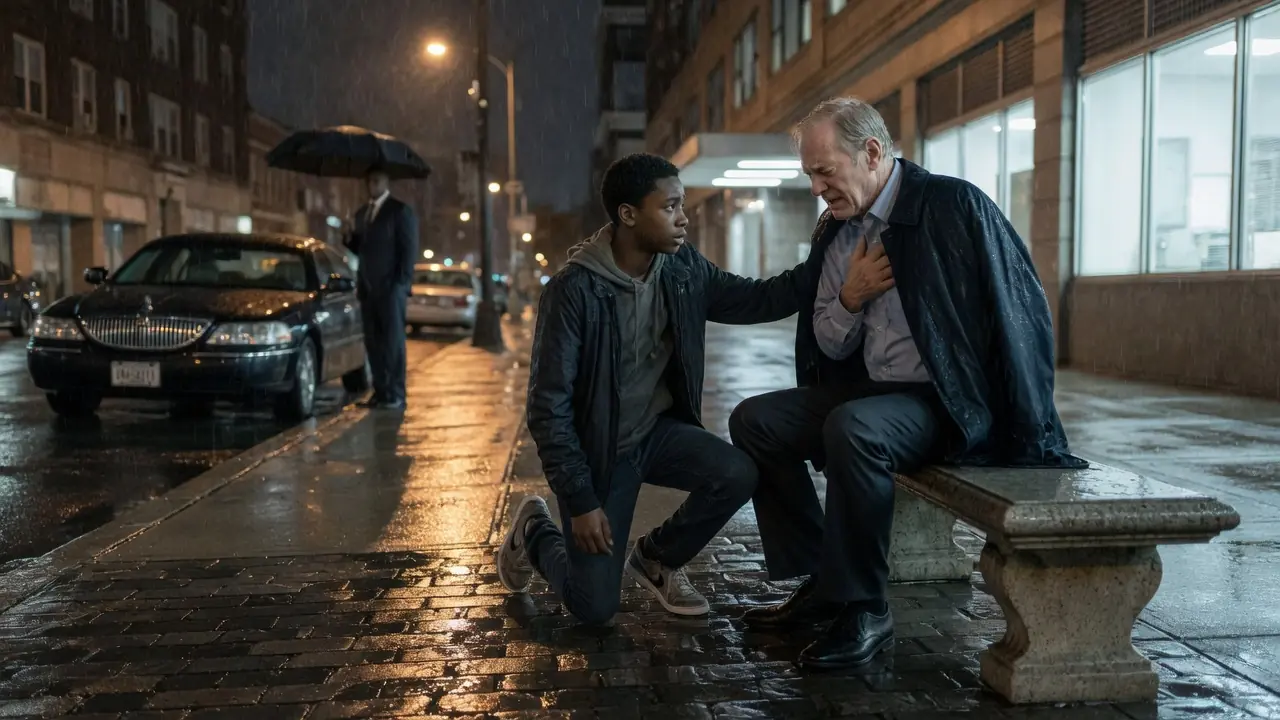
In that split second of light, Deshawn saw him.
The elderly white man from yesterday, standing outside a medical building. No umbrella, no coat. Soaked through, dress shirt plastered to his body, trying to hail a cab, waving frantically.
Cabs passed without stopping.
The man stumbled, caught himself on a lamppost, face pale, lips slightly blue, hand clutching his chest.
Deshawn’s mind raced.
Grandma’s waiting. She’s probably panicking. I’m already soaked. I need to get home. He’s a stranger. He’s clearly rich. Look at that watch. He’ll be fine. Someone else will help.
But the man staggered again.
His breathing, even from fifteen feet away, Deshawn could see his chest heaving.
He looked like Papa.
That day, the day before he fell, Papa had been breathing like that. Tired. Too tired. Said his chest felt tight. Went to work anyway.
Fell forty feet the next morning.
Then Deshawn noticed something strange.
A Lincoln Town Car was parked fifty feet away. Hazard lights blinking. The driver’s door opened. A man in a suit stepped out, holding an umbrella.
The old man saw him and waved him off angrily.
“No, I said no. Get back in the car.”
The driver stopped.
“Mr. Reynolds, please.”
“I told you I’m not going with Edwards. I’ll find my own way home.”
The driver hesitated, then retreated to the car.
Deshawn was confused.
Why would someone refuse their own ride in a storm when they were clearly sick?
Thunder cracked.
The old man’s knees buckled. He went down, caught himself on his hands, kneeling on the wet sidewalk.
People rushed past. Cars splashed through puddles.
No one stopped.
The man tried to stand.
He couldn’t.
His arms gave out.
Deshawn moved before he decided to.
“Sir. Sir, are you okay?”
He ran and knelt next to the man, rain pouring down both their faces.
The man looked up, eyes unfocused.
“I just… I need to get home. Can’t find my phone. I can’t…”
His voice was slurred.
He was in medical distress.
“Where do you live?”
“Rittenhouse Square. Eighteenth Street. Building with the green awning. I can’t remember the number.”
Rittenhouse Square.
Twelve blocks. Opposite direction of home. Through the worst of the storm.
Deshawn’s phone was at home charging.
He couldn’t call 911. Couldn’t call Grandma.
He looked at the Town Car.
“Sir, your driver’s right there.”
“No.”
The man grabbed Deshawn’s arm.
“Not with him. I won’t. I can’t explain. Please. I need to walk home.”
He wasn’t making sense.
But he was desperate.
And he was sick.
This wasn’t about the storm. This was about something else. Pride, a fight, whatever.
It didn’t matter.
What mattered was that this man was going to collapse if someone didn’t help.
The stakes flashed through Deshawn’s mind.
If I walk this man twelve blocks, I’ll be soaked for over an hour. Risk of getting sick. Grandma will be terrified. I might lose tomorrow’s shift. We need twenty-eight dollars.
But if I walk away and this man dies, I’ll carry that forever.
Deshawn took off his jacket. Thin, soaked, basically useless, but it was something. He draped it over the man’s shoulders.
“I’ll walk you home, sir. Lean on me.”
The man looked at him, a long searching look.
“You don’t have to do this. You don’t even know me.”
“I know you need help. That’s enough. Come on.”
Deshawn pulled the man to his feet. The man was heavy, at least one hundred ninety pounds. Deshawn was five foot seven, maybe one hundred thirty-five pounds, soaking wet.
They started walking.
Behind them, the driver got out of the car again.
“Mr. Reynolds.”
The old man didn’t turn around.
Deshawn didn’t know it yet.
This walk, this choice, this moment, was about to change everything.
Every step through that storm was a choice.
And William Reynolds was counting every single one.
Blocks one through three.
Physical battle.
Rain came in sheets, almost horizontal. Wind tried to knock them over.
Deshawn’s sneakers, holes in both soles, filled with water every step.
Squish. Squish.
The man, William Reynolds, was dead weight. He leaned on Deshawn’s shoulder, breathing ragged.
Deshawn’s shoulder already ached. His legs burned.
They had walked two blocks.
Ten more to go.
Lightning struck close, maybe two blocks away. Thunder so loud Deshawn felt it in his chest.
William stumbled.
Deshawn caught him.
“I got you. Just keep moving. One foot, next foot. One foot, next foot.”
Deshawn repeated it in his head like a mantra.
His teeth chattered. His hands were numb. Water streamed down his face. He couldn’t tell rain from sweat anymore.
Don’t let him fall.
Don’t let him die.
Block four.
The rain lessened slightly. Still pouring, but the worst had passed.
William’s breathing stabilized a little, enough to talk.
“What’s your name, son?”
“Deshawn, sir. Deshawn Carter.”
“Deshawn.”
William repeated it.
“I’m William. William Reynolds.”
The name meant nothing to Deshawn. He nodded and kept walking.
“You should have just called 911. This is too much to ask of a kid.”
“Didn’t have my phone. And you needed help now, not in twenty minutes.”
William fell quiet, studying Deshawn’s profile in the streetlight.
Blocks five and six.
William started talking, maybe to distract himself, maybe because he needed to say it out loud.
“I had a son once. Michael. He’d be thirty now, maybe thirty-one. I lose track sometimes.”
Deshawn didn’t know what to say.
He just listened.
“Car accident seventeen years ago. He was seventeen. Drunk driver ran a red light. Michael was coming home from a volunteer event at a youth shelter.”
William’s voice cracked.
“He was a lot like you. Kind. Saw people who needed help and just helped. Didn’t think twice about it.”
“I’m sorry,” Deshawn said.
“He wanted to be an engineer. Civil engineer. Build bridges.”
William laughed, bitter and sad.
“Ironic, right? Bridges, things that connect people. And I’ve spent the last seventeen years building walls.”
“What kind of walls?”
“Emotional ones. I threw myself into work, made a lot of money, started a foundation in his name, built buildings, funded programs, wrote checks, thought I was honoring him.”
He paused, taking a labored breath.
“But really, I was running from grief, from guilt, from the fact that I worked eighty-hour weeks when he was alive and barely saw him. I missed his baseball games, his science fairs, his graduation speech. I was always too busy.”
His voice broke.
“And now I’m sixty-eight and sick. And I realize I spent seventeen years building monuments to my guilt. But I stopped seeing people. I stopped seeing what Michael saw. Humans who need help.”
They walked another block in silence.
Just the sound of rain and their footsteps.
Then Deshawn spoke.
“You’re seeing me right now.”
William stopped walking and looked at Deshawn.
“What?”
“You’re seeing me right now, in this moment. So maybe you didn’t forget. Maybe you just needed a reminder.”
William’s eyes watered. Could be rain. Could be tears.
“How old are you, Deshawn?”
“Fourteen.”
“Fourteen.” William shook his head. “When I was fourteen, I was stealing cigarettes and failing algebra. You’re different.”
Deshawn shrugged.
“I’m just cold and wet, sir. Let’s keep moving.”
Blocks eight through ten.
The struggle intensified. They were in Center City now. Streetlights brighter. More people, though still not many in this weather.
William’s pace slowed. He was exhausted. Every step was a fight.
“I’m sorry. I’m slowing you down.”
“Don’t be sorry. Just keep walking.”
A car passed and splashed them with a wave of gutter water. Deshawn closed his eyes and kept moving.
His whole body was shaking, not just from cold, but from exhaustion. He had been on his feet since 5:30 a.m. It was after seven p.m. now.
But he didn’t stop.
William noticed.
“You’re limping.”
“Hole in my shoe. It’s fine.”
William looked down and saw Deshawn’s soaked, beat-up Nikes. His face changed.
Shame.
Realization.
Something else.
“Deshawn, why are you doing this? You could have walked away. Most people did.”
Deshawn thought about it.
“My dad used to say, ‘If you see someone who needs help and you can help, you help. That’s it. No reason needed.’”
“Your dad sounds like a good man.”
“He was.”
“Was?”
“Three years ago. Construction accident.”
William went quiet.
They walked another block.
“I’m sorry. That’s too young to lose a father.”
“Yeah, it is.”
Another block.
They were breathing synchronized now.
In, out. Step, step.
William asked, “What does your dad’s voice tell you right now?”
Deshawn didn’t hesitate.
“Keep walking.”
William smiled. First real smile since they started.
Blocks eleven and twelve.
Arrival.
They reached Rittenhouse Square. A completely different world. Elegant brownstones, manicured trees, doormen in uniforms, gas lamps, wealth radiating from every brick.
Deshawn felt it immediately.
He didn’t belong here.
He was , soaked, looked homeless. People would assume the worst.
William pointed.
“That one. Green awning.”
The doorman, a middle-aged white man with a name tag that said George, saw them coming.
His eyes went wide. He rushed out with a massive umbrella. Too late to help.
“Mr. Reynolds. My God. What happened? Are you hurt? Should I call Dr. Patterson?”
“I’m fine, George. Just got caught in this rain. This young man helped me home.”
George looked at Deshawn for the first time. His expression shifted.
Suspicion. Confusion. Disapproval.
He looked Deshawn up and down, taking in the cheap clothes, the soaked jacket, the holes in the shoes. His eyes said, What is this kid doing here?
Deshawn felt it like a punch.
The shift.
The judgment.
The unspoken message.
You don’t belong here.
He stepped back.
“You’re home now, sir. I should…”
William grabbed his arm.
“Wait. Please don’t go yet.”
George hovered, protective, still eyeing Deshawn.
“George, give us a moment.”
George hesitated, then stepped back. But he was watching.
William looked at Deshawn. Really looked.
“Thank you. You didn’t have to do this, but you did. That means something.”
Deshawn nodded. He didn’t know what to say.
“You should get inside, sir. You need to get warm. Maybe see that doctor.”
“I will. But first, I need to know you get home safe. George, call this young man a car.”
“No, sir. I’m fine. I’ll walk.”
“Deshawn.”
“Really. I’m already wet. It’s fine.”
William studied him, saw the pride, independence, the refusal to take what he hadn’t earned.
And something in William’s chest tightened.
This boy.
This fourteen-year-old boy who had nothing, who gave everything.
“At least let me…”
William started to reach for his wallet, but Deshawn was already backing away.
“You get inside and get warm, sir. That’s all I need.”
He turned to go.
William called after him.
“Deshawn Carter. I won’t forget this. I promise you that.”
Deshawn waved without turning around and walked back into the rain.
Twelve blocks home, opposite direction.
Through the storm he had just walked through.
But somehow, despite everything, despite the cold and the exhaustion and the ache in every muscle, Deshawn felt something he hadn’t felt in a long time.
He felt like maybe, just maybe, doing the right thing still mattered.
Even when nobody was watching.
Even when it cost you everything.
Even when the world told you to keep walking.
William Reynolds wanted to repay the boy.
But Deshawn’s answer would prove he was even rarer than William thought.
Inside the lobby, marble floors, crystal chandelier. Deshawn was dripping on the expensive rug. George hovered nearby, still suspicious.
William pulled out his wallet. Leather, soaked but intact. He opened it and pulled out five hundred-dollar bills.
“Please take this. You saved my life tonight.”
Deshawn stared at the money.
Five hundred dollars.
His brain did the math automatically.
That was rent. That was Grandma’s medicine. That was two months of groceries. That was two months of breathing room.
His hand almost reached out.
Then he heard his father’s voice.
Son, we don’t take what we don’t earn. Our word is all we got.
He heard Grandma.
Your daddy never took charity.
Deshawn’s hand dropped.
“I can’t, sir.”
William stared.
“You can’t, or you won’t?”
“Both.”
“Deshawn, do you need this money?”
“Doesn’t matter. I helped because you needed help, not for money. If I take this, it wasn’t kindness. It was a transaction.”
William looked stunned.
“Do you have any idea how rare that is? I know billionaires who’d take this five hundred even though they don’t need it. And you need it, and you’re saying no.”
Deshawn shrugged.
“I’m not from your world, sir.”
William laughed. Real, genuine.
“No, you’re not. And thank God for that.”
He put the cash away.
“Okay. I respect that. But do something for me.”
He pulled out a business card. Heavy stock, embossed.
Deshawn read it.
William J. Reynolds. Founder and Chairman. Reynolds Foundation.
His stomach flipped.
Reynolds.
The construction site. The sign.
“Are you building the center on Broad Street?”
William nodded.
“You’ve seen it?”
“I walk past it every day on my way to work.”
William’s expression softened.
“Of course you do.”
He pointed to the card.
“If you ever need anything, call that number. Day or night. Promise me you’ll keep it.”
“I promise.”
“What school do you go to?”
“Lincoln High, South Philly.”
William nodded slowly, memorizing.
“Lincoln. Good.”
George brought towels, still watching Deshawn.
“Thank you, Deshawn Carter. You didn’t just help an old man. You reminded him why he does what he does.”
Deshawn nodded, not fully understanding.
“Get inside, sir. See that doctor.”
“I will. And Deshawn, I won’t forget this.”
Deshawn turned and left.
The walk home was long and cold. His teeth chattered. His shoulder ached. His feet were numb.
But he felt something strange. Light, like something had shifted.
He looked at the card.
William J. Reynolds.
Billionaire.
And I just walked him home.
Will he remember me, or is this just another story he’ll tell?
He didn’t know.
But he did the right thing.
That was enough.
Still, deep down, there was a spark of hope.
What if this changes something?
At 8:42 p.m., Deshawn climbed the stairs to apartment 3C.
The door flew open before he could unlock it. Grandma Loretta stood there, face tight with fear.
“Where were you?”
“Grandma…”
“I called the store. Mr. K said you left two hours ago. I thought you were hurt.”
She saw how wet he was. Anger melted.
“Baby, what happened?”
She pulled him inside, wrapped him in a blanket, and made him strip out of his wet clothes right there.
“I helped someone, Grandma. An old man. He was sick. I walked him home.”
She stopped and looked at him.
“You walked him home in that storm?”
“He needed help.”
Her eyes filled with tears. She cupped his face.
“You got your daddy’s heart. That same good heart. But you got to take care of yourself, too.”
“I know.”
She made him hot tea, heated up soup, and wrapped him in two more blankets.
Deshawn didn’t mention the card or the five hundred dollars he turned down or the feeling that his life had just changed.
He sat at the table, drank soup, and warmed up.
For the first time in months, he didn’t think about money.
He thought about bridges.
Connections.
How one walk in the rain might have meant something.
Tomorrow was Friday. School, work, the same routine.
But tonight, something felt different.
He didn’t know what yet, but he felt it.
Deshawn thought that was the end of the story. He went to bed. He woke up.
But sixteen hours after he walked William Reynolds home, men in suits came looking for him.
And the whole neighborhood would never forget it.
Friday morning, 6 a.m.
Deshawn woke up sore. His shoulder ached. His feet hurt. Dark circles sat under his eyes.
He found the business card on his nightstand, pulled out his cracked phone, and Googled William Reynolds Philadelphia.
Results flooded in.
Billionaire philanthropist William Reynolds pledges fifty million to Philadelphia education.
Reynolds Foundation awards five hundred million in grants to urban development.
William J. Reynolds, the man who rebuilt Philadelphia.
Forbes profile, net worth estimated at 2.7 billion dollars.
Deshawn’s hands shook.
I walked home a billionaire, and I turned down his money.
Part of him regretted it. Part of him was proud.
Mostly, he was just stunned.
“Deshawn, you’re going to miss the bus.”
He pocketed the card and told himself, It doesn’t matter. He’s probably already forgotten about me.
But Deshawn had a fever that morning. One hundred point two.
Grandma made him stay home.
He was lying on the couch wrapped in blankets, half asleep. Grandma was in the kitchen making tea.
Then sounds came from outside.
Car doors slamming.
Multiple vehicles.
Grandma went to the window.
Her face went white.
“Deshawn. Baby, come here.”
“What?”
“Come here now.”
He got up and looked out the window.
Three SUVs, Lincoln Navigators, tinted windows, parked in a row.
Four men in dark suits stepped out. Sunglasses, earpieces, moving in synchronized precision.
One carried a leather folder. Another spoke into his wrist.
Neighbors froze. Mrs. Washington from 2B clutched her rosary. Kids on bikes scattered.
Someone yelled, “FBI!”
Someone else yelled, “ICE!”
A teenager shouted, “Yo, somebody’s in trouble.”
Windows opened. People leaned out, watching.
Mrs. Rodriguez ran up the steps.
“Loretta, you okay? You need me to call somebody?”
Grandma’s hands shook.
“Deshawn, what did you do? Baby, what did you do?”
“I didn’t do anything.”
“Then why are they here?”
Heavy footsteps on the stairs. Three floors up, getting closer.
Grandma grabbed Deshawn’s shoulders.
“Did you steal something? Did you get in a fight? Tell me the truth.”
“No, I swear.”
A knock came on the door.
Three sharp wraps.
Grandma and Deshawn stared at each other.
Another knock.
Louder.
A voice spoke.
“Mrs. Carter. This is Jennifer Haas with the Reynolds Foundation. We need to speak with Deshawn Carter. It’s urgent.”
Grandma mouthed, “Reynolds?”
Deshawn’s heart pounded.
The business card.
William.
Oh my God.
Grandma opened the door with the chain still on.
A woman stood there. Mid-forties, , tailored charcoal suit, briefcase, professional but kind face.
Behind her, two men in suits stood guard.
“Mrs. Carter, I’m Jennifer Haas, director of special projects for the Reynolds Foundation. Is Deshawn home?”
“What do you want with my grandson?”
“Mr. William Reynolds would like to speak with him today. As soon as possible.”
“Is he in trouble?”
Jennifer smiled.
“No, ma’am. The opposite, actually. May we come in?”
But when Deshawn met William Reynolds on Saturday morning, he learned the truth.
And the truth was bigger and more heartbreaking than he could have imagined.
Inside the apartment, Grandma let Jennifer in. The two men stayed outside.
Jennifer looked around without judgment.
“Is Deshawn here?”
Deshawn stepped forward.
“I’m Deshawn.”
Jennifer’s face softened.
“Mr. Reynolds would like to meet tomorrow, Saturday, 10 a.m. Would that work?”
“Why?”
“He’ll explain, but he asked me to give you this.”
She handed him an envelope. Thick, cream-colored, Reynolds Foundation logo.
“Open it.”
Inside was a handwritten note.
Deshawn, you asked for nothing. That’s why I want to give you everything you need. Tomorrow we will talk about your future.
W.R.
Below that was a check.
Five thousand dollars.
Memo: For rent, medicine, and peace of mind.
Grandma gasped and covered her mouth.
Deshawn couldn’t breathe.
“Mr. Reynolds wanted you to have that now. No strings. We’ll send a car at 9:45 a.m. tomorrow.”
Jennifer left.
Car doors. Engines.
Silence outside.
Neighbors gossiped loudly.
Grandma looked at the check, then looked at Deshawn.
“Baby, what did you do last night?”
“I just walked him home, Grandma.”
She started crying.
“Your daddy is so proud.”
Deshawn hugged her. He was crying, too.
Saturday morning, 9:45 a.m.
A Mercedes pulled up. The driver opened the door.
Deshawn wore his best clothes. Khaki pants. A button-up shirt, slightly too big. Borrowed shoes.
Grandma kissed his forehead.
“You be polite. You represent our family.”
“I will.”
The car went to Broad Street, to the construction site, the Reynolds Center. They pulled through security and stopped at a trailer marked Administration.
Jennifer met him.
“Mr. Reynolds is inside.”
Inside, blueprints covered every wall. 3D models. Renderings.
At the center table sat William Reynolds, gray slacks, navy sweater. He looked better than Thursday, but still tired.
He turned.
His face lit up.
“Deshawn, you came.”
“Yes, sir.”
“Did you cash the check?”
“Yes, sir. Thank you.”
“It wasn’t enough. Sit, please.”
They sat. Jennifer stood nearby.
“I owe you an explanation about Thursday night. About why I refused my driver.”
“You don’t owe me.”
“I do. Because what I’m about to ask requires you to understand who I am.”
He took a breath.
“Thursday afternoon, I had a doctor’s appointment. Cardiologist. Heart disease, advanced.”
He tapped his chest.
“He told me I have six months, maybe a year. There’s no surgery, no cure, just management and time.”
Deshawn’s stomach dropped.
“Let me finish. I’m sixty-eight. I’ve built companies, started a foundation. I lost my wife ten years ago. My son, seventeen years ago. And when the doctor said I was next, I felt relief.”
His voice cracked.
“Relief. Because I’m tired, Deshawn. Tired of being angry. Tired of throwing money at problems. Tired of waking up alone, wondering what it was all for.”
William pulled out a photo and slid it across. A teenage boy, white, brown hair, bright smile, holding a model bridge.
“My son Michael died when he was seventeen. Senior year, coming home from volunteering. A drunk driver ran a red light.”
Deshawn stared at the photo.
“Michael wanted to be a civil engineer. Build bridges. He’d explain physics to me, even though I didn’t understand.”
William smiled through tears.
“He believed infrastructure was about connecting people, making sure everyone had access to opportunity. He’d say, ‘Dad, what’s the point of building something if the people who need it most can’t reach it?’”
Deshawn’s throat tightened.
“After he died, I spent seventeen years building things in his name. This center, scholarships, projects. I thought I was honoring him. But really, I was avoiding grief. Avoiding the fact that I worked eighty-hour weeks when he was alive and barely knew him.”
William looked at Deshawn.
“So Thursday night, I did something stupid. I told my driver to leave. I sent my assistant away. I walked into that storm thinking, if this is how it ends, fine.”
He paused.
“But then you appeared. Fourteen years old, soaking wet, shivering. You took off your jacket and put it on my shoulder. Said, ‘I’ll walk you home, sir.’”
His eyes watered.
“And I realized I don’t get to quit. Not yet. Because if a kid who has nothing can give everything, what am I doing giving up?”
He looked directly at Deshawn.
“You’re exactly who Michael would have been at your age. Kind, selfless. You see people. You see what needs fixing, and you just fix it.”
Silence.
“You didn’t just save my life. You gave me a reason to fight for the time I have left. And I want to spend that time doing what Michael would have wanted. Building bridges.”
William slid another folder across.
“Here’s the truth. I’m not doing this because I feel guilty. I’m not doing this because you’re charity. I’m doing this because for the first time in seventeen years, I feel like I can breathe. Like maybe Michael’s death wasn’t meaningless. Like maybe if I can help you, his dream lives on.”
Tears streamed down his face.
“I want to offer you something, Deshawn. But understand, this isn’t charity. This is me trying to do what my son would have wanted. This is me trying to build a bridge between his memory and your future, between what I lost and what you could become.”
He reached across the table.
“Will you let me?”
Deshawn couldn’t speak. His eyes burned.
He was crying.
“I don’t know what to say.”
“Don’t say anything yet. Let me tell you what I’m offering. Then you decide.”
William opened the folder.
And inside was a future Deshawn had never dared to dream about.
What William Reynolds offered wasn’t just money.
It was a future Deshawn didn’t know he was allowed to dream about.
William opened the folder. Official documents. Legal letterhead.
“This center opens September 2026, one year from now. It will serve five hundred students. Full scholarship, tuition, meals, supplies, everything. Focus on engineering, technology, skilled trades, architecture.”
He slid the first page across.
“I’m establishing the Michael Reynolds Memorial Scholarship. Full ride to any university in the country. Four years undergrad, four years of graduate school if you want, plus a fifty-thousand-dollar annual stipend for living expenses and family support.”
Deshawn’s breath caught.
“Fifty thousand a year?”
“Yes. So you can focus on school instead of working three jobs.”
William slid another page.
“Total scholarship value over eight years, approximately 1.2 million dollars. You’ll be the first recipient. We’ll select one new recipient every year forever. I’m endowing it with fifty million. Your scholarship will exist as long as there are kids who need it.”
Deshawn couldn’t breathe.
1.2 million.
MIT. Stanford. Penn.
I could study engineering.
I could build bridges.
William pointed to blueprints on the wall. A pedestrian bridge. Sleek, modern, curved arch.
“We’re building a bridge connecting this center to the public library two blocks away. Michael’s Bridge. It’ll be a symbol. Knowledge on one side, opportunity on the other, and a path connecting them.”
He looked at Deshawn.
“I want you to co-design it. You and my engineering team. Your ideas, their expertise. Students will be part of the construction process. The community builds it together.”
“Me? But I’m not…”
“You’re smart, you’re passionate, and you see things others don’t. That’s enough.”
Jennifer added, “You’ll be paid as a consultant. Twenty-five dollars per hour, weekends and after school, six-month project timeline.”
Deshawn did the math.
Twenty-five times ten hours times twenty-four weeks equaled six thousand dollars.
More than a year at the corner store.
William continued.
“One more thing. I know your grandmother works two shifts at the hospital laundry. I know her arthritis makes every day painful.”
Deshawn tensed.
How much does he know?
“I’d like to offer her a position as community outreach coordinator for the Reynolds Center. She’ll work with local families, help with enrollment, coordinate with churches and schools. Part-time, twenty hours a week. Salary, sixty-five thousand per year.”
Deshawn’s mouth fell open.
“Sixty-five thousand?”
“Plus full health benefits. Her arthritis treatment will be covered. Physical therapy, medication, everything.”
Tears streamed down Deshawn’s face. He couldn’t stop them.
She’ll never have to scrub sheets again.
She’ll never have to work in pain.
She can rest.
“Deshawn. Don’t you want that for her?”
Deshawn nodded.
He couldn’t speak.
Jennifer opened a calendar.
“Here’s the timeline. Today, you sign preliminary agreements. We will announce the scholarship next week. In November, you start working with the engineering team on bridge design. December, media announcement. You’ll be the face of the program if you’re comfortable. January, groundbreaking ceremony. You’ll speak. Spring, bridge design finalized. Summer, bridge construction begins. You’ll intern on site, paid. September 2026, the center opens. You enroll as a student.”
Deshawn hesitated.
“Why me? There are thousands of kids who need this more.”
“Are there?” William asked. “Because from where I’m sitting, you’re exactly the kid who needs this. You’re brilliant. You’re kind. You work harder than anyone I’ve ever met. And you’re one bad month away from dropping out of school to work full-time. Am I wrong?”
Deshawn looked down.
He couldn’t deny it.
“You deserve this, Deshawn. You earned it the moment you ran toward me instead of walking past. Most people walked past. You didn’t. That says everything.”
Jennifer laid out the contracts.
“Since you’re a minor, your grandmother will co-sign, but everything is yours. The scholarship, the stipend, the job. No catches, no strings.”
Deshawn read them slowly, carefully, like Grandma had taught him.
He looked at William.
“What if I fail? What if I’m not good enough?”
William answered, “Then you fail, and you learn, and you try again. That’s what Michael would have done.”
Deshawn picked up the pen and signed his name.
Deshawn J. Carter.
His hand shook so badly the signature was barely legible.
William stood and offered his hand.
They shook.
“Welcome to the Reynolds family, Deshawn. Let’s build something beautiful.”
Deshawn broke down.
Full sobs.
Jennifer handed him tissues. William hugged him. This frail old man was hugging a fourteen-year-old boy and whispering, “Thank you for giving me a reason to fight. Every extra day I get is because of you.”
In the Mercedes, Deshawn clutched the folder and read every page.
Contract. Scholarship terms. Grandma’s job offer. Letter from William about Michael.
My son believed we’re all connected, that our lives touch each other in ways we can’t predict. You touched mine, Deshawn. Let me touch yours.
Deshawn stared out the window at Philadelphia passing by.
The same city, but completely different now.
This morning, I woke up planning to drop out.
Tonight, I’m going to MIT.
He burst through the apartment door.
“Grandma!”
She was cooking. Gospel music on the radio.
“Baby, how’d it go?”
He couldn’t speak. He just handed her the folder.
She read.
Her hands shook.
She sat down hard.
“Deshawn… baby. Is this real?”
“It’s real, Grandma.”
She read the job offer. Salary, benefits, arthritis treatment covered. She looked up at him, tears streaming.
“I don’t have to go back.”
“You never have to go back.”
They held each other and cried.
That night, they ordered pizza. First time in eight months. They ate it at the table, laughing, crying, not believing this was their life now.
Grandma kept looking at the papers.
“Your daddy. Wherever he is, he’s smiling.”
Deshawn thought about his father, about walking Grandma home from the bus stop, about the emergency jar with forty-seven dollars, about how forty-eight hours ago he was Googling how to drop out of school.
And now he was going to college.
Any college.
Full ride.
He was going to build bridges.
Real ones.
That night, Deshawn lay in bed, staring at the ceiling. He thought about William, about Michael, about that storm, about how one choice, one moment, one walk in the rain changed everything.
He pulled out his notebook, the one with bridge designs, opened to a blank page, and started sketching Michael’s Bridge.
But Deshawn’s scholarship was never supposed to be just his.
It was a spark.
And sparks start fires.
Three months later, December 2025, Deshawn’s transformation was complete.
Before, he had been the invisible kid in the back row, working at the corner store, carrying adult weight.
After, he was working with engineering teams every Saturday. His design ideas for the bridge, a curved arch that echoed the Schuylkill River, were being implemented.
His sketches became reality.
The Philadelphia Inquirer ran a front-page story.
From Storm Walker to Scholar: Teen’s Act of Kindness Leads to Full-Ride Scholarship.
Local TV did a segment. Deshawn stood on camera wearing a hard hat, explaining load distribution, speaking like he belonged there.
Teachers at Lincoln High treated him differently. The guidance counselor asked him to mentor other students.
He was on the honor roll, not hiding anymore.
Grandma Loretta’s transformation was even more dramatic.
Before, two jobs, constant pain, exhaustion.
After, she worked twenty hours a week at the Reynolds Center and loved it. She talked to families about enrollment, coordinated with churches. Health insurance covered physical therapy. Her arthritis pain reduced by sixty percent.
She walked without limping.
She smiled all the time.
She told a reporter, “I got my grandson back. He used to come home exhausted. Now he comes home excited. That’s worth more than any money.”
The story went viral.
#StormWalker trended.
Comments flooded in.
This is what humanity should be.
Proof that kindness is never wasted.
But there were also negative comments.
He only got it because he’s .
Performative charity.
Deshawn read them. They stung.
William called.
“Turn off the comments. You earned this through character. Let them talk.”
Community reactions were mixed.
Mr. Kowalski framed the article and hung it behind the register.
“That’s our boy.”
Lincoln High saw applications to magnet programs increase forty percent. Students were suddenly interested in engineering.
The local church invited Deshawn to speak.
He told two hundred people, “I didn’t do anything special. I just helped when someone needed it. You can, too.”
Standing ovation.
But some kids at school resented him.
“Must be nice. Walk one old white dude home and get a million dollars.”
Deshawn talked to William about it.
William said, “Jealousy is fear. There’s not enough to go around. Show them there is.”
December press conference.
William and Deshawn announced the Storm Walker Initiative. Ten additional scholarships awarded annually. Five hundred thousand dollars per year, funded in perpetuity.
Criteria: exceptional character through community service, financial need, academic potential.
Message: Deshawn isn’t the exception. There are thousands of kids like him. Let’s find them.
Hope replaced resentment.
June 2026.
Bridge construction began.
Groundbreaking ceremony.
Five hundred people attended.
Deshawn spoke.
“This bridge isn’t just steel and concrete. It’s a promise. A promise that where you come from doesn’t determine where you go.”
Applause echoed.
William stood next to him, visibly frailer but smiling. He used a cane now, but he was present.
Construction crew, sixty percent local hires.
Jobs created.
Paychecks to families who needed them.
August 2026.
The center neared completion. Five hundred students enrolled for the first year. Waitlist of twelve hundred. Eleven Storm Walker scholarships awarded. One hundred fifty local jobs created. Eight million dollars invested in South Philadelphia.
Twenty-five Lincoln High students received scholarships to other programs inspired by Deshawn.
National media picked it up.
NPR feature: How One Act of Kindness Created a Movement.
Other cities reached out.
Can you replicate this model?
Unexpected ripples spread.
Two other Philadelphia billionaires announced youth centers. Both credited the Reynolds model.
Corporate partnerships formed. Google donated computers. Comcast donated internet. Construction firms offered internships.
The bridge got a nickname.
The Storm Walker Bridge.
The city council made it official.
Tour groups visited the construction site.
It became a symbol.
September 2026.
The Reynolds Center opened.
Ribbon-cutting ceremony.
The mayor spoke. William spoke. Deshawn spoke.
Five hundred students walked through the doors on the first day.
Deshawn was one of them. Sophomore now, fifteen years old.
But he wasn’t just a student.
He was a symbol.
A reminder.
A promise kept.
The community knew it.
Crime down eighteen percent in surrounding blocks. High school graduation rates up twelve percent.
Numbers don’t lie.
One act of kindness.
One walk in the rain.
One choice.
And an entire community transformed.
One year after the storm, Deshawn stood on the bridge he helped design.
But this time, someone else needed help, and he knew exactly what to do.
September 2027, one year after opening, the Reynolds Center was thriving. Five hundred students enrolled, fifty staff members, dozens of programs running. College acceptance rate, eighty-seven percent for the first graduating class.
Thirty-two Storm Walker scholarships awarded over two years.
Community impact measurable.
Crime down eighteen percent.
High school graduation rates up twelve percent.
William Reynolds was still alive. He had defied the six-month prognosis.
Treatment bought time, not a cure, but time.
He was frailer. Used a cane. Needed oxygen sometimes.
But he was present.
He attended every center event, knew students by name, and watched Deshawn like a proud father.
He told reporters, “I was ready to die. Deshawn gave me a reason to live. Every day I wake up is a gift he gave me.”
The Storm Walker Bridge was complete. Officially named, beautiful curved pedestrian bridge. LED-lit at night.
Plaque at the entrance.
Dedicated to Michael Reynolds, 1987–2007, and to Deshawn Carter, who reminded us that the strongest bridges are built with human kindness.
It became a landmark. People took photos. Tourists visited.
A rainy evening, September 2027.
Deshawn, now fifteen, sophomore at the center, was walking home after robotics club. It was raining, not a storm, just steady rain.
He was crossing through Rittenhouse Square, the fancy neighborhood where William lived. He visited sometimes. They had dinner. Talked about bridges and life.
He saw her.
A girl, maybe thirteen, struggling with an elderly woman at a crosswalk. The grandmother had a walker and could barely move. Traffic was impatient, honking.
The girl looked overwhelmed, embarrassed, near tears.
Deshawn stopped.
“Need help?”
The girl looked up, suspicious.
“We’re okay.”
“I got time.”
He helped the grandmother across, walked them two blocks to their building, carried the grandmother’s bag.
The girl asked, “Why’d you do that? We’re strangers.”
Deshawn smiled.
“Someone did it for me once. Changed my life.”
He handed her a card.
Reynolds Center for Youth Innovation.
“If you ever need help, school, tutoring, college applications, anything, call that number. Tell them Deshawn sent you.”
The girl took the card, confused but grateful.
“Thank you.”
Deshawn walked away.
He crossed the Storm Walker Bridge, stopped in the middle, and looked back at the center, glowing with light and life.
His phone buzzed.
Text from William.
Dinner Thursday. I want to hear about your MIT application.
Deshawn smiled.
He texted back.
Yes, sir. 6 p.m.
He looked up at the rain.
Remember that night?
The cold. The fear. The choice to help.
People asked him all the time, “Do you ever regret turning down that five hundred dollars?”
And he told them, “I didn’t turn down five hundred dollars. I invested it. I invested it in believing that doing the right thing matters, and the universe paid me back a thousand times over.”
He continued walking.
The bridge behind him.
The center glowing.
The city lights reflecting in puddles.
Rain falling softly.
And somewhere, he knew his father was smiling.
If you see someone struggling in a storm, on a street corner, in a classroom, stop. Help.
You never know what that moment might mean.
Maybe you won’t meet a billionaire. Maybe no one will write a story about you.
But kindness creates ripples.
Small acts become big waves.
Deshawn was just a kid who walked an old man home in the rain.
And it changed everything.
Not just for him.
For his grandma.
For five hundred students at the Reynolds Center.
For every person who heard the story and decided to be a little kinder.
So be someone’s storm walker.
You never know what happens next.
Because the smallest gesture can change everything.