On a brutal winter night in Austin, seventeen-year-old Ethan Bennett pedaled his battered delivery bike through streets glazed with ice, trying to finish one final order before eight o’clock.
That last delivery meant everything.
It meant rent for one more night at the boarding house. It meant keeping his job. It meant not sleeping outside in the cold.
His thin jacket did almost nothing against the wind that cut through downtown Austin like a knife. The insulated delivery bag on his back held tacos and queso for a customer on South Congress Avenue who had tipped exactly zero dollars, but Ethan still rode as fast as his aching legs would allow.
His phone buzzed against his thigh.
He did not need to look.
It would be Mr. Rodriguez, his dispatch manager, warning him again.
“Clock’s ticking, Bennett. Don’t be late again.”
Ethan gripped the handlebars tighter.
He had already been late twice before. Once because a customer had given the wrong address. Once because his bike chain had snapped on a hill. Mr. Rodriguez did not care about excuses. He cared about numbers on a screen.
One more late delivery, and Ethan was done.
No job.
No paycheck.
No rent.
At seventeen, Ethan had already learned how quickly life could collapse.
He had once been the kind of student teachers talked about with excitement. Gifted. Hardworking. The boy who might get scholarships, study pre-med, and someday become someone important. But then his mother got sick. Hospital bills came first. Medicine came first. Homework came last.
Ethan left school temporarily to care for her.
At least, that was what he told himself.
But his mother died anyway.
Sixteen months earlier, she had passed on a Tuesday morning while Ethan was at the grocery store buying her prescriptions. Since then, he had been alone in a city that did not seem to notice whether he lived or disappeared.
Still, he kept going.
Still, he pedaled.
The small silver necklace beneath his collar bumped against his chest as he rode. It had belonged to his mother, Anna Bennett. She had worn it since childhood, the only thing she had from before she was adopted. The pendant was smooth, handmade, and marked with a tiny carving on the back.
It was cold against his skin, but the memory of her was warm.
Ethan turned onto Sixth Street, taking a shortcut that might save him three minutes.
That was when he saw her.
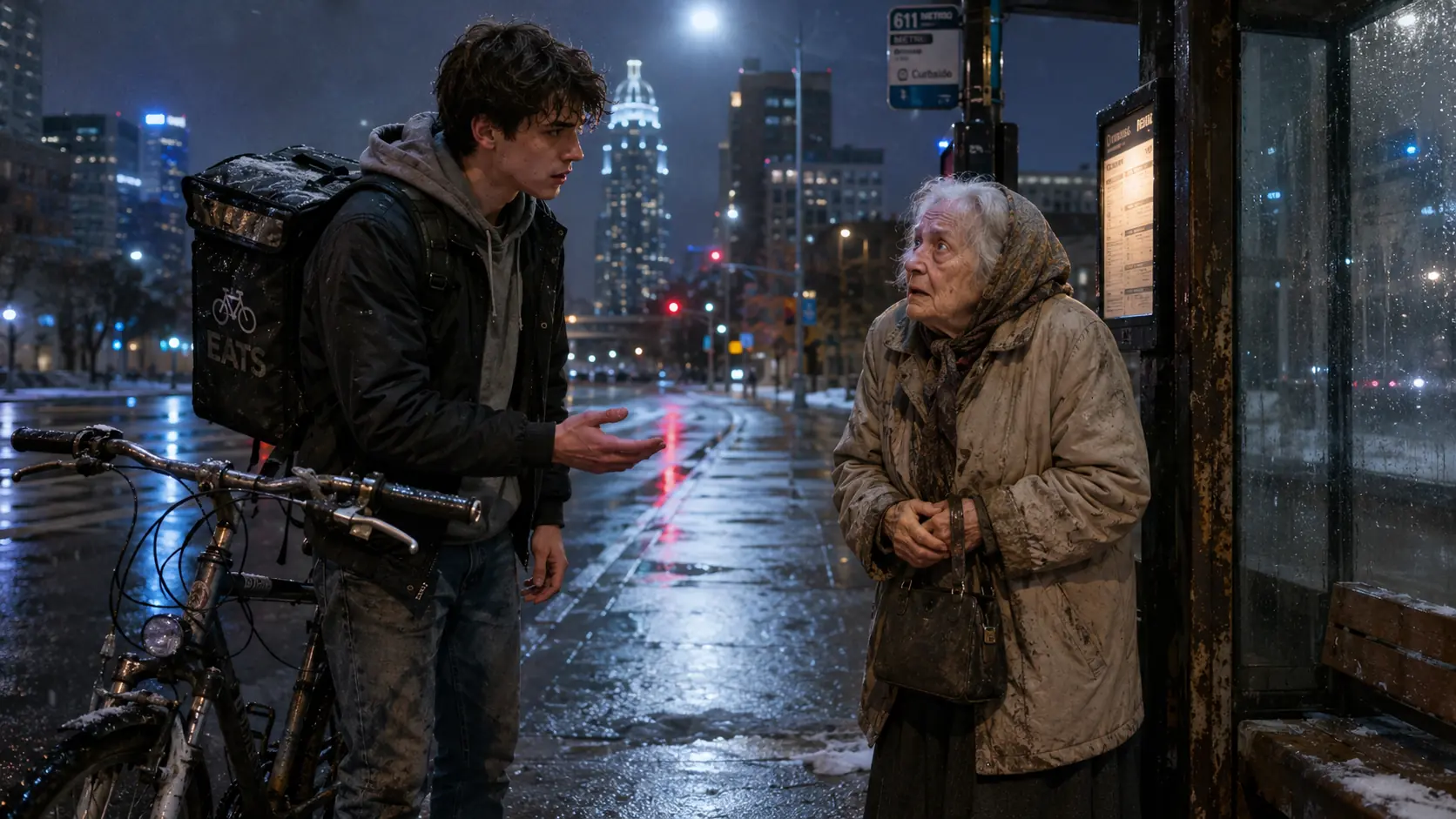
At first, he thought she was a pile of old clothes near the rusted bus shelter. Then the bundle moved.
An elderly woman stood barely upright, one trembling hand gripping the bus stop pole, the other clutching a small handbag to her chest. Her coat looked thin and old, her shoes were soaked through, and her lips were turning blue.
Ethan pedaled past.
He had to.
It was 7:43.
Seventeen minutes left.
But something made him look back.
The woman swayed like a tree about to fall.
Then his mother’s voice rose in his memory.
“Baby, if you ever see someone alone like that, you stop. You hear me? You stop.”
Ethan squeezed the brakes.
His bike skidded on the ice.
He looked at the delivery bag, then at the old woman.
“Damn it,” he whispered.
He turned around.
“Ma’am,” he said softly as he approached. “Are you okay?”
The woman blinked at him with pale blue eyes full of confusion.
“The bus,” she whispered. “I’m waiting for the bus.”
“Which bus?”
“The 47. To Cedar Park. My house is on Limestone Trail.”
Ethan felt his stomach drop.
Cedar Park was nearly fifteen miles away.
And the 47 bus had been canceled years ago.
“Ma’am,” he said gently, “that bus doesn’t run anymore.”
Her face crumpled.
“That can’t be right.”
“I’m sorry, but it is.”
She stared at the ground, ashamed and frightened.
“I must have forgotten,” she said quietly. “I forget things now.”
“Do you have someone you can call?”
She fumbled with an old flip phone, staring at it like she no longer understood what it was.
“My daughter usually helps me. Or maybe she moved. I can’t remember.”
Ethan checked the time.
7:47.
Thirteen minutes left.
He should have called someone and ridden away. But the police might take hours. A taxi to Cedar Park would cost more than he had earned all week. And the woman looked like she might not survive hours in that cold.
“What’s your name?” he asked.
“Dorothy,” she said. “Dorothy Whitfield.”
“I’m Ethan Bennett. I’ll get you home.”
“You will?”
“Yes, ma’am. But I only have a bike.”
Dorothy looked at the battered bicycle like he had offered her a ride on a dragon.
Then, with surprising courage, she nodded.
Getting her onto the cargo rack took five minutes they did not have. Ethan wrapped his delivery blanket around her shoulders and told her to hold tightly to his waist.
Before they started, he glanced at his phone.
Eight messages from Mr. Rodriguez.
The last one read, “That’s it, Bennett. You’re done.”
Ethan turned the phone off and started pedaling.
The wind fought them every inch of the way. What should have been a difficult ride became a brutal journey through freezing streets. Ethan’s legs burned. His lungs felt like they were full of broken glass. But Dorothy held on without complaint.
They stopped once at a closed gas station, where Ethan spent the last six dollars and fifty cents in his pocket on two hot chocolates from an old vending machine. The drinks were barely warm and tasted like chemicals, but they helped.
“Why are you doing this?” Dorothy asked as they stood beneath a flickering light. “You don’t know me.”
Ethan thought of his mother.
“My mama taught me to stop,” he said simply.
Dorothy nodded slowly.
“Good woman,” she murmured.
By the time they reached Limestone Trail, it was after nine.
The houses were large and set back from the street behind gates and long driveways. Dorothy guided him uncertainly until they reached a stone house with warm lights glowing in the windows.
Before Ethan could knock, the door flew open.
A woman in her fifties rushed out, her face filled with panic.
“Mother, where have you been?”
“This young man brought me home,” Dorothy said clearly. “From the bus stop.”
The woman stared at Ethan, then at his bike.
“The bus stop? That is twelve miles from here.”
“Yes, ma’am,” Ethan said. “She was freezing.”
The woman’s face changed from suspicion to shock, then to gratitude.
“I’m Sharon Whitfield,” she said. “Please come inside. You look half frozen.”
“I can’t,” Ethan replied. “I should go.”
He did not want pity. He did not want charity. He had done what he had to do, and now he had to face the consequences.
Dorothy reached into her purse and wrote a number on an old receipt.
“Call me,” she said. “Please. I want to thank you properly.”
“You don’t need to thank me, ma’am. I’m just glad you’re safe.”
Dorothy’s cloudy eyes cleared for one brief instant.
“You did more than you know,” she said.
Ethan rode away before they could stop him.
When he reached the boarding house, his belongings were already on the sidewalk.
Two trash bags of clothes.
A backpack of schoolbooks.
A box of his mother’s things.
His key no longer worked.
A notice was taped to the door.
“Rent overdue. Locks changed.”
Ethan sat on the steps, too tired to cry.
The landlord opened the door behind him.
“You got my note?”
“Yes, sir. I was going to pay tomorrow.”
“I don’t care. Rules are rules.”
“Can I at least—”
“No.”
The door closed.
The deadbolt slid into place.
Ethan gathered his things and walked eight blocks to an all-night convenience store called Quick Stop. He had delivered food there before. An old man named Walter owned the place. A younger clerk named Tyler worked nights.
When Ethan entered with his bags, Tyler looked up from his phone.
“We’re not a homeless shelter.”
“I know. I just need an hour to figure out where to go.”
“Buy something or leave.”
“I don’t have any money.”
“Then get out.”
Walter looked up from behind the counter, studying Ethan’s frozen sleeves and hollow eyes.
“You’re that delivery kid,” he said. “Bennett, right?”
“Yes, sir.”
Walter closed his book.
“There’s a cot in the storage room. It’s not much, but it’s warm. You can sleep there tonight.”
Ethan blinked.
“You’d really let me?”
“One night,” Walter said. “Just don’t steal my coffee pot.”
It was half a joke, but it made Ethan smile weakly.
Walter handed him a packet of instant noodles.
“Eat before you sleep. You’ll think straighter in the morning.”
That night, Ethan curled up on the narrow cot, holding his mother’s photograph close.
“I’m trying, Mama,” he whispered.
He fell asleep dreaming of Dorothy’s trembling hands around his waist and her voice saying, “You did more than you know.”
The next morning, Ethan tried to repay Walter by cleaning the storage room. For an hour, he stacked boxes and swept dust, grateful to have something useful to do.
Then Tyler accused him of stealing twenty dollars from the register.
Ethan emptied his pockets. He opened his backpack. His textbooks, his mother’s photo, his cracked glasses case, and a faded UT Austin acceptance letter spilled across the counter.
“That’s everything,” Ethan said quietly.
Tyler smirked.
“Money doesn’t just disappear.”
But Walter did not accuse Ethan. Instead, he pressed a button under the counter and pulled up a security feed Tyler had forgotten existed.
The footage showed Tyler opening the register, glancing toward the door, and slipping a twenty-dollar bill into his pocket.
Walter’s voice stayed calm.
“Guess the old camera still works.”
Tyler’s face went pale.
“That’s old footage.”
“It’s timestamped,” Walter said. “Ten minutes ago.”
Tyler grabbed his jacket and left without another word.
Walter placed two bills in Ethan’s hand.
“For the work and the trouble.”
“I can’t take this.”
“It’s not charity. It’s payment.”
Then Walter’s voice softened.
“There’s a cot in the back if you need it again tonight.”
Ethan looked at him, confused.
“Why are you being so kind to me?”
Walter smiled faintly.
“Because someone was kind to me once when I needed it. I’ve been trying to return the favor ever since.”
Something inside Ethan cracked open, like ice beginning to thaw.
The next morning, Sharon Whitfield found him at the Quick Stop.
“My mother has been asking for you,” she said. “She’s lucid this morning. That does not happen often. Please come.”
Ethan hesitated, then agreed.
The Whitfield house looked even larger in daylight. Sharon led him to a sunroom where Dorothy sat wrapped in a blanket, morning light softening her fragile face.
“There you are,” Dorothy said warmly. “I was afraid you wouldn’t come.”
Ethan sat across from her.
She studied him carefully.
“You lost your job for me,” she said.
“It’s all right.”
“No, it is not.”
Her voice was gentle but firm.
“Why did you stop, Ethan?”
He looked down at his hands.
“My mother always said you don’t ride past someone who looks forgotten.”
Dorothy smiled.
“Your mother sounds like someone I would have liked.”
“She would have liked you, too.”
Dorothy reached for a folder beside her chair.
“I asked Sharon to learn a little about you. You were an excellent student. Top marks. Scholarship recommendations. You left school to care for your mother. Since she passed, you have been trying to survive alone.”
Ethan nodded.
“I just did what I had to.”
“And now,” Dorothy said, “you can do something more. You can stay here.”
Ethan looked up sharply.
“Stay here?”
“Yes. This house has too many empty rooms and not enough laughter. Finish school. Get back on your feet. Let me help.”
He shook his head.
“I didn’t do enough to deserve something like that.”
Dorothy smiled, weary but radiant.
“You stopped. That was enough.”
Then she told him she wanted to start a foundation for young people like him, teenagers trying to survive while the world looked past them. She could fund it, but she wanted someone beside her who understood what it meant to be invisible.
“Why me?” Ethan asked.
“Because you remind me of someone I once loved,” Dorothy said softly. “My closest friend. She had your way of seeing good in people, even when the world gave her no reason to.”
Ethan’s eyes stung.
“I don’t know what to say.”
“Then don’t say anything yet,” Dorothy replied. “Just think about it.”
After a long silence, Ethan nodded.
“If you really think I can help, ma’am, I’d like to try.”
Dorothy reached out and placed her frail hand over his.
“Welcome home, Ethan Bennett.”
The first three months in Dorothy’s house were the happiest Ethan had known since before his mother became sick.
He had a real bed, a desk, bookshelves, and windows that looked out over the Texas hill country. Dorothy hired tutors, and Ethan returned to his studies with fierce determination. At first, it was harder than he expected. His mind, long trained for survival, struggled with stillness. But slowly, the patterns returned. Equations made sense again. Words stopped tangling on the page.
Dorothy asked every morning what he had learned, and every evening she listened as if every answer mattered.
“Mistakes mean you’re trying,” she told him once.
Sharon, cautious at first, began to trust him. She saw his patience with Dorothy, the way he listened instead of speaking over her, the way he treated her confusion with dignity. One evening, she sat with him in the kitchen and admitted the truth.
“She’s happier,” Sharon said. “I haven’t seen her this engaged in years.”
“She’s an amazing woman,” Ethan said.
“She is. And so was Patricia, my sister. You remind my mother of her. Not in looks, but in spirit.”
Ethan did not try to replace Patricia. He knew he could not. But he gave Dorothy something she had lost: purpose.
Together, they began building the Lone Star Light Foundation.
Dorothy’s lucid days were unpredictable, but on her good days, she was sharp, focused, and determined. She and Ethan drafted mission statements, researched youth homelessness, and planned how to reach young people who had fallen through the cracks.
Then the story leaked.
A local reporter published a piece about the “homeless teen taken in by elderly heiress.” At first, the response was warm. Then suspicion grew. Online strangers called Ethan a con artist, a manipulator, a thief preying on a vulnerable old woman.
Tyler, angry after being fired from Quick Stop, posted an edited video making it look as if Ethan had stolen from the register.
The lie spread fast.
For days, Ethan stopped going outside.
Then Walter posted the full security footage.
The truth was undeniable. Tyler had stolen the money, not Ethan.
Alongside the video, Walter wrote, “I will not let a good kid’s reputation be destroyed by a liar. Ethan Bennett is honest, hardworking, and kind.”
The story shifted again.
Apologies came.
Support came.
But Ethan felt exposed and afraid.
“Maybe I should leave,” he told Dorothy.
“Absolutely not,” she said. “You are family now. Family does not abandon each other when things get hard.”
By December, the foundation had helped nine young people with housing, tutoring, medical care, and job training.
Dorothy’s health was declining, but whenever Ethan entered the room, she smiled.
One afternoon, while he helped her button her cardigan, the silver pendant slipped from beneath his collar.
Dorothy froze.
“That necklace,” she whispered.
“It was my mother’s,” Ethan said. “She said she had it since before she was adopted.”
Dorothy’s eyes widened, and for the first time in weeks, the fog lifted completely.
“Anna,” she whispered. “Anna Evelyn Bennett.”
Ethan stared at her.
“My mother’s name was Anna.”
Dorothy reached for the pendant with trembling fingers.
“That belonged to Evelyn’s little girl. Evelyn Whitfield. My best friend in all the world.”
Sharon came running when she heard her mother’s raised voice.
Dorothy turned toward her, tears in her eyes.
“Sharon, the necklace. It’s Evelyn’s. This boy’s mother was Evelyn’s daughter.”
The truth came slowly, then all at once.
Dorothy’s dearest friend, Evelyn Whitfield, had lost her baby daughter during a hurricane evacuation decades earlier. The child had vanished and was presumed dead. But she had survived, been adopted, and grown up as Anna Bennett.
Ethan’s mother.
Ethan was not a stranger after all.
He was what remained of Evelyn’s family.
Dorothy wept as she held the pendant.
“You didn’t just save my life,” Sharon whispered to Ethan later in the kitchen. “You brought my mother’s best friend home.”
In the months that followed, Dorothy drifted in and out of lucidity. On her good days, she told Ethan stories about Evelyn, about their childhood, their friendship, and the promise they made never to let each other face the world alone.
One night, Dorothy clasped Ethan’s hand and whispered, “Tell Evelyn I kept my promise. I never let the light go out.”
Dorothy Whitfield died peacefully the following June, holding the same thin blanket Ethan had wrapped around her shoulders on the night they met.
At her funeral, Sharon asked Ethan to speak.
He stood before hundreds of people and told them about the night he found Dorothy at the bus stop.
“Dorothy Whitfield taught me that family is not only the people you are born to,” he said. “It is also the people who refuse to abandon you. She chose me when I was a stranger. She chose me when the world called me a fraud. And in choosing me, she taught me how to choose others.”
Dorothy’s will left Ethan a quarter of her estate.
But more importantly, it left him control of the Lone Star Light Foundation, with Sharon as co-director.
Her letter to them was simple.
“Make it matter. Help the ones who slip through the cracks. Be the person who stops. Always stop.”
Ethan cried for the grandmother he had known for such a short time, and for the mother he had lost long before he understood where she came from.
The years that followed became a slow kind of healing.
Sharon became his family. She made sure he ate, left notes on his textbooks, and called him son without hesitation.
Ethan returned to school, graduated with honors, and entered the University of Texas. At first, he studied social work, but the foundation’s young people drew him toward medicine. Too many had gone untreated, unseen, uncared for.
“If Dorothy saved me,” he told Sharon, “maybe I can learn to save others.”
Years later, Ethan became a doctor and expanded the Lone Star Light Foundation across Texas. The centers offered housing, education, counseling, and medical care to young people who had nowhere else to turn.
Twelve years after that frozen night, he opened a new center in Houston. One of the foundation’s first clients, a young woman named Maya Rodriguez, spoke at the ceremony. She had once been living in her car after aging out of foster care. Now she was a nurse at Texas Children’s Hospital.
“Lone Star Light gave me more than shelter,” Maya said. “It gave me proof that I mattered.”
Ethan stood beside Sharon, tears in his eyes.
“One more,” she whispered.
“One more,” he replied.
Years turned into decades.
The fifteenth Lone Star Light Foundation Center opened under a clear Dallas sky. Ethan was fifty now, silver streaking his hair. His wife, Rachel, sat in the front row with their three adopted children. Beside him stood Michael Patterson, a once-homeless teenager the foundation had helped years earlier, now a celebrated architect who had designed the new center himself.
The bronze plaque above the door read:
The Dorothy and Anna Whitfield Center for Youth.
Below it were the words:
They stopped. They cared. They lit the way.
After the ceremony, Ethan noticed a teenage girl standing near the entrance, clutching a backpack that looked far too light. She was thin, tired, and afraid, with the look of someone balancing on the edge of disappearing.
He crossed the lobby.
“Hi,” he said gently. “I’m Ethan. Is this your first time here?”
She nodded.
“Do you need anything?”
“I need help,” she whispered. “I don’t have anywhere to go.”
The years collapsed around him.
The bus stop.
The freezing wind.
Dorothy’s trembling hands.
His mother’s voice.
Ethan smiled softly.
“You’re not alone anymore,” he said. “Come on. Let’s get you somewhere warm.”
As the girl followed him into the center, Ethan felt the quiet presence of every person who had brought him there.
His mother, Anna, who taught him to stop.
Dorothy, who gave him a home.
Sharon, who chose him as family.
Walter, who believed him when it would have been easier not to.
One small act of kindness had become a light that spread across generations.
And Ethan finally understood what his mother had meant.
Home was not only a place.
Home was the moment someone refused to let you face the cold alone.
And as long as one person stopped for another, that light would never go out.