It was the kind of late spring afternoon in Des Moines, Iowa, where the sun hung lazily over the city streets and the air smelled faintly of asphalt and freshly cut grass. Tom Reynolds, thirty-eight, wiped the sweat from his forehead as he leaned over the hood of his old, battered pickup. His daughter, Lily, aged nine, played nearby with a plastic jump rope, her laughter piercing the quiet hum of the neighborhood. Tom had just returned from a double shift at the auto repair shop, exhausted but determined. Money was tight, rent due next week, groceries running low, but he always found a way to keep a roof over their heads.
As he adjusted the oil cap, he noticed a figure shuffling along the sidewalk across the street. The man was elderly, hunched, with gray hair matted by the afternoon drizzle, and a coat far too thin for the chilly breeze that had drifted in from the river. His steps were hesitant, uncertain, as if each one required more energy than he possessed. Tom squinted, curiosity and concern tugging at him.
“Lily, keep an eye on the yard, okay?” he called. She waved, the jump rope swinging from her small hands. Tom grabbed a clean rag, wiped his hands quickly, and crossed the street.
“Sir, you need some help?” he asked gently. The man looked up, startled. His eyes were pale blue, cloudy in the corners, but full of confusion and exhaustion.
“I… I don’t know where I am,” the man stammered. “I was supposed to catch a bus… but… it’s gone. I think I walked too far. Can you… help me?”
Tom studied him carefully. He looked harmless, frail, maybe in his seventies. The streets weren’t safe for someone so old, especially alone. He gestured toward his driveway. “Come on. You can wait at my place. Just for a little while.”
The man nodded slowly, shivering as he followed Tom. Once inside the small one-story house, Tom helped him remove the wet coat and drape a blanket over his shoulders. “Name’s Henry,” the man said quietly, his voice raspy. “Henry Whitaker.”
“I’m Tom Reynolds,” Tom replied. “And this is Lily’s house.” He gestured toward his daughter, who had paused mid-jump to watch. Lily gave a small wave. Henry smiled faintly, a shadow of warmth flickering across his lined face.
“Thank you,” Henry said. “I… I don’t know what I’d have done if you hadn’t seen me.”
Tom shrugged. “Anyone would have stopped. Now sit down. You look like you could use some tea.” He moved to the kitchen, boiling water and gathering mugs and sugar from the cabinet. Lily helped by finding a small plate of bread and cheese they had prepared earlier.
As Henry sipped the hot tea and ate slowly, Tom listened to his story. He had been traveling from Chicago to Des Moines to visit distant relatives, but a missed connection had left him stranded. The bus schedules were confusing, his wallet was missing, and his cell phone had died hours ago. He’d walked, trying to find shelter, until fatigue and the drizzle had overwhelmed him.
Tom’s heart tightened. He knew exhaustion intimately. Working two jobs to support Lily, he barely had time to breathe. Yet something about this man, his fragility, his vulnerability, compelled Tom to act. “You can stay here tonight,” he said firmly. “We’ll figure out a plan tomorrow.”
Henry hesitated. “I… I can’t impose on you.”
“You’re not imposing,” Tom replied. “Lily and I have space. Besides, you need help.”
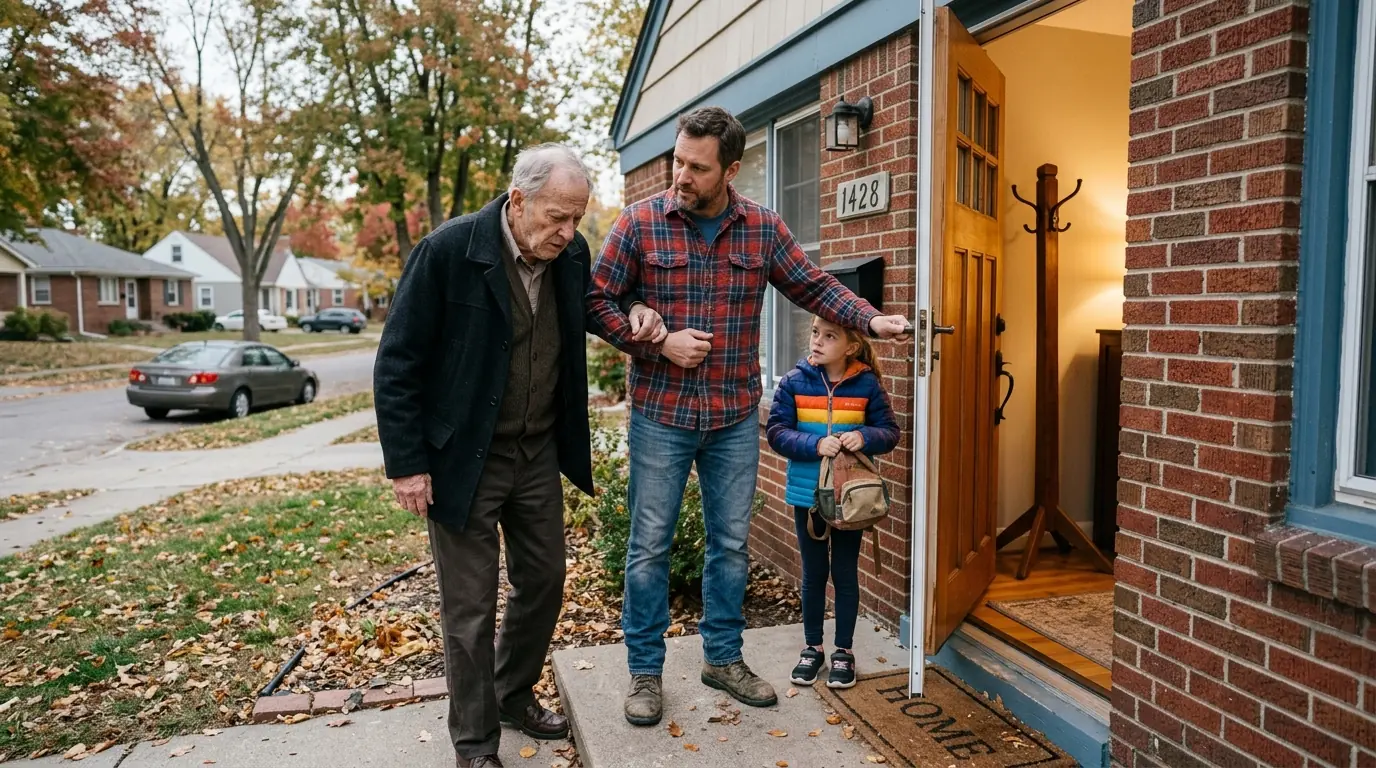 That night, Henry slept in the small guest room, bundled in blankets. Lily insisted on leaving a small nightlight on for him, muttering that “everyone deserves to see at night.” Tom watched them, a small smile on his face, feeling warmth he hadn’t experienced in weeks. He realized that sometimes, helping someone wasn’t about money or convenience—it was about humanity.
The next morning, Tom prepared a simple breakfast of scrambled eggs and toast. Henry ate quietly, his energy returning slightly with each bite. Lily served orange juice, asking questions about his life and travels, her curiosity genuine and unfiltered. Tom listened as Henry spoke of his youth, his career as an architect, and the projects he had overseen in Chicago. He was soft-spoken but intelligent, and Tom found himself intrigued by the man’s stories.
After breakfast, Tom drove Henry to a nearby bus station. “You’ll catch a bus back to Chicago?” Tom asked.
Henry shook his head. “No. I don’t want to burden anyone else. I’ll… I’ll find another way.”
Tom frowned. “Listen, you can’t just wander around like this. Let me help you make a plan. We can call your family, figure out where you’re supposed to be. You don’t have to do this alone.”
Henry hesitated but nodded. “Okay… okay.”
They spent the day together, making calls, checking schedules, and arranging accommodations. Tom insisted that Henry stay in a nearby hotel until his next train departed. By evening, Henry was settled and grateful. “I can’t thank you enough,” he said. “You’ve done more than I ever expected from a stranger.”
Tom waved off the thanks. “Don’t mention it. Just stay safe. That’s enough.”
The following week, Tom returned home from work to an unusual sight. Fifty luxury cars, sleek and shiny, filled the street in front of his modest home. The engine hums and polished metal caught the late afternoon sunlight. Tom’s jaw dropped. Lily ran to the window, eyes wide. “Dad… what is that?”
Before Tom could react, a line of impeccably dressed men and women approached the house. At the front, a man in a tailored suit, tall, confident, with silver hair neatly combed, stepped forward. “Mr. Reynolds?” he asked politely. “We’re looking for you. Are you Tom?”
Tom’s brow furrowed. “Yes… I am. Who… who are you?”
“I’m Charles Whitaker,” the man said, his eyes sharp but kind. “Henry is my father.”
Tom’s heart skipped a beat. “Henry… my Henry?”
“Yes,” Charles said, smiling. “He told us everything. How you helped him when he was lost and alone, how you gave him shelter, food, and kindness when no one else would. We wanted to find you. Properly thank you.”
Lily’s jaw dropped, her small hands clenching the window sill. “Fifty cars, Dad… whoa…”
Charles gestured toward the line of vehicles. “We brought you a token of our appreciation.” The driver opened the door to a polished black Mercedes, the license plate embossed with the family crest. Another vehicle—a sleek Jaguar—waited beside it. And another. Fifty in total, all models of rare luxury cars, each one a testament to wealth Tom could scarcely imagine.
Tom shook his head, disbelief written across his face. “I… I don’t understand. I just… I did what anyone would do.”
Charles smiled gently. “Not anyone would. You saw a man in need, alone and cold, and you acted without hesitation or thought of reward. Your selflessness is rare. We want to repay you… properly.”
Tom’s mind raced. Money had never been his goal. Security for his daughter, food on the table, keeping a roof over their heads—those were all he wanted. And now, suddenly, everything had changed.
“You… you’re serious?” Tom whispered, glancing at Lily, who was bouncing with excitement.
“Completely,” Charles said. “We’ve also arranged a scholarship fund for Lily’s education, a trust account for you to stabilize your home, and… well, everything to ensure you and your daughter never have to struggle like this again.”
Tears welled in Tom’s eyes. He looked at the luxury cars, at the entourage of people who had come to honor a simple act of kindness, and felt a mixture of awe, disbelief, and gratitude. “I… I don’t know what to say.”
“Say you’ll continue to be the man you already are,” Charles said softly. “A man who helps others, even when it costs nothing less than everything.”
Tom nodded slowly, understanding the weight of the gesture. Henry’s safety, his family’s gratitude, and now the chance for a better life—these were things that could never have been imagined in the dark hours of the previous week.
That evening, Tom and Lily explored their new neighborhood, driving the first of the luxury cars lent to them temporarily. Tom felt the seat beneath him, leather smooth, the engine purring quietly, and he thought about how life could shift in a single day, how a simple act of kindness could ripple far beyond comprehension.
Over the next few months, Tom used the resources generously but wisely. He stabilized their home, ensured Lily had access to the best education, and even began volunteering at local shelters, teaching young people how small choices could change lives. The story of that snowy afternoon spread quietly through the city. Neighbors whispered of the single father who had sheltered an elderly man, and of the extraordinary recognition that followed.
Every time he thought about Henry, about the storm, about the fear and the quiet warmth of their shared apartment, Tom felt the lesson deeply: life is fragile, and kindness—true, uncalculated, selfless kindness—is the most powerful force anyone can wield.
Months later, Henry returned to Des Moines, fully recovered and thriving, visiting Tom and Lily regularly. Together, they shared meals, stories, and laughter. Marcus—Henry’s grandson—joined in eventually, adding energy and youthful curiosity to the household.
Tom often looked at the row of luxury cars outside, a reminder not of wealth or status, but of the boundless, unpredictable ways that a simple good deed could echo across the lives of people he might never have imagined affecting. And every time, he felt the quiet satisfaction that comes from knowing he had done what was right, and the universe had, in its own extraordinary way, repaid him tenfold.
In the end, Tom realized that the night he had opened his door to a frail, lost man had changed everything—not just for Henry, but for himself, for Lily, and for everyone they touched. And the fifty luxury cars? They were just a symbol. The real reward had been the affirmation of humanity, the proof that generosity and courage never go unnoticed.
The days that followed the arrival of the luxury cars were surreal. Tom had never owned anything so new, so polished. His old pickup, rusted and dented from years of work, now felt like a relic from a different life. Yet, he couldn’t focus on the cars, the money, or the accounts. His mind kept returning to Henry Whitaker, the frail, confused man who had appeared on his doorstep that stormy night. It was Henry’s story—the man’s vulnerability, the trust he had placed in Tom—that had triggered everything.
Each morning, Lily would insist on helping prepare breakfast for Henry, even though he could manage on his own now. “It’s fun, Dad,” she said, her small hands chopping strawberries carefully for Henry’s oatmeal. “I like making people happy.” Tom smiled, a mixture of pride and awe. The generosity she had inherited from him, or perhaps witnessed that night, was already evident.
Henry, now steady on his feet, often recounted tales of his younger years, sitting in Tom’s kitchen with a steaming mug of tea. He spoke of architecture projects, charitable initiatives, and the quiet victories of helping others in his community. Tom listened intently, fascinated by the life Henry had once led and inspired by the determination he still carried. It was a reminder that people carry entire worlds within them, often hidden beneath fragile appearances.
One afternoon, a formal letter arrived at Tom’s home. The envelope was thick, cream-colored, and sealed with an embossed stamp. Inside was an invitation for Tom to visit the Whitaker estate in Chicago, a gesture of thanks and a chance to meet the extended family. Marcus had arranged the travel, and Emily—Henry’s daughter—helped coordinate the arrangements.
Tom hesitated at first. He wasn’t accustomed to such formality. His life had always been grounded in hard work, in earning every dollar through sweat and labor. But he knew this visit wasn’t about luxury—it was about acknowledgment, respect, and perhaps the continuation of a chain of kindness that had started with a single decision.
The journey to Chicago was quiet. Lily stared out the window, marveling at the passing landscapes, while Tom considered the odd twists of fate that had brought them here. The snowstorm, the elderly man, the late-night walk back from work—all pieces of a puzzle that had reshaped their lives.
When they arrived, the Whitaker estate was sprawling and meticulously maintained. Charles Whitaker greeted them at the door with a warm smile, his presence commanding yet gentle. “Tom, Lily, welcome,” he said. “We’ve been eager to meet the family behind the kindness.”
Inside, Henry introduced them to rooms filled with artwork, books, and photographs chronicling decades of a life devoted to philanthropy. Tom felt out of place, yet he sensed the sincerity behind every gesture, every word. They were here not to impress him but to honor him.
Charles led them to a sitting room where a small gathering awaited: a mix of family, close friends, and a few board members from the Whitaker Foundation. Conversations buzzed, punctuated by laughter and the clink of fine china. Tom remained quiet, absorbing everything. He realized that wealth and influence could be tools for good, but only when paired with integrity and empathy—qualities he had shown without thought that fateful night.
Henry, seated beside him, gave a small nod. “You did more than provide shelter,” he whispered. “You reminded us what humanity truly is.” Tom’s eyes glistened. “I just did what anyone would,” he said, though he knew deep down that most people wouldn’t have acted.
Later, Charles presented a series of envelopes, each containing deeds, stocks, and letters. “Consider this an investment,” he said, his voice steady. “Not in material wealth, but in character, courage, and the power of kindness. We’ve seen how you act without expectation. That is rare. That is valuable.”
Tom felt overwhelmed. The weight of responsibility mingled with gratitude, a complex cocktail of emotion he hadn’t anticipated. Lily tugged at his sleeve. “Dad… this is amazing!” she whispered.
“It is,” Tom admitted softly. “But it’s also… a reminder. That helping someone… even in the smallest way… can change more than one life.”
Over the next weeks, Tom used the resources to stabilize his home, pay off debts, and secure Lily’s schooling. Yet he never lost sight of what truly mattered: the human connection, the trust, and the choices that defined character. Henry’s visits became frequent. They shared meals, stories, and the simple joys of family. Marcus joined in whenever possible, and the four of them developed a rhythm of support, laughter, and shared responsibility.
Tom also began using his newfound stability to extend help to others. He partnered with local shelters, offering temporary housing, meals, and guidance. He hired staff who had struggled to find employment, ensuring dignity and fair wages. Each act of kindness reinforced the lesson from that snowy night: generosity and compassion have far-reaching consequences.
Months later, a gala was held in Chicago at the Whitaker Foundation headquarters. Tom and Lily were honored for their role in that night’s events. Henry gave a speech, his voice steady, filled with emotion. “This family reminded us that even in a world that often feels indifferent, there are still hearts that care. Tom and Lily Reynolds acted without expectation, without calculation. They gave humanity its due.”
Tom stepped forward, speechless at first, then found his voice. “I only did what anyone should do,” he said. “I hope this encourages everyone here to act, to help, even when it costs nothing less than everything.”
Lily stood beside him, holding his hand. Her young eyes sparkled with pride and understanding. She had learned firsthand the power of kindness, and she knew it would shape her life forever.
That evening, as they returned home to Des Moines, Tom reflected on the past week. Fifty luxury cars, a foundation’s recognition, letters of gratitude—these were all symbols. The real reward had been far simpler: the affirmation that humanity, generosity, and courage matter. That the decision to act in a moment of need could ripple outward, affecting lives in ways beyond imagination.
As Lily slept that night, Tom watched over her. The quiet of their home felt profound. The struggles, the exhaustion, the sacrifices—they had all led to this moment, a moment of security, dignity, and hope. And somewhere, in the quiet of his heart, Tom knew that the ripple of kindness he had set in motion would continue, touching others in ways he might never see, perpetuating a cycle that began with a single decision to open his door to a lost, elderly man in need.
And so, in the heart of Des Moines, the story of Tom Reynolds and his daughter Lily became more than a tale of survival—it became a story of how compassion, courage, and selflessness could transform lives, bridging generations, inspiring communities, and reminding the world that even the simplest act of kindness is never wasted.