“Sign it, Sarah—your goats eat better than your daughter, and this farm is already mine.”
Wade Benson dropped the purchase contract onto the final unopened sack of feed beside Sarah Miller’s barn. Eleven dairy goats watched through the temporary fence while dust drifted across the faded Missouri pasture behind them. Sarah looked at the papers, then at the smug feed dealer who had spent months waiting for her to become desperate enough to surrender everything.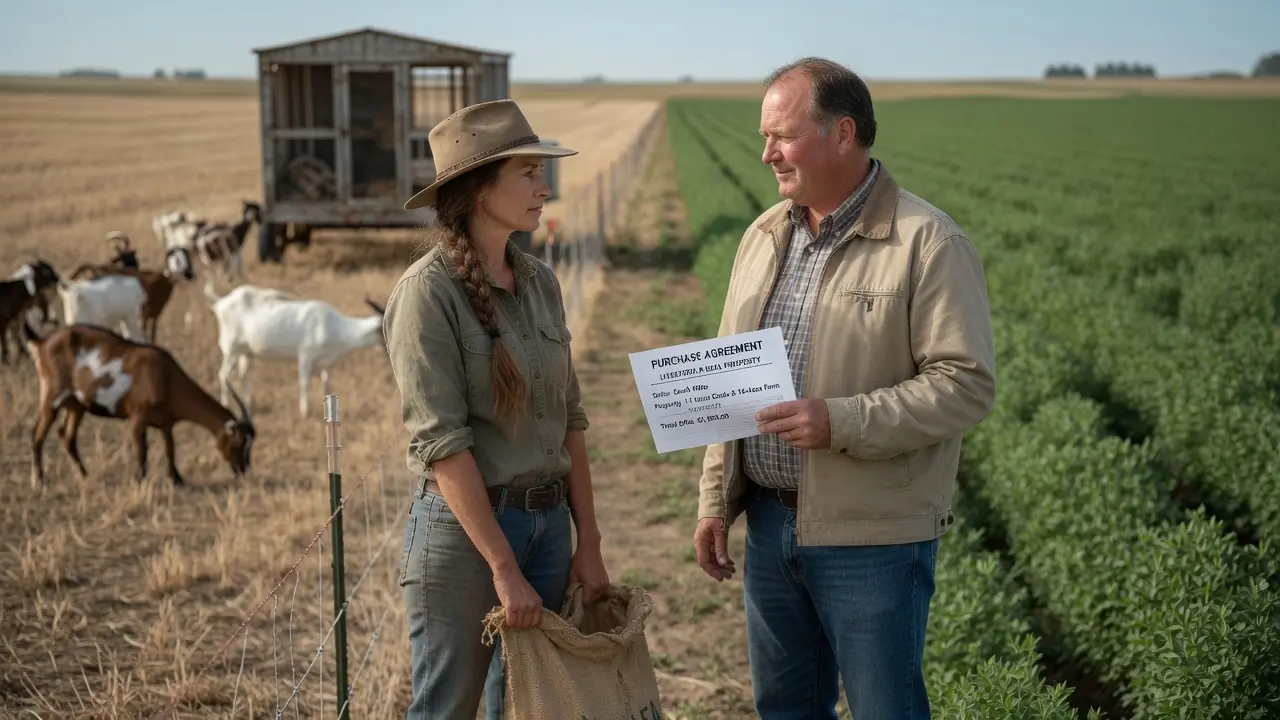
She planted one muddy boot on the contract. “You waited for my child to go hungry so you could disguise theft as business.”
Wade glanced toward the brittle grass covering most of the eighteen-acre farm. “When the drought finishes this field, you’ll beg me to take everything.”
Sarah pulled aside a curtain of dried weeds growing along the fence. Beneath them stood several rows of dark-green alfalfa, their roots holding firm in soil everyone else had declared ruined.
“Come back at harvest,” she said. “I’ll charge you for every insult.”
Three years earlier, Sarah would not have spoken to Wade that way.
At thirty-eight, she had inherited the small Ozark farm after her father died from a sudden heart attack. The property included an old farmhouse, a leaning barn, eighteen exhausted acres, eleven goats, and thirty-four laying hens. It also included unpaid repair bills, broken fencing, and soil so compacted that rainwater ran downhill before the ground could absorb it.
Sarah had never planned to become a full-time farmer. She worked part-time at a nursing home and cleaned vacation cabins on weekends while raising her twelve-year-old daughter, Lily, alone. Her former husband had disappeared from their lives after the divorce, leaving occasional promises of child support but rarely sending money.
The goats were supposed to provide extra income.
Sarah sold milk, simple cheese, handmade soap, and young animals whenever the herd produced more than she could manage. The chickens supplied eggs for a roadside cooler near the mailbox. Yet every dollar the animals earned seemed to disappear into feed sacks, hay deliveries, medicine, minerals, fencing wire, and repairs.
The farm consumed money faster than it produced it.
One February evening, Sarah sat at the kitchen table with four bills arranged beneath the yellow light. The electric company wanted payment by Friday, the old Ford pickup needed an alternator, and the feed store had refused to extend her account again. In the barn, the goats had enough hay for nine days.
Lily sat across from her working through a page of fractions. She looked up after noticing that her mother had stopped moving.
“Are we going to sell Daisy?” she asked.
Daisy was the oldest milk goat and Lily’s favorite. The animal had been born the year Sarah’s marriage ended and had become part pet, part business partner, and part witness to their hardest years.
Sarah looked toward the dark window. “I don’t know.”
“If we sell the goats, do we still keep the farm?”
The question hurt more than the bills.
“I’m trying to make sure we keep both.”
After Lily went to bed, Sarah opened her father’s old filing cabinet. She expected to find tax records and faded machinery receipts, but beneath several folders rested a bundle of soil reports, seed catalogs, and handwritten notes. Her father had circled one word repeatedly.
Alfalfa.
Sarah understood its value as animal feed. Dairy farmers prized it because of its protein, and good bales sold quickly during winter. Yet she had never considered planting it herself because alfalfa was known as a crop that demanded careful soil preparation.
Her land was acidic, depleted, and packed almost as hard as a gravel road.
Planting expensive seed into it seemed reckless.
Still, she kept reading.
Alfalfa sent roots several feet into the ground, deeper than ordinary pasture grasses. Those roots could reach moisture during dry periods, open channels through compacted soil, and leave organic matter behind when older roots died. Because alfalfa was a legume, bacteria around its roots could also capture nitrogen from the air and return it to the soil.
The crop might feed the goats.
It might produce hay Sarah could sell.
Most importantly, it might repair the field while doing both.
The next morning, Sarah called the county conservation office. A soil specialist named Martin Gray visited the farm, pushed a probe into several locations, and frowned at the results. He told her the pH was too low, phosphorus was limited, and organic matter had nearly disappeared from the upper pasture.
“This ground needs years of work,” he said.
“I don’t have years of money.”
Martin looked across the hillside. “Then start small.”
Sarah could not afford to plant all eighteen acres. She chose the weakest four-acre field behind the barn, where cattle had grazed continuously during her father’s final years. She rented a small no-till drill from the county, bought lime on credit, and traded goat-milk soap to a neighbor who owned a manure spreader.
She also bought alfalfa seed mixed with red clover.
The clover would fill gaps while the slower alfalfa established itself. It was not a perfect plan, but perfect plans belonged to people with enough money to survive failure.
Sarah had only enough money to survive action.
Wade Benson heard about the planting before the seed touched the ground.
He owned Benson Farm Supply, the only feed store within twenty miles, and controlled much of the local hay market. Farmers who could not pay cash depended on his credit accounts, which carried high fees and contracts written heavily in his favor. Sarah’s father had disliked him but still purchased emergency feed there because no other dealer delivered to their road.
Wade stopped beside Sarah’s field while she prepared the drill.
“You’re planting alfalfa in that?” he asked.
“That’s the plan.”
“That ground won’t grow weeds without help.”
“It grows plenty of weeds.”
“You know what I mean.”
Sarah continued checking the seed tubes. “Then say what you mean.”
Wade smiled. “You don’t have the money to repair this farm.”
“I have enough to start.”
“You’d be smarter selling before the place loses more value.”
“To whom?”
“I might make an offer.”
Sarah looked at him. “You already own enough land.”
“There’s no such thing.”
That was the first time she understood he had been watching the farm.
Wade’s property bordered her western fence. Purchasing Sarah’s eighteen acres would give him direct access to the paved county road and a spring-fed pond near the lower pasture. The goats and equipment mattered little compared with the land beneath them.
Sarah refused to discuss a sale.
Two weeks after planting, narrow rows of seedlings emerged across the four-acre field. She walked among them every morning before work, counting plants and searching for bare patches. Some rows looked strong enough to justify hope.
Then the rain came.
For three days, water hammered the hillside. Because the soil could not absorb it quickly, muddy sheets rushed across the new field and carried seed toward the ditch. When the storm ended, long brown scars cut through nearly one-third of the planting.
Sarah stood beside the washed-out rows and felt physically sick.
The seed was gone.
The drill rental remained unpaid.
The lime supplier expected money by the end of the month.
Wade drove past slowly but did not stop. His expression through the truck window said everything he might have spoken.
Sarah reseeded the damaged areas by hand.
The replacement plants emerged unevenly, and weeds quickly filled the open soil. She spent evenings pulling thistle while Lily moved behind her carrying a bucket. They worked until insects rose from the grass and the last daylight disappeared behind the oak trees.
Then Daisy became sick.
The veterinarian diagnosed a serious infection requiring medicine and three follow-up visits. Sarah used nearly every dollar she had saved for winter hay. When Wade refused another credit extension, she understood that the farm might not survive until spring.
A friend offered to purchase four goats.
Sarah nearly accepted.
Selling them would pay the electric bill and buy several months of hay. Yet the animals were essential to the system she hoped to build. Their manure fed the compost pile, their grazing controlled unwanted growth, and their milk generated the small income keeping food in Sarah’s kitchen.
If she sold the herd every time money became tight, the farm would never become strong enough to support itself.
Sarah sold her father’s old fishing boat instead.
It had rested beneath a blue tarp behind the barn for six years. She received far less than its sentimental value, but enough to purchase hay and finish Daisy’s treatment. Lily cried when the buyer towed it away because the boat held some of her last memories of her grandfather.
Sarah cried only after the truck disappeared.
The first winter nearly ended the experiment.
The alfalfa field looked thin, uneven, and unimpressive. Neighbors passed it without slowing, and Wade told customers at the feed store that Sarah had wasted her final savings trying to grow premium hay in ruined dirt. Even Sarah sometimes believed him.
Then spring arrived.
Green shoots pushed through the old residue earlier than the surrounding grass. The surviving alfalfa returned thicker, while roots that had worked invisibly through winter sent up stronger stems. Sarah filled the bare sections again and spread compost only where the field needed it most.
By June, she cut her first small harvest.
The bales did not fill the barn. They barely formed two short rows against the back wall. Yet when Sarah opened one, the hay smelled sweet and clean, and every goat crowded the gate.
For the first time, the herd ate feed grown on its own farm.
That small harvest reduced Sarah’s feed bill enough to plant two additional acres the following year.
She also changed how the goats used the remaining pasture. Instead of allowing them to wander continuously, she divided the land with temporary electric fencing. The goats grazed one small section for a short time, then moved before plants were eaten down to bare soil.
Behind them came the chickens.
Sarah built a lightweight mobile coop from scrap lumber, old wheels, and roofing metal salvaged from the barn. Lily helped pull it across the field every few days. The hens scratched apart manure piles, ate insects and fly larvae, and spread nutrients across the soil.
Then the pasture rested.
That resting period confused many neighbors.
From the road, it appeared Sarah was wasting grass because she moved the goats while plants still stood. Tom Benson, Wade’s older cousin, stopped one afternoon while she rolled up fencing.
“They can still eat what’s in there,” he said.
“I know.”
“Then why move them?”
“Because the roots need leaves above ground to recover.”
Tom looked across the thin pasture. “You need grass before you worry about saving it.”
Sarah smiled politely. “That’s what I’m trying to grow.”
The second year brought slow improvements.
The goats consumed more feed grown on the farm. Their bedding and manure became compost, which returned to the weakest fields. The chickens produced enough eggs to keep the roadside cooler stocked, and Sarah completed the permits required to sell flavored goat cheese at the weekend market.
No single product made much money.
Together, they began holding the farm upright.
The most important changes happened below ground.
After heavy rain, water no longer rushed immediately from one section of the alfalfa field. A shovel sank several inches deeper before meeting resistance. Earthworms appeared where Sarah once found only hard clay and stones.
The soil darkened near the surface.
Alfalfa remained green longer between rains.
Sarah sent another sample to the laboratory and compared it with the original report. Organic matter had increased slightly, the pH had improved, and water infiltration was moving in the right direction.
The results were not miraculous.
They were enough.
Then the third summer arrived.
Rain fell normally through early June before stopping without warning. One dry week became three, then five. Temperatures remained in the nineties while ponds dropped, shallow wells weakened, and pastures lost their color.
By July, farmers were already feeding hay intended for winter.
Wade raised his prices twice in ten days.
He told customers transportation costs had increased, but everyone knew scarcity allowed him to charge whatever desperate families would pay. Some farmers began selling cattle and horses because keeping them alive cost more than the animals were worth.
Sarah’s older grass fields turned brown too.
Dust rose around the goats when she moved them between paddocks. The farm was not immune to the drought, and every morning she checked the well with fear in her stomach.
The alfalfa responded differently.
Its growth slowed, but the plants did not disappear. Their deep roots reached moisture stored beneath the compacted layer they had gradually broken apart. Plant residue shaded the surface, while improved soil held more of every earlier rainfall.
From the road, Sarah’s field looked almost impossible.
Brown land surrounded several acres of stubborn green.
Wade noticed.
He arrived one morning carrying a feed bill and a prepared purchase agreement. Sarah had missed one payment after using her money to repair the well pump. Under the store contract, Wade could stop deliveries, but he had no legal claim to the animals or land.
His papers pretended otherwise.
The agreement offered Sarah nine thousand dollars for all eleven goats, the chickens, the barn equipment, and an option to purchase the farm within ninety days. The amount would barely cover her existing expenses.
Wade laid the contract on the final feed sack and delivered the insult he had likely rehearsed while driving over.
He expected tears.
Instead, Sarah stepped on the contract.
When she revealed the green alfalfa behind the dry weeds, Wade’s smugness weakened.
“That field isn’t ready,” he said.
“It will be.”
“You won’t get enough bales to matter.”
“I only need enough for my goats.”
“You owe me money.”
“I owe you for one delivery. Not my farm.”
“I can make sure no other dealer sells to you.”
Sarah looked toward the field. “Soon I won’t need another dealer.”
Wade left the papers beneath her boot and drove away.
Sarah waited until his truck disappeared before allowing her hands to shake.
His threats were not empty. Benson Farm Supply had relationships with livestock buyers, lenders, and equipment companies throughout the county. Wade could spread rumors, challenge her credit, and make ordinary business far more difficult.
But he could not stop roots already growing beneath her soil.
Sarah spent two nights calculating how much hay she could safely sell.
Keeping every bale would protect the goats through winter, but the farm needed money for the well repair, electricity, medicine, and the barn roof. Selling too much could leave the herd starving if the drought continued.
She counted the stored bales.
She estimated consumption for each goat.
She added a safety margin large enough to survive a late spring.
Only then did she mark the remaining field for sale.
The first buyer arrived before the hay had fully cured.
He was a dairy farmer from fifteen miles away who had already sold six cows because his pasture failed. He examined Sarah’s bales, smelled the alfalfa, and asked how many she could spare.
“Forty today,” she said.
“I’ll take all forty.”
The second buyer arrived that afternoon.
By the third day, every bale Sarah intended to sell was gone.
Cash replaced overdue notices on the kitchen table.
She paid the electric bill, repaired the well, and purchased enough roofing metal to patch the barn. More importantly, the goats continued eating hay she had kept for them, and Sarah did not purchase a single bale from Wade.
Then the phone calls began.
Farmers wanted to know when she would cut again. Horse owners offered deposits. Two families drove from another county after hearing that the poor single mother outside Willow Creek had produced premium hay during the worst drought in years.
Pickup trucks started arriving almost every morning.
Most drivers asked the same question before switching off their engines.
“How many bales do you have left?”
Wade returned near the end of August.
This time he carried no contract.
He stood beside the field while Sarah loaded hay into a customer’s trailer. The alfalfa was not lush by normal standards, but it remained alive while his own supplier fields had failed.
“I’ll buy the next cutting,” he said.
Sarah continued lifting bales. “No.”
“I’ll pay market price.”
“You set the market price.”
“Then I’ll beat it.”
“You refused me one week of credit when my goats needed feed.”
“That was business.”
“So is this.”
Wade lowered his voice. “You cannot move enough hay without my distribution network.”
“The trucks seem to find my gate.”
“You think one drought makes you important?”
Sarah placed the bale inside the trailer and faced him. “No. It makes your warehouse empty.”
The customer nearby pretended not to listen.
Wade’s face reddened. “Be careful, Sarah.”
“I was careful. That’s why the hay belongs to me.”
He left without making another offer.
The drought continued into September, but Sarah’s farm remained functional. Goat milk production slowed only slightly, the hens continued laying, and the roadside cooler stayed stocked with eggs, soap, and cheese.
One crop protected three income streams.
The alfalfa fed the goats.
The goats produced milk and manure.
The manure became compost.
The chickens spread nutrients and reduced insects.
The healthier soil grew more forage.
For years, Sarah had treated every problem separately. Feed required money, soil required fertilizer, weeds required control, and bills required additional work away from the farm. Recovery began only when each solution became connected to another.
The laboratory report arrived near the end of August.
Lily opened it at the kitchen table and read the numbers aloud. Organic matter had risen, water infiltration had improved, and nutrient cycling had increased. The field that once behaved like packed construction soil was beginning to function like living ground.
“Does this mean we fixed it?” Lily asked.
Sarah looked through the window toward the alfalfa.
“No.”
Lily frowned.
“It means it’s healing.”
Tom Benson visited the following week carrying a notebook.
He asked Sarah to show him everything.
She walked him through the rotational paddocks, mobile chicken coop, compost piles, and the places where the first alfalfa planting had washed away. She did not hide the failures or pretend the transformation had been easy.
She told him about Daisy’s illness, the lost seed, the fishing boat, the overdue bills, and the nights she considered selling the herd.
Tom pressed his boot into the softened soil.
Three years earlier, the ground would barely have taken an imprint. Now it gave slightly beneath his weight.
“I thought you needed better land,” he said.
Sarah shook her head. “I needed the land to start working with me.”
By winter, Sarah was not wealthy.
The truck still complained during cold mornings, the farmhouse needed new windows, and she continued taking occasional nursing-home shifts. Yet she no longer sat at the kitchen table deciding whether electricity mattered more than animal feed.
Her farm had begun producing choices.
She planted another four acres in alfalfa and clover. She improved the pasture rotation and began selling a few breeding goats raised almost entirely on farm-grown forage. Once each month, local farmers met at her property to compare soil tests and discuss methods for reducing purchased feed.
Some came from curiosity.
Others came because desperation had removed their pride.
Sarah told them there was no miracle crop.
Alfalfa alone had not saved the farm. Neither had the goats, chickens, compost, or fencing. The change came from connecting them and allowing the land enough rest to rebuild itself.
Wade attended one meeting from the far side of the group.
He asked no questions and left before coffee.
The following spring, Benson Farm Supply lowered its hay prices after two new dealers began delivering to the county. Several farmers who once depended completely on Wade had started producing more of their own feed or purchasing directly from Sarah and neighboring growers.
Wade did not lose his business.
He lost his control over everyone else’s desperation.
Years later, Lily took over the cheese operation after studying agricultural business at college. She returned to the same farm where she once asked whether Daisy would have to be sold.
Daisy was gone by then, buried beneath an apple tree behind the barn.
The herd had grown carefully, never beyond what the fields could support. Sarah refused to chase expansion that would return the farm to dependence on purchased feed.
At the gate stood a simple wooden sign:
MILLER FAMILY FARM — HAY, GOAT CHEESE, EGGS, AND SOIL-BUILDING WORKSHOPS
Below it, Lily added a smaller line without telling her mother:
COME BACK AT HARVEST.
Sarah noticed the words one morning and laughed.
The line reminded her of Wade’s contract beneath her boot, the final feed sack beside the barn, and the fear she had hidden while refusing his offer. She had not known with certainty that the alfalfa would survive.
She only knew surrendering the farm would make failure permanent.
The field Wade called dead eventually produced more than hay.
It produced resilience, income, food, and enough independence to stop one powerful dealer from deciding whether Sarah’s animals ate.
The poor single mother did not save the farm by forcing exhausted ground to give more.
She saved it by teaching every living part of the farm to support the others.
Root by root, season by season, the land returned the favor.