“Sir, are you all right? Let me help you carry those.”
The old man stood outside the grocery store with his arms trembling beneath six heavy bags. He coughed so violently that his entire body folded forward. Rain soaked through his coat while cans slipped through torn plastic and struck the pavement.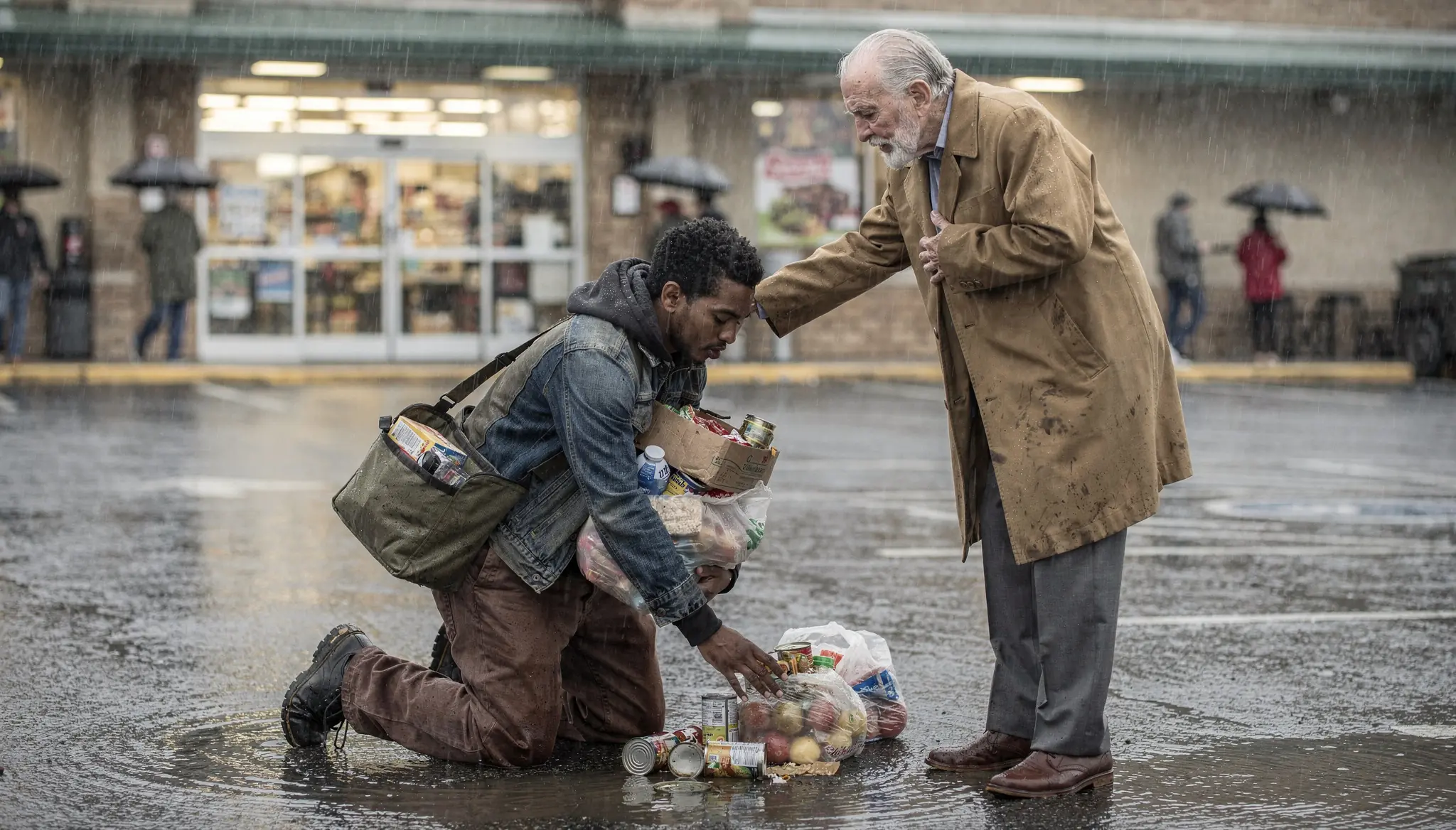
“Mind your own business, kid,” someone said.
“He can barely stand.”
“Not your problem.”
A woman nearby laughed.
“Broke helping broke. Classic.”
Solomon knelt in the rain and gathered every can and jar. He carefully repacked the bags and stacked them against his chest.
There were holes in his shoes, his stomach was empty, and he had only four dollars to his name.
“I’ve got you, sir. Where do you live?”
“Thank you, boy.”
Two miles.
Six grocery bags.
Pouring rain.
Solomon did not ask for a single penny.
He had no idea that this one act of kindness was about to change his life and the lives of everyone he loved.
At seven years old, Solomon had carried the flowers for his mother’s coffin because no one else in the family could afford a second trip to the funeral home.
At twelve, he carried his grandmother’s oxygen tank up four flights of stairs after the apartment elevator broke and the landlord declared that repairing it was not worth the expense.
At nineteen, he carried two jobs, a stack of overdue medical bills, and a fear he never spoke aloud.
Every morning, Solomon feared he would wake up and discover that his grandmother had stopped breathing.
Edna Mitchell was seventy-four years old.
She had raised Solomon since the night his parents died in a head-on collision on Route 9.
Solomon had been five years old.
Edna had been sixty.
The social worker asked whether Edna was certain about taking responsibility for a young child while living on a fixed income.
Edna did not blink.
“That is my grandson,” she said. “Give me the papers.”
For fourteen years, she kept Solomon fed, kept him in school, and kept the electricity connected through her pension check and sheer stubbornness.
Then her lungs began failing.
The diagnosis was stage-three chronic obstructive pulmonary disease.
The doctor explained the condition calmly, almost as though he were reading a grocery list. Edna would require supplemental oxygen around the clock. She would also need medication that cost more each month than their rent.
Eventually, she would need surgery.
That estimate contained so many zeros that Solomon stopped counting.
He dropped out of school at sixteen.
He did not leave because he wanted to. He left because their electricity bill was $340, Edna’s inhaler cost $280, and there was no mathematical formula that could fit both expenses inside her monthly pension of $863.
By nineteen, Solomon worked two jobs.
In the mornings, he washed dishes at Hal’s Diner on Franklin Street. The job paid $8.25 an hour, offered no benefits, and allowed no break longer than six minutes.
In the afternoons, he delivered packages for a courier service that paid in cash and did not ask many questions.
Every dollar went into three envelopes taped beneath his mattress.
Rent.
Medicine.
Food.
During most months, the food envelope remained empty.
Solomon survived on whatever Hal’s Diner planned to discard. He ate day-old rolls, leftover vegetables, and soup that had remained on the warmer too long.
He never told his grandmother.
Their apartment was on the fourth floor of a building that should have been condemned a decade earlier. Water stains spread across the ceiling like bruises, and the hallway smelled of mildew and fried oil.
The lock on the front door had been broken since January.
Every night, Solomon wedged a kitchen chair beneath the handle.
The apartment possessed one thing that mattered.
A window.
Edna’s bed stood beside it. On clear mornings, sunlight touched her face and made her smile.
For a few seconds, the rattling inside her chest did not sound quite as loud.
That was enough for Solomon.
That smile and that window were the reasons he continued.
The afternoon he met the elderly stranger, Solomon had just completed his delivery shift.
His back ached. His shoes were the same pair he had worn for eleven months, and a crack in the left sole allowed rainwater inside with every step.
He had four dollars in his pocket.
That money had already been assigned to the bus fare he would need the following morning.
There would be no dinner that night.
Solomon was cutting through the parking lot of Greenfield’s Grocery when he noticed the old man.
The stranger was white and appeared to be in his mid-seventies. He stood near the curb clutching six plastic bags.
His knuckles were white, and his arms shook under the weight.
A violent cough rose from his chest. It was deep and wet, the kind of sound that suggested something was tearing inside him.
One bag slipped from his grasp.
Cans scattered across the pavement.
The old man bent down to retrieve them and nearly fell.
People walked past.
A couple pushing a cart overflowing with groceries stepped around him without looking down.
A teenager on a skateboard swerved around the cans and muttered something Solomon could not hear.
A store employee stood near the entrance with folded arms and watched.
Nobody helped.
Solomon did not pause to calculate the cost.
He crossed the parking lot, knelt beside the stranger, and began gathering the cans.
“Let me get those for you, sir.”
The old man looked up.
His eyes were red and watery.
“You don’t have to do that, son.”
“I know.”
Solomon placed the final can into the damaged bag and lifted three bags onto each arm.
“Where do you live?”
The man pointed east.
“About two miles in that direction. But it’s raining, and you look like you’ve already had a long day.”
Solomon adjusted the weight across his shoulders.
Rainwater ran down the back of his neck.
“I’m fine,” he said. “Let’s go.”
Two miles.
Six bags.
Pouring rain.
Solomon did not complain once.
He did not know the man’s full name or understand his history. He did not know that the quiet, trembling stranger beside him owned more buildings than Solomon had entered during his entire life.
All Solomon knew was that someone needed help and that he was capable of giving it.
That had always been enough.
They spoke very little during the first mile.
The old man moved slowly, one hand gripping Solomon’s arm for balance while the other remained pressed against his chest, as though he were holding something in place.
Every few steps, he coughed.
The thick, gurgling sound made Solomon’s stomach tighten.
The rain continued without mercy.
Solomon adjusted the bags across his shoulders. The plastic handles cut into his palms until the skin turned white.
The bags contained canned beans, bread, milk, cough syrup, and three boxes of tea.
They were heavy.
Solomon had carried heavier things.
“What is your name, son?” the man asked between breaths.
“Solomon. Solomon Mitchell.”
“I’m Walter.”
He did not offer a last name.
“Do you live around here?”
“About two miles back in the opposite direction.”
Walter stopped walking.
“You’re telling me that you are walking two miles in the wrong direction, in this rain, while carrying a stranger’s groceries?”
Solomon shrugged.
“You needed help.”
Walter stared at him for a long moment.
Rainwater dripped from the brim of his hat.
Then he shook his head and continued walking.
“Your parents raised you properly,” Walter said quietly.
“My grandmother raised me.”
“Where are your parents?”
“They died in a car accident when I was five.”
Walter said nothing for a while.
There was only the rain, their footsteps, and his own labored breathing.
“And your grandmother?” he finally asked. “Is she well?”
Solomon did not answer immediately.
He shifted the bags to his other shoulder.
The crack in his shoe allowed cold water to soak through his sock with every step.
“She is sick,” he said. “Her lungs are failing. She needs a machine to breathe. Some days are better than others.”
“And the bad days?”
“On the bad days, I sit beside her bed and count her breaths until she falls asleep.”
Walter’s grip tightened around Solomon’s arm.
This time, it was not because of weakness.
“You work?”
“Two jobs. I wash dishes in the morning and make deliveries in the afternoon.”
“What about school?”
“I dropped out. We couldn’t afford both school and her medication.”
They turned onto a quiet street lined with old oak trees.
The houses were positioned far from the road and partially hidden behind hedges and iron gates.
Solomon had never walked through that neighborhood.
The lawns remained green despite the rain. The mailboxes stood perfectly straight.
“This one,” Walter said, pointing toward a house at the end of the street.
From the outside, it appeared modest.
It was a two-story brick house with a small porch and a rocking chair. Nothing about it openly displayed wealth.
However, the yard was carefully maintained, the gutters were clean, and the front door was made of solid oak.
Solomon carried the bags up the porch steps and placed them down gently.
His arms burned, and his back ached.
Rain had plastered his shirt against his skin.
“Let me bring you a towel,” Walter said as he reached for the door. “Come inside. I’ll make tea.”
“I appreciate that, sir, but I need to return home. My grandmother’s medication is due at seven. If I’m late, she tries to get up by herself.”
His voice caught.
He swallowed.
“She cannot get up by herself anymore.”
Walter studied Solomon’s face.
He noticed the hollow cheeks, dark circles under his eyes, and the way the young man’s jaw tightened when he spoke about his grandmother.
There was no anger in that expression.
It was the strain of trying to hold everything together.
“At least let me pay you,” Walter said, reaching into his coat.
“No, sir.”
Solomon stepped backward.
“I didn’t help you for money.”
“Then why did you do it?”
Solomon looked at him.
Rain streamed down his face, and for a moment, he looked much older than nineteen.
Older than his cracked shoes, empty stomach, and four dollars should have allowed.
“Because my grandmother told me that if someone is struggling and you can help, then you help. That is all. You don’t need another reason.”
Walter’s hand froze inside his coat.
His eyes glistened.
“What is your address, son? In case I want to send you a thank-you card.”
Solomon gave it to him without hesitation or suspicion.
He was simply a young man who still trusted the world because one woman had taught him to.
Walter wrote the address on the back of a receipt with a pen that cost more than Solomon’s monthly grocery budget.
Solomon did not notice.
“Thank you, Solomon.”
“Take care of yourself, Mr. Walter.”
Solomon turned and walked back into the rain.
Two miles.
No umbrella.
An empty stomach.
Holes in his shoes.
Walter remained on the porch until Solomon disappeared around the corner.
Then he looked down at the address written on the receipt.
His jaw tightened.
He removed his phone and dialed a number he had not called in months.
“It’s Caldwell. I need you to learn everything about a boy named Solomon Mitchell. Everything. Tonight.”
Solomon reached home at 8:14 p.m.
He was seventeen minutes late.
He found his grandmother lying on the kitchen floor.
Edna had attempted to reach her medication on the counter, but her legs failed halfway across the room.
The oxygen tube had slipped from her nose and lay coiled beside her.
Her breathing came in short, wet gasps.
Each one seemed weaker than the last.
“Grandma!”
Solomon dropped to his knees and returned the oxygen tube to its proper position.
His hands shook.
“I’m here. I’m here. I’m sorry.”
Edna’s fingers closed around his wrist.
Her grip was so weak that he barely felt it.
“It’s not your fault, baby,” she whispered. “I only wanted my tea.”
Solomon lifted her.
She weighed only ninety-one pounds.
He carried her back to bed, tucked the blanket around her shoulders, adjusted the oxygen tube, and checked the meter.
Eighteen percent remained in the tank.
She would need a refill by Thursday.
A refill cost $62.
Solomon did not have it.
He sat beside her bed until her breathing became steadier.
Then he went to the kitchen, boiled water, and made tea with the final bag in the box.
He brought it to her with two pills and half a cracker.
Solomon did not eat.
There was nothing left for him.
At midnight, Edna fell asleep.
Solomon sat at the kitchen table beneath the only light bulb that still worked and counted the money inside his envelopes.
The rent envelope was $214 short.
The medicine envelope was $89 short.
The food envelope was empty.
He lowered his head onto the table and closed his eyes.
Not to sleep.
Only to stop seeing the numbers.
His phone rang at six the following morning.
It was Craig Holloway, his supervisor at Hal’s Diner.
“You’re scheduled for the early shift. Be here in thirty minutes, or don’t bother coming back.”
Solomon splashed water over his face, checked his grandmother’s oxygen supply, and saw that it had fallen to twelve percent.
He kissed her forehead and ran.
Craig was already angry when Solomon reached the diner.
A health inspector had visited the previous day and recorded three violations.
Craig blamed everyone except himself.
“You’re four minutes late,” he said, blocking the kitchen entrance.
“I’m sorry, sir. My grandmother…”
“I don’t care about your grandmother.”
Craig pushed a mop into Solomon’s hands.
“Bathrooms, then dishes, then the fryer. If I hear one more excuse, you’re finished. Plenty of other kids want this job.”
Solomon took the mop and said nothing.
He cleaned the bathroom floor on his hands and knees because the worn mop could no longer reach the corners.
At 11:40 a.m., his phone began ringing.
The number was unfamiliar.
He ignored it because Craig would fire him for answering a personal call.
The phone rang again.
Then a third time.
On the fourth call, Solomon stepped behind the dumpster and answered.
“Mr. Mitchell, this is Greenfield Memorial Hospital. Your grandmother was brought in by ambulance forty minutes ago. She suffered respiratory failure and is currently in the intensive care unit.”
The parking lot seemed to tilt.
Solomon pressed one hand against the dumpster wall.
Grease and rainwater covered his fingers.
“Is she alive?”
“She is stable for the moment, but her condition is critical. We need to discuss surgical options. The estimated cost is $85,000.”
Eighty-five thousand dollars.
Solomon stood behind a dumpster that smelled of old fryer oil, wearing a bleach-stained shirt with four dollars in his pocket.
A stranger had just told him that saving his grandmother would cost more money than he could earn in four years.
“I’ll be there,” he said. “I’m coming right now.”
He ended the call, returned to the kitchen, and removed his apron.
Craig blocked his path.
“Where do you think you’re going?”
“My grandmother is in the hospital.”
“If you walk out that door, you’re fired.”
Solomon looked at him.
He said nothing.
Then he placed the apron on the counter, walked through the door, and began running.
Solomon ran fourteen blocks to Greenfield Memorial Hospital.
He arrived soaked, his chest heaving and his shoes striking the wet floor as he pushed through the emergency entrance.
The receptionist looked up.
Her mouth tightened when she saw a drenched teenager in a bleach-stained shirt struggling to catch his breath.
“I’m here for Edna Mitchell. She arrived in an ambulance.”
The receptionist typed slowly.
“Relationship?”
“I’m her grandson. I’m all she has.”
“Third floor, intensive care, Room 312.”
Solomon used the stairs because the elevator was too slow.
By the time he reached the room, his legs burned and his hands trembled.
He told himself the shaking came from running.
Edna lay behind a wall of machines.
There were tubes in her nose, an intravenous line in her arm, and monitors flashing green and red.
Her chest rose and fell in a shallow mechanical rhythm.
Her eyes were closed.
Her skin looked gray.
Solomon pulled a chair beside the bed and took her hand.
It was cold.
He held it between both of his hands and pressed it against his forehead.
“I’m here, Grandma. I’m right here.”
She did not wake.
Dr. Harper entered twenty minutes later.
She was a tall woman with kind eyes and a clipboard she repeatedly tapped with a pen.
“Mr. Mitchell, your grandmother suffered acute respiratory failure. Her left lung has less than twenty percent function, and the right lung is deteriorating.”
She paused before continuing.
“Without surgical intervention, specifically a partial lobectomy and reconstruction, she has only weeks. Possibly less.”
“What does the surgery cost?”
“Approximately $85,000. Her current insurance does not cover the procedure.”
Dr. Harper looked at him sympathetically.
“There are payment plans, but they require a credit check and a co-signer with verifiable income.”
Solomon had no credit history.
No co-signer.
No verifiable income.
“What if I can raise the money?”
Dr. Harper paused.
She had heard similar promises before.
“Mr. Mitchell, the surgical window is approximately seventy-two hours. After that, her lungs may no longer be strong enough to tolerate anesthesia.”
Seventy-two hours.
Eighty-five thousand dollars.
Solomon calculated the numbers in his mind.
There was no solution.
Still, he nodded.
“I’ll find it.”
He began that night.
His first stop was every apartment in their building.
There were fourteen units, most occupied by people who struggled to afford their own problems.
But they gave whatever they had.
Mrs. Dawson in Apartment 4C handed him a crumpled ten-dollar bill.
“It’s my laundry money,” she said. “But your grandmother watched my children whenever I worked double shifts. Take it.”
Mr. and Mrs. Torres in Apartment 2A gave him fifteen dollars and a plastic bag of homemade tamales.
“You need to eat, mijo,” Mrs. Torres said, pressing the bag into his hands. “You cannot save her if you collapse first.”
Mr. Perry in Apartment 3B was eighty years old, partially blind, and living on Social Security.
He opened the door, listened to Solomon, and removed twenty dollars from his wallet without speaking.
Then he placed one hand on Solomon’s shoulder and squeezed.
Bobbie Johnson in Apartment 4A had known Edna longer than anyone else in the building.
She opened her door and began crying before Solomon finished the first sentence.
She gave him twenty dollars and hugged him so tightly that he felt her heartbeat against his chest.
“Your grandmother is the strongest woman I have ever met,” Bobbie said. “Bring her home, baby. Bring her home.”
Solomon left the building with $112 in his pocket.
He had started the day with four.
The next morning, he went to First National Bank on Broad Street.
He wore his cleanest shirt, the one containing only a single stain.
He waited in the lobby for forty minutes before a loan officer called his name.
The conversation lasted six minutes.
No credit history.
No collateral.
No stable employment.
No co-signer.
The loan officer clicked his pen.
“I’m sorry, Mr. Mitchell. There is nothing the bank can do.”
“My grandmother is dying.”
“I understand, but the bank has policies.”
Solomon stood.
“Thank you for your time.”
He visited three more banks.
The answers were the same.
The same clicking pens.
The same apologetic expressions that forgot him before he reached the parking lot.
He went to the Greenfield Community Aid Foundation.
A woman sitting behind a desk told him the waiting list was six months long.
Solomon explained that he had seventy-two hours.
She apologized and handed him a pamphlet.
He went to the church on Fifth Street.
Pastor Collins prayed with him and gave him thirty dollars from the emergency assistance fund.
Solomon thanked him.
He did not mention that thirty dollars was nearly meaningless compared with $85,000.
By evening, Solomon sat on a bench outside the hospital.
The rain had stopped, but the air remained damp and cold.
He removed the money from his pockets and counted it on his knee.
$347.
Out of $85,000.
He stared at the bills.
Wrinkled five-dollar notes.
Crumpled tens.
Coins from a jar belonging to Mrs. Dawson’s eight-year-old daughter.
The little girl had offered him her piggy bank money, forty-three cents in pennies and nickels.
Solomon had tried to refuse.
The girl shook her head.
“Mama says it all counts.”
It all counted.
Forty-three cents.
Solomon folded the money, returned it to his pocket, and pressed his palms against his eyes.
That was when a sport utility vehicle entered the hospital parking lot.
Solomon did not notice it.
He was too busy trying not to collapse.
The vehicle remained nearby with its engine idling and headlights cutting through the damp evening air.
Inside, a man in a gray suit spoke into a telephone.
“I confirmed the boy’s story, Mr. Caldwell. His grandmother is in intensive care. There is a seventy-two-hour surgical window, the operation costs $85,000, and she has no adequate insurance or other family.”
He paused.
“The kid has been knocking on doors all day trying to raise the money. He has approximately three hundred dollars.”
Another pause.
“He refused payment yesterday when you offered it. He wouldn’t take a cent. In twenty years of doing this work, I’ve never met a young man like him.”
The silence on the other end lasted longer this time.
Then Walter Caldwell spoke quietly.
“Arrange a meeting at my house tomorrow morning. Ten o’clock.”
The sport utility vehicle drove away.
Solomon never looked up.
He remained on the bench for another hour.
Then he returned upstairs, sat beside his grandmother’s bed, held her hand, and whispered the only promise he had left.
“I’m going to fix this, Grandma. I don’t know how, but I’m going to fix it.”
Edna’s monitor continued beeping.
Steady.
Slow.
Alive.
For now.
Edna woke at three in the morning.
Solomon had fallen asleep in the chair beside her, his hand still wrapped around hers.
The room hummed with machines, quiet alarms, flowing oxygen, and a fluorescent light buzzing above them like a tired insect.
“Baby,” Edna whispered.
Solomon’s eyes opened immediately.
“I’m here. Do you need water? Should I call the nurse?”
“Sit down.”
Her voice was weak but steady.
She squeezed his fingers.
“I need to tell you something.”
Solomon sat and listened.
“Your grandfather was the poorest man on our block,” she said. “He couldn’t repair a car, balance a checkbook, or keep one job longer than six months.”
She paused to breathe.
Oxygen hissed through the tube.
“But every Sunday, he walked to the corner store and purchased two loaves of bread. One for us and one for whoever needed it.”
“I remember those stories,” Solomon said.
“Then remember this one.”
Edna looked directly at him.
Her eyes were clearer and more present than they had been in weeks.
“The year the factory closed, half the neighborhood lost everything. People ate directly from cans. We barely had enough for ourselves, but your grandfather gave away our extra bread every week.”
She smiled faintly.
“I asked him once, ‘Henry, how can you give away what we do not have?’ Do you know what he said?”
Solomon shook his head.
“He said kindness is the only currency that never loses value.”
The words settled in the room.
Solomon felt them enter his chest like a stone falling into still water.
“He died poor,” Edna continued. “But one hundred and twelve people came to his funeral. One hundred and twelve people, for a man who never carried more than forty dollars in his wallet.”
She coughed softly.
“That is wealth, baby. It is the only kind that matters.”
Solomon pressed her hand against his forehead.
He did not trust his voice.
“Whatever happens,” Edna said, “do not let this world make you hard. Promise me.”
“I promise.”
She closed her eyes.
Within minutes, her breathing slowed into sleep.
Solomon’s phone vibrated.
A message had arrived from an unknown number.
Mr. Mitchell, 742 Oakwood Drive, tomorrow at 10:00 a.m. A friend.
Solomon stared at the screen.
He did not recognize the address or know who had sent it.
But he had nothing left to lose.
Solomon arrived at 742 Oakwood Drive at 9:53 the following morning.
He had almost decided not to go.
The address was in a neighborhood he had never entered.
The streets were wide, the hedges carefully trimmed, and every house appeared as though it had never experienced a broken window.
Solomon walked along the sidewalk wearing his cleanest jeans and the only shirt he owned without a visible stain.
He felt every pair of eyes watching from the porches he passed.
A woman watering her lawn turned off the hose and stared.
A man walking a golden retriever crossed to the opposite side of the street.
Nobody waved.
Nobody smiled.
Then Solomon saw the house.
Two stories.
Brick walls.
A rocking chair on the porch.
He recognized it.
The door opened before he could knock.
Walter Caldwell stood in the entrance.
He looked cleaner and healthier than he had in the rain, wearing a pressed shirt with reading glasses resting on his forehead.
He appeared steadier, almost as though the previous day’s storm had washed something away from him too.
“Solomon, come inside.”
The interior was nothing like the modest exterior suggested.
Bookshelves stretched from floor to ceiling throughout the living room.
Oil paintings hung on the walls, and a marble fireplace occupied the center of the room.
Framed photographs covered the mantel.
Walter shaking hands with senators.
Walter standing behind podiums.
Walter cutting ribbons in front of buildings Solomon recognized from downtown.
One photograph stopped him.
Walter appeared thirty years younger, standing in front of a skyscraper with gold letters displayed above the entrance.
Caldwell Enterprises.
“You’re Walter Caldwell?” Solomon whispered. “The Walter Caldwell?”
“I was Walter Caldwell yesterday too,” Walter replied. “I simply had heavier grocery bags.”
He guided Solomon toward a leather chair and sat across from him.
A woman wearing a gray blazer stood near the window.
She was Margaret Cole, Walter’s personal assistant.
“Solomon, I’m going to speak directly,” Walter said. “After you left yesterday, I made several calls.”
Walter leaned forward.
“I know about your grandmother. I know about the hospital. I know about the $85,000.”
Solomon gripped the arms of the chair.
“Sir, I didn’t come here asking for…”
“I know you didn’t. That is exactly why I’m offering.”
Walter held his gaze.
“I want to pay for your grandmother’s surgery. Every cent.”
Solomon stopped breathing for a moment.
“I also want to establish a scholarship for you. Full tuition at any university willing to accept you. Housing, meals, books, and every necessary expense.”
The room became silent.
Solomon stared at him.
His mouth opened, but no words emerged.
“There is one condition,” Walter continued. “The Caldwell Foundation has a board meeting next week.”
He sat back.
“I want you to attend and tell your story. Not so that they will pity you or treat you like a charity case. I want them to hear what real courage looks like.”
Solomon’s jaw tightened.
“I am not a charity case, Mr. Caldwell.”
“No, you are not.”
Walter’s answer came immediately.
“You were the only person in an entire parking lot who stopped to help a sick old man in the rain.”
He leaned forward again.
“That is not charity. That is character.”
Walter did not look away.
“I am not offering you pity, Solomon. I am offering you what you earned.”
Solomon sat quietly with those words.
The leather chair creaked beneath him.
Sunlight entered through the window and fell across the photographs on the mantel.
Walter, his buildings, his empire, and the life he had built.
“Okay,” Solomon said quietly. “I’ll do it.”
Walter smiled.
It was the first time Solomon had seen him smile.
The expression transformed his entire face.
“Margaret will handle the hospital paperwork today. The operation will be scheduled within twenty-four hours.”
Walter stood and extended his hand.
“Welcome to the rest of your life, son.”
Solomon shook it.
His hand trembled.
He did not try to hide it.
He left the house feeling something he had not experienced in years.
He could not yet name it, but it was warm and rested inside his chest like a second heartbeat.
Solomon did not know that six blocks away, another man was already making a telephone call intended to destroy everything.
Derek Lawson had worked as a property manager in Caldwell Enterprises’ rental division for nine years.
He managed twelve buildings on the South Side.
Those were the buildings where families like Solomon and Edna lived.
Buildings where maintenance requests disappeared and rent increases arrived exactly on schedule.
Derek did not see tenants.
He saw numbers.
Solomon Mitchell’s number had been causing problems for months.
Three months behind on rent.
Repeated requests for extensions.
A grandmother whose oxygen equipment consumed too much electricity and who, in Derek’s opinion, never properly thanked him for allowing the power to remain connected.
Derek had filed eviction documents weeks earlier.
Friday was the deadline.
He had been looking forward to enforcing it.
Then his phone rang.
A colleague from the corporate office was calling.
“Derek, I wanted to warn you. Walter Caldwell is personally involved with a tenant from one of your buildings. A young man named Solomon Mitchell.”
The colleague continued.
“Caldwell is paying for a surgery and establishing a scholarship. The old man hasn’t been this personally involved in anything for years.”
Derek’s stomach tightened.
Solomon Mitchell.
The same young man Derek had shouted at outside Apartment 4B.
The same young man whose grandmother Derek had called a wheezing old woman.
The same young man whose payment receipt Derek had once torn in half and allowed to fall onto the carpet while laughing.
If Walter learned how Derek had treated Solomon, and Derek knew Walter well enough to understand that he always discovered the truth, Derek’s career would be over.
Nine years.
Pension.
Benefits.
Reputation.
Everything would disappear.
Derek paced around his office for twenty minutes.
He picked up the telephone, put it down, and picked it up again.
Then he called the Greenfield Police Department.
“I would like to report a break-in at a private residence. The address is 742 Oakwood Drive.”
The officer asked for a description.
“The suspect is a young man, approximately nineteen years old. His name is Solomon Mitchell.”
Derek provided additional details.
He described Solomon entering Walter’s home, which was true.
He stated that Solomon had been alone near valuable property, which was irrelevant.
Then Derek added the lie.
“The homeowner is elderly and in poor health. I have reason to believe this individual deliberately targeted him. Possible theft and possible elder exploitation.”
He ended the call and leaned back in his chair.
Then he loosened his tie and took a slow breath.
In Derek’s mind, the strategy was simple.
He would discredit Solomon before Solomon could expose him.
If the police arrested the young man and removed him from Walter’s life, the problem might disappear before Walter connected his new protégé with his worst property manager.
It was a clean plan.
Efficient.
Cold.
Derek failed to consider the security camera mounted above Walter Caldwell’s front door.
The camera recorded every arrival, departure, handshake, and smile in clear resolution.
Twenty-four hours a day.
Seven days a week.
The trap had been set.
But it was not waiting for Solomon.
The police arrived at four in the afternoon.
Solomon was sitting beside Edna’s bed in the intensive care unit, reading aloud from a magazine he found in the waiting room.
Two officers appeared in the doorway.
One rested a hand near his belt.
The other held a folded document.
“Solomon Mitchell?”
“That is me.”
“Stand up, please. A report has been filed against you.”
The officer looked at the paper.
“Burglary and suspected elder exploitation at 742 Oakwood Drive.”
Solomon blinked.
“What? I didn’t do anything. That is Mr. Caldwell’s house. He invited me.”
“Sir, we need you to come with us.”
“I was helping him. He asked me to visit.”
“Place your hands behind your back.”
Edna’s eyes opened.
The heart monitor accelerated.
She attempted to sit up, but the tubes prevented her from moving.
“What are you doing to my grandson? He didn’t do anything.”
Her breathing became faster.
“Solomon!”
“Grandma, it’s okay. Stay still. Please stay still.”
The officer pulled Solomon’s arms behind his back and secured the handcuffs.
The cold metal clicked twice.
A nurse rushed into the room and pressed Edna gently against the pillow.
An oxygen alarm began sounding.
Edna screamed Solomon’s name.
It was a sound he had never heard from her before.
Raw.
Broken.
Like something tearing loose inside her chest.
“Please,” Solomon said to the officer. “She is dying. Please don’t do this in front of her.”
They walked him through the hallway.
Past the nurses’ station.
Past a family in the waiting room who pulled their children closer.
Past a doctor who looked up from a clipboard and then looked away.
Solomon kept his eyes forward and his jaw locked.
He did not cry.
Not yet.
At the station, they placed him in an interrogation room.
Concrete walls.
A metal table.
One chair bolted to the floor.
Detective Harris sat across from him with a file.
“Mr. Mitchell, we received a report stating that you unlawfully entered a private residence at 742 Oakwood Drive and may have stolen property from an elderly homeowner.”
The detective opened the folder.
“Can you explain?”
“He invited me. I carried his groceries home the previous day in the rain. He asked for my address. Then someone sent me a message asking me to visit his house this morning.”
“Do you have evidence that Mr. Caldwell invited you?”
Solomon did not have an attorney.
He did not have proof.
He had only the truth and a message from an unfamiliar number that did not contain Walter Caldwell’s name.
“Ask Mr. Caldwell,” Solomon said. “He will tell you.”
Detective Harris wrote something inside the file and left.
Solomon sat alone.
The fluorescent light buzzed above him.
The handcuffs had left red marks around his wrists.
He placed both palms against the cold metal table and stared at the wall.
He thought about his grandmother screaming his name.
He remembered the oxygen alarm.
He wondered whether the stress of watching her grandson arrested would push Edna’s lungs beyond what they could survive.
Solomon thought about disappearing inside a room like that.
Not because of a violent act, but beneath the slow, grinding weight of poverty, prejudice, and the knowledge that one accusation could take away everything.
One hour passed.
Then two.
The door opened.
A man in a tailored suit entered.
He had gray hair, sharp eyes, and carried a briefcase worth more than the contents of Solomon’s apartment.
“Mr. Mitchell, my name is Graham Bennett. I am Mr. Caldwell’s personal attorney.”
Graham placed the briefcase on the table.
“Do not answer another question. I am here to take you home.”
Fifteen minutes later, Graham stood inside Detective Harris’s office with a laptop open on the desk.
“This is the footage from Mr. Caldwell’s front-door security camera. It is time-stamped.”
The recording showed Solomon arriving at 9:53 that morning.
Walter opened the door and invited him inside.
They shook hands.
Forty minutes later, Solomon left while carrying nothing.
“Nothing was stolen,” Graham said. “Nothing was damaged.”
Harris watched the recording.
His jaw tightened.
“Who filed the original report?” Graham asked.
Harris examined the file.
“A man named Derek Lawson. He claims to be a property manager for Caldwell Enterprises.”
Graham closed the laptop.
“Mr. Lawson is an employee of Caldwell Enterprises. He filed a false police report against a nineteen-year-old young man who had been personally invited into Mr. Caldwell’s home.”
Graham stood.
“Mr. Caldwell knows what happened and is traveling to the station now.”
Detective Harris leaned back.
“Well,” he said, “this has become complicated.”
“No, Detective,” Graham replied. “For Mr. Mitchell, it has become very simple.”
He looked directly at Harris.
“He is free to leave.”
The interrogation-room door opened.
Solomon looked up.
Graham stood in the entrance.
“You’re going home, son. The man responsible for this is about to have a very difficult evening.”
Walter Caldwell arrived at the police station in a town car at 6:37 p.m.
He did not hurry.
He did not raise his voice in the lobby.
He entered with a cane in one hand and Graham Bennett beside him.
The entire station became quiet.
Everyone in Greenfield recognized Walter Caldwell.
His face had appeared on buildings, in newspapers, and on the wall of the community center he had funded fifteen years earlier.
Detective Harris met them in the hallway.
His posture had changed since Graham’s earlier visit.
It was straighter and more careful.
“Mr. Caldwell, I want you to understand that we take every report seriously.”
“I am not here to discuss your procedures, Detective.”
Walter’s voice was calm and flat.
It was the voice of a man who had dismissed entire rooms of executives without raising a single syllable.
“I am here to see the boy. After that, I am going to deal with the man who placed him inside this building.”
They brought Solomon from the processing area.
He had been sitting on a bench, his wrists still red from the handcuffs and his eyes dry but hollow.
When he saw Walter, something cracked across his face.
It was neither relief nor anger.
It was something between them.
“Mr. Caldwell, I didn’t steal anything. I swear.”
“I know.”
Walter placed one hand on Solomon’s shoulder.
“I know exactly what happened. It will be addressed immediately.”
Walter turned toward Graham.
“The hospital?”
“Already handled,” Graham answered. “Surgery is confirmed for seven tomorrow morning. The foundation processed full payment. Dr. Harper has been briefed.”
Walter nodded.
Then he looked at Solomon.
“Go to your grandmother. She needs you more than I do tonight. Graham will drive you.”
Solomon hesitated.
“What are you going to do?”
“What I should have done nine years ago.”
Solomon left with Graham.
Walter remained behind.
An emergency board meeting was scheduled for eight that evening at Caldwell Tower.
It would take place on the thirty-second floor inside the corner conference room overlooking downtown Greenfield.
Seven board members attended.
Two company attorneys sat near the end of the table.
Margaret Cole stood beside a laptop and projector.
Derek Lawson received the call at 7:15 p.m.
An urgent board meeting.
No agenda had been provided.
Derek fixed his tie inside his car and told himself it was routine.
He told himself there was no possibility they had connected the events so quickly.
He entered the conference room at 8:03 p.m.
Every seat was occupied.
Every person in the room looked toward him.
Walter Caldwell sat at the head of the table.
He did not greet Derek or offer him a chair.
“Sit down, Mr. Lawson.”
Derek sat.
His palms were damp, so he pressed them against his trousers beneath the table.
“Margaret,” Walter said, “play the first file.”
The projector illuminated the wall.
It displayed Walter’s front-door security footage.
Solomon arrived at 9:53.
Walter opened the door, smiled, shook his hand, and guided him inside.
Forty minutes later, Solomon left with empty hands, smiling as he walked down the porch steps and turned east toward the hospital.
“Play the second file.”
An audio recording began.
Derek Lawson’s voice came through the speakers clearly.
“The suspect is a young man, approximately nineteen years old. His name is Solomon Mitchell. Possible theft. Possible elder exploitation.”
The room became silent.
Walter allowed the silence to remain.
Five seconds.
Ten seconds.
Fifteen.
Then he spoke.
“Nine years ago, I hired Derek Lawson to manage twelve residential properties in the South Side district.”
Walter stood and walked toward the window.
“His responsibility was to maintain those buildings, support the tenants, and uphold the principle upon which this company was built.”
He looked out over the city.
“Every person living in a Caldwell property deserves dignity.”
Walter turned.
“Instead, Mr. Lawson harassed tenants who fell behind on rent. He ignored maintenance requests from families who could not afford to complain.”
His voice remained level.
“He threatened a seventy-four-year-old woman with eviction while she was dependent upon supplemental oxygen.”
Derek’s face became pale.
“When Mr. Lawson discovered that I, his employer, had taken a personal interest in that woman’s grandson, he filed a false police report accusing the young man of burglary and elder exploitation.”
Walter’s voice never rose.
That made the words more severe.
“Solomon Mitchell is nineteen years old. He works two jobs. He left school to pay for his grandmother’s medication.”
Walter looked around the table.
“Two days ago, he found me in a parking lot. To him, I was merely a sick old stranger who could not carry his groceries.”
He continued.
“Solomon walked two miles through the rain to bring six bags to my door. He refused payment. He refused a towel and a cup of tea because he needed to return home and give his grandmother her medication.”
Walter paused.
“That is the young man Derek Lawson attempted to place in prison.”
Derek’s hands trembled.
His complexion had turned white.
“I can explain.”
“You filed a false report with the police department,” Walter said. “You accused an innocent young man of a felony.”
He stepped closer to the table.
“You did it to protect yourself because you knew that once I examined Solomon’s living conditions, I would discover how you had treated the people inside my buildings.”
He looked directly at Derek.
“The people those buildings were created to serve.”
Derek stood.
“Mr. Caldwell, I have given this company nine years.”
“And during those nine years, how many families did you force out?”
Derek froze.
“How many repair orders did you destroy? How many people called your office begging for assistance and received only your voicemail?”
Derek had no answer.
Walter turned toward the board.
“I move for the immediate termination of Derek Lawson, a complete investigation into his conduct at all twelve properties, and referral of the false police report to the district attorney for criminal review.”
The vote was unanimous.
Seven to zero.
Security officers escorted Derek out of the building.
He crossed the lobby carrying a cardboard box, his face appearing ten years older than it had thirty minutes earlier.
The elevator doors closed behind him.
On the ground floor, Derek walked through the corridor toward the glass entrance.
Solomon Mitchell stood near the doors.
He had just returned from the hospital.
Their eyes met.
Solomon did not smile, mock, or speak.
He looked at Derek the way his grandmother had taught him to look at people who wronged him.
Not with hatred.
With a silence that carried more weight than hatred ever could.
Derek looked away first.
He always would.
The entrance doors opened.
Derek walked into the night.
Solomon watched him leave.
Then he turned and entered the elevator to the thirty-second floor.
Walter Caldwell was waiting with a handshake and one sentence Solomon would remember for the rest of his life.
“One kind act can rewrite an entire life. Yours just did.”
Edna’s surgery lasted four hours and eleven minutes.
Solomon remained inside the waiting room the entire time.
His elbows rested on his knees, his hands remained clasped together, and his eyes stayed fixed on the floor.
He counted the tiles because counting was easier than thinking.
Graham Bennett sat beside him for the first hour.
Margaret Cole brought coffee, but Solomon never touched it.
A nurse emerged once and said the procedure was progressing well.
Solomon nodded.
His hands continued trembling.
At 12:16 p.m., Dr. Harper walked through the double doors wearing surgical scrubs.
She was smiling.
“She made it, Solomon. Both lungs are responding. She will need several weeks of recovery, but she is going to be all right.”
Solomon stood.
His knees gave way.
He caught himself against the armrest, placed one hand over his mouth, and began crying.
It was the kind of crying that rose from somewhere deeper than the chest.
Solomon had kept that place locked for years because there had never been time, space, or permission to fall apart.
He cried for ten minutes in the hospital waiting room.
Nobody told him to stop.
Nobody needed to ask why.
Two weeks later, Edna sat upright in bed without an oxygen tube for the first time.
Sunlight touched her face through the hospital window.
She closed her eyes and breathed deeply.
Completely.
On her own.
Walter visited that afternoon.
He brought yellow roses, Edna’s favorite, which he had learned from Solomon.
He also carried a small box of chocolates from a bakery downtown.
Edna took his hand.
“You saved my boy’s future, Walter. I don’t know how to repay you.”
“Your boy saved mine first.”
Walter spoke quietly.
“I was alone in that rain. If I am honest, I had been alone for two years.”
He looked toward Solomon.
“He reminded me why I built everything I built. It was never supposed to be about the buildings. It was supposed to be about people like him.”
Walter and Edna spoke for an hour.
Two elderly people sitting inside a hospital room, laughing about grandchildren, gardens, and the rising price of bread.
That is what kindness does.
It creates room for laughter, even in the most difficult places.
The following week, the Caldwell Foundation announced a new scholarship program.
The Mitchell-Caldwell Kindness Fund would provide complete university scholarships to young people from low-income families who demonstrated exceptional service to their communities.
Solomon Mitchell became the first recipient.
He moved Edna into a new apartment on the west side of Greenfield.
It had two bedrooms, clean walls, a functioning elevator, and a balcony overlooking a park where children played every afternoon.
The first object Solomon hung on the wall was a photograph of his grandfather, Henry Mitchell.
Beside it, he placed his university acceptance letter.
Edna stood next to him, breathing without assistance, and rested her hand against his back.
“Your grandfather would be proud of you, baby.”
“He would say we got lucky.”
“No.”
Edna shook her head.
“He would say that you carried someone’s groceries, and the world carried you back.”
One year later, Solomon Mitchell walked across a university campus with a backpack over one shoulder and a textbook beneath his arm.
He studied business administration on a full scholarship and finished his freshman year at the top of his class.
Edna called every morning at seven.
“Did you eat breakfast, baby?”
Solomon always said yes.
Sometimes, it was even true.
Edna was stronger than she had been in years.
She volunteered at the community center Walter had built, reading to children and preparing tea for anyone who entered.
Walter visited every Thursday.
He and Edna argued over card games, and neither ever admitted to losing.
The Mitchell-Caldwell Kindness Fund awarded twelve scholarships during its first year.
Twelve lives were transformed.
All because a young man wearing broken shoes stopped to pick up a stranger’s groceries in the rain.
Solomon never forgot that walk.
Two miles.
Six bags.
Pouring rain.
Not a single penny requested.
He never forgot what Edna told him inside the hospital room.
Kindness is the only currency that never loses value.
He never forgot what Walter said on the night everything changed.
One kind act can rewrite an entire life.
Solomon’s already had.