“Sir, are you all right? Let me help you carry those.”
The elderly man stood outside Greenfield’s Grocery with six plastic bags hanging from his trembling arms. Rain soaked through his coat while a deep cough bent his body forward. One bag tore at the bottom, sending cans and jars rolling across the wet pavement.
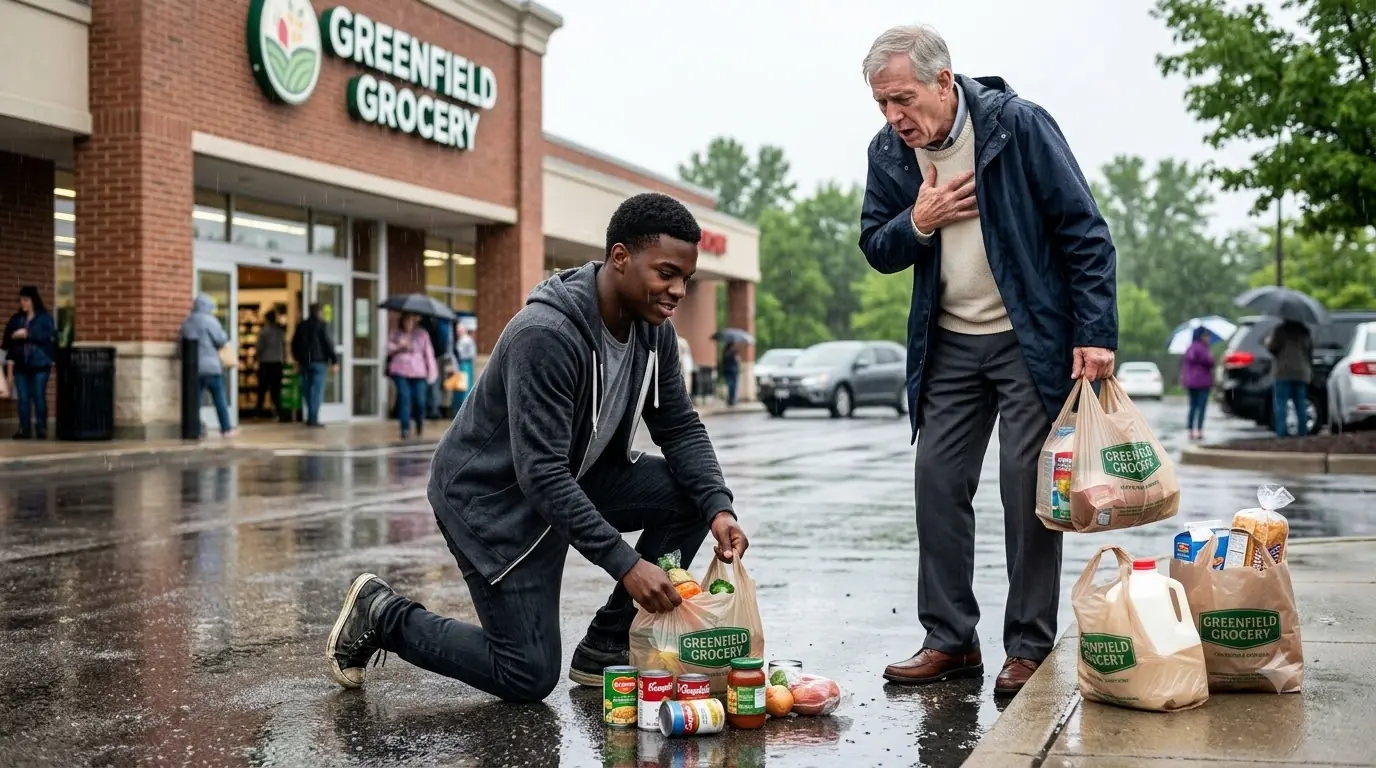
“Mind your business, kid,” someone muttered as Solomon hurried toward him.
Another passerby laughed. “Broke helping broke. Classic.”
Solomon ignored them.
He knelt in the rain and collected every can and every jar. His shoes had holes in the soles. His stomach was empty. There were exactly four dollars in his pocket, and he needed that money for tomorrow’s bus fare.
Still, he lifted the bags against his chest.
“I’ve got you, sir. Where’s home?”
The old man looked at him through watery eyes.
“About two miles from here.”
Solomon adjusted the weight.
“Then let’s go.”
At seven years old, Solomon Mitchell had carried flowers behind his mother’s coffin because his family could not afford another trip to the funeral home.
At twelve, he carried his grandmother’s oxygen tank up four flights of stairs when the elevator in their apartment building broke and the landlord decided repairing it was not worth the expense.
At nineteen, Solomon carried two jobs, overdue medical bills, and a fear he never spoke aloud: that one morning he would wake up and his grandmother would no longer be breathing.
Edna Mitchell was seventy-four.
She had raised Solomon since the night his parents died in a collision on Route 9. He was five. She was sixty.
The social worker had looked at Edna skeptically.
“Are you certain? Raising a child at your age, on a fixed income…”
Edna did not hesitate.
“That’s my grandson. Give me the papers.”
For fourteen years, she kept him fed, kept him in school, and kept the electricity running through a combination of her pension check and extraordinary stubbornness.
Then her lungs began failing.
Chronic obstructive pulmonary disease.
Stage three.
The doctor explained that Edna would require supplemental oxygen almost constantly. Her medication cost more each month than their rent, and if her condition worsened, surgery might eventually become necessary.
Solomon stopped listening when the doctor mentioned the possible cost.
There were too many zeros.
He dropped out of school at sixteen.
Not because he hated school. Not because he lacked ability.
The electricity bill was $340.
One of Edna’s medications cost nearly $280.
Her monthly pension was $863.
There was no arithmetic Solomon could find that allowed all three numbers to coexist.
By nineteen, he worked mornings washing dishes at Hal’s Diner on Franklin Street. The pay was low, the work exhausting, and his boss, Craig Holloway, treated breaks like a personal insult.
In the afternoons, Solomon delivered packages for a local courier service.
Every dollar went into three envelopes taped beneath his mattress.
Rent.
Medicine.
Food.
Most months, the food envelope remained empty.
Solomon ate day-old rolls from Hal’s Diner and soup the kitchen was going to discard anyway.
He never told Edna.
Their apartment sat on the fourth floor of a building that had needed serious repairs for years. Water stains spread across the ceiling. The hallway smelled of mildew and cooking oil. The front-door lock had been broken since January, so Solomon wedged a chair beneath the handle every night.
But Edna’s bedroom had a window.
Her bed sat beside it.
On clear mornings, sunlight touched her face and she smiled.
For a few seconds, the rattling in her chest did not seem quite so loud.
That smile was enough to keep Solomon moving.
The afternoon he met the old man outside Greenfield’s Grocery, Solomon had just completed his delivery shift.
His back hurt.
The left sole of his sneakers had split, allowing cold rainwater to soak his sock with every step.
He had four dollars.
No dinner.
He had been cutting across the grocery-store parking lot when he saw the elderly stranger struggling with the bags.
People walked around him.
A couple pushing a full shopping cart simply stepped over one of the fallen cans.
A teenager swerved around him.
A store employee watched from near the entrance.
Solomon never considered whether helping was convenient.
He simply crossed the parking lot.
“Let me get those for you, sir.”
The old man looked up.
“You don’t have to do that, son.”
“I know.”
Solomon collected the last can and lifted three bags onto each arm.
“Where are we going?”
The old man pointed east.
“About two miles.”
Then he looked at Solomon’s soaked clothing.
“But you look like you’ve already had a long day.”
“I’m good.”
“You sure?”
“Let’s go.”
They walked two miles through pouring rain.
Solomon never complained.
He did not know the old man’s last name or anything about his life. He certainly did not know that the stranger beside him owned more buildings than Solomon had ever entered.
For the first mile they barely spoke.
The old man moved slowly, occasionally holding Solomon’s arm for balance. His coughing worried Solomon. Every few steps, the older man stopped and pressed a hand against his chest.
“What’s your name, son?”
“Solomon. Solomon Mitchell.”
“I’m Walter.”
No last name.
“You live around here?”
“Two miles back the other direction.”
Walter stopped.
“You’re walking two miles away from your own home, in this weather, carrying a stranger’s groceries?”
Solomon shrugged.
“You needed help.”
Walter stared at him.
Then they continued.
“Your parents raised you right.”
“My grandmother raised me.”
“Your parents?”
“Gone. Car accident when I was five.”
Walter became quiet.
After a while he asked, “Your grandmother doing well?”
Solomon shifted the bags.
“She’s sick.”
“What kind of sick?”
“Her lungs. She needs oxygen.”
He looked down at the road.
“Some days are better.”
“And the bad days?”
Solomon hesitated.
“On the bad days, I sit beside her bed and count her breaths until she falls asleep.”
Walter’s grip on his arm tightened.
“You working?”
“Two jobs.”
“School?”
“Dropped out.”
“Why?”
“Couldn’t afford school and her medicine.”
They eventually entered a quiet neighborhood lined with old trees and carefully maintained houses.
“This one,” Walter said.
The home was brick, two stories, with a simple front porch and rocking chair. Nothing about it looked extravagant from the street, but Solomon noticed the solid oak door, immaculate gutters, and perfectly maintained yard.
He placed the groceries on the porch.
Walter reached for the door.
“Come inside. I’ll get you a towel and make some tea.”
“I appreciate it, sir, but I need to go.”
“After walking through all that?”
“My grandmother’s medicine is due at seven.”
His voice weakened.
“If I’m late, she tries to get it herself. She can’t really get out of bed by herself anymore.”
Walter looked closely at him.
“At least let me pay you.”
He reached inside his coat.
Solomon stepped backward.
“No, sir.”
“You carried six bags for two miles.”
“I didn’t do it for money.”
“Then why?”
Solomon looked at him.
Rain ran down his face.