The rain had not stopped for almost two days in Chicago, Illinois.
It came down in long silver sheets, sliding endlessly down old brick buildings, running in dark streams along the curb, dripping from fire escapes and awnings and bus stop roofs until the whole city seemed to be dissolving under the weight of gray water.
Buses splashed through crowded intersections.
Taxi headlights blurred in the wet streets.
People hurried beneath umbrellas with their heads down, shoulders hunched, faces hidden behind scarves and collars.
No one slowed down for strangers anymore.
No one had time.
Especially not Naomi Carter.
At twenty-five years old, Naomi felt like she had already lived three different lives.
One life had ended when her father walked out.
Another had ended when her mother got sick.
The third was the one she was living now, and it felt like nothing but bills, hospital hallways, unanswered job applications, and fear.
She lived in a tiny apartment on the south side of Chicago, in a building that leaned slightly with age and groaned whenever the wind pressed against it. The wallpaper peeled near the corners. The radiator clanked and hissed whenever it felt like working. The kitchen light flickered if the refrigerator kicked on at the wrong time.
Beside the microwave sat a stack of envelopes Naomi had begun turning facedown because she could no longer bear seeing the red letters.
Past Due.
Final Notice.
Payment Required.
Urgent.
Every morning began with fear.
Fear that the landlord would finally lose patience.
Fear that the hospital would call demanding another payment she did not have.
Fear that her mother’s condition would worsen before Naomi could afford the medication she needed.
Her mother, Angela Carter, had been in St. Mary’s Hospital for nearly three weeks after heart complications left her too weak to stand without help.
The doctors were kind but careful.
That frightened Naomi.
Kind doctors used gentle voices when the truth was ugly.
Insurance covered some things, but not enough. Never enough. Every new test seemed to come with a new balance. Every medication had a price. Every conversation with billing felt like someone asking her to prove her mother was worth saving.
Naomi worked part-time cleaning offices at night in a downtown building where executives left half-full coffee cups on desks and tossed out catered food after meetings. She vacuumed carpet, emptied trash, wiped glass doors, and scrubbed bathrooms so polished she could see her tired face in the sinks.
But two weeks earlier, her hours had been cut nearly in half.
Budget reductions, her supervisor said.
Temporary, he promised.
Naomi did not believe in temporary anymore.
Temporary problems had a way of moving in permanently when you were poor.
Now she spent her days searching for another job while pretending to her mother that everything would somehow be all right.
But hope became expensive when overdue notices kept arriving.
That afternoon, Naomi stepped out of another jewelry store after another rejection.
“We’re looking for someone with more sales experience,” the manager had told her politely, even though she had barely looked at Naomi’s résumé.
The woman had been around forty, with perfect nails, a silk scarf, and the kind of smile that closed doors gently so you could not accuse it of being cruel.
Naomi had thanked her anyway.
She always thanked people.
Even when they dismissed her.
Even when they looked through her.
Even when the interview lasted less than five minutes and ended with a sentence that sounded kind but meant no.
She stood beneath the awning for a moment, clutching her folder tightly against her chest while cold rainwater dripped from the edge of the building beside her.
It was the fifth rejection that week.
Two jewelry stores.
One department store.
One hotel front desk.
One office receptionist position where the interviewer had asked if she had “reliable availability,” and Naomi had immediately thought of hospital visits, unpaid bills, and her mother’s trembling hands.
Her stomach hurt from hunger, but she ignored it.
She had exactly eighteen dollars left until Friday.
Eighteen dollars for bus fare, hospital trips, food, laundry, and whatever emergency life decided to invent next.
Her phone buzzed in her coat pocket.
Naomi pulled it out quickly, hoping it was a job call.
It was the hospital.
Her chest tightened before she even answered.
“Hello?”
“Miss Carter, this is St. Mary’s billing department. We wanted to remind you that your mother’s medication balance is still pending.”
Naomi closed her eyes.
Rain struck the awning above her like fingers tapping impatiently.
“I know. I’m trying.”
“We understand, but the account is becoming urgent.”
“I said I’m trying,” she repeated quietly.
The woman on the phone softened her tone, which somehow made it worse.
“We can discuss payment plan options if you’re able to provide something toward the balance this week.”
Naomi almost laughed.
Something.
People loved that word.
As if something appeared simply because they asked politely.
“I’ll call back,” Naomi said.
“Miss Carter, I should note that—”
“I’ll call back.”
She ended the call before the woman could finish.
Then she leaned against the cold brick wall and rubbed her face with both hands.
For one terrible moment, she wanted to scream.
Not because she was angry.
Because she was exhausted.
Her father had abandoned them when she was nine years old.
He left on a Tuesday morning with two suitcases, a leather jacket, and a promise that he would “send for them once things got settled.”
Things never got settled.
At first, Naomi waited by the window every evening. Then only on Fridays. Then only on her birthday. Eventually she stopped waiting, but some small foolish part of her still listened whenever heavy footsteps passed outside the apartment door.
Her mother never spoke badly of him in front of her.
Angela Carter simply worked.
She cleaned hotel rooms until her hands cracked.
She folded sheets until arthritis twisted her fingers.
She came home limping after double shifts and still helped Naomi with homework at the kitchen table.
When Naomi cried over school projects or mean girls or not having the right shoes, Angela would touch her cheek and say, “Baby, we may not have much, but we have dignity. Don’t let anybody take that.”
Dignity.
Naomi had grown up believing dignity was something poor people protected because sometimes it was all they owned.
Now she watched the strongest person she knew lying weak in a hospital bed, connected to machines, apologizing every time Naomi brought her clean socks or brushed her hair.
Life felt cruel lately.
Cruel and expensive.
Naomi stepped out from beneath the awning and began walking through the crowded downtown streets, trying not to cry.
The rain hit her hood and soaked the ends of her hair. Her shoes were already damp from stepping into puddles too deep to avoid. She held her résumé folder under her coat, protecting paper that no one seemed to want to read.
She passed restaurants glowing with warmth.
Boutiques with mannequins in dry clothes.
Jewelry windows sparkling beneath perfect lights.
Diamonds on velvet.
Pearls in glass cases.
Gold bracelets arranged like sunlight.
Naomi slowed in front of one window despite herself.
When she was little, her mother used to bring her downtown in December just to look. They would press their faces close to windows they could not afford to enter and pretend they were choosing gifts.
“What would you pick?” Angela would ask.
Naomi always chose the smallest pieces.
Tiny earrings.
Delicate chains.
A silver ring with a blue stone.
Even as a child, she understood that wanting too much was dangerous.
Her mother always smiled and said, “You have an eye for beauty.”
Naomi had loved jewelry ever since.
Not because of wealth.
Because of craftsmanship.
Because someone could take stone and metal, pressure and fire, and turn them into something that carried memory.
A ring could mean a marriage.
A locket could hold a face.
A bracelet could pass from mother to daughter.
Beautiful things lasted longer than the people who bought them.
Maybe that was why Naomi kept applying to jewelry stores even though they kept rejecting her.
She wanted to work somewhere beauty had value.
Even if she could not afford any of it herself.
She forced herself to keep walking.
Then she saw her.
An elderly white woman sat alone near a bus stop bench beside a closed restaurant.
She looked close to eighty years old.
Her gray hair was soaked flat by rain. Her coat was old and wrinkled, the hem dark with water. Her gloved hands rested in her lap, shaking slightly. Beside her sat a large brown suitcase that looked almost as old as she was.
But what caught Naomi’s attention was not the suitcase.
It was the woman’s face.
She was crying quietly.
Not dramatically.
Not loudly.
Just the exhausted tears of someone who had run out of strength and no longer had the energy to hide it well.
People walked around her without slowing down.
A businessman in a dark overcoat glanced at her and muttered, “Probably homeless.”
A teenage girl looked briefly, then kept walking.
A couple under one umbrella stepped around the suitcase as if it were trash on the sidewalk.
Nobody stopped.
Naomi did.
She had every reason not to.
Her mother was in the hospital.
She had eighteen dollars.
Her feet hurt.
Her stomach was empty.
The rain was getting worse.
But the old woman’s shoulders shook once, very slightly, and Naomi thought of her mother sitting alone in a hospital bed trying not to cry when Naomi left each night.
She stepped closer.
“Ma’am?” Naomi asked softly.
The old woman quickly wiped her face as if embarrassed to be seen crying.
“I’m sorry,” she whispered. “I didn’t mean to bother anyone.”
“You’re not bothering me.”
The woman tried to smile politely, but her lips trembled.
Naomi glanced toward the closed restaurant behind her.
Its front windows were tall and polished. Inside, people sat beneath warm lights, eating from white plates while soft music drifted faintly through the glass.
“What happened?” Naomi asked.
The old woman lowered her eyes.
“I asked if they had any leftovers,” she admitted quietly. “I told them I hadn’t eaten in three days.”
Naomi felt her chest tighten.
“And?”
“They told me customers didn’t want to see someone like me sitting near the windows.”
Rain tapped steadily against the sidewalk between them.
Naomi looked through the restaurant glass again.
A waiter in a white shirt was pouring wine.
A woman laughed over a plate of pasta.
A man cut into steak.
The old woman sat outside in the rain.
Naomi’s stomach growled painfully.
The old woman noticed.
“You’re hungry too,” she said softly.
Naomi forced a small laugh.
“I’ll survive.”
The woman looked down at the wet pavement.
“At my age,” she whispered, “three days feels very long.”
Something about those words shattered whatever emotional strength Naomi had been holding together all week.
Three days.
Naomi thought of her mother missing meals in the hospital because nausea made eating difficult.
She thought of the way Angela used to skip dinner when Naomi was young and say, “I ate at work,” though Naomi later understood that was often a lie.
She thought of herself walking past the old woman, going home, maybe making instant noodles, maybe crying alone, while the woman stayed there in the rain with three days of hunger folded into her body.
Without thinking further, Naomi reached into her pocket and counted her money quickly.
Eighteen dollars.
That was all.
Bus fare.
Hospital visits.
Food.
Everything.
Then she looked at the old woman again.
“Come with me,” Naomi said.
The woman blinked.
“What?”
“You need food.”
“Oh no,” the woman protested weakly. “You shouldn’t spend money on me.”
Naomi shook her head firmly.
“My grandmother used to say hungry people shouldn’t argue.”
The old woman stared at her for a moment like she had not heard kindness in a very long time.
Then slowly, she nodded.
Naomi grabbed one side of the heavy suitcase while the woman held the other, and together they walked down the block toward a small diner called Miller’s Kitchen.
The diner was not fancy.
The booths were cracked.
The coffee was too strong.
The neon sign outside flickered whenever the weather turned bad.
But it was warm.
That mattered.
Inside, a tired waitress greeted them from behind the counter.
“Table for two?”
Naomi nodded.
The waitress looked at the old woman’s soaked coat and suitcase, then at Naomi’s face. Something passed through her expression, judgment maybe, or curiosity, but she said nothing.
She led them to a booth near the back.
As Naomi and the woman sat down, several customers glanced over.
Naomi noticed immediately.
The judgment.
The quiet assumptions.
She had seen that look directed at poor people her entire life.
The waitress handed them menus.
“What can I get you?”
The old woman hesitated immediately.
“Oh, I don’t need much…”
Naomi interrupted gently.
“She’ll have whatever she wants.”
The woman looked shocked.
“Dear, no.”
“You said three days.”
The old woman’s eyes filled again.
She looked at the menu with trembling hands.
After several moments, she quietly ordered meatloaf, soup, mashed potatoes, hot tea, and apple pie.
Naomi ordered only coffee.
The waitress walked away.
The old woman looked at Naomi carefully now.
“What’s your name?”
“Naomi.”
“I’m Evelyn.”
Naomi smiled softly.
“Nice to meet you, Evelyn.”
The older woman studied her face for a long moment.
“You look exhausted.”
Naomi laughed quietly.
“That obvious?”
“You carry worry in your shoulders.”
Naomi looked down at the table.
“My mother’s in the hospital.”
Evelyn’s expression softened instantly.
“What happened?”
“Heart problems.”
“And you’re still buying food for strangers?”
Naomi shrugged weakly.
“I couldn’t leave you outside.”
Evelyn stared at her silently for several seconds.
Then she asked quietly, “Why not?”
The question caught Naomi off guard.
Because honestly, she was not sure anymore why she kept helping people when life had shown her so little mercy lately.
She could have said because it was right.
Because she had been raised that way.
Because hunger was ugly.
Because the rain was cold.
But none of those answers reached the center of it.
Finally, Naomi answered softly, “Because I’d want someone to stop for my mother.”
For the first time, Evelyn looked away completely.
As if trying to hide emotion.
When the food arrived, the old woman stared at it almost in disbelief.
Steam rose from the soup.
The smell alone seemed to overwhelm her.
“Go ahead,” Naomi encouraged gently.
Evelyn picked up the spoon slowly.
Then she began eating.
At first carefully.
Then faster.
Like someone trying not to appear desperate while desperately hungry.
Naomi looked away politely to give her dignity.
A few minutes later, Evelyn suddenly stopped eating and covered her mouth.
“I’m sorry,” she whispered.
“For what?”
“I forgot what hot food tasted like.”
Naomi felt tears sting her own eyes.
Outside, rain continued falling across Chicago.
Inside, two women who had been complete strangers an hour earlier sat quietly together over warm food and coffee.
Eventually Evelyn looked toward Naomi’s untouched menu.
“You didn’t order food.”
“I’m okay.”
“No, you’re pretending.”
Naomi laughed softly.
“You sound like my mother.”
“And she’d probably be angry right now.”
“She would.”
Evelyn reached across the table gently.
“Eat something.”
Naomi hesitated.
Then finally ordered the cheapest sandwich on the menu.
When it arrived, she ate slowly at first, trying to appear less hungry than she was.
Evelyn noticed but did not embarrass her.
They talked for nearly two hours.
Not quickly.
Not like people trying to fill silence.
They spoke the way lonely people sometimes do when they unexpectedly find someone safe enough to receive the truth.
Evelyn asked about Angela.
Naomi told her about the hospital, though not all the bills at first.
Then Evelyn asked one gentle question too many, and Naomi found herself saying everything.
The reduced hours.
The job interviews.
The overdue notices.
The phone calls from billing.
The fear of losing the apartment while her mother was still fighting to stay alive.
“Nobody wants to hire someone desperate,” Naomi said quietly.
Evelyn tilted her head.
“That’s not true.”
“It feels true.”
“What kind of work do you want?”
Naomi smiled weakly.
“Anything at this point.”
“No dream?”
The question made Naomi look toward the window.
Dream.
It sounded almost childish.
People with bills did not get dreams.
They got shifts.
Applications.
Payment plans.
Still, Evelyn waited.
Naomi finally admitted quietly, “I always loved jewelry.”
Evelyn raised an eyebrow.
“Jewelry?”
“My mother used to take me window shopping downtown when I was little. We never bought anything. But I loved the designs. The craftsmanship. The way a ring or necklace could mean something bigger than itself.”
Evelyn leaned back silently.
“Interesting.”
Naomi shrugged.
“I know it sounds silly.”
“No,” Evelyn said. “It sounds specific. Specific dreams are rarely silly.”
Naomi did not know what to do with that.
People usually told her to be realistic.
Evelyn asked, “Have you worked in sales?”
“Not really. Customer service, cleaning, some cashier work when I was younger.”
“Why jewelry stores?”
Naomi looked embarrassed.
“I thought maybe if I started small, inventory, cleaning cases, greeting customers, I could learn. But they all want experience.”
“Yes,” Evelyn said dryly. “The old locked door. You need experience to get the job, and the job to get experience.”
Naomi smiled.
“Exactly.”
Evelyn took another bite of mashed potatoes.
“What happened to your father?”
Naomi’s expression changed instantly.
“He left.”
“How old were you?”
“Nine.”
“I’m sorry.”
Naomi shrugged like she no longer cared, but her eyes betrayed her.
“You stop missing people eventually,” she said quietly.
Evelyn looked at her carefully.
“No,” she replied softly. “You just learn how to carry the absence.”
The words hit Naomi harder than expected.
She looked at Evelyn, suddenly aware that the old woman was not only hungry and wet.
She was grieving something too.
Maybe not recently.
Maybe not visibly.
But deeply.
“Who did you lose?” Naomi asked before she could stop herself.
Evelyn’s hand paused around her teacup.
For a long moment, Naomi regretted asking.
Then Evelyn said, “My husband.”
“I’m sorry.”
“It was twelve years ago.”
“That doesn’t mean it stopped hurting.”
Evelyn looked at her sharply, then softly.
“No. It doesn’t.”
The waitress returned with the bill.
Naomi swallowed hard seeing the total.
Almost sixteen dollars.
Nearly everything she had left.
She paid it anyway.
Not because she could afford to.
Because she had already decided that leaving Evelyn hungry would cost more in a way no receipt could measure.
As they stood to leave, Evelyn reached down for the suitcase.
Then suddenly stopped.
“Naomi.”
“Yes?”
Evelyn slowly pushed the suitcase toward her.
“Take this.”
Naomi frowned immediately.
“What?”
“The suitcase.”
“I can’t take your belongings.”
Evelyn’s expression remained calm.
“I want you to.”
“No, ma’am.”
“Please.”
Naomi shook her head firmly.
“You need this more than I do.”
Evelyn smiled faintly.
“No,” she whispered. “I don’t.”
Then before Naomi could argue further, the old woman leaned closer.
“Open it when you get home.”
Naomi blinked in confusion.
“What’s inside?”
Evelyn only smiled gently.
“A reason not to give up.”
Before Naomi could stop her, Evelyn turned and walked slowly toward the diner door.
“Wait.”
The old woman stepped into the rain.
Naomi grabbed the suitcase handle and hurried after her, but by the time she reached the sidewalk, Evelyn had disappeared into the moving crowd.
Chicago swallowed people easily.
Especially in the rain.
Naomi stood outside Miller’s Kitchen holding the heavy suitcase, confused, concerned, and a little frightened.
Had Evelyn left everything she owned?
Was she in danger?
Was this some kind of test?
Naomi considered taking the suitcase to the police.
Then she thought of the note in Evelyn’s voice.
Open it when you get home.
Not now.
Not here.
Home.
So Naomi carried it.
The suitcase was heavier than expected. She dragged it through puddles, down train steps, onto the bus, then up the narrow stairs to her apartment. By the time she reached her door, her arms ached and her coat was soaked through.
Inside, the apartment was silent except for dripping pipes and distant thunder outside.
Naomi placed the suitcase carefully on the kitchen table.
For several minutes, she only stared at it.
Then slowly, with trembling fingers, she opened the latches.
The lid lifted.
Naomi froze completely.
Stacks of cash filled the inside.
Neatly wrapped bundles.
Thick bands.
More money than Naomi had ever seen outside a bank window or movie scene.
She stumbled backward so fast she nearly knocked over a chair.
“Oh my God…”
Her hands trembled violently.
Her first thought was not excitement.
It was panic.
Was it stolen?
Illegal?
A mistake?
Was someone going to come looking for it?
Naomi stepped closer again, heart pounding, and touched one bundle as if it might bite her.
Real.
She counted one stack.
Then another.
Then another.
Thirty thousand dollars.
Thirty thousand.
Naomi sat down hard at the kitchen table.
For almost ten full minutes, she could not breathe properly.
Thirty thousand dollars meant medication.
Hospital payments.
Rent.
Food.
Heat.
Time.
It meant her mother might not have to hear the anxiety in Naomi’s voice.
It meant Naomi might sleep one night without calculating disaster.
Then she noticed an envelope taped beneath the lid.
Her name was written on it.
Naomi.
She removed it carefully and opened the flap.
Inside was a handwritten note.
Dear Naomi,
If you are reading this, then you did exactly what I hoped you would do. You opened the suitcase only after bringing it safely home instead of taking what you wanted and abandoning the rest. That tells me more about your character than you realize.
The money is yours.
Use it for your mother.
Use it for your future.
Use it to breathe again.
Three days ago, I lost faith in people. Tonight, you returned some of it.
Tomorrow morning, if you are willing, come to Bellamy Jewelers on Wabash Avenue at 9:00 a.m. Ask for Evelyn Bellamy.
The old woman you fed.
Naomi read the note three times before her brain finally understood the name.
Bellamy Jewelers.
One of the most famous luxury jewelry companies in Chicago.
Her eyes widened.
“No way…”
She grabbed her phone and searched the name.
Evelyn Bellamy appeared immediately.
Founder.
Owner.
Widow of Thomas Bellamy.
Philanthropist.
Jewelry designer.
Businesswoman.
A photograph loaded.
There she was.
Not wet.
Not hungry.
Not bent under the rain.
Evelyn stood in a navy suit beside a display of diamonds, her gray hair styled perfectly, her face strong and elegant.
Naomi covered her mouth.
She had fed one of the richest women in Chicago with nearly the last of her money.
That night, Naomi barely slept.
She hid the suitcase beneath her bed, then pulled it out again because she feared someone would break in. Then she placed it in the closet, then finally sat on the floor in front of the closet door with a kitchen knife beside her, feeling ridiculous and terrified.
At three in the morning, she gave up trying to sleep and went to the hospital.
She stopped at a gas station on the way and bought a small bouquet of flowers with the last two dollars in her wallet.
Her mother was awake when Naomi arrived, propped against pillows, face pale beneath the hospital lights.
But Angela smiled immediately when she saw her.
“There’s my girl.”
Naomi sat beside her carefully.
“You should be sleeping.”
“So should you.”
Angela studied her daughter’s face closely.
“What happened?”
Naomi hesitated.
Then quietly told her everything.
The rain.
The old woman.
The dinner.
The suitcase.
The cash.
The note.
The name.
By the end, Angela Carter was staring at her daughter in disbelief.
“Thirty thousand dollars?”
Naomi nodded slowly.
“I thought maybe I was dreaming.”
Angela’s eyes filled.
“You know why this happened?”
“Why?”
“Because kindness has a way of finding its way home.”
Naomi lowered her eyes.
“I almost walked past her.”
“But you didn’t.”
Angela reached for her daughter’s hand weakly.
“Naomi, promise me something.”
“What?”
“No matter how much money comes into your life after this, never become the kind of person who ignores crying people on sidewalks.”
Naomi’s eyes filled instantly.
“I promise.”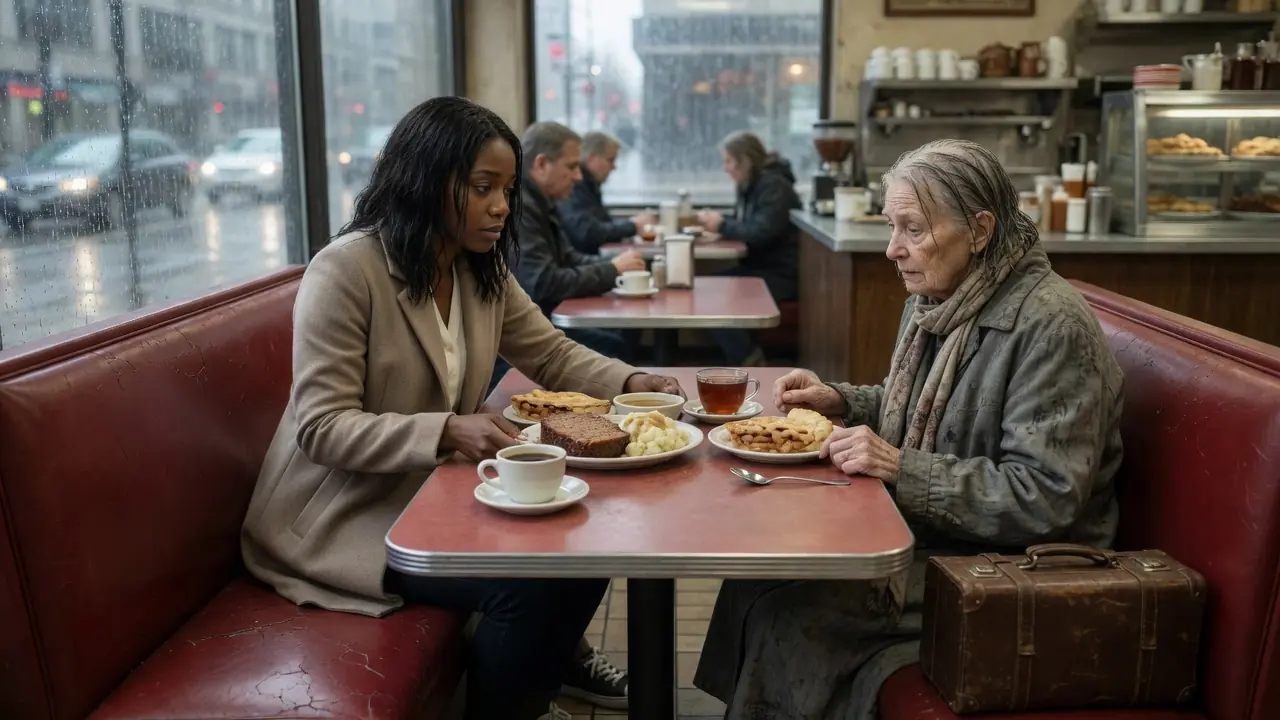
The next morning, Naomi stood outside Bellamy Jewelers at exactly 8:55 a.m.
She wore her cleanest clothes.
Black slacks that had faded at the knees.
A white blouse carefully ironed.
A dark coat she had brushed twice to remove lint.
Her hair was pulled back neatly, though the rain had already loosened a few strands near her face.
She was nervous enough to feel sick.
The building looked nothing like the old woman from the bus stop.
Elegant glass windows.
Polished marble floors.
Warm display lights.
Security guards near the entrance.
Inside the window, necklaces rested on velvet like captured stars.
Naomi almost turned around twice.
Then the doors opened.
And there stood Evelyn.
But now everything was different.
Her gray hair was perfectly styled.
Her posture was straight.
She wore an elegant navy coat, diamond earrings, and carried herself with the calm authority of someone used to owning entire rooms.
Employees greeted her immediately.
“Good morning, Mrs. Bellamy.”
Naomi stared, speechless.
“You…”
Evelyn chuckled softly.
“Yes. I own the company.”
Naomi blinked repeatedly.
“But yesterday…”
“I wanted to walk the city without people knowing who I was.”
Evelyn’s expression darkened slightly.
“Turns out kindness disappears quickly when wealth does.”
She guided Naomi inside and took her through the showroom toward a private upstairs office overlooking the floor.
Naomi could barely breathe.
Everything sparkled.
But not loudly.
Bellamy Jewelers was elegant in a way that made even silence feel expensive.
Employees moved with quiet precision. Display cases gleamed. Customers spoke in low voices. Behind one glass case, a diamond necklace shimmered beneath a light so perfect it seemed unreal.
Naomi thought of her apartment, the radiator, the peeling wallpaper, the suitcase hidden in her closet.
She felt like a mistake in human form.
Evelyn seemed to sense it.
“Stand up straight,” she said.
Naomi quickly straightened.
“I’m sorry.”
“Don’t apologize. Just stand as if the floor belongs under your feet.”
Naomi did not know why those words nearly made her cry.
In Evelyn’s office, the older woman motioned for her to sit.
The room was lined with framed sketches of jewelry designs. Some were old, pencil on yellowed paper. Others were modern and sharp. A black-and-white photograph of a young Evelyn and a tall man stood on the desk.
Her husband, Naomi guessed.
Evelyn followed her gaze.
“Thomas,” she said quietly. “He had better business instincts than I did. I had the better eye.”
Naomi smiled faintly.
“Sounds like a good partnership.”
“It was.”
Evelyn sat across from her.
“I built this business with my husband fifty years ago. After he died, I began wondering whether the people around me respected me, or only my money.”
Naomi listened silently.
“So for the last year,” Evelyn continued, “I occasionally walked the city alone, dressed exactly as you saw me yesterday.”
“And people treated you badly?”
Evelyn laughed sadly.
“You’d be amazed how cruel people become when they think someone is powerless.”
She walked toward the large office window and folded her arms.
“One restaurant told me customers would stop eating if I sat near the entrance. A young man once dumped coffee near my feet and told me to clean it up if I wanted money. Another place threatened to call police because they thought I was scaring wealthy shoppers.”
Naomi felt sick hearing it.
“How could people be that cruel?”
Evelyn looked at her carefully.
“Because many people only respect dignity when it wears expensive clothes.”
A long silence followed.
Then Evelyn placed a folder on the desk.
Inside was an employment contract.
Naomi stared at it.
“What’s this?”
“A job offer.”
Naomi looked up, stunned.
“You barely know me.”
Evelyn smiled softly.
“I know enough.”
She leaned back slowly.
“You spent your last dollars feeding a hungry stranger while your own mother lay in a hospital bed.”
Her voice softened further.
“Character like that cannot be taught.”
Naomi felt tears welling instantly.
“I don’t have jewelry experience.”
“You can learn jewelry.”
Evelyn looked directly into her eyes.
“You cannot teach compassion.”
Naomi covered her mouth, trying not to cry.
“You really mean this?”
“Yes.”
Evelyn turned the page in the folder.
“The position is junior client associate. You will learn inventory, customer care, stone basics, design history, and sales. It includes training, a salary, and healthcare benefits.”
Naomi’s hands began to shake.
Evelyn continued gently, “For your mother too, once you complete the family coverage paperwork.”
That finally broke Naomi completely.
She burst into tears.
Not polite tears.
Not graceful tears.
The kind that come after carrying fear too long.
Evelyn walked around the desk quietly and placed a hand on her shoulder.
“It’s all right,” she whispered.
For the first time in months, Naomi believed maybe life was not finished being kind to her yet.
The first few weeks at Bellamy Jewelers were overwhelming.
Naomi learned inventory systems, diamond grading, gemstone families, luxury sales etiquette, repair intake procedures, and the quiet art of making wealthy customers feel understood without making them feel pressured.
She learned that sapphires came in more colors than blue.
That platinum was heavier than white gold.
That older women often touched lockets before buying them because they were not purchasing metal, but memory.
She learned how to carry trays properly.
How to lock cases.
How to speak about clarity and cut.
How to listen.
Listening came easiest.
Naomi had spent her life listening to what people did not say.
At first, some employees quietly questioned why Evelyn had hired someone with no experience.
One saleswoman named Claire whispered near the break room, “She picked her up off the street basically.”
Naomi heard it.
So did Evelyn.
The next morning, Evelyn gathered the staff privately.
“You all admire diamonds,” she said calmly. “But you forget pressure is what creates them.”
The room fell silent.
Then she looked directly at Naomi.
“Some people arrive polished. Others arrive strong.”
After that, nobody openly questioned Naomi again.
Still, Naomi could feel some employees watching her carefully, waiting for mistakes.
And mistakes came often at first.
She mixed up inventory codes.
Forgot product names.
Nearly locked the wrong tray in the wrong case.
Once, she became so nervous helping a wealthy customer choose a necklace worth more than her entire apartment building that her hands began trembling visibly.
The customer, a rich woman wearing designer sunglasses indoors, glanced at Naomi’s name tag.
“How long have you worked here?”
“About three weeks, ma’am.”
The woman smirked slightly.
“You don’t really look like someone who belongs in a jewelry store.”
Naomi froze.
Old humiliation rose instantly in her chest.
Before she could answer, Evelyn appeared beside them.
“She belongs here because I personally chose her,” Evelyn said calmly. “Is there a problem with that?”
The woman’s face changed immediately.
“Oh, no, Mrs. Bellamy. Of course not.”
After the customer left, Naomi quietly stared at the floor.
“I’m sorry.”
Evelyn frowned slightly.
“For what?”
“For embarrassing the store.”
Evelyn stepped closer.
“Naomi, look at me.”
Naomi slowly raised her eyes.
“Never apologize for other people’s prejudice.”
Those words stayed with Naomi for a very long time.
Slowly, she improved.
She stayed late studying catalogs.
She borrowed books from Evelyn’s private library and read about Art Deco settings, Victorian mourning jewelry, modern minimalist design, and the history of engagement rings.
She watched how senior associates spoke to customers, noticing who sold with flattery and who sold with truth.
Naomi preferred truth.
One afternoon, a young man came in wearing a delivery uniform, clearly nervous. He wanted an engagement ring but had very little money. Claire almost directed him toward the lowest-priced tray with visible impatience, but Naomi stepped in.
“May I help you?”
The man looked relieved.
“I don’t have a big budget.”
“That’s all right,” Naomi said. “Tell me about her.”
He blinked.
“What?”
“The woman you’re asking. Tell me about her.”
He smiled then.
Naomi listened as he described a woman who loved simple things, cried at old movies, worked as a nurse, and hated anything flashy.
Naomi showed him a modest vintage ring with a small oval stone and delicate engraving.
“This one has been waiting for someone who likes quiet beauty,” she said.
The man bought it.
Two weeks later, he returned with his fiancée, who hugged Naomi across the counter because the ring was perfect.
Evelyn watched from the balcony.
Later she said, “That was good work.”
Naomi smiled.
“It wasn’t expensive.”
“I didn’t say profitable. I said good.”
Naomi learned then that Evelyn measured value differently than most people assumed.
Money mattered.
But meaning mattered more.
With the salary from Bellamy Jewelers and the thirty thousand dollars from Evelyn, Naomi paid down her mother’s urgent hospital balance. She arranged better medication coverage. She bought groceries without calculating every penny. She fixed the apartment heater. She replaced Angela’s worn slippers with soft blue ones lined with fleece.
The first time Angela came home from the hospital for a weekend visit, she stood in the apartment doorway and looked at the small changes.
The stocked refrigerator.
The clean curtains.
The repaired radiator.
Then she turned to Naomi with tears in her eyes.
“You made it warm again.”
Naomi hugged her carefully.
“No, Mama. We’re making it warm again.”
Evelyn visited Angela two weeks later.
Naomi was nervous about the meeting.
Her mother had insisted on making tea even though she tired easily. Evelyn arrived in a soft gray coat with a bouquet of white lilies and no diamonds except her wedding ring.
Angela studied her from the couch.
“So you’re the woman my daughter fed.”
Evelyn smiled.
“And you’re the mother who raised her to stop.”
Angela nodded slowly.
“Then I suppose we both did something right.”
Evelyn laughed, and from that moment, the two women liked each other.
They spoke about motherhood, grief, and stubborn daughters as if Naomi were not sitting right there.
“I’m not that stubborn,” Naomi protested.
Both women looked at her.
She stopped talking.
As the months passed, Evelyn became more than Naomi’s employer.
Not exactly a grandmother.
Not exactly a mentor.
Something more complicated and more chosen.
Evelyn was demanding.
She corrected Naomi’s posture, grammar in client emails, product descriptions, and habit of saying “just” before every sentence.
“I just wanted to ask…”
“I’m just checking…”
“I’m just learning…”
One afternoon Evelyn circled the word in red ink on Naomi’s draft note.
“Stop shrinking before you speak.”
Naomi stared at the paper.
“I don’t do that.”
“You do.”
Naomi began to argue, then stopped because Evelyn was right.
Poor people often learned to make themselves smaller in rooms where money had louder shoes.
Evelyn taught her not to.
Naomi taught Evelyn something too.
At first, Evelyn’s kindness was controlled, almost strategic. She gave generously, but through systems, policies, checks, and foundations. Naomi began inviting her into more direct acts.
A meal program at St. Mary’s for families who could not afford cafeteria food.
Emergency clothing vouchers for patients discharged without proper coats.
A partnership between Bellamy Jewelers and a women’s shelter, offering interview clothes, grooming support, and job training.
Evelyn resisted the emotional messiness at first.
Then one day they visited the hospital together and saw a woman crying over a vending machine because her card had declined while her husband was in surgery.
Naomi bought the woman food.
Evelyn stood very still.
On the drive back, she said quietly, “I built a foundation and somehow forgot vending machines.”
Naomi understood.
Big charity could miss small hunger.
After that, Evelyn changed.
Bellamy Jewelers started the Bellamy Dignity Fund, quietly covering meals, transportation, medication gaps, and emergency needs for patients’ families at three Chicago hospitals.
No ceremonies.
No giant checks.
No cameras.
Just help when help was needed.
Angela’s health improved slowly.
She still had weak days.
Still needed medication.
Still moved carefully.
But color returned to her face. She began cooking again, small meals at first. She sat by the window and crocheted scarves she insisted Naomi take to work because “rich buildings are always cold.”
One evening, nearly a year after the rainy day, Angela asked Naomi to bring home takeout from Miller’s Kitchen.
“The diner?” Naomi asked.
“Yes.”
“Why?”
Angela smiled.
“Because that’s where the door opened.”
So they ate sandwiches and apple pie at the small kitchen table, and Angela lifted her tea.
“To crying women on sidewalks.”
Naomi laughed through tears.
“To mothers who taught daughters to stop.”
By then, Naomi had become one of Bellamy’s most trusted junior associates.
She was not the most polished.
Not the most experienced.
But customers remembered her.
She made people feel seen.
An elderly widower came in to resize his late wife’s ring so he could wear it on a chain. Naomi handled it with such care that he returned a month later with a handwritten thank-you note.
A mother brought her teenage daughter to choose a graduation necklace and whispered that money was tight. Naomi found a delicate silver piece within budget and packaged it so beautifully the daughter cried.
A wealthy client once demanded Naomi be removed from assisting her because she “wanted someone senior.” Evelyn offered the client another associate, but the woman later returned after overhearing Naomi explain a custom piece to someone else with warmth and intelligence.
“You know your work,” the client admitted.
Naomi smiled.
“I’m learning every day.”
Evelyn later said, “You could have enjoyed that more.”
Naomi laughed.
“I did. Internally.”
Then came the winter gala.
Bellamy Jewelers hosted one every year for clients, partners, designers, and charity donors. Naomi dreaded it for weeks. She had never attended anything like it. The event would be held at a grand hotel downtown with chandeliers, photographers, champagne, and people whose watches probably cost more than her mother’s hospital bills.
Evelyn insisted she attend.
“You are part of this company.”
“I can work the registration table.”
“You will attend.”
“I don’t have a dress.”
“I know.”
Naomi frowned.
“If you buy me one, I’ll feel weird.”
“If I don’t, you’ll hide behind logistics.”
Naomi sighed.
“You’re very difficult.”
“Yes. It has served me well.”
Evelyn did not buy her the most expensive gown.
She chose a deep emerald dress, elegant and simple, with sleeves Naomi loved because they made her feel less exposed. Angela cried when she saw her.
“My baby looks like she owns the room.”
Naomi laughed nervously.
“I barely own my shoes.”
“Stand straight,” Angela said.
Naomi looked at her.
“That’s Evelyn’s line.”
“Then she’s right.”
At the gala, Naomi felt every old insecurity return.
The room glittered.
Women wore diamonds like punctuation.
Men spoke in low confident tones.
Waiters moved silently with trays of champagne.
Naomi stood near a column, holding sparkling water and trying not to look like she was counting the exits.
Then Evelyn approached the podium.
She spoke first about the company’s anniversary, new designs, and charitable partnerships.
Then she paused.
“There is someone I want to honor tonight,” she said.
Naomi’s stomach tightened before she knew why.
“A year ago, I sat in the rain outside a restaurant in this city. I was dressed poorly. I was hungry. I was dismissed by people who saw no value in me because they believed I had none to offer.”
The room went quiet.
Naomi stopped breathing.
“One young woman stopped. She had nearly nothing. Her mother was in the hospital. Her own future was uncertain. And still, she spent almost everything she had to feed me.”
Evelyn’s voice softened.
“That young woman reminded me that character is not proven in comfort. It is revealed under pressure.”
People began turning.
Naomi wanted to disappear.
Evelyn looked directly at her.
“Naomi Carter, please come here.”
Naomi shook her head almost imperceptibly.
Evelyn raised one eyebrow.
That meant come here now.
Naomi walked to the podium on legs that felt unsteady.
The applause began before she reached it.
Evelyn took her hand.
“I hired Naomi because she showed me compassion. I kept her because she showed me excellence. Tonight, I am announcing the Carter-Bellamy Apprenticeship Program, which will train women from low-income backgrounds in jewelry sales, design support, gemology basics, and luxury client service. Naomi will help lead it.”
Naomi’s eyes filled.
Evelyn squeezed her hand.
“Beauty should not belong only to those born near it.”
The applause rose.
This time Naomi did not shrink.
She stood beside Evelyn and let the room see her.
Afterward, Claire, the coworker who had once whispered about her, approached.
“I owe you an apology,” Claire said.
Naomi studied her.
“Yes, you do.”
Claire looked startled.
Then nodded.
“I’m sorry.”
Naomi accepted it.
Not warmly.
Not cruelly.
Just honestly.
Growth, she had learned, did not require pretending harm had not happened.
The apprenticeship program changed everything.
Women arrived nervous, guarded, hopeful, and afraid.
Some were single mothers.
Some were former caregivers returning to work.
Some had survived difficult marriages.
Some had records for mistakes made in desperation.
Naomi saw herself in many of them.
She taught them how to greet clients, handle delicate pieces, describe jewelry honestly, and stand without apology in rooms that expected them to feel grateful for permission.
On the first day of each training class, Naomi told them a version of her story.
Not all of it.
Enough.
“I entered this building thinking I didn’t belong,” she said. “Then someone taught me that belonging is not always given. Sometimes you stand there long enough, work hard enough, and refuse to shrink until the room adjusts.”
The women listened.
Some cried.
Some lifted their chins.
Evelyn watched from the back of the room, proud and quiet.
Naomi’s mother attended the first graduation ceremony for the apprentices.
Angela wore a navy dress and the silver necklace Naomi had bought her with her first bonus. She still walked slowly, but she walked. When Naomi called the graduates’ names, Angela clapped hardest every time.
Afterward, she pulled Evelyn aside.
“You gave my daughter a chance.”
Evelyn shook her head.
“She gave me one first.”
Angela smiled.
“Then I suppose we’ll call it even.”
“No,” Evelyn said, looking at Naomi laughing with the graduates. “I suspect we’ll spend the rest of our lives adding to it.”
Years passed, but the rainy day never became small in Naomi’s memory.
It became a foundation stone.
Naomi rose through Bellamy Jewelers not because Evelyn favored her, though people sometimes whispered that at first, but because Naomi worked harder than almost anyone else and learned the business from the roots upward.
She studied gemology at night.
Learned design software.
Spent weekends in the repair workshop watching jewelers reset stones.
Traveled with Evelyn to trade shows and estate auctions.
Learned how to identify not only what a piece was worth, but why it mattered.
Evelyn once handed her a brooch shaped like a bird.
“What do you see?”
Naomi examined it.
“Gold. Small rubies for eyes. The clasp looks repaired. Probably sentimental more than high value.”
Evelyn nodded.
“And emotionally?”
Naomi looked closer.
“The wing is worn where someone touched it often.”
“Yes,” Evelyn said. “Never forget that wear can be evidence of love.”
Naomi never did.
Her relationship with Evelyn deepened into something the press eventually described as mentorship, though that word felt too thin.
They argued.
Often.
Evelyn wanted Naomi to move faster into leadership.
Naomi wanted to master every step first.
Evelyn pushed.
Naomi resisted.
Angela watched them once over dinner and said, “You two fight like family.”
Evelyn and Naomi both said, “We do not,” at the same time.
Angela laughed until she coughed.
Then life, as it always does, changed again.
Angela’s health began to decline five years after Naomi first met Evelyn.
Not suddenly.
Not dramatically.
But steadily.
Some mornings, her hands shook too much to hold a mug.
Some afternoons, fatigue pulled her back to bed before dinner.
Naomi, now financially stable and no longer terrified by every bill, moved Angela into a better apartment close to both the hospital and Naomi’s work. She hired home health support. She bought the best medication plan available.
But money could not stop time.
One autumn evening, Angela asked Naomi to sit with her by the window.
Chicago glowed beyond the glass, wet from rain again.
“Do you remember what I asked you to promise?” Angela said.
Naomi held her hand.
“Never become the kind of person who ignores crying people on sidewalks.”
Angela smiled faintly.
“You kept it.”
“I tried.”
“No. You kept it.”
Naomi’s eyes filled.
Angela looked toward the city.
“I used to worry life would harden you. It had reason to.”
“It almost did.”
“But it didn’t.”
Naomi pressed her forehead to their joined hands.
“Because you didn’t let it.”
Angela’s voice softened.
“Because you chose not to.”
She passed away two weeks later, peacefully, with Naomi beside her and Evelyn standing quietly near the doorway, giving them both the dignity of silence.
Grief changed Naomi.
Not by breaking her.
By deepening her.
For a while, she moved through work like someone underwater. Evelyn did not rush her. She reduced Naomi’s responsibilities without announcing it. Sent meals. Sat with her. Argued with funeral directors when they tried to upsell grief.
At the funeral, Evelyn stood beside Naomi as Angela was laid to rest.
Naomi whispered, “I’m alone now.”
Evelyn took her hand.
“No,” she said. “You are grieving. That is not the same thing.”
Naomi leaned into her then, just slightly.
Enough.
Months later, Naomi returned fully to Bellamy.
But something in her work shifted.
She became more determined to build programs that protected people before they reached the edge.
The Carter-Bellamy Apprenticeship expanded.
The Dignity Fund grew.
Bellamy Jewelers launched a line of affordable memorial jewelry, designed for families who wanted to carry loved ones close but could not spend thousands.
Naomi designed the first piece herself.
A simple silver locket with a small inner engraving.
Still here.
It became one of the company’s most beloved pieces.
Not because it was expensive.
Because it told the truth.
Evelyn grew older too.
Her steps slowed.
Her hands became less steady.
But her mind remained sharp, and her standards remained terrifying.
One morning, ten years after the rainy day, Evelyn called Naomi into her office.
The same office overlooking the showroom.
The same desk.
The same photograph of Thomas.
Naomi was thirty-five now, poised and confident, wearing a cream blouse and small sapphire earrings she had bought herself after closing her first major custom design deal.
Evelyn sat behind the desk with a folder in front of her.
Naomi narrowed her eyes.
“I know that folder face.”
Evelyn smiled.
“Sit.”
“That folder face usually changes my life.”
“Then you’re learning patterns.”
Naomi sat.
Evelyn placed the folder before her.
Inside were legal documents.
Naomi read the first page, then looked up sharply.
“No.”
“Yes.”
“Evelyn.”
“I am appointing you president of Bellamy Jewelers.”
Naomi stood.
“No. Absolutely not.”
Evelyn looked amused.
“That is not usually how one accepts a promotion.”
“I’m not ready.”
“You have been ready for two years.”
“The board—”
“The board already approved it.”
“The family?”
“I have no children. You know that.”
Naomi softened.
“Evelyn…”
The older woman’s expression changed.
“My husband and I built this company because we believed beauty should carry meaning. For a while after he died, I forgot the people beneath the meaning. You reminded me.”
Naomi’s eyes burned.
“I fed you dinner.”
“You saw me,” Evelyn said. “At a moment when I was beginning to believe the world only saw money or waste. You saw a hungry old woman.”
Naomi whispered, “You changed my life.”
“You changed mine first.”
The silence between them was full of every year since.
Rain.
Soup.
Cash.
Training.
Angela.
Apprentices.
Arguments.
Laughter.
Loss.
Evelyn pushed the folder closer.
“Take it, Naomi. Not as repayment. As continuation.”
That word returned to Naomi like an echo from long ago.
Continuation.
She signed.
The press loved the story when it became public.
Former struggling woman becomes president of Bellamy Jewelers.
But Naomi refused to let them flatten it into a fairy tale.
In interviews, she said, “This story is not about a rich woman rewarding a poor woman. It is about what happens when two people meet each other without the costumes life puts on them. Hunger showed us the truth. Kindness built the rest.”
Some outlets wanted glamour.
Naomi gave them honesty.
Bellamy Jewelers changed under her leadership.
Still luxurious.
Still elegant.
Still respected.
But warmer.
The apprenticeship program became national.
The Dignity Fund became a model copied by other companies.
Bellamy stores partnered with hospitals, shelters, and community colleges.
Naomi insisted every employee, from security guard to senior gemologist, receive training in dignity-based service.
“No one who enters our doors should be treated according to what we assume they can afford,” she said. “If we cannot honor humanity before wealth, we do not deserve to sell symbols of love.”
Some wealthy clients disliked the changes.
Most stayed.
New clients came because they trusted what Bellamy stood for.
A woman once entered the flagship store in worn clothes, carrying a broken necklace in a plastic bag. The old Bellamy staff might have quietly redirected her elsewhere. Naomi personally helped her.
The necklace was not valuable in money.
It had belonged to the woman’s mother.
Bellamy repaired it for free through the Dignity Fund.
A week later, the woman returned with flowers.
Naomi placed them in Evelyn’s office.
“Another crying person on a sidewalk?” Evelyn asked.
“In a way.”
“Good.”
Evelyn passed away at ninety-one.
Not in rain.
Not alone.
Naomi was with her.
They sat in Evelyn’s bedroom overlooking Lake Michigan, the winter sun pale on the water. Evelyn’s hand rested in Naomi’s, thin but still elegant.
“Do you remember what I wrote in the note?” Evelyn asked.
Naomi smiled through tears.
“A reason not to give up.”
Evelyn nodded.
“You became mine too.”
Naomi bent over their joined hands and wept.
In her will, Evelyn left Naomi controlling ownership of Bellamy Jewelers, with instructions that the company could never be sold to any buyer who would dismantle its worker protections, apprenticeship programs, or dignity initiatives.
She left smaller gifts too.
The navy coat she had worn the morning Naomi came to Bellamy.
A set of design sketches from the early years.
A letter for Angela, written years earlier but never delivered before her death, thanking her for raising the woman who saved Evelyn from despair.
And the brown suitcase.
Empty now.
Except for one item inside.
The receipt from Miller’s Kitchen.
Sixteen dollars and twelve cents.
Evelyn had kept it all those years.
Naomi framed it and placed it in the lobby of Bellamy’s Chicago flagship, beside a small plaque.
It read:
This company believes dignity is not determined by appearance, wealth, hunger, or circumstance. It began again with one meal in the rain.
Years later, on the anniversary of the day they met, Naomi returned to Miller’s Kitchen.
The diner was still there.
Older.
Renovated slightly.
The neon sign still flickered in bad weather.
Naomi sat in the same booth with a cup of coffee and apple pie.
Rain slid down the window.
She could almost see them.
Her younger self, soaked and terrified, spending the last of her money.
Evelyn, pretending to be powerless but truly starving for proof that humanity still existed.
Two women at the edge of giving up.
One meal between them.
The waitress came by and asked if she needed anything else.
Naomi looked toward the front window.
Outside, near the bus stop, a young woman stood in the rain holding a child’s hand and a stack of papers against her chest. She looked tired in a way Naomi recognized immediately.
Not lazy.
Not careless.
Tired from fighting invisible wars.
Naomi stood.
She left money on the table for her bill and walked outside.
The rain was cold.
The young woman looked up when Naomi approached.
“Are you all right?” Naomi asked.
The woman quickly wiped her face.
“I’m sorry. I didn’t mean to bother anyone.”
Naomi felt the years fold gently around her.
She thought of her mother.
She thought of Evelyn.
She thought of the suitcase, the note, the job, the losses, the company, the thousands of lives now connected to one rainy evening.
“You’re not bothering me,” Naomi said.
The child looked hungry.
Naomi opened the diner door and held it wide.
“Come inside,” she said gently. “Hungry people shouldn’t argue.”
The young woman blinked.
Then, slowly, she stepped forward.
And as Naomi followed her into the warmth, she understood something she had spent years learning.
Kindness was never meant to end with the person who received it.
It was meant to move.
Hand to hand.
Table to table.
Life to life.
The rain continued falling over Chicago, washing the streets, blurring the lights, softening the hard edges of the city.
Inside Miller’s Kitchen, a tired woman and her child sat down to eat.
Naomi ordered them whatever they wanted.
And somewhere in the quiet rooms of memory, Angela Carter smiled.
Evelyn Bellamy smiled too.
Because the promise had been kept.
Naomi had not become the kind of person who ignored crying people on sidewalks.
She had become the kind of woman who opened doors.
The kind who remembered hunger.
The kind who knew that dignity could wear diamonds, hospital slippers, wet coats, or worn-out shoes.
The kind who understood that sometimes a life changes not when someone gives you a fortune, but when someone first sees you as worthy of a meal.
And in the end, that was the real inheritance Evelyn left her.
Not the money.
Not the company.
Not the diamonds.
The lesson.
Feed the person in front of you.
Protect their dignity.
Open the door.
Let kindness find its way home.