“Promise me forever, Beatrice.”
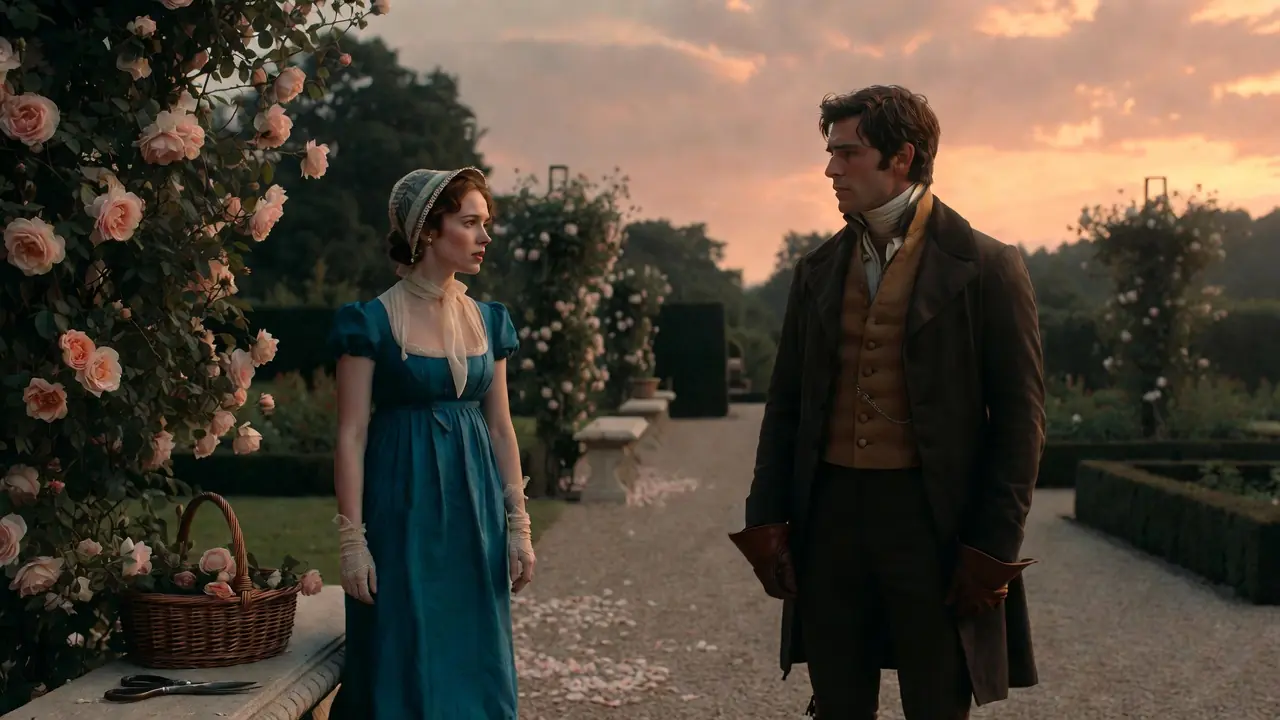
The Duke of Ashford said it without preamble, three sun-darkened seconds after he stepped between the climbing roses and the gravel path.
And Beatrice Hollister, who had spent the last eleven days carefully not thinking about this man, felt her entire plan crack down the middle like a struck bell.
She did not turn at once.
There was a perfectly good reason.
The basket on her arm held six freshly cut sprigs of Damasque rose and a pair of pruning shears she had forgotten she was carrying.
And there was a less good reason, which was that her face had not yet been informed of what the rest of her was supposed to do with that sentence.
She set the basket down on the low stone bench.
She set the shears down with deliberate care, points away.
She straightened.
Then, and only then, she turned around.
He stood with the late June sun behind him, a tall, broad-shouldered shape against a sky going copper at the edges.
Three years in the East had darkened him.
The Ashford uniform of impeccable gray was gone.
He wore a riding coat the color of wet bark, a plain linen shirt open at the collar, and the kind of boots a man earns rather than orders.
His hair, which she remembered as brown, had a streak of harvest gold through it now from a sun she had never stood under.
His eyes were the same.
Gray, watchful, infuriatingly steady.
And they were currently engaged in the unforgivable activity of looking at her as if he had spent the last three years rehearsing this particular look in a mirror.
“Edmund,” she said pleasantly, “you appear to have lost your sense of preface.”
He drew one slow breath through the nose.
“I have not lost it. I have considered it. Then I have set it aside.”
He did not step closer.
He did not need to.
“We are running out of evenings. I have eleven days.”
“Ten and a half,” she said before she could stop herself.
Then she bit the inside of her cheek hard enough to taste copper, because the fact that she had been counting down to the hour was not information she had meant to share with the Duke of Ashford this June.
The corner of his mouth moved.
He did not quite smile.
“Ten and a half. Yes.”
In the months that followed, when she thought about that exact moment in the rose garden, and she thought about it more often than she would ever admit, even to her own diary, Beatrice Hollister would notice that what gave him away was not the eyes.
It was the hands.
His hands, which were broader than she remembered and brown across the knuckles, were perfectly still at his sides.
A man who is bluffing fidgets.
A man who has decided what he is going to lose and has come to spend it anyway holds himself absolutely quiet.
She had thought, when she heard the Ashford household had been thrown open again, that she would have a fortnight of polite calls in which to avoid him.
One stiff drawing-room conversation.
Two cups of lukewarm tea.
And a graceful wave from the carriage as she set off for Southampton.
She had thought she had budgeted for the Duke of Ashford the way a careful traveler budgets for customs duties.
Annoying, predictable, paid in coins set aside long in advance.
She had not, in any of her plans, budgeted for him to walk into the South Rose Garden at twenty minutes past seven in his road coat, smelling of horse and lemon soap, and demand forever before she had managed her first sentence.
“You have,” she said, “the wrong garden.”
On the gravel below the window, a thrush took itself elsewhere.
“I have the right garden.”
“This is my brother’s garden.”
“This is the garden in which you were standing.”
He inclined his head very slightly in the direction of the gate.
“I asked the gardener which way you had gone. He pointed.”
“Watkins,” she said with feeling. “I shall poison Watkins.”
“He thought you would want to be found.”
“Watkins thinks every unmarried woman within ten miles wishes to be found by every unmarried man within ten miles. Watkins has the imagination of a hen.”
Edmund Ashford’s mouth moved again, and this time it did become something like a smile.
The kind of slow, private smile that belonged in private rooms and had no business at all out among the Damasque roses with the daylight failing.
“Beatrice,” he said.
“Don’t,” she said. “Don’t say it like that. Don’t say my name like a sentence with a full stop in the middle of it.”
“Then I shall begin again.”
He took one step forward.
Only one.
It put him level with the second rose bed.
The roses were Madame Hardy, white and unforgivable, planted by his mother thirty years ago in a year when nothing had been forgiven.
“Miss Hollister, I have come home. I find that you are leaving. I have a proposal.”
“I have noticed.”
“You have not heard it yet.”
“I heard the first three words of it. They were exhaustive.”
“Beatrice.”
His voice was perfectly even, and underneath the evenness was something she could not quite read.
Not pleading.
Not command.
Something quieter and far worse.
The sound of a man who had thought a great deal in a hot climate and had arrived at a conclusion he no longer intended to talk himself out of.
“Will you listen?”
She did not answer at once.
She looked down at the basket on the bench, at the six Damasque cuttings she had taken for her brother’s wife, and which would, if she did not get them into water in the next half hour, be useless.
She looked at the gravel between her shoes, at peacock-blue silk shoes dyed to match the traveling gown she had been quietly fitted into last week.
She noted, with the dry interior voice that had been her closest companion since she was eight years old, that she did not seem to be running away.
“Edmund,” she said, “if you are about to ask me to forget Italy, I will hand you back this set of pruning shears, and I will walk to the house, and I will tell my brother that the climate of Wiltshire has made you mad.”
“I am not asking you to forget Italy.”
She looked up.
He had not moved closer.
He held her eyes across the roses like a man holding a thread that was about to be cut and intended to hold it anyway.
“Listen to me carefully,” he said, “because I have rehearsed this in three different oceans, and I will not say it twice. Marry me. Sail on Tuesday. Do the survey. Climb your mountains. Paint your orchids. Come home in October. Live in Ashford House for the rest of your life. Half the year, three-quarters, whatever portion of you the rest of your work will allow. The marriage settlement protects your aunt’s bequest from anyone presently scheming to take it. The expedition is fully funded. I will fund it tonight. I am not asking you to give up your plan. I am asking you to let me stand inside it.”
His voice did, very briefly, do something that was not even.
“I am asking you to promise me forever, Beatrice, and to allow me to promise you the same.”
The dusk was the color of an old penny.
The Damasque roses, which had no business at all in a conversation of this nature, smelled the way they had smelled the summer she was sixteen and he had been twenty.
She had once, only once, seen him reading in his mother’s chair with his boots off and had thought with a piercing, perfectly inappropriate clarity, “Oh, that one.”
She set her teeth together so that her chin would not move.
“Edmund,” she said, and her voice was, to her credit and to her enduring private fury, almost steady. “What in the name of every god, every saint, and every reasonable man who has ever returned from the Indies has put it into your head that I would believe you?”
“Several things,” he said. “None of them are flattering to your uncle. I would like to discuss them with you in the morning in the library with your brother present. And I would like to ask you tonight, here in your brother’s rose garden, only one thing. Whether you will listen tomorrow.”
“My uncle.”
“Tomorrow.”
“You said tomorrow.”
“He said tonight. Beatrice. One question, one answer.”
The wind shifted.
Somewhere on the lawn behind her, a wood pigeon set up an injured argument with another wood pigeon.
Inside the house, three rooms away, somebody, almost certainly her brother’s wife, was playing the third movement of a Haydn sonata badly on a pianoforte that had not been tuned since Easter.
The world, in short, continued to behave as if a duke had not just rearranged the geography of her life from the other side of a flower bed.
“One question,” she repeated. “One? Ask it properly.”
He looked at her for the length of one long breath.
Then, with no theater, no kneeling, no flourish, he said, “Will you let me come to your brother’s library at ten tomorrow morning and lay every piece of this in front of you, and after that, only after that, answer me?”
“That is two questions.”
“Edmund Ashford,” she said, “you have not changed at all.”
“I have changed almost entirely.”
“You have always negotiated your grammar.”
“And you,” he said softly, “have always counted the days.”
She bent down very deliberately and picked up the basket.
She tucked the pruning shears under her arm.
She looked at him over the Damasque cuttings and said in the voice she used at country dinners when somebody asked her opinion of the regiment, “Ten o’clock. The library. If you are late, I shall begin without you.”
“I shall not be late.”
She walked past him without touching him on the gravel path.
She was aware, she would be aware for some days afterwards with a clinical, faintly outraged precision, that her shoulder passed within three inches of his coat sleeve, and that she did not turn her head.
He, for his part, did not move his hand from his side, although it was, she would have sworn under oath, the hand of a man who would have liked to.
The gravel was warm under the thin soles of her peacock-blue shoes.
The Damasque roses brushed her hip as she went, and one cutting dropped from the basket into the bed, a small, bright surplus.
She did not stop for it.
A blackbird in the hedge scolded her professionally as she passed, answered by the steady, deliberate breathing of a man who had not in the last two minutes made a sound.
The smell of the box hedge, green, dusty, summery, reached her, magnified beyond its actual share of the air.
She cataloged it, as she cataloged every other sensation in the next twenty paces, with the precision of a woman who had learned by the age of eleven that the only way to keep a thing from breaking her was to look at it very carefully.
At the gate, she paused.
She did not look back.
She said to the air in front of her, “Edmund.”
“Yes.”
“You have not asked me this evening whether my plans were the kind that could be improved by company.”
“No,” he said. “I have not.”
“Why?”
There was a small pause, the length of a held breath.
The light on the gravel went a shade redder.
“Because,” he said, “you have spent eleven years building a plan in which no one was permitted to stand beside you, Beatrice. And I am the man who is going to ruin it. I would not insult you by pretending otherwise.”
She stood very still for the time it took the wood pigeon to make its argument once more.
Then she said, “Tomorrow at ten.”
And she walked back to the house with a basket of roses and the perfectly steady step of a woman whose entire careful eleven-year, eleven-day plan had just, by a stranger she had loved since she was sixteen, been informed that it had been seen, named, and decided against.
The lime walk at the front of Hollister Park was at its midsummer fullest that night.
The moon dropped small bright coins onto the gravel.
Beatrice walked back up the drive at the unhurried pace at which she had always conducted her interior emergencies, basket on her arm, one Damasque sprig fewer than she had set out with.
She did not turn her head to see whether the man in the dark riding coat had come out by the lower gate or had stayed standing among the white roses.
She had not, since the age of fourteen, permitted herself the small, expensive luxury of looking back.
And she was not, on the evening she was first promised forever in a serious voice by a man she had loved since she was sixteen, going to begin now.
It was twenty-three minutes past one in the morning before Beatrice gave up.
She had tried, with the discipline of a woman trained in her own company, the four things that always worked.
She had read three pages of a book on alpine grasses.
She had drunk a glass of water at the window, watching the moon ride a thin cloud over the lime walk.
She had taken down her hair and put it up in a loose night braid.
She had even, in something close to desperation, copied out a clean version of her packing list in the precise small hand she normally reserved for botanical labels.
None of it worked.
She sat in the window seat of her bedchamber in her plain white wrapper, with her bare feet drawn up under her and her knees tucked into the curve of her arms, and she stared at the South Rose Garden until the rose garden, in self-defense, gave up looking back.
“Promise me forever.”
The Damasque roses, which had no opinion about dukes, moved very gently in a wind too small to be felt at this height.
“Right,” she said aloud to the moonlight and to nobody else. “Let us be a serious woman about this.”
She had said that phrase aloud to herself in this same window seat on twenty-four separate occasions since she was nineteen.
It was the small ritual by which she had, over those eight years, talked herself out of a great many things.
A poorly considered engagement to a baronet’s son who could not draw a primula if his life depended on it.
A small foolish hope concerning the curate at Linham.
Three separate inappropriate flutters concerning a married geologist from the society.
And twice, both at midnight, the entire idea of the Duke of Ashford.
The Duke of Ashford had been her most serious flutter, and she had handled him by simply refusing to admit that he had ever existed in that drawer of her mind.
It had been an excellent strategy.
She recommended it.
She kept a small mental shelf labeled, “Men who are not for you, Beatrice, be sensible.”
And on it, she had filed Edmund Ashford for the eleven years between his eighteenth birthday and tonight.
He had, by walking into the rose garden, taken himself off the shelf.
“Hm,” she said.
She unfolded one arm, hooked her hair back from her cheek, and in the careful interior voice that had once allowed her, at fifteen, to itemize all of her father’s failings without weeping, began her audit.
Item one, the expedition.
The Royal Geographical Society survey of the Italian lakes had been her dream since she was sixteen, when she had read Mrs. Fruan’s Botanical Wanderings in the Lombard Foothills by candlelight until the spine collapsed in her lap.
She had spent four years convincing Sir Edmund Rowhampton that a woman could draw a competent botanical plate.
Three more convincing him that the woman in question could endure mules and middle-aged surveyors for five months.
And two further years securing her aunt Maud’s bequest.
The remainder was her independence.
Five years of careful, plain living if she was prudent, which she was.
The expedition departed Southampton in ten and a half days, Tuesday week, eleven in the morning.
Item two, her brother Theodore, whom she loved, and who even tonight, six hours after the rose garden, had still managed to ask her as she came back into the house with the basket of cuttings, “Bee, dearest, was that Ashford? Did he say anything useful?”
With the air of a man who had been waiting for someone, anyone, to come and save him from his own correspondence.
Theodore was kind, weak, and afraid of his uncle.
Beatrice loved him.
Beatrice did not always trust him, which was a separate matter.
Item three, which she did not particularly want to write down.
She wrote it down anyway.
She wrote it down in the careful interior hand that allowed her, in moments like this one, to look at a thing directly without flinching.
Item three, my uncle.
Sir Quentyn Hollister was forty-eight, very handsome in the cold, rich way of men who had once been beautiful and had not yet been required to put their beauty down.
He was married to an heiress who had stopped speaking to him in 1822, and presently in residence at his townhouse in Curzon Street and his country box in Marlborough, neither of which he had any legal business calling his own.
He lived on the Hollister name, the Hollister credit, and the patience of his elder nephew Theodore, who in Beatrice’s private and unwavering opinion would one day be ruined by his uncle.
Sir Quentyn had, in the eight months since Beatrice’s aunt Maud had died and the bequest had been read, made three visits to Hollister Park.
The first had been ostensibly to console Theodore.
The second had been ostensibly to discuss the grouse.
The third, two weeks ago, had been ostensibly to look at a horse, and had ended with him sitting in her own drawing room at two in the afternoon, smiling pleasantly across his teacup, telling Beatrice that a young woman of your gifts and your constitution, my dear, must not be allowed to overtax herself with quite so much traveling.
She had said very pleasantly, “Uncle, I am twenty-seven, not seventeen.”
He had said, more pleasantly still, “Quite. Quite. Which is why one begins to concern oneself. You know, a spinster with a head full of mountains and a purse full of pounds is, well, one does worry.”
He had not used the word unfit.
He had not needed to.
He had set the word down on the carpet between them like a small folded note and had let her read it for herself.
She had not told Theodore.
She had not told anybody.
Edmund Ashford, who had been at sea or in Madras the entire eight months, had said in the rose garden tonight, “Marry me. The marriage settlement protects your aunt’s bequest from anyone presently scheming to take it.”
It was, Beatrice told herself in the window seat at twenty-three minutes past one, perfectly possible that the Duke of Ashford was a fool.
It was possible that he had merely heard from his cousin Aurelia or from a London friend the surface story.
Beatrice Hollister is leaving for Italy.
Her uncle is being difficult.
Marry her and you save her, you romantic idiot.
And had decided, with the unilateral high-handedness of a duke, that he would simply ride home and do the saving.
It was possible.
It was possible.
She did not, in her bones, believe it.
The thing that gave him away was not his hands this time.
It was the sentence.
“I would like to discuss them with you in the morning in the library with your brother present.”
The plural.
Them.
Not the situation with your uncle.
Not the matter.
Them.
A man who had merely heard a rumor did not collect thems.
He had a list.
He had come back to England with the list.
She tipped her forehead against the cool windowpane and watched the moon move a slow inch behind the lime trees.
“Damn you, Edmund Ashford,” she said softly with great precision and absolutely no force.
For being the kind of man who returns from Madras with a list.
She had been promised forever once before in her life, and it had been, on balance, an unflattering experience.
She had been nineteen.
Her father had been four months dead.
The man in question had been a tall, sallow son of a baronet near Devizes, who had spent two summers riding past Hollister Park and declaring himself in the language he had been taught, which was the language of his mother, his clergyman, and a circulating library novel of 1810.
He had taken her hand in the conservatory of an autumn ball.
She had been wearing a poorly cut gown of puce silk that her aunt Maud had despised.
He had said in the steady, ringing voice of a man who had practiced in front of the looking glass, “Miss Hollister, I promise you forever.”
She had said, “Mr. Trevenick, that is a very long time.”
He had said, with the small frown that was the only honest expression he was ever permitted to make, “I beg your pardon.”
“Forever,” she had said. “It is a very long time. Have you considered what it is made of?”
He had not.
She had been able to see in the careful, well-shaved planes of his face the precise instant at which he realized that the conversation had departed from the script he had been issued, and that he was now regrettably standing alone on the conservatory tiles with a woman he did not entirely understand.
She had withdrawn her hand very gently.
She had said equally gently that she would not marry him.
She had felt, walking back into the candlelight of the ballroom, an absolutely uncomplicated relief.
That night, in this same window seat, she had said aloud to the moonlight, “Beatrice, be a serious woman about this.”
And she had taken a piece of paper and a sharpened pencil and, in her small careful botanical hand, had begun for the first time in her life to plan.
Eight years and four months later, she was still planning.
The plan had, on the whole, gone well.
Italy was, had been, ten and a half days away.
The bequest was sound.
The society’s letter of engagement, signed and countersigned and lodged with her solicitor, sat in the top right drawer of her writing desk under a sheet of blue blotting paper and a pressed campion.
She had, by midnight on her twenty-seventh birthday three weeks ago, achieved very nearly every concrete thing the nineteen-year-old in the puce gown had wanted.
The thing the nineteen-year-old in the puce gown had not, with hindsight, properly costed was the loneliness of it.
She got up from the window seat.
She crossed the bedchamber barefoot.
She opened the top right drawer of her writing desk and looked by the moonlight that came in across the floor at the folded letter from Sir Edmund Rowhampton, with its red society seal and its careful kindly addressed superscription.
Miss B. Hollister, Naturalist to the 1826 Survey.
She found that she could, with no effort at all, name every line of the letter from memory.
She also found that her chest was, for some reason she did not wish to interrogate too closely, behaving as if a hand had been laid gently and without invitation on the second button of her wrapper.
She closed the drawer.
She said to the empty room in the small dry voice with which she had once itemized her father’s failings, “Tomorrow at ten.”
And then, against her own better judgment and against the entire collected wisdom of her twenty-seven careful, unmarried, well-planned years, she added very softly to the moonlight and to nobody else, “And do not, Beatrice, you fool, walk down to that library hoping.”
The moonlight, having no opinion on the matter, declined to comment.
The morning of the library meeting came up clean over Wiltshire.
Beatrice was up before the maid, having slept four and a half hours, not enough by any honest reckoning.
She dressed slowly, took her tea at the south-facing window, and went down at twenty minutes to eight to the library, where she opened the long west window herself and set the day’s specimens out on the mahogany table.
She began the morning the way she had begun every morning of the last eight years, by giving herself an hour of work she could do with her hands while the larger part of her mind was kept busy with something else.
The library at Hollister Park had been, in Beatrice’s father’s time, the most badly used room in the house.
Her father had read three books in his life, all of them about horses, and had used the library principally to sleep off Madeira after dinner, to scold his bailiff in private, and on one notable occasion in 1809, to be sick into the empty Chinese vase in the corner.
The vase had survived.
The carpet had not.
Theodore had inherited the room, the vase, the carpet, and the habit of regarding the library as a problem rather than a refuge.
Beatrice had inherited the books.
She had, over eight unbothered years, cleaned them, cataloged them, rebound the three that mattered, sold the seventeen that did not, and quietly made the library hers.
By the morning of the meeting, the long mahogany table held her brass microscope, her drawing board, her flat presses of dried specimens, three folio volumes of Mrs. Fruan, and, neatly squared at the far end, the small pile of papers she had assembled for her own ten o’clock meeting, because Beatrice Hollister did not attend a meeting unarmed.
She arrived at twenty minutes to ten.
She wore her morning gown of pale slate gray muslin with a high collar, a narrow plum sash, and the cuffs turned back exactly once.
It was the gown in which she conducted the parish accounts, sat for the half-yearly visit from the rector, and once memorably told the bailiff that the South Meadow ditch was a disgrace.
She had chosen it deliberately.
It was, she had decided in her looking glass, the gown of a woman who would not today be ruined.
Theodore arrived at six minutes to ten, looking as if he had slept in his coat.
Beatrice doubted this.
Theodore, when he could not sleep, did not crumple.
Theodore, when he could not sleep, ironed his neckcloth at three in the morning and rang for tea before the kitchen was awake.
He had this morning very probably been up since five.
“Bee,” he said.
She felt her own teeth on the inside of her lip.
“Theodore,” she said.
He sat down opposite her at the head of the long table.
He passed a hand across his face.
He looked at the squared-off pile of papers in front of her, at the ribbon-marked Mrs. Fruan, at the microscope, at her, and he said very quietly, “I should have told you.”
“I know.”
“It is not… it is not as bad as he is going to make it sound.”
“Theodore,” she said, “if you start by managing my expectations, I shall have to manage yours, and we shall be here all morning.”
He laughed once, a small unhappy sound, and pressed the heels of his hands into his eyes.
“He is going to ask you something extraordinary,” Theodore said behind his hands. “Bee, he is… he is not a fool. Whatever he asks, he is not a fool.”
She lifted her chin by the width of a sovereign and set it down.
“Edmund Ashford is many things,” Beatrice said, “but I have never accused him of being a fool. Sit up, Theodore. Have some tea. He will be here in four minutes.”
He was there in three.
The library door opened.
Watkins, who had not, after all, been poisoned, had ushered him as far as the threshold and then withdrawn with the discretion of a man whose tip he had calculated long in advance.
Edmund Ashford walked into the long, sunlit room with the morning at his back and a slim leather portfolio under his arm.
He looked by daylight like a man who had not slept either.
He bowed to Theodore.
He bowed with very slightly more care to Beatrice.
He sat down on Theodore’s right, set the portfolio on the table in front of him, looked at Beatrice across the dried specimens and the ribbon-marked books, and said in the same level, careful voice he had used among the Damasque roses, “Good morning, Miss Hollister.”
“Good morning, Your Grace.”
He pressed his thumb briefly against his lower lip.
“You said,” he said, “that if I were late, you would begin without me.”
“I do not appear to have done so.”
“No.”
“It would have been rude.”
She did not look at him.
She looked at her own thumb.
“Yes.”
“Also,” she said, “I wished to see what you had brought.”
He smiled properly this time, a small unguarded creasing at the corners of his eyes, and he laid his hand flat on the leather portfolio in a way that drew her own eyes against her will to the brown spread of his fingers.
“I have brought everything.”
He opened the portfolio.
He laid the contents out across the punished mahogany with the methodical hands of a man who had once briefed company directors in the East.
He set them out in tidy rows.
A letter from a Chancery solicitor in Lincoln’s Inn.
Three sworn affidavits in a small clerk’s hand.
A copy of the Hollister marriage settlement of 1798, which was Beatrice’s mother’s and which she had never seen with her own eyes.
A copy of her aunt Maud’s will with the Holborn seal.
A letter from Sir Edmund Rowhampton on Royal Geographical Society paper, which she recognized before he had finished placing it down.
And a single folded sheet of plain blue notepaper, which he did not unfold and did not name.
“Beatrice,” Theodore said.
She felt the velvet of the chair under her hand.
“Hush, Theodore.”
Edmund Ashford did not look up from the papers.
He aligned the corners.
He turned the solicitor’s letter so that the writing faced her.
He moved Sir Edmund’s letter to her left hand and the will to her right.
Then he said in the easy, almost conversational voice with which he had once explained to her, when she was thirteen and he was sixteen, the principles of a Roman aqueduct, “May I begin with the smallest piece?”
“You may begin,” Beatrice said, “with whichever piece you intend to use to ruin my morning.”
“The smallest piece,” he said, “is the one your brother is sitting beside.”
She did not look at Theodore.
Theodore did not look at her.
The library, which had been her room for eight years, did a small private thing in which the air went very still, and the dust motes in the long sunbeam over the table stopped moving, as if the room itself had decided to take notes.
“Six weeks ago,” Edmund said, “your uncle, through a junior counsel in Lincoln’s Inn, lodged a private petition with the Lord Chancellor’s office requesting that the Court of Chancery appoint a guardian ad litem for Miss Beatrice Hollister on grounds of, and I quote, eccentric habit, intemperate ambition, and an evident inability to manage substantial pecuniary affairs without male oversight.”
The room was very quiet.
“He used the word intemperate,” Beatrice said, because it was the first thing her mouth was prepared to do.
“He did.”
“He used it on paper to the Lord Chancellor.”
“He did.”
“Where is the document?”
“On the table in front of you.”
She did not pick it up immediately.
She let her eyes rest on it for the length of one breath.
Two.
Three.
The page was a soft pale gray, the color of February.
The hand was clerkish.
Across the top, in the careful enlarged script of a Lincoln’s Inn copyist, ran the heading: In the matter of Beatrice Susanna Hollister, Spinster of Hollister Park in the County of Wilts.
She put her thumb on the corner.
She drew it toward her.
She read it through once in silence, all four close-written pages.
Then she folded it in half along the original crease, then in quarters, and laid it back down on the polished wood with the same gentle deliberation she would have used on a pressed specimen too fragile to be handled twice.
“Theodore,” she said.
“Bee, I…”
“Theodore, you knew.”
“He told me,” Theodore said. “Three weeks ago. He told me he had reconsidered. He said he would not press it. He said it had been a moment of misjudged concern. He… Bee, you must understand. The man is our father’s brother.”
“I do understand.”
“Beatrice…”
“Theodore, I am not going to weep at you. Please stop preparing for it.”
She turned back to Edmund.
“Your Grace. Continue.”
Edmund Ashford had not moved while she folded the petition.
He was watching her very carefully, and she could feel the watching in the back of her neck, like the weight of a hand laid there with absolute restraint.
“Three weeks ago,” he said, “your uncle did not, in fact, withdraw the petition.”
Theodore made a small noise.
Edmund did not turn his head.
“He altered it.”
Edmund said, “He added a private rider. The rider proposes that should the court not find the original grounds compelling, the petitioner, your uncle, be appointed as receiver for the duration of any extended absence from English jurisdiction undertaken by the subject.”
“Extended absence,” Beatrice repeated.
“Five months in Italy,” Edmund said, “would qualify.”
She drew in a slow breath.
She let it out through her nose very gently, the way her aunt Maud had once taught her to let out a breath when she was being measured for a gown that did not fit.
She turned with great deliberation to her brother.
“Theodore,” she said, “did you sign anything?”
“Bee!”
“Did you sign anything?”
“I… I gave him a letter six weeks ago. He said he needed it for his own records. He said it was nothing. Bee, it was a private letter, a letter from me as the head of the family, expressing only that I was concerned for your health on the journey. He said he would never…”
“Theodore.”
She closed her eyes for the briefest possible moment.
She opened them again.
“Theodore, my dear, I love you. I do. I want you to know that before I am about to speak to you in the voice I would prefer not to use in front of guests.”
“He swore.”
“Theodore, your uncle swore by his pocketbook in 1814, and by your father’s grave in 1820, and by his own dead mother in 1823, and on every occasion he was, on closer examination, lying. The fact that he swore is not an argument. Do not bring it back into this room.”
Theodore put his face in his hands.
“Your Grace,” Beatrice said. “How do you know?”
Edmund did not pretend to misunderstand the question.
“Because,” he said, “the copyist who fair-copied the rider three weeks ago is the son of a man I employed in Madras. He wrote to his father, who wrote to me. I came home a fortnight earlier than I had intended.”
He paused.
“I came home, Miss Hollister, by way of three nights without sleep on the road from Portsmouth. I’ve been in London for one day. I’ve ridden from London since dawn. I have not slept.”
“Edmund,” she said before she could stop herself.
He looked, for one moment, at the gravel beyond the gate.
“That is not,” he said, “an argument either. Pray do not be moved by it.”
“I had,” she said dryly, “no such intention.”
She picked up the folded gray petition between two fingers as if it were the corpse of a small unpleasant insect, and she laid it on top of the will, which she laid on top of the marriage settlement, which she laid on top of the affidavit.
She squared the small pile up with the back of her hand.
Then she put her two hands flat on the polished mahogany on either side of it and looked across the table at Edmund Ashford.
“Tell me what you propose.”
“Marry me on Friday.”
A wood pigeon said its single sentence and was not answered.
“That is not a proposal,” she said. “That is a date.”
“By license. The Bishop of Salisbury is a school friend. The license is already requested. The marriage settlement, drafted by my solicitor, ring-fences your aunt’s bequest as your separate property, places the income beyond my own control as well as your uncle’s, names you as the sole signatory on your account at Coutts, and provides that should you predecease me without issue, the entire bequest reverts to a fund of your choice. Sir Edmund Rowhampton has confirmed, in the letter beside your left hand, that the society will receive a married woman accompanied by her duly appointed maid on the same terms as a single woman, provided that her husband consents in writing. I am prepared,” he said, “to consent in writing this morning.”
Beatrice looked at Sir Edmund’s letter.
The handwriting was real.
The seal was real.
The phrase, We shall be delighted to receive Mrs. Ashford of Ashford House on the same terms, was real, and was, she suspected, the most quietly outrageous sentence Sir Edmund had ever set his name to in his life.
“You wrote to Sir Edmund,” she said, “before you wrote to me.”
Outside, the swifts completed one more circuit and were gone.
“I wrote to Sir Edmund,” Edmund said, “from Portsmouth, before I rode here.”
“Yes.”
“You were extraordinarily certain of yourself, Your Grace.”
“No.”
He looked at her very steadily, and his hand on the leather portfolio was again perfectly still.
“I was extraordinarily certain of you.”
There was briefly a silence which Theodore, who was still hiding behind his hands, did not break and was not going to.
“You are buying,” she said slowly, “the part of my plan I cannot pay for myself.”
He pressed his thumb against the corner of the portfolio.
“I am offering. I am not buying.”
“You are paying,” she said, “for the part of the plan that has, since six weeks ago, ceased to exist.”
“I am restoring,” he said, “the part of the plan your uncle has tried to remove.”
“There is,” Beatrice said, “a difference.”
She breathed in once, the faint dust of old books at her throat.
“There is, Edmund.”
She set her chin on the back of her hand and looked at him with the careful interior gaze she would, in another life, have turned on a half-developed orchid.
“You have not yet told me why.”
He held her eyes.
“I will tell you,” he said, “but not in front of your brother.”
Theodore lowered his hands.
He looked between the two of them.
He looked at the squared-off pile of papers.
He looked with a kind of stricken, almost grateful relief at Beatrice.
“I shall,” Theodore said, “go and shoot something.”
“It is half past ten in the morning, Theodore.”
“I shall,” he amended, “go and walk in the direction of something I might one day shoot.”
He rose.
He bowed with very great care, first to Beatrice and then to Edmund.
At the door, he paused.
“Bee,” he said.
“Theodore.”
“Whatever you decide,” he said, “I will sign it. Whatever paper, I will sign it this morning. I will not… I will not be that uncle to you ever, in any year, on any matter. I have been a poor brother. I am not going to be a worse one.”
She did not, for a moment, trust her voice.
“Go, Theodore.”
He went.
The door closed behind him with a small, almost apologetic click.
Beatrice did not look at Edmund Ashford.
She kept her eyes on the long bar of sunlight on the mahogany, and on the small square pile of folded papers in the center of it, and on her own two hands flat on either side of the pile.
“Edmund,” she said.
“Beatrice.”
“It is now,” she said, “the moment in which you will tell me why.”
The room was very quiet.
Outside the long west window, a thrush, which had no interest in the Lord Chancellor or in marriage settlements or in spinsters with ambitions, set up a small, clear declaration on a yew branch.
He did not this time line up his words in advance.
“I came home,” he said, “with three things in my pocket that I had carried out of Madras. One was a letter to your brother about a drainage scheme on the South Meadow. One was a copy of my mother’s prayer book that I had taken with me at nineteen, to which I had added in the margins over three years a list of every plant I had failed to identify because you were not there to tell me what it was. The third was a question that I had…”
His mouth moved very slightly, in the particular way it had when he was, against his own training, being honest.
“That I had not in three years and two oceans managed to put down.”
She did not move.
“The question,” he said, “was whether I had been at eighteen an unforgivable coward.”
He pressed his thumb against the corner of his jaw and lowered it.
“Edmund.”
“Beatrice, may I finish?”
“You may.”
He drew a slow breath.
The thrush in the yew tree said something complicated and was answered by a second thrush further away.
“When I was eighteen,” he said, “and you were sixteen, I sat in my mother’s chair in the small library at Ashford. You came in. You had been gardening. You had a smudge of garden earth on your cheek, on the right side, just under the eye. You stood in the doorway. You said, I remember the exact words, ‘I had thought I might find a book about Italian mountains. Do you have one?’ I said yes. I went to the shelf. I took down Mariana’s Tour in the Lakes. I put it into your hands. I did not say what I was thinking. I did not say what I had been thinking, in fact, for two years. I said, ‘Let me know if it suits.’ You said thank you. You went. I went to India three months later. That was eleven years ago. The book is still on your bedside table. I know because when I was nineteen and you were seventeen, you wrote me a letter telling me so. I never answered the letter. I carried it. I carry it still.”
She did not look at him.
She could not.
“I did not come home,” he said, “to rescue you, Beatrice. I came home because three months ago, your brother wrote to me about your aunt’s bequest. And my conscience, which has been slow, finally caught up with my calendar. I came home to tell you that I had been a coward and to apologize for it and to ask whether the door I closed at eighteen would be permitted, even by a fraction, to open again.”
He paused.
“I had not, until three days ago, intended to propose by license in a rose garden. I had intended a year of careful, slow, entirely separate courtship, in which you would have every conceivable opportunity to tell me to go back to Madras. I had intended to be patient. I had intended to be modest, Beatrice.”
“And then?”
“And then,” he said, “I read the rider to your uncle’s petition, and I understood that you had ten and a half days, and that patience was regrettably a luxury we no longer had between us.”
He drew a second breath.
He laid his palm flat on the leather portfolio, the way a man steadies himself on a stone wall.
“You are entirely free,” he said, “to refuse me. You are entirely free indeed to refuse me with the kind of phrase that would, in normal circumstances, oblige me to leave the county. I have in this portfolio an alternative settlement drawn by the same solicitor in which I make no claim on you whatever.”
She looked at him then.
“It would establish a private trust funded by me in the names of your brother and Sir Edmund Rowhampton, which would defeat your uncle’s petition and preserve your bequest and your expedition entirely without your marrying me. I have it here. I can hand it to you now. It will work. You have my word. Should you wish to use it, I will sign it this morning, and I will not for the rest of my life raise this conversation with you again.”
Beatrice, who had not blinked, did then finally blink.
“You came,” she said carefully, “with a refusal already prepared.”
“I came,” he said, “with a way for you not to be coerced. A proposal in which one party has the only available means of saving the other is not a proposal, Beatrice. It is a debt. I will not put you under a debt to me. I…”
His voice did, for the third and final time, do the thing that was not quite even.
“I would, with every part of myself, prefer that you marry me, Beatrice. But not as the price of your expedition, not as the price of your aunt’s six thousand pounds, not as the price of anything other than that, on consideration, you find that you would, on balance, prefer to spend your forevers in my company rather than out of it.”
She looked, for the first time since he had begun to speak, directly at him.
He was sitting very still on the far side of the table.
The morning light came in across his right shoulder.
His gray eyes were entirely steady, and his hands, his betraying hands, were folded over the leather portfolio with the particular composure of a man who had spent three years deciding to be honest and was, in this instant, paying for it.
She did not say anything for a long time.
“Edmund Ashford,” she said at last.
“Beatrice.”
“You are,” she said, “a much more inconvenient man than I had remembered.”
“Yes,” he said. “I am sorry.”
“Do not,” she said, “be sorry. I have not yet decided which of your two papers I intend to keep.”
“Take both,” he said. “Take them upstairs. Read them at your own pace. I will be at Ashford House. If you ring the bell, I will come. If you do not ring it, I will on Friday morning send a footman with a small note inquiring as to your health. And that is all. I will not come again to your brother’s rose garden uninvited.”
“That,” she said dryly, “is a great loss to the rose garden.”
He almost laughed.
He did not quite.
He gathered up the squared-off pile of papers, set the petition, the will, the settlement, Sir Edmund’s letter, and the two drafts on the table in front of her in two neat stacks, with marriage, without, and he closed the portfolio over the remaining papers, which he kept on his own side.
“Beatrice.”
“Yes.”
He rose.
He bowed.
He did not offer his hand.
“Whatever you decide,” he said, “I’m glad I came home.”
He went.
The door closed.
The thrush in the yew, who had been listening to all of this without comment, said something definitive on the subject of June and then went quiet.
Beatrice sat alone at the long mahogany table in her brother’s library with two small neat stacks of papers in front of her, and a slate-gray muslin sleeve turned back exactly once at the wrist.
She did not, she would after give herself credit for this, even for a moment allow herself to cry.
She did, however, put her forehead down briefly onto her own folded forearms in the cool of the polished wood, and she said in a voice that was very nearly but not quite steady, “Damn you, Edmund Ashford.”
And then, because she was a serious woman, “Right. Let us then be a serious woman about this.”
Beatrice did not, in the end, ring the bell at Ashford House on the Friday morning.
She did not ring it on the Tuesday night, on the Wednesday morning, or at any other hour over the two and a half days between Edmund Ashford’s quiet exit from her brother’s library and her uncle’s noisier arrival at her brother’s drive.
She spent those two and a half days with very great deliberation doing the small, ordinary work she would have done on any other midsummer Tuesday and Wednesday.
Finishing two folio plates of Damasque roses.
Writing three letters to women she would not see for five months.
Going over the household accounts with Mrs. Bell the housekeeper.
And walking twice in the kitchen garden with Pencil at her heels and the careful interior voice in her chest set deliberately to the lowest possible volume.
She did not, in those forty-eight hours, allow herself either to plan or to hope.
She did twice sit down at her writing desk with a clean sheet of paper, write the single word Edmund at the top of it, fold it in quarters, and put it into the small enameled box in which she kept her aunt Maud’s hairpin.
Neither paper was sent.
Neither was, on the Wednesday afternoon when her uncle’s chariot turned the South Drive, the first thing she had in mind.
The first thing she had in mind when Smith, the head groom, came up to the kitchen door at twelve minutes past three with his cap in his hand was the small black notebook in the top drawer of her writing desk.
She did not ring the bell on Friday morning because by Friday morning the bell had been overtaken by Wednesday afternoon.
And by Wednesday afternoon, the bell had been overtaken by her uncle.
Wednesday afternoon, to be exact, at twelve minutes past three, a traveling chariot turned the long bend of the South Drive at a pace which Theodore’s coachman, watching from the stable yard, judged uncharitably and said so.
Out of the chariot, in thorn-colored trousers, a dove-gray traveling coat, and the small ironic smile he had been wearing since 1809, stepped Sir Quentyn Hollister.
Beatrice was at that moment in the South Rose Garden, on her knees on a folded square of canvas, drawing a Madame Hardy at four times its natural size in soft black lead and white chalk on gray paper.
Pencil, the dog, a young liver-and-white spaniel of indeterminate ancestry, firm purpose, and excellent ears, who had been given to her by Theodore’s wife on the occasion of Beatrice’s last birthday in the entirely unfounded hope that he would make her settled, lay across her feet, lightly snoring.
She heard the chariot.
She did not look up.
She finished the curve of the bottom petal.
She marked in the small careful penciled key in the corner of the page, “Third row from south wall, plant eleven, R. damascena, Madame Hardy, in fullest bloom, 24th of June, 1826. Weather fair.”
She wiped her thumb very deliberately on a tuft of grass.
Pencil, having ascertained that she did not intend to rise, sighed loudly and settled deeper across her instep.
“Pencil,” she said, “your uncle is here.”
Pencil, who had not previously been informed of any uncle, opened one eye, considered the suggestion, and closed the eye again.
“Yes,” Beatrice said. “I take your point.”
She did not, however, allow herself the privilege of staying in the rose garden until summoned.
She rose, rolled her drawing into the wax paper tube, picked up her flat box of chalks, and with Pencil ambling unwillingly behind her, walked back to the house.
In by the morning room door, up the back staircase, she washed her hands, exchanged her chalk-smudged garden apron for a pale lilac-gray day gown with deep cream lace cuffs, pinned her hair afresh, and picked up the small black notebook in which she kept her household accounts because it occurred to her that it might be useful.
She went down the front staircase exactly seventeen minutes after the chariot had stopped.
Her uncle was already in the long drawing room.
He stood with his back to the fire, which in the south-facing drawing room of Hollister Park was not lit in late June and would not be lit until Michaelmas, and which he was therefore standing in front of in the manner of a man asserting a principle rather than warming his hands.
He was admiring her aunt Maud’s portrait above the chimneypiece with the contemplative attention of a man pricing it.
Theodore was on the sofa.
Theodore looked, as Beatrice came in, like a man who had been told he was about to be hanged and was not yet quite sure on what charge.
“Beatrice, my dear,” said Sir Quentyn warmly, “how well you look.”
“Uncle.”
“And how clever of you to be down so soon. Theodore had warned me I might have to wait an hour. Botanizing, he said. One pictures one’s nieces, you know, in floods of mud.”
“There is no mud in June, Uncle.”
“Is there not?”
He turned from the portrait, came forward, and held out both his hands to her with the air of a man performing a piece of music he knew very well.
“Then perhaps the picture is improved upon. May I?”
He took her two hands in his two.
His were dry, soft, and faintly perfumed.
Bergamot and lavender water, and the very faint cigar leaf undertone of a man who smoked good Havanas and had taken pains for two days not to.
She permitted the contact for the exact count of three.
She withdrew her hands.
“Uncle,” she said, “what an unexpected pleasure.”
A cloud passed.
The room paled and brightened again.
“Quite unexpected. I had not, in fact, intended to come at all this week. But the news, my dear.”
“Which news?”
“Why, your news.”
He laughed.
A small warm laugh.
The laugh of an avuncular man at a parish dinner.
“The most extraordinary news. Theodore tells me, Theodore, do correct me, Theodore tells me that the Duke of Ashford, who has been three years on the other side of the world, has come home and within a fortnight has proposed to my niece. I came at once. I had to come. I was at my desk in Curzon Street when the letter arrived, and I said to your aunt, to my wife, I said, Quentyn, you must go down. The child will be quite overwhelmed.”
Beatrice did not, by any movement of her face, indicate that she had noticed the use of the word child.
She crossed to the smaller sofa opposite Theodore.
She sat.
She arranged her skirts.
She set her small black notebook on the side table beside her, with the pencil lined up beside it at a right angle, the way she had once seen a man set out his cards in a game whose rules she had not yet been told.
“Uncle,” she said, “I am twenty-seven.”
“Quite. Quite. And the more reason. The first proposal at twenty-seven is…”
He made a small, graceful, regretful gesture in the air.
“A steep thing, my dear. The unaccustomed muscle. One does not, you know, wish you to be overmanaged.”
“I have not, Uncle, accepted any proposal.”
“No?”
His pale, beautiful eyebrows rose in a fine theater of surprise.
“Theodore had given me to understand…”
“Theodore,” said Beatrice, “has given you to understand a great many things this year that he was not, in fact, fully in possession of. Theodore is going to be more careful in future. Are you not, Theodore?”
“I am,” said Theodore from the sofa with a small, unhappy laugh. “I am, Bee. I’m going to be quite extraordinarily careful.”
“Well,” said Sir Quentyn, in the unchanged warm voice of a man who had not heard a single thing he had not chosen to hear. “Well, well. Then I may speak more freely than I had supposed. I am, my dear, worried.”
“Are you, Uncle?”
“I am.”
He came away from the unlit fire.
He sat down with the easy grace of a man who had sat in this room more times than its current owner, on the sofa beside Theodore.
He crossed one elegant leg over the other and laid one elegant hand upon his elegant knee.
“It is a piece of, may I say, considerable clumsiness on Ashford’s part. Returning, proposing within a fortnight, pressing for a bishop’s license. Yes, my dear, I have been told that too. To a young woman who by every report is at this moment within days of taking ship to a foreign country. It looks, let us be plain among ourselves, it looks bad, Beatrice. It looks like a man who has heard of a bequest and ridden in to collect it.”
Beatrice, who had been quietly waiting for him to use this particular sentence, did not allow herself the small private pleasure of letting it land.
She said pleasantly, “Does it, Uncle?”
“It does.”
He shook his elegant head.
“It does, dear child. It pains me to say so. The man is, what shall we say, the man is thirty-one. The estate is in good order. The estate has indeed been overmanaged by stewards for three years and now requires a sum of liquid capital for the South Meadow drainage scheme, of which your aunt’s six thousand pounds would form, you will not be surprised to learn, almost precisely the necessary moiety.”
“Drainage,” said Beatrice.
A piece of the world paused to observe.
“Drainage on the South Meadow?”
“On the South Meadow.”
“Uncle,” she said, “the South Meadow of Ashford Park is, by the bailiff’s own survey of 1818, the highest-lying meadow in the parish. It has been drained since the reign of Queen Anne. It does not currently require six thousand pounds. It does not require six hundred. The Duke of Ashford could, on the present rents alone, drain every meadow on his estate twice over before Michaelmas. I know this,” she added gently, “because I read the parish drainage commissioner’s report at Trowbridge in March on the basis that one ought, before one traveled abroad, to know what one’s neighbors were complaining about. Would you care, Uncle, to amend your example?”
Theodore, on the sofa beside Sir Quentyn, made a small, almost involuntary sound that was very nearly a cough.
Sir Quentyn Hollister, who had not in twenty-eight years been precisely interrupted by his elder brother’s daughter, smiled at her with absolutely undamaged warmth.
“My dear,” he said, “you are charming when you read parish reports. I had not, you must forgive me, I had not realized quite how thorough you were.”
He inclined his head a degree and was still.
“It is,” said Beatrice, “the small consolation of an overmanaged spinster.”
“Beatrice.”
“Uncle, six weeks ago, on the eleventh of May, a junior counsel in Lincoln’s Inn lodged on your behalf a private petition with the Lord Chancellor’s office requesting a guardianship ad litem. Three weeks ago, on the second of June, an amended rider was filed adding receivership of my estate during any extended absence from English jurisdiction. I have at this moment both papers in my brother’s library upstairs. I have not yet decided how I shall proceed. I am telling you, Uncle, that I have them. I am telling you in this room, in front of my brother, at a quarter to four on Wednesday the twenty-fourth of June. I would like you, please, to do me the courtesy of not pretending in any future conversation that you do not know what I am referring to.”
She said it pleasantly.
She said it with her hands folded over her small black notebook.
She did not raise her voice.
Pencil, who had followed her in and was at this moment lying across her left foot, did not even open an eye.
Sir Quentyn Hollister, for the space of one heartbeat, did not move.
It was the smallest possible thing.
A man who had not been watching closely would have missed it.
Beatrice was watching closely.
She saw the precise instant at which the elegant hand on the elegant knee tightened by perhaps an eighth of an inch, and the elegant, beautiful jaw set itself by perhaps the same.
The warm, regretful, avuncular smile did not falter at all.
It went on smiling at exactly the same temperature, like a lamp that has been turned up because the room behind it has gone cold.
“My dear,” he said, “you have been talking to people.”
She did not look at him directly.
She looked at the brass knob.
“I have, Uncle, been talked to. There is a difference.”
“By Ashford.”
“By,” said Beatrice mildly, “people.”
“By Ashford.”
“Uncle, you have asked me. I have answered. You have asked me again. I shall not, in this room, in front of my brother, on a Wednesday afternoon, be drawn into a second answer to my first. I have told you what I know. I have told you that I know it. I would now like very much to ask you a question.”
He inclined his beautiful silver-blond head.
“You have, in your petition,” she said, “described me as eccentric, intemperate, and unable to manage substantial pecuniary affairs without male oversight. Uncle, I have managed the household accounts of Hollister Park, including the south-wing repairs of 1821 and the new roof of the dairy in 1823, since I was nineteen. I have managed, on Theodore’s authority, the parish charity, of which our late father was the principal trustee, and the books of which were examined by the rector this Easter and pronounced, I think the exact word he used was, unimprovable.”
She folded her hands more neatly.
“I have managed, since Aunt Maud’s death, the modest investment of six thousand pounds in three percent consols, which is the substance of my bequest and the interest of which has this half-year exceeded by eleven pounds the interest of the same sum lodged by Theodore’s solicitor in identical consols. Uncle, I have the slip from Coutts in the small black notebook beside me. May I show it to you?”
“Beatrice.”
“May I show it to you, Uncle?”
“I do not…”
“Then permit me to summarize. The accusation against me, Uncle, is not that I cannot manage pecuniary affairs. The accusation is that I propose to remove myself for five months from a jurisdiction in which you have this year found yourself unable to live within your means. The petition is not a petition about me. It is a petition about you. I am telling you this in case it has not, in the rush of business, been made clear to you by your own counsel.”
There was a small silence.
Theodore, on the sofa beside Sir Quentyn, was looking at his sister with the same stricken, grateful, almost frightened expression he had worn at the library table on Tuesday morning.
Sir Quentyn Hollister, whose silver-blond hair caught the four o’clock sun in the long drawing-room window in a way that was, despite everything, almost beautiful, said nothing for the space of three deliberate breaths.
Then he said very pleasantly, “Beatrice, may I beg a single private word with my niece, Theodore? Five minutes, no more.”
A fly met the windowpane and concluded civilly it was not the way out.
“No,” Beatrice said before Theodore could open his mouth.
“My dear…”
“No, Uncle. Anything you wish to say to me in this house this afternoon, you will say in front of my brother. I do not, on the strength of present evidence, intend to be in any room with you alone.”
The smile, which had not yet failed, finally, for one half second, failed.
It came back at once, but she saw it.
She filed it.
“My dear child,” he said softly, “you have been very poorly advised.”
“I have been,” said Beatrice, “excellently advised. I shall in particular mention to my excellent adviser that the South Meadow at Ashford Park is in no need of drainage. I think he will find it diverting.”
“Beatrice.”
“Uncle.”
She rose.
Pencil rose with her, ears suddenly forward, nose pointed in the general direction of Sir Quentyn’s elegant calf.
“I am afraid I have an appointment at four. I shall not, in any other room of this house this afternoon, be available to you. Theodore will, if he wishes, ring for tea. I shall, if you will excuse me, return to my drawings.”
She did not curtsy.
She walked past her uncle’s chair with Pencil pacing very close at her hip, and she paused exactly once in the doorway.
She did not turn back.
“Uncle,” she said to the door panel.
He looked at her.
He did not, by any other muscle, move.
“My dear?”
“Withdraw the petition. The original, the rider, the lot. Withdraw it tomorrow in writing, at your own cost, with a private letter of apology to my brother. If you do, I shall not in any drawing room between here and London this season mention the South Meadow drainage scheme. If you do not, I shall. I shall mention it in some detail. I am not going to ask twice.”
She went.
The drawing-room door closed behind her.
In the long passage outside, she walked perfectly upright, perfectly composed, the seventeen steps to the foot of the back staircase.
At the foot of the back staircase, she stopped.
She put one hand on the newel post, which was a small carved acorn of polished oak that her aunt Maud had used to pat absently for luck.
Pencil, who had picked up something in the air that Beatrice was not pretending to feel, pressed the warm side of his rib cage against her shin and looked up at her with anxious, unwavering gold-brown eyes.
“Quite,” she said softly. “Quite, Pencil. Yes.”
She went up the stairs at her usual pace.
She did not, until she had reached the upper landing, allow herself the small private indulgence of putting the heel of her palm briefly against the wall.
Then she went on to her own room, closed the door, and rang the bell for Annie, the upper housemaid.
She said in the perfectly steady voice she had been using since the rose garden on Monday, “Annie, dear, run to the stables, please. Tell Smith I want the brown mare saddled. I’m riding over to Ashford House now, if you please.”
Annie, who had been with Beatrice since Beatrice was nineteen and had once seen her, on a wet October Tuesday, recite the whole of Lycidas in Latin from the inside of a tipped-over hay cart, did not ask any questions.
She ran.
Beatrice changed in seven minutes into her plum riding habit.
She pinned her plain low-crowned hat over her braid.
She picked up her gloves.
She went down the back stairs, out by the kitchen door, across the stable yard, mounted the brown mare with one fluid practiced swing, and rode at a steady, sensible, perfectly composed working trot down the South Drive between the lime trees, past the entrance to the South Rose Garden, and out by the lower gate.
There she turned left toward Ashford House and did not, although her shoulders were perfectly square and her hands perfectly steady on the reins, allow herself the smallest backward glance.
It was four miles by the lane.
She did it in twenty-two minutes.
The brown mare, who had not had a serious commission since Easter, sensed the rider’s mood and made the second mile in under five minutes.
At the long avenue of Ashford House, where the gates stood open in the way they had not stood open for three years, she pulled up to a walk.
She rode the last quarter mile at a state-procession pace because she was a serious woman about this, and because if she was going to arrive at the Duke of Ashford’s house in a plum habit and a temper, she was going to do it as if she had been invited.
Edmund Ashford was, as it happened, on the front steps.
He had, she would learn afterwards from his cousin Aurelia, been at the South Meadow with his bailiff.
He had ridden in at three.
He had taken off his coat at four on the basis that the afternoon was unconscionably warm and was at this moment standing on the top step in his shirt sleeves and a buff waistcoat, with his coat over his arm, talking to a footman who had been sent to find him from a different part of the estate.
He saw her.
He stopped talking.
He handed the coat to the footman without looking at the footman.
He came down the steps two at a time.
She drew rein at the bottom.
The brown mare, very pleased with herself, blew once loudly.
“Beatrice.”
The seconds became, for one held breath, the air itself.
“Edmund.”
“You did not send a footman.”
“I had not, I thought, the time.”
“Are you hurt?”
“No.”
“Is your brother hurt?”
“No.”
He let out one long breath.
He put his hand briefly on the brown mare’s neck.
Not on the rein.
Not on the saddle.
On the warm chestnut velvet of the mare’s neck, where it had nothing to do with Beatrice at all.
And the mare, gratified, lowered her head.
“My uncle,” said Beatrice, “is at this moment in my brother’s drawing room. He has been there since twelve minutes past three. I have told him in front of my brother that I have his petition and his rider, and I have told him that I will tomorrow mention the South Meadow drainage scheme at Ashford Park in detail in every drawing room between here and London if he does not withdraw the petition by tomorrow night. I have told him this without raising my voice. I have just ridden four miles in twenty-two minutes to inform you, Your Grace, that I have made the South Meadow drainage scheme part of my evidence on the strength of one half hour of your conversation on Tuesday morning, and that if you have at any point in your life actually contemplated draining the South Meadow at Ashford, I will have to reconsider almost every conclusion I have drawn about you in the last three days.”
He looked up at her on the brown mare.
He was, she observed with the very precise interior voice that had been her companion since she was eight, doing his best not to laugh.
“Miss Hollister,” he said, “I have, in eighteen years as the heir to Ashford and three years as the duke, never seriously contemplated draining the South Meadow at Ashford.”
“Edmund, it is on a chalk down.”
“I know. You once told me when you were fourteen and I was sixteen that anybody who drained a chalk down had no business owning land. I have not in eighteen years forgotten the lecture.”
“Edmund.”
“I have not,” he said gently, “drained it.”
She let out at last, at last, the breath she had been holding for two hours and forty minutes since Sir Quentyn Hollister’s chariot had come up the South Drive of Hollister Park.
“Right,” she said. “Right, good. Then we are on that point in agreement. Help me down, Your Grace.”
“Beatrice.”
“Help me down. I am going to need to sit down and drink something, please. Anything in this house that is not tea. I have had quite enough tea today to keep me upright until 1830.”
He reached up.
She slid out of the side saddle into his hands.
He set her down on the gravel as a man would set down a piece of porcelain whose value he had known since he was sixteen.
He did not in any way allow the touch to last a moment longer than was necessary.
He did, however, look down at her in the four o’clock sun on the gravel of his own forecourt with an expression Beatrice did not in the moment have time to file.
“Beatrice.”
“Yes.”
“You may,” he said, “drink anything in this house. I have ridden several thousand miles to be in a position to say so. Come in.”
She went in.
The forecourt of Ashford House had been laid in pale gravel in 1788.
Beatrice stood on it now in her plum riding habit, with the brown mare blowing softly behind her and the long avenue of beech to her right.
Pencil was not on this occasion in attendance.
She had left him in the stable yard at Hollister Park with the promise of a piece of cold mutton at six, and she missed in his absence the warm reassurance of his shoulder against her shin.
The forecourt was very large, and she was very alone in it, and the front door of Ashford House had not in three years been opened for a Hollister woman in any capacity at all.
Edmund Ashford’s hand on the mare’s neck had been only a touch, only a courtesy, only the steadying gesture of a man who knew horses and was in this moment addressing one.
But the mare had lowered her head into it.
Beatrice, who had ridden the brown mare every fine morning of the last seven years, had never previously seen her do that for a stranger.
It was, she filed it once, useful information.
She filed it under useful information regarding Edmund Ashford that the brown mare has independently corroborated.
And the file, she observed with mild dry interest, was beginning to be quite full.
The west drawing room at Ashford House faced the lower terrace, the lime walk, and the long pale slope of the South Meadow.
A small fire was burning against the bones of the house rather than the weather.
The room smelled of furniture polish, old books, and lavender bags.
He showed her to a high-backed wing chair by the long window and poured her, without asking, a small glass of dry sherry.
He poured himself the same.
He did not sit down opposite her at once.
He stood by the chimneypiece with his shoulder against the wood, in his shirt sleeves and his buff waistcoat and his sun-marked hands.
He watched her drink the sherry as a man watches a horse cool out with anxious professional attention.
“Better?” he said.
He waited.
He had learned in Madras how to wait.
“Yes.”
“Beatrice.”
“Edmund.”
“You frightened me.”
She rested her hand, palm flat, against her own knee.
“I am sorry.”
“Do not be sorry. I…”
He paused.
He set his own untouched sherry on the chimneypiece.
He did not, she noticed, look away from her face.
“I should have ridden over yesterday. I told myself I would not because I had told you that you would have your own pace. I should have made the exception.”
“You should not.”
She turned the small glass in her fingers.
The sherry was the color of pale autumn cider.
“I should not, in fact, have arrived this afternoon. I should have been a sensible woman. I should have sat in my brother’s drawing room, drunk a fourth cup of tea, sent my uncle out into the South Rose Garden, locked the door, and ridden over in the morning. Instead, I rode over now.”
“I am pleased that you rode over now.”
Beatrice felt the room hold a breath it had not been asked to hold.
“Are you, Edmund?”
“Yes.”
She did then look up at him.
The light from the long window fell across the left side of his face and put a small straight line across the cheekbone where the East had left its mark.
“Edmund, I have been thinking.”
“Yes.”
“I have been thinking very seriously.”
“Yes.”
“I have been thinking,” she said carefully, “about your two pieces of paper. Both of them. I have read each of them four times. I have read the marriage settlement five times because I wished to be entirely sure that the income clause did what your solicitor said it did, and it does. The alternative trust is, I will say it plainly, Edmund, an extraordinarily generous instrument. I have, on consideration, decided that I do not wish to use it.”
He did not say anything.
He did not in any way indicate either pleasure or relief.
He waited.
“It is not,” she said, “because I am moved by the rose garden.”
“No.”
“And it is not because, on reflection, my uncle frightens me. He does, but I have known him since I was four. He has not in twenty-three years frightened me into a single decision that I would not, in his absence, have made.”
“No.”
“And it is not…”
She hesitated, then went on with the very precise voice she had once used to itemize her father’s failings.
“It is not because I am at last, after eleven years, prepared to be sensible about Edmund Ashford.”
His mouth moved very slightly.
“Beatrice.”
“Let me finish.”
“Forgive me.”
She set the small sherry glass down on the wide oak side table.
She folded her hands in her lap on the plum-colored velvet of the riding habit.
“You said in my brother’s library on Tuesday morning,” she said, “that you had not in three years and two oceans been able to put down a question. You said the question was whether you had been at eighteen an unforgivable coward. I would like to answer that question for you now so that you may put it down. You were not. You were nineteen. I was seventeen. We had each other’s books. We did not have any other thing the world recognizes. You did not owe me at nineteen a single sentence. I did not at seventeen expect one. I expected, in fact, that you would go to India, marry a young woman in Hampshire by Easter of 1815, and that I would, at parish dinners, hear of her for the rest of my life. You were not a coward. You were, as far as I could see, simply a sensible young man taking a sensible decision.”
“Beatrice.”
“I am not finished. The thing for which I have, in eleven years, occasionally been quietly angry with you, quietly, you understand, in the small drawer of my mind where I do not normally examine the contents, was not that you did not propose, Edmund. It was that after India, after Madras, after one Hampshire engagement that did not in the event come off, after three years in which you might have written me a single uncomplicated letter, you did not, before this June, give me any indication that I was a person you remembered.”
She drew a steady breath.
“That is the thing. Not that you went. That you went so completely. I had to assume, did I not, that I had been remembered exactly as much as I had been worth remembering, which was very little. I made my own arrangements accordingly. I made them well. I made them so well. But when you walked into the rose garden on Monday evening, I did not know whether to be grateful or murderous.”
“Beatrice.”
“Edmund, I have not finished.”
“Forgive me.”
She drew one quiet breath.
“I am in fact grateful,” she said. “It is not the part of me that speaks first, but it is the larger part. I am grateful that you came. I am grateful that three days before my uncle arrived in the drawing room, you walked into the rose garden with a question I had thought no one was ever going to ask me. I am grateful that you brought with the question a piece of paper that would make my answer cost me nothing. I am grateful in particular that you offered me the alternative trust before you offered me yourself, and that you did so without any pretty speeches about the rose garden you might otherwise have spoken.”
She looked at him.
“That, Edmund, that was the thing that did in the end decide me.”
He waited.
“I am not,” she said, “going to use the trust. I am going to marry you on Friday. I am going to do it for two reasons, and I want now to name them aloud. Are you listening, Your Grace?”
“I am.”
“First, because I have since I was sixteen years old taken down a book about Italian mountains from a shelf at Ashford House, and I have since I was sixteen years old returned it. I have, over those eleven years, looked at every other shelf in Wiltshire, and I have not seen on any of them a book I would prefer to take down. I am tired, Edmund, of going to other people’s shelves.”
He very deliberately did not move.
“Second,” she said, “because when I made my plans, I did not, I will say this plainly, I did not properly cost the loneliness of them. I do not regret the plans. I am going to Italy. I am going to climb a great many mountains. I am going to paint a great many orchids. I am going to come back in October with three hundred plates and a notebook so dense Sir Edmund Rowhampton will not in his entire remaining life finish indexing it. I will then go again in 1828 to the Tyrol, and again in 1830 to the Apennines, and again in 1832 to wherever else they may by then be willing to send me. I am not on any account going to marry a man who proposes to keep me in his drawing room. I am, on the other hand, prepared to consider…”
She paused exactly once.
“A man who proposes to keep a chair for me in his drawing room and not to mind whether or not I am sitting in it on any given Wednesday afternoon.”
She looked at him very steadily across the room.
“Are you,” she said, “that man, Edmund Ashford?”
He pushed off the chimneypiece.
He crossed the rug.
He did not in any way hurry.
He came to stand directly in front of her chair.
He did not touch her.
He looked down at her in her plum riding habit, with her hair coming loose from the hard ride, and her gloves on the side table and her sherry glass half empty beside them.
Then he said in the very steady voice he had not in five days varied from, “Beatrice Hollister, I am that man. I have, I think, always been that man. I came home in order to find out whether you would let me be that man for you. The answer to your question is yes. The chair will be kept. I will not on any account complain about the days on which it is empty. I will, on the days you are sitting in it, attempt, though I make no guarantee, not to stand staring at you the way I am staring at you now.”
“That,” said Beatrice, “would be much appreciated.”
“Beatrice.”
“Edmund.”
“May I now,” he said, “kiss you?”
“You may. Once. Briefly. I have, after all, ridden four miles. My uncle is presumably still in my brother’s drawing room, and we shall in the next hour have to ride back. There is no time for foolishness.”
“None whatever,” he said gravely, and he bent.
It was not, in fact, brief.
She did not, afterwards, in any of the months that followed, succeed in correctly remembering how long it had been.
She had a clear memory of the first five seconds, in which he had put his right hand very gently just along the line of her jaw, with the broad warm pad of his thumb at the corner of her mouth, and had kissed her once on the mouth with the careful, concentrated attention of a man who had been promising himself in three different oceans that if he was ever permitted, he would do this slowly.
She had a clear memory of the last five seconds, in which he had withdrawn, set his forehead very lightly against her temple, drawn one breath, and said in a voice she had not heard from him since they were both about twelve, “Oh, Beatrice.”
What happened in the middle she found she had filed under not for daylight examination, and the file was on the whole more comfortable kept closed.
“Edmund,” she said when she was capable of words.
“Yes?”
“That was not brief.”
“No.”
“We shall,” she said, “have to ride back. My uncle is, as I have said, still in my brother’s drawing room.”
“Yes.”
“Edmund.”
“Yes.”
“Are you going to let me up out of this chair, or shall I have to negotiate?”
He let her up.
He kept her hand briefly between both of his, the broad sun-darkened hands with the patch of pale skin across the back of the left where a Madras sun had not, after all, reached.
Then he said, “I am riding back with you.”
“Of course.”
“I am riding into your brother’s drawing room with you.”
“Of course.”
“I am, on the way, going to send my own footman ahead to my solicitor in London with a note instructing him to ride down by mail tonight with the license application, with both settlements, and with two new clauses I now wish to add to the marriage settlement that he and I discussed yesterday and that I had not until this afternoon been entirely sure I had your permission to insert.”
“Which two clauses, Edmund?”
“The first,” he said, “is that in the event of my death without issue, you inherit Ashford House outright and not as a life tenant. The second is that the expedition fund I have set aside is replenished automatically every four years, irrespective of the state of the rents. I should like to have before Friday your formal agreement to both.”
“You have,” said Beatrice, “the agreement of a woman who is, as you have rightly observed, going to be very rarely in your drawing room, Edmund.”
“Yes.”
“Thank you for the chair.”
“You are welcome,” he said, “in the chair.”
Sir Quentyn Hollister did not, in the end, see them ride back into the South Drive of Hollister Park, because Sir Quentyn Hollister had fifteen minutes before they got there called for his chariot and departed without taking tea.
He had left, on the side table of the long drawing room where Theodore was by then drinking very large brandy at the unprecedented hour of four, a small note.
The small note read, in his elegant, perfectly slanted hand, Theodore, I have been called back to Curzon Street by an urgent matter. I shall write to your sister.
He did not write to her sister.
He wrote instead, two days later on the Friday morning, to Theodore, a careful regretful letter explaining that on reflection the petition had been a misunderstanding of his late brother’s wishes, and that his own counsel had been regrettably overzealous, and that he had that very morning instructed Lincoln’s Inn to withdraw the matter entirely.
He enclosed a copy of the counsel’s instruction.
He did not in the letter use Beatrice’s name.
He did not in any subsequent communication that year use Beatrice’s name.
The withdrawal of the petition arrived at Hollister Park at twenty minutes past nine on the Friday morning.
The marriage of Miss Beatrice Susanna Hollister, spinster of Hollister Park, and His Grace Edmund Charles Ashford, sixth Duke of Ashford of Ashford House, took place by bishop’s license at the parish church of Market Sutton at eleven o’clock the same morning.
The bride wore a gown of soft chamois yellow with a high lace collar, a small spray of Damasque rose at the throat, and her aunt Maud’s pearls.
She carried a single white Madame Hardy rose cut by Theodore’s gardener at six o’clock that morning.
The bridegroom wore his uniform of plain dark blue.
The bride’s brother gave her away with a steady hand and an unsteady voice.
The bride’s uncle, having been formally invited by the bride and having formally declined, was at that hour two hundred miles away in his townhouse in Curzon Street, drinking small, careful brandies at the precise rate of one every forty minutes.
The bride and bridegroom signed the register.
They walked out of the church together.
The wedding breakfast lasted forty minutes.
At twenty minutes past one in the afternoon, the bridegroom handed his bride into the Ashford traveling chaise, took the seat beside her, and they set off for Southampton.
It was, by any reasonable standard, the briefest and most efficient ducal wedding Wiltshire had seen in a generation.
It was, by Beatrice’s standard, exactly the wedding it was supposed to be.
There were a great many things on the morning of the wedding that Beatrice had expected to feel and did not.
She did not feel transformed.
She did not feel in any new way the property of her husband or, for that matter, of any other man.
She did not feel, although she had been told by every married woman who had ever sat by her elbow at a parish dinner that she would, a small private mourning for the surname she was, in the act of signing the register, about to set down.
She did feel, with great clarity, the warmth of Edmund’s gloved hand under her own gloved hand as she made the signature.
And she did feel, in the brief moment afterwards in which he turned to look at her in the porch of the parish church of Market Sutton, that she had not, for the first time in her life but for the first time without subsequently reconsidering the matter, taken a perfectly accurate measure of a man and made on that basis an irrevocable decision she did not in any future year expect to regret.
The dairy maid’s children threw petals at her shoes.
A small wire-haired terrier, somebody’s, ran twice round the bridegroom’s boots.
A pair of swallows in the church porch scolded everybody.
The rector’s wife wept gently into a clean handkerchief.
The bridegroom’s cousin, Aurelia, who had not previously been on terms with the bride, kissed her on both cheeks and said with a small breath of mingled relief, “Welcome, my dear, to a family that has been waiting for somebody like you for rather longer than is entirely flattering to itself.”
They reached Southampton at ten o’clock on Sunday night.
They lodged at the Dolphin.
They walked after a late supper down the long quay where the society’s chartered steamer, the Catania, lay at her moorings under a midsummer moon with a single thin black funnel against the soft pale sky.
Beatrice stood at the rail with her gloved hand in the crook of her husband’s arm and looked at the ship in which she was, on Tuesday morning, going to leave him for five months.
She found that she did not, in fact, mind in the way she had thought she would mind.
“Edmund.”
“Yes?”
“Are you going to be unhappy on Tuesday at midday?”
He said, “I am going to be unhappy by Wednesday morning. I am going to be busy. Beatrice, I have in fact a great deal of work to do at Ashford this autumn. There is a new dairy. There is a school. There is a quarrel with the rector. I will be perfectly all right. I will be at the quay in October on the morning the Catania docks. I will, if you will permit me, in the meantime write you a letter a week to be delivered by your agreed society courier, and I shall expect from you none.”
“You shall have,” said Beatrice, “two a month, if I can manage it, which I usually can.”
“Beatrice.”
“Yes?”
“Promise me forever.”
“I do, Edmund. I have. I have done.”
He covered her gloved hand on his arm with his own gloved hand.
The Catania sailed at eleven on Tuesday morning.
Beatrice stood at the stern rail with her plain low-crowned hat and her wax paper tube of working pencils tucked into the deep pocket of her traveling cloak, and she watched the long pale line of the English coast become a paler line, and a line, and at last nothing more than a darker quality in the haze on the horizon.
She did not cry.
She did not, until she was three days out and well past Brest, allow herself to cry.
When she did cry in the cramped little cabin she shared with her plain capable maid Annie, it was, by her own private count, exactly seven minutes.
Then Annie brought her a cup of strong black tea and a piece of dry bread and said firmly, “Right, miss. We’ve had that. Now, Italian, please.”
Beatrice laughed.
She took out her grammar.
And they did Italian.
The five months that followed are not the proper business of this story.
Although Sir Edmund Rowhampton would in his published account of the 1826 survey describe Mrs. Ashford’s plates of the high Lombard orchids as unsurpassed in the literature and unlikely, in the present century, to be surpassed.
Beatrice climbed eleven peaks.
She walked, by the surveyor’s reckoning, four hundred and ninety-two miles.
She broke one shin on the lower slope of the Sasso del Ferro, set it herself with the help of an Italian-speaking mule driver, and recovered in a high-pasture farmhouse for nine days.
During that time, with a left arm in a sling, she finished fourteen of her best plates of the season, drank a great deal of grappa, and made friends with the farmer’s grandmother.
In late September, in a small inn at the head of Lake Como, she opened, in the order in which they had reached her, the eighteen letters her husband had sent her over the preceding eighteen weeks.
She read them all on the same evening by the light of a single tallow candle in the small room above the inn courtyard, with the windows open onto the lake and a thrush, not, she was prepared to admit, the same thrush, but distinctly its Italian cousin, singing in the yew below.
She was crying again mildly by letter seven.
She was laughing mildly by letter nine.
By letter twelve, she had set her chin on her fist and was reading aloud in her own private voice in the empty room the postscript Edmund had added to letter twelve in his particular careful hand.
Pencil has taken to sleeping on your chair in the west drawing room. I have not on any account displaced him. He has been told you are coming home. He does not, I think, entirely believe me, but he has very politely consented to wait.
She put the letter down.
She set both her hands flat on the small inn table.
She looked by the candle at her own brown, ink-stained fingers, and she said in her own dry private voice to the empty room and to nobody else, “Right. Yes. Be a serious woman about this, Beatrice.”
She wrote that night the longest single letter she had written him in five months.
It went out by the next morning’s southbound post.
He had it in his hand at Ashford House on the eighteenth of October, eleven days before she arrived back in Southampton.
Mrs. Holley the housekeeper, who had met the post in the hall and who knew her master’s hand and her mistress’s, said afterwards that the duke had read the letter standing in the inner hall by the long window.
He had then sat down in the window seat with the letter still in his hand, and remained there perfectly still for thirty-five minutes before he had risen, gone to his study, and rung for ink.
The Catania docked at Southampton at twenty minutes past eight in the morning on the twenty-ninth of October in a soft fine gray rain that smelled, after five months of lake water and high pasture, unmistakably of England.
Beatrice came down the gangway with her wax paper tube under her arm, her plain cloak buttoned at the throat, her left shin still very faintly tender on cobblestones, and Annie one step behind her with the larger of the two traveling cases.
Edmund Ashford was, as he had said he would be, on the quay.
He was standing alone at the foot of the gangway.
He had taken off his hat.
The rain had begun to settle in his hair.
He was wearing the same dark riding coat he had worn in the rose garden in June, and the same plain boots, and an expression Beatrice did not in the moment recognize because it was the first time in her life she had ever seen Edmund Ashford look uncertain.
She stopped three steps from the bottom of the gangway.
She set down her wax paper tube.
She did not in any way hurry.
She walked the last three steps.
She stood in front of him in the soft gray rain and said pleasantly, “Your Grace.”
“Mrs. Ashford.”
“Edmund.”
“Beatrice.”
“You appear,” she said, “to have lost your sense of preface.”
His face, which had not until that instant decided what it was going to be, broke open into the smile that had in the rose garden in June very nearly happened and had not.
She held up her one ungloved hand.
He took it.
He did not, in front of half of Southampton on the quay that morning, do anything else.
But he did, with great care, raise her ungloved fingers to his mouth and kiss the knuckles very briefly.
Then he said in the soft particular voice he had used in the west drawing room on the Wednesday afternoon in June, “Welcome home.”
“Edmund.”
He let one slow breath out through his teeth.
“Yes?”
“Tea, please. Anything in the inn at Southampton that is not seawater. I have had quite enough seawater this season to keep me satisfied until 1830.”
He laughed.
He picked up the wax paper tube.
He took her arm.
They walked together along the quay in the soft gray English rain toward the Dolphin, where a hot breakfast and a hot fire had been ordered for eight.
Annie, two paces behind, allowed herself, where nobody could see, a small private, satisfied smile.
The following June, on the very last day of the month, the South Rose Garden at Ashford House was in its first proper season since 1823.
Edmund had had it restored over the winter on Mrs. Holley’s quiet insistence and Beatrice’s quiet, detailed plan.
The original Madame Hardies, planted by his mother in 1796, had been pruned hard and had repaid the attention by producing that June the most absurdly full bloom in the parish.
The gravel walks had been relaid.
The low stone bench on which Beatrice had once set down a basket and a pair of pruning shears had been moved to face the south wall in full sun.
There was a new sundial and a young hawthorn just within the gate.
Beatrice was kneeling on the gravel walk on a folded square of canvas, doing what she very seldom did indoors and never in winter, drawing the rose immediately in front of her in life at its actual size in soft brown chalk on cream paper.
The wax paper tube was on the bench beside her.
Pencil, who had not been displaced from any chair in the house in fourteen months and had grown very slightly stout as a consequence, lay across her feet.
She heard Edmund step on the gravel.
She did not look up.
“Pencil,” she said, “your master is here.”
Pencil, who had not previously been notified of any master, opened one eye, considered, and closed it again.
“Yes,” she said. “I take your point.”
Edmund came round the corner of the south wall.
He had a small folded paper in his hand.
He was in his shirt sleeves and a buff waistcoat.
The June sun, which was a year older than it had been when he had first walked into this garden, fell across his right shoulder in exactly the same way.
He came up the gravel walk.
He sat down on the bench beside her wax paper tube.
He did not in any way hurry.
“The society,” he said, “has written.”
“Has it, Edmund?”
“They want you in the Tyrol next August.”
“How extremely civil of them.”
“They have offered,” he said, “a longer commission. Seven months. They will, on this occasion, accept a married woman without the usual letter of consent. They have asked, however, whether the husband in question will permit the deeper commission, and they have in the same letter expressed the hope that the husband in question will this year accompany the survey for at least the first six weeks on the strength of his demonstrated knowledge of mountain road engineering acquired in the East Indies.”
Beatrice did not, for the moment, lift her chalk from the paper.
She finished the curve of the petal.
She marked in the small careful penciled key in the corner, “Madame Hardy, South Wall, plant one, June 1827. My own garden. Weather fair.”
She wiped her thumb on a tuft of grass.
Pencil, who had ascertained that nothing in the conversation required him to stand up, did not stand up.
Then she did finally look up at her husband.
“Edmund.”
“Yes?”
“The husband in question,” she said pleasantly, “will, of course, do as he likes. The husband in question, however, will be informed in the friendliest possible way that his wife would, on balance, prefer that he came.”
“Beatrice.”
“For at least the six weeks.”
“Beatrice.”
“And that,” she said, putting the chalk back into her flat tin box and closing the lid with a small dry click, “the chair in the west drawing room on the days in question will be kept by Pencil.”
Pencil, hearing his name, sighed.
Edmund laughed.
He bent forward on the bench in the bright midsummer English sun and kissed his wife very lightly on the temple, in the place where she had once, when she was sixteen and he had been eighteen, had a smudge of garden earth.
“Promise me forever,” he said softly.
“I do, Edmund. I have. I have done.”
The Damasque rose immediately in front of them, which had no opinion of dukes or of marriages or of mountain surveys, moved very gently in a wind too small to be felt at this height.
A wood pigeon set up in the lime walk beyond the garden gate a small injured argument with another wood pigeon.
From the open windows of the west drawing room three rooms away, Mrs. Towey, who was teaching Theodore’s wife to play the third movement of a Haydn sonata, struck the same bad chord she had been striking since Easter.
The world, in short, continued.
Beatrice picked up her chalk again.
She set her tin of paints on the bench.
She moved an inch closer to her husband on the canvas square.
The sun in the South Rose Garden at Ashford House was a perfectly ordinary English midsummer sun, neither warmer nor colder than the sun of the June before.
And she did not in any way find that she was lonely in it.
She drew in soft brown chalk on cream paper the small careful detail of one open Damasque rose.
And she filed it in the careful interior filing system she had kept since she was eight years old under the only heading that any of it had ever in the end required.
Home.