“An expensive car, a polished ID, and this costume still don’t prove you belong here.”
The young police officer held the soaked black robe beneath the flashing red and blue lights, laughing as rainwater ran from its heavy sleeves. Across from him stood a distinguished 58-year-old Black American widowed single father whose hands rested against the roof of his own dark-blue Mercedes.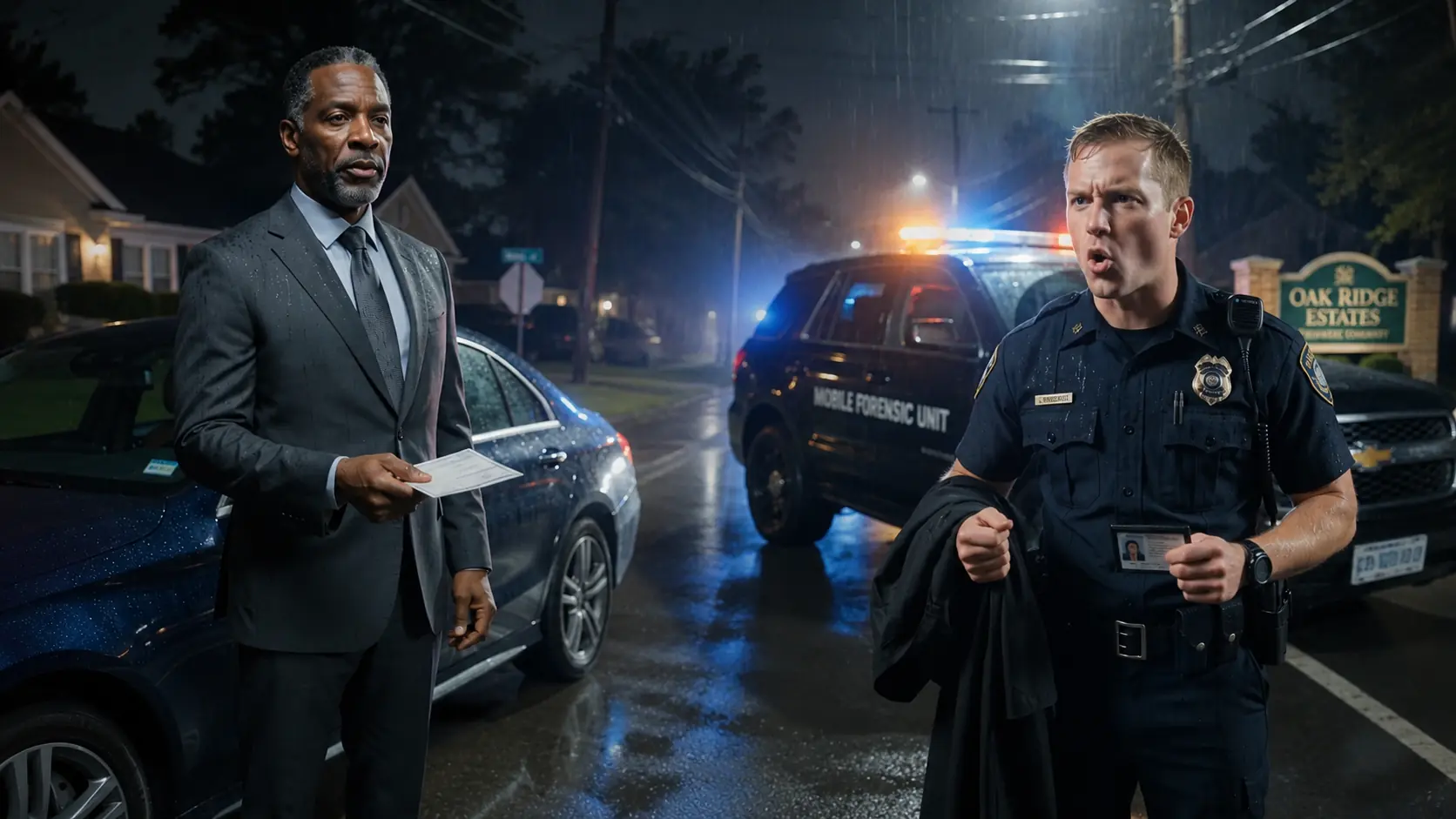
The man’s charcoal suit was drenched, his silver-threaded hair glistened beneath the streetlamp, and freezing rain moved down his face. Yet his dark eyes remained calm.
“That registration matches my name,” the single father said evenly. “Your suspicion matches nothing.”
The officer’s expression hardened. He had expected fear, apology, or hurried obedience. What he received sounded too much like authority.
“Keep challenging me,” the officer said, reaching for his handcuffs, “and you’re going to booking.”
The single father looked directly into the officer’s body camera.
“Then drive,” he replied. “The fingerprint scanner can introduce me properly.”
The officer believed it was arrogance.
It was actually a warning.
Less than forty minutes earlier, the single father had been sitting behind the elevated bench of the Fifth District Superior Court. For nearly thirty years, he had worked inside the American legal system, first as a public defender, then as a prosecutor, and finally as one of the state’s most respected judges.
His sixteen-year-old daughter was waiting at home in Oak Ridge Estates.
He had promised to be back before midnight.
Since losing his wife five years earlier, the judge had built his life around quiet routines with his daughter. He made breakfast before school, attended debate competitions whenever his docket allowed, and texted whenever court kept him late.
That evening, he had presided over the final arguments in a difficult criminal trial. After dismissing the jury, he returned to his chambers and reviewed motions until the courthouse corridors became silent.
Before leaving, he packed his judicial robe inside a waterproof garment bag. He needed it professionally cleaned before a ceremony welcoming new attorneys into the state bar.
The robe meant more to him than fabric.
It represented three decades of discipline, sacrifice, and responsibility. His late wife had attended the ceremony where he first wore it. His daughter had touched the sleeve when she was six and asked whether it made him powerful.
“No,” he had told her. “It reminds me not to misuse power.”
At 12:47 a.m., he left the courthouse and entered his Mercedes.
Rain covered the city in silver sheets. The roads shone beneath streetlights, and classical music played quietly through the speakers. The judge drove carefully toward his neighborhood, thinking about the message he would send his daughter when he reached the gate.
Then police lights appeared behind him.
He checked the speedometer.
Thirty-five miles per hour in a thirty-five-mile zone.
His registration was current. The headlights worked. He had not changed lanes improperly or crossed the center line.
Still, he signaled and pulled onto the shoulder.
Experience had taught him that knowing the law did not always protect a person from someone determined to ignore it.
He turned off the engine, lowered the windows, and placed both hands visibly on the steering wheel. The driver’s side officer approached with a flashlight aimed directly at his face.
“Whose car is this?” the officer demanded.
The judge blinked against the beam.
“Mine.”
“You expect me to believe that?”
The second officer, a nervous rookie standing near the passenger side, looked uncomfortable. He had already noticed the registration sticker and the calm, deliberate behavior of the driver.
The senior officer had noticed different things.
A Black man.
A luxury vehicle.
An affluent neighborhood after midnight.
He had written the story before asking a single neutral question.
“I live less than two miles from here,” the judge explained. “May I ask why I was stopped?”
The officer leaned toward the open window.
“You don’t ask the questions. License, registration, and insurance.”
“My wallet is inside my jacket. I’m reaching for it slowly.”
The judge announced every movement before making it. He handed over a valid state license and retrieved the registration from the glove compartment.
The officer compared the names.
They matched.
Instead of returning them, he tapped the license against his palm.
“Good fake.”
The judge studied him.
“It is state-issued identification.”
“Where did you steal the car?”
“I did not steal it.”
“You’re driving a vehicle worth more than most houses.”
“That is not evidence of a crime.”
The officer’s jaw tightened.
“You trying to teach me my job?”
“I am asking whether I am being cited or whether I am free to leave.”
The question irritated the officer because it forced him to confront the absence of any lawful reason for extending the stop.
He opened the driver’s door.
“Step out.”
“On what basis?”
“It wasn’t a request.”
The rookie spoke from the opposite side.
“The registration matches, and dispatch hasn’t reported the vehicle stolen. Maybe we should verify before—”
“Stay out of it,” the senior officer snapped.
The judge slowly unfastened his seat belt. He understood that the roadside was not a courtroom and that the officer was seeking resistance he could later describe as aggression.
He stepped into the freezing rain.
At six feet two inches, the judge stood several inches taller than the officer. The height difference seemed to intensify the younger man’s hostility.
“Hands on the roof.”
The judge complied.
The officer searched his pockets, finding only a phone, wallet, courthouse security card, and car keys. Then his flashlight moved toward the garment bag hanging in the back seat.
He pulled it out and unzipped it.
The black robe unfolded beneath the rain.
The officer laughed.
“What’s this supposed to be?”
“My judicial robe.”
“A judicial robe?”
The officer held it up mockingly.
“What are you dressing up as? A television judge?”
The rookie did not laugh.
The judge’s face remained composed, but something changed in his eyes when the officer allowed the robe to fall against the muddy roadside.
“Return it to the garment bag,” he said.
“You’re not giving orders.”
“I strongly recommend that you run my full name through dispatch.”
“I don’t need a computer to tell me what I’m looking at.”
“You are making a serious mistake.”
The officer stepped closer.
“Are you threatening me?”
“I am informing you that your actions are being recorded and will be reviewed.”
That calm sentence wounded the officer’s pride more than shouting could have.
He seized the judge’s wrists and pulled them behind his back. The judge offered no resistance, but the officer tightened the handcuffs until the metal pressed painfully into his skin.
The rookie moved forward.
“He’s complying. The cuffs don’t need to be that tight.”
“He threatened my career.”
“He said the stop would be reviewed.”
“Same thing.”
The judge turned his face slightly toward the body camera.
“For the record, I am not resisting. I am voluntarily presenting my hands, and I am requesting that the restraints be properly adjusted.”
The officer ignored him.
“You’re under arrest for vehicle theft, possession of fraudulent identification, and obstruction.”
“The vehicle is registered to me.”
“You can tell booking.”
The officer placed him in the rear of the cruiser while the rookie arranged for the Mercedes to be towed. The wet judicial robe was stuffed into an evidence bag and labeled as possible stolen property.
Inside the cramped back seat, the judge’s wrists throbbed. Rainwater soaked through his suit, and the plastic seat carried the sharp smell of disinfectant.
His phone had been taken before he could contact his daughter.
He knew she would become worried when he failed to arrive. A neighbor had agreed to remain with her that evening, but she would still watch the driveway and wonder why her father was not answering.
That thought hurt more than the restraints.
The officer looked into the rearview mirror.
“Not so important now, are you?”
The judge met his gaze.
“I am exactly where I need to be.”
The officer laughed and drove toward the precinct.
The judge could have ended the encounter immediately by announcing his title more forcefully. He could have demanded that the officer contact the courthouse or ask for the police chief, who had appeared before him many times.
But he understood what would happen.
Once the department recognized him, apologies would arrive. The cuffs would be removed, the report would disappear, and the encounter would be described privately as an unfortunate misunderstanding.
The officer would remain on patrol.
The next person might not be a judge.
That person might be a warehouse employee without legal training, a teenager frightened by flashing lights, or another single father trying to return home to his child.
The judge decided the truth needed to reach a place where it could not be quietly erased.
The precinct.
The booking system.
The surveillance cameras.
The written report.
He would allow the officer to carry his assumptions beneath fluorescent lights and put them into official records.
Only then would the institution be forced to see them.
The cruiser arrived at the Twelfth Precinct at 1:41 a.m.
The officer led the judge inside by the chain between the cuffs. Water dripped from the judge’s trousers onto the worn linoleum floor.
The booking sergeant glanced up from his computer.
“What have you got?”
“Vehicle thief with fake identification,” the officer announced proudly. “Caught him driving a stolen Mercedes through Oak Ridge Estates.”
The booking sergeant looked at the man standing before him.
The suspect was older, well dressed, and completely calm. His posture did not resemble fear, intoxication, or panic. Even soaked and restrained, he carried himself with extraordinary control.
“Fake identification?” the sergeant asked.
The officer placed the judge’s wallet on the counter.
“High quality. It even scans.”
The sergeant frowned.
“If it scans, what makes it fake?”
“Look at him.”
The words hung in the room.
The rookie entered carrying the evidence bag containing the robe. He set it on the counter without meeting the judge’s eyes.
The senior officer pointed toward it.
“He had that costume in the back seat.”
The judge turned his face toward the ceiling camera.
“The time is 1:47 a.m.,” he stated clearly. “I am formally requesting that my restraints be loosened. My hands are becoming numb.”
The booking sergeant looked down.
Deep grooves had formed around both wrists.
“Loosen them.”
“He threatened me,” the arresting officer protested.
“What did he say?”
“He said I would lose my badge.”
The judge answered calmly.
“I said his actions would be reviewed and could cost him his badge.”
The booking sergeant sighed.
“Still not a reason to injure him.”
“He’s a flight risk.”
“He’s standing still.”
The officer refused to adjust the restraints.
The judge looked once more toward the camera.
Every important word was now documented.
The booking sergeant entered the name from the license.
“Place your thumb on the scanner.”
The judge stepped forward. Because the handcuffs restricted his movement, the rookie helped position his right hand over the illuminated glass.
The fingerprint system began processing.
The arresting officer returned to a workstation and started writing his report. He described suspicious movements that had never happened, aggressive language the judge had never used, and resistance that the body-camera footage would directly contradict.
The rookie stood beside the wet robe.
He opened it more carefully this time.
The wide sleeves and heavy pleats did not resemble a costume. An official tailor’s label was sewn inside the collar, along with embroidered initials matching the license.
The rookie’s face became pale.
“Sergeant,” he said quietly, “I think we should check this before logging it.”
The computer chimed.
The booking sergeant read the screen.
His expression changed immediately.
He leaned closer, reading the result again.
Identity verified.
State official.
Superior Court Judge, Fifth District.
Judicial security status: Tier One.
No criminal record.
Do not detain without an active warrant or verified emergency basis.
The sergeant slowly lifted his eyes.
The exhausted Black man standing in painfully tightened handcuffs was one of the most respected judges in the district.
The black garment was his judicial robe.
The Mercedes belonged to him.
The identification was authentic.
“Officer,” the sergeant called.
The arresting officer continued typing.
“I’m finishing the obstruction narrative.”
“Stop typing.”
“What?”
“Take your hands off the keyboard.”
The entire booking area became quiet.
The sergeant rushed around the counter, fumbling with the handcuff key.
“Your Honor,” he said, his voice shaking. “I am deeply sorry.”
The arresting officer laughed uncertainly.
“Your Honor? Come on. Don’t tell me you believe that fake profile.”
The cuffs opened.
The judge brought his hands forward slowly, pain moving through his wrists as circulation returned. Dark bruising had already appeared beneath the skin.
The rookie stared at the floor.
A ceramic cup shattered near the staircase.
The precinct captain had entered the booking area and recognized the judge immediately. Only three weeks earlier, the captain had testified in the judge’s courtroom during a major criminal proceeding.
“Judge,” the captain whispered.
He looked at the wrists, the wet suit, and the robe hanging from the evidence bag.
“What happened?”
The judge’s voice changed.
Until that moment, he had spoken like a cooperative motorist. Now he spoke with the controlled authority that had silenced courtrooms for decades.
“I was stopped without an articulated traffic violation. My valid identification was declared fraudulent. My vehicle registration was ignored. My robe was mocked and placed into evidence as a costume. I was restrained after complying with every instruction.”
The captain turned toward the arresting officer.
“Tell me that isn’t accurate.”
The officer’s confidence collapsed.
“He didn’t look like—”
He stopped.
The unfinished sentence explained everything.
The judge stepped closer.
“Like what?”
The officer said nothing.
“Like the owner of a Mercedes?”
Silence.
“Like a resident of Oak Ridge?”
Still nothing.
“Or like a judge?”
The officer looked toward the captain for help.
None came.
The judge directed the captain to preserve all cruiser video, body-camera recordings, dispatch logs, booking footage, and draft reports. He requested immediate photographs of his injuries and an independent internal-affairs investigator.
The captain issued each order without argument.
Then he faced the officer.
“Remove your weapon and badge.”
“Captain, this was a good-faith mistake.”
“No.”
“The road was dark, and he refused—”
“His registration matched.”
“I believed the documents were fraudulent.”
“Based on what?”
The officer opened his mouth.
Again, no defensible answer arrived.
The captain extended his hand.
“Weapon and badge.”
The officer removed them slowly and placed them on the counter. The same badge he used to dismiss another man’s identity now lay beyond his reach.
The judge turned toward the rookie.
The young officer looked close to tears.
“I told him the registration matched,” the rookie said. “I tried to slow things down.”
“You tried once,” the judge replied. “Then you watched.”
The rookie swallowed.
“He was my training officer.”
“Your oath was not to him.”
“I know.”
“Tomorrow, investigators will ask what happened. You will decide whether your loyalty belongs to a colleague or to the truth.”
“I’ll tell them everything.”
“Tell them precisely. Do not protect me because I am a judge, and do not protect him because he wore the same uniform. Tell them what occurred.”
“Yes, Your Honor.”
A photographer documented the bruising. The judge’s car was located before it reached the impound lot, and the robe was removed from the plastic evidence bag.
The captain offered to drive him home.
The judge declined.
“I entered this building as someone your officers believed had no power,” he said. “I will not leave as a privileged guest simply because you discovered my title.”
A private car service arrived at the front entrance.
Before leaving, the judge collected his wet robe and looked toward the suspended officer.
“You believed your badge placed you above the citizen standing before you,” he said. “It does the opposite. It places you beneath a greater obligation.”
The officer lowered his head.
“You will have time to study that distinction.”
The judge returned home shortly before four in the morning.
His daughter ran from the living room when he entered. She saw the wet suit, the marks around his wrists, and the damaged garment bag.
“What happened?”
He held her carefully.
“I was delayed.”
“By who?”
“Someone who forgot what authority is for.”
She stepped back and examined his hands.
“Are you hurt?”
“I’ll heal.”
“Are they going to apologize?”
He looked toward the robe.
“An apology is not enough.”
Three days later, the judge filed a federal civil-rights action. He did not seek personal compensation. He refused to transfer the cost of one officer’s misconduct to taxpayers and then walk away satisfied.
Instead, the lawsuit demanded reform.
Independent review of traffic stops.
Mandatory body-camera preservation.
Training on unlawful profiling.
A clear duty for officers to intervene.
External review of complaints involving excessive restraint.
The decertification of the officer who arrested him.
When the video became public, millions watched the encounter. They heard the officer question how a Black man could own a luxury car. They watched him reject valid documents and mock the judicial robe.
They also watched the judge remain calm.
Public outrage forced the department to examine earlier complaints against the same officer. Investigators discovered multiple motorists had described similar behavior, though those complaints had been dismissed because no influential person had been involved.
The department chief resigned.
The officer was terminated and later charged with official misconduct and deprivation of rights. The rookie received discipline for failing to intervene but remained employed after providing a complete statement and agreeing to additional supervision.
Months later, the judge returned to court for a ceremony welcoming new attorneys.
His restored robe hung inside his chambers, cleaned and pressed. Before putting it on, he ran his fingers across the fabric.
His daughter stood beside him.
“When I was little, I asked whether that robe made you powerful,” she said.
“I remember.”
“You said it reminded you not to misuse power.”
“Yes.”
“Did the officer learn that?”
The judge looked toward the courtroom doors.
“He learned that power without accountability is only intimidation.”
The bailiff knocked.
“All rise, Your Honor.”
The judge placed the robe over his shoulders. Its weight settled around him, familiar and solemn.
He entered the packed courtroom and looked across the rows of new attorneys waiting to take their oaths.
“The law does not become justice simply because someone in authority speaks its name,” he told them. “Justice requires discipline, restraint, and the courage to recognize another person’s dignity before learning their title.”
His daughter watched from the front row.
The robe the officer called a costume now rested behind the bench where it belonged.
But the judge knew the true lesson had nothing to do with clothing, cars, wealth, or status.
The traffic stop should have ended lawfully before anyone knew he was a judge.
His rights mattered when he appeared to be an ordinary Black single father driving home through the rain.
They did not become important only after a fingerprint scanner revealed his power.
And that was why he had allowed the officer to take him all the way to booking.
Not to prove that the officer had arrested a judge.
To prove that no citizen should need to be one before the law treats him like a human being.