She could not see the badge on his chest, but she could feel his hatred. A blind woman, a sacred cane, and a public act of cruelty that no one dared to stop.
What the officer did not know was that her son was a federal prosecutor. What began as humiliation was about to spark a reckoning the whole town would feel.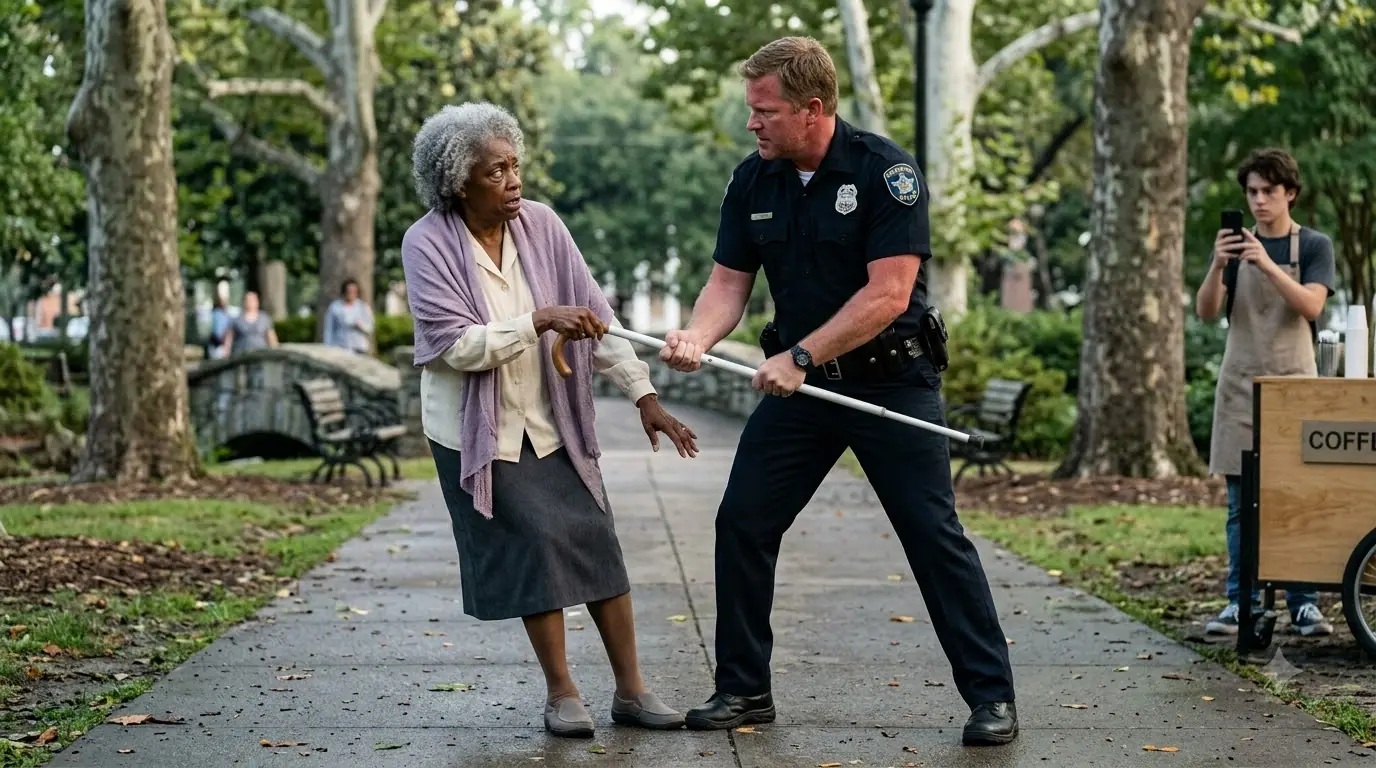
There was something sacred about mornings in Franklin Square, Georgia. Long before the city's heartbeat quickened, before horns blared and screens lit up, the world moved at a quieter frequency.
Wind slipped through the sycamore branches, and the air carried magnolia, cinnamon from the corner bakery, and the memories of people who had walked those streets for decades. Most mornings, anyone awake early enough would see Claudine Hayes.
Claudine was seventy-six years old and had been blind since she was forty-eight. Wrapped in a faded lavender shawl, with a cane in one hand, she moved through the neighborhood smoothly, unhurriedly, and with intention.
Her route was etched into years of habit, down the cracked sidewalk from her modest brick home, past the bakery, and across the little footbridge that divided Franklin Square. She had followed that path nearly every day for twenty years.
To the rest of the town, she was Miss Hayes, the woman who hummed hymns on park benches and told stories with her hands. Few knew what she had seen before losing her sight, what she had survived, or how much quiet strength remained coiled inside her.
Fewer still knew that her son, Malik Hayes, had grown up to become an assistant United States attorney. Claudine never used his title to command respect because pride, in her view, was carried in the spine rather than displayed for strangers.
That morning began like all the others. The sun had barely reached the horizon when Claudine buttoned her coat, one slow loop at a time, and reached for the smooth handle of her cane.
It had belonged to her late husband, Theodore, a proud and gentle man who had left her more than memories. The cane had become part of her independence, a familiar extension of the courage he had helped her build.
Her path to the park lived in muscle memory. The trees whispered directions, the wind warned her of corners, and the tapping of the cane marked a rhythm of resilience against the pavement.
Claudine did not walk simply for exercise. She walked for connection and for control in a world that had too often tried to take both from her.
Halfway through Franklin Square, she heard boots grinding against gravel. It was not the casual shuffle of a jogger or the distracted movement of someone walking a dog.
The sound was heavy and deliberate, as though the person approaching wanted the ground to announce him. Claudine paused, tapped the cane forward once, and held still.
Claudine turned slightly toward him. She could feel his eyes moving over her, not seeing who she was, but judging what he believed she represented. "I'm fine, thank you," she replied calmly. "I'm just walking."
"You out here alone?" he asked.
It did not sound like concern. It sounded like an accusation dressed in civility. Claudine lifted her chin. "I know this park like the back of my hand. I've walked it nearly every day for the past twenty years."
The man gave a low, disbelieving laugh. "Well, that might be part of the problem. You should be more careful. The world isn't as kind as it used to be."
"No," Claudine answered quietly. "It is not."
A tense silence settled between them. Then the officer stepped closer and said, "Let me see that for a second."
Before Claudine could react, his hand closed around her cane. The movement came so quickly that she did not understand what was happening until he pulled. Her fingers tightened, but he yanked harder, and the cane slipped from her grip.
"What are you doing?" she asked, panic threading through her voice.
Her balance shifted. One hand reached into the empty air, searching for something solid in a world she could not see. Then she heard a clean, brutal crack.
The cane Theodore had carried and Claudine had trusted for years snapped in two. The broken halves struck the ground with a soft clatter that somehow sounded louder than the traffic, the birds, and the breathing of every witness nearby. Claudine stood frozen, her breath caught between her chest and throat.
The officer was Steven Klene, badge number 214. Claudine could not read the number on his uniform, but she would soon know it by heart. He tossed the broken pieces at her feet as if they were trash.
"Next time, don't get smart," Klene said, his voice thick with contempt. "Some people might not be as patient as me."
Then he turned and walked away.
Claudine did not move at first. She stood beneath a sky too blue for something so cruel, shoulders squared, hands shaking. Slowly, she lowered herself toward the ground and searched through the grass until her fingers found the splintered wood.
People were nearby. She could hear their whispers, their uneasy movements, and the terrible stillness of people choosing not to intervene. No one asked whether she was hurt. No one challenged the officer. Their silence became part of what happened.
Claudine gathered both halves of the cane and stood. She did not scream, cry, or curse the heavens. She began walking home one trembling step at a time, palms extended, guided by memory, sound, faith, and will.
She passed the bench beneath the oak tree and the bakery where someone should have stepped out to help. She crossed the place where the officer had taken her balance but had failed to take her dignity. When she reached home, she wrapped the broken cane in an old linen napkin and placed it carefully on the kitchen table. It looked less like a damaged tool than a wounded heirloom.
Claudine sat beside it and waited for her shaking to stop. She waited for her breathing to steady and for the weight of the humiliation to settle into the corners of the house. She did not call anyone, at least not at first. She did not have to.
James Monroe, the nineteen-year-old who ran the coffee cart near the bridge, had seen everything. His hands had trembled around the paper cups, and he had been too frightened to step between Claudine and an armed officer. He was still learning what it meant to carry the fear placed on young men in towns where authority was rarely questioned. But before Officer Klene had spoken his first word, James had sensed that something was wrong and pressed record on his phone.
Later that day, James walked the half mile to Claudine's house and knocked on her door. He stood there holding the phone as though it weighed far more than it did. Claudine let him in, and he played the recording.
She listened to every word, every contemptuous pause, and the exact moment the cane broke. When the video ended, Claudine closed her eyes. James whispered, "I'm so sorry."
"It is not your fault," she said.
After a long silence, she added, "But it is someone's."
Neither of them yet understood how far the video would travel or what it would awaken. Officer Klene believed he had committed one more act of cruelty under the protection of his uniform. He had no idea that the woman he humiliated had a son who understood federal civil rights law, evidence preservation, official misconduct, and institutional silence. The video had set something powerful in motion, not revenge, but reckoning.
Three days passed, and Franklin Square had not returned to normal. People spoke in hushed voices, offered Claudine sideways looks of pity, or avoided her entirely. Silence, she realized, had many shapes.
Claudine had not left the house since the incident. The broken cane now rested on the mantel, half memorial and half warning. Malik was still in Washington, D.C., and she had not yet called him because she knew that once he learned the truth, he would come home immediately. She had not decided whether she was ready to light that match.
Then someone knocked firmly at the door. Claudine paused with one hand against the wall and a mug of chamomile tea in the other. A second knock followed, louder and more purposeful.
"Who is it?" Claudine called.
"Mrs. Hayes, my name is Detective Karen Elliott with the Georgia Bureau of Investigation. I would like to speak with you. May I come in?"
Claudine opened the door only a few inches. Detective Elliott was in her mid-forties, dressed plainly but carrying herself with purpose. A badge hung from a leather cord around her neck.
"What is this about?" Claudine asked.
"A complaint was filed regarding Officer Steven Klene," Elliott said. "He is being investigated for excessive force, but that is not the only reason I am here."
Claudine opened the door wider. "Then what is?"
The detective lowered her voice. "You are not the first, Mrs. Hayes. I have three complaints from the past year involving the same officer and different victims. None of them held because there was no footage and no witness willing to remain on the record. Now we have you, and I understand that there is a video."
Claudine's breath caught. She immediately thought of James.
"I need to be honest with you," Detective Elliott continued. "If you testify, this will not be easy. Klene is protected. He has friends in the right places and victims who were made to feel powerless. But with the video and your testimony, we may be able to bring more than your case into the light. We may finally expose what has been happening for years."
Claudine stood silently with one hand on the doorknob. She was not surprised because part of her had already understood that what happened in the park was not an isolated storm. It was part of a larger weather system that had been raining down on vulnerable people for generations. Her tea had gone cold by the time she answered.
"I will do it," she said.
Detective Elliott did not smile. She nodded with the gravity of someone who understood the weight of Claudine's decision. In that moment, Claudine knew the case was no longer only about her. It never had been.
In Washington, Malik Hayes had just finished reviewing a federal case when his phone buzzed with a message from a name he did not recognize. It was James Monroe. The message was short: "You don't know me, but I know your mother. You need to see this."
Malik almost dismissed it as a scam. Then he pressed play.
The image shook slightly, recorded from behind the coffee cart, but the scene was unmistakable. His mother stood blind, proud, unarmed, and composed while Officer Steven Klene loomed over her. Malik watched the officer take the cane and heard it snap.
The sound turned his blood cold. It was louder to him than any courtroom accusation he had ever heard because it was the sound of someone publicly violating the person who had taught him what dignity meant. The silence after the crack was worse because it showed how many people had watched and done nothing.
Malik booked the next flight to Atlanta.
At 6:42 the following morning, he stepped from a taxi in front of his mother's house. He still had a key and entered without knocking.
"Ma," he called softly.
Claudine sat by the window in her usual chair. The broken cane lay beside her like a ghost.
"I knew you would come," she said without turning toward him.
Malik crossed the room and took her hand. "Why didn't you call me?"
"I didn't want to bring this to your doorstep," she said. "You are doing important work in Washington. You have a life."
Malik dropped to one knee beside her chair. "You are my life. You are the reason I do that work."
Claudine smiled, but sadness remained behind it. "Then maybe it is time you did that work here."
Malik was silent for a long moment. Then he looked at the broken cane and said, "They don't know who you are."
"They don't care who I am," Claudine replied.
"They will care about what they did," Malik said as he stood.
Later that day, Claudine and Malik met Detective Elliott in a quiet booth at a coffee shop just outside town. James joined them, nervously twisting a baseball cap in his hands. Elliott placed a manila folder on the table.
"We have enough to press charges," she began. "But with the politics in this town, the evidence may not be enough by itself. That is why your presence matters, Malik."
Malik opened the folder. "How?"
"You are an assistant United States attorney, and you were born here," Elliott answered. "You built your name on service, truth, and accountability. The moment people understand that Claudine's family knows the system and will not be intimidated by it, the pressure changes."
"I don't want to make this about me," Malik said.
"It is not about you," Elliott replied. "It is about what your position allows you to protect. In towns like this, names and titles sometimes make people look up from silence long enough to see the person they were ignoring."
Claudine sipped her tea quietly. "Your father would have been proud."
Malik placed a hand over hers. "He gave me the name. You gave it weight."
That evening, Malik held a press conference at the community center near Franklin Square. He had invited only a few trusted local leaders, Claudine's pastor, and several friends from church. Word spread quickly, and by the time he stepped to the podium, the room was full.
"My name is Malik Hayes," he began. "Some of you may not recognize it, and that is fine. But you know my mother, Claudine Hayes."
He described the woman Franklin Square had seen for decades. She had taught Sunday school, volunteered at the food pantry, and walked through the park each morning even after losing her sight. Then he held up the broken cane.
"Last week, my mother was humiliated by someone sworn to protect her," Malik said. "This is not only about one broken cane. It is about the kind of justice we tolerate, the way we treat people who are easiest to ignore, and what happens when a badge becomes a weapon while silence becomes complicity."
The room leaned toward him. A few people nodded, and someone whispered, "Amen."
"I have prosecuted cases across this country," Malik continued. "But this is home. No uniform gives anyone the right to take away my mother's dignity. Officer Klene did not only target one elderly blind woman. He acted with the confidence of someone who believed vulnerable people could be humiliated without consequence."
Malik raised the cane higher. Its jagged ends looked almost ceremonial beneath the lights.
"This cane is not only broken," he said. "It is evidence. It is a symbol. Starting tomorrow, we will make sure it speaks louder than the silence that allowed it to break."
The crowd erupted, not in rage, but in resolve. Afterward, Malik stood beside Claudine beneath the wide Georgia sky. She reached for his arm.
"You did well, baby," she whispered. "You are doing it the right way."
Malik looked at the new cane someone from her church had brought that afternoon, then at the broken one in his evidence case. "I learned from you," he said.
The broken cane stayed with him because names carried weight, but stories carried legacy. Theirs was only beginning.
By the following Monday, the atmosphere across Franklin Square and the surrounding county had changed. A community that had relied for years on whispered conversations and resigned shrugs was suddenly speaking the unfamiliar language of accountability. Regional headlines spread the story of a blind woman's mistreatment and the federal prosecutor who returned home to demand a lawful response. The attention did not create Claudine's dignity, but it forced institutions to acknowledge how deliberately it had been attacked.
Inside the Fulton County Civilian Oversight Board, officials moved with unusual urgency. The board had long been criticized as symbolic, but reporters were calling, civil rights attorneys were watching, and elected officials were being questioned publicly. Most importantly, the people of Franklin Square were no longer willing to look away. Claudine had given them a reason to speak, and Malik had removed their excuse for remaining silent.
At the hearing, Officer Steven Klene sat stiffly in a gray suit. His lawyer leaned close and whispered strategy, but Klene's eyes remained fixed on the board members. He had seen complaints disappear before through rewritten statements, missing footage, and intimidated witnesses. This case was different because the video was clear and the family he had targeted understood the playbook.
Malik sat across the room with the broken cane sealed inside a clear evidence bag on the table. He wore a simple dark suit without a visible federal badge or lapel pin. He had not come to display authority. He had come to make the system look at itself honestly.
"Would you please state your relationship to Claudine Hayes?" the board chair asked.
"I am her son," Malik replied. "I am also an assistant United States attorney who has handled civil rights and use-of-force matters. I know what misconduct looks like, and I know how institutions protect it."
Board members leaned forward, and reporters typed rapidly.
"This is not about embarrassment or an officer having a bad day," Malik continued. "It is about power used not to protect, but to humiliate a vulnerable person in broad daylight, in front of witnesses, without fear of consequence."
The video played again. Officer Klene's voice filled the hearing room, followed by the crack of the cane. Someone in the audience gasped.
The chair turned toward Klene. "Officer Klene, the video shows you removing the cane from Mrs. Hayes's possession and breaking it. Do you deny that this occurred?"
Klene's attorney stood quickly. "We dispute the context. My client was conducting a safety check, and the object was not immediately recognized as a mobility device."
Malik's voice remained firm and composed. "Are you suggesting that a trained police officer could not identify a white cane in the hands of a blind woman?"
The lawyer bristled, but Malik continued. "Let us not insult this board or the public. The image is clear, the sound is clear, and the context is clear. What is not clear is why this officer is still wearing a badge."
Outside the hearing, residents gathered in growing numbers. Church members who had known Claudine for years stood beside college students carrying signs that read, "A Cane Is Not a Weapon." Young fathers pushed strollers, retirees sat in folding chairs, and neighbors who had remained silent in the park now listened to people tell stories they had hidden for years.
An elderly Latino man described being accused by Klene of loitering while sitting outside his own apartment. A teenager said the officer had stopped him on his walk home from school and forced him to empty his backpack to prove he had not stolen anything. Others recognized the same pattern of contempt, intimidation, and confidence that no one would challenge him. Most had never filed complaints because they believed nothing would happen.
Claudine's case changed that calculation. Her story had lit a spark, and people who had once believed they were isolated began to understand that they were witnesses to the same pattern. One by one, their private humiliations became public evidence.
Back inside, the board began asking sharper questions. A former judge leaned toward Klene. "You were the only officer assigned to the area that morning. Multiple witnesses confirm that you approached Mrs. Hayes without provocation. Do you understand the legal definition of harassment, Officer Klene?"
Klene shifted in his seat. His mouth opened, but no answer came.
Malik met his eyes. "You did this in public. Now you answer in public."
The board recessed after two hours of testimony. Before leaving, the chair announced that the board would recommend Klene's immediate suspension and forward the matter to the district attorney for criminal review. The room filled with stunned murmurs, relief, and tears. Outside, the news moved through the crowd in seconds.
That night, Malik sat with Claudine on the porch of her home while cicadas hummed in the trees.
"You stood tall, son," Claudine said.
"You gave me the reason to," Malik replied.
She touched his hand. "I did not think I would live to see a man like him held accountable, not in this town."
Malik looked toward the dark outline of the square. "We are not finished, but the system blinked, Ma. Sometimes that is how the wall begins to crack."
Claudine nodded. The day had not been about a title, a famous name, or a press conference. It had been about refusing to let a public violation become another private burden. For once, the system had been forced to look back.
In the weeks that followed, the investigation widened. Detective Elliott reopened the three earlier complaints and interviewed the residents who had stepped forward after the hearing. James turned over the original recording and metadata from his phone, preserving the evidence exactly as it had been captured. The district attorney's office began reviewing Klene's conduct for harassment, destruction of property, official misconduct, and civil rights violations.
The case drew national attention, but Claudine measured change differently. She noticed it in the way people greeted her at the bakery, in the paper bag of her favorite scones left with a note that read, "Thank you for your courage." She heard it when a little boy called from across the street, "Miss Claudine, everyone knows your name now." Most of all, she felt it in the voices that had replaced the silence around her.
People told her, "We see you. We believe you. We are with you."
One clear morning, Claudine stepped onto the sidewalk carrying a new cane carved from polished oak. Her initials had been etched near the handle. It felt firmer and steadier than the temporary cane she had used since the incident, but it was more than a tool. It was a statement that she was still walking.
She followed the familiar route toward Franklin Square. The magnolia-scented breeze moved gently through the branches, and the bakery released the smell of cinnamon into the street. The town had changed, but Claudine's steps remained deliberate and calm.
At the edge of the square, a small group waited. They had not gathered to protest or shout. They had come to witness her return.
Malik stood beside a newly placed bench beneath the tall oak tree. A bronze plaque had been fixed to the backrest and polished until it shone. Its inscription read, "In honor of Claudine Hayes, for every step taken in strength and every voice raised for justice."
When Claudine arrived, Malik guided her hand toward the plaque. She ran her fingertips slowly over the raised letters, allowing touch to translate what sight could not. The crowd watched as she took a breath and sat down, centered, proud, and unshaken.
Malik stepped forward. "My mother taught me to fight, not with fists, but with dignity. She taught me that silence can sometimes be survival, but there are moments when survival requires breaking that silence."
He looked around the square. "What happened here began with cruelty, but it did not end there. People stepped forward, spoke honestly, preserved evidence, and refused to let this become another forgotten incident."
Then he looked at Claudine. "This is not only her bench. It is a reminder that strength does not always roar. Sometimes it walks slowly, with grace and purpose, and leaves a legacy in every step."
Later that afternoon, Claudine sat with her hands folded while the square resumed its ordinary rhythm. Children played near the fountain, joggers moved along the paths, and elders talked on nearby benches. Yet something in the atmosphere had shifted. The same place that had held public humiliation now held respect and hope.
"Your father would have been proud," Claudine said softly.
Malik smiled. "He always said you were the strongest person he knew."
"I only kept walking," she replied. "Even when the world wanted me to stop."
"Now they are walking with you," Malik said.
Claudine nodded. "That is the legacy. It is not only what we survive. It is what our survival inspires."
Claudine had never intended to become a symbol. She wanted what every person deserved: the right to move freely, to exist in peace, and to be treated with dignity. When her cane was snapped in public and the people around her remained silent, her pain could easily have disappeared into another forgotten injustice.
It did not disappear because James recorded the truth, Detective Elliott recognized the pattern, and Malik refused to let the institutions involved retreat into comfortable silence. What began as one act of humiliation became something larger. A community awakened, a system was confronted, and other victims found the courage to speak.
Malik's decision to act was rooted in love, but it was also an act of disciplined defiance. He understood how deeply institutional protection could run, so he chose evidence over outrage and procedure over spectacle. By doing so, he made room for others to add their voices without being dismissed as isolated or unreliable.
Claudine's strength had never depended on grand gestures. It lived in the steady rhythm of her footsteps, the quiet resolve with which she stood after being humiliated, and the dignity she refused to surrender. It also lived in the son she had raised, a man who knew when to say that enough was enough.
Justice did not begin in the hearing room. It began when ordinary people refused to let Claudine become invisible. It began when a frightened young witness preserved the truth, when a detective chose to connect patterns others had ignored, and when a community finally decided that silence was no longer safety.
The broken cane remained preserved as evidence. Claudine kept Theodore's memory in it, Malik kept the lesson it represented, and Franklin Square kept the responsibility it had once failed to meet. The officer had believed that snapping the cane would make a blind woman smaller.
Instead, the sound of it breaking woke an entire town.