“Step out of the car… or I’ll drag you out myself. Men like you don’t drive vehicles like this without stealing them.”
Officer Travis Kane pointed through the open driver’s window as rain struck the roof of Marcus Cole’s dark-blue SUV. Red and blue lights flashed across the wet highway, reflecting from the guardrail and the pine trees lining the road outside Richmond, Virginia. Marcus kept both hands visible on the steering wheel and looked directly at the officer whose name had appeared in a confidential file on his desk less than forty-eight hours earlier.
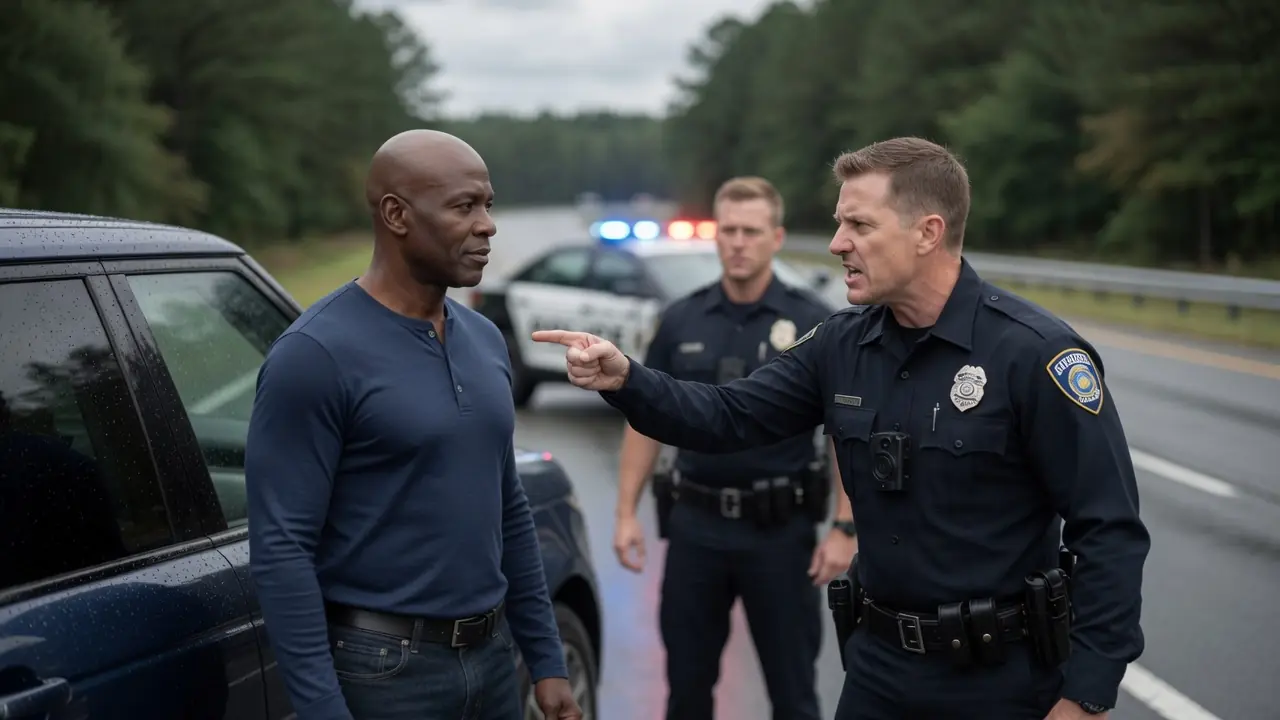
“You stopped me for my skin, ignored my documents, and threatened me before finding a single violation,” Marcus said.
Travis reached toward the handcuffs on his duty belt. “Keep talking, and I’ll write resisting arrest across your record before you ever see a lawyer.”
Marcus slowly removed one hand from the wheel and opened the government identification wallet resting beside his license. “Write carefully, Officer Kane—I’m the prosecutor assigned to your case, and internal affairs heard every word.”
For a moment, Travis did not react.
Rainwater ran from his short light-brown hair and down the side of his face. His hostile expression remained fixed, but his eyes moved from Marcus’s photograph to the gold state seal beneath it. The identification named Marcus Cole as Chief Prosecutor for the Virginia Civil Rights Enforcement Division.
Behind Travis, Officer Luke Bennett stood near the second patrol car with his hand resting against his belt. He had arrived two minutes earlier as backup, expecting an ordinary traffic stop. Now his face revealed that he understood something far more serious was unfolding.
Travis laughed once, but there was no confidence in it. “Anybody can buy a badge wallet.”
Marcus did not move. “Call the number printed beneath my title.”
“I don’t take orders from suspects.”
“You haven’t identified a crime.”
“You were driving suspiciously.”
“How?”
“You slowed down when you saw me.”
“The speed limit dropped from sixty-five to forty-five.”
“You crossed the center line.”
“My dashboard camera says otherwise.”
Travis leaned closer to the window. “Get out.”
Marcus glanced toward the body camera mounted on Travis’s chest. A small red light should have indicated that it was recording. The light was off.
“Activate your camera,” Marcus said.
Travis’s jaw tightened. “You don’t tell me how to do my job.”
“Department policy requires recording before first contact.”
“I turned it on.”
“The indicator is dark.”
Luke shifted behind him. “Kane, your camera isn’t running.”
Travis looked over his shoulder. “Stay out of it.”
Luke’s hand moved away from his belt. “I’m your backup. That makes this my stop too.”
Marcus could see the conflict in the younger officer’s face. Luke had probably worked beside Travis for years, trusted his experience, and learned not to question him in front of civilians. Yet the rain-soaked roadside had become too public, too recorded, and too dangerous for silence.
Marcus’s phone sat inside the cup holder with its screen turned downward. Before lowering the window, he had activated an emergency evidence application connected directly to the state inspector general’s office. Audio and video were uploading continuously to a secure server.
The application existed partly because of Travis Kane.
Over the previous eighteen months, nine drivers had accused Travis of conducting unlawful searches, making racist remarks, planting suspicions unsupported by evidence, and threatening arrests when questioned. Six complainants were Black men. Two were Latino. The ninth was a white woman traveling with her Black husband.
Every complaint had been closed by Travis’s immediate supervisor.
The official explanations followed the same pattern. The driver appeared nervous. The vehicle matched a vague description. The officer believed contraband might be present. The body camera failed, was activated late, or contained no useful footage.
Marcus had spent the previous week reviewing those files.
He had been driving to the regional police headquarters that morning to announce an independent investigation into Travis and two supervisors who repeatedly cleared him. Only the inspector general, the attorney general, and a small internal-affairs team knew the meeting was scheduled.
Travis could not have known Marcus’s identity.
That made the stop more valuable as evidence.
It also made it more dangerous.
“Step out now,” Travis repeated.
Marcus remained calm. “State the legal basis for ordering me from the vehicle.”
“I don’t need to explain the law to you.”
“You do when you exercise government power.”
Travis opened the door himself.
Marcus did not resist as the officer grabbed his forearm and pulled him onto the wet shoulder. He stepped carefully onto the pavement, keeping his hands open and visible. Luke moved closer but did not touch him.
Travis kicked the car door closed. “Hands behind your back.”
“What crime am I being detained for?”
“Failure to obey.”
“An unlawful command does not create its own justification.”
Travis seized Marcus’s wrist.
Luke stepped between them. “Stop.”
Travis stared at him. “Move.”
“He’s cooperating.”
“He refused to exit.”
“You opened the door before he finished asking for the reason.”
“He’s manipulating you.”
Luke looked at Marcus’s credentials again. “We need a supervisor.”
“I am the senior officer here.”
“That isn’t the same thing.”
Travis released Marcus’s wrist but remained close enough for the threat to continue. He pulled his radio from his shoulder and requested a sergeant, describing Marcus as an “aggressive male refusing lawful commands.”
Marcus spoke loudly enough for dispatch to hear. “For the record, I have not threatened, touched, or approached either officer.”
Travis reached for the radio volume. “Be quiet.”
“No.”
“You want another charge?”
“I want an accurate record.”
Luke activated his own body camera manually. The red light appeared immediately.
Travis noticed and lowered his voice. “Turn that off.”
“Why?”
“This is my investigation.”
“It’s now recording mine.”
The balance of the roadside changed again.
Luke asked Marcus whether he was carrying any weapons. Marcus answered that a licensed handgun was secured inside a locked compartment in the rear of the SUV, inaccessible from the driver’s seat.
Travis smiled as if he had finally discovered the crime he needed.
“He’s armed.”
Marcus looked at Luke. “The firearm is registered, declared, and stored according to state law.”
Luke nodded. “Then it isn’t relevant unless we have legal grounds for a search.”
Travis walked toward the rear door. “We have grounds now.”
He reached for the handle.
Marcus stepped sideways without blocking him. “Opening that vehicle without consent or probable cause will become a separate violation.”
Travis turned. “You think that title makes you untouchable?”
“No. I think the Constitution applies even when the driver has no title.”
The statement struck Luke harder than it struck Travis.
A third patrol car arrived, followed by an unmarked sedan. Sergeant Rebecca Mills stepped onto the wet road and walked toward the group while fastening her raincoat. She was fifty-one, with twenty-seven years in law enforcement and the cautious eyes of someone who understood that roadside stories often changed once recordings appeared.
“What do we have?” she asked.
Travis answered first. “Possible stolen vehicle. Driver crossed the center line, refused to exit, became confrontational, and admitted there’s a weapon inside.”
Marcus looked toward Rebecca. “My registration is in the visor. My license matches the vehicle owner. My dash camera records the lane. I exited without resistance after Officer Kane opened the door. The firearm is legally secured.”
Rebecca turned toward Luke. “Your observation?”
Luke hesitated.
Travis stared at him.
Luke took a breath. “I did not see the original driving behavior. When I arrived, Mr. Cole had both hands visible and was asking for the reason behind the detention. Officer Kane’s body camera was off. Mr. Cole showed government credentials, and Kane attempted to search the vehicle without consent.”
Travis’s face changed. “You little coward.”
Rebecca snapped toward him. “Enough.”
Luke remained still, though the insult visibly landed.
Rebecca examined Marcus’s credentials. Unlike Travis, she did not dismiss them. She called the verification number, identified herself, and listened for less than thirty seconds before ending the call.
“His credentials are valid.”
Travis folded his arms. “That doesn’t excuse his behavior.”
“What behavior?” Rebecca asked.
“He questioned me.”
“That is not a crime.”
“He resisted.”
Luke answered before Travis could continue. “No, he didn’t.”
Rebecca looked toward the dark SUV. “Do we have a report that this vehicle was stolen?”
Travis said nothing.
“Did the plate return stolen?”
“No.”
“Did it return to Mr. Cole?”
A dispatcher’s voice came through Rebecca’s radio. The plate, registration, and insurance all matched Marcus.
Rebecca’s expression became colder. “Then why did you say possible stolen vehicle?”
Travis looked toward Marcus. “It didn’t fit him.”
Rain continued falling, but the road seemed to become silent.
Rebecca’s eyes narrowed. “Explain that sentence.”
Travis realized too late what he had admitted. “The vehicle didn’t fit the area.”
“It is registered five miles away.”
“I meant his behavior didn’t fit.”
“You said the vehicle didn’t fit him.”
Marcus said nothing.
He did not need to.
Rebecca ordered Travis to step away from the scene and wait beside her patrol car. Travis refused at first, claiming she had allowed Marcus’s title to intimidate her. When Rebecca repeated the order and placed one hand near her radio, he finally moved.
A black state sedan arrived several minutes later.
Deputy Inspector General Nina Patel emerged with two investigators wearing plain clothes beneath rain jackets. Marcus had not called them after the stop began. The emergency application automatically alerted their office when Travis opened his door and raised his voice.
Nina approached Marcus first. “Are you injured?”
“My wrist is sore. Nothing appears broken.”
She looked toward Travis, who stood beneath the supervision of another officer. “Did he search the vehicle?”
“He attempted to.”
“Did he activate his camera?”
“Not until after the supervisor arrived.”
Travis shouted from beside the patrol car. “Because this was a routine stop until he turned it into a political ambush.”
Nina looked toward him. “Your body camera was remotely activated three minutes ago. It has already uploaded the current footage.”
The color left his face.
Modern department cameras retained a background buffer even when officers failed to press record. Once remotely activated, the device could preserve the previous two minutes of video, though not always the full audio.
Marcus’s phone had captured everything else.
Nina asked Rebecca to secure Travis’s body camera and duty phone. Travis stepped backward.
“You don’t have authority to take my equipment.”
“I have an inspector general’s preservation order signed this morning.”
He looked at Marcus. “You planned this.”
Marcus’s expression remained controlled. “I planned an investigation into nine complaints. You planned what happened on this highway.”
Travis turned toward Luke. “You’re going to regret choosing him over your own partner.”
Luke’s face tightened, but he did not look away. “I chose what happened over what you wanted written.”
Nina ordered Travis relieved of duty pending investigation.
His badge and service weapon were removed on the roadside. He was not arrested immediately because investigators still needed to determine which charges applied and whether additional officers were involved. But he left in the back seat of a state vehicle rather than the patrol car he had driven.
Before the sedan door closed, Travis looked at Marcus.
“You think this proves I’m racist?”
“No,” Marcus said. “Your words, your conduct, and your history will prove whatever the evidence supports.”
The rain eased shortly after Travis left.
Rebecca offered Marcus an apology on behalf of the department. He accepted the acknowledgment but refused to treat the event as resolved.
“You believed me after verifying my office,” he said. “Would you have believed another driver?”
Rebecca looked toward the road.
“I don’t know.”
“That is the problem.”
The formal investigation began that afternoon.
Marcus recused himself from prosecuting the specific roadside assault because he was now a witness. Another senior prosecutor, Elena Ruiz, took control of the criminal inquiry while Marcus continued overseeing the broader civil-rights review.
The evidence accumulated quickly.
Marcus’s dash camera showed he had remained within his lane and reduced speed precisely when the limit changed. Travis’s cruiser data showed he followed Marcus for nearly three miles before activating his lights, though his report claimed immediate concern after observing dangerous driving.
There was no dangerous driving.
His body-camera buffer showed him approach the SUV with one hand already near his restraints. The live audio from Marcus’s phone captured the stolen-car accusation, the racial remark, the threat to manufacture resisting charges, and the order to disable Luke’s camera.
The department’s computer records revealed something worse.
Travis had searched Marcus’s license plate before initiating the stop. The database returned the registered owner’s full name and home address but not his government title. Travis knew the vehicle was not reported stolen before he walked to the window.
He invented the suspicion afterward.
Investigators reopened all nine earlier complaints.
One driver, Andre Wallace, said Travis stopped him while he was taking his daughter to a piano recital. Travis ordered both from the car, searched the trunk, and scattered the child’s sheet music across the wet pavement. The official report claimed Andre consented.
He had not.
A Latino contractor named Javier Morales described being handcuffed beside his work van while Travis insisted the tools inside were stolen. Receipts proved ownership, but Travis kept him detained for nearly two hours.
The white woman traveling with her Black husband said Travis ignored her until she explained the expensive car belonged to her. He then apologized to her while continuing to question her husband.
The pattern was unmistakable.
Travis treated Black and Latino drivers as suspicious first, then searched for facts that could justify the decision afterward. When no crime appeared, he described their confusion or anger as threatening behavior.
Supervisors protected him by reviewing each complaint separately.
No one compared the language, vehicle types, locations, or missing body-camera footage across cases. The same phrase appeared in seven reports: The driver displayed unusually nervous behavior.
Marcus asked analysts to compare that phrase with body-camera recordings from officers across the region. Many drivers appeared nervous during traffic stops, regardless of race. Yet Travis used the description almost exclusively against minority motorists.
His reports were not neutral observations.
They were templates designed to manufacture suspicion.
The investigation also uncovered text messages between Travis and Lieutenant Paul Warren, the supervisor who closed most complaints.
After Andre Wallace filed his report, Travis texted:
Another one trying to turn attitude into a race complaint.
Paul replied:
I’ll clean it up. Keep your camera on next time.
In another exchange, Paul warned Travis that a driver had hired an attorney.
Travis answered:
He’ll settle down when he learns complaints don’t beat badges.
Paul was placed on leave.
A second supervisor resigned before investigators completed their interviews.
Local news obtained portions of the roadside recording. The first clip broadcast showed Travis pointing toward Marcus and threatening to drag him from the SUV. The second showed Marcus opening his credentials and revealing that he was the prosecutor assigned to the investigation.
The story spread nationally.
Many headlines focused on the reversal: a racist officer unknowingly stopped the very man investigating him.
Marcus disliked the framing.
During a press conference, a reporter asked whether Travis’s greatest mistake had been choosing such a powerful driver.
“No,” Marcus said. “His greatest mistake was believing an ordinary driver would be powerless.”
Another reporter asked how he remained calm.
Marcus looked toward the cameras. “People often praise calm victims because calm makes injustice easier to watch. Mr. Kane’s conduct would have been unlawful if I had shouted, cried, trembled, or demanded help. A person does not lose constitutional protection because fear changes the volume of their voice.”
Luke Bennett attended the press conference from the rear of the room.
He had been placed on administrative duty while investigators examined his role. Although he had ultimately intervened, questions remained about whether he had witnessed earlier misconduct and remained silent.
Marcus met with him privately several days later.
“How long have you known?” Marcus asked.
Luke stared at the table. “Known what?”
“That Kane treated people differently.”
Luke did not answer immediately. “I saw him become harder with some drivers.”
“Which drivers?”
“Black men. Young Latino guys. Sometimes women who challenged him.”
“Did you report it?”
“No.”
“Why?”
“He trained me. He controlled my evaluations. Officers who crossed him lost overtime and good assignments.”
Marcus opened one of the reopened complaints. “Andre Wallace’s daughter was nine years old when she watched her father handcuffed in the rain. Was protecting overtime worth what she remembers?”
Luke flinched. “No.”
“Then why did you act today?”
“Because I saw him about to write another lie, and I realized my camera could become part of it.”
“That answer does not make you a hero.”
“I know.”
“It makes you a witness who finally stopped cooperating.”
Luke nodded. “I’ll testify.”
His testimony became critical.
He described how Travis coached younger officers to use vague language such as officer-safety concern, furtive movement, and unusual nervousness. He explained how Paul Warren revised reports before complaints were reviewed. He admitted that he had once remained silent while Travis searched a driver without legal grounds.
Luke accepted a disciplinary suspension and mandatory retraining. He lost eligibility for promotion for two years.
Some police-union members accused him of betraying his colleagues.
Luke answered publicly, “A uniform is not a promise to protect another officer’s lie.”
Travis was eventually charged with deprivation of civil rights under color of law, assault, falsifying records, obstruction, and conspiracy with his supervisor. Prosecutors also filed charges connected to three earlier unlawful detentions supported by newly recovered evidence.
His attorney argued that Marcus had manipulated the stop.
The defense claimed the prosecutor drove through Travis’s patrol area hoping to provoke him and secretly recorded the encounter to create a career-making scandal.
The evidence contradicted that theory.
Marcus’s route led directly from his home to the scheduled headquarters meeting. Travis initiated the stop without knowing who he was. Marcus never insulted, threatened, or approached him. Every escalation came from the officer.
At trial, the jury watched footage from the highway.
They heard Travis say men like Marcus did not drive expensive vehicles without stealing them. They heard him threaten to fabricate resisting charges. They watched him order Luke to disable his camera and attempt to search the SUV after learning the firearm inside was legally secured.
Then Elena Ruiz displayed the database record proving Travis knew the vehicle belonged to Marcus before approaching.
“Why did you accuse him of theft?” she asked during cross-examination.
Travis shifted in the witness chair. “The vehicle and driver seemed inconsistent.”
“Inconsistent how?”
“He didn’t appear like the registered owner.”
“The computer displayed his name.”
“A name does not confirm identity.”
“He handed you a matching license.”
“I believed it could be fraudulent.”
“Did you perform a fraud check?”
“No.”
“Did you call dispatch?”
“No.”
“Did you ask a neutral question before threatening him?”
Travis’s expression hardened. “Traffic stops are dangerous.”
“So is government power in the hands of an officer who invents danger.”
His attorney objected.
The judge sustained the objection, but the jury had heard the sentence.
Andre Wallace testified about the piano music scattered across the roadway. Javier Morales described watching customers cancel jobs after seeing him detained beside his marked business van. Other drivers explained how Travis transformed lawful questions into alleged hostility.
Luke testified last.
Travis stared at him throughout the entire examination.
When asked why he finally activated his camera, Luke answered, “Because I realized if I left it off, his lie would become our report.”
The jury convicted Travis on every major charge.
Paul Warren accepted a plea agreement and admitted altering reports, discouraging complaints, and protecting Travis from discipline. He received a shorter prison sentence in exchange for evidence against other supervisors.
At Travis’s sentencing, Marcus spoke not as prosecutor but as a victim.
He did not request revenge.
He described how a traffic stop forced citizens to place their safety in the hands of officers they did not know. That power required restraint, honesty, and accountability because even a brief abuse could permanently change how a person viewed every badge afterward.
“You believed fear belonged to the driver and authority belonged to you,” Marcus said. “The law gives officers authority. It does not give them ownership of another person’s dignity.”
The judge sentenced Travis to federal prison and permanently barred him from law-enforcement employment.
The consequences extended beyond one officer.
The department created automatic alerts whenever body cameras remained inactive during traffic stops. Supervisors could no longer close complaints involving officers under their direct command. Data analysts began reviewing stops for racial disparities, repeated language patterns, search outcomes, and unusually high rates of alleged resistance.
Every driver received a tracking number after filing a complaint.
The department also established a civilian review office with access to body-camera footage and disciplinary histories. Officers who reported misconduct received independent protection from retaliation.
Marcus insisted that training include something more uncomfortable than policy lectures.
Officers watched recordings of real stops without being told the driver’s profession, wealth, or later identity. They had to decide whether the officer’s conduct was lawful before learning that one driver was a doctor, another a janitor, another a teenager, and another the civil-rights prosecutor.
The correct answer could never depend on who the driver became after the stop.
One year later, Marcus drove the same highway during another rainy morning.
A patrol car appeared behind him near the speed-limit change. Its lights remained off. The officer followed for half a mile before turning onto another road.
Marcus noticed that his hands had tightened around the steering wheel anyway.
The body remembered what the mind had already processed.
At headquarters that afternoon, Luke Bennett waited outside Marcus’s office. His suspension had ended, and he had returned to patrol under a different supervisor. He carried no expectation of praise.
“I wanted to tell you something,” Luke said.
Marcus gestured toward the chair.
Luke remained standing. “I stopped a young man last week for a broken taillight. He was nervous, and I almost wrote that down automatically.”
“What did you do?”
“I told him why I stopped him, asked for the documents I needed, and gave him a repair notice.”
“Was anything else wrong?”
“No.”
“Then you performed a traffic stop.”
Luke nodded. “It felt ordinary.”
“Ordinary is often the goal.”
Before leaving, Luke paused at the door. “Do you forgive me?”
Marcus considered the question.
“Forgiveness is personal. Accountability is public. Keep doing the work whether I forgive you or not.”
Luke accepted the answer.
Years later, law-enforcement academies across Virginia still used the roadside recording in ethics training. Students watched Travis step toward the SUV with his body camera off and certainty already fixed in his face.
Most knew the twist before the video began.
They knew the Black driver would reveal himself as the prosecutor assigned to Travis’s case. They waited for the satisfying moment when power reversed and the officer realized whom he had threatened.
The instructor always paused before Marcus opened the credentials.
“At this moment,” she asked, “does the driver deserve lawful treatment?”
Every student answered yes.
That was the lesson Marcus wanted preserved.
He had not gained dignity by opening a government wallet.
He had not become innocent when the inspector general arrived.
He had been entitled to safety, honesty, and constitutional protection from the first flash of police lights in his mirror.
Travis Kane crossed a line he could not undo when he assumed a Black man in an expensive SUV must be a thief.
Discovering that the driver was a powerful prosecutor did not create the line.
It only ensured that, for once, the officer could not erase it.