The first strike shattered the Ducati’s windscreen. Deputy Travis Cole brought the heavy sledgehammer down onto the black-and-gold motorcycle with both hands, sending fragments of carbon fiber and glass across the dusty main street of Oak Creek, Arizona. Behind him, a sheriff’s SUV sat crooked across the road while tourists outside the general store lifted their phones to record. Elijah Mercer stood six feet away with his fists clenched, watching a motorcycle worth more than most new cars being destroyed in front of him.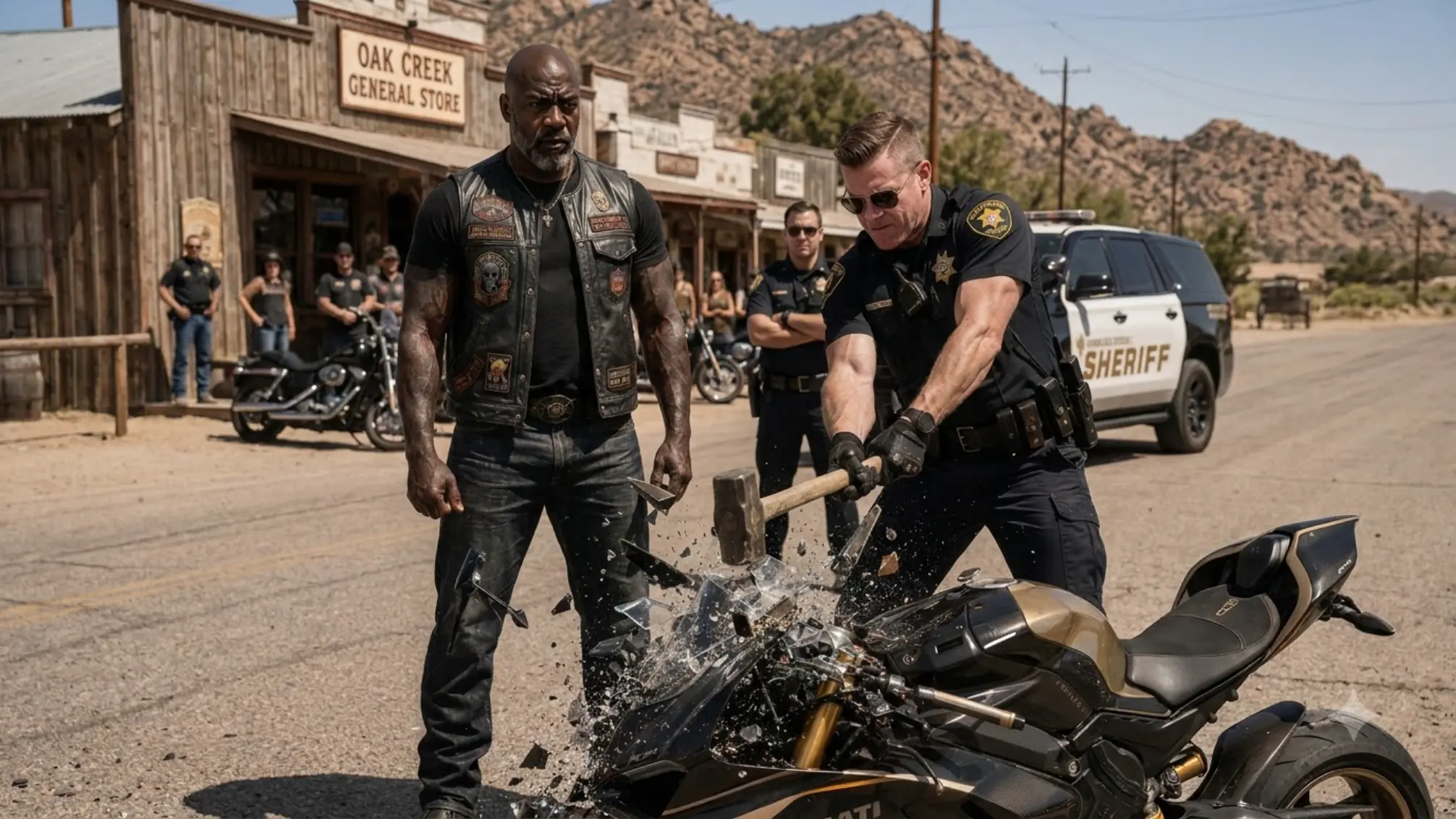
Elijah was forty-five, broad-shouldered and heavily muscled, with dark-brown skin, a bald head, tattooed arms, and a thick salt-and-pepper beard. His black leather vest was covered with old riding patches, but there were no outlaw insignias, no threatening slogans, and nothing illegal about the Ducati Superleggera V4 parked beside him. He had bought it legally three years earlier after selling a piece of property outside Phoenix, and every document proving ownership sat inside the locked saddle case Travis had already kicked open. None of that mattered to the deputy.
“Trash like you doesn’t ride a Ducati like this unless it’s stolen,” Travis said, lifting the hammer again. Elijah took one slow step forward and stared directly into the deputy’s mirrored sunglasses. “Hit my bike again and you better pray that badge protects you.” Travis grinned. “I’ll crush every inch of it, then drag you out of my town in cuffs.”
The second blow landed on the instrument cluster. Elijah did not move. He simply said, “Do it—then say that same thing when you find out who I used to be.” Travis laughed hard enough to attract another deputy from beside the SUV.
That deputy, Logan Pierce, was younger and clearly less comfortable with what was happening. “Trav, maybe we should run the VIN before—” Travis pointed the sledgehammer at him. “I already know what this is.” Elijah turned his eyes toward Logan and asked, “Your body camera running?” Logan’s expression tightened.
Travis heard the question and immediately stepped closer. “You don’t ask my deputies questions.” Elijah looked at the small camera clipped to Travis’s own chest. Its indicator light was dark. “Then maybe your supervisor can explain why yours is off.”
The deputy’s smile disappeared. For the first time since stopping Elijah fifteen minutes earlier, irritation turned into something sharper. He dropped the hammer beside the damaged Ducati and reached toward Elijah’s vest. “Turn around.”
Elijah did not. “Why?” Travis said, “Obstruction.” Elijah almost smiled. “Obstructing what, exactly?”
That question was dangerous because Travis had no clean answer. Elijah had been riding west through Oak Creek when Travis pulled behind him and activated his lights without stating any traffic violation. Elijah stopped immediately, removed his helmet, and provided license, registration, and insurance. Travis glanced at the registration for perhaps two seconds before deciding it was fake.
The Ducati was rare enough to attract attention anywhere. Carbon-fiber bodywork, numbered production, gold wheels, racing-derived suspension, and a price that could exceed one hundred thousand dollars depending on condition made it especially conspicuous in a desert town where most motorcycles were old cruisers. Travis had looked at Elijah, then the bike, and apparently decided one of them did not belong with the other. Everything after that flowed from the assumption.
“Where’d you steal it?” Travis had asked. Elijah answered calmly, “I didn’t.” Travis demanded the title, then called the VIN suspicious when it matched the documents Elijah handed him. Elijah offered to wait while dispatch verified ownership, but Travis never made the request.
Instead, he accused Elijah of carrying forged papers. When Elijah asked for a supervisor, Travis said he was the senior deputy on duty. When Elijah asked why his body camera was not recording, Travis told him to stop acting like a lawyer.
That was the first clue Travis had chosen the wrong man. Elijah knew exactly how police documentation was supposed to work because for twelve years he had investigated officers accused of falsifying it. Before becoming a private security consultant and eventually stepping away from government work entirely, Elijah Mercer had served as a senior investigator with a federal-state public corruption task force based in Arizona.
He had investigated bribery, evidence tampering, unlawful seizures, fraudulent traffic stops, and deputies who believed small-town authority made them untouchable. Elijah had interviewed officers who lied better than Travis. He had testified in court against sheriffs with more power than anyone in Oak Creek.
But he had no intention of revealing that yet. A title from the past did not make his current rights more valuable than anyone else’s. If Travis was willing to destroy property belonging to an ordinary citizen, Elijah wanted the entire incident preserved exactly that way.
People began gathering outside the Oak Creek General Store. A waitress from the diner across the street leaned against the doorway filming, while two bikers parked near a gas pump quietly watched. Elijah noticed at least five phones pointed toward them.
Travis apparently noticed too. He grabbed Elijah’s wrist. “Turn around now.” Elijah pulled only enough to keep his balance. “Tell me the charge before you put hands on me.”
“Resisting.”
“You can’t create resisting before you have a lawful detention.”
Travis twisted harder. Elijah’s body changed immediately, not with panic but trained control. He could have broken the deputy’s grip in less than two seconds, but he did not. He spread his fingers visibly and said, “I am not resisting. Everyone here can hear me saying that.”
That made Travis angrier. Men like him needed fear more than compliance. Elijah’s calmness deprived him of both. He shoved Elijah toward the sheriff SUV.
Logan stepped closer. “Travis, dispatch just answered me.” Travis turned sharply. “What?” Logan held his radio near his chest. “VIN comes back clean. Registered to Elijah Mercer, Scottsdale address.”
The street became very quiet. Elijah looked at Travis. “So now we’re done.”
Travis glanced toward the destroyed Ducati. He had reached the moment when an honest officer would stop, apologize, and begin documenting damage. Instead, he looked for a way to make the original accusation true after the fact.
“Could still be cloned,” he said. Logan stared at him. “It isn’t.” Travis barked, “You suddenly working against me?”
Elijah watched the younger deputy’s face. Fear appeared there. Not fear of Elijah—fear of Travis.
That interested him more than the motorcycle. Corrupt behavior rarely survived alone. It required people who looked away, supervisors who discouraged questions, records that disappeared, and employees who learned survival depended on silence.
Sheriff Darren Holt arrived eleven minutes later. He stepped from an unmarked black Tahoe wearing a tan uniform, polished boots, and the expression of a man annoyed that someone had forced him away from lunch. He surveyed the broken Ducati, Travis, Elijah, and the crowd.
“What happened?” he asked. Travis answered before anyone else could speak. “Suspected stolen vehicle. Subject became confrontational.” Elijah looked at Sheriff Holt. “Your deputy destroyed my motorcycle after dispatch confirmed it was mine.”
Holt ignored that. “Who are you?” Elijah gave his name. The sheriff squinted as though it meant nothing.
“Passing through?” Holt asked. “Yes.” The sheriff nodded toward Elijah’s leather vest. “Club business?”
“No.”
“What kind of business?”
Elijah’s eyes narrowed. “None of yours unless you have legal grounds to ask.”
Holt sighed. “There’s the attitude.” Several people recording began murmuring.
Elijah recognized the pattern instantly. The sheriff had arrived not to investigate Travis but to reinforce him. Questions about ownership became questions about character, appearance, affiliation, and whether Elijah belonged in Oak Creek at all.
Holt walked around the motorcycle. “Looks expensive.” Elijah said nothing.
“You understand why my deputy had concerns.”
“No.”
Holt raised an eyebrow.
Elijah continued, “My license was valid. Registration was valid. Insurance was valid. VIN was valid. No stolen-vehicle report existed. Your deputy never completed a verification before striking the bike.”
Travis interrupted. “He got aggressive.”
Elijah turned toward the witnesses. “Who here saw me get aggressive before he hit the motorcycle?”
Three hands rose immediately. Then four more.
The waitress shouted, “He never touched anybody.”
A gray-haired man beside the general store added, “Deputy started swinging the hammer while that man was standing still.”
Holt’s face hardened. “Everybody put your phones away.”
Nobody did.
That was when Elijah understood Oak Creek had probably seen versions of this before. The witnesses were frightened, but they were not surprised. Their reluctance looked practiced.
A woman near the diner called out, “Ask Travis what happened to my son’s truck last month.” Holt snapped his head toward her. “Stay out of police business, Marlene.”
Elijah filed the name away.
Another man said, “Or Ruben’s tools.”
Holt raised his voice. “Enough.”
Elijah looked at the sheriff. “How many vehicles has your department seized this year?”
The sheriff stared.
Travis stepped toward him. “I told you, stop asking questions.”
Elijah finally smiled, but there was no warmth in it. “That one bothers you.”
Holt looked from Elijah to the crowd. “Take him in.”
Logan froze. “For what?”
The sheriff’s eyes narrowed.
That was the moment the young deputy made his decision.
Logan slowly removed his phone from his pocket. “I’ve been recording since before you got here.”
Travis lunged toward him. “Give me that.”
Elijah moved between them.
Not aggressively.
Just enough.
Travis stopped when he realized nearly every phone on the street now captured him trying to seize a deputy’s personal recording.
Sheriff Holt’s face turned pale with anger. “Pierce, you’re suspended.”
Logan’s breathing quickened. “For recording misconduct?”
“For insubordination.”
Elijah looked at him. “Back up that video.”
Logan stared.
“Now,” Elijah repeated.
The deputy’s thumb moved across the screen.
Travis stepped closer. “Who the hell do you think you are?”
Elijah reached slowly into the inside pocket of his vest and removed an old leather credential case. The badge inside was no longer active, and he never pretended otherwise. He opened it anyway because the identification card beside it still carried the seal of the Arizona Public Integrity Task Force Alumni Association and his former service designation.
Travis looked down.
His expression changed.
Holt recognized the name first.
“Elijah Mercer.”
Elijah closed the case.
The sheriff took half a step backward.
Travis looked confused. “What?”
Holt did not answer.
Elijah did.
“Eight years ago, I led the investigative team that helped convict Sheriff Raymond Sutter in Pinal County.”
Logan’s eyes widened.
Elijah continued. “Before that, I worked the Red Mesa evidence-seizure case. Eleven deputies charged. Four supervisors convicted.”
Travis’s confidence began disappearing.
Elijah looked directly at Sheriff Holt.
“And for twelve years, I specialized in officers who used traffic stops to create property seizures.”
Nobody spoke.
The sheriff’s face tightened. “You’re retired.”
“Correct.”
“So you have no authority here.”
“Also correct.”
Travis laughed nervously. “Then this changes nothing.”
Elijah looked at the shattered Ducati.
“You’re right.”
He turned toward the crowd.
“It shouldn’t.”
Those words confused Travis.
Elijah faced him again. “You shouldn’t need to discover I used to investigate corrupt cops before deciding whether destroying my property was wrong.”
That was the line people remembered.
By sunset, the video was everywhere in Arizona. One clip showed Travis smashing the Ducati. Another showed Sheriff Holt ordering witnesses to stop recording. Logan’s footage captured Travis refusing to wait for dispatch verification and saying, “Guys like him don’t own bikes like this.”
That statement changed everything.
Elijah did not contact former colleagues first. He contacted an attorney and filed an evidence-preservation demand with the county. He requested dispatch logs, body-camera activation records, VIN searches, vehicle seizures, tow authorizations, forfeiture paperwork, complaints against Travis, disciplinary files, and all communications involving Holt.
The county resisted.
Elijah expected that.
Then Marlene contacted him. Her son’s pickup had been seized two months earlier after Travis claimed its identification plate looked altered. No charges were ever filed, but the truck was transferred to a county-contracted towing yard, where storage fees rose beyond what the family could afford.
Ruben came next. Deputies had taken nearly twelve thousand dollars in construction tools from his trailer during a traffic stop. The report claimed the serial numbers appeared suspicious. Ruben provided receipts, but the property remained in evidence for months before disappearing from the county inventory system.
Then a retired teacher named Denise called. Her late husband’s classic motorcycle had been impounded after deputies alleged an insurance discrepancy. She never recovered it.
Elijah built a spreadsheet.
Vehicle.
Owner.
Deputy.
Reason.
Charges filed.
Property disposition.
Tow company.
Auction date.
Buyer.
Patterns appeared quickly.
The same towing company handled most disputed seizures: Holt Recovery Services.
It belonged to Sheriff Darren Holt’s cousin.
Elijah sat silently when he discovered that.
He called Logan.
“You knew?”
The suspended deputy answered after a long pause. “I suspected.”
“What else?”
Logan exhaled.
“Some vehicles never reach public auction.”
Elijah opened a notebook.
“Keep talking.”
The scheme was simple enough to hide behind bureaucracy. Deputies identified valuable vehicles during questionable stops, created suspicion about VINs, insurance, titles, or ownership, and impounded them. Even when no criminal case developed, owners faced storage fees, administrative delays, and complicated recovery procedures.
Some gave up.
Vehicles were declared abandoned or sold through county-approved auctions.
Several buyers appeared repeatedly.
One was a company connected to Holt’s brother-in-law.
Elijah turned everything over to the Arizona Attorney General’s Public Integrity Section.
This time, he did not join the investigation. His past gave him contacts, but he refused to become the hero inside his own complaint.
“I’m a witness,” he told the lead investigator. “Treat me like one.”
The state opened a formal case.
Subpoenas followed.
Financial records exposed payments between the towing company and businesses connected to Holt.
Body-camera audits revealed unusual gaps. Travis Cole had failed to activate his camera during eleven separate seizures involving high-value motorcycles or vehicles.
Dispatch records showed several stops were never called in until after impoundment had already been arranged.
Logan agreed to cooperate fully.
He provided internal messages.
One from Travis read: Nice bike coming east on 82. Let’s see if paperwork gets complicated.
Another from Holt said: Don’t over-document roadside decisions. Reports can be cleaned later.
That message ended Holt’s career.
State investigators executed warrants at the sheriff’s office, Holt Recovery Services, and a private warehouse outside Oak Creek.
Inside the warehouse sat eleven vehicles.
Ruben’s tools were stacked against one wall.
Denise’s husband’s motorcycle was under a tarp.
Three luxury cars carried county auction labels despite owners still actively contesting their seizures.
Elijah’s Ducati was not there.
It sat inside a specialty repair facility in Phoenix, where the county’s insurer eventually paid more than seventy thousand dollars in damage and replacement costs.
The motorcycle could be repaired.
Oak Creek’s reputation would take longer.
Travis Cole was terminated and later charged with offenses related to official misconduct, criminal damage, falsified reports, and conspiracy. Sheriff Darren Holt resigned before the county board could remove him and was later indicted alongside two relatives connected to the towing operation.
Logan Pierce was reinstated.
He did not become sheriff.
He did not want the job.
Instead, he transferred to another county and later told investigators that the moment everything changed was not when Elijah revealed his former career.
It was when people on Main Street refused to put their phones away.
Months later, Elijah returned to Oak Creek.
The Ducati looked almost new.
A replacement windscreen curved over the instrument cluster, damaged carbon panels had been rebuilt, and the gold-and-black bodywork shone beneath the desert sun.
He parked outside the same general store.
People recognized him immediately.
Marlene walked across the street carrying coffee.
“You actually brought it back.”
Elijah removed his helmet.
“Bike didn’t do anything wrong.”
She laughed.
Ruben arrived twenty minutes later.
His tools had been returned.
Denise came too.
Her late husband’s motorcycle was back inside her garage.
Nobody talked much about Travis.
He had once filled the town’s attention because fear made him important.
Without the badge, he became smaller.
Elijah stood beside the Ducati while a teenage boy admired it from several feet away.
“How fast does it go?” the boy asked.
Elijah smiled.
“Faster than you need to know.”
The kid laughed.
Then he looked toward the repaired windscreen.
“That where the deputy hit it?”
“Yeah.”
“Were you scared?”
Elijah considered the question.
“Yes.”
The boy looked surprised.
“You didn’t look scared in the video.”
“That doesn’t mean anything.”
Elijah rested one hand on the bike.
“Courage isn’t looking calm because nothing scares you.”
The boy waited.
“It’s knowing somebody has power over the moment and still refusing to help them lie about what happened.”
The teenager nodded slowly.
Elijah put on his helmet.
Before mounting the Ducati, he looked down Oak Creek’s main street.
The sheriff SUV was gone.
The old general store remained.
So did the mountains.
So did the people who had once watched deputies treat authority like ownership.
Elijah started the Ducati.
The engine cracked through the desert air.
Marlene covered one ear and laughed.
Elijah pulled onto the road.
For Travis Cole, the motorcycle had represented something impossible: an expensive machine beneath a Black man he had already decided could not legitimately own it.
For Elijah, it had become evidence of something much larger.
A deputy destroyed a motorcycle because he thought the man beside it would be easy to explain away.
Instead, every hammer strike helped expose years of seizures, false reports, missing property, and people who had been too isolated to realize the same thing had happened to their neighbors.
Travis eventually learned exactly who Elijah Mercer used to be.
But by then, that was no longer the important part.
The important part was who Elijah had been when the deputy first saw him.
A citizen.
A property owner.
A man standing beside his own motorcycle.
And that should have been enough.