The stagecoach depot in Red Hollow, Wyoming, fell so quiet that the horses shifting beside the weathered black coach sounded unnaturally loud. Townspeople stood outside the mercantile, saloon, and telegraph office, watching the confrontation with the hungry curiosity reserved for public humiliation. The young woman in the rust-red traveling dress had barely placed one boot on the boardwalk before the man waiting for her began questioning the child in her arms.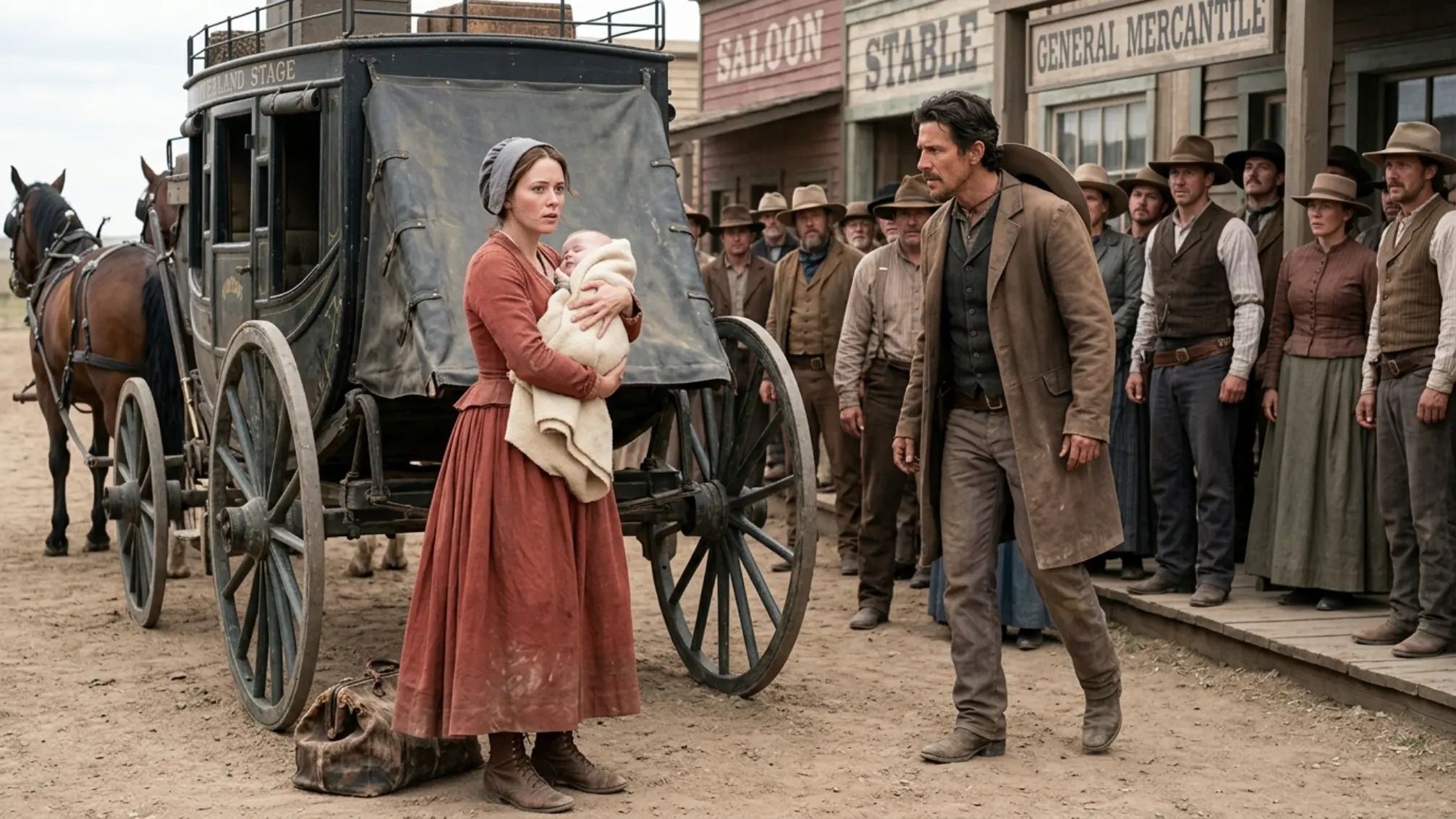
Her name was Eleanor Whitmore, though most people had called her Nell since childhood. She was twenty-seven, with fair wind-chapped skin, blue-gray eyes, and dark-brown hair pinned beneath a plain gray bonnet. The infant sleeping against her chest was six-month-old Samuel, the only family she had left after fever took her husband and debt took their rented home in Ohio.
The rancher was Jacob Mercer, thirty-nine, tall and lean, with a sun-weathered face, dark wavy hair, and a trimmed mustache. His brown coat was dusted from the long ride into town, and the expression beneath his wide-brimmed hat looked more wounded than cruel, though Nell was too angry to care about the difference. He had paid a Helena marriage agency twenty dollars for correspondence, background verification, and Eleanor’s journey west.
That payment did not make him her owner.
The stagecoach driver climbed down and pretended to examine a wheel. Two women near the depot whispered that the widow had deceived the rancher. A gray-bearded storekeeper muttered that no sensible man would take responsibility for another man’s child when winters in Red Hollow already killed enough livestock and people.
Nell heard every word.
She shifted Samuel higher against her shoulder and reached for the battered carpetbag beside the coach. Jacob moved before she could lift it, but she slapped his hand away.
“Do not touch my belongings.”
“I was trying to help.”
“You made your position clear.”
Jacob glanced toward the crowd. “The agency said nothing about a child.”
“The agency knew.”
His anger sharpened. “I read every letter you sent.”
“And I mentioned Samuel in three of them.”
“No, you did not.”
Nell stared at him, searching his expression for the signs of a lie. Jacob looked genuinely stunned rather than evasive. That did not erase the insult, but it changed the shape of the problem.
She reached into the outer pocket of her carpetbag and removed several folded pages tied with blue thread. “These are copies of my letters.”
Jacob accepted them only after she extended them directly toward him. He unfolded the first page and read quickly. Samuel’s name appeared halfway down, followed by a paragraph explaining that Nell would never consider marriage to a man unwilling to accept her son.
The second letter was clearer.
I travel as a widow and mother. Samuel is six months old, healthy, and entirely dependent upon me. Any man who wishes for my company must understand that my child and I cannot be separated.
Jacob looked toward her.
“The agency never sent me this.”
Nell pulled another bundle from the bag. “Then what did they send?”
He removed four letters from inside his coat. Nell recognized the paper but not all the words. Entire passages had been copied in another hand. Samuel’s name was missing, as were her questions about shared property, household money, and whether Jacob believed a wife had the right to leave an unsafe home.
The agency had edited both sides of their correspondence.
“They made me sound desperate,” Nell said quietly.
Jacob looked down at the page. “They made me sound wealthier.”
That drew a bitter laugh from her. “Are you not?”
“I own land. Land does not mean money.”
“How poor are you?”
The question shocked several people in the crowd. Jacob answered without embarrassment.
“Taxes are paid. The ranch has no bank mortgage. I have forty-three cattle, six horses, and enough winter feed if the snow does not come early. But I do not have servants, polished rooms, or the income the agency described.”
“They told me you owned the largest ranch in the county.”
“I own one hundred and eighty acres, most of it rock.”
“They said you employed twelve men.”
“I employ one man during branding season, and he is seventy-two.”
The stagecoach driver coughed to hide a laugh.
Nell looked at the false letters again. The agency had removed her son and enlarged Jacob’s fortune, apparently believing two incomplete truths would be easier to sell than one honest arrangement.
A narrow man in a burgundy vest hurried out of the telegraph office. Amos Pike managed the Red Hollow branch of the marriage agency and had arranged Jacob’s contract. He carried a leather ledger under one arm and wore the anxious smile of someone hoping to stop an argument before it became expensive.
“Mr. Mercer, Mrs. Whitmore,” he called. “There has clearly been a clerical misunderstanding.”
Nell turned toward him. “Did you remove my son from my letters?”
Pike’s smile weakened. “The central office may occasionally shorten correspondence for clarity.”
“You erased a child for clarity?”
“No one erased anyone.”
Jacob thrust Nell’s letter toward him. “Why did I never receive this?”
Pike glanced at the crowd. “Private contractual matters should not be debated in the street.”
“You arranged the public meeting,” Nell replied. “You can explain yourself publicly.”
Pike lowered his voice. “Mrs. Whitmore, the agency believed disclosure of an infant might unnecessarily discourage an otherwise suitable match.”
“My son is not an unpleasant detail on a livestock bill.”
“Of course not.”
“You took my money for postage, copied my letters, and removed the truth.”
Pike looked toward Jacob for support. “Mr. Mercer, surely you understand that widows with children often struggle to receive replies. We merely allowed you to know the woman before confronting the additional responsibility.”
Jacob’s face became still.
“You expected me to send the child away after meeting her?”
Pike adjusted the ledger beneath his arm. “Some arrangements can be made. There are church homes in Cheyenne that accept healthy infants.”
Nell moved so quickly that several people stepped back.
Jacob placed himself between her and Pike, not to restrain her but to keep the agency man beyond reach. His voice dropped until it carried more danger than shouting.
“You will never speak of sending that boy anywhere again.”
Nell looked at him.
Minutes earlier, Jacob had called Samuel another mouth to feed. Now his broad shoulders blocked the man suggesting the child should be abandoned.
Pike tried to recover. “I am discussing practical alternatives.”
“You are discussing a mother’s child as if he were damaged freight.”
The agency manager opened the ledger. “Mr. Mercer, you signed a binding introduction agreement. If you reject the proposed bride after delivery, you forfeit all fees and remain responsible for her return transportation.”
Jacob laughed once without humor. “You think twenty dollars matters now?”
“The total obligation is sixty-three dollars.”
“For what?”
“Travel, accommodations, documentation, administrative preparation, and reputational damage to the agency.”
Nell’s eyes narrowed. “You intend to charge him because you lied?”
Pike pointed to the signature near the bottom of the page. “The terms are clear.”
Jacob reached for the ledger, but Pike pulled it against his chest. Nell stepped beside them and extended her hand.
“Let me read the agreement.”
Pike looked amused. “This is a legal contract.”
“I know what paper is.”
“Frontier commercial language may be difficult without assistance.”
“My father kept accounts for a railroad supplier, and my husband ran a print shop before he died. Give me the contract.”
The crowd shifted approvingly. Pike reluctantly opened the ledger on a hitching rail.
Nell read every line.
The agreement required Jacob to provide transportation from Red Hollow to his property and allowed him thirty days to decide whether a marriage would proceed. If either party rejected the arrangement, the agency claimed reimbursement from the person “whose concealed condition or material dishonesty caused termination.”
Pike tapped the clause. “The undisclosed child constitutes a concealed condition.”
“The agency concealed him,” Nell said.
“You would need proof.”
She held up her copied letters. “These are dated.”
“Personal copies establish nothing.”
The stagecoach driver finally stopped pretending to inspect the wheel. “I carried the original mail sack from Helena three months ago. The envelope from Mrs. Whitmore was thick enough to hold all three letters.”
Pike’s face changed.
The telegraph clerk stepped into the doorway behind him. She was a thin woman with wire spectacles and ink stains across her fingers. “I copied the agency’s outgoing telegram to Mrs. Whitmore. It stated that Mr. Mercer had accepted both mother and child.”
Nell turned toward her. “You have the copy?”
“Filed by date.”
Pike closed the ledger. “Internal correspondence is confidential.”
The clerk folded her arms. “Not when it proves fraud.”
Jacob looked toward Nell. “You do not owe him anything.”
“Neither do you.”
Pike stepped backward. “This matter will be referred to the sheriff.”
“Good,” Nell said. “Ask him to bring the county attorney.”
The agency manager returned to the telegraph office without another word.
The crowd lingered, disappointed that no one had been struck. Jacob picked up Nell’s carpetbag carefully and waited for her objection.
She considered taking it from him.
Instead, she asked, “How far is your ranch?”
“Eleven miles.”
“Is there shelter in town?”
“The boardinghouse has two rooms, but Pike owns half of it.”
“Of course he does.”
Jacob looked toward Samuel. The child had awakened and was staring at the edge of his coat with solemn dark eyes.
“I spoke cruelly,” Jacob said.
“Yes.”
“I was angry because I believed you had deceived me.”
“You believed it quickly.”
He accepted the judgment without protest. “I did.”
“You could have asked before insulting me.”
“I should have.”
Nell adjusted the blanket beneath Samuel’s chin. “And now?”
“Now I know the agency lied to both of us.”
“That is not what I asked.”
Jacob understood.
He looked at the infant for several seconds. “Now I know the boy is not responsible for any of it.”
Samuel reached from the blanket and closed his small hand around one of the rancher’s coat buttons.
Jacob froze.
“He does that with anything shiny,” Nell said.
The button was plain brass and barely polished, but Jacob did not correct her. He allowed Samuel to hold it until the child lost interest.
Nell looked toward the dark clouds gathering above the western ridge. “I will see your ranch.”
Jacob blinked. “You will?”
“I did not cross half the country to let Amos Pike decide where my journey ends.”
“You are not promising marriage.”
“No.”
“You may leave whenever you choose.”
“Yes.”
He lifted her carpetbag. “Then we should go before the weather changes.”
The wagon waited behind the livery stable. It was sturdy but plain, loaded with flour, lamp oil, seed sacks, and a small iron stove part. Jacob secured Nell’s bag beneath the seat and spread a heavy blanket across the boards.
He noticed her examining the supplies.
“The agency said your house had eight rooms,” she said.
“Four if you count the pantry.”
“They described imported furniture.”
“My table came from a closed saloon.”
“And the piano?”
“There is no piano.”
Nell climbed into the wagon. “I am beginning to understand why your letters sounded more interesting than you do.”
Jacob looked at her, uncertain whether she was joking.
She almost smiled.
The road climbed through open grassland before entering pine-covered hills. Samuel fussed during the first hour, and Nell struggled to shield him from the cold wind while keeping herself steady over the rutted ground.
Jacob stopped the wagon without being asked.
He removed his coat, folded it around the child’s blanket, and adjusted a canvas screen along Nell’s side of the seat. His shirt was thick enough for the weather, but the wind cut through it.
“You will freeze,” she said.
“I have another coat beneath the supplies.”
He did not.
Nell discovered that fact when they stopped near a creek to rest the horses. Jacob claimed he preferred the cold, but his hands shook while tightening the harness.
She handed the coat back. “Samuel has enough blankets.”
“He was warmer.”
“You are more useful alive.”
Jacob accepted it.
They reached the ranch at dusk.
The house stood against a low ridge, built from weathered pine boards rather than logs. A barn leaned slightly to the east, fencing crossed the lower pasture, and smoke rose from a stone chimney. The place was not grand, but it was orderly.
A gray-haired man emerged from the barn carrying a lantern. He was tall despite his age, with a bent left shoulder and a beard yellowed by tobacco.
“Thought the agency sent you a wife,” he called.
Jacob climbed down. “They sent a woman with the right to decide for herself.”
The old man looked at Nell and Samuel. His expression softened.
“I am Silas Boone,” he said. “Temporary ranch hand, permanent nuisance.”
“Nell Whitmore.”
Silas pointed toward the child. “And that small fellow?”
“Samuel.”
The old man removed his hat. “Welcome, Samuel.”
No hesitation. No question about the child’s father. No calculation of what feeding him might cost.
Nell remembered the crowd at the depot and felt some of the tightness leave her shoulders.
Inside, the ranch house was clean but painfully bare. A large table dominated the main room. Two wooden chairs, a narrow bench, a cast-iron stove, and shelves of carefully labeled jars completed most of the furniture.
Jacob had prepared a small bedroom for her. It contained a bed, washstand, wool rug, and cradle.
Nell stopped at the doorway.
“You already had a cradle?”
Jacob remained behind her. “My brother made it.”
“For whom?”
He did not answer immediately.
“My daughter.”
Nell turned.
Jacob’s wife, Mary, had died eight years earlier after giving birth during a winter storm. Their daughter lived only two days. Jacob buried them together beneath a cottonwood tree near the eastern pasture and had not allowed another person to use the room since.
“The agency knew you were widowed,” Nell said.
“Yes.”
“Did they remove that from your letters too?”
“I wrote about them once. You never answered.”
“I never received it.”
The silence between them changed.
Until then, Nell had imagined Jacob as a lonely rancher seeking labor and companionship through a commercial arrangement. Now she saw the untouched cradle, the neatly folded infant blanket, and the grief he had hidden behind blunt words at the station.
“You may use another room,” he said. “I should not have assumed.”
Nell stepped toward the cradle and placed Samuel inside. The wood creaked softly beneath his weight.
“He fits.”
Jacob looked away.
For the next ten days, Nell observed the ranch and the man who owned it.
Jacob rose before dawn, cooked badly, worked until dark, and spoke only when silence became impractical. He did not treat her as a servant. He washed his own clothing, carried water, and accepted every household task she gave him without suggesting it belonged to a woman.
Nell reorganized the pantry because rats had reached the flour. She repaired torn curtains, washed years of smoke from the windows, and showed Silas how to prepare softer food for Samuel when she needed both hands.
Jacob built a wooden stand beside the stove so the cradle could remain warm without sitting too close to the iron.
He never held the child.
He looked at Samuel often, especially when the infant laughed, but his hands always stopped several inches away.
On the eleventh evening, Nell found Jacob standing beside the cradle while Samuel cried.
“Pick him up,” she said.
Jacob stepped back. “You are here.”
“I am kneading bread.”
“I can wait.”
“Samuel cannot.”
Jacob’s face tightened. “I do not know how.”
“Support his head.”
“What if I hurt him?”
“You handle newborn calves in winter.”
“Calves do not have necks that small.”
Nell wiped flour from her hands and guided him. Jacob lifted Samuel stiffly, holding the baby as though one wrong breath might cause him to shatter.
Samuel stared at the rancher’s beard.
Then he grabbed it.
Silas laughed from the table. “Boy has better judgment than most debt collectors.”
Jacob winced but did not pull away. “Strong grip.”
“He is another mouth to feed,” Nell reminded him.
Shame crossed Jacob’s face.
“Yes.”
The gentleness in that single word ended her anger more effectively than another apology could have.
Samuel fell asleep against his chest.
Jacob stood motionless for nearly twenty minutes because he was afraid moving would wake him.
Three days later, Amos Pike arrived with Sheriff Orson Tate.
Pike climbed from a polished carriage carrying the agency ledger and a court notice. Sheriff Tate followed with the uncomfortable expression of a man who already suspected he had accepted the wrong side’s story.
Pike claimed Nell had breached her travel contract by remaining at Jacob’s property without completing the marriage. He demanded sixty-three dollars or her immediate return to Helena.
“I am not returning with you,” Nell said.
“The agency arranged your transportation.”
“You altered my letters.”
“An accusation without legal proof.”
The telegraph clerk had sent Nell a certified copy of the original telegram. The stagecoach driver provided a written statement about the mail packet. Nell placed both documents on the table.
Pike barely looked at them.
“The contract still requires a marriage decision within thirty days.”
“It has been fourteen,” Jacob said.
Pike smiled. “The agency may accelerate the deadline when material facts are disputed.”
Nell opened the copy of the contract she had written by hand at the depot. “Show me that clause.”
Pike looked toward the sheriff. “Mrs. Whitmore is attempting to avoid lawful obligations.”
Sheriff Tate removed his hat. “I would rather see the clause.”
Pike turned pages without finding one.
Jacob stepped closer. “You came to frighten her.”
“I came to protect my business.”
“You removed a child from her letters because you thought a man might reject her.”
Pike’s composure slipped. “And you did reject her.”
Jacob glanced at Nell.
“No,” he said. “I embarrassed her. There is a difference.”
Pike tapped the ledger. “Are you marrying her?”
“That is her decision.”
“You paid for the match.”
“I paid for honest correspondence. You did not provide it.”
Sheriff Tate read the telegram and both versions of the letters. Then he asked Pike why the agency’s copy differed from Nell’s originals.
“Editorial preparation,” Pike answered.
“You rewrote private correspondence.”
“It is standard practice.”
“Is it standard to remove children?”
Pike refused to answer.
The sheriff closed the ledger. “I will not force this woman into your carriage. Take the dispute before the county judge.”
Pike left with a final warning that Jacob would lose his fee and that Nell’s reputation would be circulated to every marriage office between Helena and Chicago.
Nell stood on the porch until the carriage disappeared.
“He can do that,” she said. “He can call me dishonest in every town.”
Jacob leaned against the railing. “Are you planning to answer another advertisement?”
“No.”
“Then his opinion has less value than he believes.”
She looked at him. “What if I do not marry you?”
“You remain here until you find somewhere safe.”
“For how long?”
“As long as necessary.”
“And what will people say?”
“That I have a woman and child in my house without marriage.”
“Does that concern you?”
“Less than it should.”
Nell studied his face. “You are not the man described in the agency’s letters.”
“I know.”
“You are not wealthy.”
“No.”
“You speak like every word costs money.”
“It may be the only resource I have conserved successfully.”
She laughed before she could stop herself.
Jacob stared, then smiled.
The expression transformed him.
Winter arrived early.
A storm trapped them at the ranch for nine days and buried the lower pasture fence beneath snow. One cow went missing, and Jacob left before dawn to search for it. He returned after dark with the animal but collapsed inside the barn from cold and exhaustion.
Nell and Silas dragged him into the house.
For two days, Jacob drifted through fever while Nell kept warm cloths against his skin and forced him to drink broth. Samuel remained in the cradle nearby, occasionally waking Jacob with soft cries.
During the second night, Jacob opened his eyes and mistook Nell for Mary.
“I could not save her,” he whispered.
Nell sat beside him. “You are here.”
“The road closed.”
“I know.”
“I should have brought the doctor sooner.”
“You could not control the storm.”
His eyes cleared enough to recognize her.
“I do not want to fail another child.”
Nell looked toward Samuel.
“You will fail him sometimes,” she said. “So will I.”
Jacob’s brow furrowed.
“The question is whether we stay after failing.”
He reached weakly toward her hand.
She allowed him to take it.
When his fever broke, Jacob did not pretend the night had never happened. He told Nell the entire story of Mary’s death, the doctor who arrived too late, and the two days he spent holding his newborn daughter because he could not accept that she had stopped breathing.
“That is why you would not hold Samuel,” Nell said.
“Yes.”
“You thought loving him invited another loss.”
“I thought distance might make me safer.”
“Did it?”
“No.”
By Christmas, Jacob carried Samuel around the house as naturally as he carried a feed sack. The child recognized his footsteps and reached toward him whenever he entered the room.
Nell watched the bond grow without pushing it.
She also watched Jacob change the legal structure of the ranch.
Without announcing his intention, he visited the county recorder after the roads reopened and prepared an ownership agreement granting Nell one-third interest in the property if she chose to remain for a year, whether they married or not. The document protected Samuel’s right to inherit her share.
When he placed it before her, she stared at the signature.
“You are giving land to a woman who may leave.”
“I am recognizing the work you already performed.”
“I repaired curtains and preserved vegetables.”
“You kept me alive.”
“So did Silas.”
“I offered him land. He requested whiskey.”
From the next room, Silas shouted, “Land cannot warm a man from inside.”
Nell traced Samuel’s name on the document. “Why include him?”
“Because if you stay, he belongs here. If you leave, the share may help you build somewhere else.”
She looked at Jacob for a long time.
“Is this a proposal?”
“No.”
“Why not?”
He seemed surprised by the question.
Nell folded her arms. “You have spent months showing me what kind of man you might become. Do you intend to make me ask?”
Jacob stood so quickly that his chair scraped the floor.
“No.”
“Then speak.”
He removed his hat even though they were inside.
“Nell Whitmore, I cannot promise wealth, comfort, or good conversation before sunrise.”
“That last part is already established.”
“But I can promise that no decision about you or Samuel will be made without you. I can promise that this land will be yours beside mine, not beneath it. And I can promise I will never again measure that boy by what feeding him costs.”
Nell’s eyes filled, but her voice remained steady. “Do you love me?”
“Yes.”
“Do you love Samuel?”
Jacob looked toward the child sleeping near the stove.
“With more fear than I expected.”
“That is not an answer.”
“Yes,” he said. “I love him.”
Nell stepped closer. “Then ask properly.”
Jacob took both her hands.
“Will you marry me?”
“Yes.”
They married in the ranch house two weeks later because snow made travel to church impossible. Sheriff Tate performed the civil ceremony, Silas served as witness, and the telegraph clerk brought a small cake from town.
Jacob held Samuel during the vows.
Amos Pike did not attend.
His agency collapsed by spring after Nell’s complaint led investigators to dozens of altered letters. Widows discovered that children had been erased from their applications. Men learned that debts, illnesses, and household conditions had been concealed. Pike was charged with mail fraud and ordered to repay travel fees collected under false terms.
The story spread through Wyoming, though townspeople usually repeated only the dramatic beginning: the rancher who rejected a bride because she arrived carrying another man’s baby.
Nell always corrected them.
“He did not reject us,” she said. “He spoke like a fool before learning the truth.”
Jacob never objected.
Years later, Samuel called him Pa without remembering the first time he grabbed the brass button on his coat. Two daughters followed, filling the house with noise Jacob once believed he could no longer endure.
The ranch never became the largest in the county. It remained rocky, demanding, and modestly profitable. But its deed carried both Jacob’s and Nell’s names, and each child’s future was protected in writing.
The cradle stayed beside the stove long after Samuel outgrew it.
Whenever visitors asked why Jacob had kept such a worn piece of furniture, he told them it had once held the child he believed he had not agreed to feed.
Then he looked toward the boy running across his pasture and admitted the truth.
Samuel had never been an extra burden carried into Jacob’s life.
He was the first person who taught the lonely rancher that becoming a father had nothing to do with whose blood a child carried—and everything to do with who stayed when the road home turned hard.