Noah Carson rose before dawn, the Colorado high country still locked in that deep, breathless silence that existed only before the sun fully committed to the world.
The air outside cut through his worn jacket the moment he stepped out, sharp enough to sting the inside of his nose.
Autumn in the mountains always arrived like a warning rather than a season, as if the land itself was reminding everything living on it that nothing stayed warm forever.
He didn’t light a lamp.
He never did.
The house behind him remained dark as he walked down the porch steps, boots hitting wood in a rhythm he knew by muscle memory alone. Twenty-five years old, but his body moved like it belonged to someone decades older. Not because it was weak, but because it was tired in a way age had nothing to do with.
The ranch stretched out in front of him, vast and quiet. A kingdom built by one man’s stubborn endurance and left behind to someone who had not yet learned how to carry it without breaking under the weight.
Full barns stood in the distance, heavy with hay and grain prepared for winter. Fences cut clean lines across the land, straight and deliberate, like someone had drawn order into the chaos of the valley. The cattle moved slowly in the early morning haze, their breath visible in pale drifting clouds.
Everything here worked.
Everything here survived.
Except him.
Noah didn’t stop walking as he crossed the yard. He never stopped. Stopping meant thinking, and thinking meant remembering, and remembering was the one thing he could not afford.
The barn doors groaned when he pulled them open. The sound echoed through the hollow space inside, swallowed quickly by the smell of hay, leather, and oil. He stepped in like he was entering a routine that predated him, something older than language.
Work came first.
Always.
A broken latch on the east stall. A loose hinge on the feed gate. A water trough that needed cleaning even though it wasn’t technically dirty yet. He fixed things that didn’t need fixing because stillness made him uneasy. Because if there was nothing broken, there was nothing to repair, and if there was nothing to repair, then there was nothing to distract him from the quiet inside his own mind.
By the time the sun began to rise over the peaks, Noah had already been working for hours.
He didn’t notice the cold anymore. Or rather, he noticed it and ignored it in the same way he ignored hunger or exhaustion. His body had become a tool for output. Nothing more.
A passing rancher might have called it discipline if they saw him from a distance.
They often did.
“That Carson boy honors his grandfather’s legacy,” they would say in town.
They said it like it was a compliment.
They had no idea it was survival.
Because honor implied choice.
Noah didn’t feel like he had chosen anything.
He just kept going because stopping had never been an option anyone left him.
By midmorning, he was in the pasture repairing a section of fencing that didn’t actually need immediate attention. The wire was still intact. The posts were still solid. But he checked them anyway, tightening bolts until his hands ached through the leather gloves.
Pain was useful.
Pain kept him grounded.
Pain meant he was still here.
A mare stood nearby, watching him with mild impatience as he worked on her shoeing station later in the day. Animals didn’t ask questions. They didn’t remember things you wanted to forget. That was one of the reasons he preferred them over people.
“Hold still,” he muttered under his breath, though the horse had already been standing perfectly still for ten minutes.
The only answer was a slow blink.
By noon, he realized he hadn’t eaten since early morning. That was normal. Hunger came and went like weather. He tore a strip of jerky from his pocket and chewed it standing in the barn doorway, eyes scanning the land as if something might have changed while he wasn’t looking.
Nothing ever changed.
That was the problem.
Everything stayed exactly as it was, waiting for him to either fix it or fall apart.
He swallowed, wiped his hands on his jeans, and went back to work.
Afternoon dragged itself across the sky in long, lazy stretches of light. The kind of light that made everything look softer than it was. He split wood for winter stacks until his shoulders burned. Each swing of the axe was clean, controlled, almost ritualistic. The rhythm dulled thought. That was the point.
When his palms split open under the strain, he didn’t stop.
Blood on wood meant he was still productive.
Still useful.
Still something other than empty space occupying a body.
By the time dusk approached, the ranch began to shift into its quieter state. Shadows stretched across the fields. The cattle settled. The wind slowed.
Noah finally walked back toward the house.
It was large, older, built from solid timber that had outlasted storms, droughts, and generations of silence. A house designed for a family that no longer existed.
He stepped inside.
No sound greeted him except the grandfather clock in the hall, ticking with slow, deliberate patience. The sound always felt louder at night, as if time itself had learned how empty the house was and decided to announce it.
He left one lamp on in the kitchen before he left that morning. Now its glow flickered faintly through the doorway, casting soft light across the wooden floor.
No one had turned it off.
No one had needed to.
He washed at the sink, cold water biting into his skin like judgment. Ate whatever was left from yesterday’s stew without sitting down. Standing made it easier to leave quickly if he needed to. Not that there was anywhere to go.
The house felt too big for one person.
Too quiet for anything living.
The study door sat closed at the end of the hall.
He didn’t look at it.
He never did.
That room had been sealed the day of the funeral. Not officially. Not with locks or boards. Just with absence. With the unspoken understanding that what was inside belonged to a life that no longer existed.
His grandfather’s things were still in there. Papers. Books. Glasses left on a desk like he might return at any moment. The chair still held the faint impression of his weight.
Noah walked past it every day.
And every day, he pretended it wasn’t there.
In his bedroom, he collapsed onto the narrow bed fully dressed. Boots still on. The ceiling above him was made of heavy timber beams, each one cut and placed by his grandfather’s hands decades earlier.
Strong enough to hold a house together.
Strong enough to hold everything except him.
Sleep didn’t come quickly. It never did.
When it finally arrived, it wasn’t rest.
It was absence.The stagecoach arrived without warning the next afternoon.
Noah heard it before he saw it. The uneven rhythm of wheels over packed earth, the creak of wood, the faint call of horses slowing as they approached the ranch road.
Visitors were rare.
Unwelcome, usually.
He was in the middle of shoeing a mare when it pulled into view. He didn’t look up immediately. Finished his work first. Animals came before people. Always had.
Only when he straightened did he see her.
A woman stepping down from the stage.
She carried herself with quiet purpose. No hesitation. No uncertainty. Practical dress, dust-colored, suited for travel rather than appearance. Her hair was pinned up simply. Her satchel worn but organized.
She looked like someone who didn’t waste motion.
That alone made Noah wary.
He wiped his hands slowly.
“Mr. Carson,” she called.
Clear voice. No need to repeat herself.
“That’s right,” he answered.
She approached without rushing.
“I’m Hazel Porter.”
That name meant nothing to him.
She noticed.
“I was sent by the estate lawyer.”
Something tightened in his chest, though he didn’t show it.
“I don’t deal with letters,” he said.
“I assumed,” she replied.
She opened her satchel and produced paperwork.
“I’ve been assigned to catalog your grandfather’s estate. Legally, the study must be processed and documented.”
Noah stared at her.
“No.”
It came out too fast.
Too sharp.
Hazel didn’t react.
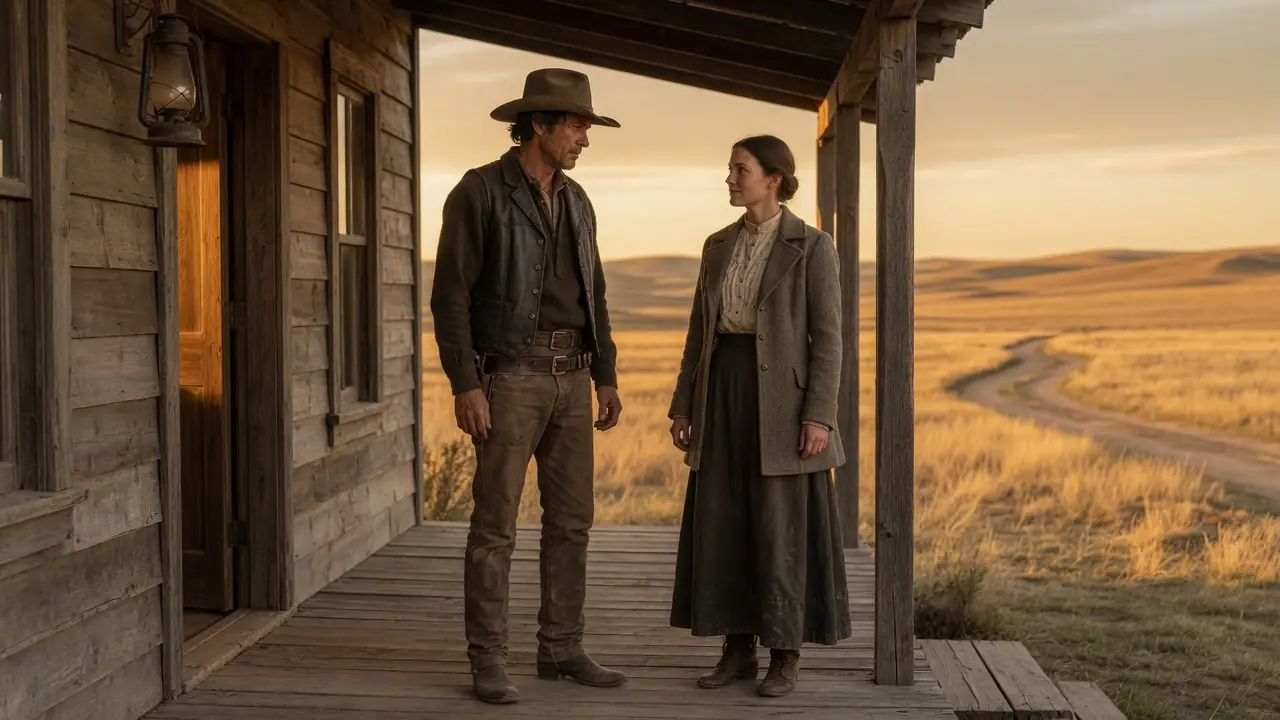
“It isn’t optional.”
The words landed like stone.
Noah looked past her toward the house.
Toward the sealed door he never opened.
“I don’t want anyone in there.”
“I understand,” she said. “But I’m not asking permission.”
That should have made him angry.
Instead, it just made him tired.
After a long pause, he turned away.
“Do what you need to do,” he said.
And walked back to the horse.
He felt her enter the house before he saw it.
The front door opened.
Closed.
Footsteps crossed the hall.
Then another sound followed.
The study door opening.
Noah froze.
Not fully turning.
Not fully stopping.
Just listening.
Then came light.
Curtains being pulled open.
Wood creaking softly.
The house changing in real time.
He looked through the barn window without meaning to.
Hazel stood in the doorway of the study.
Sunlight spilled into a room that had been dark for a year.
Dust lifted into the air like waking ghosts.
She moved through it carefully, not with reverence, but with practicality. Opening windows. Adjusting blinds. Creating order where there had only been stillness.
Then she paused.
Looked out.
Saw him.
Their eyes met through glass and distance.
She didn’t smile.
Didn’t apologize.
Just nodded once.
Then went back to work.
Noah stood there longer than he meant to.
Then forced himself to finish the horse.
But his hands weren’t steady anymore.
That night, sound returned to the house.
Paper rustling.
Drawers opening.
The soft movement of someone working late where no one had worked for a year.
Noah sat at the kitchen table longer than necessary, pretending to eat.
Listening.
The silence had changed.
It wasn’t empty anymore.
It was occupied.
And that made it worse.
Or maybe better.
He wasn’t sure which.
Days passed.
Then weeks.
The house changed slowly.
Not dramatically.
Not visibly at first.
But subtly.
Bread appeared in the kitchen.
Fires were lit earlier.
Dust disappeared from corners.
Small things that shouldn’t have mattered but did.
Hazel never announced them.
Never asked permission.
Just worked.
And in doing so, disturbed everything Noah had built around his silence.
One evening, she spoke from the doorway.
“You should read this.”
He didn’t look up.
“I don’t read other people’s things.”
“It’s your grandfather’s.”
That made him pause.
Still didn’t move.
But she left the journal on the table anyway.
Worn leather.
Old.
Familiar in a way that hurt before he even touched it.
That night, he opened it.
And everything he thought he knew began to break.
His grandfather hadn’t been silent.
He had been restrained.
Careful.
A man who wrote what he couldn’t say out loud.
Pages filled with thoughts Noah had never imagined him having.
Reflections. Regret. Love.
And one repeated line, written in different ways across different years.
Don’t let the land go to ruin.
Noah read it over and over.
Until it stopped meaning land.
And started meaning something else entirely.
The breaking point came during a storm.
Rain turned the fields into mud.
Wind cut through everything.
Noah rode out anyway.
Worked anyway.
Until his horse refused to move forward.
Until his body finally gave out.
He fell into the earth like something finally admitting defeat.
And that was where she found him.
Hazel knelt beside him in the rain.
Said his name.
Not Mr. Carson.
Just Noah.
And something inside him cracked open completely.
“I don’t know how to stop,” he admitted.
Hazel looked at him like she already understood.
“Maybe you’re not supposed to stop,” she said. “Just stop carrying it alone.”
After that, nothing stayed the same.
But nothing disappeared either.
It shifted.
The ranch didn’t become new.
It became lived in again.
Noah didn’t become someone different.
He became someone present.
And Hazel didn’t replace anything.
She simply stayed long enough for silence to stop being the only language in the house.
Winter passed.
Spring came late.
One morning, they planted an apple tree.
The soil was cold.
The work simple.
When they finished, Noah stood back and looked at it.
Then at her.
“We’re building this,” he said.
Hazel nodded.
“Yes.”
And for the first time in a very long time, the word “we” didn’t feel impossible.