"Sweetheart, the charity office is two blocks down."
"I have a 9:30 meeting on the thirtieth floor."
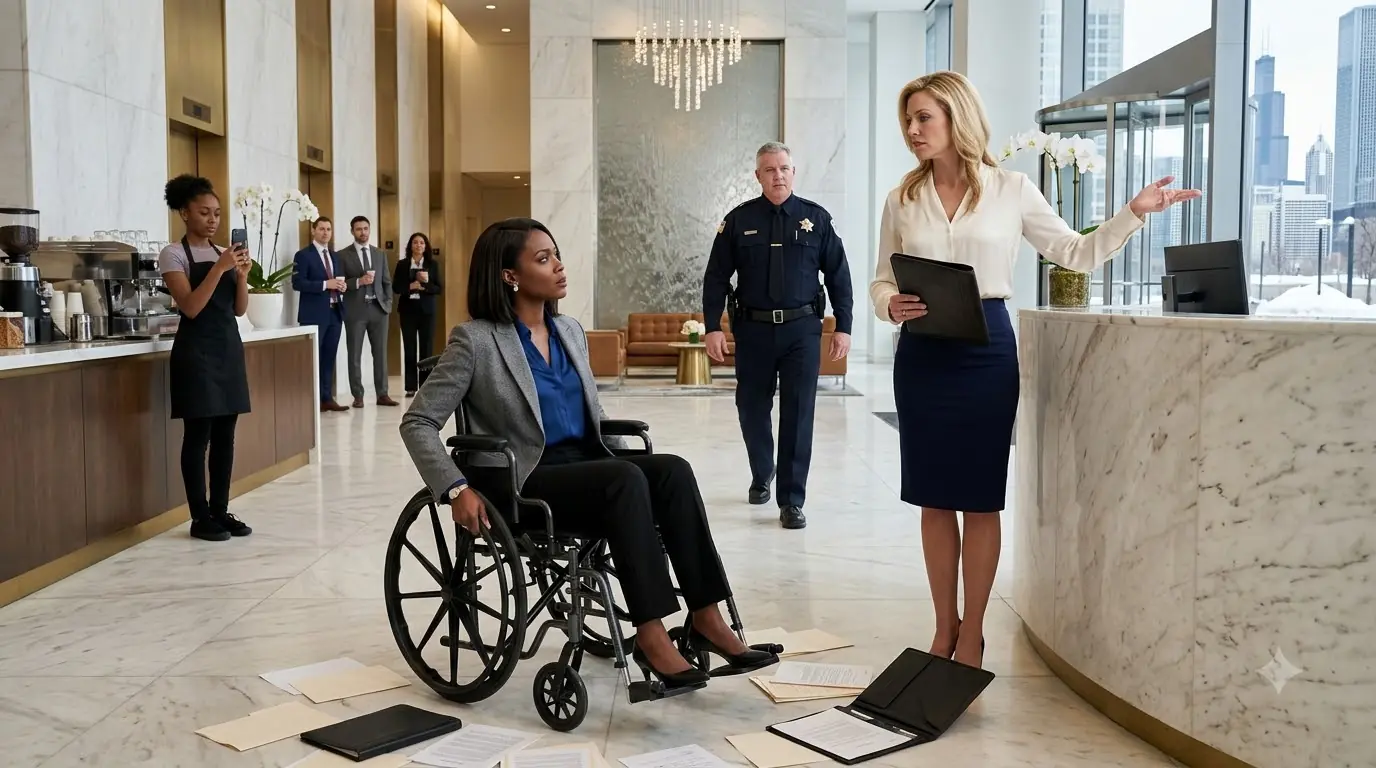
"A meeting? That's precious. The executive floor isn't for whatever this is."
"Check the visitor list. Whitfield."
"Honey, I'm not typing one letter for you. This lobby is for clients, not beggars on wheels."
"Give that folder back."
"This thing? Oops. It slipped."
Papers scattered across the spotless marble floor.
"Pick them up if you can reach."
"You'll remember this morning for a very long time."
"Is that a threat? Adorable. Dennis, roll her out before she stains my lobby."
"Ma'am, I need you to leave. Now."
"Stop! Get your hands off that chair. She owns 51 percent of us."
One hour of laughter.
One sentence that ended a career.
Three hours earlier, Chicago was still waking up.
Morning light spilled gray and gold over Lake Michigan while the wind rattled the windows of a quiet apartment on the twelfth floor of a brick building in Lincoln Park.
Inside, the smell of fresh coffee drifted from the kitchen.
Irene Whitfield sat in front of her closet deciding who she wanted to be that day.
On the left hung the armor.
Tailored suits in charcoal and navy, Italian silk blouses, the kind of clothes that made bankers sit straighter when she rolled into a room.
On the right hung a plain gray blazer.
It was ten years old, soft at the elbows, a faded thrift-store find she had never been able to throw away.
She reached to the right.
Ten years earlier, Irene had been the sharpest analyst on her floor at a Manhattan investment firm.
She was twenty-eight years old, the first person in her family to finish college, and the woman who repeatedly found value where everyone else saw risk.
Then came a rainy Tuesday.
A delivery truck ran a red light, followed by fourteen hours of surgery.
Irene woke to a doctor explaining that she would never walk again.
She also woke to silence.
The investment firm sent flowers.
Then came a settlement.
Then nothing.
Colleagues stopped calling.
Doors that once swung open now seemed to have steps in front of them in every possible sense.
So Irene built her own door.
From her kitchen table, she started a small investment fund using her savings and settlement money.
She studied companies nobody believed in and placed careful bets on people nobody noticed.
One good decision became ten.
Ten became a portfolio that quietly outperformed half of Wall Street.
She never gave interviews.
She never posted photographs of herself.
Her name lived in legal filings and wire transfers, not magazines.
Bankers knew the name Whitfield Capital, but almost none of them knew the woman behind it.
She rolled instead of walked.
Seven days earlier, Irene had sat in a conference room with Walter Brennan, the retiring chairman of Meridian Capital, and signed the largest deal of her life.
Fifty-one percent of the firm.
Controlling interest.
The ink was dry.
The wire had cleared.
The public announcement was scheduled for Monday at 10:00 a.m.
That gave Irene one narrow window.
One Monday morning when she could enter the building as nobody at all.
Her grandmother used to say, "You learn everything about a house by how it treats the stranger at the door."
Irene wanted to see Meridian's lobby through the eyes of every client, cleaner, courier, and nervous young applicant arriving in borrowed shoes.
Before her name appeared on the wall, she wanted the truth.
She pulled on the old gray blazer, tucked a leather folder beside her hip, and rolled out into the Chicago wind.
The cold came straight off the lake, sharp enough to taste.
Salt trucks rumbled past.
A bus hissed at the corner.
Her gloved hands worked the wheels in the steady rhythm she had perfected over ten years.
Block after block, she moved toward the tower.
Meridian Capital occupied forty floors of glass and steel on Wacker Drive.
Brass letters gleamed above the revolving doors.
Through the glass, a waterfall wall shimmered down polished stone.
The lobby glowed like the inside of a jewelry box.
Behind the front desk stood Candace Pruitt.
Head receptionist.
Eleven years with the firm.
Every morning at eight, Candace arranged the white orchids beside her monitor, aligning each stem like a soldier.
She knew every executive's coffee order and every partner's spouse by name.
She also ran the lobby like a velvet rope.
When a man in a cashmere coat pushed through the doors, her smile appeared instantly.
"Good morning, Mr. Sutton. Wonderful to see you."
When a bicycle courier tracked slush across the marble, the smile vanished.
One manicured finger pointed him toward the service entrance without a word.
At 9:00 a.m., Candace glanced at her watch.
Then she looked toward the side entrance.
What she saw made her sigh loudly enough for the espresso bar to hear.
A Black woman in a scuffed wheelchair was trying to work her way through the accessible entrance.
A chrome advertising sign blocked the bottom of the ramp.
The woman's blazer was old.
Her gloves were worn.
Her wheels left two narrow lines of melted snow across the gleaming floor.
Candace looked at those tracks the way most people looked at a stain.
She pressed her lips together and leaned slightly toward the desk microphone.
The chrome sign stood at the bottom of the access ramp like a guard.
"Wealth has an address," it announced in elegant black letters.
Irene almost laughed.
She gripped the cold edge of the sign and dragged it aside inch by inch.
The revolving doors continued spinning for people who never had to break stride.
Nobody stopped.
Nobody helped.
A man in a camel coat stepped over Irene's front wheel as though she were construction debris.
By the time she rolled fully into the lobby, her shoulders burned and her gloves were soaked.
Warm air washed over her.
It smelled of orchids and espresso.
The waterfall wall murmured against polished stone.
Forty feet above, a chandelier scattered light across the marble like dropped coins.
It was beautiful.
It was also a lobby with exactly one functioning access ramp, and somebody had used it as advertising space.
Irene rolled toward the front desk.
Her tires squeaked faintly on the polished floor.
Every squeak made heads turn.
A cluster of young associates near the elevators lowered their voices.
A silver-haired couple on the leather sofas looked at her, then through her, the way people look at weather.
Candace watched Irene travel the entire distance.
She did not stand.
She did not smile.
She rested her chin on interlaced fingers and allowed Irene to cross sixty feet of marble in silence.
It was the look of a critic watching a show she had already decided to dislike.
Irene stopped at the desk.
The counter rose nearly to her chin.
From the other side, she could barely be seen.
She knew that feeling well.
A world designed for standing people had countless ways of making sitting people invisible.
"Good morning," Irene said. "Irene Whitfield. I have a 9:30 meeting on the thirtieth floor."
That was when Candace delivered the sentence the entire lobby would remember.
"Sweetheart, the charity office is two blocks down. We don't do handouts here."
For one heartbeat, nothing happened.
Then somebody near the espresso bar snorted with laughter.
A young associate nudged another.
Phones began drifting upward, casual and curious.
Irene kept her voice level.
"I'm not looking for the charity office. The thirtieth floor, please. The meeting begins at 9:30."
"A meeting?"
Candace made the word sound borrowed.
"That's precious. The thirtieth floor is the executive level, honey. Board members. Partners."
Her eyes traveled from Irene's knit hat to the wet wheels.
"Whatever this is."
"Check the visitor list. Whitfield. W-H-I-T-F-I-E-L-D."
Candace did not even glance at her monitor.
Instead, she inspected her manicure.
"Honey, I'm not typing one letter for you. This lobby is for clients, not beggars on wheels."
The words landed louder than she probably intended.
Or perhaps exactly as loudly as she intended.
The espresso machine hissed into the silence.
Somewhere behind Irene, a man whispered, "Oh, wow," followed by a chuckle.
Heat climbed Irene's neck.
Ten years of moments like this had taught her exactly what anger cost and exactly what it bought.
She inhaled slowly through her nose.
Orchids.
Coffee.
The faint chlorine scent from the waterfall.
Her eyes moved with quiet purpose.
The lobby clock read 9:07.
The chrome sign still leaned near the ramp outside.