The rain had been falling over Pine County, Arkansas, since before sunrise, but by two in the afternoon the water along State Route 9 had stopped behaving like rainwater. It moved across the pavement in wide brown sheets, carrying leaves, branches, pieces of fencing, and whatever else the overflowing drainage channels had pulled from nearby fields. Near mile marker twenty-seven, a fifteen-ton passenger bus sat crooked beside the highway with its rear wheels buried almost to the hubs in mud. The thirty-two passengers had already been moved to higher ground, but if the bus shifted another few feet, it would settle into the flooded drainage basin beside the road.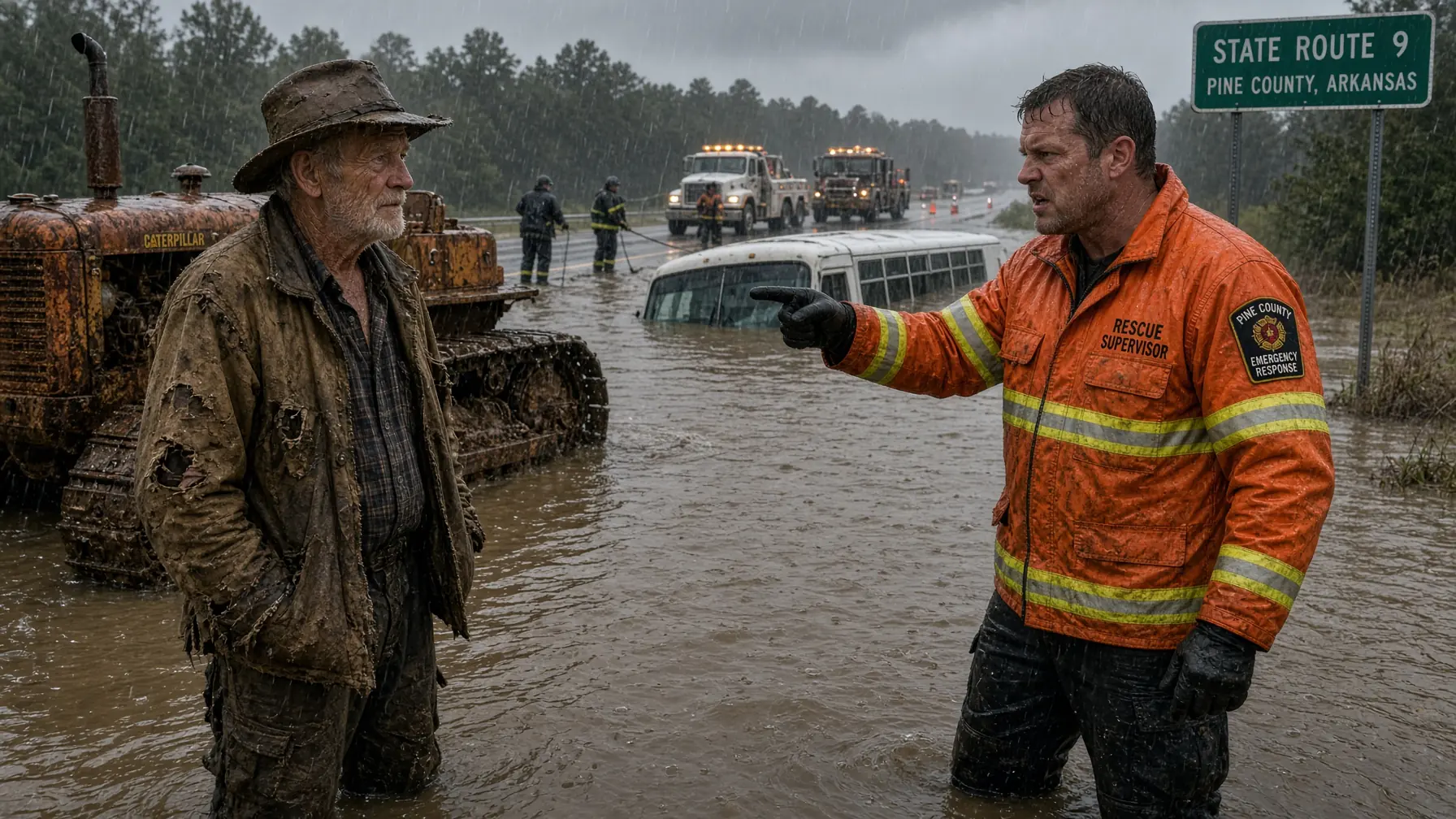
For three hours, the Pine County rescue crew tried everything they could safely justify. Two heavy recovery trucks positioned themselves on the pavement, lines running toward the front and rear of the stranded bus while workers in bright reflective jackets moved through ankle-deep water checking anchors. Each attempt began with roaring engines and tightening cables and ended almost exactly the same way. The bus moved inches, the recovery trucks began sinking toward the soft shoulder, and Derek Vaughn, the forty-four-year-old rescue supervisor, ordered everyone to stop before another vehicle became stuck.
Derek was good at his job, and everyone on his crew knew it. He had spent nearly twenty years working roadside recoveries, flooded intersections, collapsed shoulders, overturned trucks, and almost every other ugly problem that could block a rural highway. He wore his experience like armor, and most days that confidence kept his crew disciplined when other people panicked. But after three hours of rain, mud, failed pulls, and a weather report predicting several more inches before dark, confidence had begun turning into frustration.
“Pull truck two back,” Derek shouted.
One operator looked over.
“We can try one more angle.”
“No.”
Derek pointed toward the shoulder.
“That whole section is moving.”
The operator looked down and saw water bubbling around the rear tires of the recovery truck.
Derek was right.
“Back it out.”
The massive truck eased onto firmer pavement.
Workers began disconnecting one of the lines.
That was when an old orange crawler tractor appeared through the rain.
Nobody noticed it immediately.
The machine was slow enough that it seemed to emerge from the gray afternoon rather than arrive. Rust covered sections of the hood. Its faded Caterpillar lettering was barely visible beneath decades of wear, and the steel tracks carried enough Arkansas mud to make the tractor look like it had been dug directly from the earth.
Driving it was Earl Maddox, seventy-four years old.
Earl owned one hundred twenty acres bordering the flooded highway and another eighty farther south near the Saline River. His family had worked the area since before State Route 9 had pavement. Earl had grown up watching his father dig drainage channels with hand tools and old machinery, and he knew parts of the ground around him better than county maps did.
He parked the Caterpillar beside an old oak near the edge of his property.
Then he climbed down.
Derek saw him approaching.
The farmer wore a battered dark-brown hat, a mud-stained canvas jacket over an old plaid shirt, faded work pants, and boots that disappeared almost completely into the mud with every step.
Derek raised one hand.
“Sir, this area is closed.”
Earl stopped.
“I can see that.”
“You need to stay behind the trucks.”
Earl looked toward the bus.
Then toward the recovery lines.
“How long you been pulling from there?”
Derek frowned.
“Long enough.”
Earl nodded toward the shoulder.
“That’s your problem.”
One of the crew members looked between them.
Derek did not appreciate the comment.
“What exactly is my problem?”
“You’re putting your heaviest trucks over fill.”
Derek stared.
“This entire shoulder is compacted.”
“No.”
Earl pointed toward the water.
“Road is.”
He moved his finger ten feet.
“That isn't.”
Derek folded his arms.
“County plans show compacted shoulder another twelve feet.”
Earl smiled faintly.
“County plans weren't here in 1972.”
Derek’s expression tightened.
“I appreciate the concern, but we have professional recovery equipment here.”
Earl looked toward the two trucks.
“Looks expensive.”
A younger rescue worker covered a smile.
Derek noticed.
He stepped closer.
“We’ve evacuated the passengers. The bus is insured. We’re going to secure it and wait for the water to fall.”
Earl’s eyes shifted toward the flooded ditch.
“You wait overnight and that bus won't be sitting there tomorrow morning.”
Derek followed his gaze.
“Why?”
“Because water is cutting underneath it.”
Derek looked again.
The bus did appear slightly lower than it had an hour earlier.
That irritated him.
“How do you know?”
Earl pointed toward the line of trees fifty yards south.
“Because that water isn't supposed to be there.”
No one answered.
Earl continued.
“There used to be a farm road crossing this section before the county widened Route 9.”
Derek looked at him.
“What farm road?”
“Mine.”
The rain beat against Earl’s hat.
“In seventy-two, my father and I buried crushed limestone from that oak all the way to the south pasture.”
Derek stared toward the water.
“I don't see any road.”
“You’re looking thirty inches too high.”
Earl pointed beneath the floodwater.
“It's under there.”
One rescue worker named Mason Reed walked closer.
“How wide?”
“About twelve feet.”
“Still solid?”
Earl shrugged.
“Solid enough to hold that crawler.”
Derek looked toward the ancient Caterpillar.
Then laughed.
Not cruelly at first.
More from disbelief.
“You're telling me you're going to put that thing into rising floodwater?”
Earl nodded.
“Yep.”
“That crawler is older than half my crew.”
“Probably smarter than some of them too.”
Several workers laughed.
Even Mason smiled.
Derek did not.
“We’re pulling out because that ground won’t hold another recovery truck. Your fifty-year-old tractor isn’t going anywhere near it.”
Earl looked calmly toward the submerged shoulder.
“Your trucks keep sinking because you’re driving over six feet of old drainage fill.”
Derek stepped closer.
“That rusted crawler weighs half what we need. You’ll bury it beside the bus and give me two problems instead of one.”
Earl turned toward his Caterpillar.
“I buried that access road myself in ’72.”
He began walking.
“Clear your men off it—and watch what happens when somebody finally drives on solid ground.”
Mason followed Earl first.
Derek remained beside the recovery truck for several seconds.
Then frustration overcame pride.
“Wait.”
Earl stopped.
Derek walked toward him.
“Show me exactly where this road is.”
Earl pointed to the old oak.
“Starts there.”
He walked several feet through the mud and stopped.
“Runs straight toward that fence post.”
Derek looked.
There was no visible road.
Only brown water.
“How are you sure?”
Earl removed one glove and pushed a steel survey rod into the mud.
It sank almost three feet.
Then he stepped six feet sideways.
Pushed again.
The rod stopped after less than a foot.
Mason’s eyebrows rose.
“Stone.”
Earl nodded.
“Crushed limestone.”
He moved again.
Same result.
A narrow buried strip crossed the flooded shoulder almost exactly where Earl claimed.
Derek crouched and pushed the rod himself.
Hard resistance.
He stood.
“Why isn't this on county records?”
“Because nobody cares where an old farm road used to be.”
Earl looked toward the bus.
“Until they need it.”
Derek studied the terrain.
The buried path approached the bus from an angle his recovery trucks had never attempted.
Mason saw it too.
“If we run a line from the crawler…”
Derek interrupted.
“No.”
Earl looked toward him.
“You want the bus or not?”
“I want everybody going home alive.”
“So do I.”
Earl nodded toward the Caterpillar.