“Get your hands off my counter, old man. You can’t afford to breathe in here.”
The coffee hit first. A full cup, still steaming, thrown sideways like a man tossing dirty water into a gutter.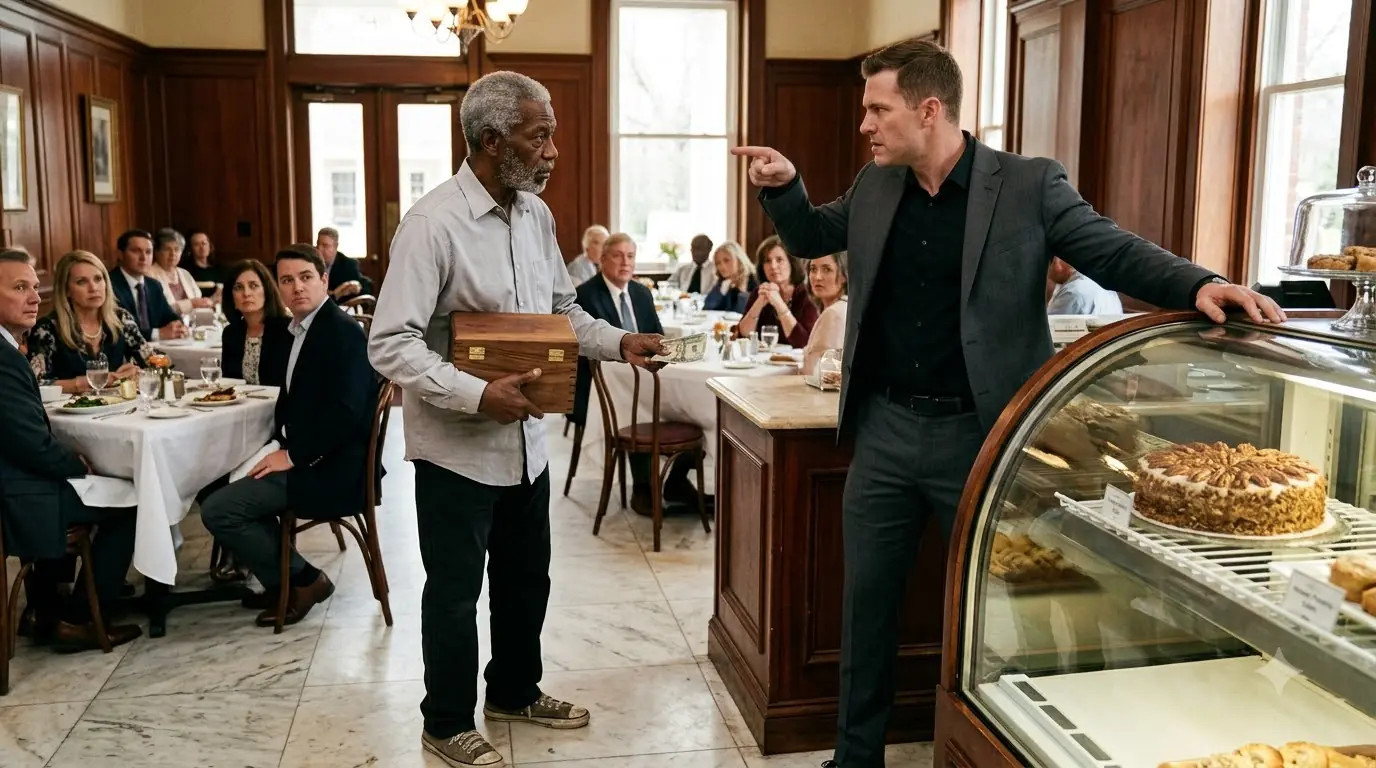
It caught the old man across the chest and throat, soaking through the pressed cotton shirt he had carefully ironed that morning with hands that shook only slightly. The ceramic cup shattered across the marble floor.
Three seconds later came the hand. A fist closed around the collar of the old man’s shirt and yanked him sideways so hard that his shoulder struck the edge of the pastry case. A small wooden box tumbled from his grip and skidded across the polished floor. It was walnut with brass hinges, the kind of box a man held close to his body when he carried something that could not be replaced.
The box stopped beneath a table where two women were finishing their eggs Benedict. One woman lifted her feet as though something unclean had rolled beneath her chair. The manager walked over and kicked the box, not a nudge but a full swing of a leather dress shoe that sent it spinning into the hostess stand. Then he stepped forward, planted his heel on the lid, and pressed down until the brass hinges buckled and the walnut split along the grain.
Inside the box was a handwritten card. Three sentences in blue ink on cream stationery, written by a woman who had been dead for three years. It was the only copy and the only thing the old man had asked to keep when he divided nearly everything else between his children and his late wife’s family. He had carried it all the way to Corbin Falls that morning.
The man who had just destroyed it managed a restaurant that would not survive another sixty days without a cash infusion it could not produce on its own. A forty-two-million-dollar investment contract had already been drafted and approved. The leather folio containing it was waiting fourteen miles south, and the signature line at the bottom read Elton J. Dorsey. The old man standing in the restaurant was Elton Dorsey.
The manager did not know that.
Elton’s morning had begun the way most of his mornings had begun during the three years since his wife died: early, quiet, and alone. At 5:15 a.m., without an alarm, he opened his eyes in the gray half-light. His body had been waking at 5:15 for longer than most people in Corbin Falls had been alive, and it no longer required permission or reminders. He lay still for a moment, then sat on the edge of the bed.
The house was small, with two bedrooms, one bathroom, and a kitchen facing east. The first light came through a window his wife had covered with plain white curtains the week they moved in. Those curtains were still there. Elton had changed almost nothing.
The sugar bowl remained in the same place on the counter. The welcome mat at the back door still read DORSEY in block letters, although years of shoes and Georgia rain had faded the D almost into a ghost. Elton showered, dressed in a light gray cotton shirt creased down the center from the iron, dark trousers, and canvas shoes that were clean but visibly worn at the heels. He barely looked at himself in the mirror beyond the seconds it took to fasten the top button.
He had never been vain. Grief had removed whatever small concern for appearance he once practiced.
Elton opened the bedroom closet and reached behind two folded blankets on the top shelf. There sat the wooden box. He brought it down, held it for a long moment, then sat on the edge of the bed again and opened the lid.
The card lay on a square of velvet lining his wife had cut and glued into place herself. Her name was Vivien. She had made the box too, using walnut scraps from the garage workshop she kept neater than most people kept their living rooms. She had sanded the wood by hand and installed the brass hinges with the jeweler-like precision that had always been entirely characteristic of her.
Vivien had given the box to Elton on their thirty-seventh wedding anniversary, three months before the diagnosis and fourteen months before the end. The card inside read:
“E,
Forty years from now, when you read this, I hope you still smell the bread from that little restaurant where you proposed. That night, you said you’d take me there every year for the rest of our lives. You kept your word thirty-seven times. I am already looking forward to thirty-eight.
All my love, all my days,
V.”
Elton read it once. Then he closed the lid.
He placed the box in a canvas tote bag, set the bag on the passenger seat of his car, and backed out of the driveway at 6:45 a.m. The drive to Corbin Falls took one hour and twelve minutes. The town sat among the low hills of Middle Georgia, population just under eleven thousand, centered around a courthouse square and a Main Street whose essential shape had barely changed in eighty years.
Elton had not returned in seven years. The last time had been an anniversary dinner with Vivien, two years before she became sick. Before that, they had returned every year without exception, driving from wherever they happened to be living at the time. The Belmont was where their life together had begun, and Vivien believed in returning to beginnings.
The Belmont occupied the ground floor of a three-story brick building at the corner of Gentry and Pine, half a block from the courthouse square. It had been a fine-dining restaurant for forty-one years, opened in 1983 by a couple named Ashby. The original owners had retired and handed operations to their daughter, Colleen Ashby.
Colleen was fifty-three and served as vice president of the Corbin Falls Chamber of Commerce. She had kept the name, the mahogany paneling, the cloth napkins, and the general atmosphere of a restaurant convinced that its own history made it more important than it probably was. Elton knew none of the details about how badly the business was struggling. Not yet.
He parked on Pine Street at 7:50 a.m. Breakfast began at eight. He sat in the car for several minutes with the tote bag on his lap and looked at the front entrance through the windshield. The brass plate beside the door still read THE BELMONT, ESTABLISHED 1983 in serif lettering.
The awning was new, dark green canvas replacing the burgundy one Elton remembered. Without deliberately meaning to, he noticed that the fire occupancy placard in the window listed 112. He noticed that the posted hours showed breakfast from 8:00 to 11:00, lunch from 11:30 to 2:30, and dinner from 5:30 to 10:00. He also noticed that the accessible-parking sign near the corner appeared mounted several inches lower than the required height.
These were not observations Elton consciously chose to make. They were residual habits from decades spent in rooms where details mattered, where a sign mounted incorrectly or a permit displayed in the wrong place could unravel something much larger. He did not consider this a skill. It was simply how he saw the world, the way a carpenter noticed joints or a mechanic listened to an engine.
Elton got out of the car. He removed the box from the tote and tucked it against his ribs, one hand underneath it and the other resting on the lid. Then he walked toward the restaurant entrance.
He did not know that the Belmont was four months behind on several commercial obligations. He did not know Colleen Ashby had exhausted two lines of credit. He did not know that the restaurant’s attorney had already drafted a bankruptcy petition and left it sitting in a desk drawer, waiting for the moment when denial could no longer outrun arithmetic.
Elton had not asked for detailed financial records yet. Before agreeing to consider the investment, he had asked only one thing.
“Is the pastry case still there?”
The curved glass display near the front counter had been there forty years earlier, on the first evening Elton and Vivien ate at the Belmont. Vivien had pointed through the glass toward a slice of pecan praline cake and said simply, “That one,” with the expression of a woman who had discovered something she intended to love for the rest of her life. She ordered the same cake every anniversary afterward.
She ordered it the final time they came too. By then, she was already thinner and more tired than she should have been. She ate only three bites. But she closed her eyes for each one.
Elton walked through the Belmont’s front door at 8:04 a.m. The dining room was about half full, perhaps a dozen patrons, mostly couples and a few people reading newspapers or phones. White tablecloths covered the tables, classical music played quietly, and the hostess station near the entrance was empty.
The pastry case stood exactly where Elton remembered it, near the far end of the counter. Internal lights illuminated rows of cakes and tarts arranged on white porcelain stands. Elton headed toward it.
He did not stop at the hostess station because no hostess was there. He did not wait for a table because he did not intend to sit. He wanted to see the pastry case, find the pecan praline cake, purchase one slice, and leave.
Ten minutes.
That was all he expected.
He was seven steps from the counter when a man moved into his path. Early thirties. Broad shoulders. Fitted charcoal suit jacket over a black dress shirt with no tie.
His name tag read:
WADE PRITCHARD
GENERAL MANAGER
Wade carried himself with the particular energy of a former athlete who had transferred his competitive instincts from the field into a dining room without losing any of the physicality. He stood six foot two. Elton stood five foot nine and weighed about 158 pounds.
Wade did not say good morning.
His eyes moved from Elton’s canvas shoes to his faded cotton shirt, then to the tote bag and the walnut box held close to his ribs. In those few seconds, he made a decision.
“Can I help you?”
It was not really a question.
It was a gate.
“I’d like to buy a slice of the pecan praline cake.”
Elton’s voice was quiet and even, the voice of a man accustomed to speaking in rooms where volume was unnecessary.
“The pastry case is for seated dining guests,” Wade said. “You need to be seated first.”
“I don’t need a table. I only want one slice. I’m happy to pay at the counter.”
“That’s not how we operate.”
Wade shifted his weight, closing more of the path to the counter.
His eyes moved to the wooden box.
“What’s in the box?”
Elton’s hand tightened slightly on the lid.
“It’s personal.”
“Personal?”
Wade repeated the word as though he had already decided not to believe it.
“Sir, this is a fine-dining establishment. We have a dress code. We have a reservation system. We do not do walk-up counter sales to people who wander in off the street.”
Three nearby tables were close enough to hear. At the nearest one, a woman in her fifties wearing a linen blazer and silver jewelry looked up from her phone. Her name was Margot Styles. At that moment she was simply another diner, watching with the detached interest of someone observing a problem she assumed would be resolved quickly and in the proper direction.
“I’ve been here before,” Elton said. “A long time ago. My wife and I used to come here.”
“Our reservation history goes back six months. What name?”
“Dorsey. But our last visit would have been more than seven years ago.”
Wade did not check anything.
He did not pick up a phone, consult a screen, open a book, or ask another employee.
“We don’t have that name.”
“You didn’t check.”
“I’m going to have to ask you to step outside.”
Elton remained calm.
“I would like one slice of cake. I will pay for it, and then I will leave.”
“And I’ve told you that is not how this works.”
Wade placed his hand flat on the counter between Elton and the pastry case. It was the way a man places his hand on a fence when he is daring someone to climb over it.
“You don’t have a reservation. You aren’t dressed appropriately for this establishment. And frankly, sir, you are making my guests uncomfortable.”
Elton looked beyond Wade toward the dining room.
Nobody appeared uncomfortable because of Elton. Two couples continued eating. A man in a golf shirt read a newspaper. Near the windows, a young woman in a Belmont apron cleared a table and watched the exchange with an expression very different from Margot’s.
She was small, dark-skinned, and in her early twenties.
“I am standing here,” Elton said carefully, “asking to make a purchase. I have not raised my voice. I have not disrupted your service. I would like the cake.”
“And I said no.”
The silence between them lasted three full seconds.
Elton reached into the tote, past the box, and removed his wallet. He took out a twenty-dollar bill and placed it on the counter.
“For the cake.”
Wade looked at the money.
Then he picked up the bill, folded it once, and held it toward Elton as though returning something that had been placed somewhere it did not belong.
“Take your money. Take your box. Get out of my restaurant before I have you removed.”
Elton did not take the bill.
His hand remained at his side.
His eyes moved once from left to right and stopped on the security camera mounted above the pastry display.
One look.
Then back to Wade.
“I’d like your full name and the name of the establishment’s owner for my records.”
Elton’s voice had not changed in volume, but the phrase “for my records” landed differently.
It was not the language of a threat.
It was the language of process.
Wade heard it without understanding why it bothered him.
His jaw tightened.
“My name is on my tag. The owner’s name is none of your business, and I’m done talking.”
Then Wade reached forward and grabbed Elton by the collar.
What happened next took about eleven seconds.
Wade pulled Elton toward the front door. Elton’s canvas shoes slid against the polished marble floor, offering almost no traction. The tote swung off his shoulder and struck a chair.
The wooden box fell.
It landed lid-first and bounced once. The brass latch opened, and Vivien’s card slid partly out.
Cream stationery.
Blue ink.
One corner visible against dark marble.
Wade did not look at it.
He released Elton’s collar with a shove that sent the older man stumbling into the hostess stand. Then he turned toward the warming station beside the register, where a fresh cup of coffee had been poured less than two minutes earlier.
Wade picked it up.
He threw it.
The coffee struck Elton across the chest.
Elton gasped, not a shout or a word, only the involuntary response of a body hit by sudden heat. The liquid soaked through his cotton shirt and spread in a dark stain from his collarbone toward his belt.
His hands came up instinctively to pull the hot fabric away from his skin.
Wade was already moving again.
He crossed toward the wooden box and kicked it with a full swing. It flew several feet and struck the base of the hostess stand. The walnut lid cracked along the center grain.
Then Wade stepped on it.
One step.
His full weight.
The heel of his dress shoe drove through the lid.
The brass hinges separated.
The velvet lining tore.
Vivien’s card, her handwriting, her anniversary message, folded beneath his shoe.
“Trash belongs in the garbage,” Wade said.
He was not breathing hard. His voice carried the cold calm of someone who believed he had performed maintenance instead of cruelty.
He looked at Elton.
Coffee dripped from the old man’s shirt. Elton’s hands trembled. His eyes remained fixed on the crushed box.
“Get out. And if I see you near this building again, I’m calling the police.”
Then came laughter.
Not the loud laughter of an entire room.
The scattered laughter of perhaps five or six people who had decided that what they were witnessing was comedy rather than abuse.
Margot Styles shook her head.
Then she returned to her phone, apparently satisfied that an unwanted disruption had been handled.
Elton bent down slowly.
His knees resisted him.
At sixty-five, with a bad left knee and the accumulated stiffness of a body that had worked hard for decades, kneeling required effort. Still, he lowered himself onto the marble floor of the restaurant where he had once proposed to Vivien.
He picked up the pieces of the box.
The walnut lid in two halves.
The torn square of velvet.
The bent brass hinges.
Then the card.
It was creased and marked with a shoe print, but not torn.
Elton held it in both hands.
For a moment, he read the familiar lines through the fold.
Then he carefully folded it and slid it inside his shirt pocket, against his chest beneath the wet cotton.
He stood.
Elton said nothing.
There was something in his face that was neither anger nor defeat.
Something Wade did not recognize.
There had been other people Wade had pushed out of his restaurant before. Delivery drivers. Workers. Customers he decided did not fit the room. They were usually quiet, embarrassed, compliant, gone before anyone had to think too much about what happened.
None of them had looked at him the way Elton did.
Elton turned toward the door.
The young woman who had been clearing tables near the windows was no longer at her station.
She had moved into the hallway near the kitchen entrance.
Her phone was held at waist height, angled toward the dining room.
She was not texting.
She was recording.
Her name was Sable Jeff.
Twenty-two years old.
A culinary-arts student at Mon State.
Three weeks into an unpaid internship at the Belmont, taken because it was the only placement available and because she needed the hours to graduate.
Sable had seen Wade operate before.
She had watched the way he spoke to delivery drivers.
Dishwashers.
Temporary staff.
Anyone whose presence in his restaurant he considered conditional.
She had never challenged him.
Interns did not challenge managers.
Interns cleared tables.
Interns stayed quiet.
Interns accumulated hours and graduated.
But she had never watched Wade throw hot coffee at a sixty-five-year-old man.
She had never watched anyone crush something that was clearly, obviously, unmistakably personal.
Elton pushed through the front door and stepped into the Georgia morning.
The sunlight struck the wet stain on his shirt.
He stood on the sidewalk holding the broken pieces of the walnut box in both hands.
For several seconds, he did not move.
Then the restaurant door opened behind him.
“Sir.”
Elton turned.
Sable stood in the doorway.
She held a white cloth napkin in one hand.
A small brown paper bag in the other.
Her eyes were red.
She was trying hard not to cry, which made it obvious she already had.
“I brought you a napkin.”
She held it toward him.
“For the burn.”
Then she extended the paper bag.
“And this is my lunch. It’s just rice and chicken, but it’s warm, and I thought…”
Her voice broke.
She stopped.
Then pressed the bag toward him.
Elton looked at her.
At the napkin.
At the bag.
At the name tag on her apron.
SABLE
INTERN
He accepted both.
He laid the napkin gently against his chest.
“Thank you.”
“I’m sorry.”
Sable whispered it.
“I should have said something. I should have…”
“You did something,” Elton said.
She looked at him.
“That is more than everyone else in that room.”
Elton walked to his car.
He opened the door and set the broken box pieces and Sable’s lunch on the passenger seat.
Then he sat behind the wheel.
For a long time, he remained there with the white cloth against his chest, staring at the Belmont entrance through the windshield.
Finally, he reached into the glove compartment and removed a small leather notebook.
Black cover.
Narrow ruled.
The kind sold in ordinary office-supply stores.
He opened it to a blank page.
Then he began writing.
Date.
Time.
Location.
Visible names.
Description of incident.
Sequence of actions.
Camera position.
Number of witnesses.
Elton wrote for fourteen minutes.
His handwriting was small, precise, and unhurried.
The notes did not resemble an emotional complaint.
They resembled a record.
Sequential.
Timestamped.
Structured for reference rather than expression.
The work of a man accustomed to writing this way.
A man trained to write this way.
When he finished, Elton closed the notebook and placed it on the passenger seat beside the broken box.
Then he took out his phone.
He called a number.
Three rings.
A woman answered.
“Mr. Dorsey.”
Not hello.
An acknowledgment.
The voice of someone who knew that Elton rarely called without purpose.
“I need the signing pushed.”
Elton’s voice was steady.
“Don’t cancel it. Just move it. I’ll give you another date within the week.”
A pause.
“Is everything all right?”
“No.”
He looked at the Belmont.
“But that is a longer conversation.”
Another pause.
“Push the signing and pull the full file on the Belmont.”
“The financial file?”
“The full file. Not the summary.”
Elton continued.
“I want compliance history, employee records, county complaints, everything available.”
Silence.
“All of it?”
“All of it.”
He ended the call.
Then he sat in the car for another minute before starting the engine and pulling away from the curb.
Inside the Belmont, Wade Pritchard wiped coffee from the floor with the satisfaction of a man who believed he had restored order. The broken ceramic cup was already in the garbage. The scuff marks from the box were disappearing beneath a mop.
Within ten minutes, the marble would look untouched.
The morning would continue.
And most of the people who witnessed what happened would file it mentally under the category of unpleasant things that were not their problem.
Sable stood in the kitchen hallway with her phone in her hand.
The video lasted four minutes and eleven seconds.
It showed everything.
The collar grab.
The coffee.
The kick.
The stomp.
The laughter.
She had not planned to record.
She had simply reached for the only tool available to her.
Now the file existed.
She did not yet know what she would do with it.
But she knew she would not delete it.
“Sable!”
Wade’s voice came from the dining room.
“Table six needs clearing.”
She slipped the phone into her apron pocket.
Picked up a clearing bin.
And returned to work.
Three hours later, two things happened almost simultaneously.
At 12:17 p.m., Elton Dorsey walked into the Corbin Falls Police Department substation on Maple Street and requested to file a formal complaint.
The officer at intake was Corporal Anise Hayward.
She had spent nine years at that desk and developed the kind of patience possessed by someone who had heard nearly everything human beings could accuse one another of doing.
She handed Elton a standard form and a pen.
Elton did not rely on the form.
Instead, he opened his leather notebook and produced four pages of handwritten documentation.
“Does the department accept supplemental documentation with complaints?”
Corporal Hayward looked at the pages.
“Yes.”
She began reading.
Civilian complaints were usually emotional.
Disorganized.
Heavy on adjectives.
Light on exact times.
Elton’s pages were different.
Every significant event had an approximate minute.
The manager’s name was documented from his badge.
The camera’s make and position were noted.
Elton had even recorded details from permits and licenses visible from the front entrance.
His description of physical contact was neutral and specific.
Hayward had encountered that style of writing before.
In formal reports.
Use-of-force documentation.
Investigative records.
Not usually from walk-in restaurant complaints.
She accepted the material.
The complaint received case number CF-2024-10147.
Hayward told Elton that an investigator would follow up within five to seven business days.
“Thank you.”
Elton requested a copy of the intake sheet.
She provided one.
He placed it inside the notebook.
Then he asked whether a complaint involving possible violations of Georgia simple-battery and property-damage statutes would be automatically routed for investigative review.
Hayward looked up from the screen.
“You’ll need to discuss specific charges with the detective.”
“Of course.”
Elton nodded.
Then he left.
Hayward watched him walk out.
After several seconds, she picked up her desk phone.
The on-duty investigator was Sergeant Dwayne Kershaw, eating a late lunch at his desk two floors above.
“I just had a walk-in complaint.”
“What kind?”
“Battery and property damage at the Belmont on Gentry.”
Kershaw stopped.
“The Belmont?”
“Yes.”
“Colleen Ashby’s place?”
“That’s the one.”
Hayward looked toward the entrance.
“Sixty-five-year-old Black male. Says the manager threw hot coffee on him and broke personal property.”
There was a pause.
The specific pause of a man thinking about the social geometry of a small town where the police department and Chamber of Commerce shared parking space during the annual Fourth of July celebration.
“I’ll swing by tomorrow.”
“The complainant cited specific statute sections.”
Another pause.
“Which ones?”
Hayward read them.
“He knew the numbers?”
“From memory, as far as I could tell.”
Kershaw’s voice changed.
Not alarm.
Attention.
“I’ll go this afternoon.”
At 12:22 p.m., five minutes after Elton entered the police substation, Wade Pritchard called the restaurant’s attorney.
Grant Telford was fifty-seven, a partner at Telford and Grimes, the main general-practice law office in Corbin Falls.
He had represented the Belmont for twelve years.
He represented other local businesses.
The Rotary Club.
And he sat on the Corbin Falls Business Alliance board with Colleen Ashby.
Telford answered his phone with a single word.
“Telford.”
“Grant, it’s Wade. We had an incident this morning.”
Wade described what happened.
Quickly.
Cleanly.
And with the specific omissions of someone who had already chosen which version of events would exist.
In Wade’s version, an unidentified man in shabby clothing entered the Belmont without a reservation. He refused to leave when asked. He became agitated and made threatening comments.
Staff escorted him toward the exit.
The coffee incident was accidental.
According to Wade, the man bumped into a server carrying a cup.
The wooden box fell during the escort.
Someone accidentally stepped on it.
Telford listened.
“Anyone hurt?”
“No.”
“He left?”
“Yes. Voluntarily.”
“Security cameras?”
“I’ll check with Petra.”
“Do that and call me back within the hour.”
Telford’s tone sharpened.
“If he files anything, send it directly to me. Do not respond yourself. Do not discuss the incident with staff.”
“All right.”
“And Wade?”
“Yes?”
“Do not talk to anyone about this who isn’t me.”
Wade hung up.
He went to the back office.
Petra Lind, the assistant manager, was working at the desk.
She was twenty-eight and had been hired by Colleen six months earlier. Efficient in the way of someone who understood that efficiency inside a failing restaurant often meant making problems disappear before ownership had to look at them directly.
Petra managed schedules.
Inventory.
Vendor disputes.
And increasingly, information Wade preferred not to manage himself.
“The cameras,” Wade said.
Petra turned.
“The one above the pastry case. This morning from eight until eight-fifteen.”
She did not ask why.
Petra opened the security system.
She located the footage.
Then watched approximately ten seconds.
She saw Wade grab Elton’s collar.
She saw the coffee.
Her expression changed.
Wade spoke.
“Back it up first. Then delete it from the main system.”
Petra copied the video to a USB drive.
She handed the drive to Wade.
Then she deleted the segment from the main server.
The deletion created a gap in the footage log from approximately 8:02 until 8:19 a.m.
A gap a competent investigator would notice almost immediately.
Neither Wade nor Petra considered that.
Their previous experiences involved insurance adjusters.
Health inspectors.
A single slip-and-fall claim Grant Telford had settled for four thousand dollars.
They had never dealt with anyone who understood digital evidence.
They did not yet understand what they had done.
Sergeant Dwayne Kershaw arrived at the Belmont at 3:45 p.m.
He was fifty-one and had spent twenty-three years with the Corbin Falls Police Department.
He had been a large man in his thirties and had settled into a broader, heavier version of himself without losing the underlying physical authority.
His badge and sidearm were visible.
Reading glasses rested on his forehead.
Kershaw entered the Belmont with the confidence of someone familiar with the building.
He had eaten anniversary dinners there.
His daughter had waitressed there two summers earlier.
He knew Colleen Ashby.
And if he had been completely honest with himself, Kershaw had not gone to the restaurant to investigate Elton Dorsey’s complaint.
He had gone to determine whether Elton Dorsey’s complaint was likely to become a problem.
Colleen met him in the foyer.
Tall.
Expertly highlighted hair.
A practiced warmth developed over decades of being one of the most recognized people in a small town.
“Dwayne.”
She shook his hand with both of hers.
“I heard there was some trouble this morning.”
“Just following up on a complaint, Colleen. Routine.”
“Of course.”
She smiled.
“Whatever you need. Wade is in the office.”
Kershaw interviewed Wade for eleven minutes.
Wade repeated the version he had given Telford.
Unidentified man.
No reservation.
Refused to leave.
Became agitated.
Accidental coffee.
Accidental damage to the box.
Kershaw wrote in his notebook.
He nodded in the rhythm of someone hearing exactly what he expected to hear.
He did not request security footage.
He did not interview other employees.
He did not identify or interview customers.
At 4:20 p.m., Kershaw drove to the address Elton had listed on his complaint.
A rented cottage on Alden Road, about two miles beyond the town center.
The house sat behind a stand of pecan trees.
Small.
Well maintained.
Clean gutters.
Swept porch.
Almost no decorative touches.
The kind of house that looked maintained by one person living alone.
Kershaw parked in the gravel drive and approached the front door.
Elton opened it before he knocked.
“Mr. Dorsey?”
“Yes.”
“Sergeant Kershaw, Corbin Falls Police. I’m here about your complaint.”
“Come in.”
They sat in the small living room.
Kershaw took the armchair.
Elton sat on the couch opposite him.
Between them, on the coffee table, rested the leather notebook, opened to Elton’s notes from that morning.
Kershaw looked at it.
“Walk me through what happened.”
Elton did.
Arrival.
Pastry case.
Request for cake.
Refusal.
Twenty-dollar bill.
Collar grab.
Coffee.
Wooden box.
Vivien’s card.
He did not raise his voice.
Did not editorialize.
Did not describe Wade as evil or cruel.
He gave actions and times.
When Elton finished, Kershaw closed his own notebook.
“Mr. Dorsey, I’ve spoken with Mr. Pritchard.”
“I expected you would.”
“His account is different.”
“I would expect it to be.”
Kershaw studied him.
“He says you entered without a reservation, became agitated when asked to leave, and that the coffee was accidental. A server collision.”
“There was no server near me.”
Elton’s response was immediate.
“Mr. Pritchard took the coffee from the warming station beside the register. He threw it deliberately.”
“He disputes that.”
“The security camera above the pastry case should resolve the dispute.”
Kershaw’s pen stopped moving.
“You noticed the camera?”
“I noticed its position, its angle, and the fact that it appears to cover the area where the incident occurred.”
Elton continued.
“I also noted the model. It appeared to be a Lorax continuous-recording system.”
Kershaw stared at him.
“The footage from approximately 8:02 until 8:15 this morning should contain the entire sequence.”
There was something about the specificity that did not fit Kershaw’s original picture.
On the drive over, he had imagined an upset older customer.
Perhaps exaggerating.
Perhaps confused.
A complaint he could document and close.
The man sitting across from him was neither confused nor imprecise.
“I’ll look into the footage,” Kershaw said.
“I would also request that it be preserved under the department’s evidence-retention procedures.”
Kershaw’s eyes narrowed slightly.
“If the recording is deleted or overwritten before review,” Elton continued, “the deletion itself could become relevant.”
That sentence landed.
Evidence-retention procedures.
The deletion itself could become relevant.
It was not the language of a man merely angry about a restaurant argument.
It was the language of someone who understood evidence chains.
Someone who was already building the architecture of a case Kershaw had not yet decided deserved to exist.
“Mr. Dorsey, what did you do for a living?”
“I’m retired.”
“Retired from what?”
Elton met his eyes.
“That is not relevant to the complaint, Sergeant.”
Kershaw waited.
“What is relevant is that a business manager used physical force against a customer, threw hot coffee, and deliberately damaged personal property in a room full of witnesses.”
Elton’s tone remained calm.
“I am asking for the investigation to proceed on the basis of those facts.”
Kershaw stood.
“We’ll be in touch.”
Elton nodded.
Kershaw walked back to his cruiser.
He sat in the gravel driveway for almost a minute.
He thought about the camera model.
The exact time window.
Evidence preservation.
Metadata.
He thought about the fact that in twenty-three years of police work, no ordinary walk-in complainant had ever explained a business surveillance system to him with that level of specificity.
Then he drove back to the station.
He did not request the footage.
That evening, Elton sat at the kitchen table.
The pieces of Vivien’s box rested on a clean towel.
Two halves of the lid.
Bent brass hinges.
Torn velvet.
He had arranged them carefully, like fragments of something he was not ready to discard and not yet ready to repair.
The card lay unfolded beside them.
The shoe print remained visible across the first line.
“E, forty years from now…”
Elton read it again.
He touched the crease where it had bent.
Then he slipped the card back into his shirt pocket.
He picked up his phone.
He dialed a number he had not personally called in seven months.
Two rings.
“Mr. Dorsey.”
The same voice as earlier.
Norah Peton.
Elton’s executive assistant.
Nineteen years working with him.
She answered his calls at any hour because experience had taught her that when Elton Dorsey called after dark, he had usually made a decision.
“The Belmont file,” Elton said. “Did you pull it?”
“It’s on my desk.”
“And?”
“I also pulled the county complaint database.”
Elton looked toward the broken box.
“There are four complaints against the establishment in the last eighteen months.”
Silence.
“Two specifically allege discriminatory refusal of service.”
“Disposition?”
“Both closed.”
“Investigation?”
“I see no interviews attached.”
Elton said nothing.
Norah continued.
“The most recent complaints were all closed by the same county employee. Rita Farwell.”
“Anything else?”
“Yes.”
Norah paused.
“She sits on the Corbin Falls Business Alliance Advisory Board.”
“With Colleen Ashby?”
“Yes.”
Elton looked down at the walnut fragments.
“I want a meeting with the county administrator’s office.”
“When?”
“Tomorrow.”
“And I want the name of every person involved in closing those complaints.”
“I’ll have it.”
Elton ended the call.
He sat alone in the kitchen.
The house whose curtains Vivien had chosen.
The table where they had eaten thousands of meals.
The pieces of the box she made sitting beneath his hands.
Outside, the pecan trees stood dark against the final light.
It was the kind of quiet that settles over a small town before it understands that something has changed.
Fourteen miles south, in a corner office on the thirty-second floor of a building with DORSEY etched into granite above the entrance, Norah Peton opened a locked drawer.
She removed a file.
Then she began reading.
The file eventually contained forty-seven pages.
Complaint records.
Inspection summaries.
County filings.
Correspondence between the Corbin Falls Business Alliance and county officials.
The information had not been particularly difficult to find.
Nobody had simply bothered to gather it into one place.
The first complaint was fourteen months old.
Denise Overstreet.
Seventy-one.
She had gone to the Belmont with her daughter for a birthday lunch.
The reservation had been confirmed over the phone two days earlier.
When Denise and her daughter arrived, staff told them the reservation did not appear in the system.
They were asked to wait in the foyer.
They waited forty minutes.
No table was ever provided.
Her daughter filed a complaint with the county consumer-affairs office.
Within nine days, the file was marked:
REVIEWED. NO ACTION.
No interview.
No follow-up letter.
The second complaint was eleven months old.
Jerome Calder.
Forty-four.
A contractor who booked the Belmont for a business dinner with six colleagues.
When the group arrived, Wade Pritchard informed them that the reservation had been moved to a smaller table near the kitchen.
The replacement table seated four.
Jerome objected.
Wade told him the main dining room was fully committed for the evening.
Three large tables remained empty throughout the meal.
Jerome complained to the county and the Better Business Bureau.
Both matters were closed without meaningful investigation.
The Better Business Bureau notation read:
BUSINESS RESPONDED. MATTER CONSIDERED RESOLVED.
The Belmont’s attached response was a single paragraph drafted by Grant Telford.
It stated that the restaurant welcomed all guests and regretted any misunderstanding concerning seating arrangements.
The third and fourth complaints were filed seven months earlier, within three weeks of each other.
Both involved Black patrons.
Both alleged that the complainants were left waiting at the hostess stand while white customers arriving later were seated first.
Both were closed by Rita Farwell.
The same Rita Farwell who served on the Corbin Falls Business Alliance Advisory Board alongside Colleen Ashby.
Norah finished reading.
Then she put the file on Elton’s desk.
A yellow note sat on top.
FOUR COMPLAINTS.
SAME PATTERN.
SAME OUTCOME.
SAME CLOSER.
Norah did not add commentary.
She did not need to.
After nineteen years, she knew Elton well enough to understand that once a pattern was documented, he acted.
Usually with precision.
Usually proportionately.
And often with consequences that arrived slowly enough for people to misunderstand them until it was too late.
The next morning, Wednesday, Elton drove back into Corbin Falls.
He did not go to the Belmont.
He went to the Corbin Falls County Administrative Building on Calhoun Street.
There, he submitted a formal open-records request.
Three typed pages.
It cited Georgia’s Open Records Act with the specificity of someone who had prepared hundreds of similar requests over the course of a career the clerk could not identify but could sense in the language.
The request sought every complaint filed against the Belmont during the previous twenty-four months.
Every disposition record.
The names of reviewing officials.
Correspondence between the county administrator’s office and representatives of the Belmont, Ashby Properties, or the restaurant’s legal counsel.
Records relating to closure of complaint files.
Conflict-of-interest disclosures.
Recusal notations.
Internal referrals.
The clerk accepted the request.
Assigned a tracking number.
Elton then submitted a separate records request to the Corbin Falls Police Department for materials relating to his own complaint, case CF-2024-10147.
Afterward, he drove to the courthouse and reviewed public property and business records associated with the Belmont.
The lease was held through Ashby Properties LLC.
Registered to Colleen Ashby.
Property records showed two consecutive years of late payments.
A recent filing showed a lien from a food-service supplier for $11,400 in unpaid invoices.
Elton photographed every page.
Date.
Source.
Document number.
He organized the images in a folder on his phone using a reference-number format no ordinary civilian would recognize.
It resembled an internal compliance-tracking system.
Elton had been using that format for thirty years.
He did not consciously think about it.
It was the way his mind organized information.
The way a surgeon labeled specimens.
The way a pilot logged flight hours.
Automatic.
Structural.
Elton returned to the Alden Road cottage at 1:45 p.m.
He opened the paper bag Sable had given him.
The rice and chicken were cold.
He ate them anyway.
Slowly.
At the table.
Across from Vivien’s broken box.
Then he called Norah.
“The records response should arrive within three business days.”
“I’m tracking it.”
“When it does, cross-reference every involved name against the Business Alliance board.”
“Already doing it.”
“Specifically, find whether whoever closed the complaints has any organizational or financial relationship with the restaurant or its owner.”
“I will.”
A pause.
“Mr. Dorsey, the signing remains on hold.”
“Yes.”
“Colleen Ashby’s attorney called this morning asking for a timeline.”
“What did you say?”
“That the chairman’s schedule was under review and that we would confirm within the week.”
“Good.”
Norah hesitated.
“There’s one more thing.”
Her voice became slightly more careful.
“I pulled the security-system specifications for the Belmont from the vendor’s public installation records.”
Elton straightened.
“And?”
“Lorax LHV series, continuous recording. Thirty-day automatic overwrite.”
“What happens if footage is manually deleted?”
“The video disappears from normal playback, but server logs should retain the deletion event.”
“For how long?”
“Approximately ninety days before metadata purge, depending on system configuration.”
Elton said nothing for several seconds.
“Mr. Dorsey?”
“Include that in the preservation request.”
“The deletion-event log?”
“Specifically the event log, timestamp, user login, file reference, and metadata-retention window.”
“All right.”
“If they already deleted the video, I want the record of the deletion preserved before they realize the record exists.”
“I’ll draft it tonight.”
Elton ended the call.
He stayed at the kitchen table.
Late-afternoon light crossed the cracked walnut and torn velvet.
The damage almost looked deliberate under that light, as though an artist had broken the box to reveal what had been hidden inside.
Thursday passed.
Then Friday.
On Friday afternoon, two things arrived.
The first was the county’s partial response to Elton’s records request.
Fourteen pages.
Complaint records.
Three pages of correspondence heavily redacted under an exemption the county described as deliberative-process privilege.
The message contents were blacked out.
But sender and recipient information remained.
Sender:
R. FARWELL, COUNTY CONSUMER AFFAIRS.
Recipient:
C. ASHBY, ASHBY PROPERTIES LLC.
Rita Farwell, the woman responsible for reviewing and closing the complaints, had been communicating directly with Colleen Ashby while those complaints were active.
The content was hidden.
The existence of the communications was not.
Elton read the response twice.
Then he opened his notebook.
Farwell-Ashby correspondence confirmed.
Content redacted.
Conflict concern documented by correspondence itself.
Challenge basis for redaction.
The second thing that arrived was a phone call.
Not Norah.
Not the county.
The man on the other end had a deep, unhurried voice.
The kind of voice carrying institutional authority without needing to announce it.
“Mr. Dorsey.”
“Yes.”
“We received the supplemental material from Miss Peton.”
Elton waited.
“The pattern is consistent with issues we have been tracking in several other jurisdictions.”
A pause.
“If you are willing to include your incident in the broader record, we can reference it in the preliminary assessment.”
Elton closed his eyes.
“Include it.”
“Full documentation?”
“Everything. I’ll sign the authorization tonight.”
“Understood.”
Then the man added:
“Mr. Dorsey, what you assembled is exactly the kind of ground-level documentation that makes a difference. We can analyze patterns from the top down, but cases built from the bottom up tend to hold.”
Elton looked at the pieces of Vivien’s box.
“I know.”
A pause.
“I spent thirty years building them.”
The silence on the phone changed.
As if the man on the other end had just remembered something important about who Elton Dorsey had once been.
“Yes, sir.”
The call ended.
Elton set the phone down.
For thirty years, he had worked inside one of the country’s most powerful civil-rights enforcement systems.
He had built cases involving patterns.
Public accommodations.
Institutional failures.
Complaint suppression.
Selective enforcement.
He had worked with investigators, attorneys, agencies, municipalities, and compliance teams.
That history explained the notebook.
The timestamps.
The camera observation.
The statute numbers.
The records request.
The preservation language.
The deleted-footage metadata.
It explained why Elton understood that discrimination rarely survived because of one dramatic act alone.
It survived because of procedures.
Missing records.
Closed complaints.
Friendly relationships.
People deciding a problem was not important enough to investigate.
The signing remained on hold.
The Belmont kept waiting.
Colleen Ashby called Norah’s office every morning.
Her voice grew slightly more anxious with each unanswered inquiry.
It was the vocal trajectory of a woman watching a lifeline fray.
Elton still had not decided what to do.
He had come to Corbin Falls to buy one piece of cake and revisit a memory.
He had arrived prepared to invest forty-two million dollars in a restaurant that held the most important evening of his life inside its walls.
He came quietly.
Plain cotton shirt.
Old shoes.
No entourage.
No announcement.
Because he wanted to see the restaurant as it truly was.
Not the version it would perform for a wealthy investor.
What he found was a manager who threw coffee at an older man.
A dining room that laughed.
Four complaints closed without meaningful investigation.
A restaurant attorney involved in dismissive responses.
A county official communicating with the business owner.
A police inquiry that leaned toward convenience.
And a twenty-two-year-old intern who ran outside with a cloth napkin and her own lunch.
Elton picked up the phone.
He called Norah.
“Schedule the signing.”
“When?”
“Tuesday. Two-fifteen.”
“At the Belmont?”
“Yes.”
Norah paused.
“Full protocol?”
“Car. Security. Contract folio. You.”
“All right.”
“One more thing.”
“Yes?”
“Do not tell them who I am.”
Norah understood immediately.
“Only confirm that the chairman of Dorsey Holdings will arrive for the previously scheduled signing?”
“Exactly.”
“They’ll prepare the red carpet.”
Elton looked toward Vivien’s card.
“Yes.”
A pause.
“They will.”
Tuesday arrived slowly in Corbin Falls.
Sunny.
Ordinary.
The kind of day a small town rarely remembers unless someone gives it a reason.
At the Belmont, preparations started at 6:00 a.m.
Colleen Ashby arrived in a champagne-colored silk blouse and heels purchased specifically for the occasion.
She had not slept properly in four months.
Not since the accountant showed her the financial projections.
The restaurant was losing approximately twelve thousand dollars every month.
Supplier lien.
Lease arrears.
First credit line exhausted.
Second line rejected.
The Dorsey Holdings agreement was no longer simply an investment.
It was oxygen.
Without it, Grant Telford’s bankruptcy petition would probably be filed within sixty days.
The forty-one-year-old restaurant her parents created would fail while her name sat at the top of the organization.
Colleen had the dining room rearranged.
The best table was prepared.
The corner booth beside the window overlooking the courthouse square.
Original 1983 china came out of storage for the first time in years.
Fresh flowers.
Cloth napkins folded into elaborate shapes after several failed attempts from the morning staff.
A bottle of wine costing more than Sable Jeff earned in a week sat breathing beside two crystal glasses.
Wade Pritchard arrived at seven.
New charcoal suit.
Tailored.
Bought on a credit card he was already struggling to pay.
Colleen briefed him.
The chairman of Dorsey Holdings was coming.
Forty-two million dollars.
Enough to save the restaurant.
Enough to renovate the property.
Enough to protect Wade’s management position for years.
He was to be gracious.
Professional.
Polished.
He spent the morning adjusting tables.
Correcting staff posture.
Rehearsing a handshake in the office mirror.
He instructed the kitchen to prepare a tasting menu.
He told Petra to ensure the classical music was right, the lighting perfect, and the restrooms spotless.
At the front entrance, Wade said, “I want somebody at the door when the car arrives.”
Petra nodded.
“Someone presentable.”
“Sable’s on shift.”
“Not Sable.”
Wade adjusted his sleeve.
“Someone presentable.”
Petra did not argue.
She reassigned Sable to kitchen preparation and took the hostess position herself.
By 1:45 p.m., the Belmont looked like a different restaurant.
The floors gleamed.
The brass fixtures shone.
The pastry case where Elton had stood six days earlier was fully stocked.
Inside it sat two perfect slices of pecan praline cake on white porcelain.
A small card beside them read:
COMPLIMENTARY FOR OUR HONORED GUEST.
At 2:05, Colleen stood beside the front window.
Wade beside her.
Grant Telford waited at a side table with the contract folio open.
The document was forty-three pages long.
The forty-two-million-dollar investment would be distributed over three years.
Renovations.
Staffing.
Debt clearance.
Operating reserves.
It was the largest agreement the Belmont had ever touched.
And the only thing between Colleen and bankruptcy.
At 2:12 p.m., a black sedan turned onto Gentry Street.
Recent model.
Tinted windows.
It slowed near the Belmont.
Then pulled directly to the curb.
Wade straightened his tie.
Colleen touched her hair.
Telford closed the folio.
The rear door opened.
A man stepped out.
Dark navy suit.
White shirt.
No tie.
Polished shoes.
Straight posture.
The posture of someone who had carried authority for so long that it no longer needed to be performed.
Sixty-five years old.
Five foot nine.
In his left hand was a six-inch piece of broken walnut with a brass hinge still attached.
Wade’s expression changed four times in approximately two seconds.
First, professional welcome.
The rehearsed smile.
The extended hand.
Then recognition.
A flicker in the eyes.
The mind matching the face to a memory it did not want.
Then confusion.
The suit did not match.
The sedan did not match.
The presence did not match.
Then came understanding.
All at once.
Old cotton shirt.
Wooden box.
Coffee.
Wade’s extended hand froze.
His mouth opened.
No sound came out.
Colleen stepped forward.
Her smile remained active for another second because her understanding lagged slightly behind Wade’s.
“Mr. Dorsey, welcome to the Belmont. We are so honored to…”
She stopped.
She looked at Wade.
At the broken piece of wood in Elton’s hand.
Then back at Wade.
The color had drained from his face.
Something about that told Colleen whatever was about to happen was not what she had prepared for.
Elton Dorsey stood on the sidewalk in front of the restaurant where he had proposed to Vivien forty years earlier.
He looked at Wade.
At Colleen.
Through the glass toward the flowers, china, wine, and illuminated pastry case.
His voice remained quiet.
The same register he used six days earlier when he asked for a twelve-dollar piece of cake.
“Last Tuesday, I walked into this restaurant to buy a slice of pecan praline cake.”
Neither of them moved.
“It was my late wife’s favorite.”
Colleen stared.
“She and I ate here every year for thirty-seven years.”
Elton looked toward the building.
“This is where I asked her to marry me.”
He held up the walnut fragment.
“This is what remains of a box she made for me.”
Wade lowered his eyes.
“Your manager threw coffee across my chest, grabbed me by the collar, kicked this box across your floor, and crushed it under his shoe.”
Silence.
“He called me trash.”
Colleen looked toward Wade.
“Then he ordered me out.”
What followed was not merely silence.
It was the soundless collapse of several futures at once.
Colleen’s smile vanished.
Her expression became that of a woman calculating reputational damage, legal exposure, financial collapse, and the disappearance of forty-two million dollars simultaneously.
“Mr. Dorsey, I… I had no idea.”
Elton did not answer.
He looked beyond her.
Inside, Grant Telford had risen.
The contract folio remained in his hand.
His expression suggested he had already started composing the opening paragraph of a legal memorandum he did not want to write.
The sedan’s second door opened.
Norah Peton stepped onto the sidewalk.
She carried a leather briefcase.
Her expression showed no surprise.
She walked forward.
Opened the Belmont’s door.
Elton entered.
The dining room was empty.
Colleen had cleared the restaurant for the private signing.
The corner table waited.
Flowers.
Original china.
Crystal glasses.
Wine.
Elton walked to the table.
He picked up the contract folio.
Opened it.
Turned to the signature page.
Then held it where Wade could see.
ELTON J. DORSEY
CHAIRMAN
DORSEY HOLDINGS
Wade stared.
Elton tore the page in half.
It was a small sound.
Paper tearing.
Nothing more.
But inside a restaurant that would not survive the next sixty days without the money represented by that page, it sounded enormous.
“I came here because of a memory,” Elton said.
He placed the two halves beside the wine bottle.
“I was prepared to invest in this place because of what it meant to my wife and me.”
He laid the broken walnut fragment beside the torn contract.
“I wanted to preserve it.”
Nobody spoke.
“I wanted this restaurant to exist for other people the way it existed for us.”
Then Elton looked directly at Wade.
“But this is what the Belmont is now.”
Wade swallowed.
“This is what happens to people who walk through your door without the right clothes.”
Elton looked toward Colleen.
“The right car.”
Then:
“The right skin.”
The room became absolutely still.
“You judge them before they speak.”
His eyes moved toward the broken walnut.
“You humiliate them.”
Back to Wade.
“You damage the things they love.”
Wade’s breathing had changed.
“And afterward, you delete the camera footage and tell the police it was an accident.”
Wade’s right knee gave out.
Literally.
He dropped partly to the floor beside the corner booth, one hand gripping the edge of the table.
His face had turned gray.
His mouth moved.
Words tried to form.
Failed.
Then came:
“Mr. Dorsey… please.”
Elton watched him.
“I didn’t… I didn’t know.”
“That is the point.”
Elton’s answer was immediate.
Wade looked up.
“You didn’t know.”
Another pause.
“And it should not have mattered.”
Colleen stood by the hostess stand with one hand over her mouth.
The next sixty days seemed visible in her eyes.
Bankruptcy.
Creditors.
Sale.
End.
“Mr. Dorsey.”
Her voice was thin.
“If there is anything we can do, any way to address this, I will personally…”
“You had four complaints in eighteen months.”
She stopped.
“Four.”
Colleen did not answer.
“All involving Black patrons and differential treatment.”
Telford’s expression changed.
“All closed without meaningful investigation.”
Elton continued.
“The county employee who closed them sits on your business advisory board.”
Colleen gripped the hostess stand.
“Your attorney drafted the responses that helped make complaints disappear.”
Grant Telford placed the folio on the table.
“Your assistant manager deleted security footage from my incident within hours.”
Petra stood near the hallway.
Her face lost color.
“This is not one employee making one mistake.”
Elton looked around the restaurant.
“This is a system.”
Telford’s face remained professionally neutral.
His left index finger did not.
It tapped rapidly against the edge of the folio.
A small involuntary movement from a lawyer watching several possible defenses disappear in real time.
“Mr. Dorsey,” he said, “I suggest any further discussion take place through counsel.”
“It will.”
Elton looked at him.
“My complaint includes allegations of simple battery and criminal damage to property.”
Telford listened.
“There is also an inquiry concerning destruction of surveillance evidence.”
Petra looked at Wade.
“The county records already document a pattern of complaints being closed while the reviewing official maintained direct contact with the business owner.”
Colleen shut her eyes for a second.
“That material has been referred for appropriate oversight review.”
Elton paused.
“Additionally, the security-system metadata associated with deletion of the October fifteenth recording has been identified for preservation.”
Wade looked up.
“The video may have been removed from ordinary playback.”
Elton’s voice remained controlled.
“The proof that it was deleted may not have been.”
Nobody spoke.
The classical music had stopped at some point.
Perhaps someone had turned it off.
Perhaps the playlist ended.
Perhaps the silence simply absorbed it.
Elton picked up the broken walnut fragment.
He looked at it for several seconds.
Then slipped it into his jacket pocket.
“I am canceling the investment.”
Colleen inhaled sharply.
“Effective immediately.”
Norah opened her briefcase.
“Miss Peton will provide formal written notice to Mr. Telford by the end of business today.”
Elton turned toward the exit.
“Wait.”
Wade remained partly on his knees.
“Please.”
His voice cracked.
“I’ll apologize.”
Elton stopped walking.
“I’ll do whatever you want.”
Wade looked toward the torn contract.
“Please. You don’t understand. Without this contract…”
Elton did not turn around.
“I came here to buy a twelve-dollar piece of cake.”
His voice changed for the first time.
Not anger.
Grief.
The sound of something breaking through a discipline that had held it down for years.
“And you destroyed the only thing I had left that my wife made with her own hands.”
Wade lowered his head.
“There is nothing you can do about that.”
Elton walked out.
Norah opened the sedan door.
He got inside.
The car moved away from the curb, turned onto Pine Street, and disappeared.
Inside the Belmont, Wade Pritchard remained beside the corner booth.
Colleen sat in the nearest chair.
She picked up one half of the torn signature page.
Read the investment amount again.
Then set it down.
Grant Telford closed his briefcase.
He left without saying goodbye.
The bottle of wine remained untouched.
The crystal glasses never held anything.
The days that followed moved with the slow inevitability of institutional machinery engaging its lowest gear.
On Wednesday, Colleen Ashby hired a crisis-communications consultant from Atlanta.
The consultant lasted two days.
Then explained that the Belmont did not have a communications problem.
It had an evidence problem.
A records problem.
A legal problem.
A financial problem.
What Colleen needed was not a better narrative.
She needed a time machine.
On Thursday, Elton’s challenge to the redacted Farwell-Ashby correspondence was reviewed by the county attorney.
After reviewing the exemption and consulting county administration, the attorney concluded that the deliberative-process justification had been improperly applied to communication involving an outside business owner.
The redacted pages were released.
There were three emails.
The first had been sent eight months earlier by Rita Farwell to Colleen Ashby.
“Reviewed and closing. Same as before. Let me know if anything else comes up.”
The second was Colleen’s response.
“Appreciate you handling this quietly.”
The third came four days later.
Farwell wrote:
“Might want to talk to Wade about being more careful. These are starting to add up.”
Elton forwarded the messages to the county ethics board.
His cover letter was four paragraphs.
Concise.
Structured.
Written like something prepared by a man who had drafted hundreds of similar referrals during another life.
Because he had.
On Friday, Sergeant Kershaw received a call from the Corbin Falls Police Department’s internal-affairs coordinator.
Lieutenant Voss.
In a department that size, internal affairs was not a major standalone unit.
Voss usually handled overtime complaints, equipment disputes, procedural issues, and the occasional misconduct review.
She informed Kershaw that a formal inquiry had been opened concerning case CF-2024-10147.
Specifically, the failure to request or preserve available security footage during the initial response.
Kershaw submitted an explanation.
He had conducted a preliminary assessment.
At that stage, he wrote, he had not considered the video necessary to resolve the complaint.
Voss documented the answer.
She also documented that the recording had apparently been deleted the day it was created.
No preservation request had been issued by law enforcement.
The file went forward for oversight review.
Kershaw ultimately received a written reprimand, not for the full investigation itself but for failure to document his decision not to request evidence known to exist.
A procedural consequence.
A line in a personnel file.
The kind of consequence that may appear small from the outside but changes how every future decision is recorded.
The following Monday, Colleen Ashby filed for Chapter 11 bankruptcy protection.
The petition listed seventeen creditors.
The food supplier.
Landlord.
Two equipment-leasing companies.
A regional bank.
Other vendors.
The filing was public.
The Corbin Falls Courier ran the story on page three.
BELMONT RESTAURANT FILES FOR BANKRUPTCY AFTER INVESTMENT DEAL COLLAPSES
The article initially did not name Elton.
It did not describe the confrontation.
Colleen was quoted saying the Belmont had suffered unexpected financial setbacks and remained committed to finding a path forward for the historic institution.
Wade Pritchard was terminated the same day.
Grant Telford drafted the letter.
Colleen signed it.
The language cited conduct inconsistent with restaurant standards.
It did not mention coffee.
A wooden box.
An older man on a marble floor.
It was written to end employment without creating a useful documentary admission for future litigation.
By that point, it was irrelevant.
A documentary trail already existed.
Forty-seven pages.
Cross-referenced.
Timestamped.
Supported by public records.
And sitting within the files of a man who had spent thirty years building exactly this kind of case.
Three weeks after the signing that never happened, Elton did one more thing.
He contacted Sable Jeff.
She no longer worked at the Belmont.
She resigned the day after the bankruptcy filing.
That decision cost her internship hours.
Without those hours, she could not complete the culinary-arts program on schedule.
She returned to Mon and took a part-time counter job at a sandwich shop while trying to find another placement before the end of the semester.
Her phone rang one Wednesday evening.
Unknown number.
Corporate exchange.
She almost let it go to voicemail.
Then answered.
“Hello?”
“Miss Jeff, this is Elton Dorsey.”
Sable sat down on the edge of her bed.
She shared the apartment with two roommates.
For several seconds, she could not speak.
“You’re… the man from the restaurant.”
“Yes.”
“Mr. Dorsey, I…”
She stopped.
“I should have done more.”
Elton said nothing.
“I should have said something to Wade. I should have stepped in. I should have…”
“You gave me your lunch.”
Sable went quiet.
“You came out the door with a napkin and your own lunch.”
Her eyes filled.
“You were the only person in that building who treated me like a human being.”
Elton paused.
“I have not forgotten that.”
Sable covered her mouth.
She was crying now.
Trying not to.
Failing.
“Miss Jeff, I understand you are studying culinary arts.”
“Yes.”
“And I understand you want to own a business one day.”
“A bakery.”
Her voice became smaller.
“I’ve wanted one since I was fifteen.”
“My company operates a small-business incubation fund.”
Sable stopped moving.
“I would like to offer you a startup grant.”
Silence.
“Full initial funding.”
She pressed one hand against her chest.
“Lease assistance. Equipment. Opening inventory. Initial operating costs.”
Sable shook her head even though Elton could not see her.
“There would be a mentor assigned and quarterly financial reviews.”
He continued.
“The program is structured around a two-year path toward self-sufficiency.”
Sable whispered:
“And the business?”
“Would be yours.”
The line remained quiet.
“Mr. Dorsey, I can’t.”
“Why?”
“That’s too much.”
“No.”
Sable wiped her face.
“I don’t understand why you would do this.”
Elton looked through the white curtains Vivien had hung.
“Because forty years ago, a woman I loved walked into a restaurant.”
He paused.
“She pointed at a piece of cake.”
Sable listened.
“And she smiled.”
Elton’s voice softened.
“The world was better because that place existed.”
Another pause.
“I would like another place like that to exist.”
Sable closed her eyes.
“I think you can build it.”
She sat on the edge of the bed and cried without trying to hide it.
The kind of crying that comes when someone has been carrying weight so long they no longer notice it until another person offers to help set it down.
Finally, she whispered:
“I’ll do it.”
Elton said nothing.
“I’ll build it.”
The bakery opened eleven weeks later.
A small storefront on Gentry Street.
Four doors from the Belmont.
Sable called it Vivien’s.
She rarely explained the name.
She did not need to.
The people who mattered already understood.
Near the register sat a walnut box.
New.
Built by a woodworker Sable had found in Mon.
Brass hinges.
Velvet lining.
Inside it lay the original handwritten card.
Cream stationery.
Blue ink.
Carefully preserved.
The faint mark of Wade’s shoe still crossed the first line.
Elton had given it to Sable on opening day.
With it came a note.
“This belonged to the woman this place is named for.
She believed in returning to beginnings.
So do I.”
The Belmont did not survive.
The Chapter 11 restructuring failed when no replacement investor could be found.
Three months later, the building was sold at auction to a property-management company.
Colleen Ashby moved to Savannah.
Grant Telford continued practicing law.
Rita Farwell resigned from the county consumer-affairs office after the ethics board issued a finding of improper conduct.
Not prosecution.
Not termination.
A finding.
She retained her pension.
Accountability did not arrive perfectly.
It rarely does.
Wade Pritchard failed to find another management position in Corbin Falls.
Then Mon.
Then several other towns where he applied.
By then, another piece of the story had become public.
Sable’s video.
Four minutes and eleven seconds.
Two days after the failed signing, she sent it to Curtis Dean at the Corbin Falls Courier.
Dean wrote a story.
It included still images from the recording.
Wade’s hand on Elton’s collar.
The coffee.
The broken box.
The dining room.
The story included a quote from Elton.
Only three sentences.
“I walked in to buy a piece of cake.
He decided I did not belong.
He was wrong.”
Three Atlanta news outlets picked up the article.
Then a national wire service.
Wade’s name appeared in all of them.
Four months after Vivien’s opened, a man stepped through the bakery door at 7:50 on a Tuesday morning.
Sable looked up.
She recognized him immediately.
Wade Pritchard.
He was thinner.
His clothes were clean but not new.
He stood near the entrance, staring at the menu board without really reading it.
His eyes avoided hers.
“I need a job.”
His voice was flat.
Stripped of the certainty it once carried.
The voice of someone who had exhausted every alternative and finally arrived at the one he dreaded.
“Anything.”
Sable said nothing.
“Cleaning.”
He swallowed.
“Dishwashing. Whatever you have.”
Sable looked at Wade standing inside her bakery.
Then she looked at the walnut box on the counter.
The cream card inside.
Blue ink.
The faint shoe mark.
She reached beneath the register.
Pulled out an application.
Placed it on the counter between them.
“Fill this out.”
Wade looked at her.
“I’ll review it.”
His hand shook when he picked up the form.
He walked to a small table beside the window.
Sat down.
Started writing.
Sable picked up a cloth and wiped the counter.
She did not watch him.
She did not need to.
The application would sit on her desk.
Maybe for hours.
Maybe for days.
She had not decided what she would do with it.
Perhaps she never would.
Giving him a form was not forgiveness.
It was not employment.
It was simply a refusal to judge him before reading what he put in front of her.
Morning light entered through Vivien’s front windows.
It crossed the walnut box.
Warmed the brass hinges.
Caught the edge of the cream stationery.
Outside, Gentry Street was waking.
The courthouse clock struck eight.
A delivery truck idled near the corner.
Two women walked past carrying coffee cups.
An ordinary Tuesday in a town that had changed in ways it still did not fully understand.
Four doors away, the Belmont’s windows were dark.
A FOR LEASE sign hung inside.
The awning had been removed.
The brass plate that once read THE BELMONT, ESTABLISHED 1983 was gone.
Four small holes remained in the brick where the screws had been.
Fourteen miles south, on the thirty-second floor of Dorsey Holdings, Norah Peton opened an email.
It came from the Georgia Attorney General’s office.
The subject line read:
PRELIMINARY ASSESSMENT
PUBLIC ACCOMMODATIONS COMPLAINT
PATTERN REVIEW
CORBIN FALLS JURISDICTION
Norah read the first paragraph.
Then she forwarded it to Elton.
The assessment was preliminary.
The investigation remained ongoing.
The findings could take months.
Perhaps longer.
The outcome was uncertain in the way institutional outcomes are often uncertain.
Dependent on funding.
Political will.
Evidence.
Procedure.
The slow and imperfect machinery of accountability.
Sometimes that machinery produces justice.
Sometimes discipline.
Sometimes only paperwork.
Sometimes nothing except a file placed in a cabinet nobody opens again.
But this time, the file existed.
The pattern had been documented.
The names were on record.
And on Gentry Street, a twenty-two-year-old woman who once gave a stranger her lunch was building something new where something old had failed.
She was doing it beneath the name of a woman she had never met.
The walnut box sat on the counter.
Inside, the card still read:
“All my love, all my days.”
Outside, the morning went on.