The hostess looked at Ava Brooks’s olive-green pinstripe suit, then at the empty tables behind her, and decided to lie.
“I’m sorry,” she said, without sounding sorry. “We’re fully booked.”
Ava remained beside the polished reservation desk at the entrance of Bellamy House, one of Manhattan’s most expensive restaurants. Warm amber light reflected from the brass fixtures and glass partitions, illuminating white tablecloths, crystal glasses, and at least eight unoccupied tables in the dining room. Behind the hostess, servers moved through the room with the controlled speed of people trained never to appear rushed.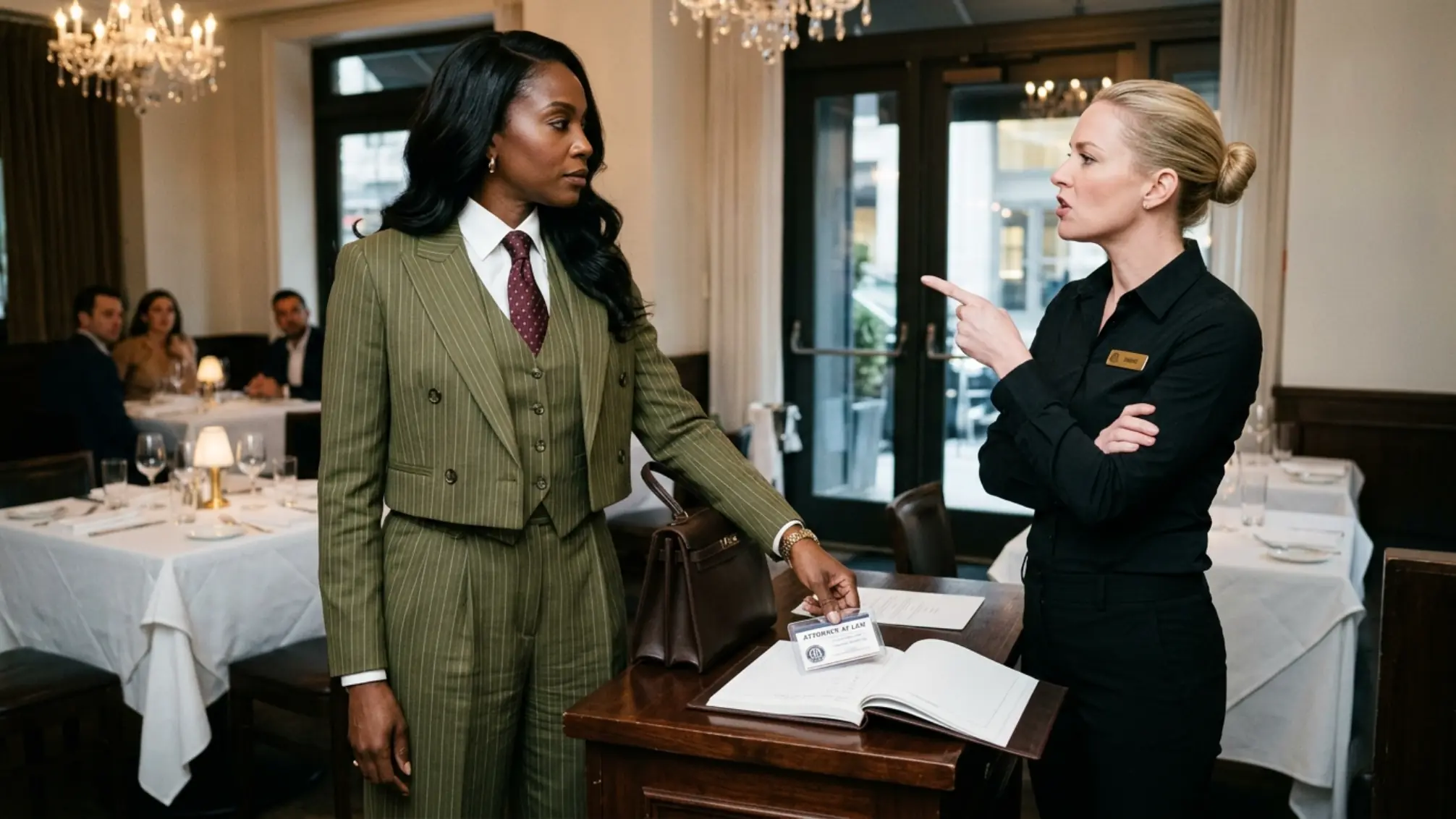
Ava glanced once at the dining area.
“My reservation is for seven thirty,” she said. “Under Brooks.”
The hostess, a white American woman in her late thirties named Lauren Pierce, lowered her eyes to the screen. Her blonde hair was twisted into a tight bun, and a gold name badge sat perfectly centered on her fitted black shirt. She tapped the keyboard twice, although Ava could see that no search results had changed.
“There is no reservation under that name.”
Ava set her structured dark-brown handbag beside the desk. She was forty-two, tall and composed, with deep brown skin, sharp dark eyes, and long glossy black hair arranged in smooth waves over her shoulders. Her cropped double-breasted blazer, fitted vest, crisp white shirt, burgundy silk tie, and wide-leg trousers had been tailored in London and cost more than most people would guess.
Lauren still called the outfit fake.
“Perhaps you’re at the wrong restaurant,” she said. “There are several casual places nearby that may be more appropriate.”
Ava looked at her.
“Appropriate for what?”
Lauren’s expression tightened slightly.
“For what you’re wearing. For the kind of evening you seem to be having.”
“I’m wearing a suit.”
“A very dramatic one.”
Ava’s gold watch caught the light when she checked the time.
“Please search the confirmation number.”
Lauren folded her arms. “I already told you there is nothing to search.”
Ava took out her phone and opened the reservation email. The Bellamy House logo appeared above the date, time, party size, and confirmation code. The reservation was for two people in the main dining room, secured nearly three weeks earlier through Ava’s executive assistant.
Lauren glanced at the screen.
“That could have been created by anyone.”
Ava’s eyes rose slowly.
“Are you accusing me of forging a restaurant confirmation?”
“I’m saying we deal with people who try things.”
“What kinds of things?”
Lauren leaned closer across the desk.
“Showing up dressed like someone important. Claiming they belong in rooms they clearly don’t.”
The insult was quiet enough to sound private but loud enough for a nearby server to hear. The young man slowed for half a step, then continued carrying a tray toward the dining room.
Ava did not react.
“Check the number.”
Lauren straightened.
“I don’t have to.”
“Then ask your manager.”
“I am the senior hostess.”
“That was not my request.”
The entrance door opened behind Ava, admitting a white couple wearing evening clothes. Lauren’s expression changed before they even reached the desk.
“Mr. and Mrs. Hammond,” she said warmly. “Welcome back.”
The couple had no reservation. Ava knew because the man apologized for arriving unexpectedly, explaining that a theater performance had ended early. Lauren laughed and told them Bellamy House would always find room for regular guests.
She escorted them toward one of the empty tables.
Ava remained beside the desk.
When Lauren returned, her smile disappeared.
“You’re still here.”
“My table is still empty.”
“You don’t have a table.”
“I have a confirmation.”
Lauren looked around the entrance as though searching for someone who could remove an inconvenience.
“Ma’am, do not make this difficult.”
Ava’s voice stayed level.
“You denied that my reservation existed. Then you seated two people who admitted they did not have one.”
“They are known guests.”
“And I am not?”
“Exactly.”
The word escaped before Lauren had time to soften it.
Ava studied her face.
“Thank you.”
Lauren blinked. “For what?”
“For answering honestly.”
The restaurant’s assistant manager, Daniel Crewe, appeared from the dining room. He was a white American man in his mid-forties with silver at his temples, a narrow black suit, and an expression carefully trained to communicate impatience without losing professionalism.
“Is there a problem?” he asked.
Lauren spoke first.
“This woman is refusing to leave.”
Ava turned toward him.
“I have a confirmed reservation that your hostess refuses to verify.”
Daniel glanced at Ava’s clothes, handbag, and hair before looking at the screen.
“What name?”
“Brooks.”
He typed more quickly than Lauren had. Ava watched his eyes pause on something.
Then he closed the search window.
“There’s nothing here.”
Ava noticed the movement.
“You found it.”
“No.”
“You stopped searching after the third letter.”
Daniel’s polite mask thinned.
“Are you attempting to tell me how to use our system?”
“I’m describing what I watched you do.”
Lauren gave a small laugh.
Ava continued.
“The confirmation number is BH-72941.”
Daniel did not enter it.
Instead, he placed both palms on the desk.
“Bellamy House reserves the right to refuse service.”
“On what grounds?”
“Dress, conduct, capacity, or the judgment of management.”
“Which ground applies to me?”
Daniel’s eyes traveled over the olive-green pinstripes.
“Your presentation is not consistent with the atmosphere we maintain.”
Ava glanced into the dining room. A man near the bar wore an open denim jacket. Another guest had arrived in bright athletic shoes. A woman seated near the windows wore a sparkling silver dress with feathers extending from both shoulders.
“My tailored suit violates your atmosphere?”
Daniel gave her a controlled smile.
“It is not only the suit.”
“What else?”
“The attitude.”
Ava’s expression did not change.
“You mean asking you to honor a reservation?”
“You are being confrontational.”
“I have not raised my voice.”
“Volume is not the only form of aggression.”
Lauren nodded as if he had finally named something she could use.
Ava removed a small leather notebook from her handbag.
“What are you doing?” Daniel asked.
“Recording the reason you gave for refusing service.”
“You are not permitted to conduct business here.”
“I am writing in a notebook.”
“You should leave.”
Ava wrote down the time.
7:34 p.m.
She recorded Lauren’s name, Daniel’s name, the visible empty-table count, the confirmation number, and the fact that the Hammond couple had been seated without a reservation.
Daniel watched her.
“Put that away.”
“No.”
“This is private property.”
“And you have asked me to leave?”
“Yes.”
“Clearly and unconditionally?”
“Yes.”
Ava closed the notebook.
“Then I will leave after you provide written confirmation that the restaurant refused to honor my reservation.”
Daniel laughed.
“We are not giving you anything.”
“Then email it.”
“No.”
“Would you prefer that I record you saying it?”
Lauren stepped around the desk.
“You need to stop threatening us.”
Ava turned toward her.
“I have made no threat.”
“You’re standing there acting like you’re building some kind of case.”
“Are you worried that I am?”
Lauren stopped less than two feet away.
“Your fake suit won’t buy you a table. Leave before I have you dragged out.”
Several diners near the entrance looked over.
Ava placed her handbag back on the desk and stepped closer.
“Touch me, and this restaurant becomes evidence.”
Daniel moved between them.
“That is enough.”
Lauren pointed toward the door.
“You think pretending to be important scares me?”
Ava reached into her handbag and removed a black credential wallet.
She placed it beside the reservation book.
“Read my name,” she said. “Then repeat every word under oath.”
Lauren looked down.
At first, she saw only the gold lettering beneath the photograph.
Then she saw the name.
Her entire face changed.
“Ava Brooks,” she whispered.
Daniel leaned toward the credential.
Ava Brooks was not merely an attorney. She was the founder of Brooks Civil Rights Group, the lawyer who had won a record settlement against a luxury hotel chain after employees repeatedly denied Black guests access to rooms they had already paid for. Her arguments had been broadcast during a nationally followed state supreme court case involving discriminatory service policies disguised as managerial discretion.
Her face had appeared in newspapers, interviews, documentaries, and legal conferences.
Lauren stumbled backward.
“No,” she said. “No, that can’t be you.”
Ava picked up the credential.
Lauren’s voice began shaking.
“Why didn’t you say who you were?”
The question hung between them.
Ava’s expression remained calm.
“Would it have changed how you treated me?”
Lauren looked at Daniel.
Daniel looked toward the dining room, where guests were now openly watching.
“I believe there has been a misunderstanding,” he said.
“No,” Ava replied. “You understood exactly what you were doing.”
Daniel’s tone transformed.
“Ms. Brooks, please allow me to personally arrange our best table.”
“Thirty seconds ago, my presentation violated your atmosphere.”
“That was based on incomplete information.”
“What information were you missing?”
Daniel did not answer.
Lauren stepped forward again, but now her arms were uncrossed and her voice had softened.
“We truly apologize. Your name did not appear correctly in the system.”
Ava turned the screen slightly.
“Search it again.”
Lauren hesitated.
“Please.”
Daniel typed the surname.
The reservation appeared immediately.
BROOKS, AVA — PARTY OF TWO — 7:30 P.M. — TABLE 14 — CONFIRMED.
Beneath the entry was a note added at 7:31 p.m.
GUEST DID NOT ARRIVE. RELEASE TABLE IF NEEDED.
Ava looked at the timestamp.
“I was standing here at seven twenty-eight.”
Lauren’s mouth opened.
Daniel closed the reservation window again.
“Someone must have entered that note accidentally.”
“Who was logged into the terminal?”
Neither answered.
Ava looked toward the small security camera mounted above the entrance.
“Preserve the footage.”
Daniel’s posture stiffened.
“You have no authority to order that.”
“I have not ordered you. I have warned you that deleting it after notice may create additional problems.”
“We are not deleting anything.”
“Good.”
A restaurant owner named Thomas Bellamy emerged from a private dining room five minutes later. Someone had recognized Ava and sent him a message before Daniel could control the situation.
Bellamy was sixty-three, silver-haired, and dressed in a dark navy suit. He approached quickly, extending both hands as though welcoming an honored guest.
“Ms. Brooks, what an extraordinary pleasure.”
Ava did not take his hands.
“Is it?”
He lowered them.
“I understand there was confusion concerning your reservation.”
“There was no confusion.”
Bellamy looked toward Daniel and Lauren.
“I am certain my staff never intended disrespect.”
“They intended to deny me service.”
Bellamy’s smile faded.
“May we discuss this privately?”
“We can discuss it here.”
Several phones were visible now. Diners near the bar had begun recording after hearing Lauren panic over Ava’s name.
Bellamy lowered his voice.
“This is not the environment for a productive conversation.”
“It was an acceptable environment when your staff insulted me.”
“I was not present.”
“You are present now.”
Bellamy looked toward the dining room.
“What would resolve this?”
Lauren’s head snapped toward him. Daniel’s eyes narrowed. They all understood the question as an invitation to negotiate.
Ava did not.
“Your first response should not be asking what I want.”
“Then what should it be?”
“Find out whether this has happened before.”
Bellamy’s face became guarded.
“Our restaurant serves thousands of diverse guests.”
“That was not an answer.”
“We have strict anti-discrimination policies.”
“So did every company I have sued for discriminatory treatment.”
Ava’s phone vibrated. Her dinner guest, Judge Elena Martinez, had arrived outside and sent a message asking whether she should enter.
Ava replied that she should wait.
Bellamy watched her.
“Ms. Brooks, perhaps we can provide a private room, dinner on the house, and transportation after your meal.”
“You still believe this is about a table.”
“What else could it be about?”
“The confidence with which they did it.”
Bellamy did not speak.
Ava continued.
“Your hostess did not fear discipline when she called my clothes fake. Your manager did not hesitate before falsely claiming my reservation did not exist. They were comfortable because they expected your system to protect them.”
Daniel finally interrupted.
“That accusation is unfair.”
Ava faced him.
“You found my reservation.”
“I did not.”
“You closed the window after seeing it.”
“You cannot prove what I saw.”
Ava looked at the security camera.
“That may be true.”
Daniel glanced upward involuntarily.
Ava noticed.
Bellamy turned to him.
“Daniel, go to my office and ask security to preserve all footage from this entrance.”
Daniel remained still.
“Now,” Bellamy said.
The manager left.
Lauren looked as though she might follow, but Ava spoke before she could move.
“Stay.”
Lauren’s face hardened again for a moment.
“You cannot tell me what to do.”
Bellamy intervened.
“Lauren, remain here.”
The hostess obeyed him.
That distinction did not escape Ava.
A server named Mia Chen approached quietly from the edge of the dining room. She was twenty-six, Asian American, and visibly nervous.
“Mr. Bellamy,” she said, “I think there is something you should know.”
Lauren turned sharply.
“Mia, return to your station.”
Mia did not move.
Bellamy looked at her.
“What is it?”
She glanced at Ava, then at the hostess.
“This has happened before.”
Lauren’s face went pale for a second time.
“That is a lie.”
Mia swallowed.
“There are names.”
“What names?” Ava asked.
Mia reached into her apron and removed her phone.
“For the past year, staff have been told to mark certain reservations with a black dot.”
Bellamy stared at her.
“What does the dot mean?”
Mia looked at Lauren.
Lauren answered before she could.
“It is an internal service note.”
“For what?” Ava asked.
Lauren’s silence provided the answer.
Mia opened a photograph on her phone. It showed a printed reservation list with several names marked by small black circles.
“Customers whose profiles they wanted checked before seating,” she said.
“Profiles?” Bellamy asked.
“Social media, photos, employment, anything they could find. Mostly Black guests. Sometimes Latino guests. Sometimes people with foreign names.”
Lauren shook her head.
“It was about payment risk.”
Ava looked at her.
“You investigated race as a payment risk?”
“No. We had problems with fraud.”
“Was I investigated?”
Mia nodded reluctantly.
“Lauren searched your name when the reservation first appeared.”
“And?”
“She found several Ava Brooks profiles. She said none looked like someone who belonged here.”
Ava remained still.
“Did she see my photograph?”
Mia looked at the floor.
“She found the correct profile later.”
Bellamy turned toward Lauren.
“When?”
“After she arrived,” Mia answered. “Lauren saw the legal articles, but by then she had already told Ms. Brooks there was no reservation.”
“So she knew who I was before reading the credential?” Ava asked.
Mia nodded.
Lauren’s panic shifted into anger.
“She was testing us.”
Ava stared at her.
“I made a reservation and arrived for dinner.”
“You dressed differently from your public photographs.”
“I wore a suit.”
“Your hair was different.”
“My hair is not an identity document.”
Lauren’s voice rose.
“You knew what people would think.”
Ava’s expression became colder.
“Say that again.”
Bellamy stepped between them.
“Lauren, stop speaking.”
But Lauren had lost control.
“She came in looking like she wanted a confrontation. That suit, that attitude, asking questions about every little thing—”
Ava moved one step closer.
“What exactly about my suit told you to erase my reservation?”
Lauren’s hands trembled.
“You were acting superior.”
“I asked you to search a confirmation code.”
“You looked at me like I was beneath you.”
“No. I looked at you like I expected you to perform your job.”
The distinction silenced her.
Daniel returned with the restaurant’s security director. He looked unsettled.
“The entrance footage is temporarily unavailable,” he announced.
Bellamy turned slowly.
“Why?”
“There appears to be a recording failure.”
Ava checked the time.
“The camera was working when I arrived.”
Daniel’s jaw tightened.
“You cannot know that.”
“The status light was green.”
The security director, a Black American man named Marcus Lee, looked toward the camera.
“It was recording.”
Daniel glared at him.
Marcus continued.
“The system shows a manual deletion request from the management terminal six minutes ago.”
Bellamy’s face hardened.
“Whose login?”
Marcus looked directly at Daniel.
“His.”
The dining room became completely quiet.
Daniel’s expression changed from defensive to desperate.
“I was clearing old files to protect guest privacy.”
“You deleted footage after Ms. Brooks told you to preserve it?” Bellamy asked.
“I did not know she was serious.”
Ava looked at him.
“You knew exactly why I was serious.”
Marcus lifted a small tablet.
“The deletion did not complete. Our cloud backup had already synchronized.”
Daniel closed his eyes.
Bellamy ordered him to surrender his key card and leave the floor. Daniel began protesting, but two security employees approached before he could finish.
Lauren watched him being escorted away.
Her confidence collapsed with his.
“I followed his instructions,” she said.
Mia shook her head.
“You created the black-dot list.”
Lauren turned toward her.
“You participated.”
“I copied it because I knew someone would eventually need proof.”
Ava asked Bellamy for access to all formal complaints involving reservation denial, dress enforcement, and alleged disruptive conduct during the previous three years.
Bellamy looked exhausted.
“My attorneys will need to review that.”
“Of course.”
“Are you planning to sue us?”
“I am planning to understand what happened.”
“That is not reassuring.”
“It should not be.”
Judge Elena Martinez entered the restaurant after waiting nearly thirty minutes outside. She was fifty-eight, Latina American, and dressed in a dark red evening suit. Several diners recognized her immediately.
Bellamy looked from Elena to Ava.
“You were dining with Judge Martinez?”
Ava nodded.
Lauren covered her mouth.
Elena examined Ava’s expression.
“What happened?”
“They lost my reservation,” Ava said.
Elena glanced at the untouched confirmation screen, the security staff, the frightened hostess, and the diners holding phones.
“Did they?”
“Then they found my name.”
Elena understood.
She stood beside Ava and looked at Bellamy.
“I assume you have preserved the evidence.”
“We are doing so now.”
“Good,” Elena replied. “Because polite behavior after recognizing power does not erase abusive behavior before it.”
Ava finally agreed to leave, but she did not accept Bellamy’s offer of a private meal. She and Elena ate at a small Ethiopian restaurant three blocks away, where the owner greeted them without asking either woman to prove she belonged.
By the time they finished dinner, Bellamy House had become the subject of hundreds of social media posts.
A diner had uploaded a video showing Lauren pointing toward the exit and insulting Ava’s suit. Another clip captured Lauren’s terrified reaction after reading the credential.
“Why didn’t you say who you were?” became the sentence people repeated most.
The question exposed the entire problem.
The following morning, Bellamy House issued a statement describing the incident as an isolated failure involving two employees. Ava released no public comment. Instead, Brooks Civil Rights Group sent the restaurant a formal preservation notice covering reservation systems, internal messages, camera footage, complaint files, employee disciplinary records, and the black-dot list.
Mia provided copies of schedules and messages.
The pattern was larger than Ava expected.
Over two years, at least seventy-three reservations had been marked for additional screening. Fifty-eight belonged to Black guests. Many were labeled no-shows even though entrance footage showed the guests arriving. Some were told the restaurant had closed for a private event, while white customers without reservations were admitted minutes later.
Several guests had complained.
Daniel had closed nearly every complaint.
His internal notes described Black women as hostile, aggressive, demanding, or suspicious even when their written messages were calm. Lauren repeatedly cited dress concerns without naming any actual policy violation.
One complaint came from a Black doctor who had been asked to present the credit card used to secure her reservation before being allowed to sit. Another came from a married couple celebrating their twentieth anniversary who were told their table had been released because they arrived four minutes late.
A white couple arrived twenty-two minutes late that same evening and received complimentary champagne.
Bellamy claimed he had never seen the pattern.
Ava believed him.
That did not excuse him.
“You built a business in which the worst information stopped below your office,” she told him during a recorded meeting. “You benefited from not knowing.”
Bellamy’s lawyers offered a private settlement within a week.
Ava rejected it.
She did not want free meals, compensation for embarrassment, or a confidential apology. She wanted an independent review, restitution for previously denied customers, structural changes to complaint handling, and a public acknowledgment that the restaurant had used racial screening disguised as guest management.
Bellamy initially refused the public admission.
Then Marcus recovered messages from Daniel’s deleted account.
One message from Lauren read:
Black dot at 7:30. Green suit. Very confident. Let’s see how long she lasts.
Daniel replied:
Release the table before she creates a scene. If she complains, use conduct.
The message was sent five minutes before Ava arrived.
There had never been confusion.
There had been a plan.
Bellamy House closed voluntarily for three weeks after the evidence became public. Lauren and Daniel were terminated. Both later faced civil claims from multiple former customers, while the state human-rights agency opened a formal investigation.
Bellamy agreed to establish an independent reservation audit, remove subjective dress standards, and prohibit employees from searching guest photographs or social media profiles before arrival.
Mia became the restaurant’s compliance liaison after completing outside training, though she initially resisted the promotion.
“I stayed silent too long,” she told Ava.
“You preserved evidence,” Ava replied.
“I still watched people get turned away.”
“Then let the guilt change what you do next.”
Bellamy House created a restitution fund for guests whose reservations had been wrongfully canceled or denied. Some accepted reimbursement. Others wanted written apologies. Several chose to participate in the investigation.
Ava did not become the restaurant’s lawyer, consultant, or public spokesperson. She refused every invitation to appear in a promotional campaign about transformation.
“My mistreatment is not your redemption story,” she told Bellamy.
Six months later, Ava returned to Bellamy House.
She wore the same olive-green pinstripe suit.
Her hair fell in the same smooth waves. The burgundy tie, gold watch, brown handbag, and pointed heels were unchanged.
A new hostess stood behind the reservation desk.
“Good evening,” the young woman said. “May I have the name on the reservation?”
“Brooks.”
The hostess searched the system.
“Ms. Ava Brooks, party of two at seven thirty.”
She looked into the dining room.
“Your table is ready.”
No recognition flashed across her face. She did not know Ava from the news, did not notice the legal credential inside her handbag, and did not care whether the woman before her was famous.
She simply honored the reservation.
That was the response Ava had wanted from the beginning.
Judge Elena Martinez joined her a few minutes later. As they were escorted toward the dining room, Ava passed the same reservation desk where Lauren had once told her that the suit on her body was a costume.
The restaurant was quieter now.
Not because employees feared her name, but because new systems had made private prejudice harder to convert into public policy.
Elena sat across from her.
“Do you trust the place?”
“No,” Ava said.
“Then why come back?”
Ava looked toward the entrance, where a Black couple had just arrived. The new hostess welcomed them, confirmed their anniversary reservation, and led them to a window table without hesitation.
“Because I wanted to see whether they had learned to treat an unknown woman correctly.”
“And?”
Ava watched the couple sit down.
“They did not ask who she was.”
Elena smiled.
Ava opened the menu.
The greatest victory had not occurred when Lauren read the credential and suddenly became polite. That moment had only proven that she understood power.
The real victory came later, when another Black woman entered the restaurant without fame, legal authority, or a recognizable name—and no one demanded that she prove she belonged.