“Fifteen dollars for a swamp? You just bought forty acres of failure.” Grant Mercer’s laughter carried across the flooded field while three neighboring farmers stood behind him on the muddy bank, their expensive trucks lined up along the county road. Ruth Callahan climbed slowly from knee-deep water, her tall rubber boots sinking into the Arkansas mud while her faded jeans and beige farm shirt clung damply to her legs. She removed one glove, pushed loose auburn hair beneath her worn cap, and looked at the men without lowering her eyes.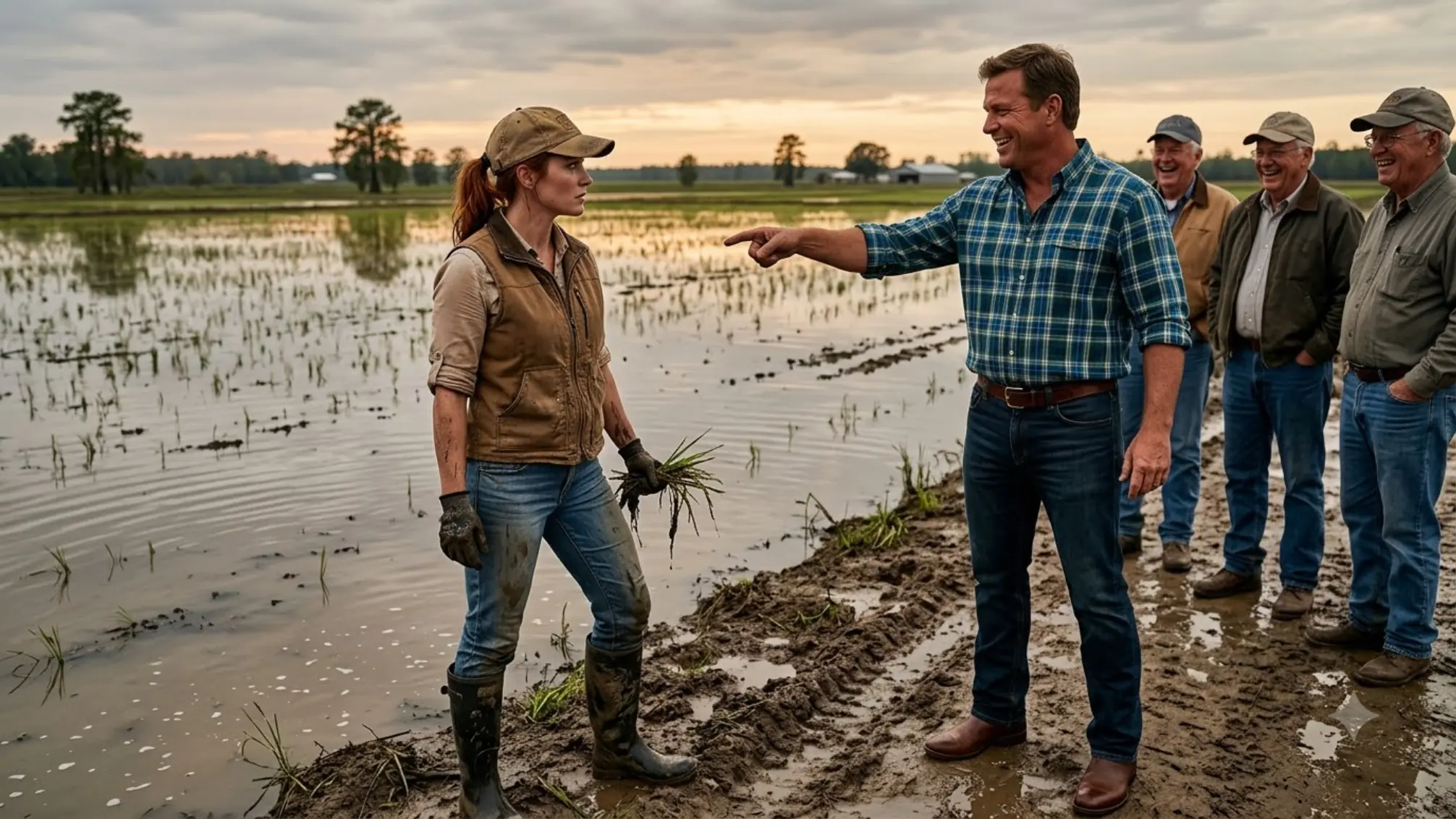
“Funny,” Ruth said, stepping onto firmer ground. “You’ve farmed here thirty years and still don’t understand what you’re looking at.” Grant’s grin disappeared as Ruth opened her gloved hand and revealed several tiny rice shoots she had been studying beneath the shallow water. He stepped closer and pointed across the flooded acreage, telling her that the water would drown every dollar she put into the place.
Ruth closed her fingers around the shoots. “Then keep laughing, Grant. By harvest, you’ll be asking me how the water made me rich.” The men behind him laughed again, but Grant did not, because there was something in Ruth’s expression that had changed since the county auction two weeks earlier. She no longer looked like the grieving widow desperately trying to recover something that belonged to her dead husband; she looked like a farmer who had finally noticed something everyone else had missed.
The land had once belonged to Danny Callahan, Ruth’s husband, and acquiring it for fifteen dollars was not the miracle outsiders later imagined. Danny had purchased the forty acres because they bordered the couple’s small homestead, even though nearly everyone in Cypress Bend believed the property was useless. Water sat across much of it for months at a time, heavy equipment sank into the clay, and three consecutive attempts by previous owners to establish conventional crops had failed. Danny never saw those failures as a verdict, only as a problem he had not yet learned how to solve.
He used to tell Ruth that when life slowed down, he would figure the land out. Then one August afternoon, Danny suffered a massive heart attack while repairing a neighbor’s hay equipment, and at thirty-four years old he was gone before Ruth could reach the hospital. He left behind Ruth, their seven-year-old daughter Emma, the small family house, unfinished plans, and debts that did not disappear simply because the person responsible for paying them had died. Grief arrived at the same time as utility bills, mortgage notices, school expenses, and the terrifying realization that Ruth now had to keep a family alive alone.
For nearly a year, Ruth took additional shifts at the feed store and cut every household expense she could find. She skipped meals when groceries ran short, repaired Emma’s clothes instead of replacing them, and sold Danny’s larger farm equipment one piece at a time to keep the mortgage current. Eventually one missed payment became two, then three, and the bank foreclosed on the flooded acreage Danny had believed in. Ruth watched legal notices appear on the property and felt as though she were losing part of him for a second time.
Months later the county listed the land at a tax auction. The opening bid was only fifteen dollars because officials expected nobody to want the property, and almost every serious farmer in Cypress Bend had already decided that the forty acres were not worth the drainage costs required to make them conventional farmland. Ruth entered the courthouse carrying barely more than six hundred dollars in her checking account and sat quietly in the back while wealthy neighbors joked about which fool might eventually inherit the swamp. Nobody raised a bidding card.
Ruth did.
“Fifteen dollars,” she said.
The auctioneer waited.
No competing bid came.
The gavel fell.
Outside the courthouse, Grant Mercer and several other farmers watched Ruth walk toward her old pickup carrying the deed papers. Grant called after her that she had just purchased forty acres of water and mosquitoes, while another farmer shouted that she would spend a thousand dollars trying to make fifteen dollars worth of land usable. Ruth climbed into her truck without responding, placed the documents beside her, and drove home with only $612 left to her name.
The legal challenge period passed without anyone contesting the sale. The land belonged to Ruth again, but the victory immediately revealed a more dangerous problem because Arkansas’s rice planting window was rapidly approaching. Ruth had forty-one days to prepare ground that most professionals believed required thousands of dollars in drainage and earthwork. If she failed to establish a crop that year, another twelve months would pass before the property had another meaningful chance to support Emma and her.
Before sunrise on March 3, Ruth walked alone into the flooded acreage. Mist hung over the water, frogs called somewhere beyond the tree line, and the surface remained remarkably still despite the rain that had fallen the previous evening. Everyone Ruth knew had always asked the same question about the property: how could they get rid of the water? Standing there in rubber boots with cold water around her knees, she suddenly wondered whether everybody had started with the wrong question.
Ruth knelt and pushed one hand beneath the surface. The water was shallow, consistent, and spread across naturally low sections of the property without moving violently toward one outlet. Beneath it, the clay held moisture almost exactly the way she remembered from fields outside Lafayette, Louisiana, where her uncle had farmed when Ruth was a child. Every summer she had watched rice rise from flooded ground, and after harvest those same acres became home to something most Arkansas farmers around Cypress Bend barely considered.
Crawfish.
The memory seemed almost ridiculous at first because Ruth had not worked on her uncle’s Louisiana farm in nearly twenty years. Yet the more she studied the water, the more details returned: controlled shallow flooding, rice stubble providing habitat, seasonal rotation, and fields that made money twice from the same water. Ruth stood slowly and looked across the forty acres everyone called ruined. Perhaps the water was not the enemy at all.
She spent evenings researching after Emma fell asleep. Agricultural extension bulletins, old farming books, borrowed university publications, and notes Ruth remembered from her uncle began covering the kitchen table. She calculated planting windows, rice seed rates, water depths, crawfish stocking numbers, and harvest seasons until numbers appeared in her dreams. Danny’s work boots still sat beside the back door, and whenever exhaustion made her consider quitting, Ruth looked at them and remembered the promise he never had time to fulfill.
The first person she approached was Walt Pruitt, one of Cypress Bend’s most experienced farmers. Walt had survived droughts, floods, collapsing commodity prices, insect outbreaks, and almost fifty Arkansas growing seasons, so Ruth respected his opinion even when she suspected he would disagree with her. She explained that she did not intend to drain the forty acres completely and instead wanted to control the standing water so rice could be planted and crawfish introduced after harvest. Walt listened without interrupting.
Then he shook his head. “You can’t beat this ground, Ruth. Water destroys farms around here.” His tone was not cruel like Grant Mercer’s; it carried the confidence of a lifetime spent learning what usually worked. Ruth drove home troubled because Walt was not an arrogant man, and if someone with his experience believed the plan impossible, perhaps she was allowing memories of Louisiana to outweigh reality.
The bank offered even less hope. Ruth returned to the institution that had foreclosed on Danny’s property and requested only enough financing to rent equipment, shape simple levees, and purchase seed before planting season ended. The loan officer reviewed the proposal carefully, then explained that the acreage already carried a history of failure and that no comparable operation existed nearby to justify the risk. Ruth left carrying the same folder she had brought inside and no additional money.
The county Extension Office estimated that developing a proper rice operation on problematic ground could require eight thousand to twelve thousand dollars before planting was complete. Levees, control structures, drainage work, field leveling, equipment rental, and preparation all cost money Ruth did not possess. She thanked the agricultural agent because he was being realistic rather than dismissive. Then she returned to her pickup and sat behind the steering wheel wondering whether reality and impossibility were beginning to look identical.
Danny’s mother Pauline confronted the emotional problem Ruth had been trying not to acknowledge. She loved Ruth and Emma deeply, and she had watched them struggle after Danny died, so her warning came from fear rather than contempt. “Emma needs security more than another impossible dream,” Pauline told her gently. That night, Ruth sat at the kitchen table long after Emma had gone to bed and wondered whether she was farming because the plan made sense or because she could not bear to let Danny’s last unfinished project disappear.
Two mornings later, an old pickup with Louisiana plates rolled onto the property. The driver was Delcus Boudreaux, an elderly Cajun farmer who had known Ruth’s uncle years before and had heard about the flooded acreage through family contacts. Delcus did not begin by asking for financial projections or looking at Ruth’s research. He stepped into the water, walked slowly across several sections of the field, lifted handfuls of clay, watched where the surface moved, and finally said, “Take me to the water that refuses to move.”
Ruth stared at him. Those words described exactly what had bothered her since the first morning. She guided him toward the shallow depression where the water remained unusually stable, and Delcus stood there for several minutes without speaking. Finally he looked at her and asked what she remembered from Louisiana.
“Rice first,” Ruth said. “Then flood the stubble again.”
“And?”
“Crawfish.”
Delcus smiled.
For the first time since the auction, someone with genuine agricultural experience did not tell Ruth she was crazy. Delcus explained that expensive infrastructure could make the system easier, but lack of money did not automatically make it impossible. What Ruth needed was control, not perfection. If the land already wanted to hold water, she should stop spending imaginary money trying to force it to behave like dry ground.
Thirty-seven days remained before the planting window closed. One evening Delcus spread an old feed receipt across the hood of Ruth’s pickup and sketched a series of low levees that followed the natural contours of the land. Instead of bulldozers and professionally engineered earthworks, the design relied on simple water-control points and thousands of hours of labor. “You don’t have money,” he told Ruth. “So let the land do most of the work.”
The next morning Ruth started digging. She owned no bulldozer, had no contractor, and could not afford a full crew, so the first levee grew one wheelbarrow of dirt at a time. Ruth worked three hours before reporting to the feed store, then returned after her shift and continued until darkness made the shovel difficult to see. Her hands blistered until the skin hardened, and every muscle in her back began protesting whenever she lifted another load.
Emma started helping without being asked. The seven-year-old carried small branches away from work areas, counted wheelbarrow loads, packed loose soil beneath her boots, and brought her mother water when the afternoon sun became unbearable. Ruth repeatedly told her she did not have to work, but Emma answered that the farm had belonged to Daddy too. Those words made Ruth turn away once because she did not want her daughter seeing tears.
By the ninth day, almost nine hundred feet of levee stretched across the property. The structure looked crude compared with the professional systems Ruth had seen in agricultural publications, yet it was beginning to divide the random flooding into manageable sections. Farmers driving along the county road started slowing down. Grant Mercer stopped one afternoon and watched from his expensive pickup without climbing out.
Ruth noticed him.
She did not wave.
Grant did not laugh.
Curiosity had begun replacing certainty.
Eighteen days remained when a violent spring storm moved across eastern Arkansas. Nearly four inches of rain fell within six hours, filling roadside ditches and sending water toward every low field in Cypress Bend. Ruth stood beneath the porch roof most of the night listening to rainfall hammer the metal gutters while imagining the unfinished levees dissolving into mud. If the system failed now, she might not have enough time to rebuild before planting season ended.
At sunrise she drove to the field with Emma beside her. The sight waiting there crushed her. Almost forty feet of the main levee had collapsed, and water rushed through the opening hard enough to carry freshly packed soil across the acreage. Two weeks of physical work were disappearing in front of her.
Ruth walked toward the break and stopped. For the first time since reclaiming the farm, she could not immediately think of the next task. Pauline’s warning returned to her, followed by the banker’s rejection, the Extension Office estimate, Grant’s laughter, and Walt’s certainty that water would always win. Maybe every one of them had simply reached the obvious conclusion before she did.
The next morning Ruth sat alone on her pickup’s tailgate with her phone in one hand. She considered calling the bank and asking whether there was any way to sell the land before she lost more money. Emma watched from the farmhouse porch but did not approach. Ruth had almost touched the number when Delcus’s old pickup rolled into the driveway.
He walked straight past her and entered the damaged levee. Delcus crouched, broke apart several clumps of soil, and studied the layers. After several minutes he looked at Ruth. “You packed dirt,” he said. “You never packed the layers.”
Ruth stared at him.
Delcus explained that the failure was not proof the farming system was wrong. Each layer of earth should have been compacted separately before the next was added, otherwise rainwater would locate weak pockets and tear the levee apart from within. Ruth had been building quickly because she was racing the planting deadline, and speed had hidden structural weaknesses.
They began rebuilding immediately. Delcus refused payment and worked beside Ruth from sunrise until evening for two straight days, placing soil in thinner layers and compacting each section carefully. Emma carried water and watched every technique as though attending a private farming school. When another heavy rain arrived several days later, Ruth barely slept.
At first light she drove to the property.
The levee stood.
No major break.
No washed-out section.
Ruth walked its length twice because she almost did not trust what she was seeing.
Eleven days remained. A neighboring farmer who had quietly watched Ruth’s progress finally offered an old seed drill, and she accepted because pride no longer mattered as much as getting rice into the ground. Ruth planted later than she wanted, but before the agricultural window closed. Then the work changed from racing time to waiting for nature.
For almost two weeks the water looked empty. Ruth checked every morning before the feed store and every evening afterward, searching for evidence that she had not planted into another expensive failure. Then one afternoon Emma screamed from the edge of the field. Hundreds of tiny green shoots were pushing through the water.
Within days there were thousands. Rows of rice slowly transformed the flooded acreage from gray-brown water into a field streaked with green. Walt Pruitt eventually stopped his truck, climbed out, and stood beside the levee studying the young plants. Another farmer pulled over behind him, one of the men who had laughed outside the courthouse.
Neither offered congratulations.
Neither laughed.
Summer strengthened the crop. Ruth monitored water depth, repaired small leaks, removed weeds by hand where necessary, and worked the feed-store job until she could barely keep her eyes open at supper. Emma spent many evenings walking the levees beside her, asking questions about rice, Louisiana, and whether Danny would have understood what they were building. Ruth always answered the final question the same way.
“He would’ve tried.”
By August, mature golden heads bent across the forty acres. Ruth rented a combine she could barely afford and watched the machine enter the first row with her stomach tight enough to hurt. Grain began pouring into the hopper. For months she had been defending an idea; now the field was producing something that could be weighed.
When the harvest ended, Extension Office calculations showed the acreage averaging approximately 6,200 pounds of rice per acre. The number compared favorably with productive Arkansas ground that cost vastly more than Ruth’s fifteen-dollar purchase. The agricultural agent who had once explained how expensive development normally would be admitted openly that he had not expected the field to perform that well. Ruth appreciated the honesty, but she knew the rice was only half of what she intended.
Several days after the combine left, Ruth closed the water-control gates and flooded the harvested field again. Grant Mercer drove past slowly and finally stopped. “You trying to drown what’s left?” he called from the roadside. Ruth did not answer.
A truck arrived from Louisiana carrying approximately sixty thousand juvenile crawfish.
Grant got out of his pickup.
“What in God’s name are you doing?”
Ruth opened the first transport container.
“Using the water.”
“You already harvested.”
“I know.”
“Then drain it.”
Ruth looked at him.
“Still think you understand this field better than me?”
Grant stared.
Ruth began releasing crawfish into the shallow water.
Thousands disappeared beneath rice stubble.
The second crop had begun.
Autumn brought another period of uncertainty. A sudden November cold front lowered water temperatures enough that the crawfish nearly stopped feeding. Ruth checked traps each morning and repeatedly found almost nothing, watching the potential second income disappear into empty wire baskets. One evening Emma looked across the field and quietly asked whether they were going to lose the farm again.
Ruth stopped walking.
She could promise effort.
She could promise she would not quit easily.
She could not promise nature.
Instead, Ruth wrapped both arms around Emma and held her until the girl stopped trembling.
Several days later, temperatures rose. The first trap contained a small catch, then the next held more. Soon nearly every trap Ruth checked contained market-sized crawfish.
By January, the first serious harvest began.
Day one produced roughly 340 pounds.
By the end of the first week, the total passed 2,100 pounds.
Word spread through Cypress Bend.
Truck traffic increased along the county road. Farmers who once avoided the flooded property now slowed almost every time they passed, and several stopped pretending their visits were accidental. The question changed from Will this work? to How is she doing it?
A regional seafood distributor eventually drove to the property after hearing about Ruth’s catches. Trucks were loaded throughout the day while workers repeatedly requested additional containers. At one point, the distributor stopped writing numbers and looked toward Ruth in disbelief. “Do you have any more traps?”
Ruth pointed across the water.
“About another hundred.”
The first full crawfish season ultimately produced more than 31,000 pounds. Combined with the rice crop, Ruth’s first-year farm revenue exceeded $110,000, an extraordinary return from forty acres nearly everyone in Cypress Bend had considered economically useless. The land had not become valuable because Ruth defeated the flooding. It became valuable because she finally understood how to use it.
That realization brought her back to the first March morning. She had knelt in the water and noticed its stability without fully understanding why the observation mattered. Her childhood memories of Louisiana had supplied the missing context. Rice and crawfish required exactly the controlled shallow-water environment her neighbors had spent years treating as a defect.
Everyone else asked, “How do we remove the water?”
Ruth asked, “What can the water produce?”
The difference was worth more than money.
Grant Mercer returned one January morning. This time there were no other wealthy farmers standing behind him and no laughter in his voice. He parked near the levee and walked toward Ruth carrying a notebook.
She raised an eyebrow.
“No jokes today?”
Grant looked across the water.
“No.”
“What happened?”
“I got tired of looking stupid.”
Ruth almost smiled.
Grant opened the notebook.
“How deep are you holding the water?”
Ruth laughed.
“You said it would drown every dollar.”
“I remember.”
“And now?”
Grant looked at the crawfish traps.
“Now I’m asking.”
Ruth let the silence last long enough for him to understand the reversal.
Then she answered his question.
Walt Pruitt arrived later that week. He spent nearly an hour walking the levees, measuring control points and asking when Ruth flooded after rice harvest. The man who once told her nobody could beat the ground now wrote down nearly everything she said. Before leaving, he closed his notebook and stared across the field.
“I should’ve listened.”
Ruth shook her head.
“You listened to fifty years of Arkansas farming.”
“Still should’ve listened.”
Then Walt asked whether Ruth would help him design something similar on one of his low fields.
That mattered more to her than defeating Grant in an argument ever could.
Ruth returned to the bank carrying no loan application. She placed a cashier’s check on the same desk where her financing request had been rejected and settled every remaining obligation connected to the property. The loan officer congratulated her, then admitted other landowners had begun asking whether the bank would finance rice-and-crawfish systems.
Ruth laughed softly.
“Funny.”
“What?”
“Last year nobody would finance mine.”
The loan officer looked embarrassed.
“We didn’t have evidence.”
“Now you do.”
The county Extension agent also returned. This time he carried measuring equipment and documented the homemade levees, gates, and water channels Ruth and Delcus built. His original estimate assumed professional infrastructure costing between eight and twelve thousand dollars, while Ruth’s basic material expenses had remained below four hundred because nearly everything else had been supplied through labor, borrowed equipment, and knowledge.
The agent did not pretend Ruth’s method could be copied blindly. Every property had different soil, water, terrain, and economics. But the system proved that unconventional land deserved evaluation before being dismissed as failure. The county added the project to agricultural records as a case worth studying.
The emotional moment Ruth remembered most happened quietly. Pauline came to the farm one afternoon and stood beside the sorting tables while Emma helped separate crawfish for shipment. She watched her granddaughter move confidently through work connected to the father she had lost. Then Pauline looked across the water.
“Danny would’ve loved seeing this.”
Ruth’s eyes filled.
No apology followed.
None was necessary.
Pauline’s earlier warning had come from love, and Ruth knew that now.
She simply nodded.
“He would’ve asked why I didn’t build the levee correctly the first time.”
Pauline laughed through tears.
“Definitely.”
Ruth eventually tried paying Delcus. She prepared an envelope containing more money than he had ever requested and handed it to him beside the field. He opened it, shook his head, and pushed it back.
“Your uncle helped me once.”
“That was decades ago.”
“Favor didn’t expire.”
Ruth tried again.
Delcus refused.
He looked toward the flooded acreage.
“Sometimes the water remembers.”
Then the old Cajun climbed into his pickup and drove back toward Louisiana, leaving Ruth with a sentence she would repeat for years.
By the second season, Ruth no longer worked every shift at the feed store. She hired two local workers during harvest, expanded her water-control system, and began keeping detailed records so other farmers could understand what worked and what failed. Emma continued following her across the levees.
The richest change was not in Ruth’s bank account.
It was in her daughter.
Emma no longer remembered the farm only as the place connected to her father’s death and the family’s financial collapse. She remembered building it with her mother.
Grant Mercer eventually converted part of his own low ground. His first attempt did not perform as well as Ruth’s because his water-control layout needed adjustment. When he complained, Ruth reminded him that even rich farmers could pack levees badly.
Grant laughed.
Their rivalry softened into respect.
He never again mocked someone’s acreage at an auction.
Years later, people around Cypress Bend embellished Ruth’s story. Some claimed she bought the forty acres with her last fifteen dollars, though she actually had several hundred left. Others claimed she became a millionaire in one season, which was not true either. The real numbers were impressive enough without exaggeration: a fifteen-dollar tax-auction purchase, approximately 6,200 pounds of rice per acre, more than 31,000 pounds of crawfish, and first-year revenue above $110,000.
But Ruth never believed the money was the most important part.
The money proved the idea worked.
The deeper lesson came earlier.
It happened when an entire farming community looked at the same land, saw the same water, and reached the same conclusion.
Worthless.
Ruth looked at it too.
She was not smarter than everyone in Cypress Bend, and she did not possess some magical knowledge unavailable to experienced farmers. She simply carried a memory from another place, asked a different question, and was desperate enough to test the answer. Experience from Louisiana met a problem in Arkansas at exactly the moment Ruth needed it.
That changed everything.
The flooded field never became less wet.
Ruth became better at understanding what wet ground could do.
She stopped trying to transform the property into the farms surrounding it.
Instead, she built the farm the property was already capable of becoming.
One winter morning, Ruth stood in almost the exact place where Grant Mercer had laughed at her months earlier. Her boots were again submerged in shallow water, crawfish traps stretched across the field, and harvested rice stubble moved beneath a cold Arkansas breeze. Several trucks waited near the road to collect another day’s catch.
Grant approached from behind.
“You remember what you told me?”
Ruth smiled.
“Which part?”
“That I’d ask how the water made you rich.”
He looked over the field.
“Well?”
Ruth turned toward him.
“The water didn’t.”
Grant frowned.
She pointed toward the levees, then the stubble, then the traps.
“Understanding it did.”
Grant nodded slowly.
That was the answer Ruth had spent nearly a year learning.
The forty acres had never been worthless.
The water had never been the enemy.
The mistake belonged to everyone who believed land had value only when it behaved the way they already understood.
Ruth Callahan bought forty flooded acres for fifteen dollars because nobody else wanted them.
By the following harvest, nobody in Cypress Bend was laughing anymore.
They were taking notes.