A wealthy woman in diamonds spits the words at a man in a worn jacket.
He stands on a public sidewalk, silent and still.
“I’m Victoria Pemberton. My family owns this district. People like you don’t breathe the same air as people like me.”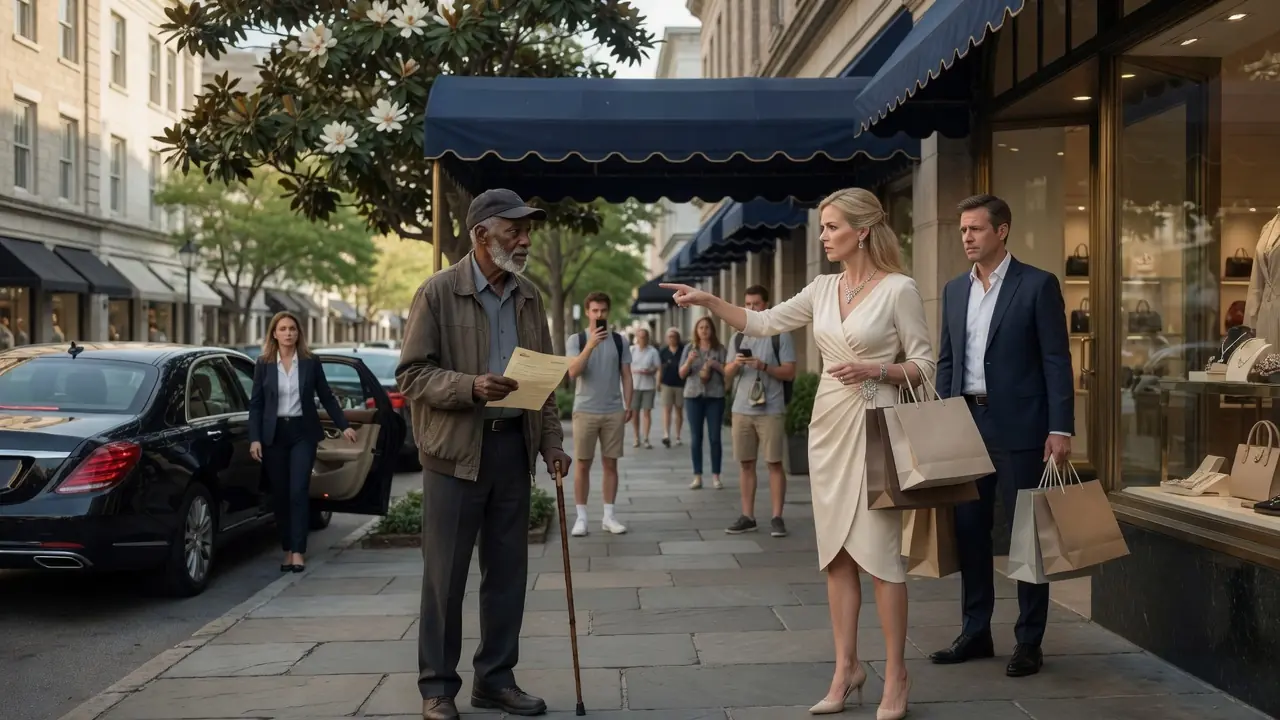
“I apologize, ma’am,” he says quietly. “I meant no trouble.”
She slaps him hard across the face.
His cheek burns red.
He does not flinch.
He does not speak.
He only watches her walk away.
Three weeks later, a private jet lands at her wedding venue.
The door opens.
A figure steps out.
She looks up.
Her knees almost buckle.
That face.
The man she slapped.
Standing at the bottom of the jet stairs in a three-thousand-dollar suit.
What happens next is something she never saw coming.
Charleston, South Carolina.
Late May.
The historic district breathes in the way only old Southern cities can, humid and honeyed, carrying the scent of magnolia and a history nobody wants to discuss too loudly.
Cobblestones gleam from last night’s rain. Church bells ring from St. Michael’s, the same bells that have marked the hours since before the Civil War. Tourists cluster on corners, cameras raised, capturing beauty without context.
Malcolm Sterling walks slowly down King Street.
Worn jacket.
Plain cap pulled low.
Sneakers that have seen better years.
He blends in nowhere and everywhere, the kind of man people look past without seeing.
He has been here eight days, watching, waiting, taking notes no one knows he is taking.
He passes a limestone building with brass letters on the cornerstone.
Pemberton.
His jaw tightens.
Then releases.
He keeps walking.
His cover story is simple. He is assessing this neighborhood for a community investment project, a potential site for a foundation grant.
It is true.
But it is not the whole truth.
His mother loved Charleston.
Eleanor Sterling visited once as a girl on a church trip, back when families from rural Georgia saved for months to afford bus fare.
She always talked about coming back.
The cobblestones.
The church bells.
The way the harbor caught the light at sunset.
She talked about it in her hospital bed near the end, when the medication made her drift between memory and dream.
She never made it back.
Malcolm is finishing the trip she never took.
He stops outside a high-end boutique.
Magnolia Row, the sign reads, cursive gold on white.
Through the window, he sees crystal chandeliers, polished floors, and price tags that could feed a family for a month.
A woman inside glances at him through the glass.
Her eyes move up, down, then away.
Quick.
Dismissive.
The kind of look that says, you do not belong here.
Malcolm is used to that look.
He has been getting it his whole life.
His phone buzzes.
He steps aside to answer.
“The venue paperwork is finalized,” his assistant says. “Belleview Plantation is fully under Sterling Holdings now. Two hundred acres, private airstrip. Ready for your signature whenever you want to announce.”
“Good,” Malcolm says. “Keep it quiet for now.”
“Understood. Anything else?”
“Not yet. I need to see something first.”
He ends the call and slips the phone into his pocket.
From his wallet, he pulls a yellowed newspaper clipping, folded and refolded so many times the creases have turned soft.
The headline is partially visible.
Pemberton Mutual Insurance Faces Class Action. Dozens Claim Systematic Denial of—
He folds it back before the rest shows.
Twenty-two years he has carried this clipping.
Twenty-two years since he found it in his mother’s things, tucked between unpaid hospital bills and a life insurance policy that never paid out.
He was twenty-two years old when she died, holding her hand in a room that smelled of antiseptic and endings, watching the monitors go flat, listening to the silence that followed.
He built Sterling Holdings from nothing.
Tech investments.
Real estate.
A charitable foundation that funds healthcare access in underserved communities.
He could have destroyed the Pemberton family a dozen times over.
Hostile takeovers.
Legal warfare.
The slow strangulation of their business interests.
He chose not to.
His mother did not raise him to destroy.
She raised him to build.
To watch.
To wait.
To give people a chance to show who they really are.
So he came to Charleston dressed like he had nothing.
To see how the wealthy treated those they considered beneath them.
To find out if anything had changed in twenty years.
He mutters to himself, barely audible.
“Show me who you are now.”
The woman in the boutique is adjusting her sunglasses, preparing to leave.
She has not noticed him yet.
Not really.
She will.
Malcolm pauses near the boutique entrance, not blocking it, just standing in the shade of an awning, watching the street the way tourists do.
The door swings open.
Victoria Pemberton exits first, shopping bags in both hands.
Designer dress, cream-colored, probably costing more than most people’s rent. Sunglasses pushed up into blonde hair. Heels clicking against the sidewalk with the rhythm of someone who has never had to hurry for anything.
Behind her is a man carrying additional bags.
Tall.
Well-dressed.
Expression tired in a way that suggests this is not his first shopping trip this week.
Her fiancé.
Though he looks less like a partner and more like a porter.
Victoria stops.
Her gaze lands on Malcolm.
Her lip curls.
“Excuse me.”
Sharp.
Loud enough for others to hear.
“You can’t loiter here.”
Malcolm says nothing.
He meets her eyes.
Calm.
Steady.
“This isn’t a shelter.”
Victoria steps closer.
Her perfume arrives before her words.
Expensive.
Floral.
Aggressive.
“Move.”
Still nothing from Malcolm.
He does not shift.
Does not look away.
A bystander across the street, Derek Trent, twenty-eight years old and heading home from a lunch shift, pulls out his phone.
Something about the scene catches his attention.
He starts recording.
Victoria notices the phone.
She does not care.
Let them record.
Let them see a concerned citizen dealing with someone who does not belong.
“Do you even speak English?” Her voice rises, performative outrage wrapped in polish. “I said move.”
Malcolm remains still, but something shifts in his expression.
Not anger.
Recognition.
Like a piece of a puzzle clicking into place.
Victoria draws herself up.
“I’m Victoria Pemberton. My family built half this district.”
She gestures at the street around them.
“You don’t belong here.”
Malcolm’s eyes flicker.
Not at the name itself.
At the certainty behind it.
The absolute conviction that some people matter and others simply do not.
He has heard that tone before.
Twenty-two years ago.
In a letter that began with the words, we regret to inform you that your claim has been denied.
Victoria’s patience snaps.
Her palm swings.
Fast.
Hard.
It connects with Malcolm’s cheek.
The crack silences the street.
Malcolm does not flinch.
Does not step back.
Does not raise a hand.
His cheek reddens.
His eyes stay locked on hers.
For three seconds, no one moves.
The humid air hangs between them.
A car horn sounds two blocks away.
Someone’s phone rings and goes unanswered.
A child asks their mother what happened.
The mother pulls them away.
Then Malcolm speaks.
Quiet.
Almost gentle.
“Pemberton. Of course.”
Victoria freezes.
Her hand is still raised, trembling now.
Not from regret.
From adrenaline.
“What did you say?”
Malcolm tilts his head slightly.
“Your father. Richard Pemberton. He was in insurance, wasn’t he?”
The color drains from Victoria’s face.
“How do you know that?”
Malcolm does not answer.
He just waits, the same way he has been waiting for twenty years.
Garrett shifts uncomfortably behind Victoria.
His expression is strange.
Not concern for his fiancée.
Not outrage on her behalf.
Something else entirely.
Something that almost looks like interest.
“Victoria,” Garrett says, his voice low. “We should go.”
“He knows things,” Victoria hisses. “He’s been stalking us. I’m calling the police.”
“I’ll do it,” Garrett says quickly.
Too quickly.
He pulls out his phone, but he does not call 911 right away.
He hesitates.
Looks at Malcolm one more time.
Studies his face.
Then dials.
Malcolm stands exactly where he is.
Cheek still stinging.
Eyes still calm.
Derek Trent, across the street, keeps recording.
He has forty-three seconds of footage now.
The slap.
The silence.
The strange exchange that followed.
He does not know it yet, but that footage is about to become the most important forty-three seconds of his life.
And the most expensive.
The 911 call comes in at 2:52 p.m.
Garrett’s voice is steady, practiced.
“There’s a man harassing my fiancée outside Magnolia Row Boutique on King Street. She had to defend herself.”
In the background, Victoria adds her piece.
“He was aggressive. He knows things about my family. I think he’s been stalking us.”
Malcolm hears every word.
He does not react.
He stands in the same spot, hands visible at his sides, watching the street fill with curious onlookers.
Some filming.
Some whispering.
None intervening.
His mind is somewhere else.
Twenty-two years ago, his mother sat in a waiting room at Charleston Memorial.
She had a lump in her breast.
She had insurance.
Pemberton Mutual.
The policy she had paid into for eleven years.
She had hope.
The waiting room smelled like floor wax and anxiety. She held Malcolm’s hand, told him not to worry, told him the Lord would provide.
The denial letter came six weeks later.
Pemberton Mutual Insurance.
Claim denied.
Reason: pre-existing condition exclusion.
Patient history indicates prior consultation for breast-related concerns.
Eleanor Sterling had never been sick a day in her life.
The prior consultation was a routine exam two years earlier.
Nothing found.
Nothing to report.
But someone at Pemberton Mutual flagged it anyway.
Someone whose signature sat at the bottom of that letter in neat, confident cursive.
Richard A. Pemberton.
Vice President of Claims.
Two police cruisers arrive at 3:04 p.m.
Lights flashing.
No sirens.
This is a wealthy neighborhood.
Sirens would be gauche.
Officer Bradley Cole steps out first.
Thirty-one years old, close-cropped hair, the kind of jaw that suggests he has never had to question his own authority.
He walks straight to Victoria.
“Ma’am, are you okay?”
Victoria smooths her dress and composes her face into something between distress and dignity.
“He was blocking the entrance. When I asked him to leave, he got aggressive. He mentioned my father by name. I think he’s been following us for weeks.”
Cole does not look at Malcolm.
Not yet.
He is writing in his notepad, taking Victoria’s statement like it is already fact.
“He assaulted you?”
“I had to defend myself.”
Victoria touches her wrist as if it is sore.
It is not.
Cole finally turns.
His eyes move over Malcolm.
The worn jacket.
The plain cap.
The dark skin.
Something hardens in his expression.
A judgment made in less than two seconds.
“Sir, turn around. Hands behind your back.”
Malcolm complies.
Silent.
The body camera on Cole’s chest captures everything.
Malcolm’s face composed.
The handcuffs clicking closed.
Victoria smoothing her dress again, satisfied.
Garrett standing slightly apart, watching with an expression no one bothers to read.
The crowd watches.
Phones rise.
Someone mutters that this does not look right, but no one speaks up loud enough to matter.
No one steps forward.
No one asks for Malcolm’s side.
Malcolm whispers something as Cole guides him toward the patrol car.
“Just like before.”
Cole pauses.
“What was that?”
“Nothing, officer.”
By the time Eleanor got treatment, it was stage four.
The cancer had spread from her breast to her lymph nodes, then to her lungs, then everywhere.
She spent her last three months in a hospital bed that cost more per day than she had earned in a week.
The bills bankrupted what little they had.
Malcolm dropped out of college to work three jobs.
Warehouse.
Restaurant.
Night security.
He held his mother’s hand in that antiseptic room and promised her he would do something with his life.
Something that mattered.
She died at 4:47 a.m. on August 22, 2004.
The monitors went flat.
The room went quiet.
And somewhere in Charleston, Richard Pemberton was probably signing another denial letter.
Another family.
Another death sentence dressed up in corporate language.
Malcolm is placed in the back of the patrol car.
Through the window, he watches Victoria whisper something to Garrett.
She looks pleased.
Problem solved.
Obstacle removed.
But Garrett’s expression is strange.
He is watching Malcolm, too.
And there is something in his eyes that does not match his role as the loyal fiancé.
It looks almost like relief.
At the Charleston Police Department, Malcolm is booked and processed.
Fingerprints.
Photographs.
The whole ritual of presumed guilt.
He is allowed one phone call.
He dials from memory, a number he has had saved for fifteen years.
“Carolyn,” he says when she answers. “I need you here. Now. And bring the file.”
“Which file?”
“The Pemberton file.”
Silence on the other end.
Then, “I’ll be there in forty minutes.”
Malcolm hangs up.
He closes his eyes.
He sees his mother’s face.
Not the way she looked at the end, but the way she looked when he was a boy.
Strong.
Warm.
Full of a faith that the world would eventually make sense.
He has a choice now.
He has had this choice for twenty years.
He can burn the Pemberton family to the ground.
He has the resources.
He has the evidence.
He has twenty-two years of carefully accumulated leverage.
Or he can do what his mother would have wanted.
He opens his eyes.
The fluorescent lights buzz overhead.
The holding cell smells of disinfectant and despair.
In the next cell, someone is crying quietly.
Malcolm waits.
Two hours later, a sedan pulls up to the precinct.
The woman who steps out is fifty-two years old, silver-haired, and dressed in the kind of understated elegance that comes from never having to prove anything to anyone.
Carolyn West.
Senior partner at West, Bradford and Associates.
One of the most respected attorneys in the Southeast.
She walks into the Charleston Police Department like she owns it.
Carolyn West does not raise her voice.
She does not need to.
“My client, Malcolm Sterling, was assaulted on a public sidewalk by Victoria Pemberton. He was then detained without investigation, without witness statements, and without any attempt to verify the accuser’s claims.”
She places a leather folder on the desk sergeant’s counter and opens it slowly.
“I want him released immediately.”
The desk sergeant, a tired man in his fifties who has seen enough to know when the wind is shifting, looks at the folder.
Then at Carolyn.
Then at the name on her business card.
“Sterling?” His voice wavers slightly. “As in Sterling Holdings?”
Carolyn opens the folder wider.
Inside are Malcolm’s identification, his corporate credentials, and a net worth statement that does not need to list specific numbers because the company name speaks for itself.
“My client is the founder and CEO of Sterling Holdings,” Carolyn says.
Her tone is patient, the way a teacher explains something to a slow student.
“He was conducting a site assessment for a charitable foundation when he was physically assaulted by Ms. Pemberton in front of multiple witnesses. He did not resist. He did not retaliate. He did not raise his voice. And he was arrested anyway.”
Officer Bradley Cole appears in the hallway.
His face has gone pale.
“Ma’am, we were responding to a 911 call.”
“I’m aware of what you were responding to.”
Carolyn does not look at him.
“I’m also aware that your body camera captured my client being handcuffed without being asked for his side of the story. I’ll be requesting that footage within the hour, along with the 911 audio and the dispatch records.”
Cole’s mouth opens.
Closes.
Opens again.
“Is there something you’d like to add, officer?”
“No, ma’am.”
Malcolm is released at 4:22 p.m.
No charges filed.
The paperwork disappears into a folder that will probably get lost by morning.
Outside, a small crowd has gathered.
Someone must have posted something online.
A few reporters are setting up cameras, though they do not yet know why this particular arrest matters.
Malcolm says nothing to them.
He gets into Carolyn’s sedan.
The door closes.
The car pulls away.
Across town, Victoria Pemberton is getting a phone call from her father.
“What do you mean, be careful?” She is pacing her living room, still in the cream dress from earlier. “Sterling? I’ve never heard of— Daddy, what are you telling me?”
Richard Pemberton’s voice is ice on the other end.
Controlled.
Precise.
“Just stay away from him, Victoria. Don’t talk to anyone. Don’t post anything. I’ll handle it.”
“Handle what?”
The line goes dead.
Victoria’s hand is shaking as she lowers the phone.
Garrett is sitting on the couch, watching her.
His phone is in his hand.
He has been Googling something.
“Sterling Holdings,” he reads aloud. “Founded 2009. Headquarters in Atlanta. Specializes in tech investments, real estate acquisition, and philanthropic initiatives focused on health care access.”
He pauses.
Scrolls.
“Net worth estimated at—”
He stops.
Reads the number again.
Deletes his search history.
“Garrett,” Victoria says, sharp. “Are you listening to me?”
“Yeah.”
He looks up.
His expression is unreadable.
“Yeah, I’m listening.”
But he is already thinking about something else.
Something that might finally give him a way out of this engagement, out of this family, out of the life he has been pretending to want for two years.
The man Victoria slapped is not homeless.
He is one of the wealthiest men in the Southeast.
And Garrett Holloway is starting to realize that he might have found an unexpected ally.
Denise Monroe has been an investigative journalist for fourteen years.
She has covered corruption at the state level, exposed a nursing home chain that was billing Medicare for patients who had been dead for months, and won a regional press award for a series on predatory lending in rural communities.
She has seen a lot of videos go viral.
Most of them are noise.
Sound and fury.
Forgotten by the following week.
But this one is different.
She watches Derek Trent’s footage for the seventh time.
Forty-three seconds.
A woman in a cream dress slapping a man outside a boutique.
The man not flinching.
The strange exchange that followed.
“Your father, Richard Pemberton. He was in insurance, wasn’t he?”
That line catches her.
Why would a man on the street know that?
Why would he say it like that?
Calm.
Almost knowing.
Like he had been waiting to say those words for a very long time.
She starts with the store.
Magnolia Row Boutique.
The manager refuses to comment.
Corporate policy.
Ongoing situation.
Legal has advised against any statements.
You understand.
But a former employee does not have the same restrictions.
Janet Ellis is forty-one.
She worked at Magnolia Row for three years before quitting last spring. Now she waitresses at a cafe on the north side of town, as far from King Street as you can get while still being in Charleston.
“They called it discretionary removal,” Janet says.
She is stirring her coffee, not meeting Denise’s eyes.
“If someone didn’t look right, we were supposed to make them uncomfortable enough to leave.”
“What does ‘look right’ mean?”
Janet finally looks up.
Her expression says everything.
“You know what it means. Everyone knows what it means. We just don’t say it out loud.”
Denise obtains the internal memo three days later.
A source in the company, someone also tired of looking the other way, slides it across a table in a different cafe.
The language is careful.
Legally careful.
Staff are empowered to ensure the shopping environment reflects our brand standards and the expectations of our core customer base.
Core customer base.
Brand standards.
Code words.
Denise has seen them before.
Different cities.
Different companies.
Same meaning.
She files FOIA requests with the Charleston Police Department.
It takes a week, but she gets what she is looking for.
Complaint records for Magnolia Row Boutique going back five years.
Four incidents, all involving people of color, all dismissed.
A woman accused of shoplifting.
Security detained her for thirty minutes before checking the cameras, which showed she had paid for everything in her bag.
No charges.
No apology.
No consequences.
A Latino teenager told to wait outside while his mother shopped.
The stated reason: customer comfort concerns.
A man asked to leave for making other customers uncomfortable.
His crime?
Browsing the men’s section for more than ten minutes.
A young woman followed by security from the moment she entered until the moment she left empty-handed because she was too intimidated to buy anything.
Four complaints.
Four dismissals.
Four form letters thanking the complainants for their feedback.
Denise tracks down the victims.
Most do not want to talk.
Too painful.
Too risky.
Too pointless.
But Lorraine Foster does.
She is fifty-five, a retired schoolteacher with thirty years in Charleston public schools.
She was buying a birthday gift for her granddaughter the day it happened.
“They followed me through the store,” Lorraine says.
Her voice is steady, but her hands are not.
“Every aisle. Every rack. Like I was going to steal something. When I complained, the manager said I was being aggressive.”
She shakes her head.
“That word. They always use that word. Like we’re the threat.”
Denise has enough for a story now.
Pattern of discrimination.
Multiple victims.
Internal policy that enables profiling under the guise of brand standards.
But something is still bothering her.
Your father was in insurance.
She digs deeper.
Victoria Pemberton.
Family history.
Source of wealth.
And she finds something.
An old newspaper article from 2008.
Pemberton Mutual Insurance Faces Class Action. Dozens Claim Systematic Denial of Coverage.
The case was settled out of court.
Sealed.
Pemberton Mutual dissolved in 2015. Its assets were folded into the family’s real estate holdings.
The details were buried under layers of legal paperwork and non-disclosure agreements.
But the headline is enough.
Denise makes a note.
Who were the claimants?
What were they denied?
And who signed those denials?
She reaches out to Malcolm Sterling’s office.
A polite brush-off.
“Mr. Sterling has no comment at this time.”
Fine.
She will keep digging.
Because she cannot shake that moment in the video.
The way Malcolm said Pemberton, like he already knew.
Like he had been waiting to say it for a very long time.
Denise submits her article draft on Friday afternoon.
It is solid work.
Documented pattern.
Multiple sources.
Clear evidence of discriminatory policy.
Her editor calls Monday morning.
“Kill it.”
“What?”
“We got a letter, Denise. Pemberton Family Trust. They’re threatening to sue if we publish anything connecting Victoria to a pattern of behavior.”
He sighs.
“We’re a small paper. We can’t afford this fight.”
Denise hangs up and stares at her notes.
The story is dead.
But she is not done.
Not even close.
Because now she knows there is something bigger here.
Something the Pemberton family is willing to spend serious money to hide.
And she is going to find out what it is.
The cease-and-desist letter arrives on Pemberton Family Trust letterhead.
Heavy paper.
Embossed logo.
The kind of stationery that costs more per page than most people spend on groceries.
Any publication of defamatory statements regarding Ms. Pemberton or her family will result in immediate legal action. We trust you will govern yourselves accordingly.
Denise’s editor will not budge.
The paper’s legal budget would not cover a week of fighting the Pemberton attorneys.
They have three lawyers on staff.
The Pembertons have an entire firm on retainer.
The story is dead.
And the witnesses are disappearing.
Derek Trent, the bystander who recorded the slap, goes silent overnight.
His video stays online, racking up views, but he stops answering calls, stops responding to messages.
His roommate tells Denise he moved out suddenly.
Got a check from somewhere.
Did not say where.
Did not leave a forwarding address.
Lorraine Foster withdraws her willingness to go on record.
“I can’t risk it,” she says over the phone.
Her voice sounds different now.
Smaller.
Frightened.
“I have grandchildren in this city. I can’t have the Pembertons coming after my family.”
One by one, the sources go quiet.
The momentum dies.
The story fades from social media, replaced by newer outrages, fresher scandals, shorter attention spans.
Victoria Pemberton attends a charity gala three days after the cease-and-desist letter goes out.
She is radiant in emerald green, smiling for photographers, accepting air kisses from women who lunch and men who write checks.
In her mind, the incident is already fading.
Just another obstacle.
Another inconvenience handled by Daddy’s lawyers.
“He was just some grifter,” she tells a friend, laughing over champagne. “Probably wanted money. Can you imagine? Daddy says it’s all handled now.”
Garrett stands beside her.
His smile does not reach his eyes.
It has not reached his eyes in two years.
But nobody at this gala knows him well enough to notice.
Nobody here knows him at all.
Victoria’s attorney releases a statement to the press.
“Ms. Pemberton acted in self-defense when confronted by an aggressive individual. She denies any pattern of behavior and will vigorously defend her reputation against false accusations.”
The narrative solidifies.
Rich woman, innocent victim.
Unknown man, aggressive threat.
Case closed.
Except Malcolm Sterling is not returning Denise’s calls.
And that bothers her more than anything else.
If he wanted to destroy Victoria Pemberton, he could.
He has the resources.
He has the platform.
Sterling Holdings could buy the kind of media attention that makes cease-and-desist letters irrelevant.
So why is he silent?
Denise sits in her apartment.
The story is dead.
Her editor has moved on.
The Pembertons have won.
But she cannot let it go.
She stares at her notes.
The old article about Pemberton Mutual.
The sealed class action.
The phrase that keeps echoing in her mind.
Your father was in insurance.
What if she has been looking at this wrong?
What if the boutique incident is not the story at all?
Just the surface.
What if the real story is buried twenty years in the past?
She calls a friend at the state records office, someone who owes her a favor from a story she killed to protect his marriage.
“I need everything you can find on Pemberton Mutual Insurance. Specifically denied claims, 2000 to 2010.”
“That’s a lot of digging, Denise. Those records are archived. Some are sealed.”
“I know, but there’s something here. I can feel it.”
“Okay. Give me a few days.”
She hangs up and looks out her window at the Charleston skyline.
Somewhere in this city, Victoria Pemberton is celebrating her victory.
Somewhere, Malcolm Sterling is waiting.
And somewhere in a dusty archive, a twenty-two-year-old denial letter is about to change everything.
Meanwhile, Victoria drives past Belleview Plantation, her wedding venue.
The place where, in three weeks, she will walk down an aisle lined with roses and become Mrs. Garrett Holloway.
She does not know who owns it now.
She does not know that the deed changed hands six months ago, transferred to a holding company based in Atlanta.
She does not know that the man she slapped has been quietly acquiring pieces of her life for years.
Not for revenge.
For this moment.
For the choice he has not made yet.
The document arrives as a scanned attachment.
Yellowed paper.
Official letterhead.
Pemberton Mutual Insurance, Charleston office.
Denise opens it on her laptop.
Her hands are already shaking before she reads the first line.
Claim number PMI-2004-8832.
Policyholder: Eleanor M. Sterling.
Condition: breast cancer screening follow-up.
Status: denied.
The reason is listed in bureaucratic language designed to obscure its cruelty.
Pre-existing condition exclusion. Patient history indicates prior consultation for breast-related concerns.
Denise cross-references Eleanor Sterling’s medical records.
Her friend found those, too, buried in a hospital archive that should have been purged years ago.
Eleanor had one prior consultation.
A routine exam two years before the claim.
Nothing found.
Nothing abnormal.
Nothing to report.
But someone at Pemberton Mutual flagged it as pre-existing anyway.
Someone who needed to meet a quota.
Someone who received bonuses for denials.
The signature at the bottom of the denial letter is neat and confident.
The handwriting of a man who signed dozens of these letters a week without thinking twice about the lives he was affecting.
Richard A. Pemberton.
Vice President of Claims.
Denise’s breath catches.
She checks the death records next.
Charleston County.
August 22, 2004.
Eleanor M. Sterling.
Age fifty-two.
Cause of death: metastatic breast cancer.
The timeline is devastating.
Denial in March.
By the time Eleanor could afford treatment on her own through borrowed money, a second mortgage, sold possessions, and help from relatives, the cancer had spread.
Diagnosis delayed by four months.
Four months that made the difference between stage one and stage four.
Between treatable and terminal.
By treatment, it was everywhere.
Denise does the math.
Eleanor Sterling died in 2004.
She had a son.
He would have been twenty-two years old.
Malcolm Sterling.
The connection hits her like a physical blow.
Richard Pemberton’s signature denied the care Malcolm’s mother needed.
Twenty years later, Richard’s daughter slapped Malcolm in the street, called him a threat, called him nothing, called him aggressive.
He knew.
The whole time.
Denise calls Malcolm Sterling’s office.
This time, his assistant does not brush her off.
“Please hold. I’ll put you through.”
Thirty seconds later, Malcolm’s voice comes through the line.
Calm.
Measured.
The voice of a man who has been waiting for this call.
“Ms. Monroe.”
“Mr. Sterling. I found the letter. I know about your mother.”
Silence.
Long enough that Denise wonders if the call dropped.
Then, “I wondered how long it would take.”
“You knew who Victoria was before she slapped you.”
“I knew who her father was. I’ve known for twenty-two years.”
Denise’s pen hovers over her notepad.
“Then why? Why didn’t you say something? Why didn’t you destroy them the moment you had the chance?”
Malcolm is quiet for a moment.
When he speaks, his voice is softer, less guarded.
“Because my mother didn’t raise me to destroy. She raised me to build. To give people chances. To see who they really are before judging them.”
He pauses.
“And Victoria? Victoria showed me exactly who she is. Her father showed me who he was twenty-two years ago. Nothing has changed.”
Denise writes quickly.
“Mr. Sterling, I want to publish this. All of it. The denial, the connection, everything.”
“I know you do.”
“Will you let me?”
Another pause.
“Tell the truth, Ms. Monroe. All of it. Even the parts that make me look less than heroic. Even the parts where I admit I came here hoping they had changed.”
He exhales.
“But first, there’s something else coming. Someone unexpected is about to reach out to you.”
“Who?”
“You’ll know when you hear from him.”
The line goes dead.
They meet at a quiet cafe on the outskirts of downtown.
Malcolm arrives first.
He is dressed simply, the same worn jacket, the same plain cap. Nothing about him suggests the net worth behind the name.
Denise sits across from him with a recorder and a notebook.
She does not turn the recorder on yet.
Some conversations are better kept between two people.
“How long have you known about the Pembertons?”
“Since I was twenty-two.”
Malcolm’s hands rest on the table, still.
“I found the denial letter in my mother’s things two weeks after her funeral. I saw Richard Pemberton’s signature.”
“So you came to Charleston for revenge?”
Malcolm shakes his head slowly.
“I came to see if they had changed.”
He explains.
Twenty years of building his company.
Twenty years of watching the Pemberton family from a distance.
He could have destroyed them a hundred times over.
Hostile takeovers.
Strategic lawsuits.
The slow suffocation of their real estate holdings.
“But my mother didn’t raise me to destroy,” he says. “She raised me to build.”
So he came to Charleston anonymously, dressed like someone with nothing, to see how the wealthy treated those they considered beneath them.
“I gave them a chance,” Malcolm says. “Victoria answered.”
Denise writes that down.
“The slap.”
“The slap.”
Malcolm’s jaw tightens just slightly.
“Twenty years and they haven’t changed. If anything, they’ve gotten worse.”
“What now? You could go public. You could destroy them tomorrow.”
Malcolm is quiet for a long moment.
“I thought about it. I sat in that police car handcuffed and imagined burning everything Richard Pemberton ever built. Every building, every account, every shred of his reputation.”
“What stopped you?”
“My mother’s voice.”
He looks at Denise directly.
“She used to say, ‘Don’t become the thing that hurt us. Build something instead.’”
Denise sets down her pen.
“And Victoria?”
“She doesn’t know about her father.”
“No?”
Malcolm’s expression shifts.
Something like pity, maybe.
Or sorrow.
“No. She doesn’t. She is a product of what he built. But she made her own choices.”
“What do you want from me?”
“Tell the truth.”
“All of it?”
“Even about me.”
“That you came here with an agenda? That you’ve been watching them for years?”
He pauses.
“Let people decide for themselves what kind of man I am.”
Denise nods slowly.
“And if I do, what happens next?”
“That depends on someone else. Someone who has been looking for a way out for a long time.”
Malcolm stands, leaves enough cash on the table to cover both their coffees and a generous tip.
“You’ll hear from him soon.”
“Him?”
Malcolm is already walking toward the door.
“Victoria’s fiancé.”
The parking garage is cold, concrete and shadows.
Garrett Holloway sits in his car with the window down, speaking quickly. His eyes keep darting to the rearview mirror.
“I’ve been looking for a way out for two years,” he says, his voice low. “Victoria isn’t who I thought she was. Maybe she never was.”
Denise leans against the adjacent pillar, recorder running.
“Why now?”
“Because I watched her slap that man. And I watched him not react.”
Garrett’s hands grip the steering wheel.
“And I saw myself. Someone who takes it. Someone who stays quiet. I don’t want to be that person anymore.”
He hands her a folder through the window.
Inside are internal Pemberton family communications, emails exchanged in the days after the incident.
Denise reads the key passage aloud.
Richard Pemberton to family attorney.
Handle the witness. Handle the journalist. This cannot reach the Sterling acquisition.
“Sterling acquisition.”
Garrett nods.
“Richard’s been negotiating a major real estate deal for months. Forty million dollars. He found out two weeks ago who the buyer is.”
He slides another document across.
A contract.
Belleview Plantation Venue.
The property where Victoria is scheduled to be married in three weeks.
The buyer?
Sterling Holdings LLC.
“Malcolm Sterling owns Victoria’s wedding venue,” Garrett says. “Richard’s been trying to salvage the deal without telling her. He covered up the slap to protect the money, not his daughter.”
The money.
Denise stares at the contract.
The irony is almost too perfect.
“He doesn’t care about Victoria’s wedding,” Garrett continues. “He cares about forty million dollars. That’s all he’s ever cared about.”
“Why are you doing this?” Denise asks. “Really?”
Garrett is quiet for a moment.
“Because when I looked at Malcolm Sterling standing there after Victoria hit him, after the police took him away, I saw someone who knew exactly who he was.”
He opens his car door and steps out.
“And I realized I don’t.”
He looks at the folder in Denise’s hand.
“I’m done protecting people who don’t deserve protection.”
Two days later, Belleview Plantation glows under a sunny afternoon.
Victoria arrives in a limousine.
She is here to finalize wedding details, take control, and prove to herself that everything is still on track.
Designer dress.
Sunglasses.
Heels clicking on stone.
She walks through the garden like she owns it.
The roses.
The white tents.
The honeysuckle hedges.
The venue staff greet her nervously.
They keep glancing at the sky.
Then she hears it.
A sound in the distance, growing louder.
Engine whine.
She looks up.
A private jet descends over the tree line, sleek and white, sunlight glinting off the fuselage.
Victoria frowns.
“Who’s landing here? I didn’t authorize—”
The jet touches down on the venue’s private airstrip.
Smooth.
Precise.
The engines wind down.
Victoria walks toward the airstrip, annoyed and confused.
The jet door opens.
Steps unfold.
A figure appears in the doorway, silhouette against the sun.
Suit.
Confident posture.
He descends slowly, one step at a time.
Victoria’s eyes adjust.
She sees his face.
Her breath catches.
Her arms drop.
Her mouth opens.
Malcolm Sterling.
The man she slapped.
The man she called nothing.
Standing at the bottom of the jet stairs in a three-thousand-dollar suit.
He walks toward her.
Calm.
Unhurried.
“You,” Victoria can barely speak. “You’re—”
Malcolm stops ten feet away.
He looks at her the way she once looked at him.
“Malcolm Sterling. CEO of Sterling Holdings.”
He pauses.
“The company that owns this venue.”
Victoria’s knees weaken.
She grabs a nearby chair.
“This is impossible. You were— You were nothing.”
“No,” Malcolm says quietly. “I was dressed simply. You decided what that meant.”
Victoria’s whole body is shaking.
“The wedding. My wedding is here.”
“Was here. I’ve decided to repurpose the property.”
He takes a step closer.
“But that’s not why I came today.”
“Then why?”
“Because I wanted to see your face when you realized.”
He pauses.
His voice drops.
“And because there’s something you need to know about your father.”
“About what?”
“What he did twenty-two years ago.”
“My father? What does my father have to do with—”
“You’ll find out. In court. One week from today.”
He walks past her into the venue.
The staff greet him by name.
“Mr. Sterling, welcome back.”
Victoria stands alone.
The woman who owned every room she walked into, now a stranger on land she thought was hers.
Her phone buzzes.
Father calling.
She does not answer.
Charleston County Courthouse.
June 12.
9:00 a.m.
Civil injunction hearing.
Malcolm sits at the plaintiff’s table, calm in the same suit from the jet.
Victoria is across the aisle, her attorney beside her. Her father, Richard, sits in the row behind, silver hair, expensive suit, jaw clenched so tight the muscles are visible.
Garrett Holloway is absent.
He gave his deposition last week.
He is already on his way to Atlanta.
The gallery holds Denise Monroe, Lorraine Foster, the other victims, Pastor Eugene Daniels from the community church, and witnesses who refused to stay quiet any longer.
Malcolm’s attorney presents the evidence methodically.
The body-cam footage.
The prior complaints.
The store memo.
Garrett’s documents showing the cover-up.
Then she produces the final exhibit.
A yellowed document.
Pemberton Mutual Insurance letterhead.
“Claim number PMI-2004-8832,” the attorney reads. “Policyholder, Eleanor M. Sterling. Status, denied. Reason, pre-existing condition exclusion.”
She pauses.
“Reviewing officer, Richard A. Pemberton.”
Victoria turns to look at her father.
“Daddy, what is this?”
Richard Pemberton’s eyes are fixed on the table.
He does not answer.
The attorney continues.
“Eleanor M. Sterling died on August 22, 2004, from metastatic breast cancer. She was the plaintiff’s mother.”
Victoria’s face drains of color.
“Eleanor Sterling was denied coverage for a cancer screening follow-up. The denial delayed her diagnosis by four months. By the time she received treatment, the cancer had spread to stage four. Terminal.”
Victoria stands.
Her voice is shaking.
“Daddy.”
Richard still does not look at her.
“Daddy! What did you do?”
“Sit down, Victoria.”
“Did you know? When you told me to make this go away, did you know who he was?”
Richard Pemberton says nothing.
Victoria’s breakdown is not rage.
It is something deeper.
The sound of a worldview collapsing.
Everything she believed about herself, about her family, about her place in the world.
She looks at Malcolm.
Really looks at him for the first time.
“I didn’t know,” she whispers.
Malcolm’s expression is unreadable.
He neither forgives nor condemns.
He simply witnesses.
The judge rules.
Compensatory damages: $385,000.
The store is ordered to revise its policies and undergo civil rights training.
Richard Pemberton’s involvement in the cover-up is referred to the state bar for investigation.
Victoria does not hear the ruling.
She is still staring at her father.
Richard Pemberton will not meet her eyes.
Through his attorney, he releases a statement later that day.
All claims decisions at Pemberton Mutual were made in accordance with policy guidelines at the time.
It is not a denial.
It is not an apology.
It is nothing.
The gallery empties.
Reporters rush to file their stories.
Victoria remains in her seat, motionless, until a court officer asks her to leave.
Malcolm walks out of the courthouse into the afternoon sun, too bright for what just happened inside.
Denise approaches him on the steps.
“What now?”
Malcolm looks back at the courthouse doors.
Victoria is emerging alone.
Her father is already gone.
“Now,” Malcolm says quietly, “I build something.”
Two weeks later, Belleview Plantation is transformed.
The roses are gone.
The white tents are gone.
The venue that was supposed to host Victoria Pemberton’s wedding has become something else entirely.
Malcolm stands outside the main building.
Fresh paint.
New signage.
Sterling Community Center.
In Memory of Eleanor Sterling.
He donated the settlement.
All of it.
Plus matching funds from his foundation.
Plus the property itself.
Two hundred acres of land that will now serve the community instead of the privileged few.
Lorraine Foster is there.
Pastor Eugene Daniels is there.
The other victims are there.
They cut the ribbon together.
Denise approaches Malcolm as the small crowd disperses.
“You could have destroyed them,” she says. “The forty-million-dollar deal. Everything Richard Pemberton built. One signature and he loses it all.”
Malcolm watches the building.
“I thought about it.”
“What stopped you?”
“My mother.”
He pauses.
“Build something. She used to say, don’t just tear down.”
He turns to Denise.
“Besides, living with what he’s done is worse than anything I could take from him.”
Victoria Pemberton canceled her wedding.
She has not spoken to her father since the hearing.
Sources say she is seeing a therapist, working through decades of lies she never knew she was living.
Some say she is planning to leave Charleston.
No one knows what she will become.
Garrett Holloway moved to Atlanta the day after his deposition.
He sent Malcolm a letter.
Two words.
Thank you.
Richard Pemberton is under investigation by the state bar.
His reputation is shattered.
His business partners are distancing themselves.
His daughter will not take his calls.
He has everything money can buy.
Except forgiveness.
Except peace.
Except his daughter’s respect.
Malcolm walks away from the community center.
Worn jacket.
Plain cap.
The same clothes he wore the day he arrived in Charleston.
A reporter calls after him.
“Mr. Sterling. What do you want people to remember about this story?”
Malcolm stops.
Turns.
“Dignity isn’t something you grant or take away.”
His voice is calm.
Clear.
“And assumptions always have a cost.”
He keeps walking.
His footsteps fade on the gravel path.
The sun is setting over Charleston.
The light catches the new sign on the building.
Eleanor Sterling’s name.
Permanent now.
Built into something that will outlast all of them.
Victoria swung her palm.
Malcolm did not flinch.
And when she saw him step off that jet, she finally understood.
She never knew who she was hitting.
She never knew who she was.
Malcolm Sterling did not destroy the Pembertons.
He showed the world who they were.
And let them live with it.
That was his justice.
And it was enough.