Evan Cole knew something was wrong before he reached seat 2A.
The first-class cabin of Flight 417 from New York to San Francisco was nearly full, yet a pair of nude designer heels rested across the cream leather cushion assigned to him. Their owner lounged in the adjoining seat with one leg crossed over the other, dark sunglasses concealing her eyes and a pale-pink dress beneath a sharply tailored black blazer. She appeared entirely comfortable occupying both spaces while other passengers watched from behind newspapers, phones, and carefully neutral expressions.
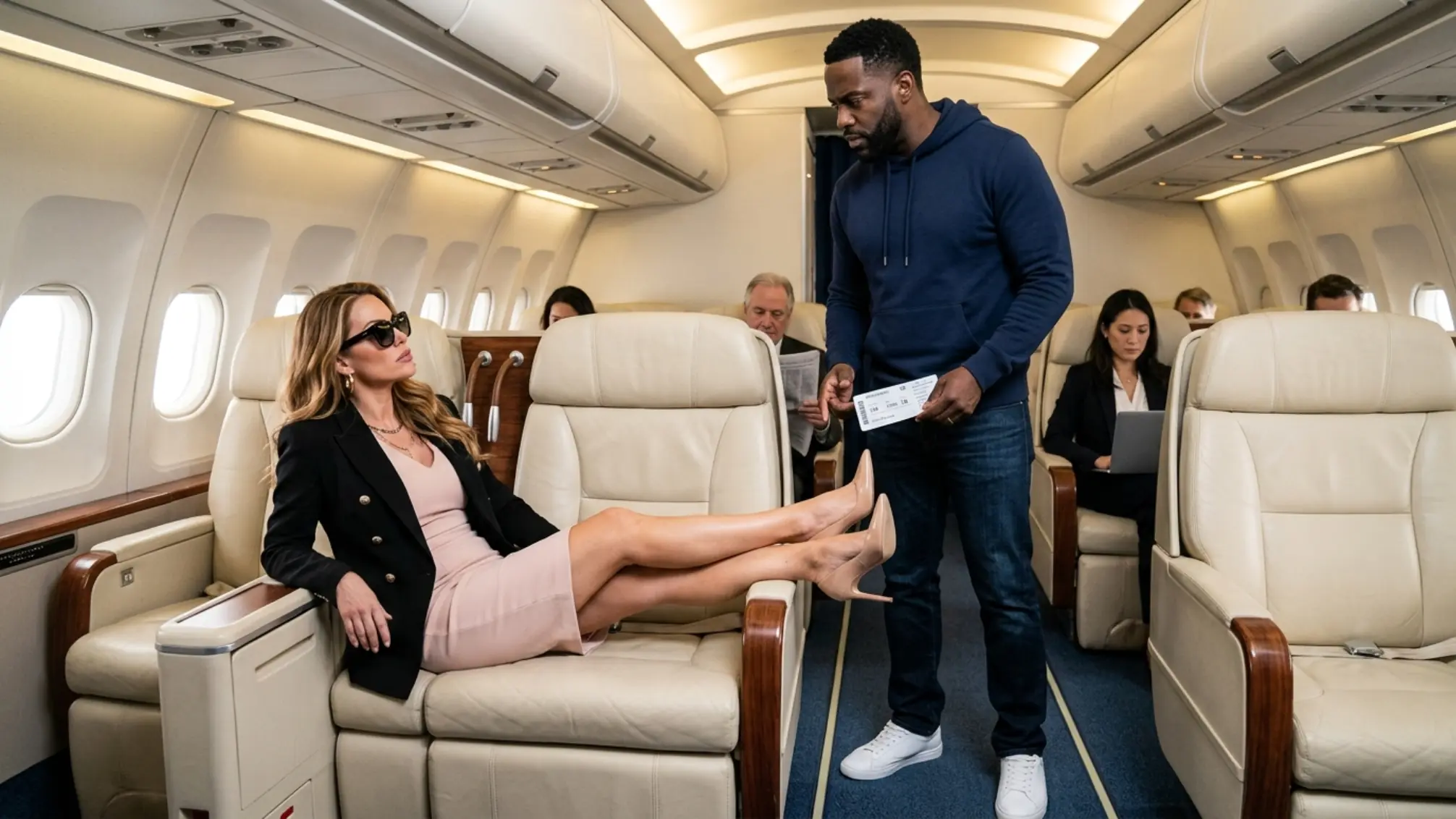
Evan stopped beside the row and checked his boarding pass.
“Excuse me,” he said. “That’s my seat.”
The woman barely turned her head. “There are other seats.”
“Not with my name attached to them.”
She slowly lowered her sunglasses enough to examine him. Evan wore a navy hoodie, fitted jeans, and clean white sneakers. He carried no briefcase, displayed no luxury watch, and had boarded without an assistant or visible security.
To Darla Whitmore, he looked like someone who had reached first class by mistake.
“I settled in already,” she said. “Ask the flight attendant to move you.”
Evan glanced at the heels planted squarely on his cushion. “Move your feet.”
Her lips parted in disbelief.
Passengers nearby shifted in their seats. A middle-aged man across the aisle lowered his tablet, while a woman behind Darla quietly angled her phone toward the confrontation.
Darla pushed her sunglasses back into place. “You don’t give me orders.”
“I’m not interested in ordering you around. I’m interested in sitting in the seat I purchased.”
She gave a short laugh. “Purchased?”
“Yes.”
“Seats like this aren’t usually occupied by men dressed like you.”
The cabin became noticeably quieter.
Evan looked at her for several seconds. He had heard variations of the sentence in hotel lobbies, corporate elevators, private clubs, and boardrooms throughout his career. Sometimes the language was polished. Sometimes it was disguised as concern about procedure, dress codes, or security.
Darla had chosen not to disguise it at all.
“What exactly does a man who belongs here look like?” Evan asked.
She tilted her head. “Successful.”
The passenger across the aisle visibly winced.
Evan’s expression remained calm. “Move your feet before your husband loses more than his company.”
Darla sat upright.
“What did you say?”
“You heard me.”
Her heels remained on the seat, but her confidence flickered. “You don’t know my husband.”
“I know Richard Whitmore.”
Darla laughed again, louder this time. “Everyone in business knows Richard.”
“Not the way I do.”
She removed her sunglasses completely. Her blue eyes narrowed as she studied his face, perhaps searching for recognition she had missed. Evan gave her nothing.
Richard Whitmore was the founder and chief executive of Whitmore Aeronautics, a once-respected manufacturer of aircraft components and navigation systems. For nearly three decades, the company had supplied commercial airlines, defense contractors, and private aviation firms.
Then the failures began.
Two delayed government contracts drained operating cash. A European acquisition collapsed beneath hidden liabilities. Three major customers suspended orders after quality-control problems surfaced at a factory in Ohio. By the beginning of the year, Whitmore Aeronautics carried nearly nine hundred million dollars in debt and had less than six weeks of available payroll.
Richard had spent three months searching for a rescue investor.
Only one firm possessed both the capital and industry connections to stabilize the company before creditors forced it into bankruptcy.
Cole Meridian Holdings.
Evan’s company.
The final meeting was scheduled for nine the following morning in San Francisco. Richard intended to request a six-hundred-million-dollar investment in exchange for majority control.
Darla Whitmore had no idea the casually dressed man standing beside her was the founder and chief executive who would decide whether her husband’s company survived.
She leaned closer. “My husband doesn’t associate with people who threaten women on airplanes.”
“I haven’t threatened you.”
“You said he would lose his company.”
“He may.”
“Because I won’t give you a seat?”
“No. Because the person asking me to save nine thousand jobs apparently never explained to his wife whose decision matters tomorrow.”
A flight attendant hurried from the galley. Her name tag read MELISSA, and concern showed on her face before she reached them.
“Is there a problem?”
Darla pointed at Evan. “This man is harassing me.”
Melissa looked at him. “Sir?”
Evan handed her his boarding pass.
“Seat 2A.”
The flight attendant verified the number, then looked at the heels occupying the cushion.
“Mrs. Whitmore, he is assigned to this seat.”
Darla’s voice sharpened. “Then find him another one.”
“I’m afraid the cabin is full.”
“Move someone else.”
Melissa hesitated. “We cannot remove another passenger from an assigned seat.”
Darla gestured dismissively toward Evan. “He can sit in economy.”
Evan looked at the flight attendant. “I’d prefer you simply enforce the ticket.”
Melissa nodded. “Of course.”
She turned to Darla. “Ma’am, please remove your feet and allow Mr. Cole to sit.”
Darla’s head snapped toward Evan.
“Cole?”
Evan met her eyes.
She searched his face again.
The name meant something, but not enough yet. Cole was common. The billionaire who controlled Cole Meridian rarely appeared in tabloids or at society events, and his public photographs generally showed him in formal suits with glasses and a clean-shaven face.
Today, Evan wore neither glasses nor a suit.
Darla recovered. “I don’t care what his name is. I was here first.”
“The seat is assigned to him,” Melissa repeated.
Darla’s mouth tightened. “Call security.”
Several passengers exchanged glances.
The flight attendant lowered her voice. “That is unnecessary.”
“I said call security. He has been standing over me, making threats, and refusing to leave.”
Evan glanced toward the open aircraft door. Boarding had nearly finished. Two airport security officers stood near the gate entrance outside, visible through the jet bridge.
“Call them,” he said.
Darla smiled triumphantly.
Then Evan continued.
“Afterward, call your husband and explain why his new owner canceled tomorrow’s rescue deal.”
The smile vanished.
“What owner?”
Evan took out his phone.
The screen displayed an email headed:
WHITMORE AERONAUTICS — FINAL ACQUISITION AND RECAPITALIZATION TERMS
Beneath it appeared the names of the negotiating parties.
Richard Whitmore, Chief Executive Officer
Evan Cole, Chairman and Chief Executive Officer, Cole Meridian Holdings
Darla stared at the screen.
The passenger filming behind her lowered her phone slightly, stunned.
“No,” Darla whispered.
Evan locked the device. “Yes.”
Her eyes moved from the phone to his face.
“You’re Evan Cole?”
“I am.”
“That’s impossible.”
“Your husband didn’t send photographs?”
“He said you were older.”
Evan almost smiled. “I’m sure that’s comforting.”
Darla quickly removed her feet from the seat.
The movement came too late.
She straightened her blazer and forced a laugh. “This has been a misunderstanding.”
“No. You understood the situation exactly as you wanted to understand it.”
“I thought someone had made an error.”
“You decided I belonged in economy before checking my boarding pass.”
“You were dressed casually.”
“This aircraft does not have a clothing-based ownership policy.”
Melissa stood silently beside them, uncertain whether to intervene further.
Darla rose from her seat.
“Mr. Cole, I apologize if my words sounded rude.”
“They didn’t sound rude. They were rude.”
“I was tired.”
“So were the passengers you expected to move for you.”
“I had a difficult morning.”
“That did not place your shoes on my seat.”
Darla glanced toward the watching cabin. Her face reddened as she realized the confrontation had become public.
“Can we discuss this privately?”
“No.”
Her expression hardened again. Humiliation was replacing fear, and Darla Whitmore had spent most of her adult life treating humiliation as an attack rather than a consequence.
“You can’t destroy a company because of a conversation on an airplane.”
“I haven’t destroyed anything.”
“You said you were canceling the deal.”
“I said your husband may lose more than his company.”
“That is retaliation.”
Evan finally sat in seat 2A.
He carefully brushed the cushion where her heels had rested, fastened his seat belt, and looked up at her.
“You’re still standing in the aisle.”
Melissa touched Darla’s arm. “Ma’am, we need everyone seated for departure.”
Darla returned to 2B reluctantly.
For several minutes, neither spoke.
The cabin door closed. The aircraft pushed away from the gate, and the safety demonstration began while Darla stared straight ahead. Evan opened a tablet and reviewed the final acquisition documents as though nothing unusual had occurred.
Darla watched the pages reflected faintly in the dark window.
“Are you really canceling?” she asked once the plane began taxiing.
Evan did not look up. “I haven’t decided.”
“My husband has worked thirty years to build that company.”
“And thousands of employees spent their lives building it with him.”
“You know what I mean.”
“I do. That’s the problem.”
She lowered her voice. “Richard has been under enormous pressure.”
“That doesn’t explain you.”
“He hasn’t slept properly in months.”
“Still doesn’t explain you.”
Darla clenched her hands in her lap. “What do you want?”
“I wanted my seat.”
“You know what I’m asking.”
Evan placed the tablet on the armrest.
“Your husband wants six hundred million dollars. In exchange, Cole Meridian receives sixty-one percent ownership, appoints a new financial chief, restructures the debt, and protects the company’s operating workforce.”
Darla stared at him.
“Richard said he would remain in control.”
“Richard says many things while asking for money.”
“He founded Whitmore Aeronautics.”
“And nearly drove it into bankruptcy.”
Her voice sharpened. “The contract failures weren’t his fault.”
“Some weren’t.”
“Then why are you speaking as though he is incompetent?”
“Because he ignored internal warnings about the European acquisition. He replaced the quality director who refused to approve defective components. He paid executive bonuses while delaying supplier invoices. And he used corporate aircraft for family travel after requesting emergency credit from three banks.”
Darla’s face tightened.
“You had no right to investigate our personal travel.”
“The company paid for it.”
“That is normal for executives.”
“Not while missing payroll.”
She looked away.
Evan reopened the tablet.
Darla reached across and touched his wrist.
He withdrew it immediately.
“Don’t.”
Her hand fell back.
“Please,” she said. “Whatever you think of me, don’t punish Richard’s employees.”
“That was never my intention.”
“Then the deal remains.”
“The deal was already under review.”
Her breathing changed. “Why?”
“Because Richard failed to disclose a federal inquiry into export certifications.”
Darla’s face emptied.
Evan noticed.
“You know about it.”
“No.”
“That response arrived too quickly.”
“I don’t know what you’re talking about.”
“The Justice Department requested records from the Nevada facility. Your husband described it as a routine audit. It isn’t.”
Darla stared toward the aisle.
For the first time since Evan approached the seat, she looked genuinely afraid rather than embarrassed.
“What did Richard tell you?” he asked.
“Nothing.”
“Darla.”
She flinched at the use of her first name.
“I’m not discussing my husband’s business.”
“You’ve spent the last twenty minutes demanding that I save it.”
“That doesn’t mean I have access to confidential information.”
“Do you?”
She remained silent.
The aircraft accelerated.
As it lifted over New York, Darla gripped the armrest and closed her eyes. Evan returned to the acquisition report, but his attention remained on the woman beside him.
Something had changed.
Her arrogance had not vanished, but fear now sat beneath it.
When the seat-belt sign turned off, Darla ordered champagne.
She drank half the glass before speaking again.
“The Nevada inquiry isn’t what you think.”
Evan turned toward her.
“Then explain it.”
“I heard Richard discussing a shipment with someone in his office.”
“What shipment?”
“Navigation modules.”
“Destination?”
“I don’t know.”
“You do.”
She took another drink.
“Dubai.”
Whitmore Aeronautics held licenses to export civilian navigation equipment to several international customers. But components with military applications required separate federal approval, and Dubai was frequently used as a transit point for restricted technology headed elsewhere.
“When?” Evan asked.
“Last September.”
“That shipment does not appear in the disclosure file.”
“I wasn’t involved.”
“Who was Richard speaking to?”
“His operations director. Martin Voss.”
Evan knew the name. Voss had served as Whitmore’s chief of international logistics for twelve years and was scheduled to remain after the acquisition.
“What exactly did you hear?”
Darla looked around before answering.
“Richard said the certification had to show civilian use. Voss said the customer had changed the destination. Richard told him to fix the paperwork and stop putting details in emails.”
Evan’s expression became still.
“Why didn’t you mention this earlier?”
“To whom?”
“Anyone.”
“He is my husband.”
“That doesn’t make the law optional.”
“You don’t understand what pressure does to people.”
“I understand pressure. I don’t use it to excuse fraud.”
Her eyes flashed. “You’ve never made a decision to protect your life’s work?”
“I’ve made difficult decisions. I haven’t falsified export records.”
“You don’t know that he did.”
“You just described him ordering someone to alter paperwork.”
Darla’s voice dropped. “If the government proves it, he could go to prison.”
“Yes.”
“And you would let that happen?”
“I don’t control federal prosecutors.”
“But you control whether the company survives.”
Evan studied her.
“Why are you telling me this?”
She looked down at the champagne glass.
“Because if the deal collapses, Richard loses everything.”
“And if it proceeds without disclosure, Cole Meridian inherits criminal exposure.”
“You can fix it.”
“That is not how criminal conduct works.”
“You have lawyers.”
“Lawyers do not erase facts.”
Darla’s jaw tightened. The entitled woman who had occupied his seat was now confronting something money and status could not easily intimidate.
“What happens now?” she asked.
Evan picked up his phone.
“Now I notify my legal team.”
She grabbed his forearm.
“Wait.”
He looked at her hand.
Darla released him.
“If Richard knows I told you—”
“That is a personal issue.”
“He will blame me.”
“He should blame himself.”
“You don’t know him when he’s angry.”
The sentence carried a different weight.
Evan set the phone down.
“Has he hurt you?”
Darla stared at the window.
“That isn’t relevant.”
“It may be.”
“He has never struck me.”
“That wasn’t my only question.”
She swallowed.
Richard controlled the accounts, household staff, travel schedule, and nearly every public appearance Darla made. Her luxury was real, but so was the cage surrounding it. He had threatened divorce without settlement, exposure of private medical information, and financial isolation whenever she challenged his decisions.
Darla had responded by controlling people with less power than she possessed.
That did not excuse what she had done.
But it explained the desperate cruelty beneath it.
“I’m not asking for sympathy,” she said.
“Good.”
“I’m asking for protection.”
“From your husband?”
“From what happens when he realizes I spoke.”
Evan considered her.
“If you cooperate with independent counsel and federal investigators, protections can be arranged.”
Her face tightened. “You want me to testify.”
“I want the truth documented.”
“And the company?”
“If the misconduct is limited to Richard, Voss, and a small group, Cole Meridian may still proceed—after disclosure and leadership removal.”
Darla looked at him sharply.
“You would remove Richard?”
“Yes.”
“He’ll never agree.”
“He doesn’t need to if creditors do.”
The flight continued west.
For the next hour, Darla told Evan what she knew.
Richard had ordered employees to route sensitive messages through personal accounts. He maintained a private office safe containing export documents. Martin Voss traveled repeatedly to Dubai and Ankara under the pretext of customer meetings. Darla had once seen invoices referencing a shell distributor in Cyprus.
She gave Evan names, approximate dates, and the location of a backup phone Richard kept inside their Connecticut home.
Evan took notes but made no promises beyond legal protection for truthful cooperation.
When they finished, Darla looked exhausted.
“Do you hate me?” she asked.
“I don’t know you well enough.”
“You think I’m a terrible person.”
“I think you treated me as though I were beneath you.”
Her eyes dropped.
“I did.”
“You also expected flight staff to remove me because you assumed their authority would serve your prejudice.”
“I know.”
“That matters independently of what your husband has done.”
“I said I know.”
“Knowing after consequences arrive is easier than knowing before.”
She flinched but nodded.
The flight attendant returned with lunch menus.
Darla declined food.
Evan ordered coffee and a salad. After Melissa moved away, Darla looked toward the seat beneath him.
“I’m sorry about the shoes.”
He raised an eyebrow.
She almost smiled despite herself.
“I understand how inadequate that sounds.”
“It’s a beginning.”
When the aircraft landed in San Francisco, Evan’s legal team was waiting.
Three attorneys and a former federal prosecutor met him inside the private arrivals lounge. Darla walked beside him without sunglasses, her confidence replaced by a guarded stillness.
Richard Whitmore called before they reached the vehicles.
Evan answered on speaker.
“Evan,” Richard said warmly. “I hope the flight was comfortable. I’m looking forward to tomorrow.”
Darla closed her eyes.
Evan looked at her before responding.
“The meeting has been moved to tonight.”
A pause followed.
“Why?”
“Because we need to discuss Nevada, Dubai, and Martin Voss.”
Silence.
Then Richard’s voice changed.
“Who spoke to you?”
Evan did not answer.
Richard continued, colder now. “Is my wife with you?”
Darla’s face went pale.
Evan looked toward the attorneys.
“She is represented by independent counsel as of this moment.”
“What has she told you?”
“Enough to postpone the acquisition and notify federal authorities.”
Richard’s breathing became audible.
“You have no idea what you’re doing.”
“I know exactly what I’m doing.”
“You will destroy nine thousand jobs.”
“No. You placed those jobs at risk. I’m deciding whether they can be saved without you.”
Richard’s voice rose. “Put Darla on the phone.”
“No.”
“She is my wife.”
“She is not your property.”
Darla looked at Evan.
Richard cursed, then ended the call.
By midnight, federal investigators had received a voluntary disclosure from Cole Meridian’s legal team. Darla entered protective accommodation under counsel and provided access to the backup phone and documents stored in Richard’s home safe.
The evidence confirmed a deliberate scheme.
Whitmore Aeronautics had exported restricted navigation components using falsified civilian certificates. Several shipments traveled through Dubai before reaching a sanctioned military contractor. Richard and Martin Voss approved the transactions to conceal revenue shortages and maintain lender confidence.
Federal agents arrested Voss two days later.
Richard was taken into custody at his Connecticut home before sunrise.
The board removed him as chief executive within hours.
Whitmore Aeronautics’ stock collapsed, but the company did not disappear. Cole Meridian negotiated with regulators, creditors, and the Justice Department to separate the operating business from the executives responsible for the violations.
Evan completed the acquisition six weeks later at a lower valuation.
The agreement protected factories, employee pensions, and nearly eight thousand seven hundred jobs. Several senior executives were dismissed, a new compliance structure was imposed, and whistleblower protections were written directly into company policy.
Richard eventually pleaded guilty to export fraud, conspiracy, and obstruction. He received eleven years in federal prison.
Martin Voss received eight after cooperating.
Darla filed for divorce.
She surrendered several luxury assets purchased with improperly reported corporate funds and testified before both the federal grand jury and a congressional oversight committee. Public opinion remained divided. Some viewed her as a courageous witness. Others saw a woman who spoke only when her own status was threatened.
Darla accepted both interpretations.
Months later, Evan received a handwritten letter at his office.
She did not ask forgiveness.
Instead, she wrote that the first person she had ever treated as truly untouchable was herself. She had believed money insulated her from consequences and that status entitled her to decide who belonged in any room, seat, or conversation.
The flight proved otherwise.
She ended with one sentence:
You told me knowing after consequences arrive is easier than knowing before. I’m trying to learn before the next time.
Evan placed the letter inside a drawer.
One year after the acquisition, he boarded another flight from New York to San Francisco. He wore the same navy hoodie and carried the same understated backpack.
His boarding pass again showed seat 2A.
A woman had accidentally placed her purse on the cushion while arranging her luggage. When Evan approached, she apologized immediately and moved it.
No argument.
No humiliation.
No security threat.
Just an ordinary human correction.
Evan sat down and opened the annual report for the company now renamed Meridian Flight Systems. Revenue had stabilized. Quality failures had fallen sharply. Employee-retention rates were rising, and no factory had closed.
The company Richard Whitmore nearly destroyed was alive.
His marriage was not.
His freedom was gone.
And the woman who had once placed her heels on Evan’s seat no longer moved through the world believing wealth made every space hers.
Darla had told Evan that first-class seats were not for men like him.
By the time the plane landed, she learned the truth.
He owned the company her husband was begging him to save.
But that was not the lesson that stayed with either of them.
The real lesson was simpler:
A person’s dignity should never depend on whether someone important recognizes his name.