Walter Reed had been watering collard greens for less than ten minutes when a police officer appeared beside his backyard fence. The fifty-seven-year-old homeowner wore an old charcoal-gray T-shirt, olive cargo shorts, and rubber yard shoes, with a green garden hose looped loosely through one hand. He had lived at 418 Brookfield Lane in Charlotte, North Carolina, for seventeen years, long enough to plant every tree along the fence and build the raised vegetable beds himself. Yet the young officer staring at him seemed completely convinced Walter was the one who needed to prove he belonged there.
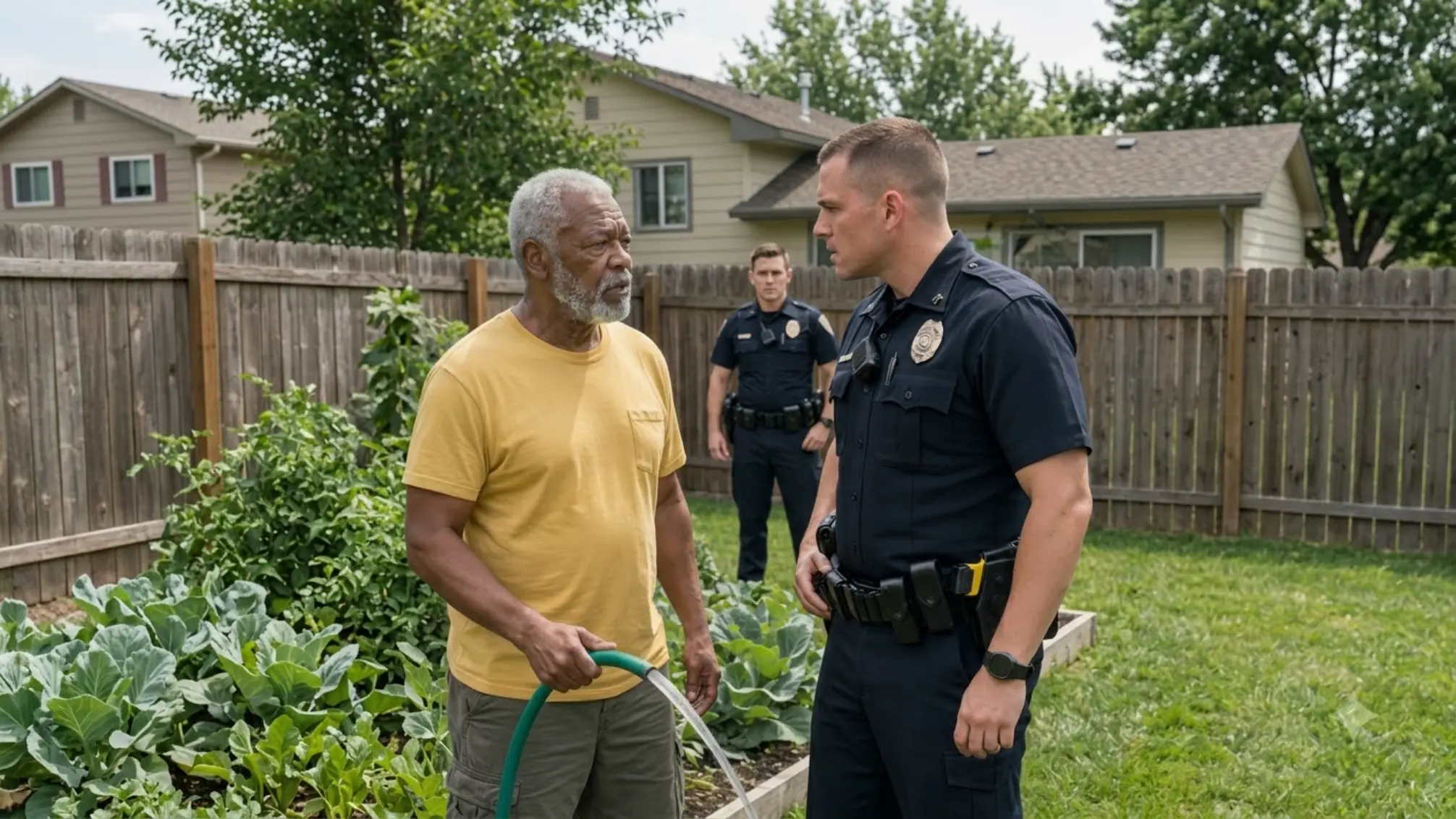
Officer Evan Cross looked barely old enough to have spent more than a few years wearing the dark navy uniform. At twenty-seven, he carried himself with the rigid confidence of someone trying hard to make sure nobody mistook youth for weakness, and his right hand hovered constantly near his duty belt as he stepped through Walter’s open side gate. Another officer, Daniel Mercer, remained several yards behind near the driveway, watching without saying much. Walter lowered the hose slightly and looked from Evan to the running water spilling across the soil.
“Can I help you?”
Evan stopped directly in front of him. “Identification.”
Walter waited.
“For what?”
“We received a call about a suspicious person behind this residence.”
Walter looked toward his house, then toward the tomatoes growing beside the fence. “You mean me?”
“That’s why I’m asking for identification.”
Walter’s expression tightened. “I’m watering my own garden on my own property. What exactly do you need my ID for?”
Evan stepped closer instead of answering.
“Because I asked for it.”
Walter glanced toward the active body camera clipped to the officer’s chest. A tiny indicator light told him the encounter was being recorded, and that mattered because the explanation he was receiving made less sense with every passing second. He set the hose nozzle on the wooden edge of the garden bed so the water continued flowing harmlessly toward the cabbage. “Officer, are you investigating a crime?”
“I’m investigating why you’re behind this house.”
Walter stared at him.
“I live here.”
“Then show me ID.”
“My wallet is inside.”
“Go get it.”
Walter did not move.
“No.”
Evan’s eyebrows rose. “Excuse me?”
Walter folded his arms slowly. “You walked into my backyard while I was watering vegetables. I told you I live here. Unless I’m suspected of committing a crime, I’m not going inside to retrieve identification simply because you don’t believe me.”
Behind Evan, Daniel shifted his weight.
“Evan,” he said quietly.
The rookie ignored him.
“You don’t decide how this investigation works.”
Walter looked directly at the bodycam again. “That’s an interesting sentence.”
“What’s that supposed to mean?”
“It means you’re recording yourself.”
Evan’s jaw tightened.
The call had originated from Marjorie Bell, a sixty-four-year-old woman who had moved into the neighboring house four months earlier. She had seen Walter behind the fence from an upstairs window and called the non-emergency line to report “an unfamiliar man wandering around the property next door.” She did not tell dispatch that the supposed stranger was carrying a garden hose, tending vegetables, or entering through a gate attached to the same home. She simply said she was concerned because she did not recognize him.
Dispatch sent Evan because he and Daniel were already nearby. Daniel expected a quick welfare check: confirm the resident, thank the caller, move on. Evan viewed it differently. He had graduated from the academy only eight months earlier and had recently been praised by one supervisor for being “proactive” during suspicious-person calls. To Evan, proactive increasingly meant refusing to accept explanations until he personally decided they were enough.
Walter could see the attitude immediately.
He had spent thirty-one years working for the city’s water department before retiring as a regional maintenance supervisor. His career had involved angry property owners, burst mains, contractors, inspectors, emergency crews, and public meetings where people shouted because flooding had ruined basements. He had learned that people who genuinely understood authority rarely needed to advertise it every thirty seconds. Evan was advertising.
“I’m going to ask you one more time,” the officer said. “ID.”
Walter picked up the hose again.
“And I’m going to ask you one more time. What crime do you suspect me of committing?”
Evan’s hand moved closer to his cuffs.
“Men like you don’t get to decide when I stop asking questions.”
The sentence landed differently from everything before it.
Walter stopped watering.
Daniel’s head snapped toward his partner.
Even Evan seemed to realize something had escaped his mouth that had not sounded as clean as it had inside his head.
Walter turned slowly.
“Men like me?”
Evan hesitated.
“You know what I mean.”
“No.”
Walter stepped closer, keeping both hands visible.
“I want you to say exactly what you mean.”
Daniel moved forward.
“Evan, maybe we should verify the address through dispatch.”
“I’ve got it.”
“You’ve got what?”
Evan shot him an irritated look. “The situation.”
Walter pointed toward the camera.
“Say that again and look straight into your bodycam.”
Evan’s face flushed.
“You think the camera scares me?”
“No.”
Walter’s voice became colder.
“I think it protects both of us from pretending later.”
That sentence pushed Evan past the point where good judgment might have brought the encounter back under control. His shoulders squared, and he stepped within arm’s length of Walter. “Keep testing me, and that camera can record me taking you off your own lawn.”
Daniel finally intervened.
“Evan.”
The rookie turned.
“What?”
“Back up.”
For the first time, Walter saw uncertainty on Evan’s face.
Daniel was thirty-six, almost a decade older, and had spent eleven years in patrol. He was not Evan’s supervisor, but he had been assigned to work with him precisely because younger officers were expected to learn judgment through experienced partners. Daniel had been uncomfortable from the moment Evan walked through the gate, yet discomfort had not become intervention until the language escalated.
Evan pointed toward Walter. “He’s refusing to identify.”
Daniel looked at the garden.
Then the house.
Then the hose attached to the rear spigot.
“He says he lives here.”
“Anybody can say that.”
Walter spoke. “Would you like me to unlock the back door?”
Daniel looked toward him.
“That would be helpful.”
Evan immediately shook his head. “No. He could be burglarizing the residence.”
Walter almost laughed.
“So now I broke into a house, found its hose, started watering vegetables, and decided to stand here waiting for police?”
Daniel turned away slightly, hiding a reaction.
Evan did not find it funny.
“You’ve got an attitude problem.”
Walter’s expression hardened.
“No. You have an evidence problem.”
The rookie reached toward Walter’s arm.
Daniel caught his wrist before contact.
“Don’t.”
Evan stared at him.
“What are you doing?”
“Stopping this from getting worse.”
“I’m conducting an investigation.”
“Then investigate.”
Daniel pointed toward the back door.
“Verify whether he lives here.”
Evan pulled his hand free.
“Fine.”
He grabbed his radio.
“Dispatch, run the property owner at 418 Brookfield Lane.”
There was a brief pause.
Walter waited.
The garden hose continued running.
A mockingbird landed on the fence.
Then dispatch answered.
“Property records show Walter James Reed and Denise Reed.”
Daniel looked toward Walter.
“Walter Reed?”
“Yes.”
Evan remained silent.
Dispatch continued.
“Vehicle registration associated with the address is a 2018 gray Ford F-150 and a 2023 white Honda CR-V.”
Walter pointed through the open gate.
The gray truck sat in the driveway.
Daniel exhaled.
“That’s enough.”
Evan looked dissatisfied.
“You have something with your name on it?”
Walter stared at him.
“You just confirmed my name through dispatch.”
“That doesn’t prove you’re Walter Reed.”
Walter smiled without humor. “Now you’re just trying to win.”
That sentence made Daniel look at Evan again.
The younger officer’s face reddened.
“I’m not trying to win anything.”
“Yes, you are.”
Walter placed the hose on the ground.
“You walked into my backyard expecting me to obey you. Every time reality gives you the answer, you move the requirement.”
Evan pointed toward him. “Watch yourself.”
Walter did not raise his voice.
“First you needed to know why I was here. I told you. Then you needed my ID. I explained it was inside. Then dispatch confirmed the homeowner’s name. Now you want something else because admitting this is over feels like losing.”
Daniel stepped between them slightly.
“Mr. Reed, give us a minute.”
Walter nodded.
“Take all the minutes you want. Just take them outside my backyard.”
That was the correct ending.
Daniel knew it.
He turned toward Evan.
“Let’s go.”
Evan looked like he wanted to argue.
Then something moved behind the neighboring fence.
Marjorie Bell appeared near the gate, holding her phone.
“That’s him,” she said.
Walter looked toward her.
Marjorie pointed.
“That’s the man I called about.”
Evan’s posture changed instantly, as though the original caller’s appearance had restored his authority.
“You see?”
Daniel closed his eyes briefly.
Walter faced Marjorie.
“We met last month.”
She looked uncertain.
“At the mailbox.”
Marjorie stared more carefully.
Walter continued.
“You asked who trimmed my oak tree because you wanted the company’s number.”
Recognition appeared slowly.
“Oh.”
Walter waited.
Marjorie’s face changed.
“You’re Mr. Reed.”
“Yes.”
Silence.
Marjorie lowered her phone.
“I’m sorry. I didn’t recognize you from upstairs.”
Walter nodded.
“That happens.”
Evan looked between them.
Nobody spoke.
Then Walter turned toward the rookie.
“Now are we finished?”
The answer should have been yes.
Instead Evan said, “She still had a legitimate concern.”
Walter’s eyes narrowed.
“About what?”
“She saw somebody she didn’t recognize.”
“Behind my own fence.”
“It looked suspicious.”
“What specifically looked suspicious?”
Evan had no answer.
Walter gestured toward the vegetables.
“The hose?”
Nothing.
“The cabbage?”
Daniel looked away again.
Marjorie quietly returned to her yard.
Evan finally said, “We were doing our job.”
Walter replied, “Then your job was finished the second you verified I lived here.”
Daniel nodded.
“He’s right.”
That changed everything between the two officers.
Evan stared at his partner.
“You taking his side?”
Daniel’s voice became firm.
“There aren’t sides. There’s the situation.”
Walter remembered that sentence.
Later, it would matter almost as much as the rookie’s bodycam language.
The officers left three minutes later.
Daniel apologized at the gate.
Evan did not.
Walter watched them walk toward the cruiser.
Then he looked down at the crushed patch of grass where the rookie had stood with one hand near his cuffs.
The hose continued spraying water.
Walter turned it off.
He no longer felt like gardening.
Inside the house, his wife Denise immediately noticed his expression.
“What happened?”
Walter told her.
She stopped halfway through unloading groceries.
“He said what?”
Walter repeated it.
Men like you don’t get to decide when I stop asking questions.
Denise stared at him.
“And the camera caught it?”
“Yes.”
“Then file the complaint.”
Walter opened the refrigerator.
“I’m thinking.”
“No.”
Denise closed the refrigerator door again.
“You always think until you convince yourself something isn’t worth the trouble.”
Walter looked at her.
She continued.
“What happens when he says that to somebody twenty years younger who gets angry?”
Walter remained quiet.
“What happens when the next person doesn’t have Daniel standing there?”
That decided it.
Walter filed a formal complaint that afternoon.
He did not demand Evan’s termination.
He did not describe the rookie as racist.
He wrote exactly what happened.
Times.
Questions.
Responses.
Dispatch verification.
Marjorie’s acknowledgment.
Daniel’s intervention.
And the two sentences he wanted preserved precisely:
Men like you don’t get to decide when I stop asking questions.
Keep testing me, and that camera can record me taking you off your own lawn.
The complaint reached Sergeant Linda Marshall the following morning.
Linda reviewed the body-camera footage twice.
Then she requested Daniel’s recording.
The difference between the two perspectives was useful.
Evan’s camera showed Walter directly ahead, which could make the encounter feel more confrontational simply because of proximity. Daniel’s camera, positioned several yards back, captured the entire context.
Vegetable beds.
Running hose.
Open rear door.
House.
Fence.
Walter standing calmly.
Evan repeatedly closing distance.
Linda paused the footage at the moment Evan reached toward Walter’s arm.
Daniel’s hand stopped him.
She wrote down the timestamp.
Then she checked Evan’s training record.
Three prior coaching notes existed.
One involved extending a pedestrian contact after identification had already been verified.
Another involved using unnecessary command language during a noise complaint.
The third came from an academy field evaluator who described Evan as technically strong but “overly focused on establishing control during low-risk civilian interactions.”
Linda sat back.
The backyard incident was no longer isolated.
She interviewed Daniel first.
He told the truth.
“I should have stepped in earlier.”
“Why didn’t you?”
“I kept thinking Evan would correct himself.”
“Did he?”
“No.”
“Did you believe Mr. Reed was committing a crime?”
“No.”
“Did you believe he posed a threat?”
“No.”
“When did you know the encounter should end?”
Daniel considered it.
“When dispatch confirmed the property owner.”
Linda looked at him.
“Not before?”
Daniel sighed.
“Probably before.”
She nodded.
That answer mattered.
Evan’s interview went differently.
He entered defensive.
“I was responding to a legitimate suspicious-person call.”
Linda agreed.
“Yes.”
He seemed surprised.
“You’re allowed to investigate the call.”
“Exactly.”
“But what did you learn after speaking with Mr. Reed?”
“That he claimed to live there.”
“And?”
“Dispatch showed a Walter Reed owned the property.”
“And?”
“The vehicle matched.”
“And?”
Evan became irritated.
“Why are you saying ‘and’ like that?”
Linda folded her hands.
“Because you continued the detention.”
“He wouldn’t show ID.”
“Was he legally required to?”
Evan hesitated.
“I needed to verify identity.”
“You had several ways to verify it.”
“He was being argumentative.”
Linda turned her monitor.
The bodycam played.
Walter’s voice filled the room.
What crime do you suspect me of committing?
Then Evan.
Men like you don’t get to decide when I stop asking questions.
Evan shifted.
“That sounds worse than I meant it.”
Linda paused the footage.
“What did you mean?”
“I meant civilians.”
“All civilians?”
“When they’re being investigated.”
Linda resumed.
Keep testing me, and that camera can record me taking you off your own lawn.
She stopped it again.
“What legal basis did you have to take him anywhere?”
Evan said nothing.
That silence shaped the disciplinary finding.
The department did not conclude that one sentence alone proved racial bias.
It concluded something more concrete.
Evan had extended an encounter after reasonable suspicion had evaporated.
He used unnecessarily threatening language.
He attempted physical control without adequate justification.
And his training history showed similar concerns had already been identified.
Walter received the findings three weeks later.
Complaint sustained.
He read the letter twice.
Denise stood behind him.
“What happens to him?”
“Suspension.”
“That’s it?”
“Five days, retraining, extended field supervision.”
Denise looked unhappy.
Walter understood.
“I didn’t ask for him fired.”
“You could have.”
“That doesn’t mean it would’ve been right.”
She crossed her arms.
“He threatened to take you away from your own yard.”
“Yes.”
“And you’re defending him?”
“No.”
Walter set down the letter.
“I’m defending consequences that fit evidence.”
Denise softened slightly.
Walter continued.
“He’s twenty-seven. Eight months on the street. If the department can correct him now, that’s better than waiting ten years until nobody can.”
The real surprise came two months later.
Evan requested permission to speak with Walter.
Walter almost refused.
Denise told him he should go.
“Why?”
“Because I want to know whether he learned anything.”
They met at a community center, with Sergeant Marshall present.
Evan looked different without the uniform.
Younger.
Less certain.
He sat across from Walter and spoke first.
“I’m sorry.”
Walter waited.
Evan continued.
“I’ve watched the footage probably fifty times.”
“That sounds unpleasant.”
“It is.”
Walter almost smiled.
Evan looked down.
“At first I kept watching for what you did wrong.”
Walter’s expression changed.
“And?”
“You didn’t.”
Silence.
“I kept telling myself your tone made me think you were challenging me.”
“I was challenging you.”
Evan looked up.
Walter continued.
“I challenged whether you had authority to do what you were doing.”
“That’s what I mean.”
Evan swallowed.
“I thought challenge automatically meant resistance.”
Walter nodded slowly.
“There’s your problem.”
Evan admitted something Walter did not expect.
At the academy, he had been terrified of losing control of an encounter. In training scenarios, hesitation sometimes caused instructors to criticize recruits for allowing situations to deteriorate. Evan absorbed the lesson too aggressively.
“I started thinking every conversation had to have a winner.”
Walter remembered his own words from the garden.
“That's exactly what I told you.”
“I know.”
Evan looked embarrassed.
“I hated hearing it on the video.”
“Probably because it was true.”
“Yes.”
Walter leaned back.
“What did you mean by ‘men like you’?”
Evan inhaled slowly.
“I’ve thought about that more than anything.”
Walter waited.
“I told Internal Affairs I meant civilians who challenge officers.”
“Do you still believe that?”
“No.”
“Was race part of it?”
Evan did not answer immediately.
“That’s harder.”
Walter appreciated the hesitation more than a rehearsed denial.
Evan continued.
“I don’t remember consciously thinking, ‘He’s Black, so he doesn’t belong there.’”
Walter nodded.
“That’s not what I asked.”
“I know.”
Evan looked toward his hands.
“I think the call already framed you as suspicious before I arrived, and I never reset after seeing what was actually happening.”
Walter listened.
“I saw you behind the fence and started trying to prove the caller was right instead of figuring out whether she was.”
That answer mattered.
Not because it absolved him.
Because it demonstrated thought.
Walter asked one final question.
“What happens next time?”
Evan answered immediately.
“I verify the situation, not my assumption.”
Walter extended his hand.
Evan stared at it, then shook it.
That was not forgiveness in the sentimental sense.
It was acknowledgment.
Six months later, Evan returned to patrol after completing extended field training.
His new training officer was Daniel Mercer.
The arrangement had been intentional.
During one afternoon shift, dispatch sent them to another suspicious-person call.
A homeowner reported a young Latino man carrying tools beside a neighbor’s garage.
Evan arrived.
The man immediately said he was repairing the garage door.
Old instincts appeared.
Evan felt them.
Then he looked at the company van.
Uniform logo.
Work order on the dashboard.
Homeowner approaching from the house.
He asked two questions.
The homeowner confirmed everything.
Evan thanked the technician and left.
Daniel said nothing until they reached the cruiser.
Then he smiled.
“What?”
Daniel started the engine.
“You figured out nobody had to win.”
Evan laughed.
“No.”
He looked through the windshield.
“We just had to figure out what was happening.”
Back on Brookfield Lane, Walter’s garden kept growing.
The cabbage eventually became enormous.
The tomatoes produced more than he and Denise could eat, so they gave bags to neighbors.
Even Marjorie received some.
She arrived awkwardly one Saturday with an empty basket.
“I owe you an apology.”
Walter handed her tomatoes.
“You already apologized.”
“Not properly.”
He waited.
Marjorie looked toward the backyard.
“I saw someone I didn’t recognize and decided that meant danger.”
Walter nodded.
“You did.”
“I should have looked again.”
“Yes.”
She seemed surprised by his directness.
Walter smiled slightly.
“You want me to lie?”
“No.”
“Good.”
She accepted the basket.
The following summer, Marjorie invited Walter and Denise to a neighborhood cookout.
Walter went.
He did not become her best friend.
Life rarely needed that kind of tidy ending.
They became neighbors who understood one another better.
That was enough.
The Charlotte Police Department eventually incorporated the body-camera footage into rookie training.
Walter agreed under one condition.
His identity would not be the focus.
The training began with the caller’s statement.
Suspicious man behind neighboring residence.
Then recruits watched Evan arrive.
Watched Walter watering vegetables.
Watched the questions.
Watched evidence accumulate that Walter belonged there.
Then watched Evan continue anyway.
The instructor paused before the worst sentence.
“What is the mistake?”
A recruit usually answered, “The language.”
The instructor shook his head.
“Earlier.”
Another answered, “He fails to update his assessment.”
“Exactly.”
Then the video continued.
Men like you don’t get to decide when I stop asking questions.
The instructor paused again.
“Now what happened?”
A recruit answered, “The officer turned uncertainty into a power contest.”
Correct.
That became the lesson.
Not that officers should ignore suspicious-person calls.
Not that residents never need questioning.
Not that every complaint involves prejudice.
The lesson was that investigation required changing conclusions when facts changed.
Walter Reed had been watering vegetables.
The hose connected to his house.
The vehicle matched the property.
Dispatch confirmed his name.
The caller recognized him.
Every piece of new information reduced suspicion.
Evan treated each one as something to overcome.
That was the failure.
Years later, Walter would occasionally see body-camera clips online where encounters escalated because neither person wanted to surrender pride.
He thought about his garden.
He thought about Evan.
He thought about Daniel’s sentence.
There aren’t sides. There’s the situation.
Walter liked that more than almost anything produced by the official investigation.
Because authority worked best when it was not treated like a contest.
One Sunday morning, Walter stood in his backyard again.
Gray T-shirt.
Cargo shorts.
Green hose.
Almost exactly like that afternoon.
A patrol cruiser rolled slowly along the street beyond the fence.
Walter glanced up.
Evan was driving.
Their eyes met.
The officer raised one hand from the steering wheel.
Walter nodded.
The cruiser continued.
No confrontation.
No explanation.
No proof of ownership.
Just two people recognizing each other and continuing with their day.
Walter turned the hose toward the tomatoes.
Water darkened the soil.
Behind him, the house he had owned for nearly two decades stood exactly where it always had.
He smiled slightly.
The most important thing captured by Evan Cross’s bodycam had never been one ugly sentence.
It was everything that came before and after it.
The assumption.
The refusal to reconsider.
The escalation.
The intervention.
The evidence.
And finally, the possibility that someone who had used authority badly could be forced to watch himself clearly enough to learn how to use it differently.
That was the outcome Walter wanted.
Not humiliation.
Not revenge.
Correction before arrogance became habit.
Because the next homeowner might not remain as calm.
The next officer might not have Daniel standing nearby.
The next camera might not be recording.
And if a department wanted fewer disasters, it could not wait until those three protections disappeared.
It had to teach the lesson while the mistake was still small enough to correct.
For Walter Reed, that lesson began with a garden hose, a rookie officer, and one question that should have ended the encounter immediately:
“I’m watering my own garden. What exactly do you need my ID for?”