The telephone began ringing before Dr. Carter Vance could wrench his wrist free. Its shrill tone cut through the trauma bay while the unconscious patient’s oxygen monitor sounded a second, more urgent alarm. Meera Santos stood between the surgeon and the gurney, her delicate face calm beneath strands of dirty-blonde hair that had slipped from her ponytail. Vance was nearly a foot taller, but the moment she caught his wrist, everyone in the room understood that she was not the frightened rookie they had mocked for the past six months.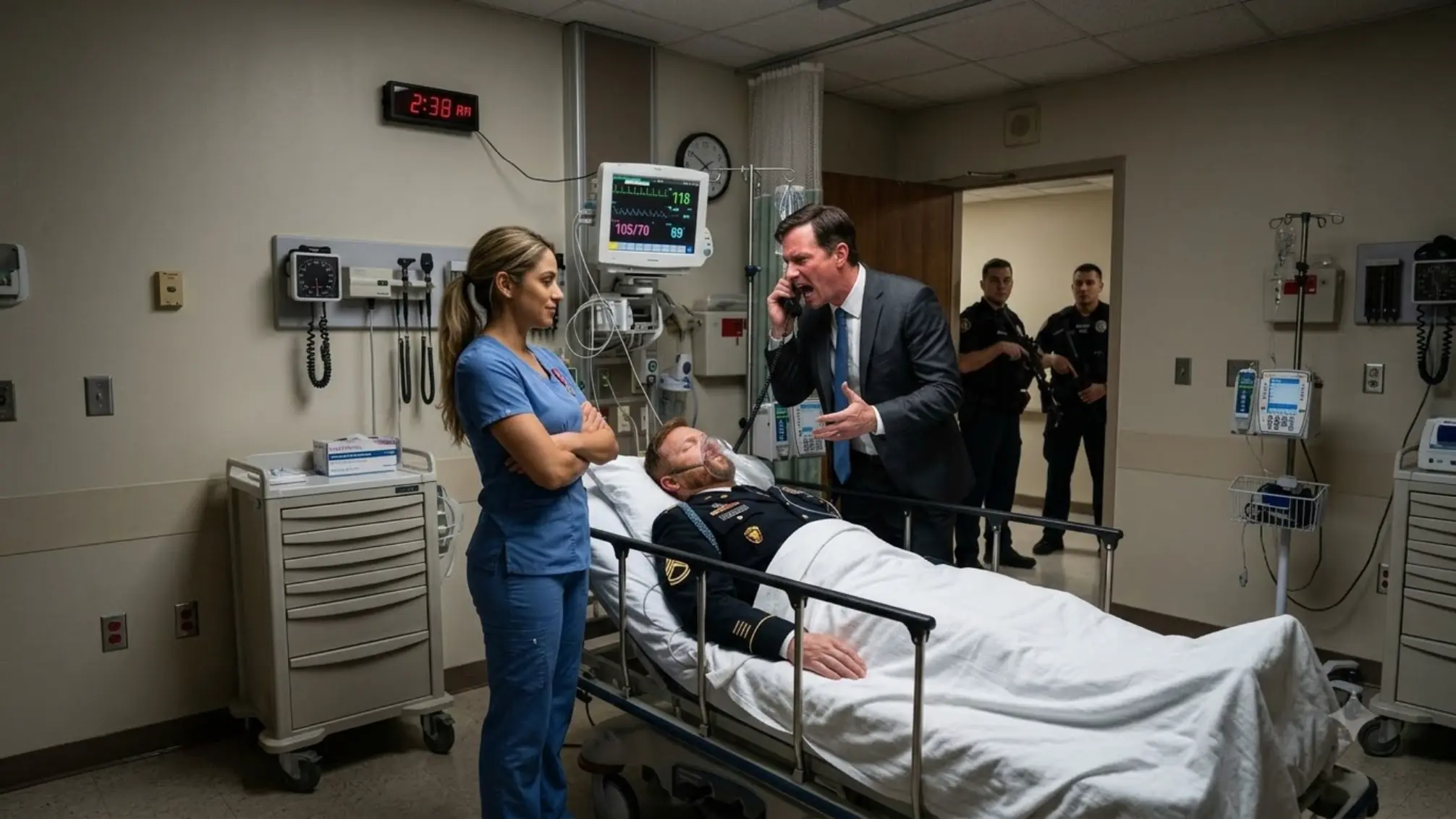
Her grip was precise rather than brutal. One slight turn had locked Vance’s elbow and forced him onto the balls of his feet, close enough to feel the quiet warning in her gray-blue eyes. Meera released him only when hospital director Evan Cross stormed into the room, his expensive suit jacket flaring behind him. Cross took in the unconscious man, the dropped medication syringe, and Vance rubbing his wrist with a face twisted by humiliation.
“What is happening?” Cross demanded.
Vance pointed at Meera. “She attacked me and interfered with treatment.”
“I stopped you from sedating a patient with a possible brain injury,” Meera answered.
Cross’s attention moved to the gurney. The patient had arrived without identification, dressed in torn jeans and a black hooded jacket. Paramedics found him unconscious beneath an overpass less than two miles from the hospital. His skin was gray, his breathing shallow, and no one knew whether he was an addict, a homeless man, or the victim of an assault.
To Vance, the explanation had seemed obvious.
“Probable overdose,” he had announced before examining the man’s pupils or checking for trauma beneath the clothing.
Meera had noticed what everyone else missed. His pupils were unequal. His breathing followed a dangerous irregular pattern. Behind his left ear, partly hidden beneath the hood, was a small black phoenix tattoo unlike any decorative design she had ever seen.
She recognized it because she carried the same symbol beneath the collar of her scrubs.
Cross pointed toward the hallway. “Security is already coming. You are suspended pending termination.”
“The patient is losing his airway,” Meera said.
“He is no longer your responsibility.”
The oxygen reading dropped to seventy-eight.
Meera turned away from Cross and placed the breathing mask over the patient’s mouth. She tilted his head with practiced control, sealed the mask, and delivered two measured breaths. His chest rose. The number on the monitor climbed slowly.
Vance grabbed for the mask.
Meera blocked his hand with her forearm. “Do that again, and he dies.”
“You are a nurse,” he snapped. “You do not give me orders.”
“Then stop making mistakes that require them.”
Several residents stared at the floor. Sarah Mills, a young emergency nurse who had quietly befriended Meera, moved closer to the gurney and checked the patient’s pulse. She looked at Vance with growing uncertainty.
“His heart rate is stabilizing,” Sarah said. “It changed when she opened the airway.”
Vance ignored her. “Prepare the sedative.”
“No,” Meera said.
Cross stepped directly into her path. “You have been employed here for six months. You have no authority, no seniority, and no right to challenge the attending physician.”
The telephone rang again.
Cross snatched it from the wall. “Trauma Bay One.”
He listened for three seconds, and the anger drained from his face.
“Yes, this is Director Cross.”
Another pause.
“No, sir. We were not informed.”
His eyes moved toward the patient.
“Colonel Brennan?”
The residents stopped moving.
Cross covered the receiver with one hand. “Who is Marcus Brennan?”
Meera’s expression did not change. “The man your surgeon almost stopped from breathing.”
Cross stared at her. “How did you know?”
She looked toward the phoenix tattoo beneath the patient’s ear. “Because he never travels without a team.”
A low vibration rolled through the windows.
At first, it sounded like distant thunder. Then the rhythm strengthened into the unmistakable pounding of military rotors. Metal trays trembled. Glass medicine bottles rattled inside cabinets.
Sarah hurried toward the window. “There is a helicopter landing in the ambulance lot.”
Meera corrected her without looking away from Brennan. “A Blackhawk.”
The aircraft dropped into the parking area with enough force to trigger car alarms. Rotor wash scattered rain and debris against the hospital walls. Six men emerged before the wheels fully settled, dressed in dark civilian clothing but moving with the discipline of combat operators.
They entered the emergency department in a tight formation.
The largest man came first. He stood six feet four, with a red-brown tactical beard and cold green eyes that examined every doorway before settling on the trauma bay. A black credential wallet appeared in his hand.
“We are here for Colonel Marcus Brennan,” he said.
Cross hurried forward. “I am the hospital director. We were only just informed of his identity.”
The operator looked past him toward the gurney. “Why is his breathing being manually supported?”
Vance answered quickly. “He arrived with signs of substance abuse. We were preparing appropriate sedation when an inexperienced nurse interfered.”
The operator’s jaw tightened. “What medication?”
Vance named the sedative combination.
Every member of the military team became still.
The operator moved close enough that Vance’s confident posture collapsed. “That combination would suppress his breathing.”
“It is standard for an aggressive overdose patient.”
“He was unconscious.”
“He could have become combative.”
“You were going to sedate a man who could not breathe because he might become difficult later?”
Vance glanced toward Cross. “We followed emergency protocol.”
The operator looked at Meera. “Did you stop the medication?”
“Yes.”
“Did you recognize the intracranial signs?”
“Yes.”
“And the tattoo?”
Meera remained silent.
The operator studied her face, particularly the thin scar above her left eyebrow. Then his gaze dropped to the way she stood: balanced, aware of every exit, her trembling rookie act completely gone.
“What is your name?” he asked.
“Meera Santos.”
A younger operator behind him inhaled sharply. “Sir.”
The leader did not turn. “What?”
“That name was on the Team Nine records.”
Vance gave an impatient laugh. “She is a floor nurse.”
The operator continued watching Meera. “Call sign?”
She lowered her eyes for one second.
“Phoenix.”
The answer transformed the room.
The younger operator straightened immediately. Two others exchanged stunned looks. The bearded leader stepped back half a pace, not from fear, but recognition.
“You are Phoenix?” he asked.
“I was.”
Behind them, Cross still held the telephone. A voice on the line was speaking loudly enough for those nearest him to hear. Cross swallowed and extended the receiver toward Meera.
“The Pentagon is asking for you.”
Vance stared at the phone. “That is impossible.”
Meera accepted it. “Santos.”
The voice on the other end identified itself as the office of the Secretary of Defense. Meera listened without interruption, her eyes fixed on Brennan’s monitor.
“Yes, sir.”
Another pause.
“I understand.”
She handed the receiver back to Cross.
“What did they say?” he asked.
“That Colonel Brennan was extracted from a classified operation eighteen hours ago. His convoy was attacked, and someone diverted the scheduled military transport. They believe the ambulance that brought him here was not supposed to find him alive.”
The bearded operator moved closer. “My call sign is Breaker. Colonel Brennan was carrying intelligence tied to Blackwell Strategic Operations.”
Cross frowned. “What is Blackwell?”
“A private military contractor that makes problems disappear.”
Meera checked Brennan’s abdomen. His body tensed when her fingers pressed beneath the left ribs, even though he remained unconscious.
“He is bleeding internally,” she said.
Vance folded his arms. “There is no external evidence.”
“There would not be. The damage is beneath his armor line.”
“He was not wearing armor when he arrived.”
“He was wearing it when the injury happened.”
Vance scoffed. “And you know that from looking at him?”
Meera pulled open the man’s jacket and exposed a wide pattern of bruising across his chest and ribs. “The impact marks show where the plate carrier sat. Dust inside the fabric indicates it was removed recently. The punctures beneath his jaw are from a field intravenous line, and the blood beneath his fingernails is not his.”
Breaker stared at her. “How long do we have?”
“Without imaging, I cannot tell you.”
Cross stepped forward. “She has been terminated.”
The room went silent again.
Breaker turned his head slowly. “For what?”
“She violated hospital protocol and physically confronted a physician.”
“She prevented your physician from killing the colonel.”
“That has not been established.”
Breaker looked toward Cross as though considering how little effort it would require to move him out of the way. “The Pentagon called because this woman is the only person in the building who recognized a Tier One commander before your staff drugged him into respiratory arrest.”
Vance moved toward Meera. “You are not touching him again.”
Meera caught his wrist a second time.
This time, she turned it farther.
Vance gasped and dropped to one knee.
“Get your hand off me,” he hissed.
Meera leaned closer. “You keep reaching for people who are trying to save your patient.”
Breaker almost smiled.
Meera released Vance and immediately grabbed the portable ultrasound unit. She spread gel across Brennan’s abdomen and moved the probe through four rapid positions. A dark collection appeared on the screen.
“Free fluid,” Sarah whispered.
Meera nodded. “Severe splenic injury, possibly liver involvement.”
Vance rose, furious and embarrassed. “She cannot make that determination alone.”
The monitor alarmed.
Brennan’s blood pressure fell to sixty-eight over forty.
Breaker drew his radio. “We need military transport.”
“He will not survive it,” Meera said. “He needs an operating room now.”
Cross looked between her and Vance. “Dr. Vance is chief of trauma.”
“Then he can assist someone competent.”
Vance stepped forward again, but Breaker placed one heavy hand against his chest. The surgeon stopped instantly.
The elevator opened, and a military surgical team entered with sealed equipment cases. Major Sarah Chen led them, an experienced Navy surgeon with iron-gray hair and the expression of someone who had crossed continents without sleeping.
She saw Meera and stopped.
“Phoenix.”
“Major.”
Chen looked at Brennan’s ultrasound image. “Grade-four splenic rupture.”
“Possibly worse.”
“We operate now.”
Cross raised both hands. “This is still a civilian hospital. You cannot take control of my surgical floor.”
His phone rang again.
He answered, listened, and closed his eyes.
“Yes, Madam Secretary.”
No one spoke while he received his instructions. When he lowered the phone, his hand was shaking.
“The Department of Defense has invoked emergency federal authority over the patient’s care.”
Meera looked toward the operating-room corridor. “Then clear the floor.”
Brennan’s gurney began moving.
Vance tried to follow.
Breaker blocked him. “You stay here.”
“I am the trauma chief.”
“You are the reason the patient almost stopped breathing.”
“I have performed hundreds of emergency operations.”
Meera stopped beside the elevator. “And yet you missed the injury before a rookie nurse found it.”
The elevator doors closed on his face.
Inside the operating room, Meera scrubbed beside Major Chen. Her hands were perfectly still now. The beautiful, hesitant nurse who apologized whenever a doctor raised his voice had vanished, replaced by a woman whose movements carried the precision of years spent treating catastrophic injuries in impossible places.
Chen looked at her. “You disappeared three years ago.”
“I followed orders.”
“The official report said you died.”
“That was the purpose.”
Brennan’s blood pressure fell again.
Conversation ended.
Chen opened the abdomen and found nearly two liters of blood. The spleen was badly torn, and a deep liver injury continued pumping blood into the cavity. Meera managed the transfusion, tracked the pressure, and anticipated Chen’s requests before she made them.
“Clamp.”
Meera placed it in her hand.
“Suction.”
Already waiting.
“More blood.”
“Running now.”
Brennan’s heart rhythm changed.
Meera recognized the pattern immediately. “Potassium rising. Slow the transfusion and give calcium.”
The anesthesiologist followed her instruction.
The rhythm stabilized.
Chen glanced at her over the surgical mask. “You have not lost anything.”
“I lost three years.”
“You are alive.”
“Not everyone was.”
Before Chen could answer, Breaker’s voice came through the operating-room intercom.
“Phoenix, we have unidentified vehicles entering the parking structure.”
Meera looked toward the observation window. “How many?”
“Three black sport-utility vehicles. No plates. Twelve armed occupants.”
Chen continued operating. “Blackwell?”
“Most likely,” Breaker answered.
Cross’s voice entered the intercom. “Hospital security is contacting the police.”
Meera shook her head. “They will be inside before local officers understand the threat.”
“What do you recommend?” Breaker asked.
“Seal the surgical floor. Disable every elevator except the freight lift. Place two operators at each stairwell and evacuate nonessential staff through the service corridor.”
Cross protested. “You cannot turn my hospital into a battlefield.”
Meera looked at Brennan’s open abdomen. “The battlefield arrived before he did.”
Breaker began issuing orders.
The fire alarm activated three minutes later.
Its piercing sound filled the operating suite. Red lights flashed above the doors, and hospital announcements ordered everyone to evacuate.
“They triggered it,” Meera said. “They want civilians moving through the halls.”
Breaker’s response came through gunfire.
“Contact at the east entrance.”
The sound echoed upward through the building. Suppressed shots were softer than ordinary gunfire, but Meera knew them instantly.
Chen never lifted her hands from the surgical field. “We stop now, Brennan dies.”
“We do not stop.”
Another transmission reached them.
“Six hospital staff taken in the lobby. Hostiles are using them as shields.”
Meera looked toward the door.
Chen noticed. “Do not even think about it.”
“Can you finish without me?”
“I can operate. I need someone to control the blood products and monitor the trauma.”
“The anesthesiologist can handle both.”
“You are more valuable here.”
“The hostages are valuable too.”
Meera stripped off her gloves.
Breaker entered before she reached the door. “You are not leaving this room.”
“Your men cannot get a clean angle.”
“That does not make you bulletproof.”
Meera opened the supply cabinet and removed a portable defibrillator, two oxygen regulators, and a heavy stainless-steel instrument tray.
Breaker watched her. “What are you doing?”
“Building an opportunity.”
“You are a medic.”
“I was also Team Nine.”
One of the younger operators behind Breaker whispered, “Kandahar.”
Breaker glanced at him.
“She held a field hospital with eleven operators,” the young man said. “The report says she used medical equipment after they ran out of ammunition.”
Meera corrected him. “We did not run out. We conserved it.”
Breaker looked from her to the equipment in her hands. Then he removed a compact pistol from his vest and offered it grip-first.
“You rescue the civilians and return immediately.”
Meera checked the chamber. “I return when the floor is secure.”
She stepped into the corridor wearing blue scrubs beneath a tactical vest that was too large for her petite frame. Her loose blonde hair fell around her face, but her eyes remained focused and cold.
The stairwell lights flickered red from the alarm.
Meera descended quietly, pushing a crash cart loaded with emergency supplies. At the second-floor landing, she heard three men speaking beyond the fire door.
“Surgical team is contained.”
“Primary target remains alive.”
“Move the hostages in five minutes.”
Meera opened the door and immediately hunched her shoulders.
A terrified rookie nurse appeared in the corridor.
Three armed men turned toward her.
“Stop,” one ordered.
She raised her hands. “I was hiding.”
“Move downstairs.”
“There is a ventilated patient in Room 237.”
“Not our problem.”
“He will die if the power fails.”
The nearest man grabbed her arm. “I said move.”
Meera’s frightened expression disappeared.
She twisted his wrist, drove her elbow into the side of his neck, and pulled him across her body as a shield. The second man raised his rifle, but she shoved the crash cart into his knees.
The third fired.
Meera dropped behind the first man as suppressed rounds struck the wall. She pressed the charged defibrillator paddles against her captor’s tactical vest where the conductive buckles crossed his chest.
The electrical discharge threw him backward.
She rolled, fired twice into the second attacker’s thigh, and drove the metal tray into the third man’s face before he could correct his aim. He staggered. Meera caught his rifle, redirected the barrel, and struck him beneath the jaw with the stock.
Three attackers fell in less than twenty seconds.
She took their radio.
“Breaker, second floor clear.”
“You were ordered to return.”
“Lobby still occupied.”
“Phoenix—”
She ended the transmission.
In the basement service corridor, Meera filled a portable cleaning canister with surgical alcohol and attached it to the crash cart. She wired the defibrillator’s timed discharge to a metal tray placed above the liquid, creating a crude flash device designed to blind and disorient rather than kill.
She sent the empty cart into the lobby through the service elevator.
Six Blackwell contractors guarded eight hospital employees near the main entrance. Their leader watched the elevator doors open and saw the cart roll forward without anyone behind it.
“Check it.”
Two men approached.
The flash erupted.
White light filled the lobby, accompanied by a deafening metallic blast. The contractors turned instinctively, giving Breaker’s team the opening they needed.
Meera entered from the east corridor.
She fired into the leg of the closest attacker, struck another across the temple, and kicked a dropped rifle away from the hostages. Operators descended from the stairwell, taking controlled positions around the lobby.
The Blackwell leader seized Sarah and pressed a handgun against her head.
“Everyone stops,” he shouted.
The lobby froze.
Meera aimed at his chest.
“Drop it,” he ordered. “Or the nurse dies.”
Sarah trembled but kept her eyes on Meera.
“You were hired for Brennan,” Meera said. “Killing civilians was not part of the contract.”
“You know nothing about my contract.”
“I know Blackwell does not pay operators who create international scandals.”
The weapon pressed harder against Sarah’s temple.
“I said drop it.”
Meera lowered her pistol slightly.
The man smiled.
“You made one mistake,” she said.
“What?”
“You kept watching me.”
Breaker’s voice came from behind him.
“Weapon down.”
The contractor turned enough to see four rifles aimed directly at his exposed side. His hold on Sarah loosened.
She drove her heel into his shin and dropped.
Meera fired into his shoulder before he could correct his aim. Breaker’s team surged forward and secured the remaining attackers.
Sarah crawled toward Meera.
“You came back for us.”
Meera helped her stand. “That is what nurses do.”
Breaker approached, studying the scorched scrubs, loose hair, and calm expression of the woman who had just transformed hospital equipment into a tactical rescue.
“You ignored a direct order.”
“I saved eight civilians.”
“You are going to be a problem.”
“That is what Brennan used to say.”
They returned to the surgical floor as Chen completed the final repair. Brennan’s vital signs had stabilized. The colonel would need weeks of recovery, but he was alive.
Meera removed the tactical vest and stood outside the operating room with blood and soot staining her blue scrubs.
The elevator opened.
A three-star Navy admiral stepped into the corridor, accompanied by officers carrying sealed files. Every operator snapped to attention.
Admiral Rafael Castillo walked directly toward Meera.
“I received a call saying a rookie nurse saved Colonel Brennan, uncovered an assassination attempt, and neutralized a Blackwell team inside a civilian hospital.”
Meera straightened. “Sir.”
“I told them the description sounded familiar.”
He held out a sealed envelope.
“Lieutenant Commander Meera Santos, these are your reinstatement orders, full rank restoration, back pay, and formal exoneration.”
Cross and Vance appeared at the far end of the corridor. Their faces changed when they heard the title.
Vance approached carefully. “There has clearly been a misunderstanding.”
Meera turned toward him.
“A misunderstanding is giving someone the wrong meal,” she said. “You saw an unconscious man, decided he was worthless, and nearly stopped his breathing.”
Cross stepped forward. “The hospital is prepared to reinstate you with a promotion.”
“You fired me for saving a patient.”
“We acted on incomplete information.”
“You had enough information to check his pupils.”
Vance lowered his eyes.
Admiral Castillo looked at Cross. “Your hospital dismissed one of the most decorated combat medics in modern special operations because she challenged a surgeon’s ego.”
“We did not know who she was.”
Meera’s voice became colder. “That is the point.”
The operating-room doors opened. Major Chen removed her mask.
“Colonel Brennan is stable.”
Relief moved through the corridor.
Breaker looked at Meera. “Our team lost its medic last month.”
Castillo raised an eyebrow. “Are you volunteering her?”
“I am requesting her.”
Meera opened the envelope but did not remove the orders. She looked through the observation window at Brennan, then down at the blue scrubs she had once worn to disappear.
“I will return under one condition.”
“Name it,” Castillo said.
“Full operational authority. No ceremonial assignment and no desk.”
The admiral smiled. “Approved.”
Brennan awakened several hours later in intensive care. Meera stood beside his bed while Breaker’s team waited outside.
His eyes opened slowly.
“Phoenix,” he whispered.
“You look terrible, Colonel.”
“So do you.”
She glanced at her scorched scrubs. “I had a difficult shift.”
Brennan managed a weak smile. “I heard they fired you.”
“They changed their minds.”
“I heard the Pentagon helped.”
“The people calling the phone did.”
His eyes closed again, but the smile remained.
Outside, the Blackhawk waited in the first light of morning. Meera walked toward it beside Breaker, still wearing the hospital scrubs that had made everyone underestimate her.
Sarah met her near the doors.
“Will you ever come back?”
Meera looked at the emergency department where she had spent six months pretending to be smaller than she was.
“Maybe,” she said. “But next time, I will come through the roof.”
Sarah laughed through her tears.
Meera boarded the helicopter. The operators shifted to make room, their expressions no longer doubtful.
Breaker handed her a headset.
“Welcome to the team, Phoenix.”
As the aircraft lifted above the hospital, Meera watched the building disappear beneath the morning clouds. She had entered it as a quiet rookie nurse no one respected.
She left as the woman the Pentagon trusted to keep its most dangerous soldiers alive.
The blue scrubs had never made her weak.
They had merely hidden the fire.