The administrative hallway of Baltimore Police Headquarters was unusually quiet when Sergeant Travis Boone stepped in front of Vanessa Cole. He planted his polished boots across the entrance to a restricted memorial office and looked her over as though her charcoal suit and composed expression were part of an unconvincing disguise. Behind the closed wooden door, senior officers and city officials were preparing to dedicate the room to a police chief whose reforms had changed the department. Vanessa had arrived alone, carrying no visible invitation and wearing only a small silver eagle brooch near her lapel.
“This room is for police families only, ma’am,” Boone said. “Stop pretending you belong here.”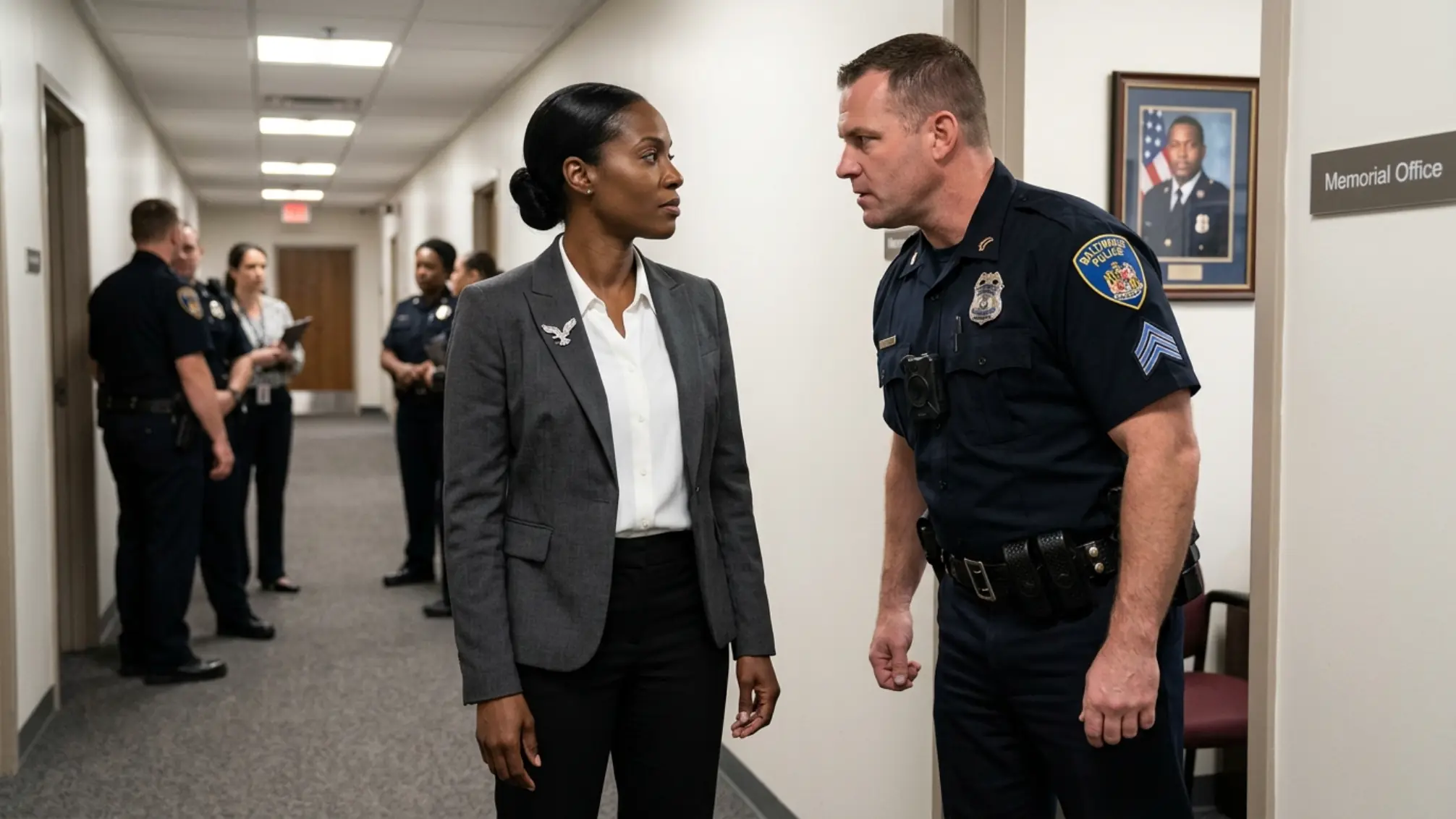
Vanessa held his stare. “Move aside before you embarrass yourself in front of your entire department.”
“One more demand like that, and I’ll have you escorted out myself.”
“Then open that door, Sergeant, and tell me whether the man in the portrait was your chief—or my husband.”
For a moment, Boone simply stared at her. He was forty-one, broad through the shoulders, and accustomed to civilians becoming nervous the instant his tone changed. Vanessa did not lower her eyes, apologize, or rush to prove herself. Her calmness felt like defiance because he had already decided she possessed no authority.
“Your husband?” he repeated with a short laugh. “Chief Marcus Cole was married to a university professor.”
“I know.”
“A highly respected professor.”
“So I’ve heard.”
Boone’s expression tightened. “And you expect me to believe that’s you?”
Vanessa glanced toward the nameplate on his uniform. “I expected you to verify my identity before insulting me.”
“You came through a restricted hallway without an escort.”
“The receptionist directed me here.”
“She should have given you a visitor badge.”
“She did.”
Vanessa slowly lifted the edge of her blazer, revealing a temporary credential clipped near her waistband. Boone looked at it for less than a second before dismissing it.
“That badge gets you into the building. It does not make you police family.”
“No,” Vanessa replied. “Twenty-six years of marriage did that.”
The hallway clock showed 9:54 a.m. The dedication ceremony was scheduled to begin at ten. Vanessa had deliberately arrived without a city escort because Marcus had spent his career insisting that police headquarters should never become a fortress where ordinary people were treated like intruders. He believed the character of an institution was revealed most clearly when employees thought no influential person was watching.
Vanessa had not come to test anyone. She had already endured enough public ceremonies, rehearsed condolences, and officials speaking about her husband as though the bronze version of him mattered more than the living man she had lost. She wanted to enter quietly, sit near the back, and listen while the city named an office after Marcus.
Instead, she found herself facing a sergeant who seemed determined to prove why her husband’s unfinished reforms were still necessary.
Boone folded his arms. “Chief Cole died almost two years ago.”
“Yes.”
“I served under him.”
“I know that too.”
“He never mentioned a wife named Vanessa to me.”
Vanessa’s composure shifted almost imperceptibly. “How often did the chief discuss his marriage with you?”
Boone did not answer.
Marcus had known thousands of officers during his thirty-four years with the department. He remembered their names, children, academy classes, disciplinary histories, and sometimes the neighborhoods where they grew up. Many officers interpreted that attention as personal friendship, though Marcus rarely discussed his private life at work. Vanessa had preferred it that way.
She taught constitutional law at Morgan State University and spent most of her career studying how public institutions exercised power over citizens. She and Marcus often disagreed about policing, but their disagreements had never weakened their marriage. They sharpened both of them. At home, they debated policy over cold dinners while their daughter complained that neither parent knew how to end an argument.
Boone moved closer. “What’s inside the briefcase?”
“Documents.”
“What kind?”
“Personal.”
“You’re standing outside a secured office during a ceremony involving city leadership. Nothing you carry is personal until I clear it.”
Vanessa looked at the black leather case in her hand. Inside were Marcus’s final handwritten notes, the speech he never lived to deliver, and a framed photograph of him holding their newborn daughter outside the old Western District station. She had promised the mayor one item for the memorial display, but she had not yet decided whether the photograph belonged to the city.
“You may inspect the case after explaining the legal grounds for your search,” she said.
Boone gave a contemptuous smile. “You think speaking like a lawyer is going to intimidate me?”
“No. Your body camera should be enough.”
His eyes flicked toward the device mounted on his chest. A small red light indicated that it was recording.
“You’re being confrontational,” he said.
“I’m standing still.”
“You refused a security instruction.”
“You demanded access to private property without identifying a threat, requesting consent, or stating a policy.”
Boone’s jaw tightened. Vanessa understood the pattern immediately. He wanted emotional resistance because emotion would allow him to redefine the confrontation. If she raised her voice, he could call her aggressive. If she tried to pass, he could call her noncompliant. If she reached inside the case, he might claim she made a threatening movement.
Marcus had warned her about officers who confused obedience with safety.
A young administrative assistant appeared at the far end of the hallway carrying a stack of programs. Her name was Claire Donnelly, and she had spent the previous week corresponding with Vanessa about the ceremony. Recognition spread across her face.
“Professor Cole, we’ve been waiting for you.”
Boone held up one hand. “Stay back, Claire.”
The assistant stopped. “Sergeant, she’s the chief’s widow.”
“I’m verifying that.”
“I verified her identification downstairs.”
Boone turned toward her. “Then you failed to issue the correct access credential.”
“The mayor’s office specifically requested that she receive unrestricted ceremonial access.”
“Do you have that request in writing?”
“Yes.”
“Bring it to me.”
Claire hesitated. “The ceremony starts in five minutes.”
“Then move quickly.”
Vanessa watched the assistant hurry away. “You had a direct witness confirming my identity.”
“I have a civilian employee making a claim.”
“She works for this department.”
“She doesn’t outrank me.”
The answer revealed more than Boone intended. Verification was not his goal. Control was. Any fact offered by someone with less rank became optional whenever it threatened his judgment.
Vanessa shifted the briefcase from one hand to the other. “Did my husband ever speak to you about procedural justice?”
Boone laughed. “I don’t need a lecture about policing from a professor.”
“That is not what I asked.”
“He gave plenty of speeches.”
“Did you listen?”
His face hardened. “Chief Cole understood that officers must control uncertain situations.”
“He believed officers should reduce uncertainty before using control.”
“I was there. You weren’t.”
Vanessa’s eyes became colder. “I was there every night he came home wondering whether this department could become something better without destroying the good officers trying to change it.”
Boone stepped within an arm’s length of her. “You need to lower your tone.”
“My tone has not changed.”
“Your attitude has.”
“My understanding of you has.”
Before Boone could respond, the memorial office door opened. Deputy Commissioner Evelyn Shaw stepped into the hallway wearing her formal dress uniform. She had been Marcus Cole’s closest professional ally and had spent the past eighteen months overseeing the reforms he designed before his death.
“Vanessa,” Evelyn said with visible relief. “There you are.”
Boone straightened. “Commissioner, I was handling an access problem.”
Evelyn looked between them. “What access problem?”
“This woman arrived without the appropriate credentials and refused inspection.”
“This woman?”
Vanessa said nothing. She wanted Boone to explain the situation in his own language.
He continued. “She claimed to be related to Chief Cole, but I had not received confirmation.”
Claire returned behind Evelyn holding a printed authorization. “I confirmed her identity twice.”
Boone ignored her. “The procedure was unclear.”
Evelyn’s expression changed from confusion to disbelief. “Sergeant Boone, you met Vanessa Cole at the chief’s funeral.”
Boone looked at Vanessa again. Hundreds of people had attended that service. He had stood with uniformed officers outside the cathedral while family members entered through a separate door. He remembered a Black woman walking behind the flag-draped casket, but grief had altered her face, and a veil had partly concealed it.
“I didn’t recognize her,” he said.
Vanessa finally spoke. “Recognition was never required. Verification was.”
Evelyn reached for the office door. “Vanessa, please come inside.”
Boone instinctively moved aside, but Vanessa did not pass him yet.
“What would have happened if Commissioner Shaw had not appeared?” she asked.
“I would have completed the verification.”
“You refused two witnesses.”
“I was protecting the ceremony.”
“From Marcus Cole’s widow?”
“I didn’t know who you were.”
“That sentence is not the defense you believe it is.”
The words settled heavily into the hallway.
Evelyn looked toward Boone’s body camera. “Preserve the footage. Do not deactivate or overwrite it.”
His face reddened. “Commissioner, this is unnecessary.”
“You prevented the honored guest from entering a ceremony dedicated to her husband.”
“I followed security protocol.”
“Then the review should confirm that.”
The office beyond the door had been transformed into a small memorial gallery. Marcus Cole’s official portrait hung above a walnut desk, showing him in dress uniform with four gold stars on each collar. Beneath it stood a bronze plaque bearing his name and the dates of his service. Display cases held his academy badge, chief’s cap, handwritten reform plans, and photographs from community meetings across Baltimore.
Nearly sixty guests stood when Vanessa entered.
The mayor approached first, followed by judges, city council members, police commanders, retired officers, and neighborhood leaders who had worked with Marcus. Vanessa acknowledged them with a quiet nod, suddenly aware that Boone could see everything through the open doorway.
The room was filled with people who knew exactly who she was.
She placed her briefcase beside the front chair but remained standing. Evelyn whispered that they could delay the ceremony or ask Boone to leave the floor. Vanessa declined.
“No,” she said. “Let him stay.”
The mayor began with prepared remarks about Marcus’s career. He described a young patrol officer who became a homicide detective, district commander, deputy commissioner, and finally the first person in decades to lead the department with unanimous approval from both the city council and civilian oversight board.
Marcus inherited a department damaged by corruption scandals, lawsuits, and deep community distrust. He introduced stricter body-camera rules, independent complaint reviews, and promotion standards that rewarded de-escalation rather than raw arrest numbers. Some officers admired him. Others believed he weakened the badge by making its authority answerable to civilians.
Boone had belonged to the second group.
He joined the department seventeen years earlier and built a reputation for aggressive street enforcement. His arrest numbers were high, his paperwork was precise, and his supervisors praised his confidence. Under Marcus’s reforms, however, promotions also considered civilian complaints and unnecessary use-of-force patterns.
Boone was denied promotion to lieutenant twice.
He blamed Marcus.
Vanessa learned this only when Evelyn began describing the chief’s final months. Marcus had reviewed several complaints involving officers who used minor access violations to humiliate civilians inside government buildings. He proposed a citywide policy requiring officers to verify identity and purpose before escalating restricted-area encounters.
The proposal remained unfinished when Marcus suffered a fatal heart attack in his office.
Vanessa looked toward the doorway. Boone stood rigidly outside, listening to a ceremony honoring the man whose policy he had unknowingly demonstrated the need for.
The mayor unveiled the plaque.
THE MARCUS ELIJAH COLE OFFICE FOR PROCEDURAL JUSTICE AND PUBLIC TRUST
Applause filled the room. Vanessa did not look at the cameras. She looked at Marcus’s portrait and remembered the night he almost resigned.
A twelve-year-old boy had been stopped outside a recreation center because an officer believed his backpack looked suspicious. The child complied, but the encounter still ended with him face down on the pavement while neighbors watched. No prohibited item was found.
Marcus came home after midnight, removed his badge, and placed it on the kitchen table.
“What if the institution cannot become what it claims to be?” he asked.
Vanessa pushed the badge back toward him. “Then the people who know better cannot be the first to leave.”
He returned to headquarters the next morning.
When the applause ended, Evelyn invited Vanessa to speak. She had prepared nothing because she expected only to offer the photograph and sit quietly. Now the encounter in the hallway had made silence feel dishonest.
Vanessa walked to the podium.
“My husband believed a badge was not proof that an officer deserved public trust,” she began. “It was a promise that the officer would earn that trust repeatedly.”
The room became still.
“Marcus understood that most abuses of authority do not begin with spectacular violence. They begin with assumptions. Someone appears poor, confused, elderly, angry, unfamiliar, or out of place. An official decides that person’s explanation matters less than the official’s instinct.”
Boone lowered his eyes.
“Today, I was denied entry to this room because an officer decided I did not look like the widow of the man being honored. My identification, visitor credential, and the testimony of an employee were dismissed. Only rank corrected the situation.”
Murmurs moved through the guests.
Vanessa continued. “The lesson is not that Sergeant Boone should have recognized me. He should have followed the same fair process whether I was Marcus Cole’s wife, a lost visitor, or a woman standing in the wrong hallway.”
The mayor glanced toward Evelyn. The commissioner gave a small nod, confirming the account.
“Respect that appears only after discovering someone’s status is not respect,” Vanessa said. “It is fear of consequence.”
She opened her briefcase and removed Marcus’s handwritten notes. His final unfinished speech contained a line she had read so many times that she could recite it without looking.
“Power reveals character most clearly when the person standing before you appears unable to challenge it.”
Vanessa placed the pages beneath the plaque.
“That is the legacy I want this office to protect.”
No one applauded immediately. The truth required a moment longer than ceremony usually allowed. Then a retired patrol officer near the back began clapping. Others joined until the entire room stood.
Boone remained in the hallway.
After the ceremony, Internal Affairs collected his body-camera footage and interviewed Claire, Evelyn, Vanessa, and several employees who witnessed the encounter. Boone submitted a written report claiming Vanessa entered a restricted area without authorization and became verbally confrontational when questioned.
The video contradicted him.
It showed Vanessa presenting her credential, stating her identity, requesting verification, and remaining motionless while Boone repeatedly escalated. It also captured him dismissing Claire’s confirmation because she did not outrank him.
Investigators reviewed Boone’s history and discovered nine similar complaints. A Latino court interpreter had been detained outside a hearing despite showing identification. An elderly Black councilman was ordered against a wall after asking why his briefcase needed searching. A female detective in plain clothes was threatened with arrest when Boone refused to believe she worked in the building.
Each complaint had been dismissed separately as a misunderstanding.
Together, they showed a pattern.
Boone was removed from headquarters security and placed on administrative duty pending a disciplinary hearing. His union representative advised him to apologize privately and describe the incident as an unfortunate failure of recognition.
Vanessa refused a private apology.
“The public conduct created a public institutional problem,” she told Evelyn. “This is not about repairing my feelings in a closed room.”
The disciplinary board convened three weeks later. Boone appeared in uniform without his service weapon. He admitted that he should have verified Vanessa’s identity more quickly but insisted his decisions were shaped by heightened security surrounding the ceremony.
Vanessa testified remotely.
“Did I attempt to enter after you blocked me?” she asked.
“No.”
“Did I threaten you?”
“No.”
“Did I conceal my hands or refuse identification?”
“No.”
“Then what danger justified your escalating language?”
Boone hesitated. “Your attitude suggested noncompliance.”
“My attitude?”
“You acted as though you had authority.”
“I did have authority over my private property and bodily freedom.”
The board chair interrupted before the exchange became argumentative. “Sergeant Boone, what specific behavior did you interpret as threatening?”
He could not identify one.
The board suspended him for sixty days, removed his supervisory authority, and required intensive retraining before he could return to public-facing duty. The department also reopened the previous complaints.
Boone requested a meeting with Vanessa after the decision.
They met inside the newly dedicated office beneath Marcus’s portrait. Boone entered without a duty belt and appeared smaller than he had in the hallway.
“I was angry at your husband,” he admitted.
Vanessa waited.
“I believed his policies made officers afraid to act. I was denied promotion twice after he changed the evaluation system.”
“Were the complaints in your file accurate?”
“Some were exaggerated.”
“That was not my question.”
Boone looked toward the floor. “Most were accurate.”
“Then Marcus did not prevent your promotion. Your conduct did.”
The words hurt, but he did not argue.
“I saw the brooch on your jacket,” Boone said. “It looked like the chief’s command eagle.”
“Marcus gave it to me after his appointment.”
“I noticed it and still decided it meant nothing.”
“Because the truth would have required you to reconsider me.”
“Yes.”
Vanessa studied him. “You mocked a woman you believed was ordinary. Do you understand why learning about my husband does not erase that?”
“I do now.”
“Then what will you do differently?”
Boone looked up at Marcus’s portrait. “Verify before assuming. Explain before commanding. Listen before escalating.”
“Those are words.”
“I know.”
“You will have to make them habits.”
Boone nodded.
Six months later, he returned to limited duty inside a community-service unit rather than headquarters security. His performance would be reviewed by civilian supervisors as well as police commanders. Some officers considered the arrangement humiliating, but Boone accepted it.
He began working at neighborhood meetings where residents described encounters officers had long dismissed. At first, he listened because his career depended on it. Gradually, he listened because the stories disturbed him.
A grandmother explained how an officer’s contempt remained with her longer than the traffic ticket. A teenager described how being repeatedly treated like a suspect changed the way he saw every uniform. A shop owner said she stopped reporting theft because responding officers treated her sons as potential offenders.
Boone began recognizing the same expression Vanessa had worn in the hallway: not fear, but exhaustion from having dignity repeatedly placed on trial.
One year after the dedication, Vanessa returned to the Marcus Cole Office for the program’s annual report. The hallway was busy with officers, attorneys, students, and community representatives. A young security officer checked her visitor credential, confirmed her appointment on a tablet, and welcomed her inside.
He did not recognize her.
The interaction lasted less than thirty seconds.
Vanessa smiled because that ordinary fairness mattered more than the dramatic moment when officials stood to greet Marcus Cole’s widow.
Inside, she stopped before her husband’s portrait. Beneath it, his handwritten line had been engraved into the wall:
POWER REVEALS CHARACTER MOST CLEARLY WHEN THE PERSON BEFORE YOU APPEARS UNABLE TO CHALLENGE IT.
Travis Boone entered quietly and remained near the doorway. He no longer expected her husband’s name to excuse what he had done. He understood now that the real test had occurred before he learned it.
He had seen a regular Black woman standing alone in a police hallway and believed that made disrespect safe.
He was wrong.
Vanessa’s marriage revealed the scale of his mistake, but it did not create her worth. She had possessed that before the office opened, before the commissioner appeared, and before every powerful person in the room spoke her name.
Marcus Cole had spent his career trying to teach officers that principle.
In the end, his widow finished the lesson.