“GET OUT OF MY BOUTIQUE, THIEF.”
The accusation cut through the quiet showroom before Celeste Morgan had even removed her hand from the white couture gown. The sales associate pointed toward the entrance as if she had caught Celeste hiding merchandise beneath her ivory designer jacket.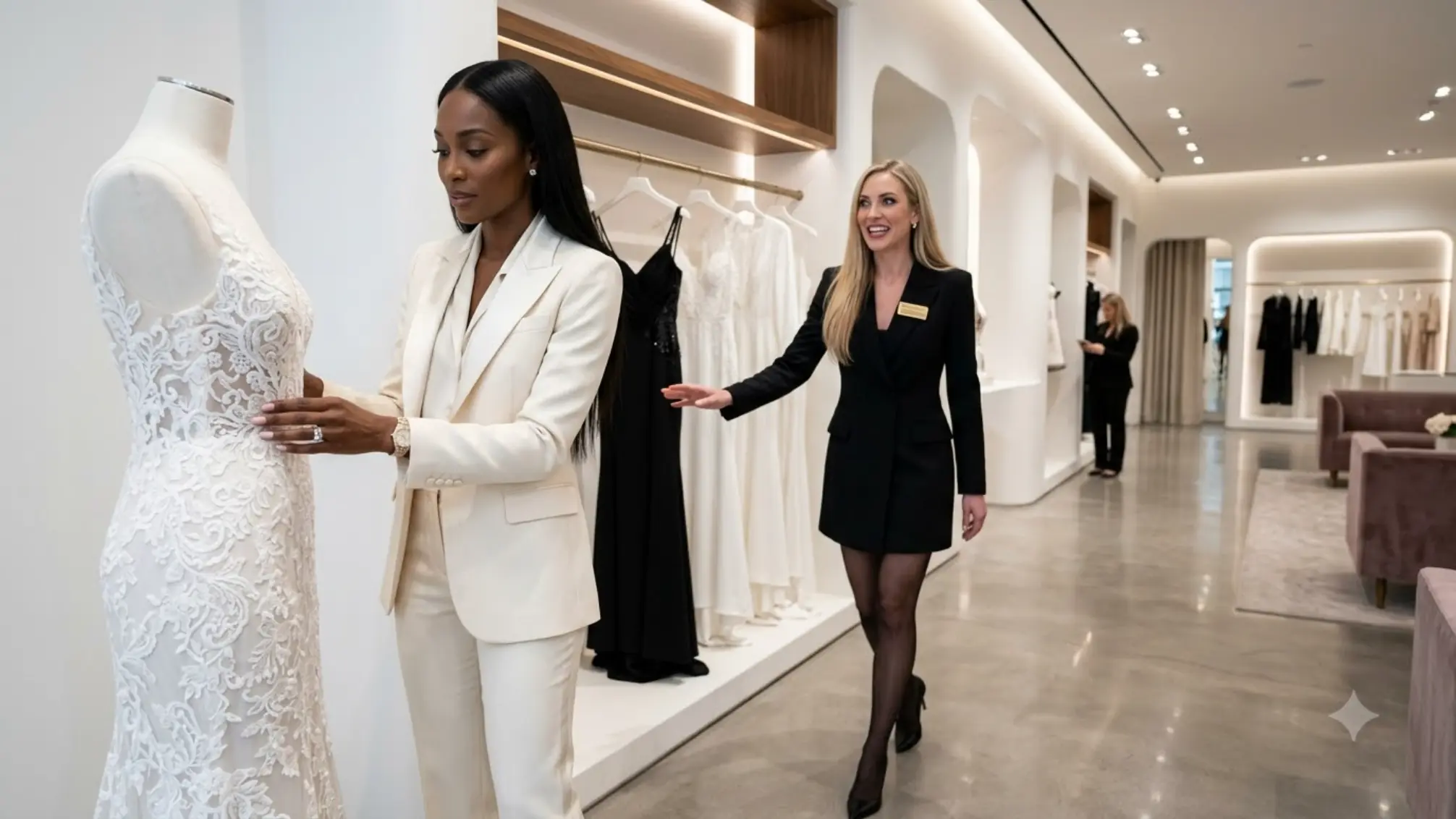
Celeste turned slowly. “Thief? You just mistook elegance for weakness.”
The blonde associate stepped closer, contempt sharpening her smile. “Women like you don’t shop here. You sneak in and touch what you can’t afford.”
Celeste locked eyes with her. “Keep talking, and your owner will hear exactly how you destroyed her biggest sale.”
The Maison Aurelia boutique occupied three polished floors in the most expensive shopping district in Chicago. Its windows displayed hand-beaded gowns beneath warm gallery lights, and every appointment was normally confirmed weeks in advance. Celebrities, executives, and wealthy families came there for custom pieces that could cost more than a house in some neighborhoods.
Celeste Morgan had arrived at eleven that morning wearing a fitted ivory pantsuit, satin blouse, diamond earrings, and pointed cream heels. Her flawless deep-brown skin, refined features, and long straight black hair made her look as elegant as any model displayed in the boutique’s campaigns. Yet her beauty was not the reason she carried herself with quiet authority.
At thirty-eight, Celeste was the founder and CEO of Morgan Meridian Group, a national hospitality and real-estate company valued at more than two billion dollars. She had built her first boutique hotel from a condemned warehouse and expanded it into a portfolio of luxury properties across twelve states. That evening, she was finalizing plans for the Morgan Children’s Foundation gala, an event expected to raise millions for pediatric rehabilitation programs.
She needed more than one dress.
The gala would include a private donor dinner, an opening presentation, a formal auction, and a closing reception. Celeste intended to commission four custom gowns for herself, six coordinated dresses for the foundation’s young ambassadors, and several evening pieces as gifts for the women chairing the event.
Her assistant had contacted Maison Aurelia two weeks earlier. The boutique confirmed a private consultation under the name C. Morgan and requested a ten-thousand-dollar appointment deposit. The payment cleared immediately.
Celeste had deliberately arrived without an entourage.
Her assistant, stylist, and event director were scheduled to join her thirty minutes later, but Celeste wanted time to examine the construction of the gowns alone. Years of working with luxury brands had taught her that true quality revealed itself in quiet details: stitching hidden beneath linings, fabric weight, seam placement, and how carefully a garment was handled when no photographer was watching.
The associate who confronted her was Vanessa Cole, thirty-four, senior sales consultant and acting floor manager for the day. Vanessa wore a structured black blazer dress, sheer stockings, and a gold name badge polished brightly enough to catch the showroom lights.
She had watched Celeste enter.
She had not welcomed her.
Instead, Vanessa remained behind the consultation desk, silently examining Celeste from head to toe. The ivory suit was clearly expensive, but Vanessa decided it was rented or borrowed. Celeste carried no visible designer handbag, wore no enormous logo, and had arrived in a gray sedan rather than a chauffeured vehicle.
Vanessa had spent years developing what she proudly called her client instinct. In reality, she had learned to estimate customers through stereotypes and then treated her own assumptions as proof.
Celeste walked toward the white couture gown displayed on a sculpted mannequin near the center of the room. The dress featured a fitted lace bodice, a full silk skirt, and thousands of hand-sewn pearls arranged in delicate branches across the fabric.
She touched only the outer edge of the skirt.
Vanessa immediately approached.
“Please do not handle the display pieces,” she said.
Celeste looked toward her. “I’m examining the lace work.”
“That gown is not available for casual browsing.”
“I have an appointment.”
Vanessa’s smile became thinner. “Our appointments are private and confirmed.”
“Mine was confirmed.”
“Under what name?”
“C. Morgan.”
Vanessa glanced toward the reception tablet but did not check it. “There is no appointment under that name.”
Celeste had seen the confirmation on her assistant’s phone that morning. “Perhaps you should look before deciding.”
“I know my schedule.”
“Then you should know the appointment begins at eleven.”
Vanessa’s eyes moved over the ivory pantsuit again. “The Morgan consultation is for a major gala client.”
“Yes.”
“She would not arrive alone.”
Celeste almost smiled. “That is your verification process?”
Vanessa stepped between her and the mannequin. “I am asking you to leave the gown alone.”
Celeste turned back toward the dress. “What fabric supports the pearl embroidery?”
“That information is discussed with qualified clients.”
“I paid a deposit.”
“Anyone can say that.”
Celeste reached toward the inside pocket of her jacket for the confirmation email. Vanessa suddenly grabbed her wrist.
The contact lasted less than a second.
Celeste looked down at the associate’s hand.
Vanessa released her, but rather than apologize, she raised her voice.
“GET OUT OF MY BOUTIQUE, THIEF.”
Two junior associates stopped arranging dresses along the rear wall. A tailor looked through the open fitting-room door, and a receptionist froze beside a tray of sparkling water.
No alarm had sounded.
No merchandise was missing.
Vanessa had simply decided that touching the gown, reaching into a jacket, and refusing to accept humiliation were evidence of theft.
Celeste’s expression remained controlled.
“Thief?” she said. “You just mistook elegance for weakness.”
Vanessa pointed toward the entrance. “Women like you don’t shop here. You sneak in and touch what you can’t afford.”
One junior associate lowered her eyes.
The other, a twenty-six-year-old Black woman named Naomi Reed, stared at Vanessa in disbelief. She had been working at Maison Aurelia for only three months and had already witnessed Vanessa redirect certain customers toward clearance accessories before asking what they wanted.
This was different.
Vanessa had accused a woman of a crime in the middle of the showroom without checking a single fact.
Celeste stepped closer. “Keep talking, and your owner will hear exactly how you destroyed her biggest sale.”
Vanessa laughed. “Our owner does not take complaints from walk-ins.”
“Then perhaps she takes calls from clients who have already transferred ten thousand dollars.”
The receptionist finally looked at the appointment tablet.
Her face changed.
“Vanessa,” she said quietly.
Vanessa did not turn around. “Call security.”
“Vanessa, the Morgan appointment is confirmed.”
The showroom became still.
The receptionist rotated the tablet so the others could see the screen. At the top of the schedule appeared:
PRIVATE COUTURE CONSULTATION
CLIENT: CELESTE MORGAN
MORGAN CHILDREN’S FOUNDATION GALA
INITIAL PURCHASE ESTIMATE: $350,000 TO $500,000
DEPOSIT RECEIVED: $10,000
Vanessa looked from the tablet to Celeste.
“You said C. Morgan.”
“That is how the appointment was entered.”
“You should have introduced yourself properly.”
Celeste’s eyes narrowed. “I gave you the name attached to the appointment.”
“You were touching a restricted gown.”
“It is displayed in an open showroom.”
“You reached inside your jacket.”
“For my phone.”
Vanessa looked toward the employees watching them. Her confidence had begun to collapse, but embarrassment pushed her toward another mistake.
“Well, perhaps the booking department should have provided a photograph. We have to protect expensive merchandise from people who wander in.”
Celeste studied her face. “You still believe the problem is how I entered.”
“I am explaining why the situation became confusing.”
“No. You are explaining why you think your assumptions should outweigh evidence.”
The elevator doors opened near the rear of the boutique.
Celeste’s assistant, Maya Brooks, stepped out first carrying a tablet and two garment-planning folders. Behind her came fashion director Luca Bennett and three members of the foundation’s gala committee.
Maya saw Vanessa standing between Celeste and the gown.
“Ms. Morgan, is there a problem?”
Celeste looked toward the reception desk. “Please cancel today’s consultation.”
Vanessa’s face tightened. “There is no need to overreact.”
Maya stopped beside her employer. “What happened?”
“This associate called me a thief and ordered me out.”
The foundation committee members exchanged shocked looks.
Luca examined Celeste’s wrist. “Did she touch you?”
Vanessa immediately answered. “I briefly prevented unauthorized handling of a couture piece.”
Celeste turned to Maya. “Request written confirmation that the deposit will be returned. Cancel the preliminary order and contact Valenne House and Armand Dupré.”
Vanessa stepped forward. “You cannot cancel an order that has not been finalized.”
“The order was projected at four hundred eighty thousand dollars,” Maya said. “It can absolutely be cancelled.”
One of the junior associates covered her mouth.
Vanessa looked toward Celeste. “You were actually purchasing that much?”
Celeste’s expression did not soften. “Would a smaller purchase have made your behavior acceptable?”
The question left Vanessa without an answer.
Naomi Reed moved from the rear wall.
“Ms. Morgan,” she said, “I’m sorry.”
Vanessa glared at her. “Stay out of this.”
Naomi’s hands trembled, but she continued. “She was never welcomed. No one checked the tablet when she gave her name. You accused her before anything was missing.”
“I am the acting manager.”
“That does not make what happened true.”
Vanessa stepped toward Naomi. “Go to the staff room.”
Celeste raised one hand. “Do not punish her for telling the truth.”
“You do not manage my employees.”
“No,” Celeste replied. “I only decide where my foundation spends its money.”
A door opened on the second-floor balcony overlooking the showroom.
Margaret Aurelia descended the curved staircase with her chief operating officer behind her. At sixty-one, Margaret was a celebrated designer known for building Maison Aurelia from a small bridal studio into an international luxury brand.
She had been conducting a private investor meeting upstairs when an employee sent her a message:
Vanessa just called Celeste Morgan a thief. The gala order is being cancelled.
Margaret reached the showroom and immediately recognized Celeste.
The two women had met briefly at a hospital fundraising dinner the previous year. Margaret had personally encouraged Celeste to consider Maison Aurelia for the upcoming gala.
“Ms. Morgan,” she said, visibly shaken. “I was not informed you had arrived.”
“I informed the person managing your floor.”
Margaret looked toward Vanessa. “What happened?”
Vanessa straightened her shoulders. “The client entered without identifying herself clearly, handled a restricted display gown, and reached inside her clothing when questioned. I responded according to loss-prevention procedure.”
Margaret turned toward her chief operating officer. “Does our procedure permit an associate to call a customer a thief without evidence?”
“No.”
“Does it permit employees to grab a customer?”
“No.”
Vanessa’s voice rose. “I barely touched her.”
Margaret looked at Celeste’s wrist, then toward the showroom cameras.
“Preserve every recording from the last hour.”
Vanessa’s face changed. “Surely we don’t need to make this formal.”
Celeste picked up her assistant’s tablet. “It became formal when you accused me of a crime in front of employees and clients.”
Margaret asked the receptionist to print the full appointment record. It showed the deposit, the projected order, Celeste’s preferred arrival time, and a note stating that she might arrive before her team.
Every fact had been available.
Vanessa had simply refused to look.
Margaret offered to continue the consultation personally and discount the full order. Celeste declined.
“This is not about price.”
“I understand.”
“I don’t think you do yet.”
Celeste gestured toward Naomi and the other employees. “Your associate behaved this way because she believed the boutique would support her version over mine. That belief did not begin when I touched the gown.”
Margaret’s expression grew more serious.
Celeste continued. “Review how customers are welcomed, who receives private rooms, who is asked for proof of payment, and whose complaints disappear. Today may not be the first incident. It may only be the first involving a client whose cancelled order reached your office immediately.”
Naomi looked at the floor.
Margaret noticed.
“Naomi, do you have something to say?”
Vanessa interrupted. “She is a new employee with no understanding of luxury client screening.”
Margaret turned sharply. “I asked Naomi.”
The young associate drew a slow breath.
She explained that Vanessa often categorized visitors before speaking with them. White customers wearing casual clothes were described as discreet wealth. Black customers wearing the same clothes were watched near exits or asked whether they had appointments.
Two weeks earlier, Vanessa had refused to show an Asian American bride a private collection until the woman’s fiancé arrived wearing an expensive watch. A Latina physician was directed toward lower-priced accessories despite requesting a custom evening gown.
Naomi had written down dates because she feared that eventually someone would be falsely accused.
She opened her locker notebook.
Margaret read the first page without speaking.
The list contained eleven incidents over three months.
The receptionist admitted she had witnessed several. Another associate confirmed that Vanessa sometimes used internal notes such as low potential or security attention without recording any objective behavior.
The boutique’s security supervisor was called downstairs.
He stated that Vanessa had repeatedly asked guards to watch customers who had done nothing except enter alone, ask prices, or photograph dresses after receiving permission. In several cases, she described Black customers as likely resellers while describing white customers doing the same things as fashion enthusiasts.
Margaret closed Naomi’s notebook.
“Vanessa, go to my office.”
Vanessa looked around the showroom. “You are taking the word of junior employees over your senior consultant?”
“I am preserving evidence before reaching a final decision.”
“She is costing us nearly half a million dollars because her feelings were hurt.”
Celeste’s expression hardened.
Margaret spoke before she could answer.
“No. You cost us that sale when you called a confirmed client a thief.”
Vanessa turned toward Celeste. “You could have avoided this by announcing who you were.”
Celeste stepped forward until only a few feet separated them.
“I should not need to announce my net worth to be treated with dignity.”
Vanessa opened her mouth.
Celeste continued. “A woman buying one scarf deserves the same basic respect as a CEO ordering ten gowns. Your apology means nothing if it depends on discovering that I am wealthy.”
Margaret instructed security to escort Vanessa upstairs while the internal review began.
Celeste and her team left without examining another dress.
Outside, Maya asked whether she should contact the press. Several employees had witnessed the accusation, and news of the cancelled order would likely spread through the industry.
“No,” Celeste said.
“You don’t want the public to know?”
“I want the boutique to decide whether it values reform before public pressure forces a performance.”
They drove directly to Valenne House, a smaller design studio owned by French American designer Isabelle Valenne. Isabelle greeted every member of the group personally, including the foundation volunteers who were not purchasing anything.
She asked Celeste what she wanted the gala to communicate.
“Strength without hardness,” Celeste replied. “Elegance that does not require permission.”
Over the next three hours, Isabelle’s team sketched four gowns and began measurements for the ambassadors’ dresses. The final contract totaled five hundred twelve thousand dollars, including a donation of custom auction pieces from the designer.
Celeste signed it before leaving.
At Maison Aurelia, Margaret’s review continued for three weeks.
Security footage confirmed Celeste’s account completely. Vanessa watched her enter, ignored the appointment tablet, approached only after she touched the gown, grabbed her wrist, and shouted the accusation without seeing any theft.
The broader review revealed that Vanessa’s behavior had cost the boutique far more than one order.
Seven former customers responded to confidential outreach. A Black surgeon described being followed between racks until she left. A successful music producer said Vanessa refused to unlock a fitting room until his credit card was preauthorized.
A young Black bride had saved for three years to purchase her wedding dress. Vanessa told her that the boutique required a budget minimum nearly twice the actual policy. The bride later bought from another designer and posted no complaint because she feared being dismissed as unable to afford the store.
Sales data exposed the financial pattern.
Customers marked for additional screening purchased far less because many left before receiving service. Management had interpreted those departures as proof that Vanessa’s instincts were correct, never considering that discriminatory treatment caused the lost sales.
The cycle protected itself.
Vanessa labeled certain people as low-value, treated them poorly, and then used their refusal to buy as evidence that she had judged them accurately.
Margaret terminated her employment for discrimination, false accusation, physical misconduct, dishonesty during the investigation, and repeated violation of client-service policies.
But Celeste had warned that firing one employee would not repair the system that allowed her behavior to grow.
Maison Aurelia removed subjective client-potential labels from its software. Every visitor received an initial welcome before any sales qualification occurred. Employees could no longer request security monitoring without recording specific conduct.
Anonymous customer evaluations were introduced across every location. Complaints bypassed store managers and went directly to an independent review team.
Margaret also promoted Naomi Reed to client-experience coordinator after learning that she had preserved dates and details while senior employees remained silent. Naomi initially refused the promotion because she feared being used as proof that the boutique had solved its problems.
Margaret accepted the criticism.
The role was redesigned to include independent reporting authority and quarterly meetings with outside advisers.
Two months later, Margaret requested a private meeting with Celeste.
They met inside one of Morgan Meridian’s hotels rather than the boutique. Margaret arrived without assistants and brought a thick report documenting every change.
“I am not asking you to restore the order,” she said.
“Good.”
“I am asking whether you will read this and tell me what remains inadequate.”
Celeste examined the report.
“You investigated the incidents.”
“Yes.”
“You compensated the customers?”
“We refunded fees, provided written apologies, and offered compensation without confidentiality requirements.”
“You removed the false internal notes?”
“All of them.”
Celeste looked up. “And Vanessa?”
“Dismissed.”
“That was necessary, but it is the easiest part.”
“I know.”
Margaret explained that she had reviewed her own leadership decisions. Vanessa produced strong sales numbers, and managers ignored concerns because wealthy repeat clients praised her attention. The company rewarded revenue without examining who was driven away before appearing in the revenue reports.
“I built a boutique that claimed exclusivity meant excellence,” Margaret said. “Some employees began believing exclusivity meant deciding who deserved to enter.”
Celeste closed the report.
“That distinction should have been made years ago.”
“Yes.”
“Why are you really here?”
Margaret answered honestly. “Because you were right. I did not understand until I saw how many people had been treated like intruders inside a business asking for their money.”
Celeste agreed to serve on a temporary external advisory panel, but she did not restore the gala purchase. Consequences mattered, and Valenne House had earned the contract through respectful service rather than receiving it as a consolation prize.
The gala took place six months later inside the grand ballroom of the Morgan Meridian Chicago Hotel.
Celeste entered wearing a white silk gown designed by Isabelle Valenne. The fitted bodice carried hand-embroidered silver branches, while the skirt moved with quiet weight beneath the ballroom lights.
The young foundation ambassadors wore coordinated gowns in deep blue, gold, and ivory. Each dress was designed around the personality and mobility needs of the girl wearing it, including two adapted gowns for children using wheelchairs.
The event raised more than nine million dollars.
Naomi attended as Margaret’s guest.
When she approached Celeste near the end of the evening, she admitted that speaking up inside the boutique had frightened her.
“I thought I would lose my job.”
“You might have.”
Naomi nodded. “I almost stayed quiet.”
“But you didn’t.”
“I wish I had spoken sooner.”
Celeste looked toward the children laughing near the dance floor. “Most people imagine courage arrives before the risk. Usually, it arrives after you have already begun speaking.”
Maison Aurelia changed slowly.
Some longtime clients complained that the boutique had become less exclusive because employees no longer judged visitors at the door. Others appreciated the new approach and began bringing younger family members who had previously found the atmosphere intimidating.
Revenue fell briefly during the transition.
Then it rose beyond the previous year’s total.
The greatest increase came from first-time customers whom the old system might have ignored.
A year after the confrontation, Celeste returned to Maison Aurelia.
She wore simple trousers, a cream blouse, and no visible jewelry. Naomi greeted her immediately, not because she recognized the famous CEO, but because the new policy required every person entering the showroom to be welcomed within thirty seconds.
“Good afternoon,” Naomi said. “What brings you in today?”
Celeste smiled. “I’m looking for a dress.”
“For what occasion?”
“My niece’s graduation.”
“What would make her feel extraordinary?”
It was the right question.
Not how much could she spend.
Not whether she belonged.
Not who she knew.
Celeste walked toward a display gown and touched the edge of the fabric.
No one shouted.
No one grabbed her wrist.
No one demanded proof that she deserved to stand near something beautiful.
Vanessa had believed luxury gave her permission to measure human worth at the door. She saw a beautiful Black woman in an ivory suit and still decided elegance could not truly belong to her.
That assumption cost the boutique nearly half a million dollars.
The deeper cost was discovering how many customers had walked away quietly before anyone thought to count them.