The final corner of the cashier’s check curled into black ash between Ryan Mercer’s fingers. Smoke drifted beneath the bright showroom lights, carrying the bitter smell of burning paper across Riverside Motors. Several salesmen laughed while customers near the espresso bar lifted their phones, eager to capture the humiliation of the Black woman standing beside the manager’s desk. Janelle Whitmore watched the check disappear without moving an inch.
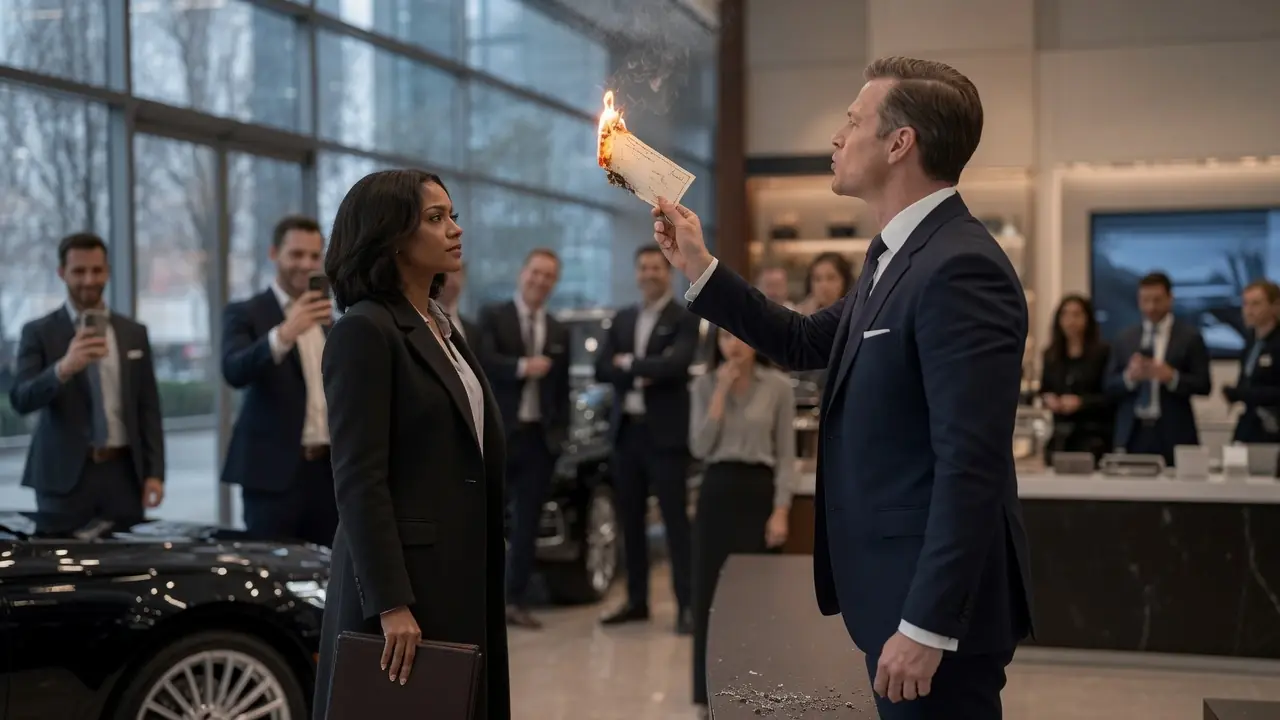
Her stillness irritated Ryan more than outrage would have. He wanted shouting, tears, or a desperate explanation that would allow him to perform authority before his employees. Instead, Janelle held her dark leather portfolio against her side and studied him with the patient expression of someone watching a careless man sign his own confession. Rain still glistened on the shoulders of her fitted black coat.
Ryan dropped the burning fragment into a glass ashtray normally used for decorative keys. “You people walk into luxury dealerships with printed checks and expect us to play along,” he said. “Riverside sells real vehicles to real buyers.” His sales team chuckled again, though the sound had weakened after Janelle mentioned the owners waiting outside.
“There are no owners outside,” Ryan added. “There’s only a woman wasting my time.”
Janelle bent and picked up a charred corner that had fallen near her polished heel. Three words remained visible beneath the smoke damage: Summit Automotive Group. She photographed the fragment, Ryan’s lighter, the desk, the surrounding employees, and the phones pointed toward her. Each quiet click made another person lower their eyes.
Ryan stepped around the desk. “You don’t have permission to photograph my staff.”
“You recorded me first.”
“That’s different.”
“It will be,” Janelle said, placing the burned fragment inside her portfolio. “Once legal reviews both versions.”
She had entered Riverside Motors forty minutes earlier requesting a specific black luxury SUV advertised for $87,400. The vehicle was intended for her mother, whose old sedan had become unreliable after years of commuting to a dialysis clinic. Janelle wanted to purchase the SUV personally before revealing her corporate role, partly to evaluate Riverside’s customer experience during Summit Automotive Group’s acquisition review.
The board had approved the purchase of Riverside Motors two days earlier. Final transfer documents would become effective Friday morning, after which Janelle would serve as executive director of the dealership’s transition. She possessed authority to retain, remove, or restructure every department leader, including the general sales manager now standing three feet away from her.
Ryan had decided who she was before asking her name.
A junior salesman named Peter Sloan approached Janelle when she entered but quickly lost interest after noticing her 2019 Honda Accord outside. He gave her a brochure without offering a test drive and disappeared when a couple wearing designer clothing walked toward a silver Mercedes. Janelle waited twelve minutes before asking the receptionist whether another salesperson could assist her.
Elena Torres apologized and found Ryan.
He arrived wearing a navy suit, an expensive watch, and the bored expression of a man summoned to deal with someone beneath his preferred commission range. Janelle identified the SUV, requested the complete purchase price, and explained that she intended to pay without financing. Ryan’s boredom became suspicion.
He asked what she did for work.
Janelle answered, “Automotive operations.”
Ryan smiled. “At a repair shop?”
“No.”
“Insurance office?”
“No.”
He studied her coat, handbag, and modest car through the glass wall. “People misunderstand what ‘cash purchase’ means. We don’t accept personal checks for vehicles at this level.”
Janelle removed the cashier’s check issued by Summit Federal Bank. It named Riverside Motors as payee for the full amount, including taxes and fees. The bank’s verification number appeared clearly beside the security watermark.
Ryan barely looked at it.
He carried the check toward his sales team and announced loudly that another fake buyer had entered the showroom. Janelle requested that he call the issuing bank. Ryan refused, claiming he could identify fraud by touch.
One salesman suggested using the check-verification terminal behind the finance desk. Ryan ignored him. He pulled a silver lighter from his pocket, held the check above it, and asked Janelle whether she wanted to confess before he called the police.
She told him to verify it.
He lit it instead.
Now the showroom doors opened behind her.
Three people entered wearing dark business coats, followed by an attorney carrying a sealed acquisition folder. At the front walked Summit Automotive Group’s chief legal counsel, Evelyn Price, whose face Ryan had seen only once during an introductory video conference. He had joined that meeting late and spent most of it answering messages.
Evelyn stopped beside Janelle. “We received your preservation request.”
Ryan’s hand tightened around the lighter. “Who are you?”
“Counsel for Summit Automotive Group.”
The employees stopped smiling.
Two weeks earlier, Riverside’s owner, Thomas Caldwell, had informed senior managers that Summit was considering purchasing the dealership. Ryan interpreted the potential sale as a distant corporate matter. He believed his numbers made him untouchable and told employees that any buyer would need him to preserve revenue.
He had no idea Summit’s transition director was standing before him.
Evelyn examined the ashtray. “Was the cashier’s check verified before destruction?”
Ryan forced a laugh. “This is being exaggerated. I recognized an obvious counterfeit.”
Janelle looked toward the finance desk. “Elena, would you enter the verification number from the photocopy in my folder?”
The receptionist hesitated. Ryan glared at her, but Janelle’s calm voice gave her enough courage to move. Elena opened the folder, entered the number into the secure bank portal, and turned the monitor toward the room.
A green confirmation filled the screen.
VALID CASHIER’S CHECK: $87,400. FUNDS GUARANTEED.
No one spoke.
Ryan stared at the confirmation as though the machine had betrayed him. “That could have been generated afterward.”
“The timestamp shows it was issued yesterday,” Evelyn replied. “The check’s security record also registered an attempted verification from Riverside Motors twenty-six minutes ago.”
Janelle looked toward Peter.
The junior salesman lowered his head. “I checked it before Mr. Mercer burned it.”
Ryan spun toward him. “You said nothing.”
“I told you the system showed valid funds.”
“You said it might be valid.”
“I said it was valid.”
One of the customers near the espresso bar quietly stopped recording. Another turned away from Ryan, suddenly aware that the entertainment had become evidence. The salesman who had accused Janelle of stealing the checkbook slipped his phone into his pocket.
Janelle faced Ryan. “You knew the money cleared.”
“I believed the system was wrong.”
“Because of what?”
Ryan opened his mouth but produced no answer that could survive the people watching him. The truth was visible in every decision he had made: the car Janelle drove, the color of her skin, the absence of designer jewelry, and the confidence he interpreted as deception because he could not imagine it belonging to her.
The showroom doors opened again.
Thomas Caldwell entered with two board representatives. The sixty-eight-year-old owner had built Riverside Motors from a small used-car lot and planned to retire after the acquisition. He had trusted Ryan’s sales reports for years, despite employee complaints concerning favoritism, pressure tactics, and customer profiling.
Thomas saw the ashtray first.
“What happened?”
Ryan moved quickly. “A misunderstanding involving a suspicious payment. I protected the dealership from fraud.”
Thomas looked at Janelle and recognized her immediately. They had spoken by video twice during negotiations. “Ms. Whitmore.”
The color drained from Ryan’s face.
Thomas approached her with visible embarrassment. “I was not informed you had arrived.”
“That was intentional,” Janelle said. “I wanted to see Riverside as an ordinary customer sees it.”
Thomas glanced around the silent showroom. “And you did.”
Janelle opened her portfolio and removed the thick transition agreement. Her authorization page sat above the acquisition documents, displaying her photograph and title.
JANELLE WHITMORE — EXECUTIVE DIRECTOR, RIVERSIDE TRANSITION AUTHORITY.
Ryan read the words twice.
“This cannot affect my employment,” he said. “I have a contract.”
Evelyn responded before Janelle could. “Your contract contains a conduct clause allowing immediate suspension for discrimination, destruction of customer property, falsification of records, or conduct exposing the dealership to legal risk.”
“I did not discriminate.”
Janelle nodded toward the showroom cameras. “The recordings will answer that.”
Ryan looked toward Thomas. “You know what I’ve done for this place. I increased premium sales by thirty percent.”
Thomas’s expression hardened. “How many customers did you drive away to reach that number?”
Ryan said nothing.
Janelle did not fire him that afternoon. Immediate punishment would have satisfied the room, but it would not reveal whether his behavior represented one man’s cruelty or a system Riverside had allowed to grow around him. She ordered Ryan placed on paid administrative leave pending the completion of Friday’s review.
His access card was disabled before he reached his office.
Security escorted him from the showroom he had threatened to throw Janelle out of. Employees watched him pass without laughter, and Elena collected his company phone under counsel’s supervision. Ryan attempted to give instructions to the sales team, but Evelyn reminded him he no longer possessed operational authority.
Outside, he saw four black Summit vehicles parked beside Janelle’s gray Accord.
The new owners had truly been waiting outside.
By Wednesday morning, Summit’s investigators had preserved every email, customer complaint, security video, commission record, and employee message stored within Riverside’s systems. The review uncovered more than Janelle expected. Ryan’s actions were not an isolated loss of control.
He had built an unofficial ranking system called the “real buyer index.”
Salespeople were taught to judge customers within thirty seconds based on clothing, vehicles, accents, age, race, and perceived profession. Those labeled low value received delayed service, were denied test drives, or were shown older vehicles regardless of what they requested. Black and Latino customers were routinely asked for larger deposits before receiving financing options.
One internal message from Ryan read:
Do not waste premium inventory on people who look like they came to take pictures.
Another instructed employees to steer “urban walk-ins” toward used vehicles unless they produced bank statements immediately. Wealthy-looking customers were offered coffee and private seating before anyone asked about payment.
The discriminatory practices also concealed financial misconduct.
Ryan manipulated lending applications to increase commissions, adding optional products without clear consent and marking them as customer-requested. Elderly buyers were charged for protection packages they had declined. Customers with limited English were given contracts containing higher prices than those verbally promised.
Peter had complained twice.
Ryan cut his sales leads afterward.
Elena had documented incidents involving customers treated unfairly, but her reports disappeared inside the human resources system. Investigators discovered that Ryan’s close friend supervised regional HR complaints and routinely closed them as “service misunderstandings.”
The burned check was merely the first offense captured clearly enough to make denial impossible.
Janelle spent Wednesday interviewing employees one by one. She did not begin by asking whether they liked Ryan. She asked what happened when someone disagreed with him.
The answers were consistent.
He controlled schedules, commissions, desirable leads, and access to management. Employees who supported his jokes were rewarded. Those who questioned him received weekend shifts, reduced opportunities, or warnings about poor team attitude.
Several people admitted laughing while Janelle’s check burned because silence felt dangerous.
“That does not excuse you,” she told them.
They nodded.
“But fear explains what must be repaired.”
Peter entered the interview room expecting termination. He admitted he had verified the check and failed to stop Ryan from burning it. Janelle asked why he remained silent.
“I have a six-month-old daughter,” he said. “Ryan already threatened to cut my leads after I questioned him last month.”
“You still knew what he was doing was wrong.”
“Yes.”
“Would you testify about it?”
Peter looked toward the closed door. “Will he come back?”
“That depends partly on what people here are willing to say honestly.”
Peter agreed.
Elena provided the most important evidence. She had quietly preserved copies of customer complaints after realizing the official system erased them. Her private folder contained twenty-seven incidents involving humiliation, unequal financing terms, and suspected contract manipulation.
One complaint came from a retired Black school principal named Doris Campbell. She entered Riverside intending to purchase two vehicles for herself and her grandson. Ryan told her the luxury SUV she requested was “probably outside her retirement budget” and directed her toward an older model without asking about her finances.
Doris left and spent $142,000 at another dealership that afternoon.
A small-business owner named Luis Mendoza had been denied a test drive because his work clothes were dusty. Riverside employees later discovered that he owned a construction company with more than two hundred vehicles. Another customer, a young Asian software entrepreneur, waited forty-five minutes while salesmen debated whether his designer watch was fake.
The lost revenue exceeded Ryan’s claimed contribution to the dealership.
Summit’s financial team calculated that his profiling had driven away at least $3.4 million in documented sales over three years. The actual number was likely much higher because many mistreated customers never filed complaints.
Ryan’s defense arrived Thursday morning through his attorney.
He claimed Janelle had created a deceptive “secret shopper trap” and provoked a public confrontation to remove a successful manager. He described burning the check as an unfortunate sales demonstration intended to expose counterfeiting. The letter demanded reinstatement, compensation, and a public apology.
Evelyn attached the showroom video to her response.
It showed Ryan asking whether Janelle had stolen the checkbook. It captured laughter from his team and his threat to have security drag her outside. Most damagingly, it showed Peter confirming quietly that the check had passed verification before Ryan lit it.
His attorney withdrew the demand that afternoon.
Ryan called Thomas directly.
He blamed stress, acquisition uncertainty, and pressure to protect Riverside from fraud. He promised to apologize privately and complete sensitivity training if allowed to keep his job. Thomas listened without interrupting.
“You did not make one mistake,” Thomas said. “You revealed the rules you have been teaching everyone around you.”
“I made this dealership profitable.”
“You made cruelty profitable enough that I stopped asking how.”
Thomas ended the call.
Friday morning arrived under clear skies. Summit Automotive Group officially assumed ownership of Riverside Motors at eight. Employees gathered inside the showroom where the smell of burned paper had finally disappeared, though the glass ashtray remained sealed inside an evidence bag.
Janelle stood before them in a navy suit.
Behind her, the black SUV she originally intended to purchase had been positioned at the center of the showroom. A temporary placard rested on the windshield:
RESERVED FOR MRS. LILLIAN WHITMORE.
Ryan attended by video with his attorney.
Janelle presented the findings without exaggeration. She explained that Riverside’s customer-treatment failures, manipulated contracts, retaliation practices, and discriminatory sales system had exposed the dealership to lawsuits, regulatory penalties, and permanent reputational damage.
Ryan interrupted. “You’re turning jokes into federal crimes.”
Janelle looked toward the screen. “The altered financing documents are already with regulators.”
His attorney placed a hand on his shoulder and whispered for him to stop talking.
Janelle announced his termination for cause.
His compensation package was canceled under the misconduct clause. The company also referred evidence involving unauthorized contract additions and lending manipulation to the state attorney general and consumer finance regulators. Ryan’s future employment in automotive sales would depend on the outcome of those investigations.
He leaned toward the camera. “You planned this from the moment you walked in.”
“No,” Janelle said. “I planned to buy my mother a car.”
The video connection ended.
Summit dismissed the HR manager who buried complaints and suspended two finance employees connected to altered contracts. Several salespeople received final warnings and mandatory retraining rather than immediate termination because they cooperated and had not participated in financial misconduct.
Peter remained employed.
He was removed from Ryan’s commission structure and placed under a new customer-service director. Janelle made clear that protecting his family could not become a permanent excuse for watching others be abused, but she also recognized the risk he accepted by testifying.
Elena received a promotion to customer integrity manager.
Her first responsibility was creating an independent complaint process that sales managers could not erase. Every complaint would receive a tracking number, external review, and written resolution. Compensation decisions would be audited for racial, gender, and age disparities.
Riverside contacted every customer in Elena’s preserved files.
Improper charges were refunded with interest. Some customers accepted apologies, while others pursued legal claims. Janelle instructed the company not to pressure anyone into silence.
Doris Campbell returned after receiving a personal call.
She walked into the showroom wearing the same modest coat Ryan had judged months earlier. Employees greeted her respectfully, but Doris refused the coffee and asked to speak with Janelle.
“You did not need to bring me back here,” she said.
“No,” Janelle replied. “Riverside needed you to see what changed.”
Doris studied the customer-integrity desk and the written pricing policy displayed openly beside every vehicle. “Change takes longer than signs.”
“I know.”
“Are you staying long enough to prove it?”
“Yes.”
Doris purchased nothing that day. She returned three months later, after speaking with other customers and watching how Riverside operated under its new leadership. This time, she bought a luxury sedan for herself.
She made the dealership verify her check before accepting it.
The story of the burned $87,400 check spread online after a customer uploaded the showroom video. Millions watched Ryan laugh, ignite the paper, and threaten Janelle before the acquisition team entered. News outlets called her the executive who bought the dealership that rejected her.
Janelle corrected them during every interview.
“Summit had already approved the acquisition,” she said. “I did not buy Riverside for revenge. What happened showed us why the business needed new leadership.”
She refused invitations to humiliate Ryan publicly. The evidence already told the story, and she had no interest in becoming cruel merely because she finally possessed power over the man who had abused his.
Ryan faced civil lawsuits from former customers and an investigation concerning deceptive financing. Without Riverside’s protection, other dealerships hesitated to hire him. The video followed every application, but the greater obstacle was the growing record of contracts bearing unauthorized additions and discriminatory notes.
He had once believed Janelle’s appearance made her invisible.
Now his own actions made him impossible to overlook.
Lillian Whitmore received the black SUV on her seventieth birthday. Janelle drove it to the small house where her mother had raised three children while working nights as a hospital administrator. Lillian walked around the vehicle slowly, touching the polished paint.
“You spent too much,” she said.
“I tried spending exactly $87,400.”
Her mother looked at her. “Tried?”
Janelle told her the story.
Lillian listened silently until the end. “Your grandfather would have told you to walk away.”
“He taught me dignity.”
“He also avoided paperwork.”
Janelle laughed.
Riverside’s first-year results under Summit surprised everyone. Transparent pricing and stronger oversight initially reduced profits from hidden add-ons, but customer referrals increased sharply. Sales grew, employee turnover fell, and complaints declined by more than half.
The dealership became more profitable without Ryan’s tactics.
One year after the incident, Janelle stood inside the showroom beside a framed copy of the verified bank record. She had refused to display the burned check because she did not want Riverside defined forever by one ugly morning.
The silver lighter remained in the legal evidence file.
Elena approached carrying a cashier’s check from a young Black couple purchasing their first luxury vehicle. The husband looked nervous, expecting extra questions. The wife held a sleeping baby against her shoulder.
“Funds verified,” Elena said.
The new sales manager accepted the check, congratulated the couple, and handed them the keys without asking whether they truly belonged in the showroom.
Janelle watched them leave through the glass doors.
Ryan had believed luxury belonged only to people who resembled the image inside his head. He burned valid money because arrogance convinced him that prejudice was professional judgment.
The check cost $87,400.
The lesson cost him his career.
And Riverside finally learned that the most expensive customer was not the person who walked in without money—it was the person management drove away without ever asking what they carried.