“Appointment only,” the silver-haired sales associate said, looking Camille Bennett over from her burgundy heels to the navy blazer resting elegantly across her shoulders. “Do you even have one?”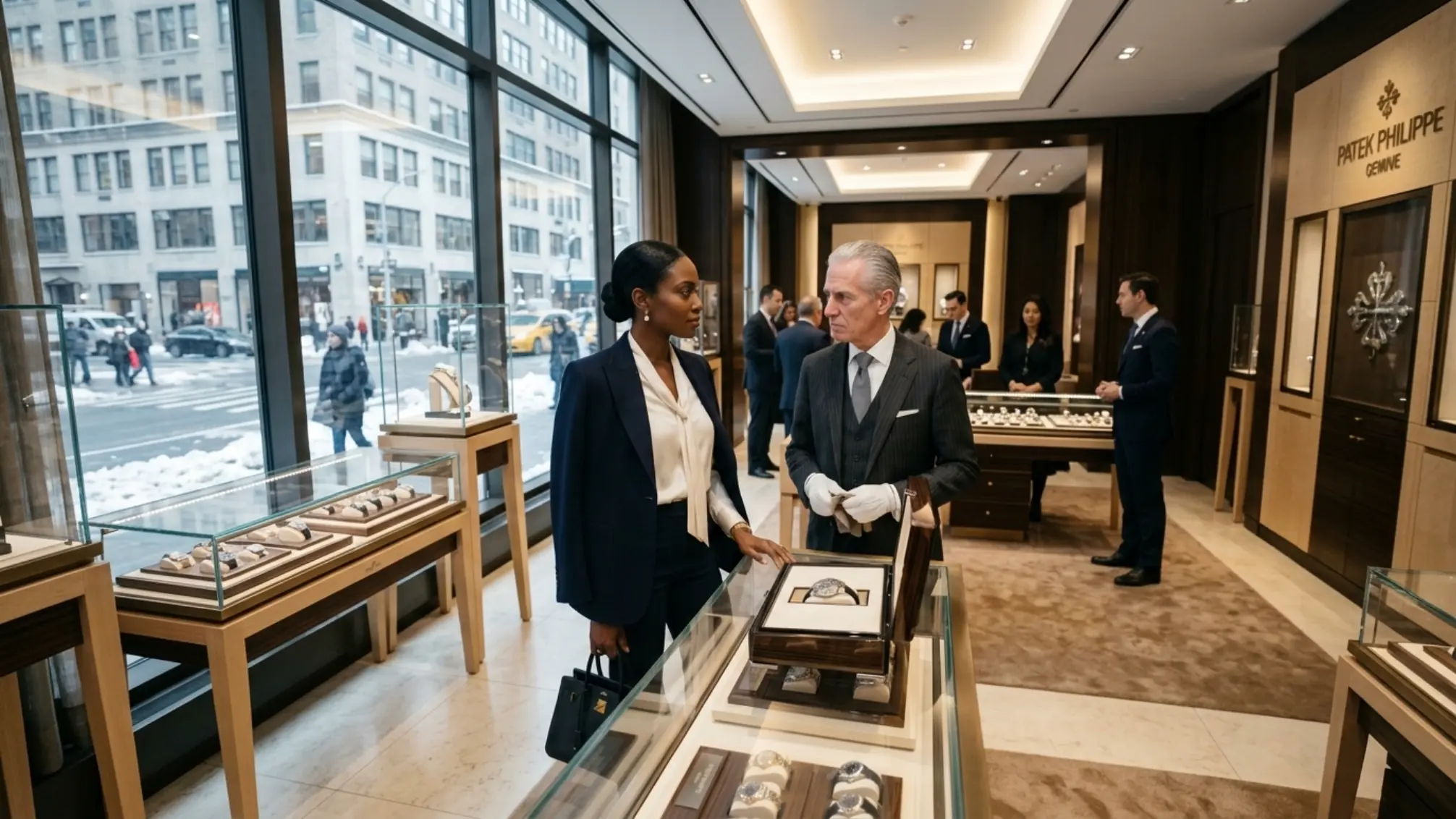
Camille placed her slim black handbag beside the glass counter. Her dark-brown eyes remained calm despite the contempt in his voice. “Grandmaster Chime 6300A-010.”
The man’s mouth twisted into a mocking smile. “That is a $31.19 million Patek Philippe. You couldn’t afford the strap, so try the quartz counter.”
Camille slid a cream ownership certificate across the glass. “Read my name. Then start begging.”
The associate did not touch the document.
His name was Alistair Crane, and for twenty-seven years he had sold rare watches to hedge-fund managers, royal families, professional athletes, and people whose names appeared on buildings. He wore white handling gloves, a charcoal pinstripe suit, and the expression of a man who believed luxury had given him the authority to decide who deserved dignity.
Camille had encountered men like him before.
At thirty-nine, she was the founder and chief executive officer of Bennett Meridian Group, a technology and logistics company valued at more than forty billion dollars. She had built it from a warehouse software system she developed while working nights to support her younger brother. Her face had appeared in financial magazines, but she avoided celebrity interviews and rarely attended public events unless they supported one of her medical or educational foundations.
Alistair did not recognize her.
More importantly, he had already decided recognition was unnecessary.
Behind him, the Manhattan boutique gleamed beneath carefully controlled lighting. Rare watches rested inside illuminated glass cases, each displayed like a museum artifact. Two junior associates quietly assisted an elderly woman near the central counter, while a young Asian salesman showed a diamond-set piece to a nervous couple by the window.
Every employee had noticed Alistair’s tone.
None intervened.
Camille looked through the display case nearest her. “The appointment is under Camille Elise Bennett.”
Alistair gave a soft laugh. “Names can be copied from newspapers.”
“The appointment was confirmed yesterday by your Geneva office.”
“Clients collecting pieces at this level do not arrive alone.”
“How do they arrive?”
“With advisers. Security. Representatives. People we know.”
Camille tilted her head. “So you do not verify ownership through documents?”
“We verify the person.”
“By looking at them?”
“By experience.”
The answer revealed more than he understood.
Camille glanced at the open wooden presentation box sitting behind the counter. A folded cream cloth covered the watch inside, but the engraved brass plate on the lid displayed the private collection number assigned to her purchase.
She had waited three years for that box.
The Grandmaster Chime was not merely an expensive object to Camille. Her father, Theodore Bennett, had repaired watches inside a narrow Baltimore storefront for more than thirty years. He never sold pieces worth millions, but he treated every damaged movement with the same patience, whether it belonged to a wealthy collector or a schoolteacher trying to preserve her husband’s retirement gift.
Camille spent much of her childhood at his workbench.
Theodore taught her to recognize balance wheels, escapements, and mainsprings before she understood algebra. He also taught her that the value printed on an invoice did not determine the respect owed to the person standing across the counter.
“A watch can tell you the hour,” he once said, holding a cracked Timex beneath his magnifying lens. “But the way you treat its owner tells people who you are.”
Theodore died four years earlier.
Soon afterward, Camille received an invitation to participate in the private allocation of an extraordinary Patek Philippe Grandmaster Chime. The watch represented the most complex traditions her father admired, and its record value made it famous throughout the collecting world.
She purchased it in his honor.
The case back carried a discreet engraving visible only when opened by an authorized watchmaker:
For Theodore Bennett, who taught me that time belongs equally to everyone.
The three-year wait included private authentication, mechanical inspection, legal transfer, engraving approval, and preparation of a custom presentation archive documenting the piece’s history. Camille had declined invitations to collect it in Geneva because she wanted the final handover to occur in New York, where her father had once taken her to stare through the windows of watch boutiques they could not enter.
Now she stood inside one.
And the man guarding her father’s tribute had directed her toward the cheapest counter.
Alistair pushed the ownership certificate back without reading it. “Miss, I am trying to save you embarrassment.”
“You are doing the opposite.”
“The real purchaser is expected within the hour.”
“I arrived twelve minutes early.”
“The purchaser is an internationally known business figure.”
“So am I.”
His smile widened. “Of course.”
Camille’s phone vibrated inside her handbag.
She ignored it.
The junior Asian associate glanced toward the certificate. His name badge read Daniel Cho. He appeared to be in his late twenties and had been watching the confrontation with increasing discomfort.
“Mr. Crane,” Daniel said carefully, “perhaps I should verify the appointment number.”
Alistair did not look at him. “Return to your client.”
“The private-collection system can confirm it in seconds.”
“I said return to your client.”
Daniel lowered his eyes.
Camille noticed the reaction. It was not simple obedience. It looked practiced, as if Alistair had punished employees before for questioning his judgment.
An elegant older woman seated near the central counter turned toward them. “Is something wrong?”
Alistair changed his voice immediately.
“No concern at all, Mrs. Alder. We are simply helping a visitor locate the correct department.”
Camille looked directly at him. “The correct department is standing behind you.”
Mrs. Alder studied Camille, then the open presentation box. Recognition flickered across her face.
“Camille Bennett?” she asked.
Alistair’s expression stiffened.
Camille offered the woman a courteous nod. “Good afternoon.”
Mrs. Alder rose. “I attended your foundation dinner in Boston last year. Your pediatric transport program funded the aircraft that moved my granddaughter during the hurricane.”
“I hope she is doing well.”
“She is thriving.”
The elderly woman looked at Alistair. “Why are you speaking to Ms. Bennett as though she wandered in from the street?”
Alistair removed his gloves slowly. “There appears to be some confusion.”
“There was no confusion when you told me I could not afford the strap,” Camille said.
Daniel looked down sharply.
The nervous couple near the window had also stopped speaking.
Alistair’s face reddened. “That comment has been taken out of context.”
“It had four words of context.”
“I was protecting a highly valuable item from an unverified claimant.”
“You refused to verify me.”
“I followed security procedure.”
Camille picked up the certificate and turned it toward him. “Show me the procedure requiring you to ignore this.”
He finally looked at the document.
The embossed seal appeared first. Then the registration code. Then the signature from the Geneva private-client director.
At the bottom, in dark formal type, appeared the name:
CAMILLE ELISE BENNETT
Alistair’s eyes stopped moving.
The silence inside the boutique changed.
He read the name twice, perhaps hoping the letters would rearrange themselves into someone else. His hands remained flat against the glass, but one finger began tapping lightly against the counter.
“That could still be reproduced,” he said.
Camille almost admired his commitment to destruction.
“Then call Geneva.”
“The private-client office is closed.”
“It is six o’clock in Switzerland. They are expecting your confirmation.”
“I cannot contact senior management for every person who enters with a piece of paper.”
Camille removed her phone.
“Fortunately, they contacted me.”
She answered the incoming call and placed it on speaker.
A composed Swiss voice filled the boutique. “Ms. Bennett, this is Étienne Marchand from the Geneva private-client office. Our system shows you arrived at the New York location, but the handover authentication has not been initiated. Is there a delay?”
Camille looked at Alistair.
“The associate believes I cannot afford the strap.”
Nobody breathed.
Étienne remained silent for one second.
“Who is assisting you?”
Camille turned the phone slightly. “Please introduce yourself.”
Alistair did not answer.
Daniel stepped forward. “Mr. Marchand, this is Daniel Cho. Mr. Alistair Crane is handling the appointment.”
“Mr. Crane,” Étienne said, “the client standing before you is the registered owner of reference 6300A-010. Her identity was distributed to your boutique director, senior sales team, security desk, and handover staff forty-eight hours ago.”
Alistair swallowed. “The photograph did not match.”
Camille’s expression hardened. “There was no photograph in the collection file.”
Étienne confirmed it immediately. “Correct. The authentication protocol requires the encrypted certificate, appointment code, and biometric signature. It specifically prohibits visual assumptions.”
Mrs. Alder folded her arms.
Alistair looked toward the ceiling camera.
He was beginning to understand that the conversation had moved beyond personal embarrassment. Every word now belonged to a formal record.
The boutique’s managing director hurried down the staircase from the second floor. Eleanor Voss was fifty-one, sharply dressed, and visibly alarmed. She crossed the showroom with two security employees behind her.
“Ms. Bennett,” she said, “I sincerely apologize. Please come to the private salon, and we will complete the presentation immediately.”
Camille did not move. “Has Mr. Crane served other customers this way?”
Eleanor paused.
“That matter will be reviewed.”
“That was not my question.”
“We take all concerns seriously.”
Daniel looked toward Camille, then at the floor.
Camille noticed.
“Mr. Cho,” she said, “how many complaints have been made?”
Alistair turned on him. “Do not answer that.”
The command carried more fear than authority.
Daniel’s jaw tightened. “Six that I know of.”
Eleanor’s face changed.
Alistair pointed at him. “You have no access to formal complaints.”
“I translated two of them for international customers. Three others were discussed in staff meetings, and one came from a woman whose husband returned after you refused to show her the watch he had reserved.”
“That customer lacked documentation.”
“She had the confirmation email.”
Eleanor raised one hand. “This discussion needs to occur privately.”
Camille looked around the boutique. “The humiliation occurred publicly.”
The elderly client nodded. “She is right.”
The young couple by the window quietly moved closer.
Camille asked Daniel what happened to the six complaints.
He hesitated. “They were closed.”
“By whom?”
Eleanor answered this time. “Senior management evaluates complaints according to internal standards.”
“Were the security recordings preserved?”
Another pause.
“They should be.”
“Should be?”
Alistair stepped away from the counter. “This has become ridiculous. One poorly phrased comment does not justify an interrogation of the entire boutique.”
Camille looked at him. “You still think this is about one sentence.”
“It is about your desire to make an example of me.”
“No. It is about the ease with which you tried to erase me before learning my bank balance.”
She turned toward Eleanor. “Secure every camera recording, complaint file, appointment log, and customer-service note connected to Mr. Crane. Do it before anything is deleted.”
“You do not have authority over our internal systems,” Alistair said.
Camille opened another document on her phone.
“Bennett Meridian acquired a twelve-percent strategic position in your North American retail partner last month. I am also chairing the independent client-access review requested by three institutional investors.”
Eleanor stared at the screen.
The investment had not yet been publicly announced.
Camille had planned to disclose it after collecting the watch. Her company’s position did not give her the right to control Patek Philippe, nor would she pretend it did. It did, however, give her a legitimate role in reviewing the retail partner responsible for staffing, client service, and compliance at the Manhattan boutique.
Alistair had not merely insulted a customer.
He had demonstrated the exact risk the review was designed to investigate.
Eleanor ordered security to preserve the systems.
Alistair moved toward the office door. “I need to call my attorney.”
A security employee quietly blocked him.
“You may call from here,” Eleanor said. “Your company devices must remain on the premises.”
His face hardened. “You are treating me like a criminal.”
“No,” Camille replied. “They are treating evidence like evidence.”
The review began before the boutique closed.
Camille completed the watch handover in the private salon with Étienne supervising remotely. Daniel assisted while Eleanor observed. When the cream cloth was lifted, the steel case of the Grandmaster Chime caught the soft light, revealing a piece famous for its complexity, craftsmanship, and record-setting value.
Camille did not immediately touch it.
She asked Daniel to open the engraved back.
When Theodore Bennett’s name appeared, she closed her eyes.
For one moment, the boutique, the insult, and the growing investigation disappeared. She saw her father bent over his modest workbench, wearing a magnifying lens and humming quietly while repairing a watch worth less than the cloth beneath the Patek.
“He would have loved this movement,” she said.
Daniel smiled gently. “Was he a collector?”
“A repairman.”
“The best collectors usually begin by loving the work.”
Camille looked at him. “Thank you for speaking earlier.”
“I should have spoken sooner.”
“You were afraid.”
“Yes.”
“Courage does not require the absence of fear. It requires deciding what deserves more weight.”
Daniel nodded.
The independent investigation lasted seven weeks.
The preserved recordings showed a pattern extending far beyond Camille’s visit. Alistair repeatedly redirected Black, Latino, Middle Eastern, and casually dressed clients away from rare collections before checking appointments. Wealthy white customers without appointments were frequently invited into private salons.
Several customers had been humiliated in nearly identical language.
A Black cardiologist arriving to collect an anniversary watch was told the repair counter handled inexpensive pieces elsewhere. A Saudi technology founder was asked whether he was delivering food. A Latina attorney carrying her father’s authenticated vintage watch was warned that presenting a counterfeit could result in arrest.
Each had valid documentation.
Each complaint disappeared.
The investigation also revealed why Eleanor had hesitated when Camille asked about preserved footage. Alistair did not control the system alone. A regional retail executive named Warren Bell had instructed managers to close discrimination complaints quietly to protect the boutique’s reputation.
His emails described certain customers as “brand-inconsistent visitors.”
One message recommended employees use appointment requirements selectively to discourage people who did not “visually align with collector expectations.”
That sentence became central evidence.
Eleanor admitted she had objected privately but lacked the courage to confront Warren. She had preserved several complaint summaries on a personal drive because she feared the official records would disappear.
Her silence had protected the system anyway.
Camille did not demand that every employee be fired. She insisted on a review separating deliberate misconduct from fear, poor judgment, and genuine efforts to challenge the behavior.
Alistair was terminated for discriminatory conduct, dishonesty during the investigation, and repeated violations of authentication policy. Warren Bell lost his executive position after investigators found he had suppressed complaints across four boutiques.
Eleanor received a formal disciplinary action and six-month oversight period. She retained her position because she cooperated fully, produced preserved records, and accepted responsibility without blaming junior staff.
Daniel was promoted to senior client adviser.
The retail partner created independent complaint reporting, required documentation-based verification, and ended the practice of allowing one associate to deny access to private appointments without review. Mystery-client audits were introduced across major boutiques, using people of different races, ages, clothing styles, and visible levels of wealth.
The reforms were not perfect.
But they replaced instinct with procedure and silence with records.
Camille contacted every customer identified in the investigation. Some accepted private apologies. Others wanted no further relationship with the boutique.
Dr. Julian Morris, the cardiologist redirected from his anniversary appointment, agreed to meet Camille for coffee.
“I could have destroyed the associate’s career that afternoon,” he told her. “I knew people in corporate leadership.”
“Why didn’t you?”
“My wife was waiting outside. I wanted to take her home before she saw how angry I was.”
“Did you file a complaint?”
“Yes. They told me the employee had misunderstood.”
“He did not misunderstand.”
Julian nodded. “That was the part that stayed with me. They needed me to believe disrespect was an accident because admitting it was deliberate would require action.”
Camille asked whether he wanted to join the new client-access advisory group.
He accepted.
Mrs. Alder joined too.
The elderly woman said she had spent decades benefiting from luxury spaces without questioning why others were treated differently. Watching Camille’s confrontation had forced her to see how politeness toward one customer could coexist with cruelty toward another.
“I thought Mr. Crane was charming,” she admitted. “He was charming to me.”
“That is how selective prejudice survives,” Camille said. “Its beneficiaries describe the person as kind.”
Three months later, Camille returned to the boutique wearing simple black trousers, flat shoes, and one of her father’s old watches. It was a modest mechanical piece with a scratched case and worn leather strap.
Daniel greeted her near the entrance.
“Do you have an appointment?” he asked with exaggerated seriousness.
Camille smiled. “I do.”
“Then I will verify it instead of examining your shoes.”
“That sounds revolutionary.”
He led her to the private salon, where a small group of watchmakers, students, and collectors had gathered. Camille had funded a new apprenticeship program for young people from communities rarely represented in luxury horology.
The program bore Theodore Bennett’s name.
Its first twelve students would learn restoration, movement design, finishing, and retail ethics. Tuition, tools, and living expenses were covered.
On a central table rested the Grandmaster Chime.
Beside it lay her father’s scratched watch.
Camille spoke to the students without prepared notes.
“These pieces are separated by millions of dollars,” she said. “But both deserve careful hands. More importantly, the people who bring them through the door deserve equal respect before anyone knows which one they own.”
She looked toward the boutique floor.
“The wrong associate believed luxury gave him permission to judge people. My father believed craftsmanship created an obligation to serve them honestly.”
After the presentation, Camille placed the Grandmaster Chime on her wrist for the first time in public. Its weight felt substantial but not overwhelming.
Daniel asked how it felt.
“Like three years of waiting.”
“And thirty-one million dollars?”
Camille looked at her father’s watch lying beside its faded strap.
“No,” she said. “Like forty years at a workbench.”
Alistair later appealed his termination, arguing that Camille had used wealth and influence to punish him for a private misunderstanding. The recordings, complaints, and internal messages defeated the claim.
He had not been dismissed because he failed to recognize a billionaire.
He had been dismissed because he believed customers deserved verification only after passing his visual test of wealth.
The distinction mattered to Camille.
She did not want the story remembered as a powerful woman revealing she could afford something expensive. That version would suggest the insult became wrong only after her fortune was exposed.
It had been wrong from the first second.
Even had Camille entered with no appointment, no ownership certificate, and no ability to purchase anything, Alistair’s contempt would still have revealed his character. The Grandmaster Chime merely made the consequences arrive faster.
The boutique displayed a new statement beside its private consultation rooms:
Every client is welcomed through facts, courtesy, and equal procedure. Assumptions are not authentication.
No customer knew the sentence came from the afternoon Camille Bennett was told she could not afford a watch strap.
Most employees knew.
They remembered the cream certificate sliding across the glass. They remembered Alistair refusing to read it and Mrs. Alder speaking from the central counter. They remembered the Geneva director confirming the owner’s identity while the man in white gloves realized the woman he mocked had waited three years for the most valuable watch in the building.
Camille remembered something quieter.
She remembered opening the case and finding her father’s name.
The watch had required thousands of hours of design, engineering, finishing, assembly, and testing. Yet the lesson attached to it remained simple enough for a child sitting beside a Baltimore repair bench.
Time belongs equally to everyone.
Respect should too.
Alistair looked at Camille and saw someone he believed belonged near the quartz display. He measured her value before checking her name, her documents, or her appointment.
Then she placed the certificate in front of him.
He finally read it.
And by the time his eyes reached the signature, the most expensive watch in the boutique was no longer the thing he should have feared losing.