At a packed motorcycle rally, a terrified boy moved like someone mapping escape routes.
He approached a biker and asked, “Can you pretend that I belong here?”
Seconds later, an SUV circled the lot, and the club realized nothing about this was a prank.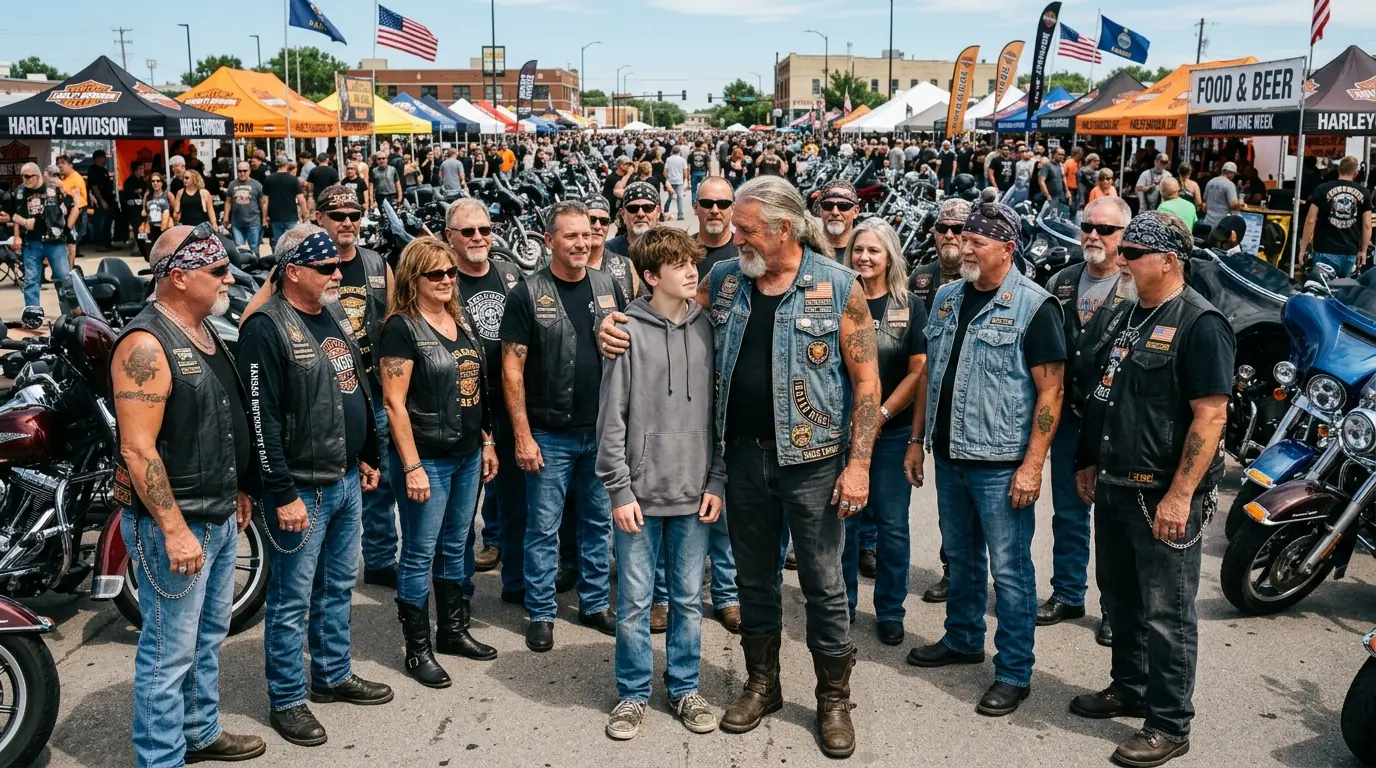
It was the moment that ignited everything that followed.
The July heat was brutal, the kind that made asphalt shimmer and turned leather seats into griddles, which made the kid in the sweatshirt stand out immediately.
Nick pushed through the crowd at the Sable Kings rally, hood pulled up despite the ninety-degree weather, hands buried in his pockets.
His eyes moved constantly, scanning faces, marking exits, tracking the flow of people like he was mapping escape routes in real time.
Fourteen years old and already moving like someone used to running.
Rob noticed him first.
Hard not to.
The kid was a ghost in a sea of color. Denim vests, band patches, tattoos catching sunlight.
Rob stood near the entrance, arms crossed, half listening to his buddy Jake ramble about carburetors.
Then the kid was just there, close enough that Rob could see the bruise yellowing along his jawline.
“Can you pretend I belong here?” Nick’s voice cracked on the last word. “Just for a few minutes.”
Rob blinked.
Of all the things people asked bikers at rallies, directions, recommendations, photos, this was a first.
Before he could respond, Nick’s attention snapped toward the street.
A black SUV rolled past, windows tinted dark as midnight, moving too slow for normal traffic.
Out-of-state plates.
Missouri, maybe.
The vehicle did not stop.
But it did not need to.
The message was clear.
Nick’s face went chalk white.
“Get behind me,” Rob said, his tone leaving no room for argument.
He stepped sideways, blocking the kid from view, and caught Jake’s eye.
One look was all it took.
Jake straightened, moved closer, creating a wall of leather and muscle between Nick and the street.
The SUV continued its crawl, brake lights flashing once before it turned the corner.
The street was empty again, but Nick’s chest stayed tight.
Hunters did not give up after one pass.
“Merchandise table,” Rob muttered, nodding toward a folding table covered in club patches and T-shirts. “Now.”
Nick moved fast, ducking behind the table like he had practiced the motion a thousand times.
His breathing came quick and shallow, hands shaking as he gripped the table edge.
Rob’s eyes caught details that told stories.
Knuckles rubbed raw from sleeping rough.
A sweatshirt that might have been white before it became survival gear.
This was not some kid playing hooky.
This was survival.
“Jake, get Cat,” Rob said quietly.
Jake disappeared into the crowd without question.
Within minutes, the energy around the table shifted. Club members drifted over in ones and twos, casual enough that nobody outside the circle would notice, but deliberate.
They formed a loose perimeter, talking and laughing, but their eyes stayed sharp.
Watching.
Cat arrived wearing her road captain patch and an expression that could strip paint. She took one look at Nick, still crouched, still trembling, and made a decision that would change everything.
“What’s your name, kid?”
“Nick.”
“You hungry, Nick?”
He nodded slowly, like he was not sure it was a trap.
“All right, then.”
Cat pulled off her own denim vest and draped it over his shoulders. It swallowed him whole, hanging past his hips, the Sable Kings patch massive across his back.
“You’re with us now. Anybody asks, you’re my nephew. Got it?”
Nick stared at her, eyes wide with something between disbelief and desperate hope.
“Why are you helping me?”
“Because you asked.”
Cat’s voice softened just a fraction.
“And because whoever’s in that SUV doesn’t get to win today.”
Rob watched the kid’s shoulders drop half an inch, the first sign of relief he had shown since arriving.
When Nick finally stood, still wearing Cat’s vest like armor, something shifted in his posture.
He was not invisible anymore.
He was surrounded.
The SUV made another pass twenty minutes later.
This time, Nick did not hide.
He stood in the center of the group, Rob on one side and a biker named Drew on the other, while Cat leaned against her Harley and stared directly at the tinted windows.
The message was unmistakable.
We see you.
And this boy is not alone.
The vehicle did not slow down.
It rolled past and kept going, swallowed by traffic and distance.
Nick’s eyes stopped darting toward the exits.
The exits were still there.
He just did not need them anymore.
The rally had thinned out by the time the sun started its descent, painting the sky in shades of orange and rust.
Nick sat on a picnic bench in the clubhouse parking lot, still wearing Cat’s vest, picking at the wrapper of a burger someone had handed him twenty minutes ago.
He had not taken a bite yet.
Rob dropped onto the bench across from him, his own plate loaded with two burgers and a mountain of fries.
“You planning to eat that or just rearrange the paper?”
Nick looked up, startled, then managed a weak smile.
“Sorry. I’m just…”
He stopped, unsure how to finish.
“Not used to sitting still?”
Rob took a massive bite and chewed thoughtfully.
“Yeah, I figured.”
Around them, club members were settling in for the night. Coolers appeared. Someone fired up a second grill, and the atmosphere shifted from rally energy to something quieter, more intimate.
Family dinner, biker style.
Cat pulled up a chair, flipped it backward, and straddled it.
“So, Nick, you going to tell us what we’re dealing with, or do we keep playing twenty questions?”
Nick’s jaw tightened.
For a long moment, he just stared at the burger in his hands.
When he finally spoke, his voice was barely above a whisper.
“There’s this place. Lighthouse Group Home. East side of the city.”
He paused and swallowed hard.
“The guy who runs it, Crawford, he’s got connections. City council, police department, social services. Everyone who’s supposed to protect kids looks the other way.”
Rob stopped eating.
“I filed a report back in April. Told them everything. How Crawford would lock us in the basement for infractions. How he’d pocket our medication and sell it. How he’d threaten us if we talked.”
Nick’s hands were shaking now, crushing the burger wrapper.
“Detective promised me he’d handle it. Said I was brave for coming forward.”
“What happened?” Cat’s voice was steel wrapped in silk.
“The report disappeared. Like completely gone from the system. When I called back, a different detective answered. Said there was never any report filed under my name. Said maybe I was confused or acting out.”
Nick laughed, but there was no humor in it.
“Two days later, I’m back at Lighthouse, and Crawford knows. Don’t know how, but he knows.”
Drew appeared beside the table, arms crossed, listening.
Then Jake.
Then more.
The circle grew tighter.
“He told me accidents happen to kids who lie. Told me the streets would chew me up faster than he ever could.”
Nick finally looked up, meeting Cat’s eyes.
“So I left. Middle of the night, climbed out a bathroom window, and I just ran.”
The words came out flat, like he had rehearsed them so many times they had lost their edges.
But his hands told a different story, white-knuckled around the burger wrapper, folding and refolding it into smaller and smaller squares.
“The worst part wasn’t leaving,” Nick continued, voice dropping. “It was the first morning after. Woke up under a bridge. Couldn’t remember where I was for a second. Then it hit me. I was free, and I was terrified, because at least at Lighthouse, I knew what was coming. Out here…”
He shook his head.
“Every cop car could be the one taking me back. Every adult asking if I’m okay could be the one who calls it in.”
The table had gone completely silent.
Even the grill had stopped sizzling.
“Three months ago,” Rob said quietly.
It was not a question.
Nick nodded.
“Libraries when they’re open. Bus stations when they’re not. There’s a church with a forgiving lock on Tuesdays, and a gas station guy who pretends not to notice when I spend twenty minutes in the bathroom after buying a pack of gum.”
“And the SUV?” Cat asked.
“Started seeing it two weeks ago. Same car, different locations. I thought I was paranoid at first, but then I saw it parked outside the library three days in a row.”
Nick’s voice cracked.
“I don’t know who they are, but I know Crawford sent them. He wants to make sure I stay quiet. Permanently.”
The silence that followed was not uncomfortable.
It was the silence of people making calculations, weighing options, preparing for war.
Cat pulled out her phone and scrolled through contacts.
“I know someone. Private investigator, former cop. Got burned by the same system that’s protecting your guy. He owes me.”
“And I know a lawyer,” Drew added. “Handles cases like this. The ones that get buried.”
Rob leaned forward, elbows on the table.
“Nick, you said other kids are still there, right?”
“At Lighthouse?”
Nick nodded slowly, understanding what Rob was really asking.
“Yeah. At least six that I know of.”
“Then we’re not just protecting you,” Cat said, already dialing. “We’re building a case that sticks.”
By the time the stars came out, the picnic table had become a war room.
Cat talked rapid-fire with the investigator, listing details while taking notes on a napkin. Drew coordinated with the lawyer, discussing timelines and evidence requirements.
Rob sat with Nick, pulling out every detail the kid could remember.
Names.
Dates.
Witnesses who might talk if they felt safe enough.
When the parking lot lights started buzzing against the dark, Cat ended her final call and looked at Nick the way you look at someone who just showed up for himself.
“You’re staying here tonight. Back room’s got a cot and a lock on the door. Tomorrow we start making calls that matter.”
Nick stared at her, eyes wet.
“Why are you doing this?”
“Because pretending you belong here?”
Cat stood up, reclaimed her vest, and replaced it with a smaller one from the clubhouse.
“That stops tonight. From now on, you actually do.”
The vest settled on Nick’s shoulders like a promise.
Nick woke to the sound of engines rumbling to life.
Panic hit first, sharp and familiar.
The SUV.
Crawford’s men.
Nowhere to run.
Then he remembered.
Clubhouse.
Back room.
Lock on the door.
He exhaled slowly, the knot in his chest loosening.
Sunlight streamed through the small window above the cot.
He had slept through the entire night.
No waking every two hours to check his surroundings.
No jumping at footsteps.
Just sleep.
Real sleep.
When he emerged, the clubhouse was already buzzing with activity.
Maxine, a woman with silver-streaked hair and reading glasses perched on her nose, stood at a folding table covered in textbooks and a laptop.
She looked up and smiled.
“You must be Nick. I’m Maxine, Jake’s wife. Used to teach seventh grade before I retired.”
She gestured to the setup.
“Cat mentioned you’ve been out of school for a while. Thought we could get you caught up. Online curriculum, work at your own pace. What do you say?”
Nick blinked, momentarily speechless.
“I… yeah. Yes. Thank you.”
“Good. We’ll start after breakfast. Can’t learn on an empty stomach.”
The morning passed in a blur of normalcy that felt surreal.
Breakfast burritos wrapped in foil.
Coffee that was too strong but somehow perfect.
Maxine walking him through a placement test while Rob tinkered with a bike nearby, explaining carburetor functions like poetry.
It was almost noon when the black SUV returned.
Jake saw it first.
He had been outside smoking, leaning against the clubhouse wall, when the vehicle rolled into view and parked directly across the street.
No pretense this time.
No slow crawl.
Just a statement.
We are here.
And we are not hiding.
Jake’s voice carried through the open door, calm but urgent.
Nick’s head snapped up from the math worksheet.
His face went pale.
But this time, he did not run.
He stood, fists clenched at his sides, and walked to the window.
Two men climbed out of the SUV.
The driver was thick-necked and broad-shouldered, wearing sunglasses despite the overcast sky.
The passenger was leaner, holding up a phone, recording.
They did not approach.
They just stood there, a silent threat broadcast in real time.
Cat appeared at Nick’s shoulder, her expression unreadable.
“Rob, Drew, Maxine, grab your phones. Everyone else with me.”
Within minutes, a dozen bikers filed out of the clubhouse and spread across the parking lot in a loose formation.
No shouting.
No posturing.
They simply stood there, arms crossed, a human wall between Nick and the men across the street.
Cat walked forward slowly, her own phone raised and recording. Rob flanked her left, Drew her right.
When she reached the curb, she stopped and spoke loud enough for every camera to catch.
“Gentlemen, I’m going to assume you’re lost. This is private property. The boy you’re looking for, he’s under our protection now.”
She paused.
“We’ve documented your vehicle, your plates, Missouri registration by the way, and your faces.”
She let the words sink in.
“We’ve also filed a report with our attorney, our private investigator, and several journalists who’d love to know why two grown men are stalking a fourteen-year-old kid.”
The driver shifted his weight, uncomfortable.
The passenger kept filming, but his hand wavered slightly.
Rob stepped forward, his voice a low rumble.
“Anything happens to him, anything at all, we know exactly where to start looking. And trust me, we’ve got a long memory and a lot of friends.”
The standoff lasted maybe thirty seconds, but it felt like an hour.
Finally, the passenger lowered his phone.
The driver muttered something inaudible, and they climbed back into the SUV.
The engine roared to life, and the vehicle pulled away, tires squealing slightly as it rounded the corner.
They did not come back.
Inside the clubhouse, Nick stood frozen at the window, watching the street where the SUV had been.
His hands were still shaking, but something in his posture had changed.
He was not crouching anymore.
He was standing tall.
Cat returned, pocketing her phone.
“They’ll report back to Crawford. Tell him it’s not worth the risk. Men like that only move when they think there’s no resistance.”
“What if they don’t give up?” Nick asked.
His voice was steadier than it had been yesterday.
“Then we escalate.”
Cat’s smile was sharp.
“But they will. Bullies always fold when someone fights back.”
Over the following days, the clubhouse became Nick’s world.
Maxine set up a learning schedule. Math in the mornings, history after lunch, science when his brain needed a break from numbers.
Rob taught him how to strip an engine, how to identify problems by sound alone, how to treat machines with respect because they would return the favor.
He started sleeping without nightmares.
Started talking without flinching.
Started laughing at Jake’s terrible jokes.
One evening, Rob found Nick sitting outside the garage, staring at the sunset like he was memorizing it.
“Thinking about running?” Rob asked, settling onto the concrete beside him.
“No.”
Nick pulled his knees up to his chest.
“Thinking about how I don’t want to anymore. That’s scarier somehow. Staying.”
Rob did not respond right away.
He just sat there, two people watching the sky turn colors neither of them had names for.
“Staying’s always scarier,” Rob said finally. “Running’s easy. It’s the stopping that takes guts.”
Nick paused and looked up at Rob.
“Why did you help me? That first day, you didn’t know anything about me. I could have been lying.”
Rob wiped his hands on a rag, considering the question.
“Could have been. But you weren’t. And even if you were, a scared kid asking for help doesn’t get turned away. Not by us.”
Nick nodded slowly, turning back to the engine.
His hands were steady now.
Confident.
He tightened a bolt, tested the connection, and smiled when it held firm.
“I’m getting pretty good at this.”
“Yeah,” Rob agreed, pride evident in his voice. “You are.”
The private investigator’s name was Edward Clay, and he did not look like what Nick expected.
No leather jacket.
No intimidating scowl.
Just a middle-aged man in khakis and a button-down, carrying a messenger bag stuffed with file folders.
He spread the contents across the clubhouse table like a dealer laying out cards.
A paper trail of corruption.
Crawford’s bank statements showing money that should not exist.
Property records under shell company names.
Emails that read like confessions if you knew what to look for.
And photographs.
Crawford, all smiles, shaking hands with a city councilman outside a restaurant that charged more for appetizers than Lighthouse spent on a kid per month.
“The state pays Lighthouse over sixty grand per kid per year,” Edward said, tapping one document. “Crawford’s got eight beds filled most of the time. That’s nearly half a million coming in. Food budget? Barely covers ramen. Utilities? Pocket change. The rest disappears. The rest vanishes into shell companies he controls.”
Cat leaned forward, studying the papers.
“That’s embezzlement.”
“That’s the start.”
Edward pulled out another folder.
“I found three other kids who aged out of the system in the past two years, all willing to testify. One of them kept a journal, documented everything. Dates, times, witnesses.”
Nick’s breath caught.
“Who?”
“Girl named Sophie. She remembered you. Said you were the one who told her it wasn’t her fault, that she wasn’t crazy for being afraid.”
Edward’s expression shifted, the way people look when they realize they are talking to someone braver than they would ever need to be.
“She’s been waiting for someone to reopen this case. Said she’d testify the moment it was safe.”
The lawyer, a sharp-eyed woman named Patricia Reeves, arrived an hour later.
She listened to everything.
Nick’s testimony.
Edward’s findings.
The accounts from Sophie and the others.
And she built her case like an architect designing a fortress.
“We file next week,” Patricia announced. “I’m also contacting the state attorney general’s office and two investigative journalists I trust. This story goes public simultaneously with the charges. Crawford won’t have time to bury anything.”
“What about the kids still there?” Nick asked.
The question had been haunting him for weeks.
“Child services will remove them the day we file. We’ve coordinated with a judge who isn’t on Crawford’s payroll. They’ll be placed in vetted homes with people who actually care.”
Patricia’s expression softened slightly.
“You did that, Nick. You speaking up started all of this.”
The weight of those words settled over him.
Heavy, but not crushing.
The guilt he had carried since climbing out that bathroom window, the weight of the kids he had left behind, finally felt like something he could carry and still walk forward.
Three weeks later, Nick stood outside the courthouse in a borrowed button-down shirt that Rob had pressed that morning.
The Sable Kings lined the steps, bikes parked in formation along the curb, engines silent but their presence thunderous.
Inside, the courtroom felt too small for everything it contained.
Crawford sat at the defense table, his lawyer whispering urgently in his ear.
When Crawford’s eyes found Nick, there was no recognition, no anger, just cold calculation.
Like Nick was still a problem to be solved.
But Nick did not look away.
He held that gaze until Crawford blinked first.
Something shifted in that moment.
Crawford had spent months making Nick feel small, invisible, erasable.
But here, in this courtroom, with the Sable Kings filling the gallery behind him and the truth laid out in exhibits and testimonies, Nick was not small anymore.
He was evidence.
The kid who refused to disappear.
Crawford looked away first.
And Nick felt himself breathe.
The testimony took three hours.
Nick spoke clearly, methodically, answering every question Patricia asked.
When the defense attorney tried to rattle him, suggesting he was lying for attention, Nick simply said, “I didn’t want attention. I wanted to survive.”
Sophie testified next, her journal entries projected on a screen for the jury.
Then two more former residents.
Then a social worker who had tried to investigate years ago and had been silenced.
Then Edward, laying out the financial crimes in excruciating detail.
By the time the prosecution rested, Crawford’s lawyer looked like he wanted to vanish.
The jury deliberated for two days.
When they returned, the verdict was unanimous.
Every count.
Every charge.
Crawford’s lawyer stopped taking notes halfway through.
Crawford was led away in handcuffs.
He did not look at Nick once.
Outside, the courthouse steps were packed with reporters, cameras, and the entire Sable Kings MC.
Cat stood beside Nick, one hand on his shoulder as flashes erupted around them.
“How does it feel?” a reporter called out.
Nick thought about it.
Really thought.
About the rally four months ago.
About asking a stranger to pretend he belonged.
About the SUV and the fear and the nights spent counting exits.
“It feels like I can breathe,” he said finally.
The clubhouse threw a barbecue that Sunday.
Burgers.
Ribs.
Corn on the cob.
And a cake that Maxine had made with Welcome Home, Nick written in blue icing.
He had been staying in the back room for months now, but this felt different.
Official.
Halfway through the afternoon, someone, probably Jake, made a joke about Nick still pretending to be a biker.
The table went quiet for a beat, everyone glancing at Nick to gauge his reaction.
He looked up from the motorcycle engine he had been rebuilding all week, grease smeared across his forearms, a socket wrench in his hand.
He smiled, slow and genuine.
“Not pretending anymore.”
The table erupted in laughter and cheers.
Cat stood, walked over to where Nick sat, and held out a folded vest.
Not borrowed.
His.
“Sable Kings don’t do full membership under eighteen,” she said, “but we do prospects. And prospects become family.”
She unfolded the vest, revealing a patch on the back that read Little Brother above the club’s emblem.
Nick took it with both hands, feeling the weight of leather and loyalty.
He slipped it on, and it fit perfectly.
Rob raised his beer.
“To Nick, who taught us that sometimes the bravest thing you can do is ask for help.”
“To Nick,” the club echoed.
He may have arrived terrified, asking strangers to pretend he belonged, but he stayed because they had given him something no system, no report, no well-meaning bureaucrat ever could.
A name that meant something.
A purpose that mattered.
And a family that did not require him to beg for a seat at the table.
He belonged, for real this time.
And when someone belongs, they stop looking for exits.