“Access denied,” Petty Officer Ryan Davis said, jerking the identification card out of Rachel White’s fingers and holding it just beyond her reach. The forty-six-year-old Black woman stood completely still beneath the hard California sun, wearing a bright red zip-up jacket, dark pants, and the calm expression of someone who had survived far more dangerous situations than an arrogant young gate guard. A faded trident-style memorial tattoo was visible along her forearm where her sleeve had pulled back. Davis looked at the ink, laughed, and decided he already knew everything about the woman standing in front of him.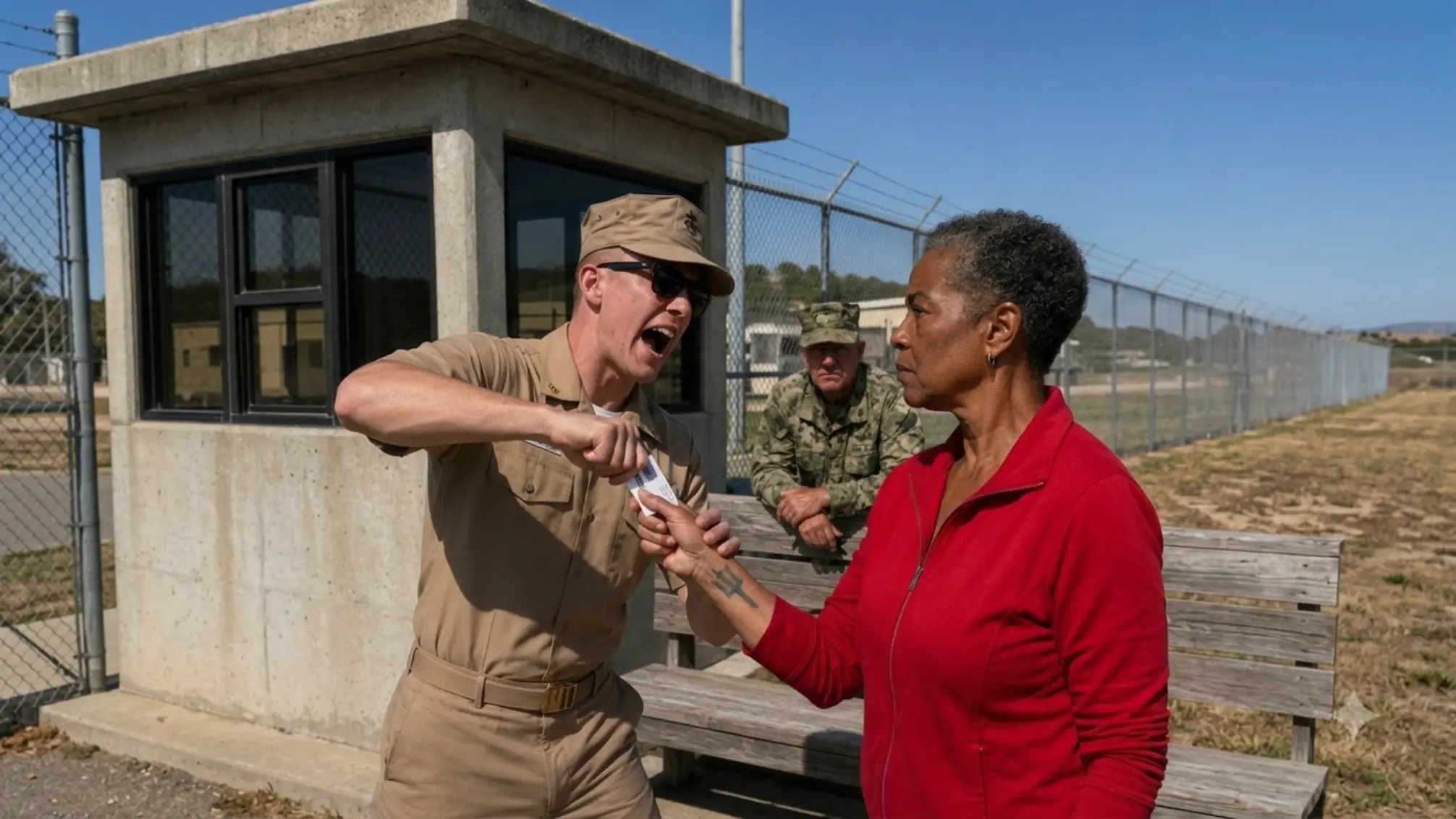
Rachel lifted her eyes. “Make the phone call, and say my name clearly.” Davis stepped closer, pointing toward the tattoo. “That ink is a disgrace, and if you reach for this card again, I’ll have you cuffed at my gate.” Rachel squared her shoulders without raising her voice. “Touch me again—then explain it to the commander.”
The entrance checkpoint at Coronado had been busy all afternoon, with vehicles rolling through one lane while pedestrians passed the guard booth on the other side. Rachel had arrived alone, carrying no luggage, no cameras, and nothing that should have attracted attention beyond a legitimate retired-service identification card. She had come for one reason: the memorial ceremony marking another anniversary of her husband Daniel’s death. For years, the visit had been quiet and deeply personal, something she did without speeches or anyone announcing who she had once been.
Davis did not know any of that. He was twenty-four, only months into the assignment, and possessed the dangerous kind of confidence that came from knowing procedures better than people. He had looked first at Rachel’s civilian clothing, then at her age, then at the tattoo, and somehow concluded the card in his hand must be fraudulent. Instead of verifying it properly through the access system, he began questioning her loudly in front of everyone passing through the gate.
“Where did you get this?” he demanded. Rachel answered, “It was issued to me.” Davis smiled as though she had confirmed his suspicion and tapped the rank field with one finger. “You expect me to believe you retired at the rank printed here?” Rachel looked toward the guard booth. “I expect you to verify the card instead of performing for an audience.”
That irritated him. “Master Chief? You?” Davis said loudly, making sure nearby people heard him. A second young guard glanced over but did not immediately interfere. Rachel felt several people slowing down behind her, drawn toward the confrontation. She understood exactly what Davis was doing: turning uncertainty into public humiliation because he wanted witnesses to see him winning.
Rachel had spent twenty-four years working in one of the most demanding technical specialties in the service. She had entered young, completed training that eliminated many candidates, and built a career around explosive-ordnance disposal, threat assessment, and technical leadership. Her assignments had placed her in environments where one careless movement could cost multiple lives. By retirement, she had reached Master Chief and trained younger specialists who now held senior positions throughout the service.
None of that was the point at the gate. Rachel did not expect Davis to recognize her face, understand her history, or treat her as important because of her past. Her credentials either verified or they did not. She expected him to follow the same procedure he should have used for anyone whose identification generated a question.
Instead, Davis grabbed her wrist when she reached toward the card. Rachel stopped immediately and looked down at his hand. “Release me.” Davis tightened his grip for one second before letting go, perhaps realizing the nearby security camera had a direct view of the exchange.
He pointed toward the faded tattoo. “You don’t get to walk around pretending you earned symbols like that.” Rachel’s expression changed, not because the insult frightened her but because the tattoo had nothing to do with proving her own rank. She had received it after Daniel died, using a design connected to his service, with his initials and the date she lost him beneath it. “You don’t know what that tattoo means,” she said quietly.
Davis laughed. “I know enough.” Rachel stared directly at him. “No, son. That is exactly the problem.” Twenty yards away, an older man seated on a wooden bench suddenly raised his head.
Retired Master Chief Thomas Thorn was sixty-eight and had returned to the base that afternoon to meet former colleagues before the memorial ceremony. He had watched the confrontation without immediately understanding who Rachel was. Then he heard Davis say the name printed on the identification card. Rachel White.
Thorn slowly stood. Years earlier, he had known Daniel White and had also crossed paths professionally with Rachel during a difficult overseas assignment. He remembered her as the technician who remained steady when everyone else understood exactly how little margin for error existed. He had not seen her in almost seven years, but the moment she turned slightly and he saw her face, there was no doubt.
Thorn pulled out his phone. Davis noticed immediately and barked, “Who are you calling?” Thorn ignored him and began dialing. Rachel saw the older man and recognized him, but she did not smile because his expression told her he had already decided the incident required someone higher in the chain.
Davis raised his radio. “I’m requesting security support for a suspected fraudulent identification.” Rachel remained perfectly still. “Make sure you tell them you refused verification first.” Davis snapped, “You don’t tell me how to run my gate.” Rachel answered, “Then run it correctly.”
The second guard finally stepped forward. His name was Petty Officer Lewis, and unlike Davis, his face showed discomfort rather than confidence. “Ryan, maybe we should scan the card.” Davis waved him away. “Look at it. The laminate feels wrong.”
Lewis took the card carefully. He looked at the security features, then at Rachel. “Ma’am, may I place this in the reader?” Rachel nodded. “That’s what should have happened five minutes ago.” Davis muttered that they were wasting time.
Lewis slid the card into the secure reader inside the booth. The system processed for several seconds before displaying a green verification screen. Identity verified. Retired Master Chief. Access eligible. Lewis stared at the screen, then looked toward Rachel.
Davis stepped closer. “Run it again.” Lewis did, and the screen returned the same result. Rachel remained silent while Davis’s face tightened. Instead of apologizing, he said, “The database can still be wrong.”
Thorn finally spoke. “Then perhaps you should stop talking until someone more qualified explains how badly you’re handling this.” Davis turned sharply. “And who are you?” Thorn held out his own retired identification. “Someone who knows exactly who she is.”
Davis barely looked at it. “Stay out of this.” Thorn’s jaw hardened. “You made it everybody’s business when you started shouting accusations in public.” Davis reached toward his radio again, but Thorn lowered his phone and said, “Too late.”
The first black command vehicle arrived several minutes later. Two more followed behind it, rolling toward the checkpoint with enough purpose that everyone nearby stopped talking. Davis stared at the vehicles and suddenly looked uncertain. The lead SUV stopped beside the guard booth.
Commander James Evans stepped out, followed by a senior adviser and a security officer carrying a tablet. Evans did not rush toward Rachel theatrically; he walked directly to the checkpoint, looked first at the guards, then at the green verification screen, and finally at Rachel. His expression changed. “Master Chief White.”
Rachel nodded. “Commander.” Evans gave her a formal salute, and Rachel returned it automatically. Behind Davis, Lewis went visibly pale.
Davis stared between them. Evans lowered his hand and said, “I was told there was an access problem.” Rachel answered, “There was a verification problem. The system seems to be working fine.” The sentence landed exactly where she intended.
Evans turned toward Lewis. “What does the reader show?” Lewis swallowed. “Verified retired Master Chief, sir. Valid access.” Evans looked toward Davis. “Then why was I told we had a suspected fraudulent credential?”
Davis began speaking quickly. “Sir, the identification looked questionable, and the tattoo—” Evans raised one hand. “The tattoo?” Davis stopped. Evans looked at Rachel’s forearm and then back at the young guard. “What does a tattoo have to do with credential verification?”
“It was a protected symbol, sir.” Evans’s eyes narrowed. “So you accused her based on a tattoo?” Davis tried to correct himself. “Not only that, sir. Her appearance didn’t match what I expected for the rank.”
Nobody moved. Evans’s voice became dangerously calm. “Say that again.” Davis realized what he had admitted and began stumbling over his words. Evans cut him off. “I heard you the first time.”
Rachel looked toward Evans. “Commander, I don’t need an audience for this.” Evans nodded. “Agreed.” He turned toward the security officer. “Relieve Petty Officer Davis from gate duties pending formal review.”
Evans continued before Davis could interrupt. “Preserve body-camera footage, checkpoint video, radio traffic, scanner records, and the access log from the first moment Master Chief White approached.” Davis’s face changed completely. “Sir, you’re relieving me because I questioned an ID?” Evans stepped closer.
“No. I’m relieving you because you verified nothing, escalated everything, physically handled a visitor, ignored another guard’s recommendation to scan the credential, and then admitted your assumptions were based partly on how she looked.” Davis opened his mouth again. Evans cut him off. “You will have due process. You will also stop talking before you make this worse.”
Lewis quietly handed Rachel her identification. “Ma’am, I’m sorry.” Rachel accepted it. “You eventually did the right thing.” Lewis looked ashamed. “Too late.”
Rachel shook her head. “Late isn’t the same as never.” That surprised him. Davis remained near the booth while another security employee took his radio and access keys.
He looked toward Rachel, perhaps expecting satisfaction. He found none. Rachel was already looking beyond him toward the memorial grounds. Evans followed her gaze. “You came for Daniel.”
“Yes.” His voice softened. “We reserved the usual place.” Rachel answered, “I didn’t ask for anything special.” Evans nodded. “You didn’t.”
Rachel put the card into her wallet. “Then let’s keep it that way.” Thorn walked closer, and Rachel finally allowed herself a small smile. “Tom.” The retired Master Chief smiled back. “Rachel.”
“You still interfere in other people’s business.” Thorn shrugged. “Only when they’re handling it badly.” For several seconds, the tension at the checkpoint gave way to something older and quieter. Davis watched the exchange and slowly understood that the woman he had reduced to a suspicious civilian had a history far beyond anything he had imagined.
Rachel would later insist that was not the lesson. She did not deserve proper treatment because senior people knew her name. She deserved proper treatment because she had presented legitimate credentials and followed instructions. The same would have been true if she had never reached Master Chief.
The command investigation began that afternoon. Security retrieved fixed-camera footage, body-camera recordings, access-reader logs, and radio transmissions. Investigators interviewed Rachel, Lewis, Thorn, Davis, and several witnesses who had been waiting near the entrance.
The evidence left little disagreement about the sequence. Rachel had approached calmly and provided valid identification. Davis had removed it from her hand abruptly, questioned her rank without first using the available verification system, made repeated comments about her appearance and tattoo, and grabbed her wrist. Only after Lewis intervened had the card actually been scanned.
The investigator asked Rachel whether she wanted Davis permanently removed from service. She looked at him for several seconds. “That isn’t my decision.” He told her she could make a recommendation.
“No,” Rachel replied. “Use the evidence. Apply the standard.” She folded her hands. “Don’t turn discipline into revenge because someone important recognizes my name.”
The investigator nodded. That answer entered the final report. The review also uncovered something larger than one arrogant confrontation.
Davis had received only limited training on retired credentials and had been encouraged by a senior gate supervisor to treat questionable cases “aggressively” after recent attempts involving forged visitor documents. That did not excuse his conduct, but it helped explain why an inexperienced guard believed suspicion alone justified confrontation. More importantly, investigators found three earlier complaints involving Davis.
One came from an elderly veteran whose outdated card required manual verification. Davis had allegedly called him a liar before the database eventually confirmed his status. Another involved a civilian contractor with a foreign accent whom Davis repeatedly questioned even after documents matched. The third came from a retired female officer who said Davis laughed when she corrected the rank he used for her.
None of those incidents had triggered formal review. Each had been dismissed as a minor customer-service disagreement. Rachel read that section twice after Evans gave her a copy. “What bothers you?” he asked.
Rachel tapped the earlier complaints. “Everybody is talking about what happened to me because somebody knew my name.” Evans looked at the pages. Rachel continued, “And nobody noticed these people.” He understood immediately.
The command response broadened. Gate personnel received revised instructions requiring credential verification before accusations of fraud unless an immediate safety concern prevented normal procedure. Supervisors were required to review complaints involving physical contact, identity disputes, or repeated inappropriate comments.
Body-camera audits became routine rather than something performed only after major incidents. Unusual credentials were routed through verification channels instead of leaving inexperienced guards to substitute instinct for procedure. Rachel agreed to participate in one training session.
She refused to let anyone introduce her by listing decorations, deployments, or dangerous assignments. The training officer objected that people needed context. Rachel answered, “They need the rule.”
“What rule?” he asked. Rachel looked around the classroom. “Verify before you assume.” That became the title of the session.
Davis attended. By then he had been removed from access-control duty and temporarily assigned to maintenance support while his qualifications were reviewed. He sat near the back without sunglasses, without his confident smile, and without a radio attached to his belt.
Rachel stood at the front in ordinary civilian clothes. She displayed an example of an identification card and asked, “What do you see?” A young guard answered, “Credential type, expiration date, identification number.” Another mentioned security features.
Rachel nodded. “What don’t you see?” The room became quiet. She looked across the guards. “You don’t see whether the person carrying it deserves respect.”
Several people shifted in their chairs. Rachel continued, “Because that isn’t printed on the card.” She paused. “Respect isn’t a clearance level.” Davis lowered his eyes.
After the session, he waited while everyone else left. Rachel continued gathering her papers until Davis approached. “Master Chief White.” She turned. “Yes?”
“I owe you an apology.” Rachel waited silently. Davis swallowed. “I made assumptions. I wanted to prove I could catch someone getting through the gate, and once I decided you were lying, I stopped looking for evidence that I was wrong.”
He continued before she answered. “I grabbed you. I embarrassed you. I insulted your husband without even knowing that was what the tattoo meant.” His voice tightened. “I was wrong.” Rachel studied him for a long moment.
“Why are you apologizing?” she asked. Davis seemed confused. “Because I treated you badly.” Rachel asked, “Because I’m a retired Master Chief?”
Davis hesitated. “That’s part of it.” Rachel shook her head. “Wrong answer.” His expression fell.
“You should regret it if I had been an E-2,” Rachel said. “You should regret it if I had been a civilian contractor. You should regret it even if my card had turned out invalid.” Davis frowned slightly, listening carefully.
Rachel explained, “An invalid credential would justify denying access. It would not justify humiliation.” Davis slowly nodded. Rachel pointed toward the empty training room. “That is the lesson you missed.”
“Yes, ma’am.” Rachel shook her head. “Rachel.” Davis looked surprised.
“You still have a career if you decide to learn from this.” Davis stared at her. “You really believe that?” Rachel answered, “I believe one bad day should have consequences. I don’t automatically believe it should define your entire life.”
Davis looked down. “Thank you.” Rachel picked up her folder. “Don’t thank me.” Then she looked him directly in the eye.
“Guard the base. Not your stereotype of who belongs inside it.” Davis nodded. Rachel left without another word.
Weeks later, Rachel saw him again near a maintenance area while visiting Coronado before a flight. Davis was wearing work clothes instead of a gate uniform, helping repair fencing under supervision. He noticed her, stopped what he was doing, and walked over without embarrassment or defensiveness.
“Rachel.” She nodded. “Ryan.” He gave a small smile. “Still learning.”
“Good.” His security qualification remained suspended pending reevaluation, and there was no guarantee he would ever return to gate duty. Rachel considered that appropriate because consequences mattered.
But what happened afterward mattered too. The older veteran whose complaint had been ignored received a formal apology from the command. So did the retired female officer Davis had previously dismissed. Their cases were added to the training material alongside Rachel’s rather than allowing Rachel’s status to make her experience seem more important.
That pleased her more than anything. The following year, Rachel returned to the memorial again. The checkpoint looked almost unchanged: concrete booth, chain-link fencing, hot asphalt, vehicles waiting patiently.
A young guard she had never met stepped forward. “Good afternoon, ma’am. ID, please.” Rachel handed it over.
He scanned it. The screen turned green. “Thank you, Master Chief. You’re clear to enter.” Rachel took the card.
“That easy?” she asked. The guard looked confused. “Yes, ma’am.” Rachel smiled. “Perfect.”
He never asked about the tattoo. He did not need to. Rachel walked toward the memorial grounds where Daniel’s name remained engraved among the names of others who had never returned home.
She placed one hand against the stone and stood quietly while the afternoon wind moved across the base. For years, Rachel had believed strength meant surviving dangerous places. Age had taught her something different.
Sometimes strength meant refusing to become cruel when someone gave you every reason to be. Davis had tried to humiliate her, and Rachel could have humiliated him in return once Commander Evans arrived. Instead, she allowed the evidence to speak.
That choice did not spare him consequences. It made those consequences legitimate. Rachel looked down at the faded tattoo on her forearm.
Daniel’s initials remained beneath the symbol, softened by time but still readable. She remembered what Davis had called it: a disgrace. Now the words seemed strangely small.
A tattoo did not prove courage. Neither did a rank, a uniform, or a title. Character showed itself in smaller moments—when nobody expected accountability, when someone held power over a stranger, and when the easier choice was assumption instead of verification.
Ryan Davis had failed that test at the gate. Rachel hoped he would pass the next one. Before leaving, she stopped beside the wooden bench where Thorn had been sitting the year before.
He was there again, older now, wearing sunglasses and drinking coffee. “You planning to interfere with anyone today?” Rachel asked. Thorn smiled. “Depends.”
“On what?” Thorn lifted his cup toward the checkpoint. “Whether they know how to use the scanner.” Rachel laughed and sat beside him.
Cars continued moving through the gate one by one. Cards were checked, names were verified, and people were allowed through or denied according to procedure. No spectacle appeared.
No accusations. No command convoy. No young guard shouting across the asphalt. Rachel watched for several minutes and realized this was exactly what success looked like.
The real victory had never been watching Davis discover that the Black woman in the red jacket once held one of the highest enlisted ranks available. It was not Commander Evans arriving at the gate or Thorn recognizing her name. None of that should have been necessary.
The victory was making sure the next person would not need an impressive past before somebody bothered checking the truth. Rachel had presented a valid card. Procedure should have been enough.
And now, finally, it was.