They pulled him off the plane like he did not belong.
So he pulled five billion dollars off the table without blinking.
He did not even get a sip of his water before it happened.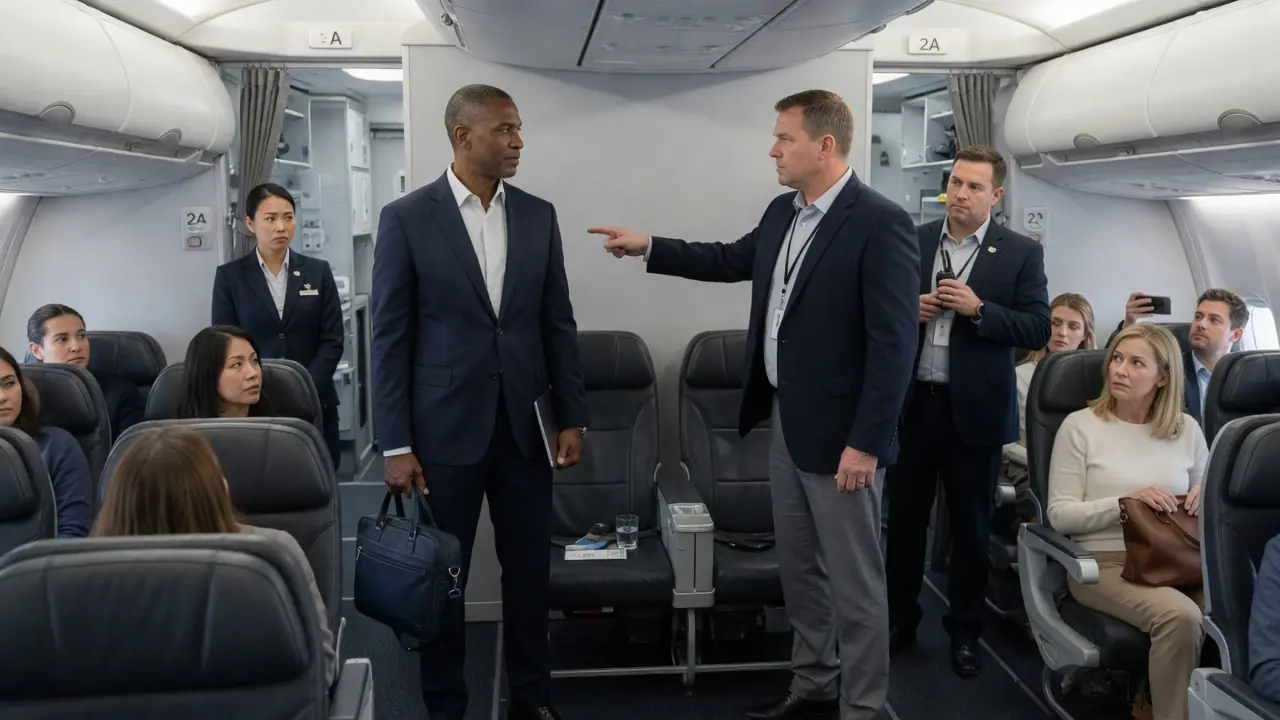
Darius Freeman, forty-seven years old, CEO of a billion-dollar AI company, sat quietly in seat 2A of flight 2280 from San Francisco to Newark. First class. Window seat. Clean navy suit. Crisp white shirt. Not a wrinkle in sight.
The boarding process had just wrapped. Passengers were settling in, and the flight attendants were closing the overhead bins. Darius had his tablet out, reviewing slides for the biggest logistics tech deal of his career.
A five-billion-dollar handshake was waiting on the East Coast.
But before the plane could even taxi, two men in navy blazers walked down the aisle toward him.
One had a radio in his hand. The other scanned the row numbers like they were looking for someone specific.
They were.
“Sir, can you step off the plane for a moment?” one asked, voice just loud enough for the surrounding rows to hear.
Darius looked up slowly, calm but confused.
“Excuse me. Is something wrong?”
“We just need to verify a few things. Could you bring your bag and come with us?”
Eyes turned.
A few people pretended not to look, but everyone was watching.
Darius kept his voice steady.
“I scanned my boarding pass and showed ID. What exactly do you need to verify?”
The man did not answer. He just motioned toward the aisle again.
That silence said everything.
A younger white woman sitting in 2C shifted in her seat. She had been chatting on the phone when Darius first sat down. She had not made eye contact since, but now she was stealing glances.
Two rows behind, a middle-aged man in a fleece vest murmured something under his breath to his seatmate.
Nobody stood up.
Nobody spoke up.
Darius stood, took his bag from under the seat, and straightened his jacket.
“Do you know who I am?” he asked.
The taller man shrugged.
“No, sir, I don’t.”
And just like that, Darius stepped off the plane.
Out of first class.
Out of line.
Out of place, at least in their eyes.
But that was not the end of it.
It was not even the worst part.
Darius Freeman did not come from old money. He did not grow up in a neighborhood where people wore cardigans on weekdays or talked about hedge funds over brunch.
He was raised in Stockton, California, in a two-bedroom house with six people and one working radiator. His mom, Bernice, was a public school librarian who made every dollar stretch. His dad, Ellis, was a mechanic who never took a sick day, even when he should have.
Darius was the kid who asked for a typewriter instead of toys, who rewired an old Game Boy just to figure out how it worked, who stayed up past midnight sneaking computer science books from the library.
He did not just want to succeed.
He wanted to build something.
Langford AI, named after his late grandfather, who taught him never to raise his voice but always raise his standards, had gone from a two-man operation in a shared workspace to a tech giant changing how global supply chains operated.
Darius was not flashy.
No yachts.
No tabloid headlines.
Just results.
He had turned down three buyouts, all north of a billion dollars.
Now he was finalizing the biggest deal of his life, a five-billion-dollar integration with Caliber Air, one of the top three airlines in the United States, to upgrade their cargo routing systems with his predictive AI.
It was a partnership that would overhaul their entire fleet, cutting delays, rerouting around weather patterns, slashing emissions, and saving them billions.
Darius was not just selling software.
He was selling the future.
And he was doing it all while staying true to who he was.
Low-key.
Focused.
Direct.
At forty-seven, he was finally starting to enjoy the fruits of what he had built. First-class tickets. Quiet vacations in Oregon with his wife, Joy. Hiking with his teenage daughter, Zion. Even the occasional headline in Forbes or Fast Company.
But none of that changed how people looked at him when he entered a room.
Not the suit.
Not the accolades.
Not even the billion-dollar valuation.
Some people still saw a man who did not fit the setting.
He was not surprised by that.
But what happened on flight 2280 cut deeper than most.
Because in all the years he had built and sacrificed and earned his place, Darius thought, hoped, things had shifted. He thought showing up clean, calm, and professional would be enough.
But the truth was, some people did not care what he built.
They only saw the threat they imagined.
And when you are calm, they call you suspicious.
When you ask questions, they say you are being difficult.
When you stand your ground, they claim you are aggressive.
Still, Darius was not the kind to snap.
He learned a long time ago that anger made them comfortable. It gave them a reason to dismiss you.
But that did not mean he was going to let this slide.
Because this was not just about him anymore.
The gate agent had barely looked at him.
“Final boarding for Caliber Air flight 2280 to Newark,” the speaker called overhead.
Darius handed over his boarding pass. First class, group one, window seat.
The agent scanned it, glanced briefly at his ID, then looked back down at the screen.
No greeting.
No “have a nice flight.”
Just a flat, mechanical nod.
He was used to that.
He walked onto the jet bridge, passed a couple hurrying to economy, and turned left into first class.
He had glanced at the seat map on the app earlier. He was one of only three passengers listed in the entire first-class cabin. One of them was already seated near the back corner, earbuds in. The other was a woman with a scarf around her curls, flipping through a Kindle in 1D.
He settled into seat 2A.
His navy carry-on slid neatly beneath the seat in front of him. He pulled out his tablet, opened the slides, and began reviewing the final revisions.
There had been a time when he used to triple-check every stat, every keyword, afraid of being picked apart in rooms where nobody looked like him.
Now he knew his work stood on its own.
A flight attendant approached with a smile.
“Can I get you anything to drink, sir?”
“Water, thanks. No ice.”
“Coming right up.”
She was kind, young, maybe early thirties. Darius returned the smile, then went back to reviewing his charts.
That was when she boarded.
The woman in the white sweater.
Blonde, maybe late forties, high-end leather tote, eyes scanning the row numbers like she was trying to solve a puzzle.
When she saw Darius in 2A, she paused.
“Hi,” she said uncertainly. “I think you might be in my seat.”
Darius blinked, looked down at his boarding pass, then up at the seat placard.
“2A. That’s me,” he said calmly.
She hesitated.
“Oh. I thought maybe there was a mistake.”
“There isn’t.”
Still, she did not move.
The flight attendant reappeared with the water. She looked between the woman and Darius.
“Is everything all right?”
The woman laughed a little.
“I just thought I was in 2A, but I guess not.”
She pulled out her phone, pretending to check, then slowly made her way to 3D.
Darius did not say anything.
He did not need to.
The attendant offered a soft smile and walked away.
A few minutes later, the pilot made his announcement.
“Good afternoon, folks. Flight time today is four hours and fifty minutes.”
Darius leaned back and closed his eyes for a moment.
The weight of preparation, of expectation, sat heavy in his chest, but it was a familiar pressure.
He thought about Joy and Zion back home. He thought about how much this deal could shift things, not just for him, but for the hundred new engineers he planned to hire if the deal went through.
Then came the voice, low and tense, near the galley.
“I don’t know. He just looked off.”
Darius opened one eye.
The woman in the white sweater was speaking to a different flight attendant. Her words were hushed, but not enough.
He was not meant to hear, but he did.
“He didn’t answer when I spoke to him. I mean, he was just sitting there, but I don’t know. You should double-check.”
Double-check what?
Darius watched as the attendant nodded and stepped into the cockpit.
Minutes passed.
Then footsteps.
Fast, deliberate ones.
Two men appeared at the front of the cabin, one in a dark blazer with a lanyard, the other stockier, holding what looked like a handheld radio.
They walked straight to 2A.
“Sir, we need to speak with you.”
Darius closed his tablet and looked them both in the eye.
“I’d like to know why.”
But what happened next would change everything.
“Is there a problem with my ticket?” Darius asked, voice steady, eyes clear.
The taller man shifted.
“We’ve been asked to verify your seating and identity, sir.”
“I already showed my ID at the gate,” Darius said. “Boarding pass was scanned. No issues.”
“Then it shouldn’t take long,” the other man replied, flashing what could have passed for a smile, but it did not touch his eyes.
Darius sighed through his nose.
He could feel the air tighten around him.
The cabin had gone quiet. Conversations dropped to whispers.
One guy across the aisle subtly angled his phone like he might be recording, but no one said a word.
Not a single voice asking why him or what for.
Darius gathered his bag and stood up.
The woman in the white sweater did not look up as he passed her. She clutched her coffee cup like she needed it to justify not making eye contact.
Once off the plane, they led him down the jet bridge and into a side corridor near the gate.
No arrest.
No cuffs.
Just the kind of questioning designed to feel official, but not quite official enough to explain itself.
“Can you confirm your name?”
“Darius Freeman.”
“Purpose of your trip?”
“Business. Meeting in Newark. Returning Friday.”
“Employer?”
“I’m the CEO of my own company.”
The man scribbled something on a notepad.
“And the name of that company?”
Darius looked him dead in the eye.
“Freeman Systems. We own Langford AI. We’re the ones your airline is finalizing a five-billion-dollar deal with.”
That landed.
Both men exchanged a glance.
Something shifted.
A moment of silence stretched too long.
The taller one cleared his throat.
“Well, this seems to have been a misunderstanding.”
“No,” Darius corrected. “This was profiling.”
Neither man responded.
Another voice joined the hallway.
A supervisor.
Nervous energy. She had a clipboard and an apologetic tone.
“Mr. Freeman, we apologize for the inconvenience. The issue seems to have stemmed from a miscommunication from the cabin.”
“You mean what?” Darius asked. “Someone thought I didn’t belong in that seat?”
She did not answer directly, just offered a printed voucher.
“We’ve arranged for you to board the next flight to Newark, leaving in three hours. We’ve upgraded the seat and included a meal credit.”
He did not take it.
“I don’t want a meal voucher,” he said quietly.
“Sir, we’re truly sorry. The crew was simply following procedure.”
“What procedure?” Darius asked. “You don’t remove people from flights over seat confusion unless someone looks like they don’t belong.”
Still, the apology stayed shallow.
He stood for a moment, debating his next move.
He had every right to raise hell. Call press. Sue.
But something else stirred inside him.
Something bigger.
He gave them one last look.
“Tell your legal team to expect a call.”
Then he walked away.
Not yelling.
Not slamming doors.
Just walking with the full weight of what had happened under his skin.
At a quiet bench outside the gate, he sat down, opened his laptop, and started typing.
First one email.
Then another.
He reached out to his general counsel, then his partner on the Caliber Air deal, then his PR manager.
Not out of rage.
Out of clarity.
This was not going away, but it was not just about getting even.
It was about changing the game.
By the time Darius landed in New York on a different plane four hours later, the headlines had already started to bubble up.
Not the major outlets.
Not yet.
But a few regional blogs and tech forums had picked it up.
tech CEO removed from first-class cabin without cause.
Freeman Systems founder detained after seat dispute despite being airline partner.
Word travels fast when you have a name people respect and a company people watch.
But that was not the part that stayed with him.
What stuck with Darius was how quiet it had been on that plane.
The silence of thirty-some strangers watching something unjust, recognizing it, and doing nothing.
He was not asking for a protest.
But maybe a question.
A “why him?”
A “what did he do?”
A “that man didn’t cause any trouble.”
Instead, there was just avoidance.
The same silence his father used to tell him about growing up in Alabama.
Don’t talk back.
Don’t draw attention.
Keep your head down.
Only now, Darius was a CEO.
And keeping his head down just meant getting stepped over in a suit instead of jeans.
In Newark, he skipped the driver and rode in a yellow cab.
No small talk.
He just watched the city blur past as he texted Joy.
Landed. I’ll explain later. Not great.
She replied almost immediately.
You okay?
Yeah. Just tired. I’ll call you after the meeting.
She did not push.
She knew the look.
The way his voice got when he was trying to stay steady.
The meeting the next morning was in a private conference suite at a hotel in Jersey City. High-rise views, fresh bagels, the usual whiteboards, bottled water, and firm handshakes.
The Caliber Air executive team greeted him with the same corporate polish as always.
But one of them, the VP of operations, a woman named Janet Rollins, looked uneasy.
“Darius,” she said after the formalities, “I heard about what happened. I honestly don’t even know what to say.”
He nodded slowly.
“That makes two of us.”
“We’re looking into it. We’ve already requested incident reports and crew statements. It’s being escalated internally.”
“Good,” he said. “But that’s not why I’m here.”
She blinked.
He stood up, walked to the head of the table, and clicked the remote.
A new slide popped up.
Terms Revision Proposal.
Gasps.
Confused expressions.
The CFO sat forward.
“We were under the impression the deal terms were locked.”
“They were,” Darius replied. “Until yesterday.”
But what he said next sent a chill through every executive in that room.
“I need you to understand something,” Darius said, his tone calm but stripped of all sugarcoating. “This wasn’t just a customer service issue. It wasn’t a delay. It wasn’t a misunderstanding. It was a statement.”
He clicked to the next slide.
“If I look like a threat sitting in seat 2A, what happens to the engineers I hire with dreadlocks, accents, or darker skin than mine?”
Silence.
He let it hang.
“This contract was going to be the most advanced logistics optimization ever implemented by a U.S.-based airline. Real-time AI rerouting, zero-emission cargo transitions, five billion dollars invested over seven years.”
He took a breath.
“I was going to announce the partnership next week. Keynote speech at the Future Freight Conference in Austin. Your logo next to mine.”
Janet leaned forward.
“Darius, please. This incident, we don’t condone what happened. It’s not who we are as a company.”
“But it is,” he interrupted. “Not officially. Not in your mission statement. But in your culture. It’s there because someone on that plane saw me and assumed I didn’t belong. And no one, not one person, thought to challenge that.”
The head of legal started to speak, but Darius raised his hand.
“This isn’t emotional. It’s structural. And if I go through with this deal, what I’m saying is that I’ll look the other way when structure trumps substance.”
Another slide appeared.
This one had a logo that looked very familiar.
Caliber’s main competitor.
AmeriSky Airlines.
“We had preliminary conversations six months ago,” Darius said. “I didn’t pursue them because I valued this relationship more.”
He looked around the room.
Some eyes darted.
Others held his gaze.
“But AmeriSky called me yesterday before I even landed. Their CEO offered an emergency board vote to approve a counterproposal. I told them I’d think about it.”
“You’re bluffing,” the CFO said.
Darius smiled.
Not arrogantly.
Just tired.
“I don’t bluff. I build. And I partner with people who value what I bring to the table, not just when it’s convenient.”
Janet exhaled slowly.
“What can we do? What do you need to see to move forward?”
Darius looked at her.
“I don’t want a press release. I don’t need a diversity pledge. I want to see change. Real policy. Real equity.”
“And if we can’t guarantee that?” the legal representative asked.
He closed his laptop.
“Then this deal dies today.”
But it was not dead yet.
Not until one last call shifted everything.
Darius left the conference room without shaking a single hand.
His team followed him out: his legal counsel, his lead developer, and two young project managers who had flown in from Oakland just to watch history happen.
Instead, they walked out in silence.
He did not speak until they were in the elevator.
“Shelley,” he said to his counsel, “tell AmeriSky I’m ready to talk.”
That night, back in his hotel room, Darius stood by the window, phone to his ear, staring out at the skyline.
Lights blinked across Jersey City.
The air buzzed with quiet tension.
AmeriSky CEO Tom Blanchard picked up on the second ring.
“Mr. Freeman. I was hoping you’d call.”
“I’ve read the revised offer. Your board moved fast.”
“We had to. I’ll be honest. Caliber Air dropping this ball gave us the clearest runway we’ve had in a decade.”
“Before I sign anything,” Darius said, “I want to hear your side on one thing.”
“Of course.”
“I don’t just want a big deal. I want a partnership that doesn’t leave my engineers, my team, or me doubting whether we belong.”
There was a pause.
Then Blanchard said, “We’ve got work to do. I won’t pretend otherwise. But we’ve got skin in this game. We know what it means to bring in a partner like you, and not just for the tech. Let’s build it the right way.”
That was all Darius needed to hear.
The next morning, press releases went out.
Freeman Systems Announces Historic Five-Billion-Dollar Deal With AmeriSky Airlines.
Caliber Air Loses Tech Contract Following Racial Profiling Incident.
CEO Darius Freeman: Dignity Is Not Optional.
Social media caught fire.
Video footage from inside the original flight surfaced. Someone had filmed the moment he was removed.
Silent.
Composed.
Bag in hand.
The clip was thirty seconds long, but it said everything.
Public opinion hit Caliber Air like a freight train.
TV anchors debated it.
Podcasts dissected it.
Tech panels brought it up.
Passengers began canceling flights.
Inside Caliber Air’s boardroom, panic set in.
Who made the call?
Where was the documentation?
Why wasn’t PR alerted sooner?
But none of it mattered now.
They did not just lose a deal.
They lost face.
Meanwhile, AmeriSky leaned in.
Darius and Blanchard held a joint conference just five days later in Dallas, where the project headquarters would be built.
Darius brought Zion with him. She stood at the edge of the stage in her blue hoodie, holding his hand.
Reporters asked the same question over and over again.
Was this retaliation?
Darius answered the same way each time.
“No. It was correction.”
Later, a Caliber Air executive tried reaching out privately.
An apology, veiled under a second-chance conversation.
Darius did not return the call.
He did not need to explain.
His silence was the message.
But what people did after hearing the message, that was what mattered most.
A week later, Darius was back home in California, sitting at the kitchen table with Zion. She was working on a science project. He was quietly answering emails.
Joy slid him a mug of coffee and kissed his cheek.
“Did you hear?” she asked. “That woman from the plane released a statement. Said she never meant for things to escalate.”
Darius gave a half smile.
“They always say that after the cameras come.”
Joy sat across from him.
“You okay?”
“I’m all right,” he said. “Not surprised. Just tired. But yeah, I’m good.”
He looked over at Zion. She was cutting out a diagram of a power grid, glue stick in one hand, brow furrowed with focus.
“What’s your project about?” he asked.
“Energy transfer,” she said. “How it moves through systems and makes everything work.”
Darius nodded slowly.
“That’s a good one.”
And it was.
Because that was what this was about, too.
Energy.
Where you put it.
How you use it.
Whether you burn it out fighting for scraps or redirect it toward something that builds power.
He did not need revenge.
He had vision.
Later that day, he posted a short message on his company’s site.
To those watching, this wasn’t about seating.
It was about systems.
Systems that judge before they ask, assume before they confirm, remove before they listen.
I didn’t pull the deal out of anger.
I pulled it out of principle.
We deserve to belong without explanation.
D.F.
That message went viral, not because it was loud, but because it said what so many people had felt and did not have the words for.
The truth is, Darius did not change the world in a single moment.
He did not tear the system down with a speech.
But he did something just as powerful.
He made people stop.
Think.
Reflect.
He made silence uncomfortable.
And sometimes that is where real change begins.
If you have ever been made to feel like you did not belong in a space you earned, do not shrink.
Do not bend.
You are not the problem.
The room is.
Use your voice.
Use your power.
And when you can, build your own rooms, like Darius did.
Because staying silent helps nothing change.
And people had been silent long enough.