The security guard’s arm stretched across the glass entrance before Dr. Simone Hayes could take another step. Behind him, the private terminal gleamed with polished floors, quiet leather seating, and tall windows looking out at a white Gulfstream waiting on the tarmac. Outside, the morning sun cut across the runway at Westchester County Airport, catching the blue stripe on the jet’s fuselage. Simone stood in front of the open doors in a white suit, dark sunglasses, and brown heels, carrying a leather handbag in one hand and a slim document folder in the other.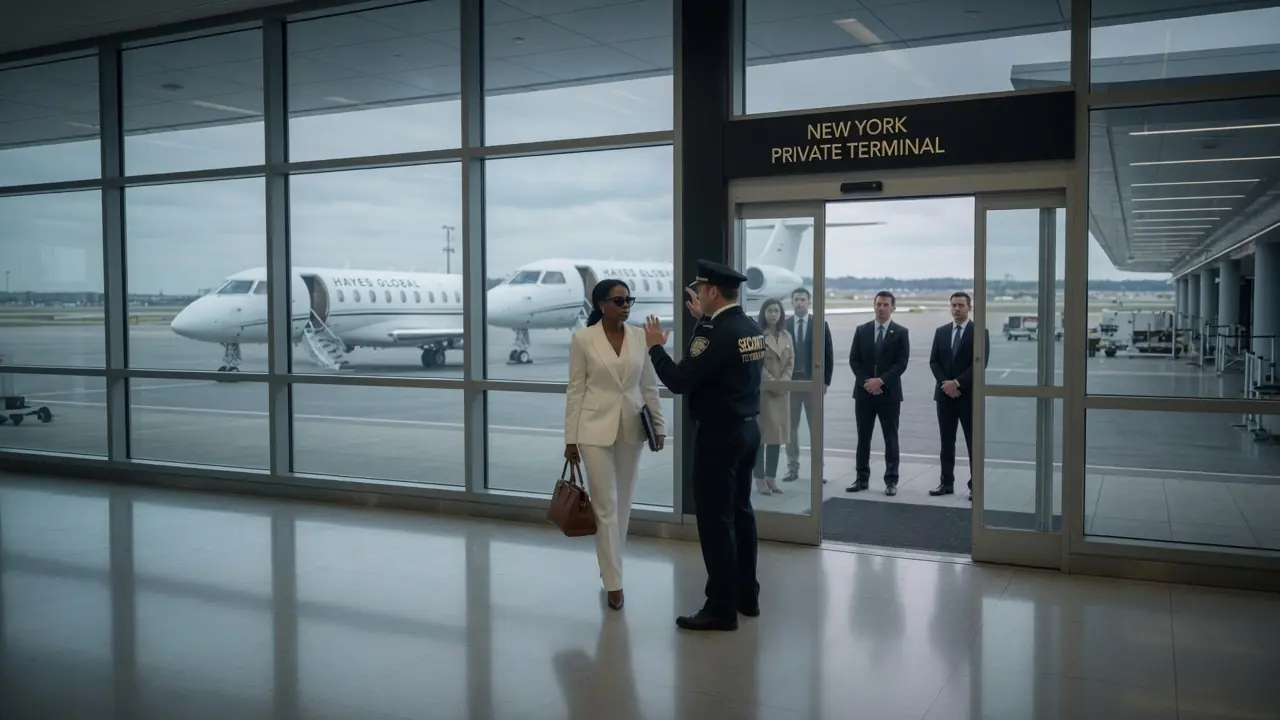
She did not look surprised. At forty-three, Simone had spent too many years walking into rooms where people measured her value before they learned her name. She had been questioned at hotel elevators, ignored in boardrooms, mistaken for assistants at conferences she was headlining, and asked whether she was “with the catering team” in buildings where her signature controlled the lease. The difference this morning was that she was tired of making other people comfortable after they insulted her.
The guard, Victor Lane, looked her up and down with open suspicion. His uniform was pressed, his badge polished, and his radio clipped high on his shoulder like a badge of moral authority. “Private aviation is through approved access only,” he said, louder now, making sure the people inside could hear him. “You can’t just walk in because you see a jet outside.”
Simone slowly removed her sunglasses. “Did I say I was just walking in?”
Victor gave a short laugh. “No, but I’ve seen this before. People come around here trying to take pictures, act important, maybe follow somebody wealthy through the doors.” His eyes moved over her suit, her handbag, then her face. “This terminal is for private owners, not people pretending they belong near a jet. Show proof you’re supposed to be here, or I’ll have you escorted back to whatever economy shuttle dropped you off.”
A quiet hush moved through the lobby behind him. A man in a navy blazer looked up from his coffee. A woman at the reception desk froze with her fingers over the keyboard. Two executives near the lounge turned slightly, pretending they were not watching while making no effort to look away.
Simone let the insult sit in the air. She had learned that some words needed space around them so everyone could understand exactly what had been said. Her face remained calm, but the stillness in her eyes sharpened. “Is that your official assessment?” she asked.
Victor frowned. “My official assessment is that you’re blocking an active terminal entrance.”
“You blocked it,” Simone said.
His jaw tightened. “Don’t get clever with me.”
The receptionist behind him finally stood. Her name tag read Meredith. She looked young, nervous, and painfully aware that something had gone wrong. “Victor,” she said softly, “maybe we should check the manifest.”
Victor did not turn around. “I know how to do my job.”
Simone looked past him at the jet. Its door was open, the stairway already lowered, and one of the ground crew members was loading a silver equipment case into the rear compartment. On the tail, written in clean blue lettering, were the initials HME. Hayes Meridian Enterprises. Her company.
She had bought the jet three years earlier, after a medical technology acquisition required constant travel between New York, Atlanta, Zurich, and Singapore. Before that, Simone had flown commercial her whole career, often while building a company people said would never scale. Now Hayes Meridian had divisions in aerospace logistics, medical AI, secure infrastructure, and disaster-response supply systems. She had come to the terminal that morning for a flight to Washington, where she would brief federal partners on a new emergency logistics platform.
Victor did not know any of that. More importantly, he did not think he needed to know. He had already decided what she was before asking who she was.
“I have a meeting in Washington,” Simone said.
Victor smirked. “Everyone has a meeting somewhere when they get caught.”
The man with the coffee lowered his cup. The woman in the navy blazer stopped pretending to read her phone. Meredith’s face reddened, and she looked toward the side corridor where terminal management offices sat behind frosted glass.
Simone’s voice stayed even. “Caught doing what?”
Victor leaned closer. “Testing a door that wasn’t meant for you.”
For the first time, Simone’s expression changed. Not anger, exactly. Something colder. Something more final.
Inside the terminal, a tall man in a charcoal suit stepped from the lounge, phone in hand. He was Gregory Ash, managing partner at a venture fund that had once begged Simone to take a meeting after ignoring her first two pitch decks years earlier. He recognized her immediately, and the blood drained slightly from his face as he realized who was being stopped at the door.
“Dr. Hayes?” Gregory said.
Victor glanced back, annoyed. “Sir, please step away. I’m handling a security issue.”
Gregory blinked. “Security issue?”
Victor pointed toward Simone without looking at her. “Unverified individual attempting access.”
Simone’s mouth curved almost imperceptibly. “Unverified.”
Gregory opened his mouth to correct him, but Simone lifted one hand slightly. It was not dramatic, not theatrical, just enough to stop him. She wanted to see how far Victor would go when no one rescued him from his own assumption.
Victor mistook the silence for victory. “See? Even the actual clients know there are rules.”
At that moment, a black SUV pulled up outside behind Simone. Two members of her executive security team stepped out, but she gave them the same small gesture to stay back. She had not brought them to intimidate anyone. She brought them because her calendar included federal briefings, government facilities, and confidential systems demonstrations. But the sight of them waiting made Meredith look even more nervous.
“Ma’am,” Meredith said, louder this time, “I really think we should confirm—”
Victor snapped his head toward her. “I said I’ve got it.”
Simone looked at the receptionist. “Thank you for trying.”
Meredith’s eyes flicked to Simone’s face, and something like shame passed through them. “I’m sorry,” she whispered.
Victor heard that and turned red. “Nobody needs to apologize because I asked a question.”
“You didn’t ask a question,” Simone said. “You made an accusation and put a question mark at the end.”
A few people inside the terminal shifted. Someone near the coffee bar made a soft sound that could have been agreement or discomfort. Victor’s pride felt the room moving away from him, and instead of slowing down, he raised his voice.
“You want proof you belong?” he said. “Then show it. Boarding pass, authorization, client pass, ownership papers, whatever story you’re going with today.”
Simone looked at him for a long second. “Ownership papers?”
He gave a hard smile. “Unless you’re claiming that jet is yours.”
The silence that followed felt almost physical.
Simone turned her head slightly toward the tarmac. Captain Malcolm Reid was walking toward the terminal from the aircraft stairs, wearing his pilot’s uniform, his hat tucked under one arm. He had flown Simone for almost three years. He had seen her take calls at midnight to reroute medical supplies after hurricanes, seen her sleep two hours between investor meetings, seen her personally call the family of an employee injured in a warehouse accident.
He saw the guard blocking her. Then he saw her face.
His pace quickened.
Victor still had his arm out. “You can stop looking around for help. This isn’t some hotel lobby where you complain until someone lets you in.”
Captain Reid came through the glass doors from the runway side and stopped behind Victor. His expression was controlled, but his eyes were hard. “Good morning, Chief Executive.”
Every person in the terminal froze.
Victor’s arm lowered an inch. “What?”
Captain Reid stepped around him and faced Simone directly. “Good morning, Dr. Hayes,” he said. “The aircraft is fueled, your Washington briefing materials are onboard, and the crew is ready whenever you are.”
Simone nodded. “Thank you, Captain.”
Victor turned slowly, first toward the pilot, then back toward Simone. His mouth opened, but no words came out. The lobby had become so quiet that the soft hum of the automatic doors sounded loud.
Gregory Ash muttered, “Oh no,” under his breath.
Meredith closed her eyes for half a second.
Captain Reid looked at Victor. “Why are you blocking the owner of the aircraft from entering her own terminal access lane?”
Victor swallowed. “I… I wasn’t aware she was—”
“Because you didn’t check,” Simone said.
Victor’s face changed from arrogance to panic so quickly it almost seemed like a mask had slipped. “Ma’am, I was following protocol.”
Simone held his gaze. “No. Protocol would have sent you to the manifest. Protocol would have taken you to reception. Protocol would have asked for a name before building a story around my face.”
A door opened near the management corridor. A woman in a gray suit hurried out, her heels clicking sharply across the floor. Patricia Vell, the terminal operations manager, looked from Victor to Simone, then to Captain Reid, and immediately understood enough to be afraid.
“Dr. Hayes,” Patricia said, forcing calm into her voice. “I am so sorry for the confusion.”
Simone turned toward her. “Was it confusion?”
Patricia hesitated. “I’m sure Victor was trying to maintain security standards.”
Simone glanced at Victor. “He told me this terminal was for private owners, not people pretending they belong near a jet.”
Patricia’s face tightened.
“He also offered to escort me back to whatever economy shuttle dropped me off,” Simone added.
The words landed with a different weight when repeated in Simone’s calm voice. The people in the lobby no longer had the luxury of pretending they had not heard. Gregory looked down. The woman in the navy blazer whispered something to her husband. Meredith stood behind the desk with her hands clasped together, eyes shining with embarrassment.
Victor spoke quickly. “It was a misunderstanding.”
Simone looked back at him. “A misunderstanding is when two people lack the same information. You lacked information and replaced it with contempt.”
Captain Reid’s jaw flexed, but he said nothing. He knew Simone did not need him to defend her. His greeting had done what was necessary. It had exposed the truth in front of everyone.
Patricia stepped closer. “Dr. Hayes, please allow us to make this right. We can escort you to the lounge immediately.”
Simone looked past her into the terminal. “No.”
Patricia blinked. “No?”
“I’m not going to the lounge yet.”
Victor shifted uneasily. “Ma’am, I apologize if my wording—”
Simone lifted a hand, and he stopped.
“Your wording was not an accident,” she said. “It was a window.”
He looked confused. “A window?”
“A view into how this terminal treats people when it does not recognize their money first.”
Patricia’s lips pressed together. “Dr. Hayes, I understand your concern.”
“No,” Simone said. “You understand liability. Concern would have appeared before the pilot greeted me.”
That silenced her.
Simone turned toward Meredith. “Did you attempt to check the manifest?”
Meredith swallowed. “Yes, ma’am.”
“And were you stopped?”
Meredith looked at Victor, then at Patricia. The fear on her face told Simone more than the answer. “Yes,” she said softly.
Victor snapped, “Because she was undermining a security decision.”
Simone’s eyes did not leave Meredith. “Do employees here often get discouraged from correcting assumptions?”
Patricia stepped in quickly. “We value all staff input.”
Meredith’s face said otherwise.
Simone opened the slim folder in her hand and removed a document. Patricia’s eyes dropped to the header, and her posture changed. It was a service review notice, pre-signed by Hayes Meridian’s aviation counsel. Simone had not planned to use it that morning, but she had brought it because her company was renegotiating long-term terminal access for its fleet expansion. She had been prepared to discuss lounge upgrades, hangar costs, fueling priority, and confidentiality procedures.
Now the conversation had changed.
“Hayes Meridian is scheduled to finalize a five-year private aviation services agreement with this terminal next week,” Simone said. “That agreement includes expanded use for executive, medical response, and federal logistics flights. Estimated value: twelve million dollars over the term.”
Patricia’s face went pale.
Simone continued. “Before I sign anything, I want a full incident report, security camera preservation, witness statements, and an explanation of why a receptionist’s attempt to verify identity was overridden by a guard’s personal assumption.”
Victor looked at Patricia, searching for help. She did not look back at him.
“Dr. Hayes,” Patricia said carefully, “we will absolutely review the matter.”
“No,” Simone said. “You will preserve the matter. My counsel will review it.”
Gregory Ash cleared his throat softly. “Dr. Hayes, I witnessed part of the exchange. I’m willing to provide a statement.”
Simone looked at him. “You witnessed more than part.”
His face flushed. “Yes. I did.”
“And you said nothing until after you recognized me.”
That hit him harder than Victor’s panic had. Gregory’s mouth closed. He had no defense, and to his credit, he did not invent one.
Simone looked around the lobby. “That is how these moments survive. One person insults. Ten people observe. Three people feel uncomfortable. Nobody moves until power identifies itself.”
The terminal remained silent.
A young baggage handler standing near the side entrance stared at the floor. An older Black driver near the coffee station lifted his eyes to Simone and nodded once, almost invisibly. She saw him. She wondered how many times he had been questioned in this building while carrying bags for people no one stopped.
Patricia folded her hands. “What would you like us to do right now?”
“Right now,” Simone said, “Victor Lane is removed from front access pending investigation.”
Victor’s head snapped up. “You can’t order that.”
Patricia looked at him. “Victor.”
“She doesn’t run this terminal,” he said, desperation making him reckless.
Simone placed the document back into the folder. “No. But my company is about to decide whether this terminal deserves to serve ours.”
Patricia turned toward Victor. “Step into my office.”
Victor stared at her. “You’re serious?”
“Yes.”
He looked toward the lobby, perhaps expecting sympathy. He found none. The same people who had watched him humiliate Simone now watched him lose authority, and they were just as quiet in both directions.
Before he left, Simone spoke again. “Mr. Lane.”
Victor stopped.
“You asked for proof I belonged here,” she said. “The next time someone walks through a door, start by asking who they are. Not by deciding who they cannot be.”
His face tightened. For a second, she thought pride might make him answer badly again. Instead, he looked down and followed Patricia toward the office.
Captain Reid stepped closer. “Dr. Hayes, we can still make the Washington window if we depart within fifteen minutes.”
Simone nodded, then turned to Meredith. “Please print the updated passenger manifest and bring it to Captain Reid.”
Meredith straightened. “Yes, Dr. Hayes.”
Then Simone added, “And thank you for trying to do the right thing before it was safe.”
Meredith’s lips parted. “Thank you, ma’am.”
Simone finally walked through the terminal. This time no one blocked her. The people who had stared before now looked away, embarrassed by the speed with which their assumptions had changed. She did not enjoy their discomfort. It was too familiar to be satisfying.
As she stepped onto the tarmac, the wind moved through her hair and tugged lightly at her white suit jacket. The jet waited ahead, clean and bright against the runway. For years, Simone had believed that success would eventually make these moments stop. She had been wrong. Success only made the reveal more dramatic after the insult.
Inside the aircraft, her chief of staff, Elena Morris, rose from a leather seat. “Everything okay?”
Simone placed her handbag down. “No.”
Elena’s expression changed instantly. “What happened?”
Simone gave her the short version while Captain Reid coordinated departure. Elena listened without interrupting, her face growing colder with each sentence. When Simone finished, Elena opened her laptop immediately. “I’ll alert legal.”
“Already starting,” Simone said. “But I want more than a complaint.”
Elena looked up. “How far?”
Simone sat by the window. “Company-wide review of all aviation access points, contractors, security protocols, and employee reporting channels. Not just this terminal. Everywhere Hayes Meridian moves.”
Elena nodded, typing. “External investigator?”
“Yes. And interview ground staff, drivers, janitorial teams, receptionists, not only executives. I want to know what happens when nobody important is watching.”
Elena’s fingers paused for a fraction of a second. “Understood.”
The jet began to move, rolling slowly toward the runway. Simone looked out at the terminal windows. Through the glass, she could see Patricia speaking sharply into a phone, Meredith at the desk, Gregory Ash still standing with his coffee untouched. Victor was nowhere visible.
As the aircraft lifted into the sky, Simone let herself exhale.
By the time they landed in Washington, the incident had already traveled further than she expected. Meredith had not posted anything, but someone in the terminal lobby had recorded enough of the exchange to send it privately to a journalist. The clip did not show the worst line clearly, but it captured Victor blocking Simone and Captain Reid stepping forward.
“Good morning, Chief Executive.”
Those four words became the headline before noon.
Elena showed Simone the first article while their car moved toward the federal complex. “It’s spreading fast.”
Simone read the headline without expression. “Of course it is.”
“Do you want us to issue a statement?”
“Yes,” Simone said. “But not a personal grievance statement. Make it about access, bias, contractor accountability, and the responsibility of private spaces that operate like public gates for power.”
Elena smiled faintly. “That sounds very much like a personal grievance turned into policy.”
Simone looked out the window. “That is how I survive them.”
The Washington briefing lasted three hours. Simone presented the emergency logistics platform to agency leaders, defense partners, and medical supply coordinators. She explained how Hayes Meridian could reroute critical equipment during disasters, track shortages in real time, and deploy aircraft faster than traditional systems. No one in that room questioned whether she belonged there. They already knew what she controlled.
But even while discussing infrastructure, Simone kept thinking about the terminal. She thought about Victor’s arm across the doorway. Meredith’s hesitation. Gregory’s silence. The older driver’s quiet nod. The way people only recognized harm after status entered the room.
That evening, back in New York, Hayes Meridian’s legal team sent formal preservation notices to the terminal operator, the security contractor, and the airport authority. Patricia Vell called personally, offering apologies, complimentary services, upgraded access, and immediate disciplinary action. Simone listened from her office, where the city lights stretched across the windows behind her desk.
“Victor Lane has been suspended,” Patricia said. “Pending investigation.”
“That is one piece,” Simone replied.
“We are also requiring bias training for security staff.”
“Training is not accountability by itself.”
Patricia hesitated. “What else are you asking for?”
Simone looked at the draft agreement on her screen. “Independent audit of access denials and complaints for the past three years. Anonymous reporting channel for staff and clients. Revised escalation policy requiring manifest verification before removal threats. Protection for employees who challenge security decisions. And a public statement acknowledging the incident without minimizing it as confusion.”
“That will be difficult,” Patricia said.
“So was being insulted at your front door.”
Silence.
Then Patricia said, “I understand.”
“I hope you do,” Simone said. “Because if your terminal only respects people after a pilot identifies them, it is not secure. It is just selective.”
The next week, Simone returned to the same terminal. She did it deliberately, though Elena offered to reroute all future flights through Teterboro. Captain Reid stood beside the aircraft stairs, waiting. Meredith was at the front desk. Patricia stood near the entrance, visibly nervous. Victor Lane was not there.
This time, the door opened before Simone reached it.
Meredith stepped forward. “Good morning, Dr. Hayes.”
Simone paused. “Good morning, Meredith.”
The receptionist handed her the manifest, printed and ready. “Captain Reid requested the updated version. I also included the revised access protocol.”
Simone accepted it. “You’re still here.”
Meredith nodded. “Yes. I gave a statement.”
“And?”
“They apologized for ignoring me.” She took a breath. “They also promoted me to access operations supervisor.”
For the first time that week, Simone smiled fully. “Good.”
Meredith lowered her voice. “I should have pushed harder.”
Simone looked at her. “Maybe. But you pushed before anyone else did. Next time, push sooner.”
“I will.”
As Simone walked toward the runway, a man near the lounge stood up. It was the older driver she had noticed the week before. He removed his cap respectfully. “Dr. Hayes?”
She turned.
“I just wanted to say,” he said, “what happened needed to happen.”
Simone studied him. “Has it happened to you?”
He gave a small laugh without humor. “Not with a jet behind me.”
The answer stayed with her.
A month later, Hayes Meridian signed the revised terminal agreement, but only after the audit began and the reporting channel went live. The first reports came from people no one had thought to ask: chauffeurs, catering staff, cleaners, junior assistants, traveling nurses, maintenance vendors, and guests of color who had been questioned more aggressively than others. The terminal operator tried to call the findings “isolated,” but the data made that word impossible.
Simone insisted the final agreement include measurable standards, not slogans. Denial incidents would be reviewed quarterly. Security contractors could lose payment for protocol violations. Employees who challenged biased access decisions would be protected. Reception staff would have authority to halt removals until identity checks were completed.
Victor Lane was terminated after the investigation confirmed multiple prior complaints. But Simone did not make him the center of the story. He had been the arm at the door, but not the whole machine behind it. The machine was built from assumptions, silence, hierarchy, and the comfortable belief that certain people could be challenged first and respected later.
The video continued circulating for weeks. People replayed the moment Captain Reid said, “Good morning, Chief Executive,” and watched Victor’s face collapse. Many called it satisfying. Some called it poetic justice. A few commentators argued that private terminals had a right to verify anyone, missing the point so completely that Simone stopped reading their opinions.
Verification had never offended her. Suspicion dressed as certainty had.
Months later, Simone stood in front of a room full of Hayes Meridian interns during a leadership program. One young woman raised her hand and asked about the terminal incident. The room went quiet, curious in the way young professionals are when they want both inspiration and survival instructions.
“Did it feel good when the pilot proved who you were?” the intern asked.
Simone thought about the question. She could have said yes because part of it had felt good. The turn, the silence, the sudden fear in Victor’s face. But that was not the truth she wanted them to carry.
“No,” Simone said. “It felt familiar.”
The room stilled.
She continued. “Power does not protect you from being underestimated. Sometimes it only makes the people who underestimated you more embarrassed afterward.”
The intern frowned slightly. “Then what protects you?”
“Preparation,” Simone said. “Documentation. Allies who speak before the reveal. Systems that make respect a requirement instead of a reward.” She paused. “And a clear memory of who you are before anyone else decides wrongly.”
Later that evening, Simone flew out again with Captain Reid. The terminal was quiet, the doors open, the manifest ready. Meredith greeted her confidently. No one blocked the entrance. No one asked whether she belonged.
As the jet climbed above New York, Simone looked down at the shrinking runways and city lights. She thought about the first question Victor had asked her, and how wrong it had been from the beginning. Can you show proof you belong here? The proof had never been in her suit, her handbag, her sunglasses, her pilot, or even the aircraft waiting outside.
The proof was in the company she built, the people she carried with her, the standards she refused to lower, and the doors she intended to leave easier for others to enter.
Captain Reid’s voice came through the cabin speaker, calm and professional. “Dr. Hayes, we’re at cruising altitude.”
Simone looked out at the clouds beneath them and smiled faintly.
Some people needed a pilot to tell them who she was.
But by then, it was already too late for their assumptions to matter.